Herpes Symptoms in Women: What the First Outbreak Feels Like
A tingling that comes and goes, internal burning no partner can see, or no visible sores at all. Herpes symptoms in women rarely look like the photos online. This guide explains what early signs really feel like, when each test works, and how to read your body without panic.



- Early herpes symptoms in women are usually subtle: localized tingling, internal burning, or nerve pain that mimics razor burn or yeast infections, often with no visible sores at all.
- PCR swab testing reads only active sores; rapid IgG blood antibody testing becomes reliable later in the antibody window, which the CDC describes as up to 16 weeks or more after exposure.
Published: November 2025 | Last updated: May 2026 | Editorial review and quality control: Martina N.
What are the first signs of herpes in women?
Early herpes symptoms in women often start with localized tingling, itching, or nerve-burning within 2 to 12 days of exposure. Many women never develop visible sores. A rapid IgG blood antibody test becomes reliable after the seroconversion window, which the <a href="https://www.cdc.gov/herpes/testing/index.html" target="_blank" rel="noopener noreferrer">CDC</a> describes as up to 16 weeks or more; PCR swab testing is most accurate only when active sores are present.
Herpes symptoms in women rarely behave the way search-engine images suggest. The dramatic blister photos are real, but they describe one possible presentation among many. A surprising share of women never develop visible sores. Some feel a tingling that comes and goes for days. Others get an internal burning their partner cannot see and a quick bedside exam cannot find.
This guide is for the woman who feels something is off but cannot label it, and for the woman with no symptoms at all who is trying to interpret a partner's diagnosis or a recent exposure. Hormones, anatomy, immune response, and stress all shape how herpes shows up in female bodies, and every one of those patterns is medically real.
By the end you will understand what early signs really feel like, how the incubation timeline works, when each test type is reliable (and when it is not), and what calm next steps look like.
Key Takeaways
- Early herpes symptoms in women are usually subtle: localized tingling, internal burning, or nerve pain that mimics razor burn or yeast infections, often with no visible sores at all.
- PCR swab testing reads only active sores; rapid IgG blood antibody testing becomes reliable later in the antibody window, which the CDC describes as up to 16 weeks or more after exposure.
The Incubation Period: What Happens Before Symptoms
After exposure to herpes simplex virus (HSV-1 or HSV-2), the virus enters what clinicians call the incubation period. The virus is present, but it has not yet triggered noticeable symptoms. For women, this stretch is usually silent on the surface even when activity is happening underneath.
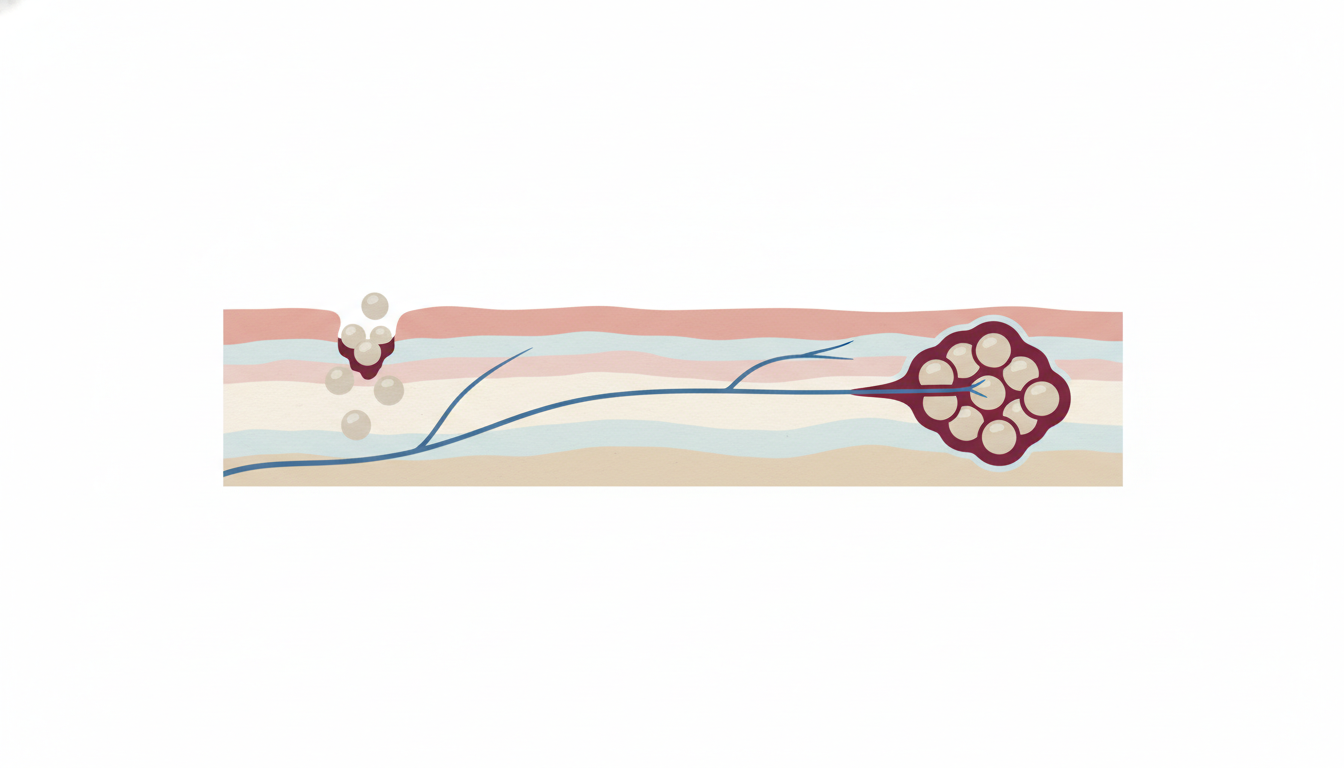
Clinical guidance generally describes the typical incubation window as roughly 2 to 12 days, though the timing varies. Some women never see a clean first symptom; others notice something only weeks or months later. During this window the virus travels along sensory nerve endings near the site of exposure and settles into nearby nerve clusters (the sacral ganglia, the nerve cell clusters at the base of the spine, in genital infections). Herpes lives long-term in nerves, not skin.
The biology follows a fairly predictable schedule. Here is what happens day by day:
Timeline After Exposure
- Day 1 Entry
Virus enters through tiny breaks in skin or mucosa; no symptoms.
- Day 2 Replication
Virus begins replicating locally and moves into sensory nerve cells.
- Day 3 Prodrome possible
Tingling, itching, or nerve-burning may start before anything is visible.
- Day 4 Visible signs possible
Small red bumps or shallow ulcers can appear as the immune system mounts its first full response.
- Day 12 Full window
Most cases that will produce symptoms do so by day 12; later presentations still occur.
Most first outbreaks follow this rough calendar, though individual variation is common.
Early Herpes Symptoms in Women (Before Any Sores)
The least understood part of herpes is the prodrome stage, the early-warning phase that often precedes a visible outbreak. In women, prodromal symptoms are subtle and easy to mislabel as shaving irritation, hormonal sensitivity, or routine friction.
Common early sensations include localized tingling, itching, or pins-and-needles around the vulva, labia, inner thighs, anus, or lower back. Some women feel deep nerve pain, shooting sensations, or a dull internal ache that seems to come from inside rather than on the skin. Fatigue, headache, low-grade fever, and tender swollen lymph nodes in the groin can also appear during a first infection. These flu-like symptoms often arrive without any visible sores, which is why many women never connect them to herpes.
Below are the most frequently reported early-warning sensations:
Early Sensations That May Precede a Herpes Outbreak
These sensations can appear days before any sore. They are not proof of herpes, but recording them helps describe the pattern to a clinician.
- Localized tingling or prickling in one specific spot, as if the skin is on alert Common
- Itching that feels deeper than a surface rash, sometimes with a faint electric sensation Common
- Burning that starts internally and can radiate to the thigh, buttock, or lower back Common
- Shooting nerve pains or a dull ache inside the vagina or pelvic area Less common
- Low-grade fever, fatigue, headache, and swollen lymph nodes in the groin Less common
The First Outbreak: What It Can Look Like
When a first outbreak does occur, it is usually the most intense episode a woman will ever have, but even a textbook first outbreak does not always match the photos online. Some women develop clusters of small blisters that break open into shallow sores. Others get only a few isolated lesions that heal quickly. Pain levels vary widely. Severe burning and difficulty urinating are common in florid presentations; mild soreness that resolves within a week is also common.
Visually, the bumps tend to be small, typically 1 to 3 millimeters across, and sit close together in one localized patch rather than scattered across a wide area. Within a day or two they often turn into fluid-filled blisters with clear or slightly cloudy contents. The blisters can break open, leaving shallow ulcers that may weep briefly before crusting over and healing. Clinical guidance generally describes a first episode of genital herpes as lasting roughly two to four weeks from first symptom to full healing, with later recurrences typically shorter. Antiviral medication started during prodrome can compress that timeline.
A first outbreak follows a fairly predictable arc, even when the intensity differs from woman to woman. Three stages are worth knowing because they shape both how you feel and what to do at each step:
- Prodrome stage: tingling, itching, or shooting nerve sensations that arrive 1 to 2 days before any sore is visible. Antivirals started here are most effective.
- Active stage: blisters or shallow ulcers, peak discomfort, and the highest viral shedding. Avoid sexual contact and treat the area gently.
- Healing stage: lesions crust and fade, soreness eases. The skin should be kept clean and not picked at to avoid secondary bacterial infection.
A noticeable first outbreak is not universal. Both the WHO and CDC consistently note that most people with HSV-2 are unaware they carry it, because their first episode was mild enough to be mistaken for something else or absent altogether.
When Symptoms Do Not Show Up at All
Asymptomatic herpes is extremely common in women. Per the CDC, the majority of people with genital HSV are unaware they carry it. You can carry and transmit the virus without ever developing sores, itching, or discomfort. The virus is not inactive in this case; your immune system is keeping the visible signs in check.
Even without symptoms, the virus can shed intermittently from skin or mucous membranes, a process called asymptomatic viral shedding. Shedding is the main reason herpes spreads so often between partners who feel completely healthy. It is also why "my partner has no symptoms" is not the same as "my partner cannot transmit."
For women, hormonal shifts, illness, stress, or immune changes can prompt a first recognized outbreak years after the original exposure. What feels like a brand-new infection is often delayed detection in someone who has been a long-term carrier without realizing it. A positive antibody test years into a long-term relationship has many plausible explanations beyond recent infidelity, including delayed seroconversion, a long-silent prior infection, and the small share of false positives that any antibody assay produces in low-prevalence populations.
This article is published by stdrapidtestkits.com, which sells the at-home test kits referenced below. We recommend tests based on fit-for-purpose for the reader's concern, not commercial benefit, and we point you to a clinician swab when that is the more appropriate tool.
The <a href="https://www.who.int/news-room/fact-sheets/detail/herpes-simplex-virus" target="_blank" rel="noopener noreferrer">WHO</a> notes that HSV-2 can be transmitted even when the skin looks normal and is often transmitted in the absence of symptoms. Daily suppressive antiviral therapy, when prescribed for frequent outbreaks, has been shown to reduce both the frequency of shedding and the risk of HSV-2 transmission to a partner.
Herpes vs Yeast Infection, BV, Razor Burn, or a Pimple
One of the biggest reasons women miss herpes is that it overlaps with much more common conditions. Itching, redness, and burning are not exclusive to HSV. Assuming the most familiar explanation is the human default, especially when symptoms are mild and nothing is visible. A single bump in particular gets blamed on a pimple or an ingrown hair almost every time.
The patterns differ in informative ways. Two features separate herpes from the everyday lookalikes: clustering (multiple small bumps sitting close together, not one isolated bump) and the prodrome sensation (tingling or nerve-burning before anything visible appears). A pimple is typically one bump with a white or yellow center and no preceding nerve sensation; an ingrown hair shows a visible hair trapped under a single red papule. The side-by-side comparison below helps when you are trying to decide whether to test:
Herpes vs. Common Lookalikes
| Condition | Typical Look or Feel | Discharge or Other Cue | Where It Tends to Appear |
|---|---|---|---|
| Yeast infection | Diffuse intense itching inside the vagina, sometimes with soreness | Thick, white, cottage-cheese texture, no odor | Throughout the vagina and vulvar opening |
| Bacterial vaginosis (BV) | Mild burning or irritation, often largely painless | Thin, gray-white, fishy odor | Throughout the vagina |
| Razor burn / folliculitis | Red bumps and stinging right at hair follicles | None; no preceding nerve sensation | Exactly where you shaved; fades within days |
| Pimple or ingrown hair | Single raised bump, often with a visible white center or trapped hair | None; tender only when pressed | Anywhere on hair-bearing skin; does not cluster |
| Herpes | Tingling, nerve pain, then clusters of small 1 to 3 mm bumps that turn into shallow ulcers | Usually none or minimal; preceding tingling or burning is the key clue | Same nerve-served area; may move between flares |
Two features separate herpes from lookalikes: clustering of bumps and preceding nerve sensations.
Testing for Herpes: What Works When
Confirming herpes usually comes down to one of two tools: a PCR swab taken from an active lesion, or a blood test measuring IgG antibodies to HSV-1 and HSV-2. They answer different questions and they fail in different ways. Mixing them up is a major source of false reassurance and unnecessary panic.
A PCR swab is the most accurate option only when active sores are present. The sample is taken directly from a lesion, which requires either a clinic visit or a mail-in lab kit. stdrapidtestkits.com does not sell a PCR swab test for genital herpes; if sores are visible right now, a clinic visit is the right call, and PCR can distinguish HSV-1 from HSV-2 with high specificity. Once lesions heal, a swab cannot detect the virus.
Blood antibody (IgG) testing measures your immune response, not the virus itself. The CDC herpes testing page states that after exposure it can take up to 16 weeks or more for current tests to detect infection, with a small share of people taking longer to seroconvert. Testing earlier than that window can produce a false negative, especially when the first episode was mild or absent. Antibody testing also cannot tell you whether you are currently shedding virus or having an active outbreak.
Here is how the two test technologies compare on timing and reliability:
If a possible exposure could involve more than one infection, these testing windows apply:
- Chlamydia, Gonorrhea: from about 2 weeks
- Syphilis: reliable from 3 to 6 weeks; 12 weeks for full confidence
- HIV: 4th-generation antigen/antibody tests detect by 18 to 45 days; antibody-only tests by 23 to 90 days
- Hepatitis B: from about 6 weeks
- Hepatitis C: from 8 to 11 weeks for antibody tests
At-Home Testing: When the Window Is Right
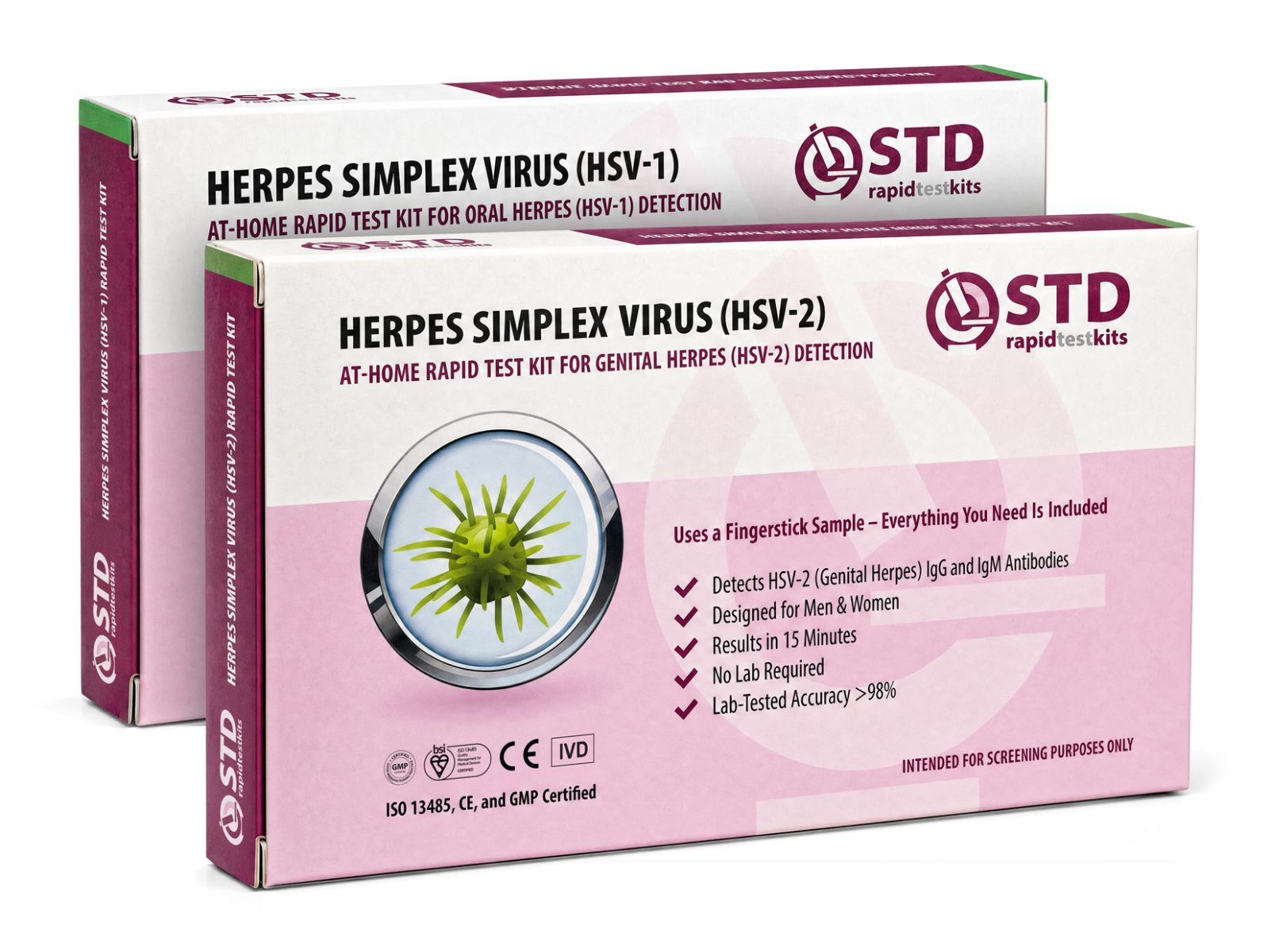
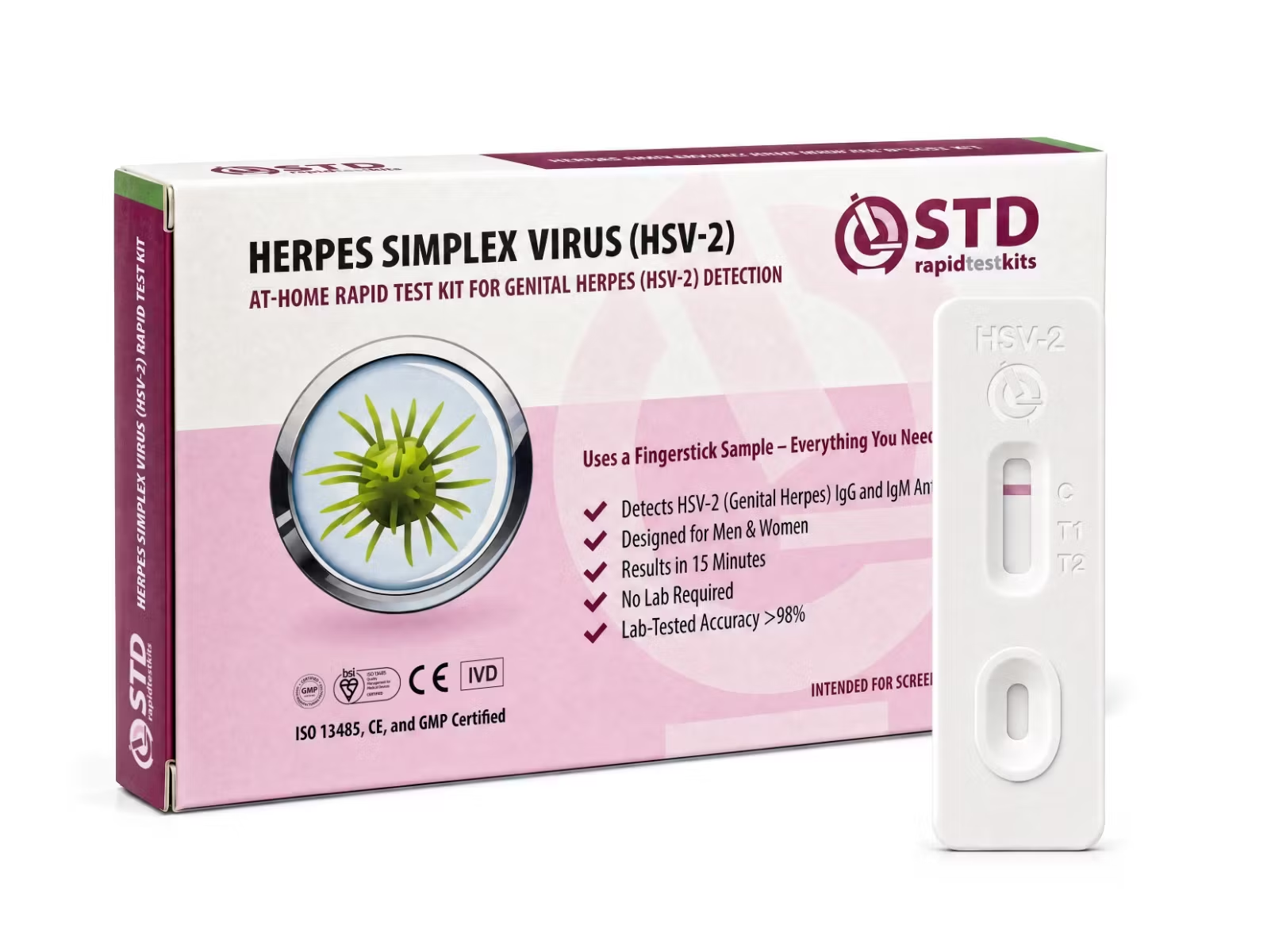
If your suspected exposure is well behind you and there are no active sores, an at-home antibody test is a private way to get an answer without booking a clinic visit. Rapid lateral-flow blood tests use a fingerstick sample and read in roughly 15 minutes (our at-home herpes antibody test follows this format). They are screening tools, not diagnostic confirmations: a positive result is worth confirming with a clinic-grade lab assay, while a negative result deep into the antibody window is generally trustworthy. Lab NAAT and Western blot remain higher-sensitivity confirmatory options for ambiguous cases.
What to Do While You Are Waiting
The hardest part of suspected herpes is the gap between worry and clarity. Two unhelpful instincts dominate this window: assuming the worst before any test, or dismissing real symptoms because no sores ever appeared. Both lead to bad decisions. The first turns into months of dread and self-blame; the second leaves an infection unaddressed.
A calm middle path: note symptom changes (location, sensation, duration), avoid sexual activity if any irritation is active, and plan testing based on timing rather than panic. If sores appear, get a swab as quickly as possible. If sores never appear, mark a date deep into the CDC's up-to-16-weeks-or-more antibody window past the suspected exposure and book an antibody test then. Set a calendar reminder. Do not retest weekly out of anxiety; the result will not have meaningfully changed and the emotional cost of repeat negatives is high.
- Track sensations briefly each day (location, type, duration) so you can describe a pattern to a clinician if one develops.
- Pause sexual activity if any irritation is active, even if you are not sure it is herpes.
- Mark one date on your calendar, deep into the CDC antibody window, for a single antibody test. Resist the urge to test weekly.
Recurrent Outbreaks and What Tends to Trigger Them
After a first episode, many women expect future flares to look identical. They usually do not. As your immune system learns the virus, recurrences tend to be shorter, milder, and easier to mistake for something else. Repeat episodes often involve only a brief stretch of tingling, itching, or local sensitivity. Some women notice mild discomfort during sex, a brief burn during urination, or a small patch of irritation that fades within a few days. The classic blister cluster may not appear at all.
Recurrent symptoms also wander. Because herpes lives in the sacral nerve roots, flares can show up on the inner thigh, the buttock, the perianal skin, or the lower back instead of the same spot every time. Symptoms that move between visits are not a different infection; they are the same nerve network firing in different branches.
Triggers cluster around physical or hormonal stressors that briefly weaken immune surveillance. Menstrual cycles are one of the most common, since hormonal shifts in the days before and during menstruation can dampen immune response and amplify prodromal sensations. Local mechanical factors (friction during intercourse, shaving, tight synthetic clothing) can stimulate the same nerve endings, which is one reason herpes is so often confused with razor burn or contact dermatitis (the dermatomal area is simply the strip of skin a particular nerve serves).
- Menstrual cycle: hormonal shifts in the days before and during menstruation
- Acute illness or infection: anything that taxes the immune system
- Sleep deprivation: consistently the most underrated trigger
- Sustained emotional stress
- Immunosuppressive medications (chemotherapy, high-dose steroids, post-transplant regimens)
- Mechanical friction: intercourse, shaving, tight synthetic clothing
- Intense sun exposure on the affected area, particularly for oral HSV-1
Managing Recurrent Outbreaks
Herpes is a long-term condition, not a short-term illness. Several treatment approaches reduce flare frequency, severity, and onward transmission risk over time. The goal is fewer outbreaks, shorter outbreaks, and lower partner risk.
Antiviral medication. The CDC's STI Treatment Guidelines name three FDA-approved oral antivirals for genital herpes: acyclovir, valacyclovir, and famciclovir. They are used in two main patterns. Episodic therapy means starting the antiviral at the first prodromal sensation of each flare to shorten that outbreak. Suppressive therapy means a daily low dose. The CDC reports that suppressive therapy reduces frequency of genital herpes recurrences by 70 to 80 percent among patients who have frequent recurrences, and lowers (though does not eliminate) asymptomatic shedding and partner transmission risk; the NHS uses the same broad framework for choosing between episodic and suppressive treatment.
Local comfort measures. Cool compresses, loose cotton underwear, and over-the-counter pain relievers help during a flare. Lukewarm sitz baths can ease urination discomfort if sores are near the urethra. Avoid scented products and harsh soaps in the area; they prolong irritation.
Lifestyle factors that reduce flares. Consistent sleep is the most underrated. Stress management and avoiding the personal triggers you have already identified do measurable work. None of this is a cure (there is no cure for herpes in 2026), but consistent management makes the condition genuinely background-level for most women within the first year or two of a diagnosis.
First-line antivirals and how they are used
- Acyclovir, valacyclovir, and famciclovir are the three FDA-approved oral antivirals for genital herpes (per CDC STI Treatment Guidelines).
- Episodic therapy: short course started at the first prodromal sensation of each flare to compress the outbreak.
- Suppressive therapy: a daily low dose; the CDC reports it reduces recurrence frequency by 70 to 80 percent in patients with frequent flares.
- Daily valacyclovir lowers HSV-2 transmission risk for serodiscordant heterosexual couples (one partner has herpes, the other does not), per CDC guidance.
- Antivirals do not eradicate latent virus; recurrence patterns return when the medication is stopped.
Is Herpes Dangerous Long-Term?
This is usually the next question after someone suspects herpes: what does this mean for the rest of my life?
For most otherwise healthy adults, herpes is not a dangerous condition. It does not damage internal organs and does not progress to more severe disease in typical cases, a point echoed in the patient overview from MedlinePlus. Once HSV is in the body, it stays in the sensory ganglia (nerve cell clusters near the spinal cord) for life, but ongoing symptoms are far from guaranteed. After the first infection, many women have fewer and milder outbreaks over time, and some have none at all. HSV-1 oral infections tend to recur less often than HSV-2 genital infections, but individual patterns vary widely.
The reason recurrences soften is that your immune system adapts. Your body builds a type-specific antibody response after the first infection, and that response helps contain the virus during reactivation. The virus still cycles between dormant and active phases inside the ganglia, but those episodes are usually shorter, less severe, and sometimes barely noticeable.
For everyone outside the two clinical exceptions called out below, the larger burden of a herpes diagnosis tends to be psychological (stress and stigma) rather than physical harm.
- Neonatal herpes. A pregnant woman with a new outbreak (especially in the third trimester) needs clinical guidance about antivirals in late pregnancy and possible planned cesarean to prevent the baby acquiring herpes during birth.
- Significant immunocompromise. Cancer chemotherapy, advanced HIV, organ-transplant immunosuppression, and high-dose long-term steroids can allow more severe and prolonged herpes disease. Speak with your specialist about prophylactic antivirals.
Disclosure, Sex, and the Long-Term Outlook
For most women, the emotional weight of a herpes diagnosis is heavier than the physical condition itself. That weight is real, but it is largely driven by stigma rather than by the medicine. From a clinical standpoint, herpes is a manageable skin and nerve infection that does not affect fertility, life expectancy, or general health for the vast majority of carriers.
Disclosure to a sexual partner is a personal call, but a few principles help. Tell partners before sex, not after. Frame the conversation as informed consent rather than confession. Be ready with the practical facts: condoms reduce but do not eliminate transmission risk; daily suppressive antivirals further reduce risk; abstaining during prodrome and active outbreaks reduces risk most of all. The combination substantially lowers transmission risk for most serodiscordant couples (couples where one partner has herpes and the other does not), per the CDC's STI Treatment Guidelines.
Tell your obstetric provider early about a known or suspected herpes diagnosis. Active genital lesions at delivery are managed with antivirals in late pregnancy and, when needed, a planned cesarean to prevent neonatal herpes during passage through the birth canal. The risk to the baby comes mainly from a brand-new infection acquired late in pregnancy; longstanding herpes is generally well-managed with the right delivery plan.
FAQs
- Can herpes symptoms in women be so mild that you do not notice anything?
- Yes, and this is one of the most common patterns. Many women describe a brief tingling that comes and goes, a single afternoon of mild irritation, or a short stretch of vague discomfort that never escalates into anything dramatic. The CDC notes that most people with genital herpes are unaware of their infection precisely because symptoms are mild or fit the picture of another irritation.
- Can herpes cause pain inside the vagina with nothing visible outside?
- Yes. Herpes lesions can occur on the cervix or inside the vaginal canal where they are not visible without a speculum exam. Internal burning, pressure, pain during sex, or light spotting after sex with no external clue is a recognized presentation. If symptoms recur in cycles, ask a clinician for a direct internal exam rather than relying on a quick external look.
- How soon after exposure do herpes symptoms appear?
- Most first outbreaks appear within 2 to 12 days, but a first recognized episode can also surface months or years later when mild early signs were missed. The practical takeaway: time elapsed since a possible exposure does not by itself rule herpes in or out. Only antibody testing deep into the CDC's up-to-16-weeks-or-more window resolves the uncertainty.
- Can early herpes look like a pimple or ingrown hair?
- Yes, especially in the first hours. The pattern that distinguishes herpes is the cluster (multiple small 1 to 3 mm bumps sitting close together, not one isolated bump) and the prodrome (tingling or nerve-burning before any bump appears). A pimple is typically one bump with a white or yellow center and no preceding nerve sensation; an ingrown hair has a visible trapped hair under a single red papule.
- If my blood test is negative, does that mean I am safe?
- If you tested shortly after a possible exposure and saw a negative, that result may not be final. Antibody tests need time, and the CDC says it can take up to 16 weeks or more for current tests to detect infection after exposure. A negative drawn inside that window is inconclusive, not a clearance. Plan a confirmatory test once you are deep enough into the antibody window.
- Can stress or my menstrual cycle really trigger an outbreak?
- Yes. Hormonal shifts before and during menstruation can dampen immune surveillance and make prodromal sensations more noticeable. Sustained stress, illness, sleep loss, and immunosuppressive medications can do the same. Tracking what preceded each flare often reveals a personal trigger pattern within a few months, which makes prevention more practical.
- Can I transmit herpes when I feel completely fine?
- Yes. The virus can shed asymptomatically from skin or mucous membranes between outbreaks. This is the main route by which herpes spreads silently between long-term partners. Daily suppressive antivirals reduce (though do not eliminate) the rate of asymptomatic shedding, and consistent condom use cuts per-act transmission further.
- Does a positive HSV-1 result mean I have genital herpes?
- Not by itself. HSV-1 traditionally caused oral cold sores, but it now accounts for a meaningful share of genital infections through oral-to-genital contact. A positive HSV-1 antibody result tells you that you have been exposed to HSV-1 somewhere; it does not specify location. Pair the antibody result with a swab during an active genital lesion to confirm whether HSV-1 is the cause of any genital symptoms.
Before You Spiral, Here Is What Helps
If you have read this far, you are likely searching for clarity rather than judgment, fear, or worst-case framing. Herpes symptoms in women are confusing because they rarely follow a dramatic script. That does not mean you missed something or did anything wrong.
The most useful next step is timing-based, not appearance-based. If sores are active right now, get a swab through a clinic. If sores are not present and a possible exposure was well into the CDC's up-to-16-weeks-or-more antibody window, an at-home antibody test gives a reliable read in private. If you are still inside that window, set a calendar reminder for when the test will work and protect yourself from spiraling in the meantime.
Whatever the answer turns out to be, a herpes diagnosis is a manageable medical fact, not a verdict on the rest of your life. Visit STD Rapid Test Kits when you are ready to take the next step on your own timeline.
Your Next Step, Based on Timing
Do you have visible sores or lesions right now?
Yes: Get a clinic-administered PCR swab as soon as possible. It is the most accurate test while sores are present and can distinguish HSV-1 from HSV-2. We do not sell an at-home PCR swab for genital herpes, so this step means a clinic visit.
Has it been about 16 weeks or more since the possible exposure, with no sores?
Yes: An at-home rapid blood antibody test gives a private, reliable read this deep into the window. Confirm any positive result with a clinician for type-specific interpretation.
No: You are still inside the antibody window, so a negative now would be inconclusive. Set one calendar reminder for the test date, track any symptom changes, and resist the urge to retest weekly.
Guidance only. A healthcare provider can advise based on your specific situation.
- U.S. Centers for Disease Control and Prevention. About Genital Herpes (CDC overview). Used for prevalence and asymptomatic-carriage statements (most people with genital HSV are unaware they carry it) and incubation window context.
- U.S. Centers for Disease Control and Prevention. Herpes testing page. Used for the antibody-window guidance: it can take up to 16 weeks or more after exposure for current tests to detect infection.
- U.S. Centers for Disease Control and Prevention. Sexually Transmitted Infections Treatment Guidelines, Genital Herpes section. Used for the three FDA-approved oral antivirals (acyclovir, valacyclovir, famciclovir), the 70 to 80 percent reduction in recurrence frequency under suppressive therapy, and daily-valacyclovir transmission-reduction finding for serodiscordant heterosexual couples.
- World Health Organization. Herpes simplex virus fact sheet. Used for general herpes simplex virus context, asymptomatic-shedding transmission risk, and the broad statement that recurrent episodes are usually shorter and less severe than the first.
- NHS. Genital herpes overview. Used for the broad framework of episodic vs suppressive antiviral treatment and pregnancy management context (active lesions at delivery and consideration of planned cesarean).
- MedlinePlus / U.S. National Library of Medicine. Genital Herpes patient-information page. Used as a patient-friendly cross-reference for symptom, prognosis, and testing descriptions.