Can I Test for Hepatitis C at Home, or Do I Need a Clinic?
A home kit and a clinic visit answer different questions about hepatitis C. One tells you privately whether antibodies are there; the other can tell you whether the virus is still active and start you on a cure. Your timing, symptoms and history decide which comes first. This guide walks through each situation so you can pick the route that fits yours.
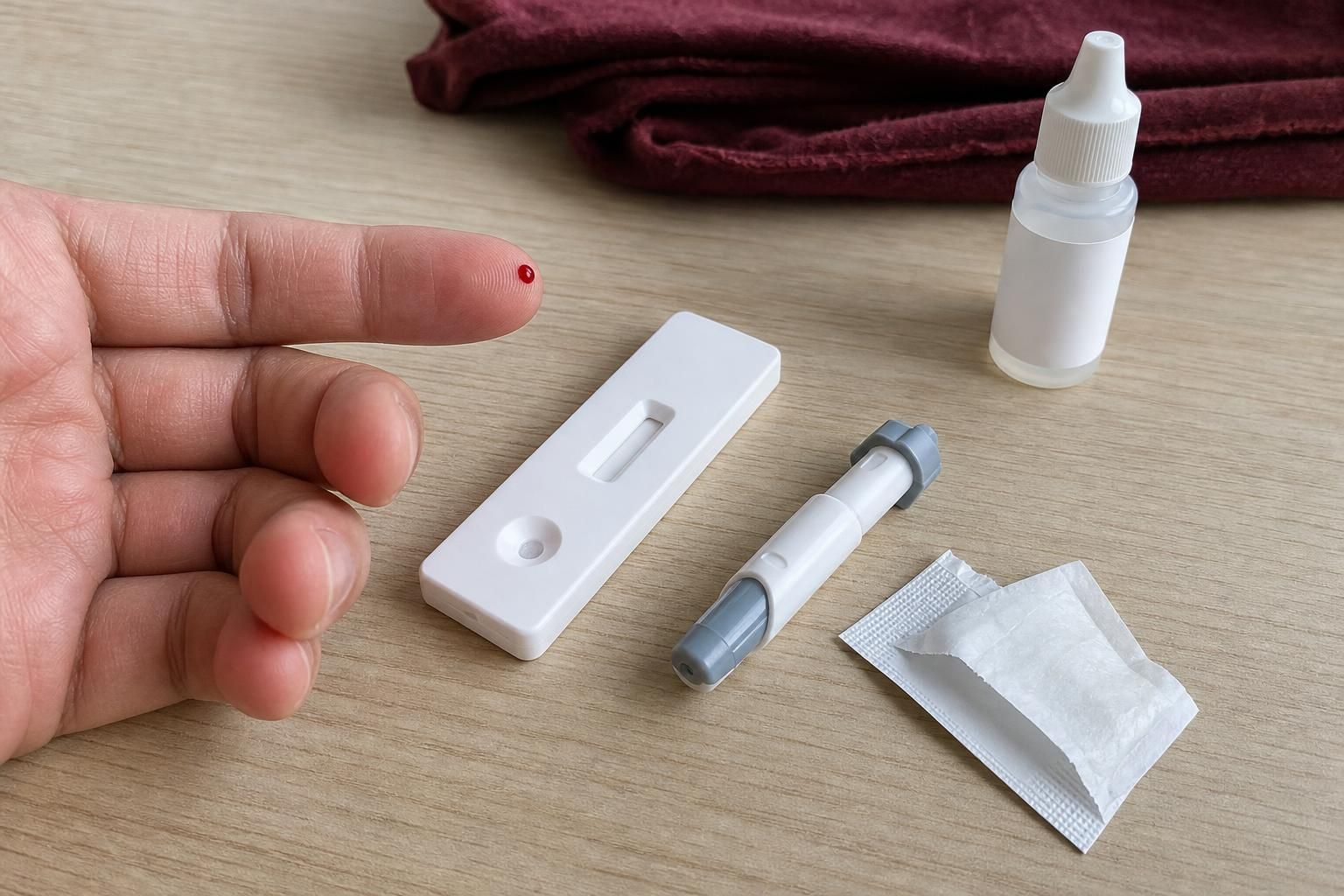



- A home kit can screen for hepatitis C antibodies, but only a clinic or lab RNA test confirms whether the virus is active.
- Exposure in the past 6 months, pregnancy, symptoms or a previous hepatitis C diagnosis are reasons to skip the home kit and see a clinician.
Published: October 2026 | Last updated: October 2026 | Editorial review and quality control: Martina N.
Can you test for hepatitis C at home?
Yes, for a first screen. A fingerstick home kit checks for hepatitis C antibodies, which suits adults with no symptoms and no possible exposure in the past 6 months. It cannot confirm an active infection: a positive needs an HCV RNA blood test. Recent exposure, pregnancy, symptoms, HIV or past hepatitis C mean going straight to a clinic.
Hepatitis C testing happens in two steps, and only the first one can be done at home. An antibody test shows whether your body has ever met the virus. An HCV RNA test, which looks for the virus's genetic material, shows whether it is still there. The CDC explains that a reactive antibody result is followed by that RNA test on your blood, and it recommends every adult be tested at least once.
So the real question is where you start, not home versus clinic as rivals. This guide sorts that out by situation: when a private home screen is a sensible first move, when it would waste time or give a misleading answer, and what each result sends you on to do.
What a home kit and a clinic test each tell you
A home kit for hepatitis C is an antibody screen. Antibodies are the proteins your immune system makes after meeting the virus, and they stay after the virus is gone, as the CDC quote further down explains. The WHO fact sheet adds that around 30% (15–45%) of people infected clear the virus on their own within 6 months, yet still test positive for antibodies.
That is why an antibody result, from a kit or a clinic, is a starting point. A clinic can take the next step in the same sitting. The CDC's clinical guidance asks clinicians to collect everything needed for a diagnosis in a single visit and to run the RNA test automatically when antibodies are reactive. Some clinics now run the RNA test on a point-of-care machine on site, according to the WHO.
Home Antibody Kit vs Clinic or Lab Testing
| Feature | At-home rapid antibody kit | Clinic or lab testing |
|---|---|---|
| What it looks for | Hepatitis C antibodies (past or current infection) | Antibodies first, then HCV RNA (current infection) when antibodies are reactive |
| Sample | Fingerstick blood you collect yourself | Blood draw or fingerstick taken by staff |
| Time to result | Read at home according to the manufacturer's instructions | Rapid antibody tests in about 30 minutes; RNA results depend on the lab or an on-site machine |
| Confirms an active infection? | No | Yes, with the RNA test |
| Cost | One flat kit price, no visit or lab fee | Visit plus lab charges; what you pay depends on insurance |
| Privacy | Result stays with you | Result goes into your medical record |
| Best fit | Private first screen, no symptoms, no possible exposure in the past 6 months | Recent exposure, symptoms, pregnancy, past hepatitis C, HIV or a weakened immune system, confirming a positive |
The home kit answers “have I been exposed?”; the clinic can also answer “is the virus active now?”
When starting at home makes sense
A home screen fits a common situation: you are an adult, you feel well, you have never been tested, or you have an older risk you want to check privately. The CDC recommends hepatitis C testing for all adults 18 and older at least once in their lifetime, and for people with ongoing risks, such as sharing needles or other drug equipment, periodically. Many people who have never been tested fall into the first group.
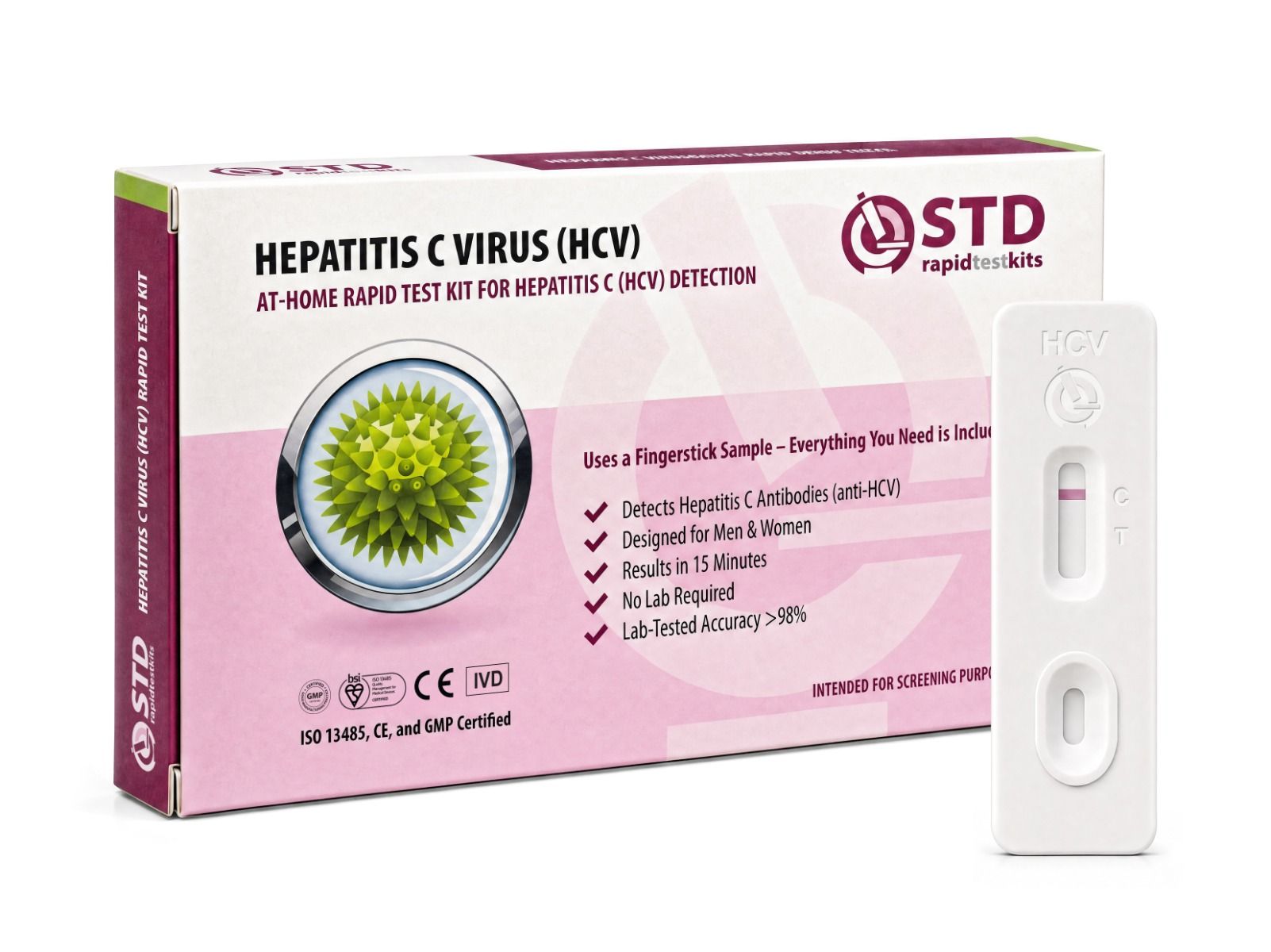
Timing matters more than anything else. If you have no possible exposure in the past 6 months, a home antibody screen is a reasonable first step. Antibodies take time to appear: the CDC's clinical guidance says it usually takes 8–11 weeks after infection before they are detectable. Our catalog's product information for the at-home hepatitis C test lists the same 8 to 11 weeks for detection and a retest at 12 weeks, but the CDC advises an RNA test, not an antibody test, for any possible exposure within 6 months. If yours was more recent, see the section on clinics below.
Cost and privacy are the practical draws. A kit is one upfront price with no appointment, no copay and no lab invoice, and nothing reaches an insurer. Before you buy, know the kit's limits. The manufacturer's insert reports 100% sensitivity and more than 99.9% specificity against a laboratory EIA, measured on fingerstick whole blood collected by clinicians; the manufacturer publishes no figure for self-collected samples or results read at home. It is a preliminary screen: a positive must be confirmed by a clinician, a negative does not rule infection out, and how likely a positive is to be real depends on how common hepatitis C is among people like you. If you are unsure what a faint line means, our guide to reading a hepatitis C rapid test cassette walks through it.
This article is published by stdrapidtestkits.com, which sells at-home STI test kits, and we only recommend one where it fits the reader's situation.
When a clinic should be your first stop
Some situations make a home antibody kit the wrong tool, either because it is too early for antibodies to show or because antibodies cannot answer the question you have. The biggest one is a recent exposure. The CDC says that if you might have been exposed within the past 6 months, a doctor should order an RNA test rather than an antibody test, because RNA usually becomes detectable 1–2 weeks after exposure, long before antibodies do.
A history of hepatitis C is another common reason. If you have tested positive before, cleared the virus or finished treatment, your antibody test will stay positive, so only an RNA test can show whether you have been reinfected. HIV or a weakened immune system is a third: the CDC's clinical guidance notes that some people may lack the immune response needed to develop detectable antibodies, and advises considering an HCV RNA test when the person tested is immunocompromised. Pregnancy is a fourth: the CDC recommends testing during each pregnancy, and that belongs with your prenatal care, where a positive can be followed up straight away.
Symptoms change things too. Most people with hepatitis C feel nothing (the CDC estimates 75%–85% have no symptoms), so when signs do appear they deserve an examination, not a cassette on the kitchen counter.
Go to a Clinic Instead of Starting at Home If
Any one of these is enough. Ask specifically for an HCV RNA test where it applies.
- A possible exposure in the past 6 months, such as shared needles or drug equipment, or a needlestick
- You have had hepatitis C before, cleared it or been treated for it
- You have HIV or a weakened immune system (antibody tests can miss infection; ask for an HCV RNA test)
- You are pregnant (ask your prenatal clinician about hepatitis C screening)
- Symptoms such as yellowing skin or eyes or dark urine
- A home antibody test has already come back positive
What happens after a positive home result
A positive home result means you need an HCV RNA test. It does not mean you have an active infection, and it is not a diagnosis. Book a primary care, sexual health or community clinic visit and tell them you had a reactive antibody screen at home. The CDC's guidance has clinicians collect everything needed in one visit, starting with an antibody test and running the RNA test on the same sample if it is reactive; a clinic may also order the RNA test directly given your home result.
If the RNA test is negative, you most likely cleared the virus at some point, or the home result was a false positive. If it is positive, the news is better than many people expect. According to the CDC, most treatments are 8–12 weeks of pills and cure more than 95% of patients. Before treatment starts, doctors check for liver damage with blood tests, elastography or imaging, and test for other infections such as HIV and hepatitis B, as the NIDDK describes. None of that can be done at home, and none of it needs to be faced alone; our guide to living with hepatitis B and C covers what daily life looks like during and after care.
Once infected, you will always have antibodies in your blood. This is true if you have cleared the virus, have been cured, or still have the virus in your blood.
What a negative home result does and doesn't settle
A negative is most useful when there has been no possible exposure in the past 6 months. In that case, with no ongoing risk, a negative antibody screen is reassuring and, under the CDC's once-in-a-lifetime recommendation, you may not need to test again unless a new risk comes up. It is still a preliminary screen and does not rule infection out, so see a clinician if symptoms appear. If you have HIV or a weakened immune system, antibodies may not form even when infection is present; ask for an RNA test instead.
If there was a possible exposure in the past 6 months, a negative is not a clearance, because antibodies may not have formed yet. The CDC says to test again, and the NHS notes that the test is not always accurate if you were infected recently and that you may be advised to get tested again in 6 months. A clinic HCV RNA test can check for infection sooner, because RNA is usually detectable 1 to 2 weeks after exposure. The catalog's product information lists a 12-week retest for the kit; NHS and CDC point to retesting at up to 6 months after a possible exposure, or an RNA test sooner. Our explainer on when to test for hep C after exposure lays out the retest timing in detail.
Choosing your route in three questions
Most people can sort themselves with three questions, asked in order. The first one catches the situations where a clinic should come before any home test, so answer it honestly before you look at the others.
Home Kit or Clinic for Hepatitis C?
Do you have symptoms such as yellowing skin or eyes or dark urine, HIV or a weakened immune system, or a possible exposure within the past 6 months, or are you pregnant?
Yes: See a clinician rather than starting at home. For symptoms, HIV or a weakened immune system, or a recent exposure, ask about an HCV RNA test: an antibody test may be too early or may miss infection. If you are pregnant, ask your prenatal clinician about hepatitis C screening; CDC recommends it in every pregnancy.
Have you had hepatitis C before, cleared it or been treated for it?
Yes: Skip the antibody kit: it will stay positive. A clinic HCV RNA test is the only way to check for reinfection.
Are you an adult with no symptoms, not pregnant, no past hepatitis C, no HIV or weakened immune system, and no possible exposure in the past 6 months?
Yes: A home antibody kit is a reasonable private first screen. A positive needs a clinic HCV RNA test. A negative with no new risk is reassuring, but it is a preliminary screen and does not rule infection out; see a clinician if symptoms or a new exposure occur.
No: See a clinician and ask about an HCV RNA test.
Guidance only. A clinician can advise on your specific situation, and symptoms always override the timing steps.
FAQs
- Will a home hepatitis C test show up in my medical records?
- No. A result you read at home is yours alone and is not reported to your doctor or insurer. If you then go for confirmatory RNA testing, that clinic visit and its result will be recorded like any other lab test.
- Should I test for hepatitis B and HIV at the same time?
- Often it makes sense, because hepatitis B and HIV can spread through some of the same routes, such as shared needles. Doctors test for both before starting hepatitis C treatment. If you had a needle-sharing exposure in the past 6 months, see a clinician about testing for hepatitis C (RNA), hepatitis B and HIV. For a routine check with no recent exposure, a blood test for each is a reasonable addition.
- I live in the UK. Is there a free home option?
- Yes. The NHS offers a free hepatitis C home test to people aged 18 and over: you prick your finger and post the blood sample to a lab rather than reading a result yourself. GPs, sexual health clinics and drug services also test.
This article summarizes current guidance from the U.S. Centers for Disease Control and Prevention (CDC), the World Health Organization (WHO), the U.S. National Institutes of Health (NIH) and the NHS. Each specific figure or recommendation links to the page that states it, and every page used is listed under Sources with what it supports. It is general health information written by our editorial staff, not a diagnosis or a treatment plan; how we choose topics and use sources is described in our editorial policy.
- U.S. Centers for Disease Control and Prevention. Testing for Hepatitis C: who should be tested (all adults once, each pregnancy, periodic testing for ongoing risk), automatic RNA follow-up after a reactive antibody test, lifelong antibodies after clearance or cure, rapid antibody results in about 30 minutes, RNA testing for exposure within 6 months.
- U.S. Centers for Disease Control and Prevention. Clinical Screening and Diagnosis for Hepatitis C: antibodies detectable 8–11 weeks after infection, RNA detectable 1–2 weeks after exposure, 75%–85% without symptoms, single-visit testing.
- U.S. Centers for Disease Control and Prevention. Hepatitis C Basics: most treatments are 8–12 weeks of pills and cure more than 95% of patients.
- World Health Organization. Hepatitis C fact sheet: two-step diagnosis, around 30% (15–45%) spontaneous clearance within 6 months with persisting antibodies, point-of-care RNA testing in clinics.
- National Institute of Diabetes and Digestive and Kidney Diseases (NIH). Hepatitis C: tests for liver damage (blood tests, elastography, imaging, biopsy) and testing for HIV and hepatitis B before treatment.
- NHS. Hepatitis C: free home test for adults 18 and over, testing at GPs, sexual health clinics and drug services, and retesting after a recent possible infection.