
Published: July 2025 | Last updated: May 2026 | Editorial review and quality control: Martina N.
Are at-home STD tests worth the cost?
At-home rapid STI tests run $29 for a single-infection kit and $99 to $199 for 6-to-10 infection panels. That usually beats uninsured clinic visits ($200 to $500 with office and lab fees), but rarely beats insured preventive screening or free public-health clinics. The right path depends on your insurance status and how much you value 15-minute private results.
Paying out of pocket for any health test feels like a calculation. You want accurate results, you want privacy, and you do not want to overpay. At-home STI rapid tests sit in a price range that overlaps with insurance copays, mail-in lab panels, and free public-health clinics, so the right answer depends on which of those three reference points applies to you.
This guide breaks down what at-home STD testing costs in 2026, where clinic testing actually prices out by insurance status, where free or low-cost public-health testing fits in, and how to spot products that look cheap on the sticker but are expensive when the result is wrong. Specific numbers, honest limits, and clear guidance on which option suits which reader.
Key Takeaways
- Single at-home rapid tests start at $29 and comprehensive panels run $99 to $199, which is typically cheaper than uninsured clinic testing but not always cheaper than insured preventive screening or free public-health visits.
- The honest comparison includes more than dollars: privacy, no-appointment access, and 15-minute results favor at-home testing, while confirmatory NAAT, active-symptom evaluation, and insurance-covered routine screening favor clinic visits.
What at-home STD tests cost in 2026
The price ranges below reflect what stdrapidtestkits.com and major direct-to-consumer competitors charge in early 2026. Specifics vary by product and by promotional pricing, but the brackets are stable.
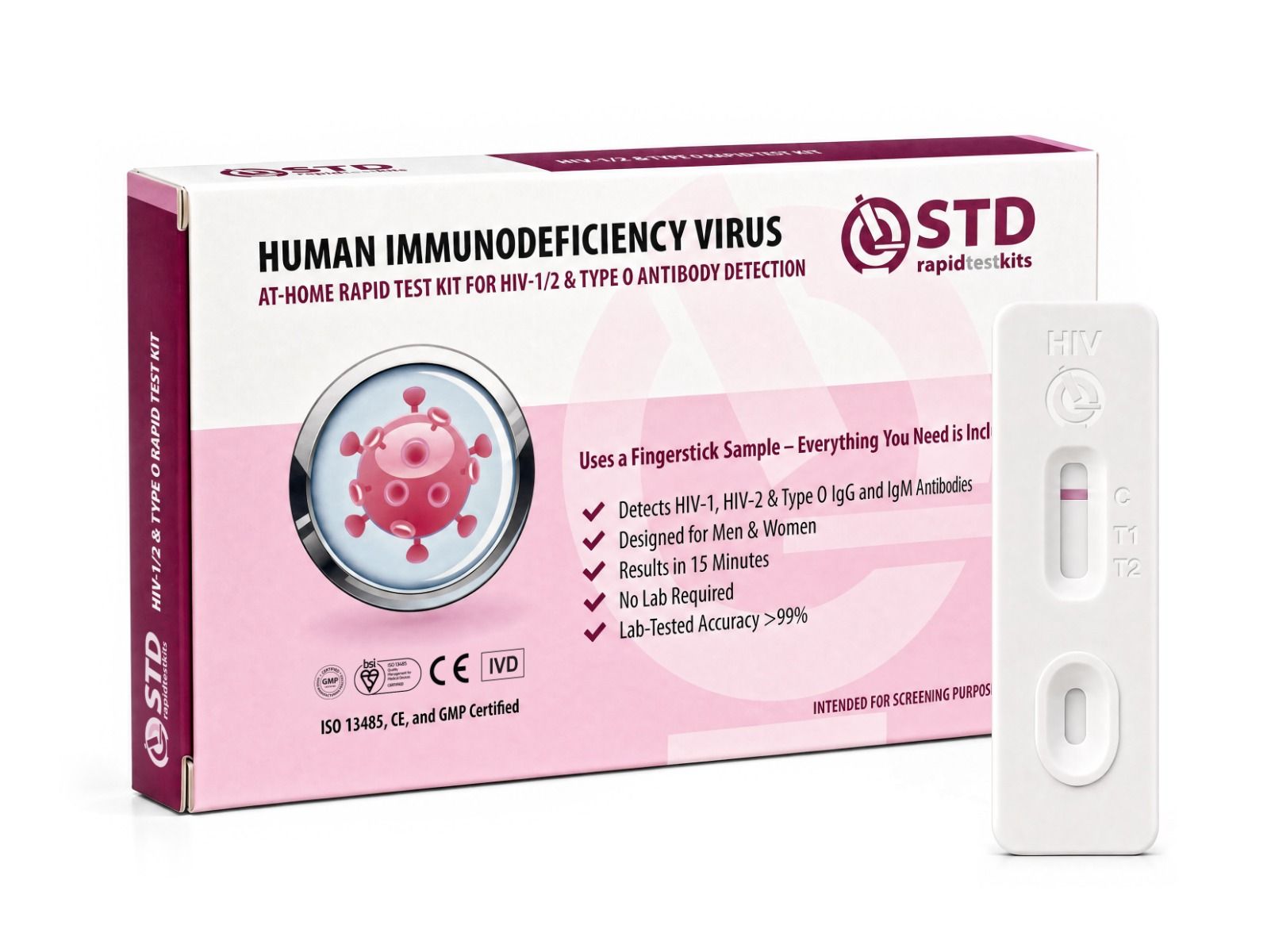
Single-infection rapid kits run roughly $29 to $50. These cover one infection per kit, use a self-collected swab or fingerstick blood sample depending on the test, and deliver a result in about 15 minutes. The lowest price points are typically for chlamydia and gonorrhea swab tests; HIV and syphilis blood tests sit slightly higher because the test-strip chemistry is more complex.
Two-test and three-test combinations run roughly $50 to $99. Combining chlamydia and gonorrhea (the two most-screened bacterial STIs) into one swab cassette is the most common pairing. Three-in-one panels typically add syphilis as a fingerstick blood component.
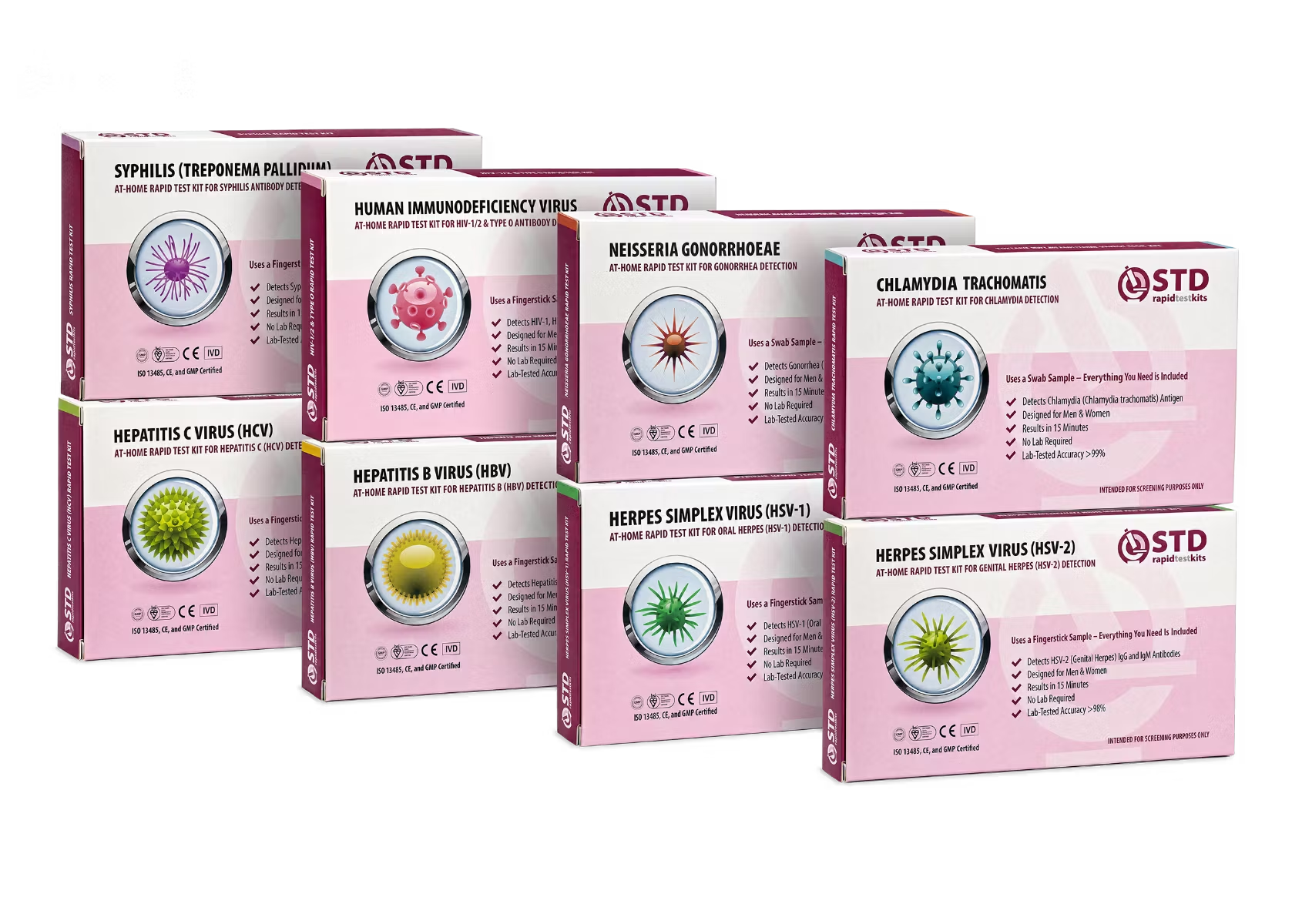
Comprehensive 6-to-10 infection panels run roughly $99 to $199. These bundle the bacterial STIs (chlamydia, gonorrhea, syphilis) with bloodborne infections (HIV, hepatitis B, hepatitis C) and viral STIs (HSV, with HPV included in some women-only panels). The 8-in-1 and 10-in-1 kits sit at the upper end of that range and offer the lowest per-infection cost when comprehensive screening is what you need.
What is included in a rapid-kit price: the test cassettes, sample-collection materials (swab, lancet, buffer), instructions, and discreet shipping. There are no recurring lab fees, follow-up visit charges, or interpretation costs because you read the result yourself. Some readers value that flat-fee transparency on its own, separately from the absolute dollar number.
Mail-in lab panels are a different product category at a different price point. Companies like Everlywell, LetsGetChecked, and myLAB Box ship a collection kit, you mail samples to a partner lab, and results come back in roughly 5 to 7 days total (mail transit plus 2 to 3 business days of lab processing). Pricing typically runs $99 to $249 depending on panel breadth. The accuracy advantage is that these panels use NAAT (nucleic acid amplification testing) at the lab, which is the same technology a clinic would use. The trade-off is the wait time and a small risk of sample-collection errors that can void the test.
Why STD test prices vary so much
Two people buying at-home STI kits can pay wildly different amounts for what looks like the same product. One buyer orders a $69 chlamydia-and-gonorrhea combo that ships in discreet packaging and uses a self-collected swab cassette. Another buys a $30 strip from an online marketplace promising results in ten minutes with no clear regulatory documentation. The cheaper option looks like the obvious deal at first glance. But the test chemistry, the timing window, and how the result gets confirmed all change whether that low price is real value or false confidence.
Cost in this category usually tracks complexity. Lab-processed kits cost more because NAAT chemistry requires trained technicians, calibrated equipment, and regulatory oversight, and labs accept broader sample types (blood, urine, self-collected swabs) per MedlinePlus guidance on STI lab testing. Rapid lateral-flow strips are cheaper to produce, but their analytical sensitivity is meaningfully lower, particularly in the days and weeks right after exposure when bacterial or viral loads are still climbing.
What most buyers do not account for is the cost of being wrong. Spending $89 on a kit that returns a clear, well-validated answer is one expense. Spending $35 on a strip that delivers a false negative is a different expense entirely, and it shows up later as untreated infection, onward transmission, partner-notification stress, or weeks of free-floating worry. Price by itself is a weak signal of accuracy. What matters is the underlying test chemistry, the timing of the test relative to exposure, and whether the seller has a clear path to confirmation if the result is positive.
A false negative from a low-sensitivity strip is not just a bad test result. It delays treatment, delays partner notification, and prolongs the worry the test was supposed to end. A missed gonorrhea diagnosis, for instance, can mean weeks of additional transmission risk before antibiotic treatment starts.
How clinic-based STD testing actually prices out
Clinic pricing is harder to summarize because it depends on three variables: where you go (specialty sexual-health clinic versus urgent care versus primary care), what you are tested for, and whether insurance picks up part of the bill.
Without insurance, paying cash: a single STI test ordered at an urgent-care or primary-care visit typically runs $30 to $250 for the lab work itself, plus a $50 to $150 office visit fee. A comprehensive panel covering six to eight infections, ordered cash-pay at a private practice, can total $200 to $500. Specialty sexual-health clinics often have lower published cash rates because they are funded in part by public-health grants, but availability varies by city. A clinic visit also includes in-person counseling, an exam if needed, and a direct prescription if treatment is warranted, all of which are part of what the visit fee buys (as outlined by Mayo Clinic on STI evaluation).
The wide range reflects real variation. A chlamydia urine NAAT at a primary-care office might be billed at $80 to $120 by the lab. The same test at a hospital-affiliated outpatient lab can be billed at $200 or more. The reader paying cash often does not know which price they will see until the bill arrives, which is itself a meaningful reason some readers prefer at-home pricing transparency.
With insurance: most plans cover STI screening as preventive care under the Affordable Care Act, which means no copay or deductible for routine annual screening of chlamydia, gonorrhea, syphilis, HIV, and hepatitis B and C in age- and risk-based recommended populations. The catch is that the test must be coded as preventive screening rather than as diagnostic workup for symptoms. If you walk into urgent care with symptoms, the same test can be billed as diagnostic and applied to your deductible, which means a real out-of-pocket cost. Annual asymptomatic screening at a primary-care visit is typically the cheapest insured path.
For HSA or FSA holders: at-home rapid test kits and mail-in lab panels are eligible expenses under IRS Publication 502, which effectively gives a tax-advantaged discount on the price you pay (typically 20 to 30 percent depending on your marginal tax rate). Save the receipt and submit it to your plan administrator.
The honest summary on clinic pricing: insurance plus an in-network primary-care visit for routine screening is usually the cheapest option overall when those conditions all line up.
| Test path | Common price range | What you are paying for |
|---|---|---|
| Single-infection rapid kit (e.g., HIV or chlamydia) | $29 to $50 | Test cassette, swab or lancet, instructions, discreet shipping. Lateral-flow chemistry; result in about 15 minutes. |
| 2-to-3 infection rapid combo | $50 to $99 | Combined cassette or multi-strip kit. Most common pairing is chlamydia + gonorrhea swab. Three-in-one adds syphilis blood. |
| Comprehensive rapid panel (6-to-10 infections) | $99 to $199 | Bundled swab + fingerstick blood. Lowest per-infection cost on this site for full coverage. |
| Mail-in lab panel (3-to-10 infections) | $99 to $249 | Sample-collection kit, prepaid return shipping, NAAT chemistry at a CLIA-certified lab, results in 5 to 7 days. |
| Cash-pay clinic visit | $80 to $500 | Office visit fee plus lab fees. Specialty sexual-health clinics often cheaper than urgent care or private practice. |
| Insured preventive screening at primary care | $0 typical | Routine annual screen covered under ACA preventive care rules in age- and risk-based recommended populations. |
| Free public-health clinic (Title X, county, GetTested) | $0 to sliding scale | Sliding-scale or free testing at Title X, Planned Parenthood, and county sexual-health departments. |
Free and low-cost clinic options most people do not know about
Before deciding to spend money on any test, a 15-minute check on the free options can save real cash. These are not gated programs in most cases. They are public-health resources funded specifically so that cost is not a barrier to STI testing.
The CDC's GetTested locator lists free and low-cost testing sites by ZIP code across the United States. Many are funded by Title X (the federal family-planning program) or by state and local health departments, and they offer routine STI screening on a sliding scale or at no charge to the patient. The locator is searchable by infection type, so you can find sites that test specifically for HIV, chlamydia, gonorrhea, syphilis, hepatitis, and herpes.
Title X family-planning clinics are required to offer STI testing on a sliding fee scale tied to income. For low-income patients, the visit and tests are typically free. The catch is appointment availability; in some areas, Title X clinics run waitlists of one to three weeks for routine screening.
Planned Parenthood health centers offer STI testing at every location, with sliding-scale pricing for uninsured patients. Cash-pay visits at Planned Parenthood are typically lower than urgent care or private practice, often falling in the $50 to $150 range for a panel rather than $200 to $500.
City and county sexual-health clinics are run by municipal public-health departments and exist in most metropolitan areas. These are often the cheapest in-person option, sometimes offering free walk-in testing for HIV and syphilis funded by public-health grants.
College and university student health centers typically include STI screening in the student health fee that students already pay. If you are enrolled, this may be effectively free at the point of service.
Free home HIV testing programs run by some state health departments and the CDC's Together Take Me Home initiative ship free HIV self-tests to U.S. residents who request them. Eligibility varies by state and by initiative, but for HIV specifically, no one in the United States should be paying out of pocket if cost is the only barrier.
- CDC GetTested locator at gettested.cdc.gov: search by ZIP code for free and reduced-cost sites.
- Title X clinic locator at opa.hhs.gov/grant-programs/title-x-service-grants: sliding fee scale tied to household income.
- Planned Parenthood at plannedparenthood.org: sliding-scale pricing at every health center.
- Together Take Me Home at together.takemehome.org: free HIV self-tests shipped to U.S. residents in eligible states.
This site sells rapid <a href="https://www.stdrapidtestkits.com/combo-std-home-test-kits">at-home STI test kits</a>. The product links in this article go to our own catalog. Pricing and product fit are stated honestly; if a free clinic is the right answer for your situation, that is what we would recommend.
What the at-home premium pays for
If your situation is one where at-home testing is more expensive than a free clinic visit, the question becomes whether the non-dollar features are worth the difference. They often are, depending on what the reader values. The American Sexual Health Association notes that at-home testing offers comfort and privacy that a clinic visit cannot always match, which makes it easier for people who would otherwise delay screening to follow through (ASHA on at-home testing).
Privacy that even insurance-covered visits cannot match. Clinic visits, even at sexual-health clinics, generate a medical-record entry. For most readers this is fine. For some (those concerned about insurance carrier visibility, family insurance plans where parents see the explanation of benefits, professions with security-clearance considerations, or simple personal preference), the absence of any record is a feature worth paying for. At-home test kits ship in plain packaging, the result is read at home, and there is no third-party log of the test.
Speed measured in minutes, not days. A rapid at-home test gives you a readable result in about 15 minutes. A clinic NAAT typically takes 1 to 2 business days to return from the lab. A mail-in panel can take 5 to 7 days from kit-receipt to result. For the reader who wants an answer before a date, before a partner conversation, or simply to stop the anxiety loop tonight, the speed is the product.
Accessibility when geography is the obstacle. Rural readers, readers without nearby Title X clinics, readers without reliable transportation, and readers in time zones that do not match clinic hours all face an access problem that at-home testing simply removes. The kit ships to your door.
No appointment, no waiting room, no time off work. A clinic visit can require half a day off when you account for travel, waiting-room time, the visit itself, and lab draw. For hourly workers without paid time off, that is a meaningful indirect cost on top of the visit fee.
Many STIs do not cause symptoms. The only way to know for sure if you have an STI is to get tested.
The honest limits of at-home rapid tests
At-home rapid tests are useful screening tools rather than lab-equivalent tools. Knowing the limits is part of buying the right product for your situation.
Lateral-flow chemistry, not molecular NAAT. Rapid at-home kits use lateral-flow immunoassays, the same technology family as a home pregnancy test. Labs use NAAT for chlamydia, gonorrhea, and trichomoniasis. NAAT is the recognized gold standard because it directly detects the pathogen's genetic material, and it has higher analytical sensitivity than lateral-flow strips, especially in asymptomatic infections with low bacterial loads. The two technologies are complementary screening tools rather than equivalents. A reactive at-home result is worth confirming with a clinic NAAT before starting treatment, and a strongly suspected exposure with a negative rapid result is worth a clinic NAAT for confirmation.
Window periods matter for rapid tests. Antibody-based blood tests (HIV, syphilis, HSV, hepatitis) detect your immune response to infection, which takes time to develop. The window period for a fourth-generation HIV antigen-antibody test is roughly 18 to 45 days, and clinic NAAT can detect HIV RNA at 10 to 33 days post-exposure (CDC HIV testing guidance). For HSV-2, the CDC notes that current antibody tests can take up to 16 weeks or more to detect infection after exposure (CDC herpes testing guidance). Testing too early produces a false negative even on a perfectly performed test.
Some products are scope-limited. Our at-home HPV and trichomoniasis kits are validated for vaginal self-swab only. Male readers needing those tests need a clinic visit. The 10-in-1 comprehensive panel is also female-anatomy-specific because it includes HPV and trichomoniasis swabs. Male readers wanting comprehensive at-home screening typically use the 8-in-1 panel, which is validated for any-gender use. A note on sample type before reading kit descriptions: the rapid kits on this site use self-collected swabs (chlamydia, gonorrhea, trichomoniasis, HPV) or fingerstick blood (HIV, syphilis, hepatitis, herpes), not urine. Urine collection is more common in mail-in NAAT kits from other sellers.
Active symptoms are a clinic question. If you have visible lesions, abnormal discharge, severe pelvic or testicular pain, or unexplained fever after a possible exposure, the right move is an in-person clinical exam. At-home tests can confirm or rule out specific infections, but they cannot evaluate physical signs that need a clinician's eye and may indicate something the kit does not test for.
Confirmation is part of the process. Treat a reactive at-home result as a screening signal that calls for follow-up confirmation through a clinic NAAT or a laboratory antibody test before starting any treatment.
| Infection | Typical window before reliable testing | Common test technology |
|---|---|---|
| Chlamydia and gonorrhea | Roughly 1 to 2 weeks post-exposure | Self-collected swab; lab NAAT preferred over rapid for early or asymptomatic detection |
| Syphilis | Roughly 3 to 6 weeks post-exposure | Fingerstick blood antibody (rapid) or lab antibody test |
| HIV (4th-gen antigen/antibody) | 18 to 45 days post-exposure | Fingerstick blood at home; lab antigen/antibody at clinic |
| HIV (lab NAAT, clinic only) | 10 to 33 days post-exposure | Lab NAAT for HIV RNA; not available at home |
| HSV-2 antibody | Up to 16 weeks or more post-exposure per CDC | Fingerstick blood antibody (rapid) or lab antibody test |
| Hepatitis B and C | Roughly 3 to 12 weeks post-exposure depending on the marker | Fingerstick blood at home; lab antigen and antibody panels at clinic |
Spotting misleading at-home tests
Search "cheap STD test" online and the results mix legitimate sellers with marketing-only operations and a few outright scams. The hardest category to spot is the in-between: products that look professional, ship from real warehouses, and charge prices that seem reasonable, but skip the lab analysis or use unvalidated chemistry under the hood.
Common warning signs in 2026 include sellers that do not name their lab partner (for mail-in kits), do not list a CLIA certification or equivalent regulatory status, advertise tests for diseases that do not have a validated home format (an "oral-only herpes test" or an "instant home HIV antibody strip" with no regulatory documentation), or refer to themselves as "clinic-grade" without defining what that means. FDA clearance status is one of the more reliable vetting signals: a kit that explicitly references a 510(k) clearance number or an equivalent regulatory submission tells you more than vague "clinic-grade" marketing. The FDA maintains a searchable registry of cleared in-vitro diagnostic devices at fda.gov, which is the cleanest way to check that a kit's regulatory claims are real. When clearance information is absent from the product page, treat that absence as information too.
What to vet before buying: for mail-in kits, the seller's named lab partner and whether the kit includes prepaid return shipping with tracking; for any kit, whether real human support is reachable by phone or email; and whether the product page describes the test technology (lateral-flow immunoassay, NAAT, antigen, antibody) rather than only the speed of the result. If a basic product question cannot get a real answer from the seller before purchase, the chance of useful help after a confusing result is even lower.
- No named lab partner (for mail-in kits) and no CLIA certification listed on the product page.
- No 510(k) clearance number or other specific regulatory documentation referenced anywhere on the seller's site.
- Tests for sample types without a validated home format, such as an "oral-only herpes swab" or an "instant home HIV antibody strip" with no FDA paperwork.
- Vague "clinic-grade" marketing that does not name the underlying test chemistry (lateral-flow immunoassay, NAAT, antigen, antibody).
- No reachable human support by phone or email, and no published path for confirmation testing or follow-up if your result is positive.
How to choose the option that fits your situation
A simple decision framework, in order:
Step 1: check whether you have a free option. Look up your local Title X clinic, your county sexual-health department, or the CDC's GetTested locator before spending money. If you are enrolled in college, check your student health center. If you have insurance and your plan covers STI screening as preventive care, your annual primary-care visit is typically the lowest-cost path.
Step 2: identify what you need to screen for. A general routine screen for sexually active adults typically covers chlamydia, gonorrhea, syphilis, and HIV. Higher-risk readers (multiple partners, condomless sex, men who have sex with men, pregnant patients) often add hepatitis B, hepatitis C, and HSV. Screening too narrowly misses something that mattered; screening too broadly costs more than it should. CDC screening recommendations are a useful baseline starting point per the CDC STI prevention hub.
Step 3: weigh how soon you need an answer. If you can wait two weeks for an appointment plus another week for results, the free clinic is the cheapest path. If you need a result this evening, at-home rapid testing is the only product that delivers that timeline. If you can wait a week and want lab-grade NAAT accuracy, mail-in panels split the difference.
Step 4: weigh privacy. If a medical-record entry is fine with you, clinic testing is fine. If you specifically do not want one, at-home testing is the only option that delivers complete privacy.
Step 5: account for total cost honestly. An at-home rapid kit at $99 may look more expensive than a free clinic visit until you add three hours of unpaid time off, transportation, and a follow-up visit to retrieve results. Conversely, a free clinic visit looks more expensive than at-home only if you ignore that it costs $0 in dollars.
Five questions that pick the right path
- Do you have a free local option (Title X clinic, county sexual-health department, student health center, or a GetTested locator hit nearby)?
- What infections do you specifically need to screen for, and does a single kit or a comprehensive panel cover them?
- How fast do you need a readable result: minutes, a couple of business days, or a week?
- Does a medical-record entry of an STI test matter to your insurance, your family plan, or your career?
- What is the total cost when you add the dollar price plus time off work plus transportation?
Cost over a year: budgeting for routine retesting
Single-test pricing is one frame. Annual retesting cost is a more useful frame for sexually active readers, because routine screening is what protects you, not a one-time test.
CDC recommendations for sexually active adults under 25 and higher-risk adults of any age include at least annual chlamydia and gonorrhea screening; HIV screening at least once and more frequently for those with risk factors; and syphilis screening based on risk profile. For readers in higher-risk categories, screening every 3 to 6 months is standard guidance.
What that costs over a year, depending on path:
- Insured primary-care preventive screening: roughly $0 out of pocket if your plan applies the ACA preventive coverage rule, plus the cost of the annual physical that most insured readers attend anyway.
- Free clinic, twice a year: $0 in dollars; roughly 4 to 6 hours of total time across two visits, plus any transportation cost.
- At-home, one comprehensive panel plus one targeted retest: roughly $130 to $250 a year. Less if you only retest specific infections after a known exposure.
- At-home rapid kits, four targeted single-infection retests: roughly $116 to $200 a year for higher-risk readers retesting chlamydia and gonorrhea every 3 months.
The cost arithmetic shifts when you think in annual rather than per-test terms. For someone in the $0 insured-preventive path, at-home testing only makes sense as a supplement for between-visit situations. For someone with no easy clinic access, the annual at-home cost is a fixed line item worth budgeting directly. HSA and FSA accounts can reduce the effective cost by your marginal tax rate, often 20 to 30 percent. The most cost-effective path on this site for routine retesters is the comprehensive panel once or twice a year rather than repeated single-test purchases.
Which testing path is right for you?
Three quick checks, in order. The first one most readers can skip if they already have a free option lined up. The other two narrow down the right kit type and the right timing before you spend.
Pick the right testing path before you spend
Have you checked for a free local option (CDC GetTested locator, Title X clinic, county sexual-health department, or student health center)?
Yes: If a free or sliding-scale site is reachable and you can wait 1 to 3 weeks for an appointment, that is usually the lowest-cost path. Skip ahead to step 3 on window-period timing.
No: Run the GetTested ZIP search at gettested.cdc.gov before spending money. The search takes 5 minutes, and many sites offer free walk-in HIV and syphilis testing funded by public-health grants.
Do you know which infections your recent exposure calls for (single-infection, two-test combo, or comprehensive panel)?
Yes: Match the kit to the infections you need. Chlamydia and gonorrhea cover most bacterial exposures; add syphilis for a three-in-one; reach for a 6-to-10 infection panel only when broader screening is warranted.
No: Default to a chlamydia, gonorrhea, and syphilis combo for an unprotected encounter with a new partner. Add HIV and hepatitis B if anal sex was involved or the partner is in a higher-risk group.
Did you take the test at the early end of the window period for the infection you are most worried about?
Yes: Plan a retest at the longer end of the window. For HIV antigen-antibody, that means re-testing at 45 days. For HSV-2 antibody, plan for up to 16 weeks per CDC before treating a negative as final.
Walk through these three checks in order before paying for any kit. Most readers should answer at least the first question before deciding.
Frequently asked questions about the cost of at-home STD testing
- Are at-home STD tests cheaper than going to a clinic?
- Insurance status sets the baseline. Uninsured readers usually save money with at-home rapid kits at $29 to $199 versus cash-pay clinic visits that can total $200 to $500 once office and lab fees stack. Insured readers whose plan covers STI screening as preventive care typically pay $0 at an in-network primary-care visit, which beats at-home pricing on the dollar number.
- Does insurance cover at-home STD test kits?
- Most U.S. medical insurance plans do not directly reimburse at-home rapid test kits purchased through a retail website. Some plans cover certain self-tests through wellness benefits. HSA and FSA accounts can be used to pay for at-home STI test kits as eligible medical expenses under IRS Publication 502, which provides effective tax savings of roughly 20 to 30 percent. Check your specific plan documents or HSA/FSA administrator before purchasing.
- Where can I get free STD testing?
- The CDC's GetTested locator at gettested.cdc.gov finds free and low-cost testing sites by ZIP code. Title X family-planning clinics offer sliding-scale STI testing tied to income. Planned Parenthood and city or county sexual-health departments provide low-cost or free services in most metropolitan areas. Free at-home HIV self-tests are available through the CDC's Together Take Me Home program in eligible states.
- Should I test for everything or just for one specific infection?
- Match the panel to the exposure and the screening frame. For unprotected sex with a new partner and no specific known risk, a combo covering chlamydia, gonorrhea, and syphilis is a sensible default. Add HIV and hepatitis B if anal sex was involved or the partner is in a higher-risk group, since both transmit more efficiently through anal exposure than vaginal. For confirming clearance after antibiotic treatment, a focused single-infection kit is enough. Full panels are convenient but include tests you may not need this month.
- How long should I wait after exposure before testing at home?
- Wait for the longest window of the infection you are most worried about before treating a negative as final. The two figures most readers actually need: 45 days for HIV on a fourth-generation antigen-antibody at-home kit, and up to 16 weeks per CDC for HSV-2 antibody. Bacterial infections clear the window much faster; the window-period table earlier in the article has the full breakdown by infection. If you tested at the early edge of a window and the result was negative, plan a retest at the longer end before relaxing.
- What happens if my at-home test comes back positive?
- Confirm before treating. A reactive rapid result is a screening signal that needs lab follow-up. For bacterial infections (chlamydia, gonorrhea, trichomoniasis), confirm with a clinic NAAT; for bloodborne infections (HIV, syphilis, hepatitis, HSV), confirm with a laboratory antibody or antigen test. Most bacterial STIs clear with a single antibiotic course after confirmation. Telehealth services can handle the prescription in many U.S. states once the lab result is in hand; primary-care and sexual-health clinics handle the same path in person.
- How often should I be testing if cost is a concern?
- CDC guidance: annually for most sexually active adults under 25 and higher-risk adults of any age, and every 3 to 6 months for individuals in higher-risk categories. Free clinic visits and insured preventive screening keep the dollar cost at or near zero, so the cost-conscious path is to use those whenever possible and reserve at-home kits for between-visit retesting or known-exposure situations.
- Can I use HSA or FSA funds for STD testing?
- Yes. Per IRS Publication 502, at-home STI test kits and lab-based STI testing are eligible expenses for HSA and FSA reimbursement. Save the receipt and submit it to your administrator. Out-of-pocket medical expenses can also count toward the IRS itemized medical-expense deduction if your annual unreimbursed medical costs exceed 7.5 percent of your adjusted gross income.
- Can my partner and I share one test kit to save money?
- No. At-home rapid kits are validated for one person, one sample, one set of materials. Sharing collection swabs, lancets, or sample tubes can return invalid results or contaminate both samples in ways that defeat the test. If both partners want to test, buy two kits. Some sellers offer two-pack pricing for couples, which is the cost-efficient path; sharing a single kit is not.
- U.S. Centers for Disease Control and Prevention. STI prevention hub, HIV testing guidance, and herpes testing guidance; supports the article's age- and risk-based screening recommendations, the 18-to-45-day HIV antigen/antibody and 10-to-33-day NAAT window figures, and the up-to-16-weeks HSV-2 antibody window.
- U.S. Food and Drug Administration. Root reference for the FDA's searchable registry of cleared in-vitro diagnostic devices, used in the spotting-misleading-tests section to confirm a kit's regulatory claims.
- MedlinePlus (U.S. National Library of Medicine); patient-facing root resource on STI lab testing, sample types, and lab-versus-home context.
- Mayo Clinic. STI overview root; supports the general framing of what an in-person clinical evaluation includes and the recommendation that any positive at-home result should be followed up with a clinician for confirmation and treatment.
- American Sexual Health Association. Testing for STIs at home; supports the privacy-and-comfort framing of the at-home premium section.
- World Health Organization. Global STI guidance on testing intervals, technology, and burden-of-disease context.
