
Published: August 2025 | Last updated: May 2026 | Editorial review and quality control: Martina N.
If your last STD panel came back clear but something still feels off, the test might not have looked everywhere it needed to. Most generic screenings check a urine sample and a blood draw and stop there. For queer men whose sex includes oral, rimming, or receptive anal contact, that approach leaves out the two anatomic sites where chlamydia and gonorrhea most often hide silently: the throat and the rectum.
This guide walks through what site-specific screening should look like, where rapid at-home tests fit, and how to ask a clinician for a panel that matches the sex you actually have. It is a refresh of our earlier post with updated CDC screening guidance and clearer notes on what at-home lateral-flow kits can and cannot catch.
Key Takeaways
- Urine-only chlamydia and gonorrhea screening misses the majority of infections in sexually active MSM (men who have sex with men), because most rectal and pharyngeal infections produce no symptoms and never reach a urine sample.
- PrEP prevents HIV; it does not prevent chlamydia, gonorrhea, syphilis, or herpes. Quarterly screening on PrEP is only useful if it includes pharyngeal and rectal NAAT swabs.
Why generic STI panels miss queer men's actual exposure sites
Standard STI screening, the version most insurance plans cover by default, usually means a urine NAAT (nucleic acid amplification test) for chlamydia and gonorrhea plus a blood draw for HIV and sometimes syphilis. That panel was designed around heterosexual transmission patterns and a single anatomic site (the urethra). It was not built for the kinds of sex queer men actually have.
The Centers for Disease Control and Prevention has documented this gap for years. CDC treatment guidance for sexually active MSM is explicit that urine-only chlamydia and gonorrhea screening misses most rectal and pharyngeal infections, and recommends NAAT sampling at every anatomic site of sexual exposure (CDC STI Treatment Guidelines: MSM). A CDC MMWR surveillance report on community-venue MSM confirmed the underlying pattern, finding meaningful prevalence of rectal and pharyngeal chlamydia and gonorrhea infections that would not have been captured without site-specific swabs (CDC MMWR: Extragenital Chlamydia and Gonorrhea Among Community Venue-Attending MSM).
The mechanism is straightforward. A urine sample reflects what is happening in the urethra. It says nothing about the throat or the rectum. Chlamydia and gonorrhea can establish stable infections at any of those three sites, and most pharyngeal and rectal infections produce no symptoms a person would notice on their own. A clear urine result is just a clear urine result.
The CDC's current guidance for sexually active MSM is to screen at least annually with HIV serology, syphilis serology, and chlamydia and gonorrhea NAAT at every anatomic site exposed to sexual contact. Men with multiple partners, recent partner changes, or who are HIV-negative on PrEP should screen every three to six months. Whether your clinic actually offers extragenital testing without you asking is another matter. Many do not, especially in primary-care settings.
CDC treatment guidance is clear that urine-only chlamydia and gonorrhea screening misses the majority of rectal and pharyngeal infections in sexually active MSM. Most of those infections produce no symptoms, so a clear urine result on its own is not the all-clear it looks like. A complete screen samples three sites: urethra, rectum, and pharynx (<a href="https://www.cdc.gov/std/treatment-guidelines/msm.htm" target="_blank" rel="noopener">CDC STI Treatment Guidelines: MSM</a>).
Where common STIs actually live (and what each test detects)
Different infections occupy different tissues, and a panel that checks one tissue can declare you clear while another tissue carries an active infection. Here is the short version of who lives where and what test picks them up.
Chlamydia and gonorrhea are bacterial infections that establish themselves at the site of contact. Throat exposure can lead to pharyngeal infection. Rectal exposure can lead to rectal infection. Both are detected by NAAT on a swab taken at the affected site. A urine sample only captures urethral infection.
Syphilis is a systemic bacterial infection. After the entry point, the bacteria spread through the bloodstream, so a blood antibody test eventually picks up infection regardless of the original site. The catch is timing: seroconversion is typically detectable about three to six weeks after exposure, sometimes longer (CDC 2021 STI Treatment Guidelines).
HIV is bloodborne. Fourth-generation antigen-antibody tests detect infection roughly 18 to 45 days after exposure; antibody-only rapid tests detect roughly 23 to 90 days after exposure (CDC HIV Testing). Both detect systemic infection regardless of route of acquisition.
Herpes (HSV-1 and HSV-2) is local. The most sensitive test during an active outbreak is a swab of the lesion itself for viral PCR or culture. Blood antibody tests can detect past exposure but do not tell you where the infection sits, and they may take weeks to months after a first outbreak to become reliably positive.
| Infection | Possible Sites | Sample Type | Notes |
|---|---|---|---|
| Chlamydia | Urethra, rectum, throat | Site-specific NAAT swab (urine for urethra) | Urine only catches urethral infection; rectal and pharyngeal infections need swabs at those sites |
| Gonorrhea | Urethra, rectum, throat | Site-specific NAAT swab (urine for urethra) | Pharyngeal gonorrhea is usually asymptomatic and clears slowly |
| Syphilis | Systemic after entry | Blood (antibody) | Detects exposure regardless of site; window roughly 3 to 6 weeks |
| HSV-1 / HSV-2 | Mouth, genitals, anus | Swab of active lesion (PCR) or blood antibody | Swab only works during outbreak; antibody test shows past exposure |
| HIV | Bloodborne | Blood (antigen-antibody or antibody) | Window 18 to 45 days for 4th-gen lab tests; 23 to 90 days for antibody-only rapid tests |
| Hepatitis B and C | Bloodborne | Blood (antigen or antibody) | Routine in MSM screening; vaccination available for Hep B |
PrEP and STI coverage: understanding the gap
PrEP is one of the most effective HIV prevention tools available. According to the CDC, daily oral PrEP substantially reduces the risk of acquiring HIV through sex when taken consistently (CDC About PrEP). That is the single most important thing to know about it.
What PrEP does not do is prevent bacterial or viral STIs that are not HIV. Chlamydia, gonorrhea, syphilis, herpes, mycoplasma genitalium, and hepatitis B and C all transmit independently of PrEP coverage. The lingering folk-belief that being on PrEP and testing every three months covers everything is wrong on two counts. PrEP does not block those infections, and the standard quarterly visit often only catches what gets sampled.
Many PrEP follow-up visits include only urine NAAT and a blood draw. Some include a rectal or throat swab. Few include both extragenital sites consistently unless the patient asks. Studies of PrEP cohorts have repeatedly shown rising rates of bacterial STIs among regular users, which is less a story about behavior and more about a screening pipeline that does not catch what is there to find.
If you are on PrEP, the practical move is to ask explicitly at each visit: "Please run pharyngeal and rectal NAAT swabs along with the urine and bloodwork." If you have had recent oral or anal exposure, name it. The CDC schedule for MSM on PrEP is every three to six months with all three sites sampled. Quarterly testing without extragenital coverage is not the same thing.
Routine screening of sexually active MSM should include chlamydia and gonorrhea NAAT at all sites of sexual exposure (urethra, rectum, pharynx) at least annually, with more frequent screening every three to six months for those at increased risk.
When and how often to test after exposure
Window periods, the time between exposure and the point at which a test can reliably detect infection, vary by infection and test technology. Testing too early produces false negatives. Testing too late leaves time for asymptomatic transmission to a partner.
For chlamydia and gonorrhea, current NAATs can typically detect infection from roughly 1 to 2 weeks after exposure. If you swab the day after exposure, the result is unreliable. If you swab two weeks later, you have a reasonable chance of catching it.
For syphilis, blood antibody tests are generally reliable from about three to six weeks after exposure (CDC 2021 STI Treatment Guidelines). If a primary syphilis chancre appears earlier than that, a clinician can swab the lesion directly for darkfield microscopy or PCR, but home testing for syphilis relies on the blood antibody approach.
For HIV, fourth-generation lab antigen-antibody tests detect infection from roughly 18 to 45 days after exposure. Rapid antibody-only tests have a longer window of about 23 to 90 days. If you have had a recent significant exposure and need an earlier answer, ask about a fourth-generation lab test or HIV RNA testing through a clinic rather than relying on a home antibody rapid alone.
For herpes, swabs of active lesions can confirm an outbreak within days. Blood antibody seroconversion can take weeks to months and may not appear at all in a meaningful share of HSV-1 oral infections.
Routine cadence for sexually active MSM is at least annual full-site screening, every three to six months for higher-risk men, and immediate testing after any exposure event that you would want a clear answer about (a partner notification, a new positive disclosure, a condom slip, an unexpected symptom).
If I had oral or anal sex and feel fine, do I need to test?
Yes, if it has been at least a week to ten days since exposure. Most rectal and pharyngeal chlamydia and gonorrhea infections produce no symptoms. At minimum, test annually at every site of exposure (urethra, rectum, pharynx), and every three to six months if you have new or multiple partners or are on PrEP. Test sooner after a partner notification, a condom failure, or any new symptom.

What our at-home rapid kits cover (and what they don't)
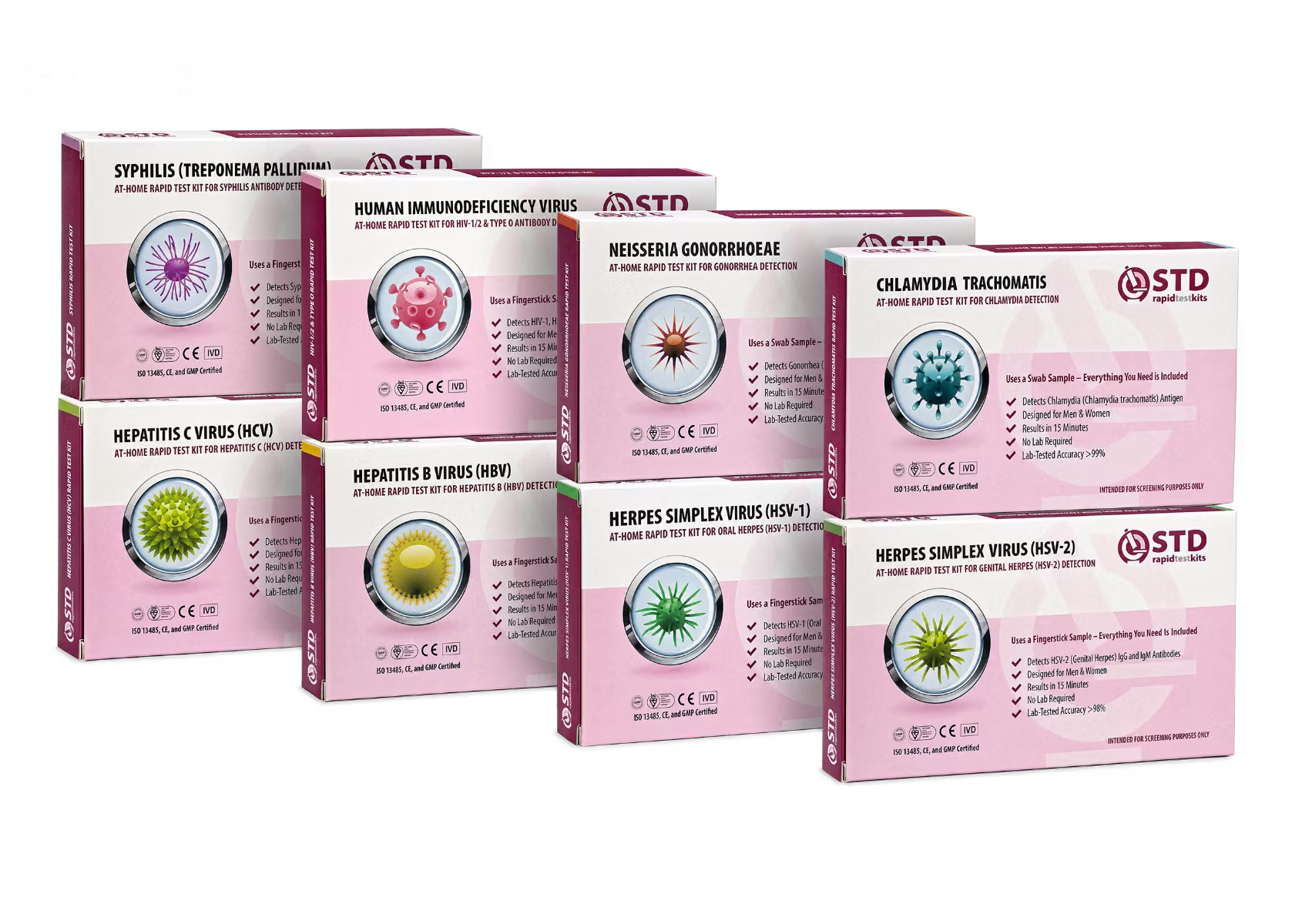
Being clear about scope helps you get the right answer faster. Our kits are lateral-flow rapid tests that give a result in about 15 minutes at home. We sell two categories: fingerstick blood tests for the bloodborne infections (HIV, syphilis, hepatitis B, hepatitis C, HSV-1, HSV-2, combined herpes panel) and self-collected genital swab tests for chlamydia, gonorrhea, trichomoniasis (women only), and HPV (women only). Our combination kits draw from those.
What that means for MSM-specific screening:
- For an HIV, syphilis, or hepatitis screen, a home rapid blood test is a reasonable choice if you are past the window period. Confirmatory testing in a clinic is recommended for any reactive home result.
- For urethral chlamydia or gonorrhea, a self-collected genital swab is a valid option, though clinic NAAT remains the analytical reference standard.
- For pharyngeal (throat) or rectal chlamydia and gonorrhea screening, we do not sell a take-home throat-swab or rectal-swab kit. CDC-recommended extragenital sampling needs to happen at a clinic or via a mail-in NAAT panel from a service that offers those sample types.
A home rapid lateral-flow test and a clinic NAAT are different technologies. Lateral-flow tests are designed to detect a target antibody or antigen quickly and visually. Clinic NAAT amplifies the pathogen's genetic material in a lab and is the analytical reference standard for chlamydia and gonorrhea. The two are complementary rather than equivalent: a home rapid kit answers "is this likely worth following up on" in 15 minutes; a clinic NAAT gives a higher-sensitivity confirmation.
Our at-home kits cover the bloodborne tests (HIV, syphilis, hepatitis B and C, HSV) and the urethral-swab tests for chlamydia and gonorrhea. We do not sell pharyngeal or rectal swab kits. For a CDC-aligned complete MSM screen, plan on a clinic visit (or a mail-in service that offers extragenital NAAT) for the throat and rectal samples, and use our kits for the blood panel and the urethral swab. Being honest about that split saves you from a false sense of cover.
If a test comes back positive: what to do next
A positive result on a home rapid test is not a diagnosis on its own. The standard pathway is: confirm with a clinic-grade test, get treated, notify partners, and retest after treatment as the infection requires.
For chlamydia or gonorrhea, the treatment is usually a short course of antibiotics. Most infections clear within a week of treatment, and CDC guidance is to retest at the affected site three months later to rule out reinfection rather than treatment failure. For syphilis, treatment is benzathine penicillin G, dosing depending on the stage. For HIV, an HIV-positive rapid result needs a confirmatory lab test and, on confirmation, immediate linkage to care; modern antiretroviral therapy is so effective that someone diagnosed early can expect a near-normal life expectancy and a sustained undetectable viral load that means they cannot transmit HIV sexually (U=U).
Partner notification is awkward and necessary. A simple template works: "Hey, I tested positive for [infection] recently, and I wanted to give you a heads up so you can test too." Some health departments offer anonymous notification through services like Tell Your Partner. Notification is not about blame; it is the only way to break the chain.
Retesting after treatment is part of the protocol, not a sign you did anything wrong. Most reinfections happen because an untreated partner re-exposed you.
The post-positive protocol, in four steps
- Confirm with a clinic-grade test. A reactive home result is a signal to follow up, not a final diagnosis.
- Complete the full treatment course. For bacterial STIs, finish the antibiotic regimen even if symptoms resolve early.
- Notify recent partners. A direct, blame-free message gets them tested and breaks the chain of reinfection.
- Retest at three months for chlamydia or gonorrhea to rule out reinfection from an untreated partner.
Asking for the right swab without flinching
The most common barrier to a complete screen is not the technology. It is the conversation. Many clinics still default to urine plus blood for everyone, and patients who want extragenital sampling have to ask for it specifically. That can feel awkward, especially if the provider has not signaled that they are queer-affirming.
A few scripts that work:
- "I have had oral and receptive anal sex recently. I would like a pharyngeal swab and a rectal swab for chlamydia and gonorrhea along with the urine and blood."
- "I am on PrEP. The CDC recommends three-site NAAT for MSM on PrEP every three to six months. Can we run all three today?"
- "I would prefer to self-collect the rectal swab if that is an option." (Many clinics now accept patient-collected rectal swabs, which sidesteps a provider exam if that feels easier.)
If your provider declines or seems uncomfortable, that is information about the provider, not about whether you should be tested. Sexual-health clinics, queer-affirming primary-care practices, and Planned Parenthood typically do extragenital sampling as a default. If geography is the constraint, a mail-in NAAT service that includes throat and rectal swabs is a viable middle path, and home rapid blood tests handle the bloodwork side without a clinic visit at all.
FAQs
- Can I really catch an STI from just oral sex?
- Yes. Gonorrhea, chlamydia, syphilis, and herpes (HSV-1 and sometimes HSV-2) all transmit through oral exposure. Most pharyngeal gonorrhea and chlamydia infections produce no symptoms, which is why CDC guidance for sexually active MSM is to include a pharyngeal NAAT swab at routine screening visits.
- My STI test came back clear. Does that mean I am clean?
- Only at the sites that were sampled. A clear urine result means no urethral infection was detected; it says nothing about the throat or rectum. If you had oral or anal contact and only a urine sample was taken, the screen is incomplete. Ask which sites were tested and which were not.
- I am on PrEP. Isn't that enough protection?
- No. PrEP is highly effective against HIV specifically, not against bacterial or viral STIs like chlamydia, gonorrhea, syphilis, or herpes. At each PrEP visit, ask explicitly for pharyngeal and rectal NAAT swabs alongside the standard urine and bloodwork. Many clinics skip the extragenital sites unless the patient names them, and that is where the silent infections sit.
- Should I test if I feel completely fine?
- Yes, on the CDC schedule for sexually active MSM. Most rectal and pharyngeal chlamydia and gonorrhea infections never produce symptoms a person would notice. Annual full-site screening (every three to six months for higher-risk men) is what catches the silent infections that get passed forward.
- Can a home rapid test cover what I need as a queer man?
- Partly. Home rapid blood tests handle HIV, syphilis, hepatitis, and HSV antibodies, and home self-swab kits handle urethral chlamydia and gonorrhea. They do not cover pharyngeal or rectal NAAT screening, which needs a swab at the throat or rectum and currently sits outside the home rapid-test category. A clinic visit or a mail-in NAAT panel covers those.
- How often should I test if I am sexually active?
- At least annually with all-site sampling if you are sexually active with male partners. Every three to six months if you have multiple or new partners, are on PrEP, or have had a recent exposure event you want a definite answer about. Sooner than that for any new symptom or partner notification.
- What if my provider does not offer rectal or throat swabs?
- Ask directly using a short script: "The CDC recommends pharyngeal and rectal NAAT for MSM screening. I would like both today." If the answer is still no, that is a signal to find a sexual-health clinic, a queer-affirming primary-care practice, or a mail-in NAAT service that includes extragenital sample types.
- How long after exposure should I wait to test?
- Roughly 1 to 2 weeks for chlamydia and gonorrhea NAAT, 3 to 6 weeks for syphilis blood antibody, 18 to 45 days for fourth-generation HIV antigen-antibody tests (23 to 90 days for antibody-only rapid HIV tests). Testing earlier than the window produces unreliable results. If you tested early, retest at the back end of the window to confirm.
How we sourced this article: Our editorial team summarized current CDC, WHO, and NHS public-health guidance on STI screening for men who have sex with men, alongside peer-reviewed surveillance data on extragenital chlamydia and gonorrhea infection in MSM populations. We are not clinicians; this article is a plain-English summary, not medical advice. For symptoms or exposure events that concern you, see a licensed provider.
- U.S. Centers for Disease Control and Prevention. STI Treatment Guidelines: Men Who Have Sex With Men. Recommendation for annual three-site (urethra, pharynx, rectum) NAAT screening for sexually active MSM, with every three to six months for those at increased risk.
- U.S. Centers for Disease Control and Prevention. MMWR: Extragenital Chlamydia and Gonorrhea Among Community Venue-Attending MSM, 2015-2019. Surveillance data on rectal and pharyngeal infection prevalence supporting the case for extragenital sampling.
- U.S. Centers for Disease Control and Prevention. MMWR Recommendations and Reports: Sexually Transmitted Infections Treatment Guidelines, 2021. Syphilis window-period and treatment guidance referenced throughout.
- U.S. Centers for Disease Control and Prevention. STI Screening Recommendations. General guidance on who to screen and at what cadence.
- U.S. Centers for Disease Control and Prevention. HIV Testing. Window periods for fourth-generation antigen-antibody, antibody-only rapid, and RNA tests.
- U.S. Centers for Disease Control and Prevention. About PrEP. PrEP effectiveness as HIV prevention and screening cadence for MSM on PrEP.
- U.S. Centers for Disease Control and Prevention. STI Testing: What to Expect. Patient-facing summary of who should test and how to find testing.
