
Published: October 2025 | Last updated: May 2026 | Editorial review and quality control: Martina N.
Home treatment for trichomoniasis can mean two very different things, and the gap between them is where most of the confusion lives. One version is grounded in clinical guidelines: order a test, collect a sample at home, send or read the result, and use a telehealth provider to fill a prescription you take in your own kitchen. The other version skips the prescription entirely and tries to clear a parasite with apple cider vinegar, garlic capsules, or vaginal washes.
This guide separates the two. It walks through what the CDC, the WHO, and major clinical references actually recommend, which at-home tools fit that picture safely, and which remedies that fill wellness blogs do nothing for the underlying infection. The short version: almost every step can happen at home now, but the medication itself still has to come from a clinician.
Key Takeaways
- Trichomoniasis is caused by a parasite (Trichomonas vaginalis), and the only treatments shown to clear it are prescription metronidazole or tinidazole. No herb, supplement, douche, or wash has the same effect.
- At-home treatment is safe and effective when it means at-home testing plus a telehealth-prescribed antibiotic, with the partner tested and treated at the same time. It is unsafe when it means trying to skip the medication step.
What "Home Treatment" Really Means
When people search for home treatment for trichomoniasis, they are usually asking one of three different questions. The first is logistical: can I avoid a clinic waiting room because of cost, travel, or work schedule? The second is private: can I handle this without a paper trail in my main medical record or a conversation with a stranger? The third is more hopeful, and harder to answer well: can I make this go away without a prescription at all?
The first two questions have good answers. At-home testing kits exist. Telehealth platforms can prescribe trichomoniasis treatment after a positive result. The medication itself is inexpensive and stocked at almost every pharmacy. Almost every step that used to require a clinic visit can now happen in a private apartment, on a single afternoon, without anyone in your daily life knowing.
The third question has a harder answer. There is no published evidence, from the CDC, from peer-reviewed trials, or from any major clinical reference, that a non-prescription approach reliably cures Trichomonas vaginalis. Symptoms can fade on their own. The parasite usually does not.
That distinction matters because the three questions get answered by very different sources online. Telehealth services and public-health pages handle the first two well. The third one gets answered mostly by wellness blogs, which trade in vinegar rinses, probiotic protocols, and supplement stacks. Those approaches have no controlled-trial evidence behind them as cures, and a parasitic infection does not respond to changes in pH or microbiome the way bacterial or fungal imbalances sometimes do.
Trichomoniasis Is a Parasite, Not a Bacterial Imbalance
Trichomoniasis is the world's most common non-viral sexually transmitted infection. The World Health Organization estimates more than 156 million new cases each year globally. The cause is a single-celled parasite called Trichomonas vaginalis, which lives in the lower genital tract in women and most often in the urethra in men.
That parasitic detail is the reason so many home remedies fall flat. Yeast overgrowth responds to environmental shifts because Candida balance is sensitive to pH, hormones, and antibiotics. Bacterial vaginosis sometimes responds to changes in the surrounding microbiome. A parasite has its own life cycle and its own metabolism. It does not back off because the surrounding pH shifted slightly, and it does not yield to probiotics the way bacterial imbalances might.
In women, the parasite often causes thin, frothy, sometimes yellow-green discharge, vaginal itching, painful urination, and a noticeable odor, per the CDC's overview. About 70 percent of infections produce no obvious symptoms at all in the first few months, which is one of the main reasons reinfection between partners is so common. One person feels itchy and worried. The other feels completely fine and assumes nothing is wrong. The parasite keeps moving between them.
In men, infection is even more often silent. When symptoms do appear they look like mild urethritis: irritation after urination, a faint discharge, or a sense of pelvic discomfort that comes and goes. Most men with trichomoniasis never know they have it unless a partner tests positive.
Yeast overgrowth and bacterial vaginosis can fluctuate with pH, hormones, antibiotic use, or local microbiome shifts. Trichomonas vaginalis is a separate organism with its own metabolism. It does not respond to pH-shifting rinses, probiotics, or microbiome-targeted protocols, which is why remedies that sometimes ease BV or yeast symptoms do not clear trichomoniasis.
Why "Waiting It Out" Quietly Makes Things Worse
There is a stubborn idea online that trichomoniasis might clear on its own if you simply wait. That belief usually comes from two places. The first is that symptoms genuinely fluctuate; itching that flared after a sexual encounter often calms down on its own a few days later. The second is confusion with conditions like bacterial vaginosis, where flare-ups truly can come and go without the organism staying permanently.
Trichomoniasis behaves differently. The NIH StatPearls reference notes that without treatment, infection can persist for months or even years, with symptoms quieting and returning in unpredictable cycles. During the quiet periods the parasite is still present, still replicating, and still transmissible to partners.
The HIV-risk piece is worth pulling out specifically. The CDC notes that trichomoniasis causes genital inflammation that makes it easier to acquire or transmit HIV during sexual exposure. The same inflammation also raises the chance of acquiring other sexually transmitted infections during exposure, which is part of why public-health bodies treat it as a screening priority rather than a nuisance condition.
The other downstream costs add up too. Trichomoniasis is associated with preterm delivery and low birth weight in pregnancy, and in some people it appears to contribute to pelvic inflammatory disease, which can affect fertility. None of those outcomes are inevitable; all of them become more likely the longer the infection sits untreated.
A familiar pattern in primary care is the patient who tested positive, was treated, and assumed the matter was closed. Months later they return with new symptoms, often blaming the antibiotic or assuming reinfection from a new partner. The simpler explanation is usually that a sexual partner went untreated and the parasite cycled back. When one partner clears the infection but the other does not, reinfection typically appears within weeks of resumed sexual contact, restarting the same diagnostic confusion the patient went through the first time.
What untreated trichomoniasis can lead to
- Easier acquisition or transmission of HIV during sexual exposure, due to local genital inflammation (CDC).
- Higher risk of acquiring other sexually transmitted infections during exposure.
- Association with preterm delivery and low birth weight in pregnancy (WHO).
- Possible contribution to pelvic inflammatory disease, which can affect fertility.
- Months-to-years persistence of the parasite, with symptoms quieting and returning in cycles (NIH StatPearls).
Safe At-Home Care Starts with Testing
Safe at-home care for trichomoniasis follows a specific sequence. The first step is testing, not guessing. Symptoms can mimic yeast infections, bacterial vaginosis, urinary tract infections, and even allergic reactions to soap or laundry detergent, so a confirmed result is what tells you whether antibiotics are even the right tool.
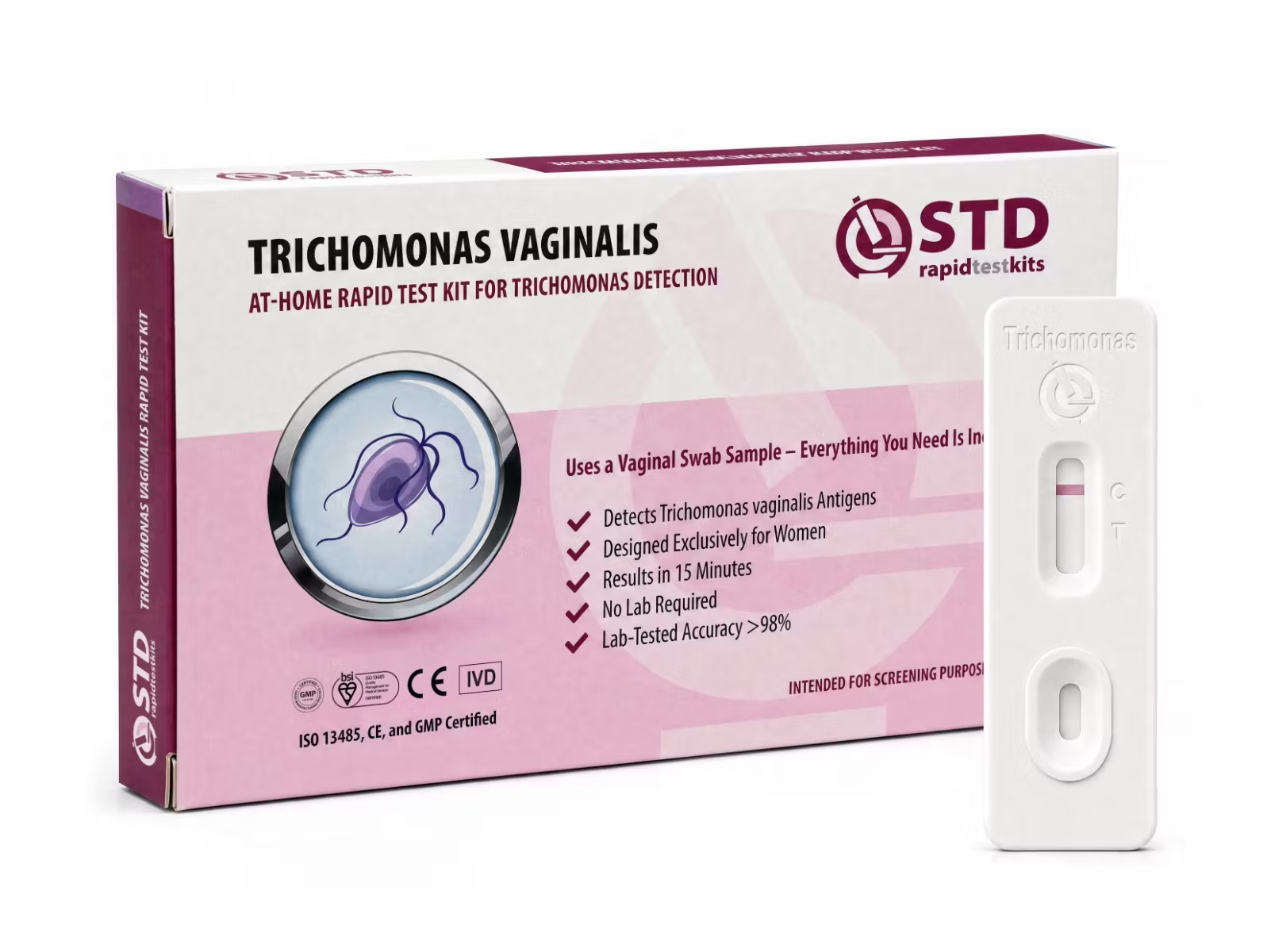
At-home trichomoniasis testing typically uses a self-collected vaginal swab. The sample either runs on a rapid lateral-flow cassette (results visible within minutes, similar to a home pregnancy test) or ships to a lab for analysis. Either way, the collection happens privately, without an exam table.
The at-home rapid trichomoniasis swab kit available on this site is validated for vaginal self-collection in women only. There is no equivalent at-home rapid swab kit for male partners, so men who suspect exposure should either see a clinic for a urethral swab or urine NAAT, or use a multi-STI combo kit while arranging treatment through a telehealth provider after a partner has tested positive.
After a positive at-home test, the next step is a telehealth visit. The provider reviews the result, asks about symptoms, allergies, pregnancy status, and current medications, and sends a prescription for metronidazole or tinidazole to a pharmacy near you. From there, the medication is picked up (or shipped, where state law allows) and taken at home on the dosing schedule the clinician set.
That entire sequence (test, telehealth, prescription, take medication) can happen without setting foot in a clinic, with privacy preserved at every step. What it does not skip is the medication. The home part is the location. The treatment part is still a clinically validated antibiotic.
This article is published by stdrapidtestkits.com, which sells at-home STI testing kits. We recommend products based on fit-for-purpose for the reader's concern, not commercial benefit. When the kit we sell does not fit a reader's situation (for example, a male partner needing a urethral or urine test), we say so plainly and point to the appropriate clinical option.
The Remedies That Don't Work, and Some That Can Hurt
The list of remedies suggested for trichomoniasis is long and constantly evolving. Garlic capsules, raw garlic cloves used vaginally, apple cider vinegar baths or rinses, hydrogen peroxide douches, tea tree oil, boric acid suppositories, oregano oil, colloidal silver, and almost every probiotic on a wellness shelf have all been proposed as alternatives to antibiotics.
None of them have controlled-trial evidence supporting them as a cure for trichomoniasis. Some are simply inert (a probiotic capsule cannot harm a Trichomonas parasite in any meaningful way). Others are actively risky: garlic inserted vaginally can cause chemical burns, hydrogen peroxide rinses disrupt the normal vaginal flora and worsen irritation, and tea tree oil at strong concentrations is a known mucosal irritant.
These remedies create a subtler problem than immediate harm: surface symptoms ease enough that people stop pursuing real treatment, and by the time symptoms return, weeks have passed and a partner may have been exposed. The original "fix" then gets blamed for failing rather than identified as never having worked.
Vaginal douching deserves a specific mention because it is so commonly recommended. Public-health guidance, including the CDC's STI Treatment Guidelines, advises against routine douching: it does not eliminate trichomoniasis, it can push organisms further into the upper reproductive tract, and it disrupts the normal vaginal environment in ways that have been linked to bacterial vaginosis and pelvic inflammatory disease.
| Common remedy | What it claims to do | What the evidence shows |
|---|---|---|
| Garlic (capsule or vaginal insert) | Antimicrobial action against the parasite | No controlled trials show a cure. Vaginal inserts can cause chemical burns. |
| Apple cider vinegar baths or rinses | Lower vaginal pH to make it 'inhospitable' | Does not kill the parasite; can irritate vaginal tissue. |
| Hydrogen peroxide douches | Oxidative kill of organisms | Disrupts normal flora; no cure evidence; worsens irritation. |
| Tea tree oil | Plant-derived antimicrobial | Strong concentrations are known mucosal irritants; no clinical cure data. |
| Boric acid suppositories | Antifungal/antibacterial balance | Used for some yeast and BV cases; no evidence for trichomoniasis cure. |
| Probiotics (oral or vaginal) | Restore microbiome balance | Cannot harm a parasite; no role in clearing trichomoniasis. |
How At-Home Trichomoniasis Testing Actually Works
Most people overestimate how complicated an at-home trichomoniasis test is. The process for a rapid lateral-flow swab kit usually takes under ten minutes from opening the box to reading the result.
Inside the kit you typically find a sterile swab, a buffer tube, a test cassette, and instructions. The user collects a vaginal sample by gently inserting the swab a few centimeters and rotating it for the time the instructions specify (usually about ten to twenty seconds). The swab goes into the buffer tube, the buffer dissolves cell material from the swab, and then a few drops of the mixed buffer are applied to the cassette window. After roughly fifteen minutes, a control line and possibly a test line appear.
A clear control line plus a visible test line is a positive result. The control line alone is negative. No control line at all means the test did not run correctly and should be repeated with a new cassette.
Sensitivity for rapid lateral-flow trichomoniasis tests is meaningfully lower than the laboratory NAAT (nucleic acid amplification test) used in clinics. Published evaluations of cleared rapid antigen-based kits typically report sensitivities in the mid-80 percent range and specificities around 95 to 99 percent, depending on the assay and the population studied. That difference matters. A laboratory NAAT is the gold standard. A home rapid test is a screening tool: useful for picking up active infection at home and turning a vague suspicion into actionable information, but worth confirming with a clinic NAAT if symptoms persist after a negative result.
If symptoms persist after a negative rapid result, the practical next step is to either repeat the rapid test in seven to ten days or ask a clinician for a NAAT-based test.
What to expect from a rapid lateral-flow kit
- Total active time: about 5 minutes for collection, plus 15 minutes wait for the cassette to develop.
- Sample type: self-collected vaginal swab. No urine, no blood draw.
- Result reading: control line plus test line = positive; control line alone = negative; no control line = invalid, retest with fresh cassette.
- Sensitivity vs lab NAAT: rapid kits sit in the mid-80 percent range; clinic NAAT remains the gold standard for confirming a stubborn negative.
Timing Your Test for Reliable Results
Trichomoniasis has a variable incubation period. The Cleveland Clinic overview notes symptoms can appear anywhere from five to twenty-eight days after exposure, and a significant fraction of people develop no symptoms for months. That range is the reason timing matters as much as the test itself.
If you test within the first few days after a possible exposure, the parasite may not yet be present in detectable amounts. A negative result at day three does not mean you are clear; it means you tested early. The general guidance is to wait one to two weeks after the suspected exposure for a more reliable result, and to retest if symptoms appear later regardless of the first result.
If you are testing because symptoms have already started, timing is less of a barrier. Once symptoms are present, the parasite has typically reached detectable levels.
The table below captures the most common timing mismatches and what to do instead:
| Situation | Common reaction | Better approach |
|---|---|---|
| Symptoms within 2-3 days of new exposure | Test immediately, assume early negative means clear | Test now if symptoms are bothersome, but plan to retest at 10-14 days if symptoms continue |
| No symptoms, but a partner just tested positive | Wait and see if anything develops | Test at 7-14 days post-exposure and treat empirically through telehealth if a clinician agrees |
| Negative test, symptoms still present after a week | Trust the result, try home remedies | Retest with a fresh kit or get a clinic NAAT, which is more sensitive than the rapid format |
| Treated and feeling better, but new partner | Skip the retest, assume cleared | Rescreen at 3 months per CDC guidance, especially if any new sexual exposure |
The Antibiotics That Actually Clear It
The CDC STI Treatment Guidelines identify metronidazole and tinidazole as the only antimicrobials with consistent evidence for clearing trichomoniasis. Both belong to a class called 5-nitroimidazoles. Both work by entering the parasite and disrupting its DNA.
The current CDC-recommended regimen for women is metronidazole 500 mg orally twice daily for seven days. For men, a single 2-gram dose of metronidazole remains the recommended regimen. Tinidazole is given as a single 2-gram dose for either sex and is sometimes preferred when adherence to a seven-day course is a concern, though it costs more in the United States.
The CDC updated its recommended regimen for women to a seven-day course, citing improved cure rates over the older single-dose approach. The single-dose approach still works in some cases but has a meaningfully higher failure rate in women. Knowing which regimen you are taking, and finishing it, is the main factor in whether the medication actually clears the infection.
Side effects are usually mild and short-lived. The most common are a metallic taste, mild nausea, and headache. The most important counseling point is the alcohol restriction: avoid alcohol during treatment and for at least 24 hours after the last metronidazole dose, or 72 hours after the last tinidazole dose, to avoid a reaction that includes nausea, vomiting, and flushing.
Telehealth services can prescribe these medications after reviewing a positive at-home test, which is what makes the entire treatment cycle accessible without a clinic visit. The medication itself is generic, available at most pharmacies, and often costs under twenty dollars without insurance.
Metronidazole and tinidazole are the only antimicrobial medications recommended for the treatment of trichomoniasis.
The Partner Step That Breaks the Reinfection Cycle
Trichomoniasis treatment almost always works. When symptoms return, an untreated partner is the usual explanation: the parasite cycles back as soon as sex resumes, restarting the same diagnostic confusion the patient had the first time.
This pattern is so common that the CDC explicitly recommends what is called expedited partner therapy where state law allows it: the original patient's clinician can write a prescription for the partner without the partner ever being seen. The point is to shorten the gap between one person clearing the infection and their partner doing the same.
Two practical rules follow from that. First, all current sexual partners from roughly the last 60 days should be tested and treated, ideally at the same time. Trichomoniasis is asymptomatic often enough in men that "they feel fine" is not reliable evidence they are not carrying it. Second, avoid sexual contact (including oral and digital contact with genital fluids) until both partners have completed treatment and any prescribed waiting period. Many clinicians recommend waiting about one week after completion of treatment and resolution of symptoms before resuming sex.
This is the part of home treatment that gets quietly skipped most often, and it is the single biggest predictor of reinfection. A partner who feels fine has no obvious motivation to take a medication, especially one with an alcohol restriction. Framing it as "we are clearing this from the household, not from one person" usually lands better than asking someone to treat a symptom they do not have.
A multi-STI combo test for a partner can also pick up other infections that often travel with trichomoniasis, particularly chlamydia and gonorrhea, which share many of the same risk factors and exposure patterns.
While You Are Waiting for Results
The window between sending a test and getting a result is short, but it is the window where most ill-advised remedies get tried. The urge to do something immediate is understandable.
Gentle, non-irritating care is appropriate during this period. That means avoiding scented soaps, bubble baths, and laundry detergents with strong fragrances in the genital area. Wearing breathable cotton underwear and avoiding tight synthetic clothing helps reduce friction. Plain warm sitz baths (just water, no additives) can ease itching without changing the local environment in any meaningful way.
What is not appropriate during this window is anything that aggressively changes the vaginal environment: douching, boric acid suppositories, vinegar rinses, garlic, tea tree oil, hydrogen peroxide, or any "detox" protocol. These can inflame tissue, alter the local pH in ways that complicate later testing, and provide false reassurance if symptoms ease temporarily.
If discomfort is significant, over-the-counter analgesics like acetaminophen or ibuprofen are reasonable for short-term relief, taken at standard doses. Topical anesthetic creams are not necessary and not recommended without a clinician's advice.
Pausing sexual activity until the result is back is the other important step. If the test is positive, that pause will continue through treatment. If it is negative but symptoms persist, the pause buys time to retest or escalate to a clinic visit.
Safe vs unsafe care while waiting for results
- Safe: plain warm water sitz baths, breathable cotton underwear, fragrance-free wash, standard-dose acetaminophen or ibuprofen, pausing sexual activity.
- Unsafe: douching, vinegar rinses, hydrogen peroxide, boric acid suppositories, garlic inserts, tea tree oil, scented washes, any "detox" protocol.
- Why the line matters: aggressive cleansing changes local pH and inflammation enough to complicate retesting and to mask symptoms without affecting the parasite.
Pregnancy, Retesting, and the Long Game
Trichomoniasis during pregnancy deserves more careful framing than the average home-treatment article gives it. The infection has been associated with premature rupture of membranes, preterm delivery, and low birth weight, according to the WHO trichomoniasis fact sheet and corroborated by multiple US public-health references. None of these outcomes are guaranteed, but the elevated risk is the reason clinical guidance leans toward treating pregnant patients rather than waiting.
Metronidazole has been studied in pregnancy more than tinidazole and is generally considered the safer option, particularly in the second and third trimesters. First-trimester use is more conservative and depends on individual clinical judgment.
Retesting after treatment is recommended for women within three months, per the CDC STI Treatment Guidelines, because reinfection rates from untreated partners are high. Retesting is not about checking whether the medication worked; it almost always does. It is about catching reinfection early. For men, retesting is recommended mainly if symptoms recur or a partner has a positive result.
The long game also includes the infections that often travel with trichomoniasis. Co-infection with other STIs raises the stakes of leaving any single infection untreated, which is why a positive trichomoniasis result is a reasonable reason to test for chlamydia, gonorrhea, and HIV at the same time.
For someone who has been through one episode, prevention is mostly about three things: consistent condom use with new or non-monogamous partners, baseline screening when starting a new sexual relationship, and a low threshold for testing again if symptoms reappear. Each of those steps lowers the probability of a second round.
Trichomoniasis treatment in pregnancy involves medication-choice and timing decisions (which agent, which trimester) that need to be made by a clinician who knows you are pregnant. Tell the prescribing provider directly, or work with your obstetric clinician. Untreated infection during pregnancy carries its own risks, so the answer is not to skip treatment, but it is also not to order a one-size-fits-all script through a service that does not ask about pregnancy.
A Safe At-Home Plan, Start to Finish
A safe at-home plan for trichomoniasis looks almost identical, regardless of who is following it. Order an at-home test when there is a reason to suspect exposure or when symptoms suggest it, and time the test for at least one to two weeks after the suspected exposure window. Collect the sample privately, read the result, and treat a positive result the same way a clinic would: with metronidazole or tinidazole prescribed by a clinician.
If a clinic visit is not the right fit for the moment (cost, time, privacy, comfort, all of them), telehealth fills the gap for prescribing. Partners get tested and treated together. Sex pauses until both people have completed treatment and any prescribed waiting period. A retest happens about three months later for women, sooner if symptoms come back.
What that plan is not is a workaround. It is not a way to avoid medication, it is not a way to handle the infection without involving a clinician at all, and it is not a way to skip the partner conversation. The home part is logistical and emotional. The treatment part is still grounded in the same antibiotics that have been used for trichomoniasis for decades, in the same doses public-health agencies recommend.
The plan in order
- Test 1-2 weeks after suspected exposure, or sooner if symptoms have already started.
- If positive, book a telehealth visit and request metronidazole or tinidazole. If pregnant, tell the provider directly.
- Take the medication as prescribed; avoid alcohol during the course and for 24 hours (metronidazole) or 72 hours (tinidazole) after the last dose.
- Have all current partners tested and treated at the same time, using expedited partner therapy where available.
- Pause sexual contact until both partners have completed treatment and symptoms have resolved (about one week post-treatment for most people).
- Rescreen at 3 months if you are a woman, or sooner if symptoms return.
Frequently Asked Questions
- Can trichomoniasis really clear on its own?
- Realistically, no. Symptoms can fade for weeks at a time, which makes it feel like the body handled it, but the parasite usually persists. Without prescription antibiotics, infection can continue for months and remain transmissible to sexual partners. The fluctuation in symptoms is what fools people into thinking the body cleared it; the underlying organism is still there.
- Are any natural remedies actually effective?
- No herb, supplement, douche, or wash has been shown in controlled studies to cure trichomoniasis. Some can ease surface symptoms enough to feel reassuring, which is exactly what makes them risky. Garlic, apple cider vinegar, tea tree oil, hydrogen peroxide, and boric acid have all been proposed and none have evidence to back them up. A few (douching, strong tea tree oil) can actively worsen irritation.
- If I have no symptoms but my partner tested positive, do I still need treatment?
- Yes. About 70 percent of trichomoniasis infections cause no symptoms in the first few months, and feeling fine is not reliable evidence of being clear. Expedited partner therapy, where a clinician prescribes for the partner without an in-person visit, is recommended by the CDC in states where law allows it. Untreated partners are the most common reason people get reinfected after their own treatment works.
- How long after a possible exposure should I wait to test at home?
- About one to two weeks after possible exposure gives the parasite enough time to reach detectable levels. Testing earlier can produce a false negative. If symptoms appear later, retest regardless of the first result. If you are testing because symptoms have already started, the timing is less of an issue; symptomatic infection is typically detectable.
- Can I drink alcohol while taking metronidazole?
- Avoid alcohol during the course of metronidazole and for at least 24 hours after the last dose. For tinidazole, the recommendation extends to 72 hours after the last dose. The combination can cause nausea, vomiting, flushing, and headache. The restriction is temporary and ends within a few days of finishing treatment, so most people manage it by planning ahead.
- Is at-home trichomoniasis testing available for men?
- Our at-home rapid swab kit for trichomoniasis is validated for vaginal self-collection in women only. Men who suspect exposure should see a clinic for a urethral swab or urine NAAT, or use a multi-STI combo kit and arrange empirical treatment through a telehealth provider if a partner has tested positive. We do not currently sell a male-specific rapid trichomoniasis test, and we will not pretend the women's kit works for men.
- Can trichomoniasis affect pregnancy or fertility?
- Untreated trichomoniasis during pregnancy has been associated with premature rupture of membranes, preterm delivery, and low birth weight. It has also been linked in some cases to pelvic inflammatory disease, which can in turn affect fertility. Treatment with metronidazole is generally considered safer than leaving the infection untreated during pregnancy. Always involve a clinician in the prescribing decision when pregnant.
- How soon after treatment can I have sex again?
- Most clinicians recommend waiting about one week after completion of the medication and resolution of symptoms, and ensuring any sexual partner has also completed treatment. Resuming earlier is the most common reason people end up reinfected. The CDC also recommends rescreening women within three months of treatment, because reinfection from an untreated partner is the most likely cause of recurrent symptoms.
How we sourced this article: Our article was constructed based on current advice from the most prominent public health and medical organizations, and then molded into simple language based on the situations that people actually experience. Primary references include the CDC's STI Treatment Guidelines and trichomoniasis overview, the WHO trichomoniasis fact sheet, the NIH StatPearls reference, and the Cleveland Clinic patient summary. Specific numeric claims (incidence figures, asymptomatic rates, dosing regimens, incubation windows, retesting intervals) are linked inline to the source they come from. The medication dosing reflects the CDC's current guidance for women and men, including the update that moved the recommended regimen for women from a single 2-gram dose to a seven-day course of metronidazole.
- U.S. Centers for Disease Control and Prevention. Trichomoniasis fact page covering prevalence, transmission, symptoms, the approximately 70 percent asymptomatic rate, and the elevated HIV-acquisition risk during active infection.
- U.S. Centers for Disease Control and Prevention. STI Treatment Guidelines, trichomoniasis section. Source for the seven-day metronidazole regimen for women, single 2-gram dose for men, tinidazole alternative, the three-month retesting recommendation, and douching guidance.
- World Health Organization. Trichomoniasis fact sheet, including the 156 million annual new-cases estimate globally and the pregnancy outcome associations.
- Cleveland Clinic. Trichomoniasis overview. Source for the 5 to 28 day incubation range and patient-facing symptom descriptions.
- National Library of Medicine, StatPearls. Clinical reference on trichomoniasis persistence, treatment-failure patterns, and the rationale for the seven-day regimen in women.
