
Published: September 2025 | Last updated: May 2026 | Editorial review and quality control: Martina N.
The reopening of social life after COVID-19 lockdowns brought a quieter public-health story along with it. People started dating again, app traffic surged, and several sexually transmitted infections climbed faster than pre-pandemic projections suggested. The U.S. Centers for Disease Control and Prevention (CDC), the World Health Organization (WHO), and the U.K. National Health Service (NHS) all flagged the same pattern: rising gonorrhea, rising syphilis, and a sharp jump in congenital syphilis cases since 2020.
This article is about timing: why protection slipped during a stressful period, what the case data shows, and how to make sensible testing choices when you have had new or multiple partners since reopening. If you are reading this after a recent hookup and wondering whether you need a test, the short version is in the takeaways below; the longer answer follows.
Key Takeaways
- Between 2019 and 2022, U.S. gonorrhea cases rose roughly 5% and primary and secondary syphilis cases rose about 51%, per CDC surveillance, with congenital syphilis more than doubling.
- Most chlamydia and gonorrhea infections cause no symptoms, so testing on a sensible schedule matters more than waiting to feel sick.
Why This Surge Looks Different from Past Spikes
The pandemic did not invent the STI rise; rates were already creeping upward through the late 2010s. What changed in 2020 and the years immediately after was the speed of the climb. CDC's national STI surveillance program showed three patterns at once: chlamydia case counts dropped on paper (likely because clinic closures suppressed routine screening, not because infections actually fell), gonorrhea kept rising, and primary and secondary syphilis accelerated across nearly every demographic. Congenital syphilis, the form passed from a pregnant person to a baby, more than doubled between 2019 and 2022.
Numbers like that do not arrive without context. People were not just having more sex when reopening came. They were coping with burnout, isolation, and a year of touch starvation. Many had postponed routine sexual-health screening because clinics were closed or felt unsafe to visit. By the time a vaccinated population started dating in earnest again, the testing infrastructure had thinned and individual habits had drifted.
Lockdowns did not kill desire. They delayed the decisions that go along with it: the conversation about condoms, the standing order at a clinic, the quarterly screen.
| Reported U.S. Cases | 2019 | 2022 | Change |
|---|---|---|---|
| Chlamydia | 1.81 million | 1.65 million | Drop on paper (screening fell during 2020-21) |
| Gonorrhea | 616,392 | 648,056 | Up about 5% |
| Syphilis (primary and secondary) | 38,992 | 59,016 | Up about 51% |
| Congenital syphilis | 1,870 | 3,761 | Up about 101% |
Behind the Numbers: Why Protection Slipped
Three trends help explain the pattern. First, condom use among adults under 35 declined steadily through the lockdown period and only partially rebounded afterward. Second, routine STI screening fell sharply: clinic visits dropped through 2020, recovered slowly through 2021 and 2022, and a lot of asymptomatic infections went undetected and untreated for longer than usual. Third, antibiotic-resistant gonorrhea continued to spread, making each undiagnosed case harder to treat once it was finally caught.
The pieces interact. Less protection plus less screening plus harder-to-treat strains is the combination public-health surveillance teams flagged repeatedly through 2022 and 2023. The WHO's STI fact sheet reported the same dynamic globally, with Europe and the Americas posting some of the steepest rises in syphilis and gonorrhea.
Most of these infections do not announce themselves. Up to 70% of chlamydia infections in women and roughly half in men show no symptoms at all, per CDC's chlamydia overview. Gonorrhea is similarly silent in many people, especially when the infection sits in the throat or rectum rather than the urethra. Syphilis can spend months moving through stages with sores that are easy to miss, particularly when they are painless and located in places people do not routinely check.
- Less protection: condom use among adults under 35 dropped during lockdowns and rebounded only partly.
- Less screening: clinic visits collapsed in 2020 and were slow to recover, leaving asymptomatic infections to spread untreated.
- Harder-to-treat strains: antibiotic-resistant gonorrhea kept gaining ground, making each delayed diagnosis costlier.
Dating Apps and the Illusion of Safety
Dating apps did not create casual sex, and they did not single-handedly create the STI rise. They did, however, accelerate something public-health researchers describe as partner fluidity: frequent and rapid changes in sexual partners across loose networks rather than within a stable circle. The more fluid the network, the faster an infection moves through it, especially when most carriers are asymptomatic.
App culture also creates a soft incentive to keep conversations light. Bios rarely mention testing status. Match-stage chats rarely include questions about recent screening. The performance of being relaxed and unbothered makes the practical conversation feel awkward, and the awkwardness is enough to skip it. Two people then meet up without a shared sense of risk, often after only a few text exchanges.
Add oral sex into the picture and the gap widens further. Many people consider oral encounters lower risk and skip protection entirely. Pharyngeal gonorrhea, oral chlamydia, herpes, and syphilis can all transmit this way. Oral syphilis sores can be painless and easy to overlook. The CDC's STI guidance lists oral exposure as a meaningful transmission route for several pathogens, even when penetrative sex never happens.
None of this means dating apps are dangerous. It means the medium normalizes meeting strangers without the conversational rituals that earlier generations used to slow things down. Rebuilding those rituals (asking about testing, agreeing on protection, checking in afterward) is the practical shift the surge is asking for.
STIs that can spread through oral exposure include pharyngeal gonorrhea, oral chlamydia, herpes (HSV-1 and HSV-2), and syphilis. Oral syphilis chancres are often painless and located on the lip, tongue, or back of the throat where they get missed. If oral was your only contact with a new partner, screening is still worth doing.
When to Test After a New Partner
If you are wondering whether it is too soon to test, the answer depends on which infection you are checking for. Every STI has a window period, the time between exposure and when a test can reliably detect it. Testing too early can produce a falsely reassuring negative.
Most chlamydia and gonorrhea tests reach reliable accuracy by about two weeks after exposure. Syphilis blood tests take longer, often three to six weeks before the antibody response is detectable, with full reliability around three months. HIV depends on the test type: fourth-generation lab tests usually catch infection by 18 to 45 days, while antibody-only home rapid tests are most reliable at the three-month mark per CDC HIV guidance. Trichomoniasis can be detected within a couple of weeks. Herpes blood antibody tests are most reliable at twelve weeks; an active lesion can be tested earlier with a swab PCR if you can get to a clinic while symptoms are present.
If you cannot remember exactly when an exposure happened, or you have had several partners in a short period, a combination test that covers multiple infections is a more practical first step than picking one at a time. Schedule it for the latest window in the panel (usually three months from the most recent exposure) for the most reliable single-test result.
| Infection | Test Type | Earliest Useful Time | Best Reliability Window |
|---|---|---|---|
| Chlamydia | NAAT or PCR (clinic), rapid swab (home) | 5 to 7 days | About 2 weeks |
| Gonorrhea | NAAT or PCR (clinic), rapid swab (home) | 5 to 7 days | About 2 weeks |
| Syphilis | Blood antibody (lab or rapid) | 3 to 6 weeks | 6 to 12 weeks |
| HIV | 4th-gen Ag/Ab (lab); antibody-only (home) | 18 to 45 days (4th-gen) | 3 months |
| Herpes (HSV-2) | Blood antibody (most useful at 12+ weeks); PCR swab from active lesion | Swab during outbreak; blood at 6 weeks | 12 weeks |
| Trichomoniasis | NAAT (clinic), rapid antigen (home, women) | 5 to 7 days | About 2 weeks |

More than 1 million curable sexually transmitted infections are acquired every day worldwide in people 15 to 49 years old, the majority of which are asymptomatic.
At-Home Testing as a Practical Option
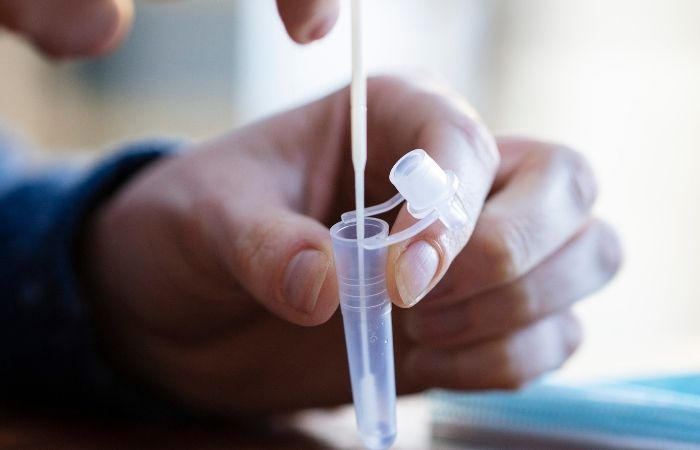
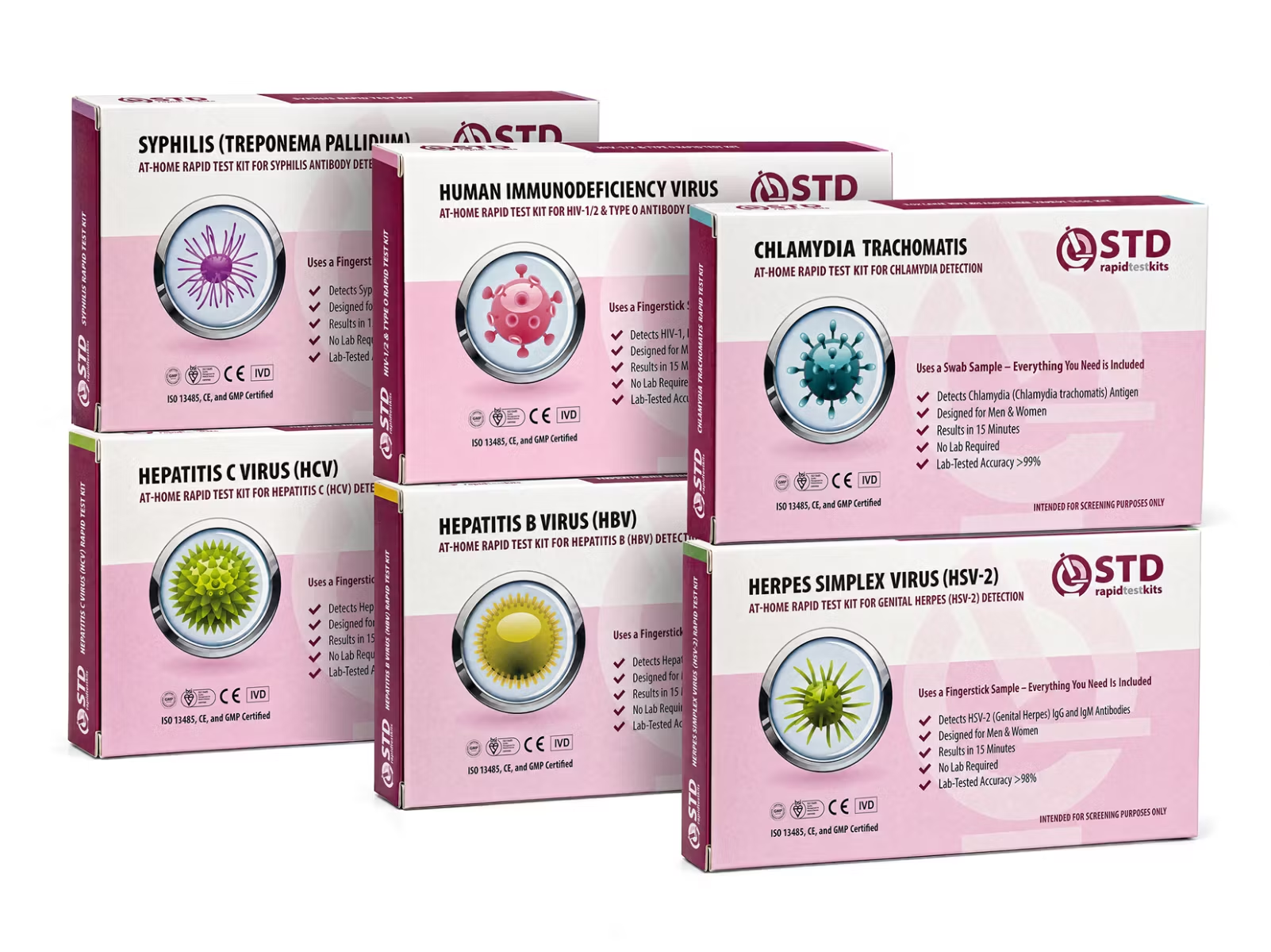
The thought of walking into a clinic, sitting in a waiting room, and discussing recent partners is enough to delay testing for a lot of people. At-home rapid tests have closed part of that gap. They are discreet, fast, and useful as a screening step when used at the right time after exposure. They are not a replacement for clinic-based NAAT or PCR testing, which remains the laboratory gold standard for several infections, but they fit a clear role: confidential first-line screening that takes about fifteen minutes at home instead of half a day off work.
Some at-home options are rapid lateral-flow tests with same-room results. Others are mail-in kits processed in certified labs. Both have legitimate uses. What matters is matching the test type to your exposure window and confirming any positive result with a clinical follow-up. Sensitivity for rapid lateral-flow STI tests is generally in the mid- to high 90s when used after the correct window period, with specificity above 99% for most products. The data sheet that comes with each kit lists the specific figures for that product.
For people meeting partners through apps, especially when the schedule does not include time for clinic visits, a rapid combo kit is a way to maintain testing rhythm without making it feel like a project. Privacy is part of the appeal; consistency is the practical benefit.
Negative Result But Something Still Feels Off
A negative result is not always the final word. If you tested before the window period closed, had another exposure between testing and now, or are noticing symptoms that started after your test, retesting is the appropriate next step. Retesting is about accuracy, not about doubt or shame. It protects you and any current or future partners from a false reassurance.
If you were treated for a confirmed STI recently, follow-up testing usually waits a few weeks for chlamydia or gonorrhea to confirm the infection cleared, and longer for syphilis or HIV depending on the test type. Your treating clinician will recommend a specific schedule. A single negative result is one data point. If timing was off, the window is still open.
Symptoms that persist after a negative test deserve a clinic visit even if you would rather avoid one. Several non-STI conditions present with similar symptoms and benefit from a clinical exam and targeted treatment rather than another self-test. A clinician can swab, culture, or run a lab NAAT panel.
- Bacterial vaginosis: thin grey discharge with a fishy odor; treatable with prescription antibiotics.
- Yeast infections: itching and thick white discharge; treatable with antifungals.
- Urinary tract infections: burning during urination, urgency, lower abdominal discomfort; treatable with antibiotics.
- Contact dermatitis: redness or itching from soaps, lubricants, latex, or laundry detergent; resolves with avoiding the trigger.
How to Stay Safer Without Shame
People are dating, hooking up, exploring relationship structures, and have every right to. The aim of safer-sex practice is not to limit what you do; it is to keep your options open by catching infections early and avoiding onward transmission. The basic checklist is short and worth keeping somewhere visible.
- Test on a regular schedule, especially after new or multiple partners. Every three to six months is a common starting point.
- Bring up testing status with new partners before sex; a casual question lands better than no question at all.
- Use protection during oral sex when you can. Flavored condoms and dental dams exist for a reason.
- Learn the basic symptom patterns so you do not mistake them for unrelated conditions like razor burn or yeast infections.
- Treat a positive result as information, not a verdict. Almost all bacterial STIs are curable and most viral STIs are manageable with daily treatment.
If You Test Positive: What to Do First
The moment a positive result arrives, the first reaction is usually a mix of shame, panic, and regret. None of that is useful, and none of it is accurate. Testing positive means you are now informed about something your body was already dealing with. It does not mean you were reckless or did anything wrong.
Most STIs are treatable with a short course of antibiotics or antivirals. Chlamydia, gonorrhea, syphilis, and trichomoniasis are curable. Genital herpes and HIV are not currently curable but are manageable with daily medication that drops transmission risk dramatically. Modern HIV treatment can reduce viral load to undetectable levels, at which point the virus is not transmitted sexually (the U=U principle, supported by CDC HIV guidance). HPV often clears on its own; some strains warrant follow-up cervical screening per the NHS STI overview.
The order of operations is straightforward: confirm the result with a clinic if it came from a home test, start prescribed treatment promptly, schedule the recommended follow-up, and notify recent partners so they can test too. None of those steps require an emotional crisis. Each one is what taking the diagnosis seriously looks like in practice.
Telling a Partner Without Making It a Disaster
Letting someone know you tested positive is rarely the disaster people imagine before doing it. The framing matters more than the words. A short, direct, no-shame message tends to land better than a long emotional explanation.
A simple template that works: "Hey, I just got tested and a [name of STI] came back positive. I wanted you to know because you may want to get tested too. The clinic can usually treat it quickly if you do test positive." Send it as a text if a conversation feels too much in the moment. Use an anonymous partner-notification service (most U.S. health departments offer one, as does Planned Parenthood) if your safety is a concern or the relationship is over.
Most reactions are calmer than feared. Some people thank you for telling them; some need a day to process; a few will react badly. None of those reactions change the right thing to do, which is to give them the information they need to make their own testing decision. Stigma is the single biggest reason STIs spread silently, and breaking that silence one notification at a time is part of how the surge is reversed.
Frequently Asked Questions
- How soon after a hookup should I get tested?
- Chlamydia and gonorrhea: two weeks is the reliable threshold. Syphilis and HIV: plan a follow-up test at three months even if an earlier result is negative, since the antibody window for both extends well past two weeks. If you tested early, the window may still be open and a confirmation test once it has fully closed is worth scheduling.
- Can someone look healthy and still carry an STI?
- Yes. Up to 70% of chlamydia infections in women and roughly half of gonorrhea infections in men cause no visible symptoms, with asymptomatic rates varying by anatomical site across all genders. Herpes, HPV, and syphilis can all be present without obvious signs. The only way to know your status is to test, regardless of how either partner appears.
- We only had oral sex. Do I still need to think about testing?
- Yes. Pharyngeal gonorrhea, oral chlamydia, herpes, and syphilis can all transmit through oral exposure. Oral STIs are sometimes harder to notice because the throat is not as easily examined, which is part of why testing is the more reliable way to know.
- Are at-home rapid tests as accurate as clinic tests?
- Home rapid tests are lateral-flow immunoassays. They are useful screening tools when used after the correct window period, and most have specificity above 99% with sensitivity in the mid- to high 90s. Laboratory NAAT or PCR remains the analytical gold standard for many infections, so a positive home result is worth confirming clinically before starting treatment.
- I tested negative, but symptoms continue. What now?
- Retest after the window period has fully closed if you tested early, and consider a clinic visit either way. Several non-STI conditions cause similar symptoms (bacterial vaginosis, urinary tract infections, yeast infections, contact dermatitis) and need different treatment. A clinical exam can rule those in or out faster than repeat home testing.
- How often should I test if I am dating actively?
- Every three to six months is a common starting point for adults with new or multiple partners. Test more frequently if you skip protection or notice symptoms. CDC guidance recommends at least annual chlamydia and gonorrhea screening for sexually active people under 25, and screening for any sexually active adult with new partners regardless of age.
- Do I have to tell a partner if I test positive?
- Most U.S. states require notification of partners for HIV and some other infections, and many encourage notification for any reportable STI. Beyond legal requirements, telling partners is what allows them to seek treatment and prevents onward transmission. If direct contact feels unsafe, anonymous partner-notification services are available through public-health departments and through organizations like Planned Parenthood.
- U.S. Centers for Disease Control and Prevention. STI surveillance data, including 2019 to 2022 trends in chlamydia, gonorrhea, syphilis, and congenital syphilis cases.
- U.S. Centers for Disease Control and Prevention. HIV testing window periods, fourth-generation antigen-antibody test guidance, and the U=U (undetectable equals untransmittable) principle.
- World Health Organization. Sexually transmitted infections fact sheet covering global incidence, asymptomatic infection rates, and the WHO 2024 STI update.
- U.K. National Health Service. Sexually transmitted infections overview covering symptoms, testing, and HPV cervical-screening follow-up.
- World Health Organization. Health-topics page on sexually transmitted infections, including global trends in syphilis and gonorrhea reported through 2024.
- Mayo Clinic. Patient overview of sexually transmitted diseases, symptoms, and recommended screening intervals for adults with new partners.
