Published: August 2025 | Last updated: May 2026 | Editorial review and quality control: Martina N.
Can an untreated STI really damage testicle size, sperm count, or testosterone?
Yes. Untreated chlamydia and gonorrhea are the leading bacterial causes of epididymitis and orchitis in men under 35. Both can scar sperm-carrying ducts, lower sperm motility, and harm the Leydig cells that make testosterone. Most of the damage is silent, so testing after a new partner beats waiting for symptoms.
The male reproductive tract is more vulnerable to silent damage than most men realize. Untreated chlamydia, gonorrhea, and trichomoniasis can climb from the urethra into the epididymis (the coiled tube where sperm matures) and from there into the testicle itself. What starts as a vague ache, or a brief uncomfortable hookup with no follow-up, can lead weeks or years later to scarred sperm ducts, reduced testosterone, or measurable changes in testicle size.
Most of this damage happens quietly. The reason is anatomical, not bad luck: the same connective passageways that carry sperm and urine also let bacteria travel upward without triggering obvious symptoms. The goal here is reassurance for the majority of men whose ache is not an STI, and clear, concrete action steps for the minority for whom it is.
Key takeaways
- Untreated chlamydia and gonorrhea are the leading STI causes of epididymitis and orchitis in men under 35, conditions that can scar sperm-carrying ducts and damage the Leydig cells that make testosterone.
- Most STI damage in men is silent. The CDC notes that chlamydia often has no symptoms, which is why routine testing after a new partner matters more than waiting for burning, discharge, or visible sores.
This article is published by stdrapidtestkits.com, which sells at-home STI testing kits. Product recommendations are based on fit for the reader's concern, not commercial benefit. The article is not a substitute for clinical diagnosis or treatment; for symptoms that concern you, see a licensed provider.
Why this matters more for men
Men are tested for STIs less often than women, and the consequences land harder when an infection is missed. Chlamydia is the most commonly reported bacterial STI in the United States, with well over a million reported cases a year, and men make up a growing share of them even though they screen at lower rates. Part of the gap is behavioral, since men report fewer routine sexual-health visits. Part is structural, because existing screening guidelines focus on women under 25 due to the link between chlamydia and pelvic inflammatory disease.
Globally the numbers are large. The WHO estimated about 374 million new infections with the four main curable STIs in 2020, including 129 million chlamydia and 82 million gonorrhea cases (WHO STI fact sheet).
The male-specific consequences are not minor. Untreated chlamydia and gonorrhea are the two leading bacterial causes of epididymitis in men under 35, according to the CDC's 2021 STI Treatment Guidelines. Epididymitis is inflammation of the coiled tube where sperm matures before ejaculation. Left untreated, it can progress to orchitis, which is inflammation of the testicle itself. Together, these two conditions account for most of the documented links between STIs, male infertility, testosterone changes, and the rare but real cases of testicular shrinkage that come up in specialist clinics.
The other reason men under-test is the symptom myth. Television and health-class diagrams imply that an STI announces itself with burning urination, visible discharge, or sores. In reality, the CDC notes that chlamydia often has no symptoms in either sex, and many men with gonorrhea have only mild discomfort that fades within a week or two. The infection does not fade with the symptoms. It continues to do mechanical damage in the background. Problems in the male partner are about as likely as problems in the female partner, according to NICHD's infertility resources, so a couple's workup that skips the man skips a substantial part of the diagnostic surface. If you fit any of these patterns, testing is worth doing even when you feel fine: a new partner in the past 12 months, unprotected oral or vaginal sex, a partner with a positive result, or a vague pelvic ache with no obvious cause.
Chlamydia often has no symptoms, but it can cause serious health problems even without symptoms. If symptoms occur, they may not appear until several weeks after having sex with a partner who has chlamydia.
How an STI reaches your testicles
The male reproductive tract is connected end to end. Bacteria that enter at the urethra can ascend through the vas deferens into the epididymis, then into the testicle. This is not hypothetical anatomy. It is the documented mechanism behind almost every chlamydia- or gonorrhea-related fertility complication described in the CDC's STI treatment guidelines.
Three structures matter most. The urethra is the tube that carries urine and ejaculate. It is the first site of infection for chlamydia, gonorrhea, and trichomoniasis. Symptoms here, when they appear, include burning during urination and clear or yellow discharge. In chlamydia, those urethral symptoms are often mild or absent.
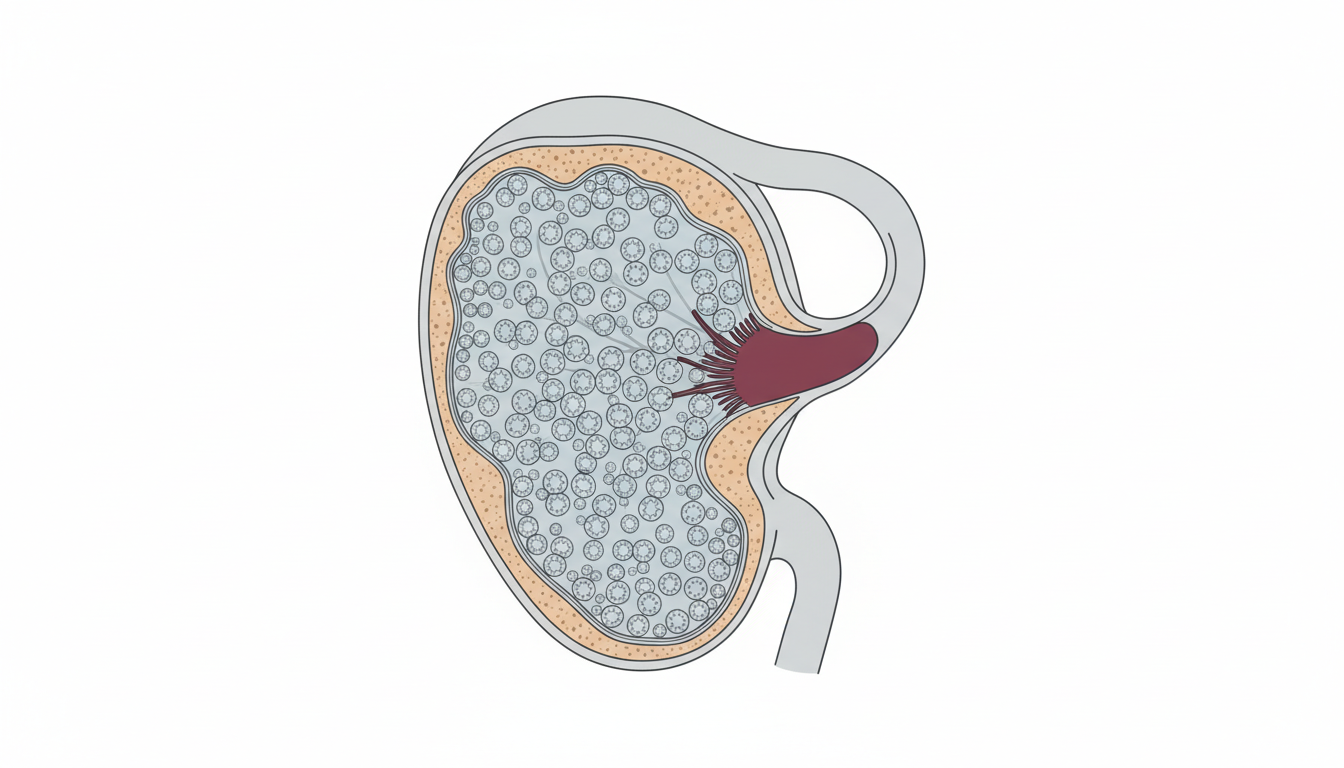
The epididymis sits on the back of each testicle. It is a tightly coiled tube about six meters long when straightened out, where newly produced sperm spend two to three weeks maturing before they can fertilize an egg. When chlamydia or gonorrhea bacteria reach it, the immune response causes swelling, pain, and scarring. Mayo Clinic notes that STI-related epididymitis typically presents with one-sided scrotal pain, swelling, and sometimes a low fever, though many cases are mild enough to be mistaken for a pulled muscle. Onset is gradual, over a day or two, and pain that started in the urethra often shifts to the back of the testicle, with tender swelling along the upper-rear part of the scrotum. The NHS notes the same age split that the CDC describes: in men under 35 the usual cause is an STI such as chlamydia or gonorrhea, while in men over 35 a urine infection becomes the more common driver.
The testicle is where both sperm and testosterone are produced. Sperm production happens in the seminiferous tubules. Testosterone is made by the Leydig cells, which sit in the connective tissue between those tubules. When inflammation from an upstream infection reaches the testicle itself, the result is orchitis, which can cause severe scrotal pain, redness, and, in severe cases, an affected testicle that shrinks and loses function. The prostate can also be drawn in, less commonly, when trichomoniasis or chlamydia tracks into it, producing a deep pelvic ache or discomfort with ejaculation.
The further upstream the infection reaches, the harder the damage is to reverse. Antibiotics can clear the bacteria, but they cannot un-scar a sperm duct that has already healed shut. That is why the CDC recommends prompt testing for any persistent scrotal pain or known exposure, rather than waiting for symptoms to escalate.
Sperm trouble: how fertility takes the hit
Sperm damage from STIs is the single most documented long-term consequence in men. The mechanism is mechanical and biological at once.
Mechanical damage happens when the epididymis or vas deferens scars after inflammation. The duct becomes narrower or fully obstructed. Sperm produced in the testicle have nowhere to go, or they reach the ejaculate in much lower numbers. Bilateral scarring on both sides is the configuration most likely to affect future fertility, since sperm from either testicle still need to make it through to the ejaculate. This is the male equivalent of fallopian-tube scarring in women, and it is why chlamydia and gonorrhea are the two infections most strongly tied to infertility on both sides of a partnership.
Biological damage happens when inflammation in the testicle interferes with the seminiferous tubules where sperm are made. The immune response generates reactive oxygen species that fragment sperm DNA and reduce motility, even when the sperm count looks normal. Peer-reviewed reviews of long-term STI effects on male reproduction have found measurable reductions in sperm count and motility in men with histories of chlamydia or gonorrhea epididymitis, sometimes years after the infection was treated. DNA fragmentation is associated with reduced fertility and with higher early-miscarriage rates regardless of count.
Here is what that looks like on a standard semen analysis, measured against the WHO laboratory manual reference ranges for human semen. Reduced concentration means fewer sperm cells per ejaculate, with the lower reference limit set at around 15 to 16 million per milliliter depending on the edition. Reduced motility means a smaller share of sperm are swimming forward, with roughly 40% or higher showing any movement and around 30% or higher showing progressive movement. Abnormal morphology means a smaller share have a normal shape, with below 4% normal forms considered a fertility risk. Complete obstruction means no sperm reach the ejaculate at all, called azoospermia, of which post-infectious scarring is one cause.
Most men do not notice any of this until they are actively trying to conceive. A standard semen analysis, ordered through a urologist or fertility lab, is the only way to measure these parameters directly. The usual threshold for a full fertility workup is 12 months of unsuccessful unprotected sex, or six months if the female partner is over 35, per NICHD's infertility guidance. If you already have a history of an untreated or late-treated bacterial STI, you can screen for the two infections most likely to be behind it with an at-home chlamydia and gonorrhea test before that timeline even starts.
Testosterone and STIs: the hormone link
The link between STIs and testosterone is real but often overstated online. It works through the Leydig cells in the testicle, the cells that produce more than 95% of a man's testosterone in response to luteinizing hormone (LH) signals from the pituitary gland.
When an STI causes orchitis, the inflammation can damage Leydig cells directly. Cytokines released during infection interfere with the steroid-synthesis pathway that converts cholesterol into testosterone. The temperature inside the scrotum rises during active inflammation, and Leydig cells are sensitive to thermal stress. If scarring follows the acute infection, fewer functional Leydig cells remain, and the affected testicle produces less testosterone permanently. This is a documented effect of mumps orchitis, where bilateral testicular involvement can cause lasting low testosterone in a meaningful minority of post-pubertal cases. Bacterial orchitis from chlamydia or gonorrhea is less likely to cause that kind of dramatic drop, partly because the infection is usually one-sided, and partly because antibiotics can stop the inflammation before extensive Leydig-cell damage occurs.
What this means in practice: men with a history of treated, mild STIs almost always have normal testosterone afterward. Men with a history of severe, untreated, or recurring epididymitis or orchitis carry a higher chance of running below the population average. Total testosterone in adult men is commonly reported on a reference range that runs from roughly 300 to 1,000 ng/dL, and many labs flag a result below about 300 ng/dL for further evaluation. The exact cutoffs vary by lab and by the time of day blood is drawn.
If your sex drive, energy, mood, and morning erections all shifted at roughly the same time, and you have had untreated STI exposures or unexplained scrotal pain in the past, ask a primary-care provider for a morning total-testosterone measurement with LH and follicle-stimulating hormone (FSH), plus a current STI screen at the same visit. The pattern matters more than any single number. Low testosterone with elevated LH points toward primary testicular dysfunction, where the testicle itself is the bottleneck, which is exactly what you would expect after orchitis. Low testosterone with low LH points upstream to the brain. And not every dip in libido is STI-related: sleep deprivation, alcohol use, obesity, and chronic stress drive many low-testosterone readings, and those are usually easier to fix.
The Leydig cells in your testicles produce more than 95% of the testosterone in your body. They sit in the connective tissue between the seminiferous tubules where sperm is made. When inflammation reaches the testicle through an untreated STI, both functions can be affected at once, which is why STI-related changes to testosterone and sperm count often track together rather than appearing in isolation.
Symptoms most men miss
The symptoms that send men to a clinic are usually the dramatic ones: burning urination, visible discharge, or a swollen testicle. The symptoms that get ignored are the ones that quietly do the most damage.
The most common pattern in chlamydia is no symptoms at all. The CDC notes that chlamydia often has no symptoms in either sex, which is the finding that drives most public-health screening recommendations. The infection still progresses up the reproductive tract whether you feel it or not. The second most common pattern is mild, intermittent discomfort that comes and goes: a subtle pelvic ache, a vague pulling sensation in one testicle that you blame on the gym, or a brief sting during urination that disappears within a day or two. Those are easy to read as a strain, prolonged sitting, work stress, or aging, which is exactly why they get dismissed. Mayo Clinic notes that early epididymitis often presents this way, with men describing weeks of low-grade symptoms before any obvious swelling appears.
The single most useful self-check is direction and duration. STI-related testicular ache tends to be one-sided and does not improve with rest over 48 to 72 hours. A pulled adductor muscle or post-sex soreness almost always improves within a day. If the ache is persistent and one-sided, that is the point to test or see a provider.
Subtle signs men tend to overlook
Having one or more of these does not confirm an STI; many have non-STI causes. Only a test can confirm infection. The point is to notice a one-sided, persistent pattern rather than wait for a dramatic symptom.
- Brief stinging or burning during urination that fades within a day or two Common
- A one-sided dull ache or pulling sensation in a testicle that you assume is a strain Common
- Thin or intermittent urethral discharge, clear or yellow (often absent in chlamydia) Common
- Tender swelling along the upper-rear part of one side of the scrotum Less common
- A low-grade fever alongside scrotal discomfort Less common
- A drop in libido or softer erections that does not match the rest of life Less common
- Thinner ejaculate volume, or a sense that one testicle feels heavier, firmer, or smaller Rare
When testicular pain needs same-day care
Most STI-related testicular ache is mild and slow to build. The pattern that needs an emergency department, not a clinic visit, is the opposite: sudden, severe, one-sided pain with nausea, often in a young man, sometimes waking him from sleep. That presentation can be testicular torsion, a surgical emergency in which the spermatic cord twists and cuts off blood supply to the testicle.
Torsion can mimic the louder versions of acute epididymo-orchitis. The crucial difference is the timeline. Bacterial epididymitis builds over a day or two. Torsion arrives suddenly and reaches peak severity within hours. Tissue damage from torsion becomes irreversible after roughly six hours without restored blood flow, which is why same-day evaluation matters. A scrotal ultrasound usually distinguishes the two when the exam is uncertain, but the decision to seek emergency care should not wait for any test.
If pain in the scrotum is sudden, severe, and one-sided, especially with nausea or a hard, swollen testicle, go to an emergency department. If the pain has built gradually over a day or two and feels like a deep ache rather than an acute injury, a same-day clinic visit, or an at-home STI test followed by a clinic visit, is the appropriate route.
Sudden, severe, one-sided testicular pain, especially with nausea, vomiting, or a hard swollen testicle, can be testicular torsion. The window before tissue damage is only a few hours. Do not wait for an at-home test result or a same-week clinic appointment. Go to an emergency department.
When and how to test
Window periods are the single most common reason an early test comes back falsely negative. Each STI has a different period between exposure and reliable detection, because the test technology measures either bacterial DNA, an antigen, or the antibody response to the infection, and each takes a different amount of time to become detectable.
Here are the approximate windows for the infections that matter most to men. Chlamydia is detectable by laboratory NAAT roughly 7 to 14 days after exposure, with lateral-flow rapid swab tests performing best when used at least 14 days post-exposure; the CDC's 2021 STI Treatment Guidelines describe the 14-day mark as the practical threshold for screening. Gonorrhea is similar, with reliable detection around 7 to 14 days. Trichomoniasis typically becomes detectable 7 to 28 days after exposure, with symptoms in men often appearing later than in women and many infections staying asymptomatic; the WHO recorded 156 million new global trichomoniasis infections in 2020, the highest of the four curable STIs it tracks. Our at-home trichomoniasis kit is validated for vaginal self-swab only, so a man who needs a trich-specific test should see a clinic.
HIV depends on the test type. Fourth-generation laboratory antigen-antibody tests detect HIV from about 18 to 45 days after exposure. Rapid at-home antigen-antibody fingerstick tests of the same generation usually need 18 to 90 days for full reliability, because a fingerstick sample is less analytically sensitive than a venous draw run by a lab. The CDC's HIV testing page advises testing again after the window period closes if an initial test is negative. Syphilis antibody tests typically become positive 21 to 42 days after exposure (CDC STI Treatment Guidelines), with confirmation by a treponemal-specific test recommended for any positive result.
A rapid at-home lateral-flow test gives a result in about 15 minutes from a self-collected swab or a fingerstick blood sample, using the same kind of chemistry as a standard pregnancy or antigen test. It is well suited to screening and to ruling out the most common infections quickly. A positive at-home result should always be confirmed by a clinic-administered NAAT before treatment, which is the laboratory gold standard. The two technologies are complementary rather than equivalent: rapid tests trade some analytical sensitivity for speed and privacy. When fertility is the specific concern, a scrotal ultrasound, a semen analysis, and a hormone panel (morning testosterone with LH and FSH) round out the picture, and those run through a clinic or fertility lab rather than at home. If you want a broader single screen, our at-home STI test kits bundle several of these into one box.
| Time since possible exposure | Recommended action |
|---|---|
| Less than 7 days | If symptomatic, see a provider for empiric treatment. Otherwise wait. |
| 7 to 14 days | Test for chlamydia and gonorrhea. Plan to retest at the 28-day mark for completeness. |
| 14 to 28 days | Optimal window for chlamydia and gonorrhea screening. HIV antigen-antibody testing can begin. |
| 28 to 90 days | Full panel including HIV and syphilis becomes reliable. Retest a rapid at-home HIV test at 90 days for full coverage. |
| Persistent symptoms after a negative early test | Retest. Window-period false negatives are the most common error. |
Misconceptions that delay diagnosis
Three beliefs send men to the clinic later than they should, and a fourth makes them think they are covered when they are not. Each rests on the same hidden premise: that a serious infection would announce itself loudly enough to notice. Chlamydia, the most common bacterial STI, reliably proves the opposite, which is why screening based on exposure history beats screening based on how you feel.
Common Misconceptions About STIs and Male Fertility
Myth: It is not an STI unless it burns when I urinate.
Fact: Chlamydia, the most common bacterial STI, frequently causes no symptoms in men per the CDC. Burning urination is one possible sign among several; its absence does not rule infection out, and the bacteria can keep ascending toward the epididymis in the meantime.
Myth: Infertility is the woman's side of the equation.
Fact: Male-factor problems are about as likely as female-factor ones, per NICHD. Low count, poor motility, abnormal shape, or absent sperm all contribute, so a couple's workup that skips the man misses a substantial part of the picture.
Myth: Once I take antibiotics, everything goes back to normal.
Fact: Often it does, especially for early infections. But antibiotics clear the bacteria; they cannot reverse structural changes already in place, such as epididymal scarring, Leydig-cell loss, or testicular atrophy. A semen analysis about three months after treated bacterial epididymitis is the simplest way to confirm recovery.
Myth: I was screened for HIV, so I am covered.
Fact: An HIV test only detects HIV. Chlamydia and gonorrhea, the infections most tied to male fertility damage, need their own test: a self-collected swab at home or a urine NAAT at a lab. A complete screen includes chlamydia, gonorrhea, syphilis, and HIV at minimum.
Recovery and what is reversible
The most important thing to know about STI-related fertility and hormone damage is that the worst-case framing is rarely the actual case. Most men who treat the infection promptly recover normal sperm parameters and normal testosterone within months. The cases that turn into permanent issues are usually the ones where the infection sat untreated for weeks or months, or recurred several times. What recovery looks like depends on what was damaged.
Active infection only, with no scarring yet. Antibiotics matched to the pathogen are the standard of care: typically doxycycline for chlamydia and a ceftriaxone injection for gonorrhea, per current CDC treatment guidance. Symptoms usually improve within days. Semen parameters normalize over the next two to three months as the body completes one full sperm-production cycle, which takes roughly 70 to 74 days. The standard follow-up is to recheck a semen analysis about three months after treated bacterial epididymitis if fertility is a concern.
Resolved infection with mild scarring. Antibiotics still help if any infection remains. Scarring may not fully reverse, though compensatory function from the unaffected side often keeps fertility within normal range. Lifestyle factors like sleep, alcohol intake, weight, and varicocele management matter more from this point on.
Severe scarring or testicular atrophy. Conception may need help. Standard options include intrauterine insemination (IUI), in vitro fertilization (IVF), or, in severe cases, testicular sperm extraction (TESE) combined with intracytoplasmic sperm injection (ICSI). For low testosterone, hormone replacement therapy is an option, though it suppresses sperm production and so has implications for future fertility. A urologist or reproductive endocrinologist sequences those decisions.
If a test is positive, the next step is a clinic visit within a few days for confirmatory laboratory testing and treatment. Most chlamydia and gonorrhea infections are cured with a short antibiotic course. Partner notification matters too: untreated partners can re-infect, which is the most common cause of repeat infections in surveillance data, so notify partners from roughly the past 60 days and avoid sex until the regimen is complete. If a test is negative but you have ongoing symptoms or a high-risk exposure still inside the window period, retesting is the standard next step.
Recovery tiers at a glance
- Active infection caught early: full recovery is typical within two to three months, as the next sperm-production cycle completes.
- Resolved infection with mild scarring: fertility often stays within normal range, and lifestyle factors matter more from here on.
- Severe scarring or testicular atrophy: assisted reproduction (IUI, IVF, TESE-ICSI) and a urology referral handle most cases.
Frequently asked questions
- Can chlamydia really cause infertility in men?
- Yes, but not in every case. Untreated chlamydia is the leading bacterial cause of epididymitis, which can scar sperm-carrying ducts and reduce sperm count or motility. Most men treated promptly have no lasting effect on fertility. Those who develop fertility problems typically had infections that went untreated for weeks or months, or that recurred several times.
- My testicle aches but there is no discharge. Could it still be an STI?
- It can be. Many cases of chlamydia and early epididymitis present with mild one-sided testicular discomfort and no urethral discharge at all. If the ache lasts longer than 48 to 72 hours and is on one side, it is worth testing. Discharge is just one symptom pattern, not a requirement for an STI diagnosis. Sudden severe pain is different and needs emergency evaluation.
- How long after a possible exposure should I wait before testing?
- Chlamydia and gonorrhea: test at the 14-day mark. HIV via rapid at-home fingerstick: reliable from about 18 to 90 days, and the CDC advises retesting after the window closes if an early result is negative. Syphilis antibody tests become positive around 21 to 42 days. Testing early is better than not testing, but a negative result taken before the window closes is not a final answer; plan a retest.
- Can an STI lower my testosterone permanently?
- Bacterial STIs rarely cause permanent low testosterone when treated promptly. The exception is severe untreated orchitis with both testicles involved, which is uncommon. Mumps orchitis is the more documented cause of lasting post-infection testosterone changes. If your levels are low after an STI, treating any active infection comes first, then retest after a few months. A morning testosterone test with LH and FSH helps separate a testicular cause from a brain-pituitary one.
- Can my testicles actually shrink from an STI?
- In rare cases, yes. Severe orchitis, especially when untreated, can cause testicular atrophy, where the affected testicle becomes smaller and produces less sperm and testosterone. This is uncommon and is more likely when an infection is left untreated for a long period or recurs. Prompt treatment of epididymitis is the main protection against progression to atrophy.
- If I treat the infection, does my fertility come back?
- Usually yes, especially when treatment came before scarring. Sperm production renews on a roughly 74-day cycle, so a semen recheck about three months post-treatment is the standard benchmark. If scarring was already present, recovery is less complete, and a urologist can advise on whether IUI, IVF, or sperm-extraction techniques make sense.
- Do condoms fully prevent STIs that affect male fertility?
- Condoms substantially reduce transmission of chlamydia, gonorrhea, HIV, and trichomoniasis when used correctly every time. They do not provide complete protection, since skin-to-skin contact outside the covered area still transmits some infections and breakage happens. Routine testing remains worthwhile for any sexually active person, particularly after a new partner.
- What do I do if my at-home test is positive?
- Take it seriously, but do not panic. Schedule a clinic visit within a few days for confirmatory laboratory testing and a treatment prescription. Most chlamydia and gonorrhea infections are cured with antibiotics, often doxycycline for chlamydia and a single ceftriaxone injection for gonorrhea, per current CDC guidance. Notify any sexual partners from the past 60 days so they can test and treat too, which prevents re-infection. Avoid sex until the treatment course is complete.
Your next step: a single at-home screen
If you had a new partner in the past year, an unprotected encounter, or any of the subtle signs above, a single at-home screen covering the infections most likely to affect male reproductive health is a practical next step. An 8-in-1 panel handles the bacterial STIs linked to epididymitis (chlamydia, gonorrhea, syphilis) and the blood-based screens for HIV, herpes, and hepatitis B and C in one box. Standard delivery in the United States runs one to five business days, and packaging and billing descriptors are plain, so a partner, parent, or roommate does not see the product on the box or the statement. The whole at-home process takes about 20 minutes from opening the box to reading the result.

- U.S. Centers for Disease Control and Prevention. Sexually Transmitted Infections Treatment Guidelines, 2021. Source for chlamydia and gonorrhea testing windows, the syphilis antibody window, epididymitis as the leading bacterial complication in men under 35, and doxycycline and ceftriaxone treatment regimens.
- U.S. Centers for Disease Control and Prevention. HIV testing. Source for fourth-generation antigen-antibody window periods (laboratory 18 to 45 days; rapid fingerstick 18 to 90 days) and the advice to retest after the window period closes.
- Mayo Clinic. Epididymitis. Source for one-sided scrotal pain, swelling, and the typical mild presentation that delays diagnosis.
- NHS. Epididymitis. Source for the age split: STIs such as chlamydia or gonorrhea as the usual cause under 35, and urine infection as the more common cause over 35.
- World Health Organization. Sexually transmitted infections (STIs) fact sheet. Source for 2020 global incidence figures, including 156 million trichomoniasis, 129 million chlamydia, and 82 million gonorrhea cases.
- Eunice Kennedy Shriver National Institute of Child Health and Human Development. Infertility overview. Source for the parity of male-factor and female-factor causes and the recommended evaluation timeline.
