
Published: July 2025 | Last updated: May 2026 | Editorial review and quality control: Martina N.
Why does an STD diagnosis still feel so personal?
STD stigma was built over centuries through moral panic, religious framing, and gendered public-health laws that treated infection as proof of bad character. The shame people feel today is the residue of that history. Routine testing is preventive care, not a confession, and most STIs are curable or manageable with treatment.
The hardest part of an STD diagnosis often isn't the infection. It is the silence that follows, when telling a partner or a friend stretches from one quiet evening into weeks of carrying something alone, because somewhere along the way you absorbed the idea that having an STI says something about who you are.
That idea is wrong, and it did not start with you. Centuries of moral panic, religious framing, military policy, and tabloid coverage built a cultural reflex that treats sexual-health infection as evidence of personal failure. Sexually transmitted infections are among the most common medical conditions on the planet, and most are either curable or manageable with treatment. What makes them feel different is stigma, and stigma can be unlearned. This guide walks through where the shame was built, what it costs at the personal and public-health level, and how to step out of the spiral with information, honest conversation, and a plan for testing on your own terms.
Key Takeaways
- Shame, more than the infection itself, is what most people describe as the hardest part of an STD diagnosis, and the fix is information and honest conversation in place of silence.
- STIs are common in adults of every demographic, per the CDC. Most are curable or manageable with treatment, and a positive result tells you nothing about your worth as a partner or a person.
What the shame spiral really is
Shame is not the same as guilt. Guilt says, I did something I regret. Shame says, I am the regrettable thing. That single shift is what makes an STD diagnosis sit so heavily for so many people. A treatable infection becomes a verdict on character, and the verdict triggers a loop that is hard to interrupt without help.
Researchers describe the loop in roughly four steps: a trigger (a positive result, an exposure, even just booking the appointment), a thought (people will think I am dirty), an emotion (shame, panic, isolation), and a behavior (silence, withdrawal, avoiding follow-up). Each step feeds the next. Silence reinforces the belief that the diagnosis is unspeakable, which deepens the shame, which produces more silence.
The CDC documents HIV-related stigma as a direct obstacle to testing, status disclosure, and entry into care (CDC: HIV stigma and health equity), and the same pattern shows up across other STIs. People skip clinic visits because they are afraid of being seen. Many delay disclosure for fear of being left. Some put off treatment because the act of being treated feels like a confession. None of that reflects a character flaw. Each is a predictable response to messaging about sex absorbed long before any diagnosis appeared.
If you landed here out of worry rather than after a diagnosis, this paragraph is for you. Most STIs are common, often without symptoms, and either curable or manageable with treatment. A worry spiral is just that, a spiral, and what interrupts it is information. Reading the rest of this article is one useful step. Booking a clinic appointment, or ordering an <a href="https://www.stdrapidtestkits.com/combo-std-home-test-kits">at-home STI test kit</a> on your own time, is another. Neither involves shame, and neither defines who you are.
Where the blame was built: centuries of moral framing
Sexually transmitted infections are older than the cultures that judge them. Egyptian, Greek, and Roman physicians described conditions that read today as gonorrhea, chlamydia, and syphilis. Without microscopes or germ theory, ancient writers blamed the symptoms on gods, witches, or what they called diseases of Venus. Bacteria and viruses were doing the actual work, but moral framing got there first.
By the late 15th century, syphilis swept across Europe under the name the Great Pox. Treatments were often as cruel as the disease, including weeks of mercury rubs that poisoned patients while doing little for the infection. The naming alone shows how blame traveled: the French called it the Neapolitan disease, the Italians called it the French disease, the Russians called it the Polish disease. Each label pointed at a neighbor, and sex workers, foreigners, and women living outside conventional households were treated as living vectors of national contamination.
By the 19th century, public-health authority grew teeth. In England, the Contagious Diseases Acts of 1864 to 1869 let police detain any woman they suspected of being a sex worker; a forced examination that found gonorrhea or syphilis could mean months in a hospital, while the men who used those women were rarely questioned. The United States imported the logic during wartime, detaining women near military bases under vague ordinances. The 20th century deepened the harm with state experimentation: the U.S. Public Health Service study of untreated syphilis in Black men at Tuskegee ran from 1932 to 1972, withholding penicillin for decades after it became the standard cure (CDC: Tuskegee historical record). The mistrust those studies seeded in Black and Latinx communities still shapes who walks into a clinic today and who does not.
| Era | STD policy or social response | Primary target of blame |
|---|---|---|
| 1500s to 1700s | National blame games: the French disease, the Neapolitan disease, the Polish disease | Women, foreigners, sex workers |
| 1800s | Contagious Diseases Acts and forced exams of suspected sex workers | Unmarried women, suspected sex workers |
| 1932 to 1972 | Tuskegee study withholds syphilis treatment from Black men for 40 years | Black communities, with a lasting legacy of medical mistrust |
| WWI and WWII | Military testing and posters blaming women for soldiers' infections | Women blamed for male infections |
| 1980s | HIV and AIDS panic, anti-gay rhetoric, hospital and funeral-home refusals | Gay men, drug users, immigrants, sex workers |
How the AIDS crisis reshaped stigma for the modern era
It is impossible to discuss STD shame without naming the early HIV and AIDS epidemic. In 1981, the first U.S. cases were reported in young gay men in Los Angeles and New York. The federal response was slow, the news coverage was hostile, and the framing was almost immediately moral. Headlines branded it the gay plague. Politicians debated quarantine. Doctors and dentists refused care, funeral homes refused bodies, families hid diagnoses, and many people died alone.
By the time epidemiologists understood that HIV could pass through blood, breast milk, or sexual contact regardless of who someone was, the moral narrative had set hard. Decades after combination antiretroviral therapy turned HIV into a manageable chronic condition, the virus still carries more social shame than many illnesses with a similar long-term outlook. The CDC documents that this stigma directly discourages testing, disclosure, and entry into care, which keeps transmission going (CDC: HIV stigma and health equity).
Two clinical realities deserve to sit against that history. Laboratory fourth-generation HIV tests can detect infection by about 45 days after exposure, and at-home rapid antibody tests are most reliable from about 12 weeks onward. And the principle written in shorthand as U=U, undetectable equals untransmittable, means people living with HIV who keep an undetectable viral load on treatment do not transmit the virus through sex.
HIV stigma can also discourage people from getting tested, sharing their status, and accessing HIV services.
What silence quietly costs us
The bill for STD stigma does not arrive as a single line item. It shows up across testing rates, partner-notification follow-through, mental-health outcomes, and reinfection cycles. Many new infections come from people who did not know they were carrying anything, because most common STIs are silent in their early stages (CDC: about STIs). When the felt cost of being seen at a clinic is higher than the cost of staying sick, people stay sick.
Most people who avoid testing are not avoiding the test. They are avoiding what a positive result might say about them: a receptionist's flicker of judgment, a partner's accusation, a self-portrait labeled careless. The avoidance loop has a recognizable shape. Someone notices a symptom or remembers an exposure, searches the internet, and talks themselves into irritation, ingrown hairs, or stress. They wait until after a trip or a relationship milestone. By the time they test, a partner may already be exposed, or the infection may have progressed. That is not irresponsibility. It is fear, fed by a culture that treated infection as a confession for centuries. The table below shows how the spiral compounds across four common situations.
| Situation | Stigma-driven response | Health impact |
|---|---|---|
| Symptoms after unprotected sex | Delays testing for weeks out of fear of judgment | Infection spreads unknowingly and symptoms worsen |
| Positive chlamydia result | Avoids notifying past partners; goes quiet on dating apps | Partners stay untreated and reinfection risk climbs |
| Herpes diagnosis | Internalizes shame and pulls back from dating | Higher rates of depression, isolation, and anxiety |
| First positive HIV result | Delays starting antiretroviral therapy out of denial | Worse long-term outcomes and higher transmission risk |
How stigma lands differently across communities
STD shame is not evenly distributed. It piles onto people who already carry social weight, and how it shows up depends on the community, the cultural context, and the specific diagnosis. None of the patterns below are personal failures. They are social patterns, which means they respond to social fixes: peer support, community-specific education, clinicians trained in stigma-aware care, and spaces where people can speak about their experience without spending the first ten minutes defending themselves.
| Community | Common stigma pattern | Compounding factor |
|---|---|---|
| Young women | Labeled promiscuous or damaged after a positive test, even with a short partner history | Cultural scripts blame women for sexual outcomes more readily than men |
| Men who have sex with men | Dating-app rejection on disclosure; the lingering weight of HIV-era stigma | Persists despite advances like PrEP (a daily HIV-prevention medication) and the U=U consensus |
| Black, Latinx, and immigrant communities | Layered medical, religious, and cultural stigma | Distrust of institutions that caused historical harm, including the Tuskegee legacy, leading to later testing |
| Non-monogamous and polyamorous people | Pre-judged by clinicians and partners despite rigorous safer-sex habits | Hyper-responsibility shows up as constant overexplanation rather than relaxed honesty |
The mental-health fallout we do not talk about enough
There is no diagnostic code for STI-related shame. Its symptoms are documented across the literature anyway: heightened anxiety in the weeks after diagnosis, intrusive rumination about how partners will react, disrupted sleep, and low mood tied to a feared loss of romantic future. For many people, the emotional load outlasts the physical infection.
The heaviest load tends to fall on people whose diagnosis is lifelong, such as HSV-2 or HIV, whose support is thin, or whose communities attach extra moral weight to sex. The WHO and CDC both name stigma as a barrier to care, and qualitative research on STI-related shame fills in the lived detail the headline numbers leave out. Antibiotic prescriptions are easy to write. Rebuilding self-image is the part that usually goes untreated.
What clinicians describe looks closer to grief than to a clean acute illness. There is shock, sometimes anger, often self-blame, then slow integration. People grieve the version of themselves who did not have to think about this, the romantic futures they assumed, and the easy sense of control they had before the result. Grief like this is an expected reaction to a real life event rather than an overreaction. The most useful interventions are also the most ordinary: accurate information about your specific diagnosis, one safe person to tell, and peer support that matches your context.
STIs have a direct impact on sexual and reproductive health through stigmatization, infertility, cancers and pregnancy complications and can increase the risk of HIV.
Why the words we use still carry blame
The vocabulary around STIs gives the whole thing away. People say clean to mean a negative result, which quietly casts anyone with a positive result as dirty. We do not talk this way about strep throat, the flu, mono, or shingles, several of which are infectious and intimately transmissible. The stigma also refreshes itself in places we barely notice: herpes is still a sitcom punchline, films use an STI as shorthand for poor judgment, abstinence-only sex education leans on fear rather than screening, and dating-app bios advertise DDF (drug- and disease-free) or filter for clean only. A single judgmental clinician encounter can cement years of avoidance.
Language shapes what feels sayable. I tested negative is a clinical fact; I am clean invites the listener to grade the speaker as a person, and once that frame is on the table, both people feel it. A few swaps carry the same information without the moral overlay: I was recently tested instead of I am clean; I have HSV-2 and manage it with suppressive therapy instead of I have a secret; a routine STI screen instead of getting checked because I might be sick.
Public-health communicators increasingly recommend dropping clean and dirty from sexual-health vocabulary altogether. The shift is small, but it changes the temperature of a conversation, and blame-free materials can make first-time testers more comfortable coming back. The CDC's <a href="https://www.cdc.gov/sti/php/communication-resources/index.html" target="_blank" rel="noopener noreferrer">communication resources</a> offer ready-made materials built around the same stigma-neutral language.
Dating and disclosure: the rejection trap
The single biggest fear most people describe after a stigmatized diagnosis is the disclosure conversation. The mental movie plays as a hard rejection, where a partner recoils, leaves, and tells other people. Real-life disclosure is consistently gentler than that movie. Most partners respond with a question or two and then carry on, and a meaningful share will tell you they have a condition of their own.
A few things tend to make disclosure go well. Pick your moment before any sexual contact, somewhere private and calm. Lead with facts before feelings: I have HSV-2, it is common, I take suppressive antivirals daily, and I am telling you so you can make an informed choice. Have answers ready for the obvious questions about transmission, treatment, and precautions, because knowing your own facts is what steadies the room. And accept that the right people will not run; a cruel reaction is information about them, and the next conversation will go better. Online communities such as PositiveSingles, condition-specific forums, and several support subreddits exist to take the disclosure question off the table by matching people with similar diagnoses.
One note on the products mentioned in this guide: stdrapidtestkits.com sells at-home STI tests, and the kits here are included where they fit the topic, never as a substitute for follow-up care with a clinician.
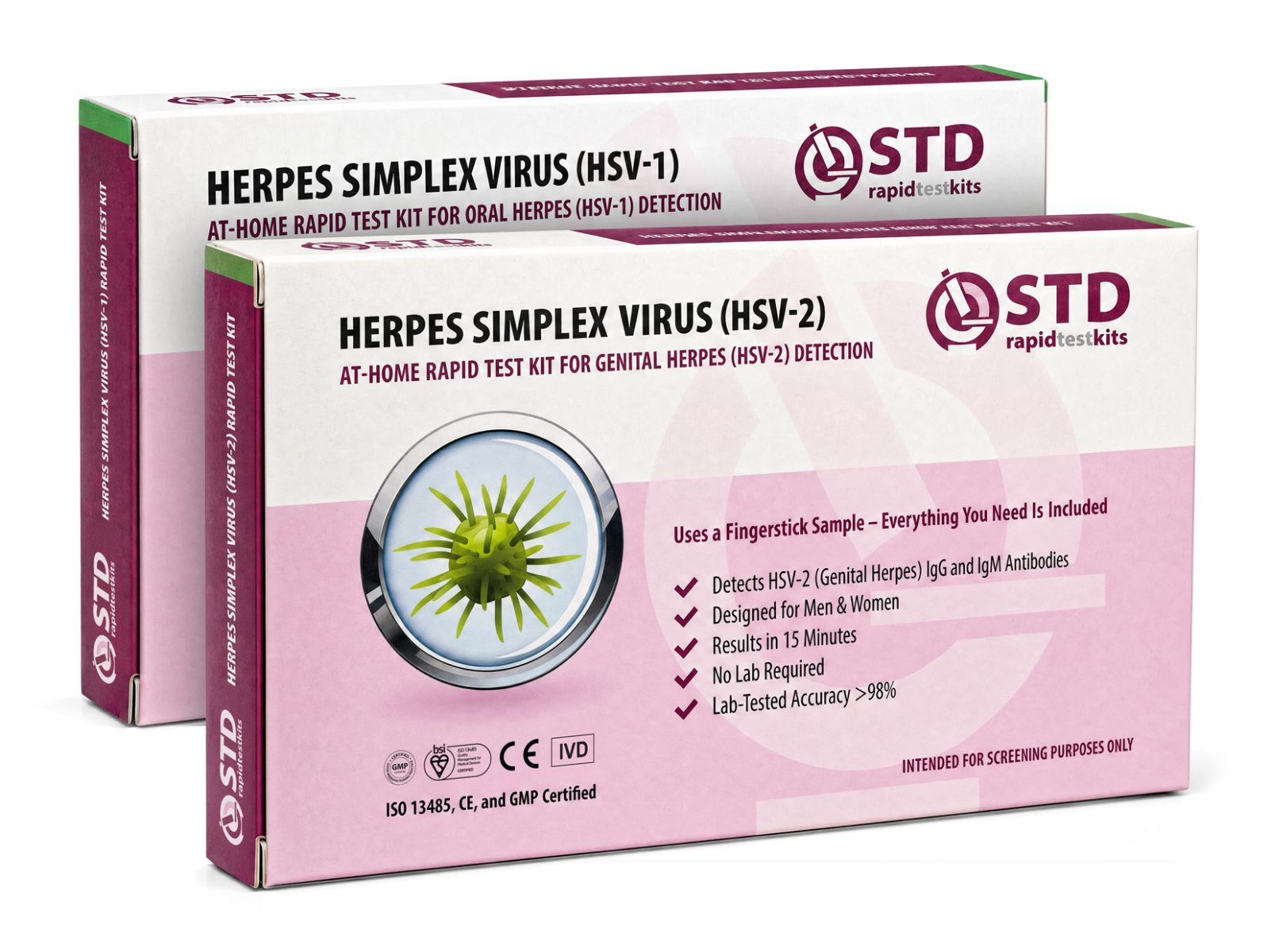
A quieter way to start: at-home testing among your options
For most of the 20th century, getting tested meant walking into a public clinic, sitting beside someone you hoped you did not recognize, and filling out forms that read like an accounting of your choices. That picture is still what many people imagine. The reality now is wider. Primary-care doctors order routine panels, telehealth services prescribe and ship treatment, and at-home rapid kits cover the common bacterial infections, the major bloodborne ones, and herpes antibody screening without an in-person visit.
At-home rapid tests use lateral-flow chemistry, the same format that made COVID home tests familiar. They are screening tools, not laboratory NAATs, so they sit alongside clinic testing rather than replacing it. A negative result on a properly timed at-home test is reassuring; a positive result is a starting point worth confirming with a clinic NAAT or follow-up bloodwork. Their real strength is lowering the cost of starting: a flat upfront price with no copay, no waiting room, and no front desk to explain yourself to, which is exactly what stigma makes hardest. People with active symptoms, a recent high-risk exposure, or a pregnancy are still better served by a clinician who can examine, diagnose, and treat in one visit. The on-ramp now has several lanes, and the quietest one gets some people testing who would otherwise wait years.
| Barrier to testing | Rooted in stigma? | What at-home testing changes |
|---|---|---|
| Fear of being seen at a clinic | Yes, fear of being marked as risky | Private collection at home in discreet packaging |
| Embarrassment describing symptoms | Yes, internalized shame | No need to describe symptoms to a stranger |
| Worry about a partner's reaction | Yes, blame myths around transmission | Test quietly first, then disclose with confidence |
| Distance from a clinic or limited hours | Partly, geography plus avoidance | Test on your own schedule with no appointment |
| Past medical mistrust | Yes, a history of coercive public-health policy | You control the whole process from order to result |
How to step out of the shame loop
You cannot reason your way out of shame in a single afternoon, but you can interrupt the loop in concrete ways, and each interruption makes the next one easier. Replace fear with information by reading about your specific diagnosis from neutral sources such as the CDC's about-STIs page, the NHS overview, or MedlinePlus. Tell one safe person, not everyone and not yet, because shame thrives in isolation and a single supportive response cuts it down noticeably. Find peer experience in forums and groups for HSV, HIV, or HPV, where people have already walked through the conversation you are dreading. Make testing routine, scheduled like a dental cleaning, so results stop carrying an all-or-nothing weight. And watch the language you use about yourself; I have a managed condition is a more accurate self-description than I am damaged.
Over time the spiral loses its grip, and the diagnosis becomes one fact about you among many.
What to do next if a result is positive
A positive result is information you can act on, and nothing more than that. It says nothing about your character or your worth as a partner. Most STIs are either fully curable with a course of antibiotics, including chlamydia, gonorrhea, syphilis, and trichomoniasis, or manageable with antiviral medication, including HIV, HSV-1, HSV-2, and hepatitis B. Early treatment shortens the infectious window, prevents complications, and protects future partners. The order of steps is the same whichever infection is involved.
If a result is positive, the order of steps
- Confirm an at-home result with lab testing through primary care, urgent care, or a sexual-health clinic.
- Start treatment as prescribed, finish the full course, and avoid sex until your provider clears you.
- Notify recent partners so they can test, using anonymous partner-notification services through the local health department if a direct conversation feels too hard.
- Retest at the interval your provider recommends to confirm clearance or to monitor an ongoing condition.
Common myths that keep the spiral spinning
Misinformation is the fuel for stigma. A few durable myths, paired with what the evidence actually says:
Myth: only people with many partners get STDs. A single encounter can transmit most STIs. Risk tracks behavior and protection more than partner count, and plenty of people are diagnosed inside long-term monogamous relationships.
Myth: a positive result means you will be alone forever. Surveys of partnered people living with HSV-2, HIV, and HPV consistently show stable, satisfying relationships. A diagnosis changes how you talk with partners; it does not make you unlovable.
Myth: a positive result means your partner cheated. Many infections sit dormant or silent for months or years before a test picks them up, so a new positive does not, on its own, prove recent infidelity. The conversation is worth having; an automatic accusation rarely is.
Myth: a standard panel tests for everything. It does not. HSV is usually left off default panels unless you ask, and HPV screening for women runs through cervical cancer screening rather than a standard STI check. Confirm which infections are included before assuming a panel covered them all.
Myth: at-home testing is not reliable. Reputable rapid lateral-flow kits perform well as screening tools when used after the relevant window period. They are not a replacement for confirmatory lab testing on a positive result, and they are a genuine first-line option for privacy and access, with any positive worth confirming through a clinic NAAT.

How the culture is slowly changing
The silence is cracking, slowly. Public-health campaigns have moved away from fear toward language that frames testing as routine self-care. Several dating apps now show optional testing-status badges. Sex educators on social platforms talk openly about herpes, HPV, and HIV without the moral framing older media used. PrEP for HIV prevention and the HPV vaccine, recommended routinely through age 26 with shared clinical decision-making through age 45, have shifted parts of the conversation from punishment to prevention.
Change mostly happens in small acts. A friend says I got tested last week without lowering their voice. A partner says I have herpes early in a relationship and is met with curiosity instead of horror. A parent answers a teenager's question about sexual health without flinching. You did not create the stigma, and you do not have to keep passing it on. Routine testing, plain language, and treating sexual health like dental health are how the next generation inherits less of it.
Public-health campaigns that frame testing as routine care, open conversations among friends and partners, and clinical advances like PrEP, U=U, and the HPV vaccine are each moving parts of the conversation from punishment to prevention. Ordinary people, in ordinary moments, carry most of that weight, far more than any single campaign or headline.
Not sure whether to test, or how?
If you have read this far and are weighing your options, the path forward usually comes down to a couple of practical questions. Work through the quick guide below, then take the step that fits your situation.
Should you test, and which route?
Do you have symptoms right now, a recent high-risk exposure, or a pregnancy to consider?
Yes: See a clinician who can examine, diagnose, and treat in a single visit. That route is fastest when something already feels wrong, and it covers sample types a home kit does not.
Has enough time passed since any exposure to clear the window period, roughly two weeks for bacterial swabs and about twelve weeks for HIV and herpes antibodies?
Yes: A private at-home rapid screen is a reasonable way to start, and you can confirm any positive result with a clinic NAAT or follow-up bloodwork.
No: Wait until the window passes and then test, or ask a clinician about earlier lab options such as an HIV NAT.
Guidance only. A healthcare provider can advise based on your specific situation.
FAQs
- Why does an STD diagnosis affect my mental health if my body feels fine?
- Anxiety, depression, and shame are well-documented responses to an STI diagnosis even when the infection is mild or silent. The mental load often comes from internalized stigma rather than the disease itself, which is why information, peer support, and honest conversation help so much.
- I keep feeling gross after testing, even when the result was negative. Why?
- That feeling is internalized stigma showing up. Your body did the responsible thing by getting screened. The discomfort is leftover messaging about sex that you absorbed long before you walked into the clinic, and it fades with practice and with normalizing routine testing.
- Does an STD diagnosis mean my partner cheated?
- Not automatically. Some infections stay quiet for years, so a new positive may reflect an older exposure neither partner knew about. Have the conversation, and do not read the result on its own as proof of infidelity.
- Is it normal to cry after a positive result?
- Yes. Emotional overwhelm is a normal response to a health scare combined with anticipated social risk. Plenty of people grieve briefly after a positive test even when the medical outlook is excellent. Give yourself the patience you would give a friend in your chair.
- Can I have a normal dating life after a herpes diagnosis?
- Yes, and many people say their dating life becomes more honest and communicative afterward. Suppressive antiviral therapy, condoms, and clear conversation reduce transmission risk substantially, and plenty of people with HSV-2 are in long-term partnerships, including with HSV-negative partners.
- How do I tell a new partner I have an STI?
- Pick a calm, private moment before any sexual contact. State the facts: which condition, how you manage it, what precautions you take. Skip the apology framing. People who matter respond with questions rather than horror, and anyone who walks away after honesty is saving you a longer disappointment later.
- Will every STI show up on a standard test panel?
- Ask for a full panel, not the default. Most routine screens cover chlamydia, gonorrhea, syphilis, and HIV, then stop. HSV usually appears only if you request it, often as an add-on with its own cost, and HPV for women comes through cervical cancer screening rather than a standard STI check. Confirm in writing which infections are included before you leave the clinic or order a kit.
- Why is STD stigma still a thing in 2026?
- Because shame is durable. It travels through fear-based sex education, awkward parental silence, hostile media history, and the casual vocabulary of dating culture. It changes when ordinary people, in ordinary conversations, treat testing as routine. Changing the culture is slow work, and ordinary conversations are where most of the movement happens.
- U.S. Centers for Disease Control and Prevention. About sexually transmitted infections: prevalence, testing guidance, and overview of common STIs.
- U.S. Centers for Disease Control and Prevention. STD stigma and communication resources, including stigma-aware language materials for public-health programs.
- U.S. Centers for Disease Control and Prevention. HIV stigma and health equity, including the discouraging effect of stigma on testing, disclosure, and entry into HIV services.
- U.S. Centers for Disease Control and Prevention. The U.S. Public Health Service Untreated Syphilis Study at Tuskegee, historical record and ethical aftermath.
- World Health Organization. Sexually transmitted infections fact sheet covering global prevalence, transmission, and the role of stigma in care access.
- NHS. Overview of sexually transmitted infections, including testing, treatment, and confidentiality of clinic services.
