
Published: October 2025 | Editorial review and quality control: Martina N.
An at-home HPV rapid test result feels deceptively simple. One line, two lines, faint line, no line. The cassette stays the same shape; the meaning behind those lines depends on a chain of decisions you made before, during, and after the swab. Most of the confusion that drives people back to Reddit threads after a home test isn't a flaw in the chemistry. It's the gap between how the test works and how the result gets read.
This guide walks through how the rapid HPV cassette performs in real-world use, when to test for the most reliable read, what a faint line really signals, and when to confirm a result with a clinic-based Pap or HPV co-test.
How accurate are HPV rapid tests?
At-home HPV rapid tests typically report sensitivity in the mid-80s to mid-90s percentage range and specificity in the high 80s to high 90s when used correctly and within the right window after exposure. The single biggest reason for an inaccurate result is testing too soon, generally less than 8 weeks after a possible exposure. Treat any visible test line during the reading window as a preliminary positive, then confirm with a clinic Pap smear or lab HPV test.
Key Takeaways
- Wait at least 8 to 12 weeks after a possible exposure before swabbing. Testing earlier is the single most common reason at-home HPV results come back falsely negative.
- Any visible test line during the reading window counts as a preliminary positive, even if faint. The next step is a clinic Pap smear or lab HPV test for confirmation, not panic.
How HPV rapid tests work, and what they actually detect
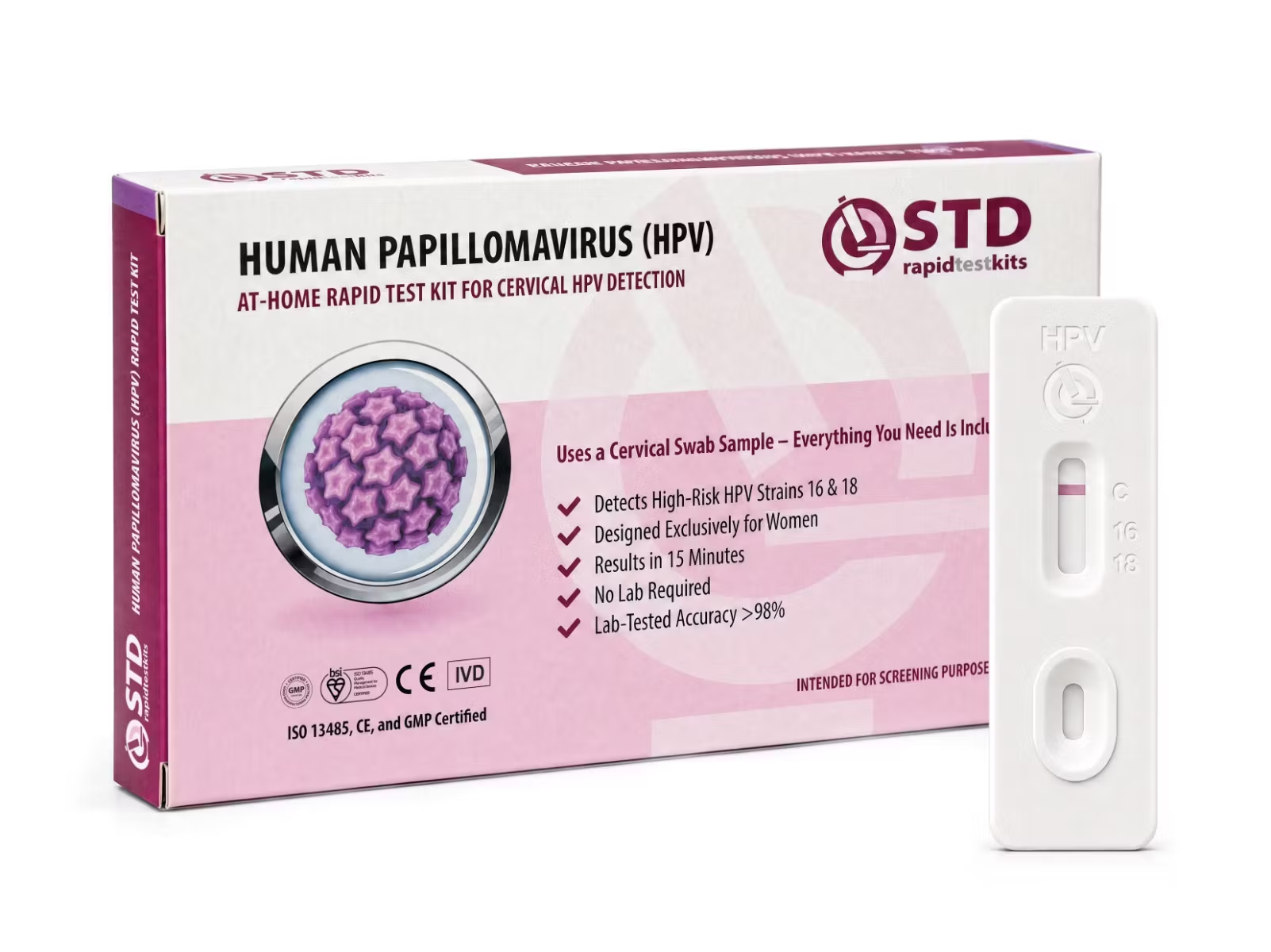
An at-home HPV rapid test screens for high-risk HPV genetic material in a self-collected vaginal sample. The kit gives you a swab to insert and rotate to reach cervical cells, a buffer tube the swab is soaked into, and a lateral-flow cassette that runs the chemistry. You wait roughly 15 to 20 minutes and read whichever lines appear in the result window.
The chemistry is closer to a pregnancy or COVID rapid test than to a lab PCR machine. Lateral-flow strips use antibodies or DNA probes attached to colored particles. When viral material in your sample binds those probes and gets caught at the test line, a colored band appears. Two lines means binding plus a successful run. One line, the control band only, means the test ran but didn't detect the target. A blank cassette means the run failed.
Two facts about the technology are worth knowing before you read a result.
First, lateral-flow tests target high-risk strains. Most home HPV cassettes are built to detect the strains most strongly linked to cervical cancer, including HPV-16 and HPV-18. Per the World Health Organization's fact sheet on HPV and cervical cancer, those two high-risk types together drive most cervical disease worldwide. A negative on a high-risk panel doesn't rule out a low-risk strain that causes warts, and a positive doesn't tell you which specific high-risk strain you have without lab genotyping.
Second, our at-home HPV swab is validated for vaginal self-collection only. If you don't have a vagina or cervix, this product isn't the right tool. A clinic visit (anal Pap, oropharyngeal exam, or urethral sampling depending on the concern) is the appropriate path.
Lab HPV tests use a different technology entirely. Hospital and OBGYN labs run nucleic-acid amplification (NAAT) or DNA hybrid-capture assays that amplify the viral DNA before reading it. That extra amplification step is why lab tests reliably detect lower viral concentrations. The two technologies serve different roles in cervical screening, and clinical guidelines use them together rather than as substitutes.
The at-home cassette gives you a fast, private screening read at moderate viral concentrations. The lab NAAT test amplifies viral DNA chemically, which lets it detect lower concentrations and identify the specific HPV strain. They answer related questions at different sensitivity levels, which is why a positive home test usually leads to a lab confirmation rather than replacing it.
How accurate are HPV rapid tests, really?
Sensitivity, specificity, and "accuracy" mean different things, and the headline number on a product box rarely tells the full story. Sensitivity is the share of truly infected people the test correctly flags; if a test has 90% sensitivity, it misses 1 out of 10 true cases. Specificity is the share of truly uninfected people the test correctly clears; a 95% specificity test wrongly flags 5 out of 100 healthy people. A single "99% accurate" claim usually blends the two and obscures whichever one is weaker.
Performance data from HPV self-sampling validation studies generally find rapid lateral-flow tests fall in the mid-80s to mid-90s percentage range for sensitivity and the high-80s to high-90s for specificity, varying with the assay, the reference standard, and how well the user followed instructions. Lab HPV NAAT and hybrid-capture tests sit higher because they amplify viral DNA before measuring it.
| Test type | Typical sensitivity | Typical specificity | Best use case |
|---|---|---|---|
| Lab HPV NAAT or hybrid capture | ~95–99% | ~95–98% | Clinic screening, follow-up, surveillance after abnormal Pap |
| Rapid at-home HPV (lateral flow) | ~85–95% | ~90–98% | Private at-home screening, post-exposure check, between-clinic-visit testing |
Timing is everything: the HPV window period trap
HPV doesn't show up in your sample the moment a partner transmits it. The virus has to enter cells, replicate, and reach a concentration the test can detect. That replication is slower than for bacterial infections like chlamydia. HPV often persists without obvious signs for months or years before any cell-level change becomes detectable on a Pap smear, and the screening window for the rapid cassette opens earlier than that, once viral DNA has accumulated to the assay's detection threshold.
The "window period" is the time between exposure and when a test becomes reliably accurate. The "incubation period" is how long until symptoms appear, and most HPV infections never produce symptoms at all. Confusing the two leads people to test too early and trust the result too much.
| Time after possible exposure | What the result usually means |
|---|---|
| 0 to 7 days | Result is not meaningful. Virus is almost certainly below the detection limit. |
| 8 to 21 days | Some early infections start to show. A negative still warrants a follow-up test. |
| 22 to 56 days | Detection is improving but a negative is not yet airtight. |
| 8 to 12 weeks | Most reliable window for at-home rapid HPV testing. A clear negative here is meaningfully reassuring. |
The most common timing mistake
The common scenario goes like this: a condom slipped or a new partner just disclosed an exposure, the worry is loud, the swab gets used five days later, the result is negative, and the worry is filed away. A month later the original concern reappears with discharge or an abnormal Pap, and the early negative now feels like a betrayal.
Eight or nine weeks of additional replication time would have produced more viral DNA than the test could detect from the earlier swab. The early result accurately reflected the concentration present on that day, not the infection's status weeks later.
If you can wait, wait. Eight to twelve weeks post-exposure is the window most clinicians recommend for at-home rapid HPV testing. If you can't wait, treat the early result as preliminary and plan a retest at the 8 to 12 week mark.
This site sells the at-home HPV rapid test described in this article. Recommendations are based on fit-for-purpose for the reader's concern, not commercial benefit.
Swab between weeks 8 and 12 after a possible exposure when you can. That is when viral DNA in cervical cells reliably reaches a concentration the rapid lateral-flow chemistry can detect. An earlier swab isn't wrong on the day it's taken, just incomplete; a clear negative becomes meaningfully reassuring once you're past the 8-week mark.
The biggest accuracy killer is user error, not the chemistry
Observational studies of at-home self-sampling consistently find that a meaningful share of users skip or fumble at least one step. Estimates vary by assay and population but commonly land somewhere around a quarter to a third of first-time users, especially when instructions arrive in dense small print without illustrations.
The mistakes that most often distort an HPV rapid test result tend to cluster:
- Swab depth and rotation. The swab needs to reach and rotate against cervical tissue to pick up enough cells. A shallow swab or a single quick pass undercollects sample, making low-level infections invisible to the chemistry.
- Pre-test contamination. Rinsing the swab with water, douching within 48 hours, intercourse within 24 hours, or testing during heavy menstrual flow can dilute or interfere with the sample. None of these guarantee a wrong result; all of them raise the odds.
- Buffer handling. Shaking the buffer vial when the instructions say to swirl. Adding too few or too many drops to the cassette. Reusing or double-dipping a swab out of sequence. The chemistry expects a specific concentration, and deviation matters.
- Read time. Reading the cassette too early misses lines that haven't fully developed. Reading it too late, after the 15 to 30 minute window depending on the kit, lets evaporation lines and dye pooling create false positives.
- Storage. A test kit left in a hot car or used past its expiration date can degrade chemically before you even open the pouch.
Better results come from slower, more careful execution: reading the instructions twice, setting a timer, testing in even daylight or under a neutral lamp, and not improvising any step the box doesn't describe.
What that faint line might mean (and what it doesn't)
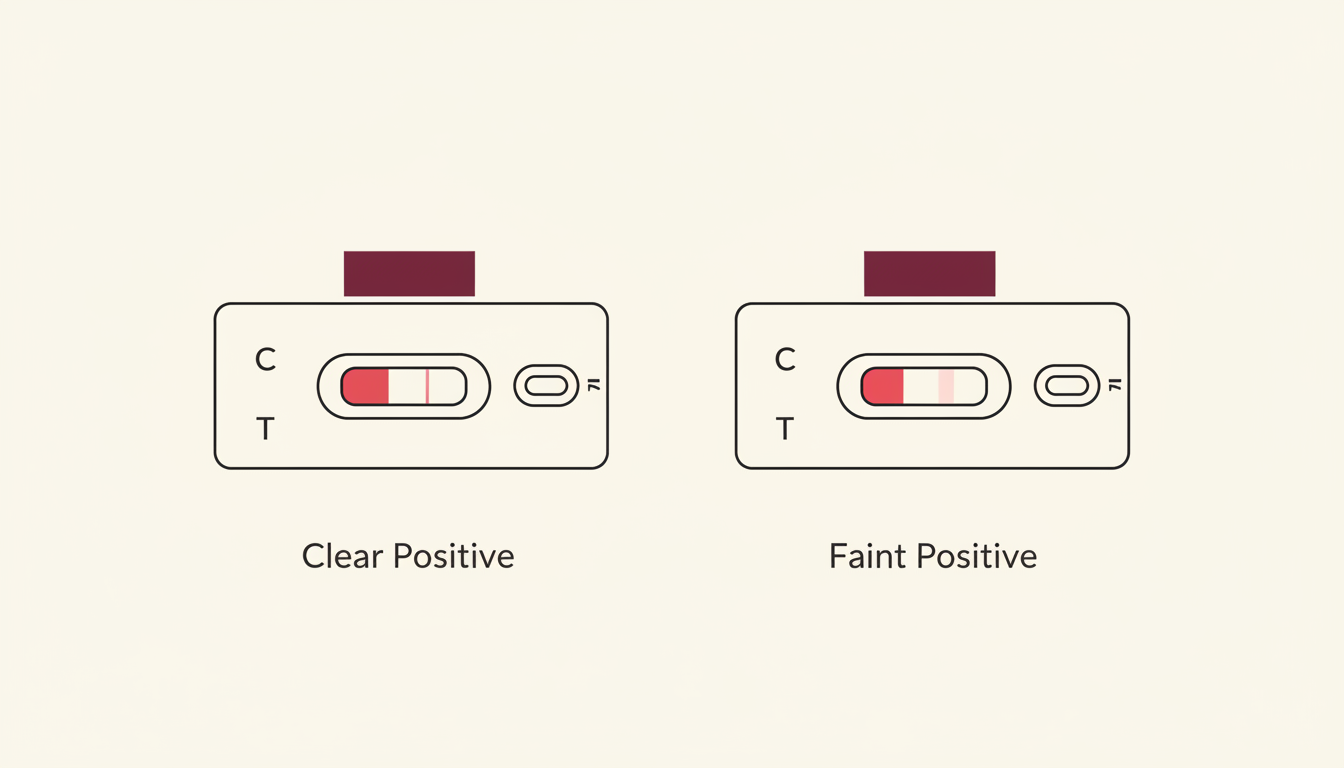
Faint lines are the most stressful at-home test result to live with. The cassette stares back, you tilt it under different lights, and the line either vanishes or stays. Here is the rule the kit instructions use: any visible test line that appears within the reading window is a preliminary positive, no matter how faint.
The strength of the line is not a measure of how much virus you have. A faint line means the antibodies or DNA probes on the strip detected enough target to bind, just barely, but the binding happened. It does not mean "a little HPV." It means the chemistry reacted at a low concentration, which can happen with an early infection, a marginal sample, or both.
What complicates faint-line reads:
- Evaporation lines can develop after the official reading window, typically past 20 to 30 minutes. These don't represent test chemistry, just dye pooling on a drying strip.
- Dye smudges from a tilted cassette or buffer overflow can create marks that look like lines but aren't aligned with the actual test-line position.
- Old or improperly stored kits can produce ghost lines as reagents degrade.
If the line is at the test-line position and visible during the reading window, treat it as positive and book confirmatory testing. If the line is outside the window or in the wrong position, run a fresh cassette before drawing any conclusions.
When to retest, and when to go to a clinic
One result on one day is one data point. HPV doesn't return a clean yes-or-no on a single attempt, so a retest or a clinic visit is sometimes the right next step.
The test was taken too early. If the original swab was less than 8 weeks after a possible exposure, the negative reading is not yet meaningful. Plan a retest at 8 to 12 weeks.
The result was faint or ambiguous. A barely-there test line, a smudged cassette, or a result you photographed for a friend because you couldn't tell. Treat it as preliminary, then confirm with a clinic Pap, an HPV co-test, or a lab-based HPV NAAT. Follow-up after a positive or ambiguous home screen typically includes colposcopy, a Pap smear, or a lab HPV co-test depending on your provider's protocol; the MedlinePlus HPV test overview covers patient-facing guidance on what those follow-ups involve.
You're in a higher-risk situation. If you're immunocompromised (HIV, autoimmune medication, recent chemotherapy), pregnant or planning to be, or have a history of abnormal Pap results, follow up with your provider regardless of what the home test shows. The home test is a screening tool. Cervical cytology and colposcopy are the tools that assess what the virus is doing to your cells, which is what actually matters for cervical-cancer risk.
Retesting at the 8 to 12 week mark gives the test more viral replication time to work with, which is when the chemistry produces its most reliable read.
- You tested too early. Less than 8 weeks after a possible exposure. Retest at 8 to 12 weeks.
- The line was faint or the cassette was ambiguous. Treat it as a preliminary positive and book a clinic Pap, HPV co-test, or lab HPV NAAT.
- You're in a higher-risk situation. Immunocompromised, pregnant, or with a history of abnormal Pap results. Follow your provider's surveillance plan regardless of what the home test shows.
Reading results in special situations
A few personal-context details can throw a rapid HPV result without you realizing it. Worth checking before you swab:
- Menstrual bleeding. Heavy flow can clog the cassette and dilute the buffer. If you can wait until your period ends, do. If you can't, use a fresh tampon, swab carefully, and plan to retest after the bleeding stops.
- Recent douching. Wait at least 48 hours. Douching strips the cervical and vaginal cells the swab needs to pick up.
- Recent intercourse. Wait at least 24 hours. Semen and lubricant residue can interfere with reagent reactions.
- Recent urination. Wait at least an hour. Frequent urination right before a swab can thin vaginal secretions and reduce cell collection.
- Immunocompromised status. If you're living with HIV, taking immunosuppressants, or in active cancer treatment, your body's HPV detection patterns can run differently. A negative home test doesn't substitute for your provider's surveillance plan.
An invalid result means the control line never appeared. The kit didn't run successfully, and any other lines on the cassette are not interpretable. Run a new cassette, don't squint at the old one. Common causes: a small or contaminated sample, a damaged or expired kit, or buffer handling that didn't follow instructions.
Two HPV types (16 and 18) cause around 76% of cervical cancers and pre-cancerous cervical lesions. There is also evidence linking HPV with cancers of the anus, vulva, vagina, penis and oropharynx.
What if your test came back positive
Take a breath. A positive HPV screening result, especially at home, is not a cancer diagnosis. It's information.
HPV is the most common STI worldwide. The CDC's HPV fact sheet notes that any sexually active person can acquire HPV, even with only one partner. Most infections clear on their own within one to two years; the WHO's cervical-cancer guidance similarly emphasizes that persistent high-risk infection over years is what drives cancer risk, not a single positive result on a screening test.
Your next step after a positive home result is a clinic visit, not a panic spiral:
- Confirmatory testing. A Pap smear or lab HPV co-test will tell your provider both whether the virus is present and whether your cervical cells are showing changes that need follow-up.
- Strain typing. Some lab tests will identify the specific HPV strain. Knowing whether you've tested positive for HPV-16, HPV-18, or another high-risk type changes the surveillance schedule.
- Routine follow-up. Even when the confirmatory test is positive, the standard of care is usually monitoring at 6 or 12 month intervals rather than immediate treatment, because most infections clear on their own.
- Talking with a partner. HPV can remain dormant in the body for years before producing any detectable sign, so a positive result now cannot reliably be traced to a specific recent partner or event. The conversation worth having is a practical one about both of you screening at your next exams. Anonymous partner-notification tools exist if a direct conversation feels too hard.
FAQs
- Can I take an HPV rapid test right after a possible exposure?
- You can, but the result won't tell you much. HPV needs weeks to replicate to a level a rapid lateral-flow test can detect. Wait at least 8 to 12 weeks for the most reliable read. If your worry is too loud to wait, test now and plan a retest at the 8 to 12 week mark.
- My test had a barely-there line. Am I positive?
- Treat it as a preliminary positive. Any test line visible during the reading window counts, even when it's far fainter than the control line. The next step is a clinic Pap smear or lab HPV test, not staring at the cassette under different lights. Take a photo during the reading window so your provider can see what you saw.
- I tested positive at home but my Pap smear was normal. Which one is right?
- Both can be right at the same time. An HPV test detects the virus; a Pap smear looks for cell changes the virus can cause. You can carry HPV without yet having any cellular abnormalities your Pap would flag. The usual plan in this case is monitoring at 6 to 12 month intervals, because most infections clear on their own.
- What if my cassette didn't show any lines at all?
- That's an invalid result. The control line is missing, which means the kit didn't run successfully. Don't try to interpret the cassette. Run a fresh test and double-check the buffer-handling and sample-collection steps.
- Can men use an at-home HPV rapid test?
- Our HPV swab is validated for vaginal self-collection only, so the answer for our product specifically is no. Men concerned about HPV (especially men who have sex with men, or men living with HIV) should ask a clinician about anal Pap or oropharyngeal screening; there isn't a widely available at-home rapid HPV test for men.
- Why did my first test say negative and a follow-up say positive?
- The most likely explanation is that the first swab happened too early in the window period. The virus needed more replication time to become detectable. A second test catching the infection isn't a contradiction of the first; it's the same chemistry working at a higher viral load.
- Do I have to tell a partner if I test positive for HPV?
- Disclosure norms vary, but the practical answer is yes, especially for high-risk strains. The conversation doesn't need to be dramatic. A short, direct message and a suggestion that they screen at their next exam is enough. Anonymous partner-notification tools exist if a direct conversation feels too hard.
- Are at-home HPV rapid tests as good as a Pap smear?
- They answer different questions. A rapid HPV test screens for the presence of the virus. A Pap smear looks for cell changes caused by the virus. Cervical screening guidelines from the CDC use them together, not in place of each other. The home test is best as a between-visit screening tool, not a replacement for your routine Pap.
- U.S. Centers for Disease Control and Prevention. Genital HPV infection fact sheet, including transmission and general HPV prevalence background.
- U.S. Centers for Disease Control and Prevention. Cervical cancer screening guidelines, with co-testing and intervals for HPV and Pap surveillance.
- World Health Organization. Human papillomavirus and cervical cancer fact sheet, including persistence, high-risk types 16 and 18 driving most cervical disease, and clearance rates.
- MedlinePlus (NIH/NLM). Patient-facing explanation of HPV testing, including indications, what positive and negative results mean, and follow-up options such as colposcopy and HPV/Pap co-testing.
- American Cancer Society. HPV testing and cervical cancer prevention guidance, including at-home self-collection context.
- Mayo Clinic. General HPV information for patients, covering testing options and follow-up.
