How to Prevent Chlamydia in College: Testing After a Hookup
When and how to test for chlamydia after a campus hookup.




- Chlamydia is concentrated among young adults in the U.S., and most cases never produce symptoms, which is why proactive screening matters more than waiting for a sign.
- The reliable testing window for current chlamydia tests is about 14 days after exposure. Earlier tests frequently miss the infection.
Published: November 2025 | Last updated: May 2026 | Editorial review and quality control: Martina N.
Campus life blurs lines fast. Shared bathrooms, sleeping in rooms that aren't yours, hookups that start at a party and end across town. Chlamydia thrives in that kind of closeness, partly because it usually causes no symptoms at all. Most people who test positive say they felt completely fine.
This guide walks through what actually prevents chlamydia in college, when to test after a hookup, how at-home swab kits compare to clinic visits, why reinfection happens, and what to do if a result comes back positive. The goal is to make each step concrete enough that you can take it without spiraling.
Key Takeaways
- Chlamydia is concentrated among young adults in the U.S., and most cases never produce symptoms, which is why proactive screening matters more than waiting for a sign.
- The reliable testing window for current chlamydia tests is about 14 days after exposure. Earlier tests frequently miss the infection.
Why Chlamydia Quietly Travels Through Campus Life
Chlamydia is concentrated among young adults in the United States, with college-aged readers sitting right in the middle of the highest-incidence age band. The combination of high partner turnover, inconsistent condom use, and low routine testing keeps the infection circulating from one hookup to the next. The CDC's chlamydia information page covers the basics of how the infection spreads and what symptoms (if any) to expect.
Chlamydia doesn't need dramatic symptoms to spread. The CDC notes that most chlamydia infections cause no symptoms at all, which is exactly why proactive screening matters more than waiting for a sign. The common assumption ("my partner would know if they had something") is the assumption that keeps it moving between people who all genuinely believe they are negative.
Layer in shame, and the gap widens. A lot of students avoid bringing up STDs with new partners. Students who are LGBTQ+, students of color, and first-generation college students often face additional stigma that makes testing and disclosure feel even harder. Silence and delayed treatment follow. The driver is rarely a bad individual choice; it is a campus environment that puts barriers in front of the right choice.
Most chlamydia infections cause no symptoms, so the only reliable way to know is to test. The CDC recommends annual screening for sexually active women under 25, and for anyone with a new partner or inconsistent condom use.
What Actually Prevents Chlamydia (and What Doesn't)
Condoms reduce chlamydia risk, but only when used consistently and from start to finish. Oral sex without a barrier still carries risk, especially for pharyngeal infection. Pulling out doesn't prevent chlamydia, because the bacteria live on mucosal surfaces and not just in fluids. "Only sleeping with people I trust" is a strategy plenty of students lean on, but it doesn't substitute for testing because most carriers genuinely don't know they have it.
Effective prevention has three layers. The first is barrier use during oral, vaginal, and anal contact, used correctly each time. The second is testing on a routine cadence, not just after a scare. The third is the part most people skip: a brief conversation with each new partner about when each of you was last tested. That conversation is awkward exactly once. After that, it becomes a normal pre-sex check, the same way you'd ask about allergies before cooking dinner with someone.
Birth control pills, IUDs, and similar contraceptives don't reduce STD risk. They prevent pregnancy. The two systems get bundled together in plenty of orientation pamphlets, but they handle different problems. Treating a contraceptive method as STD protection is one of the most common gaps in dorm-level sex education.
Myth: If we both look healthy and trust each other, we don't need to test. Reality: Most chlamydia infections cause no symptoms at all, so neither person can tell from how they feel. Trust and testing aren't substitutes for each other; testing is what turns trust into informed consent.
When to Test After a Campus Hookup
You met at a party, things moved fast, and now you're spiraling about whether to test, how soon, and what the result will mean. Here's the practical version: chlamydia's window period (the gap between exposure and the point at which a test can reliably detect it) is roughly 7 to 14 days for most current diagnostic tests. Testing earlier than 7 days can produce a false negative because the bacteria haven't yet replicated to detectable levels.
If symptoms show up sooner (unusual discharge, pelvic discomfort, burning during urination, or rectal symptoms after anal sex), test now anyway. A clinical evaluation can guide treatment even if a single early test misses the infection. The CDC also recommends a follow-up retest at three months after treatment to make sure reinfection hasn't occurred, per the CDC's STI treatment guidelines for chlamydia.
If the encounter involved sexual assault, skip the waiting math. Go to an emergency room or a sexual-assault response center as soon as possible. They can offer trauma-informed care, prophylactic antibiotics, emergency contraception if relevant, and immediate testing without judgment.
| Days After Exposure | What Testing Reveals | Recommended Action |
|---|---|---|
| 0 to 6 days | Too early; possible false negative | Wait to test, or retest later |
| 7 to 13 days | Some infections detectable | Test if symptomatic or worried, plan to retest |
| 14 days or more | High reliability for current tests | Best window for screening peace of mind |
| 3 months post-treatment | Detects reinfection from untreated partners | CDC-recommended retest |
How long should I wait to test for chlamydia after a hookup?
About 14 days post-exposure is the most reliable point for current diagnostic tests. Testing earlier than 7 days frequently misses early infection because bacterial counts haven't yet reached detectable levels. If symptoms appear before that, test sooner anyway and plan to retest at the 2 to 4 week mark to confirm.
Testing Without Leaving Your Dorm
Campus health centers handle chlamydia testing well, with high analytical sensitivity and fast turnaround. The trade-off is privacy. On a small campus, a line at the student health front desk, a roommate at the pharmacy, or a charge that shows up on a parental insurance statement can turn a routine screening into a public event.
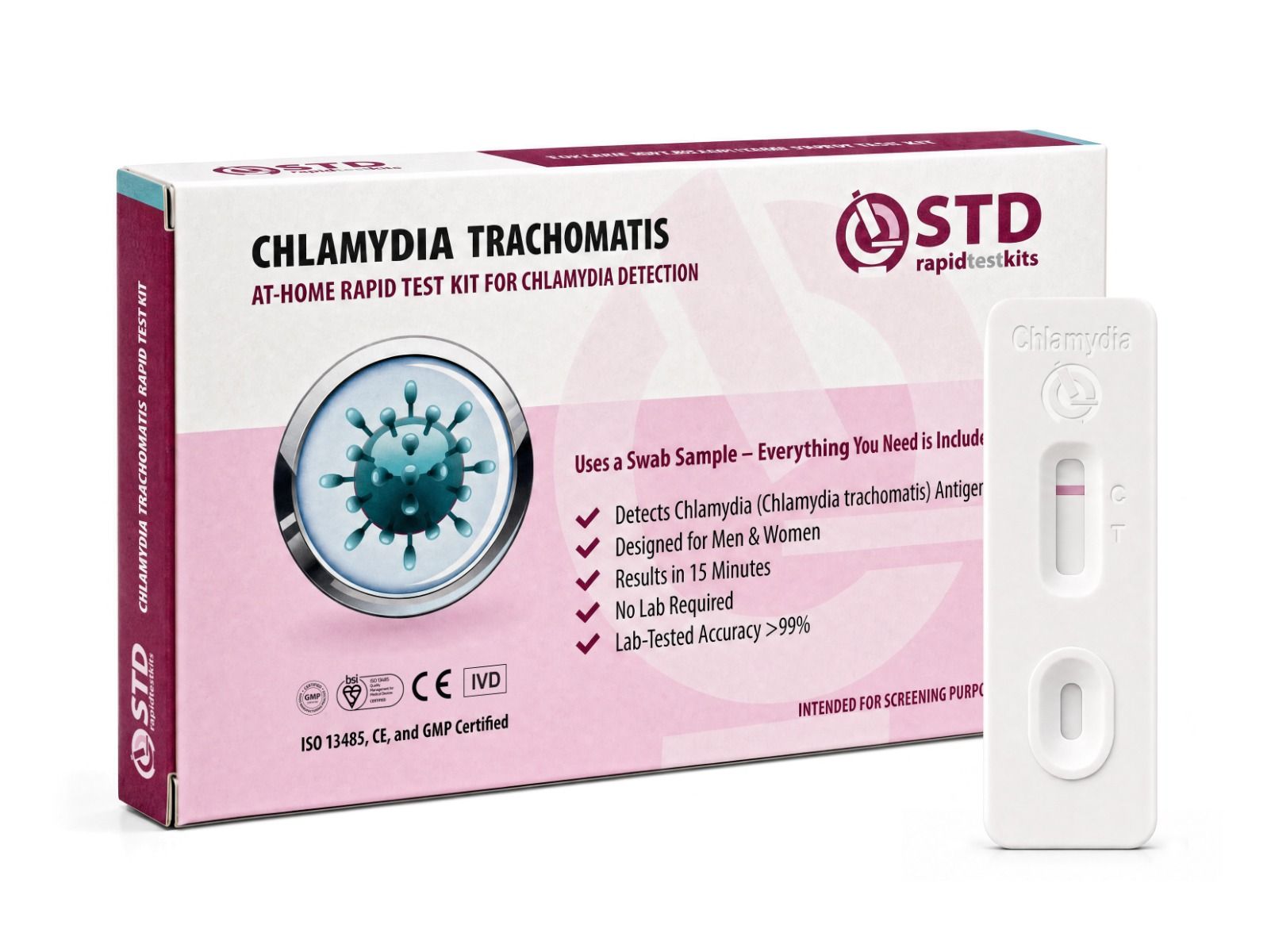
At-home rapid kits exist to fill that gap. They use a self-collected genital swab (vaginal or urethral, depending on anatomy), the same sample type used in many clinical settings. The result reads at home in roughly 15 minutes. The technology is lateral-flow immunoassay, which is meaningfully different from the lab-based NAAT (nucleic acid amplification test) that clinics use as the analytical gold standard. Lateral-flow tests are best understood as screening tools, not as a substitute for confirmatory NAAT testing if you're symptomatic or if a positive result needs to be confirmed for treatment.
We sell at-home rapid kits through this site, and we have an obvious interest in recommending them. The privacy and speed advantages described above are real regardless of where you purchase. Private at-home kits arrive in plain unmarked packaging. They don't show up on any school health portal. They aren't billed through parental insurance.
| Option | Sample Type | Privacy | Result Speed | Best For |
|---|---|---|---|---|
| At-home rapid swab | Self-collected swab | High (plain packaging) | About 15 minutes | Quick screening between hookups |
| Mail-in lab test | Self-collected, mailed in | High | 2 to 5 days | Lab-grade NAAT confirmation at home |
| Campus health clinic | Clinic-collected swab or urine | Medium (on-campus visit) | 1 to 5 days | Symptomatic visit with same-day treatment |
| Local sexual-health clinic | Clinic-collected | High (off-campus) | 1 to 5 days | Comprehensive panel and treatment |
Reinfection and the Partner Loop
A negative test today doesn't grant immunity. Chlamydia infections happen between people, which means a treated person can be reinfected as soon as they have unprotected contact with an untreated partner. The CDC's STI treatment guidelines specifically recommend retesting at three months after treatment because reinfection during that window is common, especially among adolescents and young adults.
The cause is rarely treatment failure. More often it's a partner who never got treated, or a new partner with a current infection. The CDC chlamydia treatment guidelines explicitly call out the high repeat-infection rate in this age group as the reason automatic three-month retesting is standard advice.
That makes partner notification practical, not moral. If you test positive, treatment for you alone won't fix the loop. Past partners need to know so they can test and treat too. A short factual text works: "Hey, I tested positive for chlamydia and I think you should test too." If a direct message feels impossible, anonymous notification services exist through state and city public-health departments, and online tools like TellYourPartner.org can deliver a notification on your behalf without using your name.

Sex on Campus: What Real Prevention Looks Like
The pamphlet version of prevention says "abstinence" or "monogamy" and stops there. Neither matches how college students actually live. People hook up. Sometimes the encounter is planned, sometimes it isn't. Sometimes alcohol is involved. Pretending otherwise produces sex education that nobody uses, and that nobody talks about with their friends.
Real prevention has to be honest, repeatable, and judgment-free. That starts with testing on a cadence: before a new partner if you can, after unprotected sex, and roughly every three to six months if you're sexually active with multiple partners. It continues with low-stakes conversations: "When was your last test?" "Want me to grab a couple of kits?" Awkward the first time. Routine after that.
Condoms still matter, especially for vaginal and anal sex. Dental dams and condoms during oral sex reduce risk further. Knowing your status doesn't replace barrier use, but it gives both partners the information needed to make decisions instead of guessing. The CDC's screening recommendations, summarized in the CDC's STI screening recommendations, suggest annual chlamydia screening for sexually active women under 25 and for any sexually active person with risk factors.
Most people who have chlamydia have no symptoms. If you do have symptoms, they may not appear until several weeks after you have sex with an infected partner.
Privacy: Testing Without the Spotlight
Privacy is the reason a lot of students put off testing in the first place. Thin dorm walls, shared mailboxes, an RA who once opened a package "by mistake": each of these can turn a small wellness decision into a public event. The fix isn't to overcome shame on willpower alone. It's to lower the privacy cost so testing becomes the easy choice.
At-home kits ship in plain packaging without medical labels. The charge on a card statement reads as a generic vendor name, not "STD test." Results stay on your device or paper, never automatically synced to a campus health portal or to an insurance claim that a parent might see. If you're on a parent's insurance plan and you'd rather not generate a billing trail, an at-home kit purchased directly is usually the cleanest path.
Support is also more accessible than it used to be. Many campus centers offer text-based or anonymous-call consults. Local clinics, Planned Parenthood, and community health centers offer walk-in or low-cost services for students who don't want care tied to the school.

If a Result Comes Back Positive
The first thing to know is that chlamydia is curable. Standard treatment is a course of antibiotics, typically doxycycline 100 mg twice daily for 7 days, with single-dose azithromycin used in specific situations such as pregnancy. The prescribing decision should come from a clinician, not a friend's leftover medication. If your positive result came from an at-home kit, most providers will accept the screening result as a starting point and can prescribe through a clinic visit or a telehealth consult.
Treatment matters partly because untreated chlamydia can progress. In women, it can develop into pelvic inflammatory disease (PID), which may scar the fallopian tubes and raise the risk of infertility and ectopic pregnancy. In men, it can cause epididymitis, an inflammation of the tube behind the testicle. Both complications are uncommon when infection is caught early through routine testing, which is exactly the case the rest of this guide is built around.
Avoid sex for 7 days after starting treatment, or until both you and any partners have completed treatment, whichever is longer. Sex inside that window can pass the infection back, even if you feel better. The CDC's STI treatment guidelines spell out the timing in the chlamydia treatment guideline.
Tell partners you've had sexual contact with in the last 60 days, or your most recent partner if it's been longer. A short message is enough: "I tested positive for chlamydia. You should get tested." Retest at three months after completing treatment, regardless of symptoms, because reinfection is common and silent.

Frequently Asked Questions
- Can chlamydia really transmit through oral sex?
- Yes. Pharyngeal (throat) chlamydia happens after unprotected oral contact with an infected partner. It's less common than genital chlamydia but well documented, and throat infections rarely cause symptoms, which is part of why they spread. A throat-specific swab is the right test for that anatomic site, and it's a clinic test rather than an at-home one.
- I feel totally fine. Could I still have it?
- Yes. The CDC notes that most chlamydia infections cause no symptoms at all. Feeling normal is the typical experience for someone who's positive, especially in the first weeks after exposure. If you've had a possible exposure, the only way to know is to test, regardless of how you feel.
- How do I tell whether it's a UTI or chlamydia?
- The early symptoms can overlap: burning during urination, urinary frequency, pelvic discomfort. Chlamydia is more likely to also cause unusual discharge, spotting between periods, or rectal symptoms after anal sex. A urine culture diagnoses a UTI; a chlamydia swab or NAAT diagnoses chlamydia. If symptoms are persistent or unclear, test for both.
- Do I have to tell partners if I test positive?
- Legal requirements vary by state. Practically, partner notification is the only way to break the reinfection loop. A short factual text works: "I tested positive for chlamydia and I think you should test too." If you can't message directly, anonymous notification services through public-health departments will do it on your behalf without using your name.
- Once I take the antibiotics, am I cured for good?
- Treatment cures the current infection. It doesn't grant immunity, so you can be reinfected by an untreated partner or by a new partner. The CDC recommends retesting at three months after treatment because repeat infection in that window is common, especially among college-aged people.
- How often should I get tested in college?
- Annual screening is the CDC's baseline recommendation for sexually active women under 25. Many sexually active people benefit from screening every three to six months, especially with new or multiple partners. After any unprotected contact with an unknown-status partner, test at the 14-day mark.
- How accurate are at-home rapid chlamydia tests?
- Lateral-flow rapid tests are screening tools. Their analytical sensitivity is below that of lab-based NAAT, which is the diagnostic gold standard. A negative rapid result is reassuring at the right testing window but doesn't rule infection out as conclusively as a NAAT. A positive rapid result should prompt clinical follow-up, both to confirm and to start treatment.
- Will an at-home test show up on my school record or insurance?
- Not directly. At-home kits aren't billed through insurance, so they don't generate an Explanation of Benefits that a parent on the same plan might see. They aren't synced to campus health portals. Privacy is one of the main reasons students choose them over campus services.
How we sourced this article: We summarized current guidance from the CDC, NHS, and ASHA, and translated it into plain-English steps for the situations students actually encounter. We are an at-home testing site, not a clinic; we do not provide diagnosis or treatment, and persistent or worsening symptoms warrant a licensed clinician.
- U.S. Centers for Disease Control and Prevention. Chlamydia information page, including symptoms, transmission, and asymptomatic-infection guidance.
- U.S. Centers for Disease Control and Prevention. STI treatment guidelines, chlamydial infections section, including doxycycline regimen and three-month retest recommendation.
- U.S. Centers for Disease Control and Prevention. STI screening recommendations, including annual chlamydia screening for women under 25.
- U.S. Centers for Disease Control and Prevention. STI prevention overview, including barrier-method guidance for vaginal, anal, and oral sex.
- American Sexual Health Association. Chlamydia overview for general audiences.
- National Health Service (UK). Chlamydia overview, including symptoms, testing, treatment, and complications such as pelvic inflammatory disease.