
Published: September 2025 | Last updated: May 2026 | Editorial review and quality control: Martina N.
A barely-visible second line on a rapid STD cassette is more common than most people expect, and more meaningful than it looks. You read the instructions, set a timer, and now there is a second line that is pale enough you cannot tell if it is a real positive, an artifact, or just a shadow from the bathroom light.
The short version: any second line that shows up alongside a valid control line during the reading window is treated as a positive reaction by virtually every rapid lateral-flow manufacturer. Faintness reflects how much of the target marker is in the sample, not whether the test "worked" or not. The longer version is below, with the chemistry, the timing rules, and what to do next.
Key Takeaways
- A faint test line plus a valid control line, within the reading window, is treated as a positive result. Any visible reaction is a real reaction.
- Line darkness reflects marker concentration, not infection severity. Any positive rapid result should be confirmed with a follow-up test.
What the lines on a rapid STD test actually mean
Most rapid STD tests use a lateral-flow immunoassay. The chemistry sounds technical, but the visual design is simple: one line confirms the test ran correctly, and the other line reacts to molecules linked to infection.
The control line is a built-in quality check. It shows that fluid moved through the strip and that the reagents are alive. If the control line is missing, the test cannot be interpreted, regardless of what else appears.
The test line is where things get emotionally loaded. It shows up when the strip encounters antibodies, antigens, or other markers tied to the specific infection the kit is designed to detect. Those markers do not have to be present in large amounts to trigger a visible color change. Even small concentrations can produce a real, if light, signal.
| Line | What it means | Why it matters |
|---|---|---|
| Control line (C) | Confirms the test ran correctly and the reagents are working. | Without a visible control line, the result is invalid. |
| Test line (T) | Forms when the strip detects the target marker for that infection. | Any visible line within the reading window is treated as positive. |
Why a positive line can look faint
Several normal factors can make a real positive line appear lighter than expected. None of them automatically mean the result is wrong.
The most common reason is concentration. Rapid tests respond to how much of the target marker is in the sample at the moment of testing. Less marker, lighter line. The chemistry is still doing exactly what it was designed to do.
Timing matters as well. Lateral-flow strips are designed to be read within a defined window, typically 10 to 20 minutes depending on the kit. Inside that window, a faint line is a legitimate reaction. Outside it, evaporation can produce marks that look similar but are not true signals.
Sample variability is another factor. Even with careful technique, two consecutive samples from the same person can carry slightly different amounts of antibody or antigen, which changes how bold the line looks. Hydration status, time of day, and where someone sits on the immune-response curve all influence concentration.
The bottom line is straightforward: faint lines happen because the chemistry is sensitive, not because the test is broken.
- Concentration: less target marker in the sample produces a lighter line.
- Timing: read the cassette inside the kit's 10 to 20 minute window. Earlier and the line may not be fully formed; later, evaporation can mimic a positive.
- Sample variability: two consecutive samples from the same person can carry slightly different marker amounts.
- Immune-response stage: early in infection, antibody levels are still rising, which produces a softer signal.
Positive, negative, and invalid results compared
Understanding the three possible outcomes removes most of the anxiety people feel when reading a rapid result. The lines themselves carry the answer, as long as you look at them inside the reading window.
| Result | What you see | What it means |
|---|---|---|
| Negative | Control line only | No detectable marker in the sample within the test's limits. |
| Positive | Control line plus a test line, even faint | The marker for that infection was detected. Confirmation testing is the next step. |
| Invalid | No control line, regardless of what else appears | The test did not run correctly. Repeat with a new kit. |
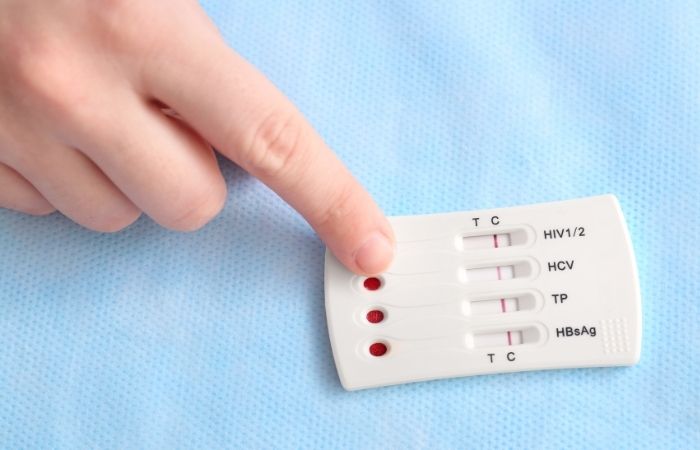
Is a faint line on an STD rapid test positive or negative?
If a faint line appears alongside a visible control line within the manufacturer's reading window (usually 10 to 20 minutes), most lateral-flow STD tests treat it as a positive reaction. Faintness reflects how much of the target marker is in the sample, not whether the test worked. Any positive rapid result should be confirmed with a follow-up test, either a repeat at-home test after the infection's window period or a clinic-based laboratory test.
Faint lines vs evaporation lines
The internet is full of warnings about evaporation lines, and they are a real phenomenon. After the manufacturer's reading window closes, the strip starts to dry. As it dries, faint marks can appear where the antibody-coated zone sits, even when no marker was present.
Evaporation lines usually look different from true positives. They tend to be gray, uneven, or colorless rather than the pink or purple of the control line. They also tend to be thinner and more streaky than a normal test band.
The biggest tell is timing. A faint line that develops inside the reading window is far more likely to be a true reaction. A faint line that emerges thirty minutes after the cassette has been sitting on the counter is the textbook scenario for an evaporation artifact, which is exactly why every set of instructions warns not to read the test late.
Following the reading window prevents most of the confusion. If a line forms during the recommended interval, take it seriously. If it appears later, do not retroactively read it as positive.
A simple kitchen timer or phone alarm removes the guesswork. Read the result once when the timer ends. Glancing again ten minutes later, after the strip has started drying, is the single most common reason healthy people convince themselves they have a positive result they do not have.
Common mistakes that make results harder to read
Rapid tests are designed to be user-friendly, but a few small errors can cloud how the result looks. The good news is that they are easy to avoid once you know what they are.
- Reading too early: lines may not have fully developed yet, so a true positive can look invisible.
- Reading too late: evaporation artifacts can appear and be mistaken for real signals.
- Too little sample: weak fluid flow can produce uneven, hard-to-read bands.
- Wrong buffer volume: too few or too many drops can stop the reaction from completing.
Lighting also changes what you see
Bathroom lighting is rarely ideal for reading a thin pink band. Yellow-toned bulbs and side shadows can hide a faint line that is genuinely there, or invent one that is not. A neutral daylight bulb, a window, or the camera on a phone with the flash off all give a more honest view of the cassette.
Hold the cassette flat under a window or a daylight-spectrum bulb, then rotate it slightly to eliminate side shadows from overhead bathroom lights. If you still cannot tell, take a phone photo with the flash off in even light and compare side by side with the kit's reference diagram.
How rapid STD tests detect infection
Once you understand the mechanism, ambiguous results stop feeling random. Rapid STD tests look for biological signals that an infection has triggered the immune system or that the pathogen itself has shed detectable proteins. Depending on the kit, that means antibodies (made by the body) or antigens (from the pathogen).
The process starts when the sample fluid is drawn across the test strip by capillary action (the same wicking force that pulls liquid through paper). As it travels, it passes through a zone packed with tiny colored particles coated in molecules that grab the target marker. If the marker is present, it sticks to those particles, and the resulting complex keeps moving down the strip.
Further along is the test-line zone, lined with capture molecules that hold those complexes in place. When enough of them accumulate, they form the visible pink or purple band. The control line works on the same principle, but it captures particles that should always be carried past, regardless of whether the sample contained the target. That is why a missing control line invalidates the whole test.
The visible test line is the product of a binding reaction between sample markers and capture molecules on the strip. No reaction means no line; a small reaction means a small line.
Does a darker line mean a stronger infection?
This is one of the most persistent myths about rapid tests. People assume that a bold line equals a serious infection and a faint line equals a borderline case. The chemistry does not work that way.
A darker line simply means more of the detectable marker was present in the sample at the moment of testing. A lighter line means concentration was lower. Neither tells you anything about how long someone has been infected, how transmissible they are, or how their body is handling the infection.
A few normal factors influence intensity:
- Sample concentration: different samples carry slightly different marker levels.
- Hydration: more dilute samples produce a softer reaction.
- Where someone sits on the immune-response curve: antibody levels rise gradually after infection.
- Lot-to-lot variation in test strips: small manufacturing differences can change band brightness.
What window periods have to do with faint lines
Window period is the gap between possible exposure and when a test can reliably detect infection. Early in that window, the biological markers a rapid test is built to find are still ramping up. Testing during the climb can produce a faint signal because there is genuinely less marker to bind to.
This does not mean the result is wrong. It means the test is showing where the infection is on its timeline. A faint positive that comes back stronger a few weeks later is consistent with the marker rising as the immune response builds.
| Infection | Typical rapid-test window period | Why timing matters |
|---|---|---|
| HIV (antibody rapid) | Roughly 23 to 90 days for most antibody tests | Antibodies must develop before the test can detect them (per CDC HIV testing guidance). |
| Syphilis (treponemal rapid) | Around 3 to 6 weeks | Treponemal antibodies build gradually after infection. |
| Hepatitis B (HBsAg rapid) | Around 4 to 8 weeks | Surface antigen levels need time to rise to detectable levels. |
If you tested very early, retesting helps
If a faint line appeared shortly after a possible exposure, repeating the test outside the window period (or following up with a laboratory test) is the cleanest way to confirm. A repeat positive at a stronger intensity is consistent with a real infection. A repeat negative outside the window period is reassuring.
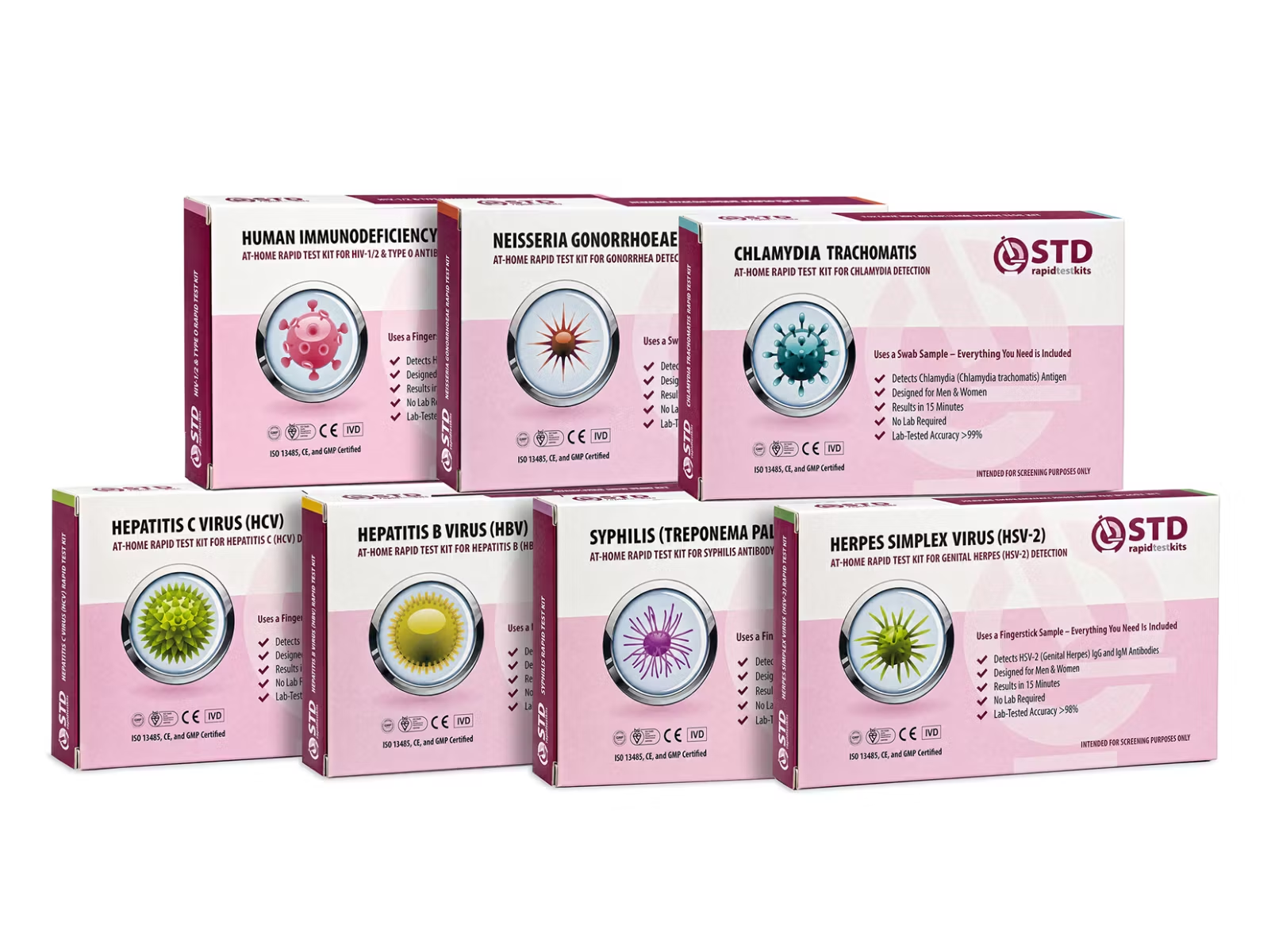
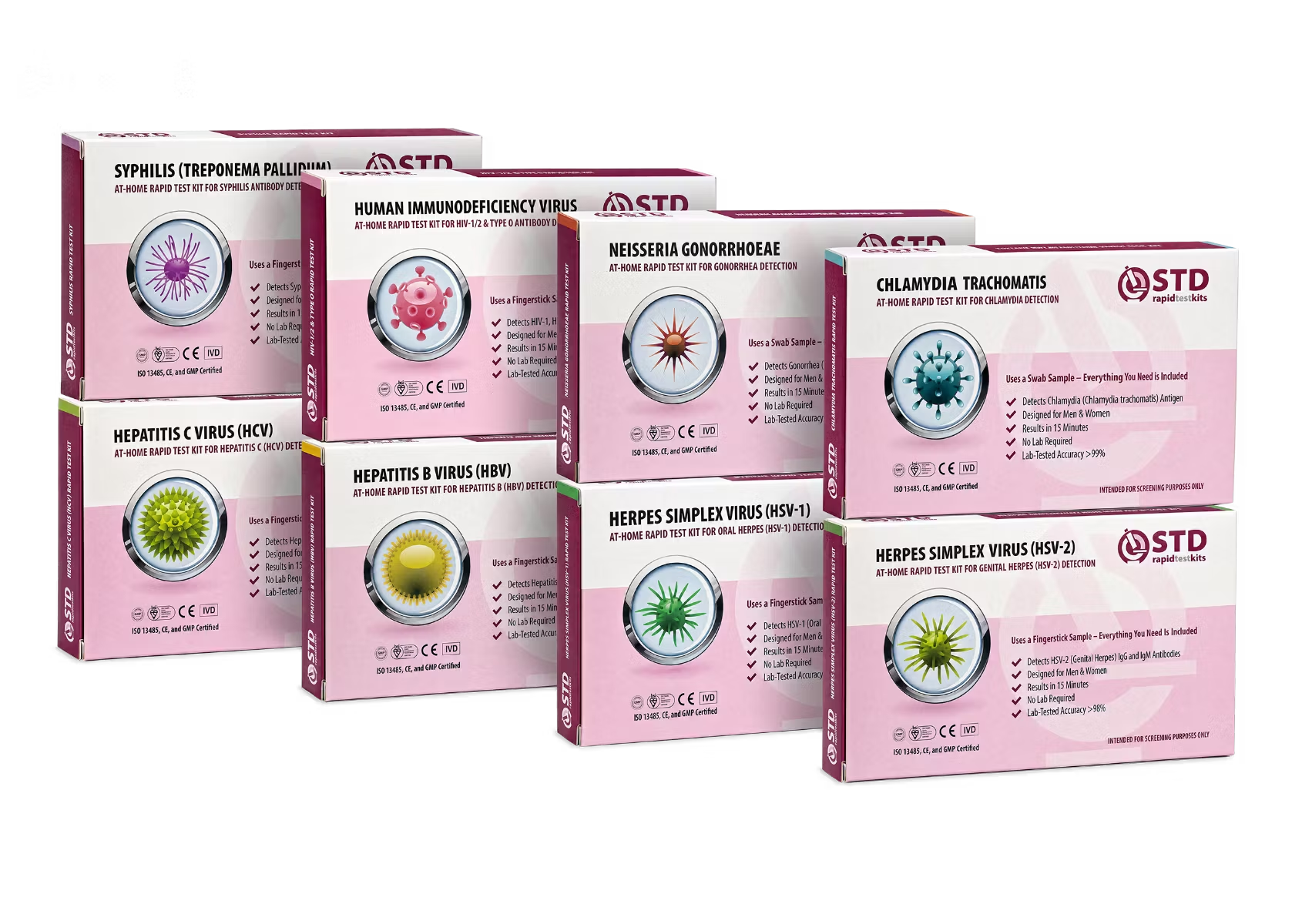
For context on the product link below: this site sells at-home rapid STD test kits, and the products recommended here are ours. We pick by fit for the reader's situation, not by margin.
Testing at home vs testing in a clinic
Both at-home rapid tests and clinic-based lab tests have a real role in sexual health. Rapid tests are fast, private, and useful for screening. Lab tests (typically NAAT or PCR for bacterial STIs, and confirmatory antibody or antigen assays for viral ones) are the analytical gold standard. The two are complementary, not competing.
Many people start at home because the emotional barrier is lower. Opening a kit in a private bathroom is less intimidating than scheduling an appointment, especially when symptoms are subtle or when the concern is precautionary rather than urgent.
If a rapid result is clearly negative and the reader is past the relevant window period, the result is usually enough to move on. If a rapid result is positive (faint or bold), or if it is unclear despite proper technique, a clinic confirmation is the right next step. Clinics can also offer treatment immediately, which matters because most bacterial STIs are easy to clear once identified.
For readers who want to start privately and only escalate if needed, the rapid panels available at stdrapidtestkits.com are designed for exactly that flow.
Home rapid vs clinic lab at a glance
- Rapid home tests are fast, private, lateral-flow screening. Useful as a first read on whether testing is warranted.
- Lab tests (NAAT or PCR, or confirmatory antibody and antigen assays) have higher analytical sensitivity. Used for confirmation and treatment access.
If you see a faint line, here is the calm next step
The first thing to remember is that faint lines are common. Every manufacturer's instructions specifically warn against ignoring them, which is why "any visible test line within the reading window" is the language that appears on most package inserts.
Practically, the response looks like this. Confirm the result was read inside the window. Confirm the control line is present. If both are true and you can see a second line under neutral light, treat it as a positive reaction and arrange confirmation testing. That can mean a clinic visit for a laboratory test, a telehealth consultation, or a repeat at-home test after the relevant window period has fully passed.
None of this requires panic. Most STIs are treatable, and the ones that are not are still highly manageable when detected early. Acting on a faint line is exactly what the test was designed to enable.
Any rapid HIV self-test result that is reactive (positive) needs to be confirmed by a healthcare provider with additional testing. A reactive rapid result is a screening signal, not a diagnosis.
FAQs
- Does a faint line on a rapid STD test still count as positive?
- If a faint second line appears alongside a visible control line within the manufacturer's reading window, the standard interpretation is that it counts as a positive reaction. The chemistry only produces a line when it has detected its target marker. Faintness reflects how much marker was present, not whether the test "worked" or not. The recommended next step is confirmation, either by repeating the test after the relevant window period or by getting a clinic-based laboratory test.
- Why is the line so faint instead of dark?
- Rapid tests respond to how much of a marker is in the sample at that moment. Lower concentration produces a softer reaction. Several normal factors can lower the local concentration, including hydration, time of day, where someone is on the antibody-response curve, and routine sample-to-sample variability. None of these mean the test malfunctioned.
- What if the faint line only appeared after the reading window?
- That is the classic scenario for an evaporation line rather than a true positive. As the strip dries, faint marks can develop where the antibody-coated zone sits, even when no target marker was present. This is why every kit's instructions warn against reading the test late. If the line appeared only after, say, thirty minutes, repeat the test with a new kit and read it inside the window.
- Does a darker line mean a more severe infection?
- No. Line intensity reflects marker concentration at the moment of testing, not infection severity, transmissibility, or stage. A person with a faint line and a person with a bold line can have the same infection. Severity is determined by clinical assessment and quantitative lab testing, not by a lateral-flow band's color.
- I tested soon after a possible exposure. Could that make the line faint?
- Yes. Most STIs have a window period during which the markers a rapid test is designed to detect are still building up. Early in the window, only a small amount of marker is available to bind, which can produce a softer signal. Repeating the test once the relevant window period has passed gives a cleaner reading.
- What if my test only shows one line?
- If you only see the control line, the result is negative under the conditions the test can detect. The control line confirms the test ran correctly. If no control line appears at all, the result is invalid and the test should be repeated with a new kit, regardless of what shows up in the test-line position.
- How common are faint lines on rapid STD tests?
- They are common enough that manufacturers explicitly address them in the instructions. Rapid lateral-flow tests are designed to be sensitive, which means they can react to small amounts of the target marker. That sensitivity is helpful for early detection, but it also means the test line does not always appear bold and unmistakable.
- What is the best next step after a faint result?
- Treat it as a positive reaction worth confirming. That usually means either repeating the rapid test after the window period for the specific infection, or following up with a clinic-based laboratory test (typically NAAT or PCR for bacterial STIs, or a confirmatory antibody or antigen assay for viral ones). Confirmation replaces uncertainty with a clear diagnosis, which is what the screening test was designed to trigger.
How we sourced this article: This guide draws on current public-health guidance for rapid diagnostic testing and peer-reviewed research on lateral-flow immunoassay performance. We cross-checked claims against CDC, WHO, and NHS materials, focusing on how rapid tests actually work, what window periods look like in practice, and how to read results correctly. Numbers and ranges in this article match the source documents linked below at the time of refresh, verified live via web fetch.
- Centers for Disease Control and Prevention. Sexually transmitted infections (STIs) overview, including testing guidance.
- World Health Organization. Fact sheet on sexually transmitted infections, including diagnostic approach.
- NHS. Guide to sexually transmitted infections, symptoms, testing, and follow-up.
- Centers for Disease Control and Prevention. STI treatment guidelines, used to anchor confirmation and follow-up steps.
- World Health Organization. Consolidated guidelines on HIV prevention, testing, treatment, service delivery and monitoring: recommendations for a public health approach. Referenced for confirmation-testing language regarding reactive rapid results.
- Centers for Disease Control and Prevention. Getting tested for HIV: overview of rapid antibody, antigen/antibody, and NAT testing, with window-period guidance.
