Published: November 2025 | Last updated: May 2026 | Editorial review and quality control: Martina N.
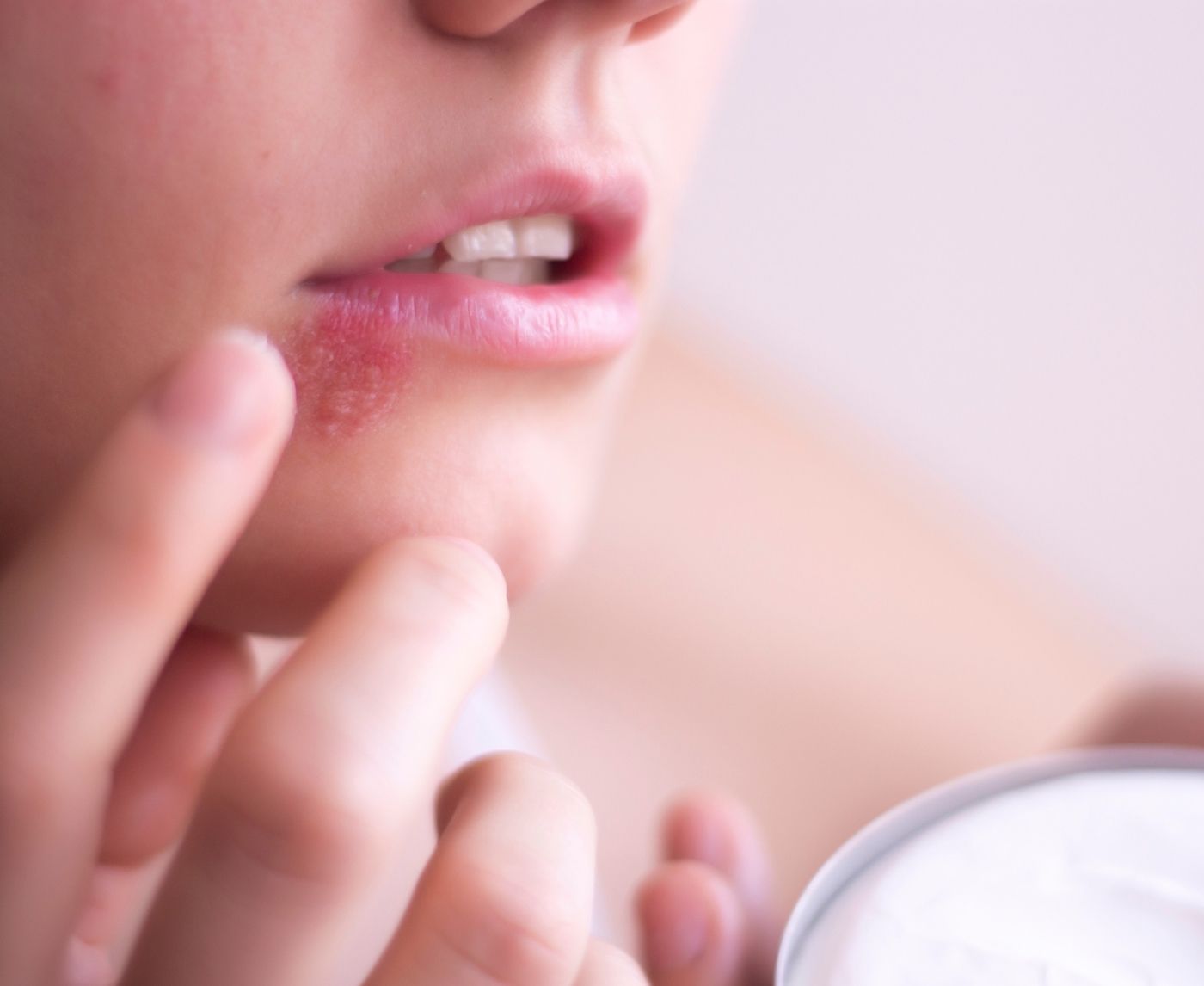
Facial herpes is real, and it does not always stay neatly on the lip line. The same virus that causes a familiar cold sore can break out on the chin, the jawline, the area under the beard, or the cheek. For people who only know cold sores from the corner of the mouth, this can feel disorienting. A small, sore patch shows up somewhere unexpected. It looks like a pimple at first, then it does not behave like one.
This guide is for anyone who has ever stared into a bathroom mirror at midnight, comparing a stubborn chin bump to photographs on their phone. We will walk through what facial herpes actually looks like, how the virus reaches the lower face when no one obviously kissed anyone, what an outbreak feels like day by day, and which tests can give you a real answer. The aim is calm clarity, not a scare.
Key Takeaways
- Most facial herpes on the chin or jawline is caused by HSV-1, the same virus behind common cold sores. It tracks along facial nerves and can surface anywhere those nerves reach.
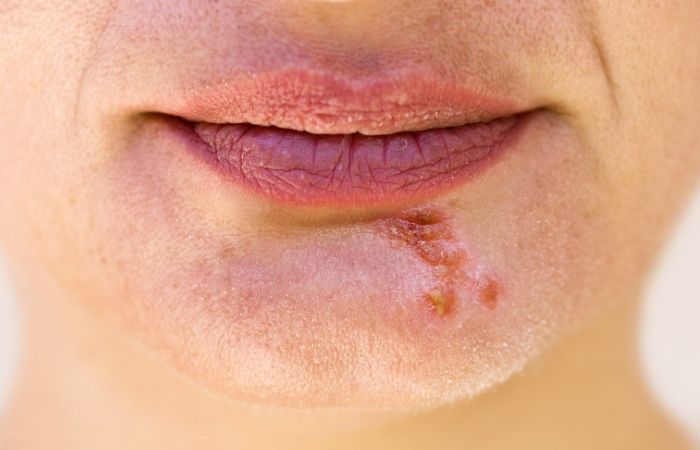
- Facial herpes often mimics acne, ingrown hair, or razor burn at first, but it follows a tingle-then-blister-then-crust timeline and does not respond to acne treatment.
What You Think Is Acne Might Be Something Else
The skin around the lower face is busy. Hair follicles, sweat glands, and friction from masks, pillowcases, and razors keep the area in a low-grade state of irritation. Hormonal cysts, ingrown hairs, allergic reactions, perioral dermatitis, and post-shave inflammation are all common. Herpes on the chin is less common than those, but it is far from rare, and it does not follow the rules of typical breakouts.
If a chin or jaw bump fits more than two of the clues below, it is worth treating it as a possible herpes lesion until a clinician says otherwise. The cost of being wrong about a pimple is low. The cost of treating a herpes lesion as a pimple, picking at it, scrubbing it, and possibly spreading it to the eye or to a partner, is higher.
Five clues that point toward facial herpes, not acne
- It starts with a tingling, burning, or tight sensation under the skin a day or two before anything is visible.
- It forms a tight cluster of small fluid-filled blisters rather than one solo bump.
- It crusts over within a few days, then heals over the following one to two weeks.
- It comes back in the same patch of skin, or very close to it, when the virus reactivates.
- It ignores acne creams; salicylic acid and benzoyl peroxide can irritate broken skin and slow healing.
How HSV-1 Reaches the Chin, Cheek, and Jawline
HSV-1 is the strain most people associate with cold sores. After someone is first infected, usually in childhood through a kiss from a relative or a shared drinking cup, the virus retreats up the trigeminal nerve, the large facial nerve that branches across the forehead, cheek, and jaw. It settles into a nerve cluster called the trigeminal ganglion and stays there for life. When the virus reactivates, it travels back down a branch of that same nerve and surfaces wherever that branch ends.
That is why a person can have an outbreak on the chin one year and the lip the next. The virus follows a specific nerve highway when reactivating, so an outbreak that appears below the lip line is on the same neural pathway as a classic lip cold sore. The mandibular branch of the trigeminal nerve covers the lower lip, chin, jaw, and lower cheek. When that branch carries the virus down to the skin, the result is what people informally call “beard herpes” or facial herpes on the jawline.
According to the World Health Organization, an estimated 3.8 billion people under the age of 50, roughly two-thirds of the global population, carry HSV-1 (WHO Herpes Simplex Virus fact sheet). The virus does not announce itself the way an acute infection does. It can sit quietly for years before something, stress, illness, sun exposure, hormonal shifts, or a new skin trauma, gives it the opening to surface.
HSV-1 can release small amounts of live virus from completely normal-looking skin or saliva, with no visible sore and no warning tingle. This is called asymptomatic shedding, and it is well documented in the clinical literature. It is the main reason most carriers cannot point to a specific exposure that gave them the virus, and it is why a kiss from a relative without a visible cold sore can still pass HSV-1 along.
Facial Herpes Versus the Common Look-alikes
Most chin and jaw bumps are not herpes. The trick is recognizing the few clues that move herpes higher up the suspect list. The table below summarizes the differences clinicians look for when sorting one cause from another. None of these clues is definitive on its own; a swab is the only way to confirm.
| Condition | First Sensation | Visible Pattern | Response to Acne Treatment | Contagious? |
|---|---|---|---|---|
| Facial herpes (HSV-1) | Tingling, burning, tight feeling | Cluster of small fluid-filled blisters in one patch | No improvement; can worsen | Yes |
| Acne (pimple, cyst) | Pressure, soreness | One or several red bumps; whitehead may form | Often improves with cleansers and benzoyl peroxide | No |
| Ingrown hair | Itchy, tender | One red bump, sometimes with a visible hair | Can improve with gentle exfoliation | No |
| Razor burn | Sting, mild itch | Diffuse red rash or many tiny bumps across the shaved area | Heals within days once shaving stops | No |
| Perioral dermatitis | Burning, itching | Small red bumps clustered around the mouth | Often worsens with steroids and heavy creams | No |
When Shaving and Skin Trauma Trigger an Outbreak
Razors are not infectious by themselves. They are, however, very good at creating microscopic abrasions in skin that already carries HSV-1. Clinicians describe a recurring scenario: someone shaves their beard area in a hurry, develops a sore patch a day or two later, and assumes it is razor burn. By day three the patch has blistered and spread, and the picture starts to look more like herpes than razor irritation. The technical term for this pattern when it happens to athletes through skin-to-skin contact is “herpes gladiatorum.” In the shaving context it is sometimes called “beard herpes” or “barber’s herpes.”
People can also reinfect themselves. Touching a lip sore and then the chin, called autoinoculation, can move the virus to a fresh site. The same is true for touching a chin sore and then the eye, which can lead to a serious condition called herpetic keratitis. Wash your hands thoroughly after touching any active sore, and avoid touching your eye while an outbreak is healing.
Common skin-trauma triggers for a facial herpes outbreak
- Shaving with a dull or shared razor over an area where the virus has surfaced before.
- Cosmetic procedures: chemical peels, dermabrasion, laser resurfacing on the lower face.
- Aggressive exfoliation or picking at existing pimples.
- Sunburn or windburn across the lower face, especially without lip and chin SPF.
- Friction from sports gear, masks, or chinstraps that rub the same patch of skin repeatedly.
What a Facial Herpes Outbreak Feels Like
According to the NHS cold sores guidance, lesions usually clear up on their own within about 10 days. Recurrent outbreaks on the face can sometimes drag on closer to two weeks, particularly if a sore was picked or knocked open during healing. It does not start with blisters either way. The earliest sign is often invisible: a tingling, burning, or tight feeling under the skin. That prodrome stage can last a few hours to a couple of days. Then small, fluid-filled blisters appear, usually in a tight cluster.
These blisters may pop, leak clear fluid, and crust over. This is when the virus is most contagious. As the sores heal they scab, flake, and eventually fade. Most people notice that the spot feels tender or itchy even after the skin looks normal. That is the irritated nerve recovering, and a sign that the virus is calming down but still present in your system. Here is a typical timeline:
| Stage | Day Range | What Happens |
|---|---|---|
| Prodrome | Day 1 to 2 | Tingling, burning, or tight skin; nothing visible yet |
| Blistering | Day 2 to 4 | Small fluid-filled blisters form in a cluster |
| Ulceration | Day 4 to 6 | Blisters rupture and leak fluid; highest contagious risk |
| Crusting | Day 6 to 9 | Sores dry, scab, and begin healing |
| Healing | Day 9 to 14 | Scabs fall off, leaving pink skin and mild sensitivity |
Testing for Herpes: Swab, PCR, or Blood
The gold standard for diagnosing an active facial outbreak is a swab. A clinician gently lifts the fluid from a fresh blister and sends the sample for PCR, which looks directly for HSV-1 or HSV-2 viral DNA. PCR is more sensitive than the older viral culture and can also tell which type of herpes simplex virus is present. Timing matters: the test is most accurate in the first 48 to 72 hours after blisters appear. Once the sores have crusted over, the virus becomes harder to detect, and the result may come back falsely negative.
For people without active sores, blood tests are the alternative. These look for antibodies your immune system has produced against HSV-1 or HSV-2. The catch, as the MedlinePlus herpes test page explains, is that antibodies take weeks to develop. A type-specific blood test is generally most reliable from about 12 weeks after a suspected exposure. Earlier than that, a negative result does not rule out a recent infection.
A second catch: a positive HSV-1 antibody result tells you that you have been exposed to HSV-1 at some point in your life, but it does not tell you where the virus lives, whether it is currently active, or whether the bump on your chin is from this virus or something else. Blood testing is most useful for people who want to know their overall HSV status, while a swab during an active outbreak is the test that can tie a specific lesion to the virus.
Routine population-wide antibody screening is not currently recommended by major health bodies, partly because of the limitations above. Practical candidates for testing include people with active or recurring symptoms, people with a known exposure, and people whose partner has herpes.
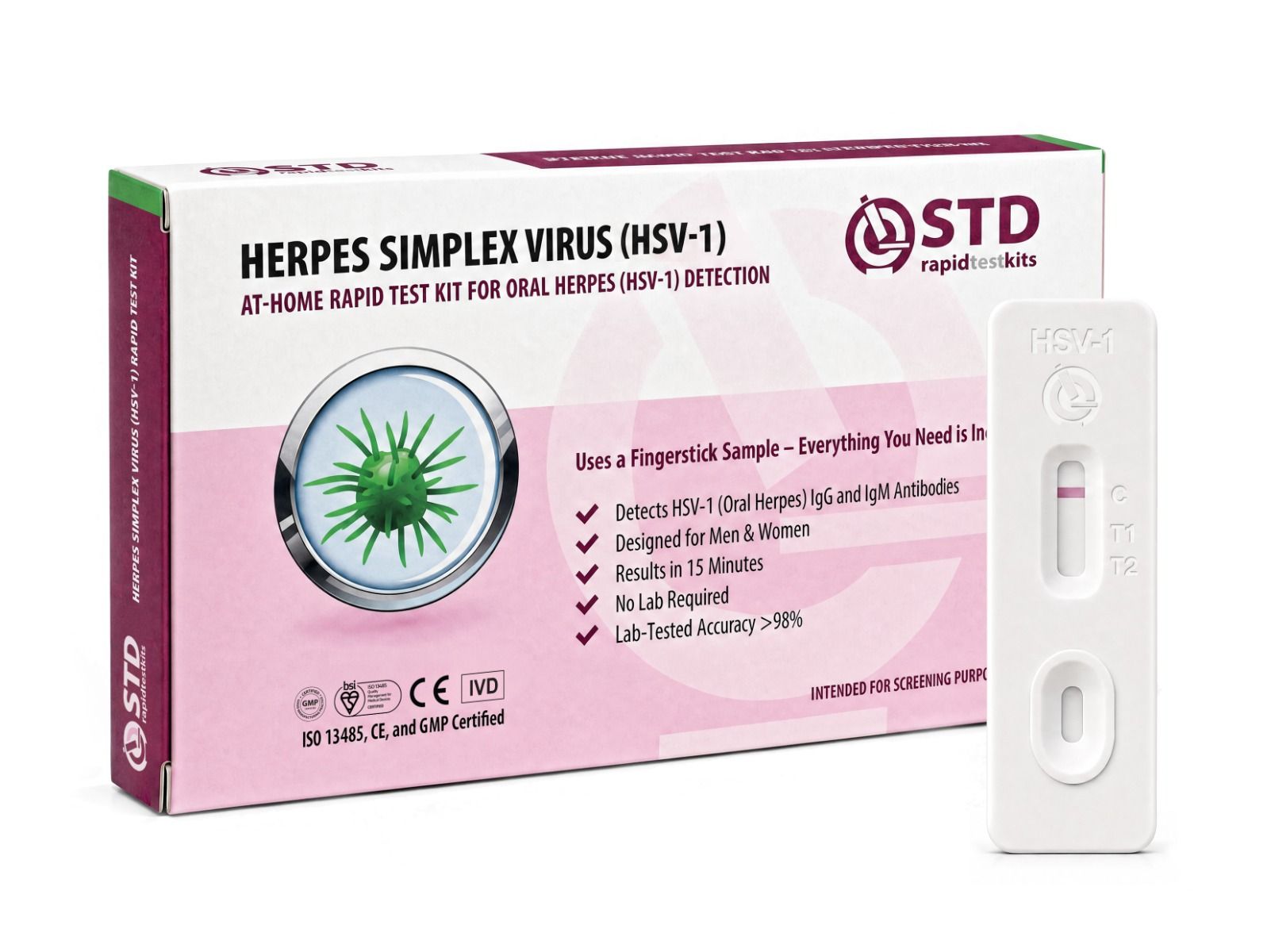
For an active blister on your face, the most accurate option is a swab in the first few days, taken and processed by a clinic or lab. That cannot be done at home. Our at-home rapid herpes tests use a small fingerstick blood sample to look for HSV-1 or HSV-2 antibodies. They can confirm whether your body has reacted to the virus, which is useful 12 weeks or more after a suspected exposure. They cannot type a specific lesion or tell you whether a sore is currently shedding virus.
Treating Facial Herpes and Reducing Recurrence
Caught early, an outbreak can often be shortened. Prescription antivirals such as acyclovir, valacyclovir, and famciclovir are most effective when started during the prodrome stage, before the blisters fully form. Some clinicians prescribe these medicines as needed, while others offer daily suppressive therapy for people with frequent or severe flare-ups. Suppressive therapy can both reduce outbreaks and lower the rate of asymptomatic shedding, which matters for partners.
Over-the-counter ointments, such as docosanol, can help when applied at the very first sign of tingling. For pain relief, cold compresses and topical lidocaine may ease discomfort. Picking at the sores is the single most consistent way to slow healing and spread the virus to nearby skin or to your eye. Petroleum jelly can keep the lesion moist, soften scabs, and reduce cracking.
Prevention is partly about identifying personal triggers. For some people, sun exposure on the lower face is the main one. For others, it is stress, illness, lack of sleep, the days around a menstrual period, or a recent cosmetic treatment. Keep a mental log over a few outbreaks and patterns usually emerge. Day-to-day habits that reduce reactivation include broad-spectrum SPF on the chin and jaw, switching out razors after an outbreak, and avoiding aggressive exfoliation in areas where outbreaks have occurred.
The popular “put toothpaste on it” trick, along with salicylic acid, benzoyl peroxide, and alcohol-based astringents, can dry out the surrounding skin, irritate broken epidermis, and prolong healing. Steroid creams, useful for some inflammatory rashes, can actually make a herpes outbreak worse by suppressing the local immune response that is fighting the virus. Stick to gentle cleansing, petroleum jelly to keep the area moist, and antiviral medication where appropriate.
Can You Pass HSV-1 to Others From a Chin Sore
Yes. One of the most common myths about HSV-1 is that it only spreads from cold sores on the lip. In reality, the virus can be shed from any active outbreak site, including the chin or jaw. While there is an active sore, or even just the tingling prodrome, avoid close facial contact, kissing, and oral sex; chin and jaw sores shed the virus just as lip sores do. Skip sharing razors, towels, and lip products during this window as well.
The Cleveland Clinic’s herpes simplex overview confirms that HSV-1 can be transmitted to a partner’s genitals during oral sex, and that outbreak frequency typically decreases over time. As a separate point of editorial explanation, genital HSV-1 then behaves like oral HSV-1 in one important way: it also settles into a nerve cluster after first infection and reactivates along a specific nerve branch.
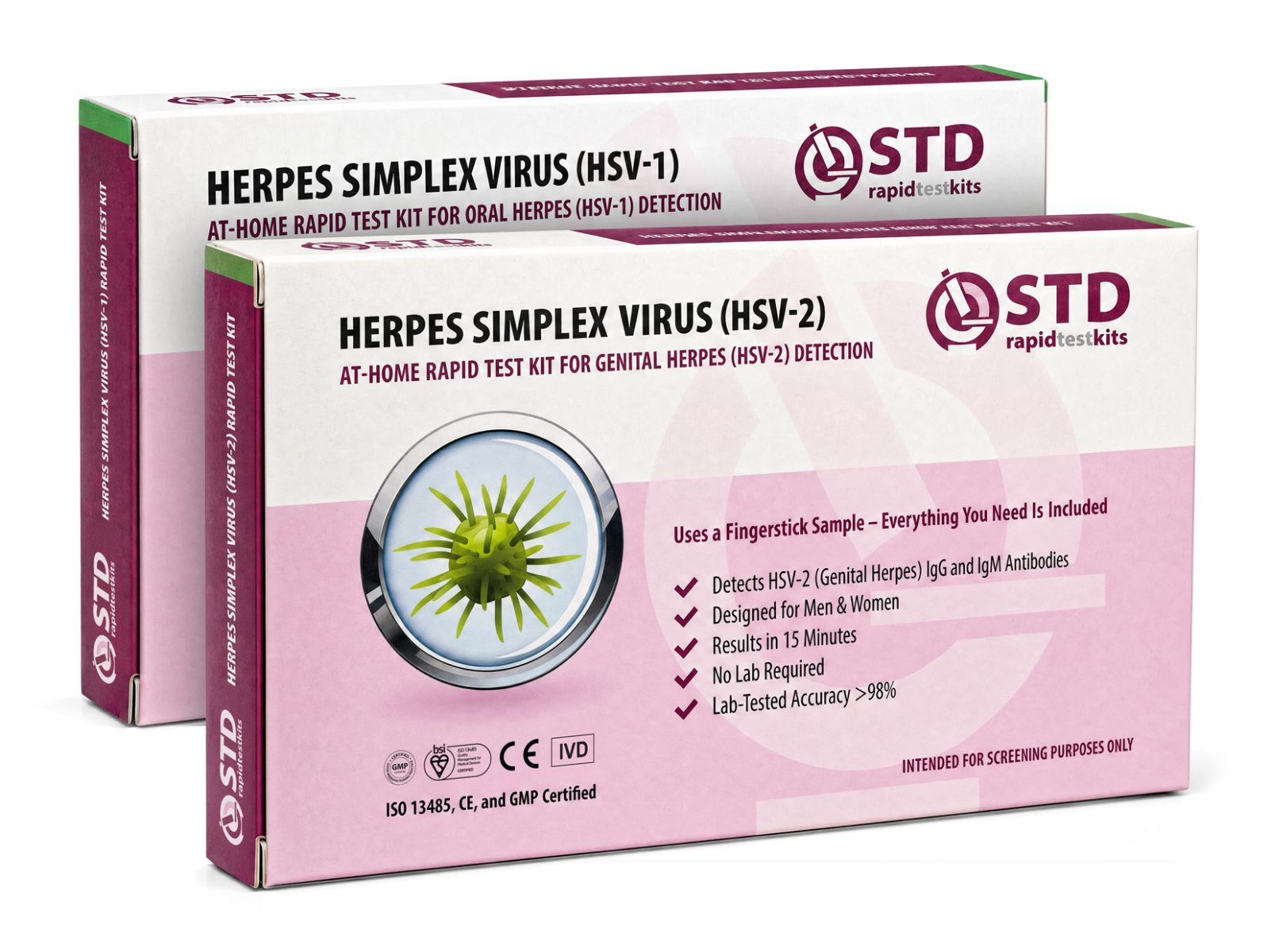
For people who want to know their HSV status across both types, a combined HSV-1 and HSV-2 antibody test answers a different question than a single-type test. It is most useful 12 or more weeks after a suspected exposure, when antibodies have had time to develop.
Pushing Back Against the Shame
There is something deeply personal about your face. When a herpes outbreak shows up there, it can feel like an accusation. The numbers say otherwise. By age 50, the WHO estimates that around two-thirds of the world’s population carries HSV-1. Most got it as small children, from family members, long before sex was part of the picture at all. Many never have a single visible outbreak.
Major medical bodies, including the CDC, treat oral HSV-1 as a common viral skin condition rather than as a disease defined by sexual transmission, even though the virus can be passed sexually. That distinction matters for how clinicians counsel patients, and it removes a layer of moral framing that has done real harm to how people seek care for what is, medically speaking, a manageable condition.
If a sore on your chin is the prompt that finally gets you to think about testing, three accessible next steps cover the common cases: a clinic swab in the first 48 to 72 hours if you currently have an active lesion, a fingerstick blood antibody test 12 or more weeks after a suspected exposure for overall HSV status, and a conversation with a clinician about antivirals to shorten outbreaks or reduce recurrence.
Most HSV infections are asymptomatic or unrecognized, but symptoms of herpes include painful blisters or ulcers that can recur over time.
Frequently Asked Questions
- Can you really get herpes on your chin or jawline, not just the lip?
- Yes. HSV-1 settles in the trigeminal nerve ganglion after initial infection and reactivates along whichever branch is involved. The mandibular branch reaches the chin and jaw, so outbreaks there are a normal variant of oral herpes, not a separate infection or a sign of genital contact.
- How do I tell if a chin bump is herpes or a pimple?
- The clearest early clue is the prodrome: a tingling, burning, or tight sensation a day or two before anything is visible. Pimples do not warn you that way. Herpes lesions also tend to form a cluster of small fluid-filled blisters in one patch, while a pimple is usually a single bump with a whitehead. Acne treatments do not improve herpes and can irritate broken skin. When in doubt, get a swab in the first 48 to 72 hours after blisters appear.
- What if I have never knowingly kissed someone with a cold sore?
- Most people who carry HSV-1 do not remember when they got it, because most infections happen in childhood through close family contact. The virus also spreads through asymptomatic shedding, when someone with no visible sore still releases small amounts of virus from their lips or saliva. You do not need a remembered exposure to be a carrier.
- Does shaving cause facial herpes?
- Shaving does not give you herpes from nothing. It can, however, trigger an outbreak in someone who already carries HSV-1 by creating tiny abrasions where the virus can resurface. If you have ever had a cold sore, consider switching to a fresh razor blade after an outbreak heals, and avoid shaving over an area that is tingling, sore, or visibly broken.
- Is it contagious before any blister appears?
- Yes. The 24 to 48 hours before a visible outbreak, the prodrome stage, is one of the most contagious windows. The virus is already replicating in the skin, but there is nothing visible to warn a partner. This is why people who feel fine can still pass the virus along, and it is why suppressive antiviral therapy can be useful for couples where only one partner has herpes.
- Can a chin outbreak transmit herpes to a partner’s genitals?
- It can, through oral sex. HSV-1 transmitted to the genital region causes genital herpes that behaves like the oral version: outbreaks tied to a specific nerve branch, often less frequent over time. Avoiding oral sex during active outbreaks and the prodrome reduces the risk significantly.
- Can I test for herpes from home?
- For an active sore, a clinic-administered swab in the first few days is the most accurate test. At home, the practical option is a fingerstick blood antibody test, which detects HSV-1 or HSV-2 antibodies several weeks after a suspected exposure. A blood antibody test confirms exposure but does not tie the result to a specific lesion. The two test types answer different questions, and many people benefit from both at different points.
How we sourced this article: We summarized current public-health and clinical guidance on HSV-1, facial herpes, and at-home testing from the World Health Organization, the U.S. Centers for Disease Control and Prevention, the U.K. National Health Service, the Cleveland Clinic, and MedlinePlus. The aim is plain-English clarity for someone trying to figure out what a chin or jaw bump might be, not clinical advice for a specific case. For a specific lesion, see a clinician for a swab.
- World Health Organization. Herpes simplex virus fact sheet, including global HSV-1 prevalence estimates and routes of transmission.
- U.S. Centers for Disease Control and Prevention. About herpes, including the distinction between HSV-1 and HSV-2 and clinical testing guidance.
- U.K. National Health Service. Cold sores overview, including the typical outbreak timeline and practical self-care.
- Cleveland Clinic. Herpes simplex overview, including HSV-1 transmission to the genital region through oral sex and decreasing outbreak frequency over time.
- MedlinePlus (U.S. National Library of Medicine). Herpes (HSV) test, including timing and limitations of antibody-based blood tests.
