

Published: October 2025 | Last updated: April 2026 | Editorial review and quality control: Martina N.
DoxyPEP is one of the most talked-about STI prevention tools in LGBTQ+ communities, and a lot of the online conversation conflates three different questions: who it is officially recommended for, which infections it prevents, and whether it lets you skip routine testing. Those three questions have different answers, and the difference matters.
You took the pill within 72 hours, like you were supposed to. Now what? You still need to test. DoxyPEP shifts the odds for certain bacterial infections, sometimes dramatically, but it does not close the loop on a specific exposure. Testing does that. Below is what the evidence shows about DoxyPEP for trans women, what the evidence cannot yet say about trans men and nonbinary people, what bacterial and viral infections fall outside DoxyPEP's reach, and the testing windows that turn probability into a clear answer.
Disclosure: stdrapidtestkits.com sells at-home rapid STI test kits. We link our own panels in the sections below where they fit the topic; product picks are matched to what each section is about, not to commercial benefit.
Does DoxyPEP work for trans people?
For transgender women with a recent bacterial STI, the CDC formally recommends DoxyPEP. The pivotal DOXY-PEP trial (NEJM 2023) reported roughly 87% reductions in chlamydia and syphilis and around 55% reduction in gonorrhea; the CDC's pooled-data summary in its 2024 guidelines reports somewhat lower per-organism figures (around 70% for chlamydia and syphilis). Trans men and nonbinary people are not yet covered by formal CDC guidance because they were not enrolled in the pivotal trials, though the antibiotic mechanism does not change with gender identity. DoxyPEP does not protect against HIV, herpes, HPV, or hepatitis. Testing at the right window is still required after any potential exposure.
Key Takeaways
- DoxyPEP is a 200 mg dose of doxycycline within 72 hours of sex; CDC 2024 guidance backs it for transgender women with a bacterial STI in the past 12 months, with no formal recommendation yet for trans men or most nonbinary people.
- DoxyPEP only addresses chlamydia, syphilis, and partially gonorrhea; it does nothing for HIV, herpes, HPV, or hepatitis, so testing at the right window remains essential.
What Is DoxyPEP and How Does It Work Against Bacterial STIs?
DoxyPEP stands for doxycycline post-exposure prophylaxis. In plain terms, it is a single 200 mg dose of the antibiotic doxycycline taken as soon as possible after sex, ideally within 24 hours and no later than 72 hours. Think of the framing as a morning-after pill, but for three specific bacterial STIs rather than pregnancy.
Doxycycline blocks bacteria from making the proteins they need to multiply. If Chlamydia trachomatis or Treponema pallidum (the organism that causes syphilis) entered the body during sex, doxycycline at therapeutic levels disrupts replication before the organism can establish infection. The earlier you take the dose, the better it works, which is why 72 hours is the upper bound and why "as soon as possible" carries real biological weight.
DoxyPEP is fundamentally different from HIV prevention tools like PrEP and HIV PEP. Doxycycline is an antibiotic; PrEP and PEP are antiviral. The two systems do not overlap. The landmark DOXY-PEP trial published in the New England Journal of Medicine enrolled more than 500 men who have sex with men and transgender women with a recent STI history, asked them to take 200 mg doxycycline within 72 hours of condomless sex, and tracked outcomes for a year. The trial reported that doxycycline cut overall bacterial STI incidence by roughly two-thirds in that population.
DoxyPEP requires a prescription. It is not over-the-counter. A baseline STI screen before starting and follow-up testing every three to six months are part of standard DoxyPEP care, alongside prescription review and the safety-monitoring checks routine antibiotic use carries.
- Chlamydia (Chlamydia trachomatis): highly susceptible to doxycycline.
- Syphilis (Treponema pallidum): highly susceptible to doxycycline.
- Gonorrhea (Neisseria gonorrhoeae): partially susceptible; tetracycline resistance reduces effectiveness in many circulating strains.
Does DoxyPEP Work for Trans People? What the Evidence Shows
The short answer is yes, the antibiotic works the same way for trans people as it does for anyone else, because bacteria do not respond to gender identity. They respond to antibiotic exposure, drug levels, and their own susceptibility profile.
The longer answer requires being honest about where the evidence is strong and where it has gaps. The clinical trials that established DoxyPEP's effectiveness, including the major DOXY-PEP study run across San Francisco and Seattle, enrolled men who have sex with men and transgender women. Transgender women are specifically represented in the evidence base. The CDC's 2024 clinical guidelines explicitly recommend that providers discuss DoxyPEP with transgender women who have had a bacterial STI in the past 12 months. That is a formal, evidence-backed recommendation, not informal guidance.
For transgender men and nonbinary people, the picture is less defined. The CDC currently gives no formal recommendation for trans men and most nonbinary individuals, citing insufficient evidence. The mechanism would be expected to work; the populations were simply not included in the pivotal trials. Some local health departments, including Seattle and San Francisco, have begun encouraging providers to consider DoxyPEP through shared decision-making for people assigned female at birth across gender identities who carry particularly high bacterial STI risk. The biological basis does not change with identity, but the formal evidence base does, and that is the gap the conversation has to acknowledge.
Awareness and access remain real barriers even among the populations with the strongest formal recommendation. Recent surveillance data on DoxyPEP awareness among transgender women in San Francisco found that uptake substantially lagged eligibility, with most respondents either unfamiliar with DoxyPEP or unable to access a prescriber comfortable writing it. If you are trans and your provider has not raised DoxyPEP with you, that is a gap in your care worth raising directly at your next visit.
| Population | CDC 2024 Recommendation | Key condition |
|---|---|---|
| Transgender women | Formally recommended; providers should discuss | Bacterial STI diagnosed in the past 12 months |
| Gay, bisexual, MSM | Formally recommended; providers should discuss | Bacterial STI diagnosed in the past 12 months |
| Transgender men | No formal recommendation; insufficient trial evidence | Shared decision-making with provider advised |
| Nonbinary individuals | No formal recommendation; insufficient trial evidence | Some local guidelines (e.g., Seattle, San Francisco) expand access |
| Cisgender women | No recommendation; one trial showed no benefit | Research ongoing; discuss with provider |
What DoxyPEP Covers, and What It Cannot Touch
This is where many people get tripped up, because "STI prevention" sounds broader than DoxyPEP is. DoxyPEP targets specific bacteria. Its protection is defined by microbiology, not by branding.
For chlamydia, the protection is strong. Chlamydia trachomatis remains highly sensitive to doxycycline, and the DOXY-PEP trial reported risk reductions of roughly 87 to 88 percent. For syphilis, the figures are similar, with about 87 percent risk reduction in the major trials. These are the two infections where DoxyPEP performs consistently well, because neither organism has developed meaningful resistance to doxycycline despite decades of clinical use.
Gonorrhea is a different story. The DOXY-PEP trial reported around 55 percent risk reduction overall, while other studies and real-world settings have reported smaller effects. The variability comes down to tetracycline resistance. Neisseria gonorrhoeae has developed resistance to doxycycline in a meaningful share of circulating strains, especially at pharyngeal sites where bacterial loads are higher and resistance patterns differ from urogenital infections. In practical terms, DoxyPEP may help with gonorrhea, or it may not, depending on the strain you encountered. Testing after any potential gonorrhea exposure remains essential regardless of DoxyPEP use.
Then there is everything else, where DoxyPEP offers nothing. HIV, herpes (HSV-1 and HSV-2), HPV, hepatitis B, and hepatitis C are viral infections, and antibiotics have no mechanism by which to prevent them. If anyone has told you DoxyPEP covers HIV, that is the most common misconception in this space and it needs to be corrected before any prevention plan is built around it.
Doxycycline is an antibiotic with no antiviral activity. If HIV exposure is a concern, that is a separate, time-sensitive conversation about HIV PEP (within 72 hours of exposure) or PrEP (ongoing). DoxyPEP and HIV prevention tools work side by side; they do not substitute for one another.
If You Are on HRT: What to Tell Your Prescriber
Doxycycline has fewer drug interactions than many antibiotics, but if you are on hormone therapy, your prescriber needs the full picture. There is a moderate documented interaction between doxycycline and estradiol that is rarely clinically significant at the single-dose level DoxyPEP involves, but the interaction is part of your medication record. Testosterone, GnRH analogues, and progestins do not have meaningful documented interactions with doxycycline, but mention them anyway.
Photosensitivity is another point worth mentioning to your prescriber. Doxycycline can amplify sunburn risk for several days after a dose, so if your encounter lands the day before a beach trip or an outdoor festival, plan extra sun protection accordingly.
Doxycycline absorption drops sharply if you take it within two hours of antacids, calcium supplements, iron tablets, or a high-calcium dairy meal. Space those products out by at least two hours in either direction, and take the dose with a full glass of water while staying upright for 30 minutes after to reduce esophageal irritation.
When Should You Test After Using DoxyPEP?
You took DoxyPEP. Now you wait, but not for symptoms, because most bacterial STIs do not produce reliable early symptoms. You wait for the right testing window, which is determined by biology, not by how confident you feel that the dose worked.
One detail that often gets missed: DoxyPEP can delay detection. If the antibiotic partially suppressed bacterial replication without fully clearing the infection, there may temporarily be too little bacterial DNA in the sample for a NAAT to register a positive, even when an infection is present. Testing too early after exposure can produce a false negative. The windows below are when you can trust the result.
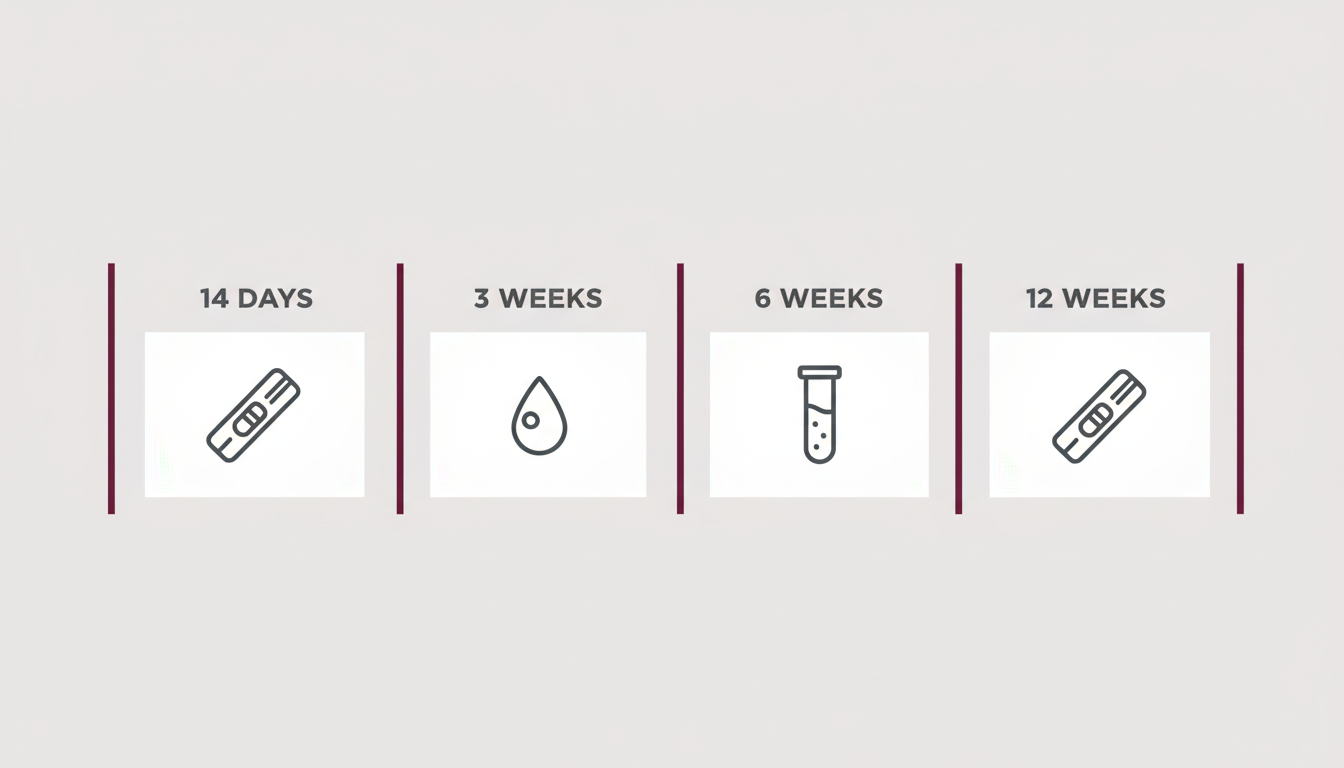
| Infection | When to test after exposure | Test type |
|---|---|---|
| Chlamydia | 14 days | NAAT (detects bacterial DNA) |
| Gonorrhea | 3 weeks | NAAT at all exposed sites (urethra, throat, rectum) |
| Syphilis | 6 weeks | Blood antibody test |
| HIV | 6 weeks first; retest at 12 weeks for certainty | Blood antigen/antibody (4th-gen) |
| Herpes (HSV-1, HSV-2) | 6 to 12 weeks | Blood IgG antibody |
| Hepatitis B | 6 weeks | Blood surface antigen and antibody |
| Hepatitis C | 8 to 11 weeks | Blood antibody |
Does DoxyPEP Affect Your STI Test Results?
Yes, but not in the way most people fear. DoxyPEP does not hide infections you already had before the exposure event, and it does not produce false positives. What it can do is temporarily reduce bacterial load to a level below the test's detection threshold during the window immediately after exposure.
For NAAT testing, the gold-standard method labs use for chlamydia and gonorrhea, the assay looks for bacterial DNA. If DoxyPEP partially knocked back replication without full clearance, DNA may briefly be undetectable, then rebound to detectable levels later. This is not a flaw in the test; it is a timing issue. Testing at the recommended window (14 days for chlamydia, 3 weeks for gonorrhea, 6 weeks for syphilis) avoids this entirely. If symptoms appear after a negative result, retest.
Antibody-based blood tests for syphilis, HIV, herpes, and hepatitis behave the same whether or not doxycycline was in your system, because the immune response that produces antibodies runs on its own clock independent of antibiotic exposure.
Antimicrobial Resistance: The Real Reason Rollout Has Been Cautious
If DoxyPEP works, the obvious question is why every clinic does not hand it out. The honest answer is bacterial resistance. Doxycycline does not act only on STI organisms. It affects gut flora, the skin microbiome, and the broader bacterial ecosystem you carry. Population-level overuse of any antibiotic accelerates resistance, and resistance erodes future treatment options for infections far beyond STIs.
Gonorrhea is the sharpest edge of this concern. Neisseria gonorrhoeae already shows high tetracycline resistance globally, and surveillance data continues to show resistance creeping upward. Public health clinicians worry that widespread DoxyPEP use could push resistance further, eventually compromising doxycycline as a first-line tool against other infections like community-acquired pneumonia, tick-borne disease, and skin infections.
This is not a moral judgment about people who use DoxyPEP. It is a systems-level question about sustainability. The CDC's current guidance reflects the resulting balance: target the populations where the bacterial-STI prevention benefit is largest and most clearly documented (men who have sex with men and transgender women with recent bacterial STIs), keep collecting real-world data, and continue to evaluate broader use as evidence accumulates. If you fall inside the recommended population, the individual-level math favors using DoxyPEP. The system-level math is why the recommendation is not yet "everyone takes it after every encounter."

Cost and Access: What to Expect
Doxycycline is generic and inexpensive. A short course of 200 mg tablets typically costs under twenty dollars at retail, and many health departments dispense doses to eligible patients at no charge. The barrier in 2026 is access, not cost.
Most insurance carriers do not yet list DoxyPEP as a covered preventive service, so out-of-pocket payment for the office visit can outweigh the drug cost. Some clinics, particularly LGBTQ+-affirming primary care and sexual-health centers in major metro areas, have integrated DoxyPEP into their standard menu. Telehealth platforms in some states now offer DoxyPEP consults for eligible patients. Rural areas, smaller health systems, and clinicians less familiar with the 2024 CDC guidance often have not, and patients sometimes leave appointments having heard "that is not something I prescribe" without a clear referral path.
If your provider does not offer DoxyPEP, ask for a referral to an infectious disease specialist or a sexual-health clinic. State and city health department STI programs typically maintain searchable provider directories online, often filterable by zip code or by which clinics use sliding-scale fees.
Local public health clinic: Many city and state STI programs dispense doses to eligible patients at no charge and run baseline STI screening on-site. Search your state or county health department website for STI-program clinic locations.
Telehealth services: In a growing number of states, telehealth platforms run DoxyPEP consults for eligible patients, with prescriptions filled at a partner pharmacy. Confirm state availability and that the platform requires baseline STI screening before prescribing.
Talking to Your Provider About DoxyPEP
DoxyPEP is a prescription medication, so getting access means a real conversation with a clinician, ideally one who is up to date on the 2024 CDC guidance and comfortable discussing your sex life without judgment. A few specifics make that conversation more productive.
Bring your STI history from the past 12 months. The CDC recommendation for transgender women is tied to having had at least one bacterial STI (chlamydia, gonorrhea, or syphilis) in the past year, and that is the population where the evidence is clearest. Without a recent bacterial STI, DoxyPEP can still be discussed through shared decision-making, but the risk-benefit calculation depends on your specific situation, partner network, and local STI rates.
Walk through your medication list, including HRT, any other prescriptions, supplements (calcium, iron, magnesium), and antacid use. The interactions are mostly about absorption timing rather than absolute contraindications, but your prescriber needs the full picture to write the dose schedule correctly.
Local gonorrhea resistance is worth raising directly. If you live in an area with high tetracycline-resistant gonorrhea, your clinician may counsel that DoxyPEP's gonorrhea protection is reduced. That does not invalidate the chlamydia and syphilis benefit, which is substantial, though it does reinforce that gonorrhea testing remains non-negotiable.
Build follow-up STI testing every three to six months into the plan from the start. That cadence is part of the protocol, not an optional extra; it is the same framework that PrEP programs use, and it is how clinicians monitor for breakthrough infections and emerging resistance.
DoxyPEP and PrEP: Different Tools, Same Strategy
If you are on PrEP for HIV prevention, you are part of the population where DoxyPEP research has been strongest. The two tools target different organisms and complement each other rather than overlap. Many providers who prescribe PrEP are now also comfortable prescribing DoxyPEP for eligible patients, because the same regular touchpoints (quarterly check-ins, baseline screening, lab work) fit a DoxyPEP protocol cleanly.
If you are interested in DoxyPEP and already on PrEP, raising it at your next PrEP visit is the most efficient path. Your clinician already has your history, and the testing rhythm DoxyPEP requires is the rhythm a PrEP regimen already runs on.
Both protocols rely on STI screening every three months and ongoing provider check-ins. If you are already on PrEP, the testing rhythm DoxyPEP needs is the rhythm you already have, so adding it usually means a single conversation at your next quarterly visit rather than a new appointment.
Why DoxyPEP Is Not a Replacement for Testing
Even when DoxyPEP works exactly as intended, it reduces risk; it does not eliminate it. The trials showed large risk reductions for chlamydia and syphilis, but not zero transmission. For gonorrhea, the variability is wide enough that assuming the dose worked is not justified. Exposures are not resolved just because you took the pill. They have to be confirmed, one way or another, with a test at the right window.
And then there is everything DoxyPEP does not cover. HIV, herpes, HPV, and hepatitis are not edge cases. HIV is a legitimate concern after many sexual exposures, and herpes is extraordinarily common and frequently transmitted without symptoms. A DoxyPEP routine that does not include regular testing for viral infections leaves a gap that can go undetected for months. The point of pairing DoxyPEP with regular testing is to convert probability into clear answers across the full menu of risks, not just the three bacteria doxycycline addresses.
CDC recommends that providers counsel gay, bisexual, and other men who have sex with men and transgender women who have had a bacterial sexually transmitted infection in the past 12 months on the benefits and harms of doxycycline postexposure prophylaxis.
Frequently asked questions
- Does DoxyPEP work differently for trans people than for anyone else?
- Biologically, no. The antibiotic interferes with how bacteria replicate, a process that does not vary with gender identity. Trans women are specifically included in the clinical trials and the CDC 2024 guidelines. For trans men and nonbinary individuals, the mechanism is the same, but the formal evidence base is smaller because they were not enrolled in the pivotal trials. The CDC currently makes no formal recommendation for those groups, so the conversation defaults to shared decision-making with a provider familiar with local STI rates.
- How long after sex do I have to take DoxyPEP for it to work?
- Within 72 hours, with sooner being better. The most effective window is the first 24 hours. Treat the timing the way you would the morning-after pill: the clock starts when sex happens, not when you remember the prescription is in your medicine cabinet.
- If I took DoxyPEP, do I still need to get tested?
- Yes, and the specific window matters. For chlamydia, test at 14 days; gonorrhea at 3 weeks; syphilis at 6 weeks. For HIV, herpes, and hepatitis, DoxyPEP offers nothing at all, so those windows are unchanged regardless of whether you took the dose. Trial-level risk reductions are population averages, not guarantees for any specific exposure.
- Can DoxyPEP cause a false negative on an STI test?
- Yes, if you test too early. Partial bacterial suppression by doxycycline can drop DNA below a NAAT's detection threshold immediately after exposure, then DNA can rebound to detectable levels later. Testing at the standard window (14 days for chlamydia, 3 weeks for gonorrhea, 6 weeks for syphilis) avoids this. Antibody-based tests for syphilis, HIV, herpes, and hepatitis are not affected by DoxyPEP at all.
- Does DoxyPEP protect against HIV?
- No. This is the single most common misconception. HIV is a virus, doxycycline is an antibiotic, and antibiotics have no antiviral activity. If HIV exposure is a concern, that is a separate, time-sensitive conversation about HIV PEP (within 72 hours) or PrEP (ongoing). The two prevention systems can run in parallel, but DoxyPEP cannot substitute for either.
- What about herpes, HPV, or hepatitis?
- DoxyPEP does nothing for any of them. HSV-1, HSV-2, HPV, hepatitis B, and hepatitis C are all viral. For herpes specifically, the testing window is 6 to 12 weeks after exposure for an antibody-based blood test. For hepatitis B, it is around 6 weeks. For hepatitis C, 8 to 11 weeks.
- I am on HRT. Is DoxyPEP safe to take with my hormones?
- For most people, yes, with one absorption note: doxycycline absorption drops sharply if you take it alongside antacids, calcium, iron, or large dairy doses, so separate those by at least two hours. There is a moderate documented interaction between doxycycline and estradiol that is rarely clinically significant at DoxyPEP's single-dose level, but tell your prescriber your full medication list including HRT so they can confirm fit for your situation.
- How often should someone on DoxyPEP get tested?
- Every three months is the standard cadence for people at higher STI risk, which is generally the population using DoxyPEP. Quarterly testing is built into responsible DoxyPEP prescribing, alongside an annual HIV test if you are not on PrEP and routine syphilis screening. Follow-up visits are part of the protocol, not optional extras.
- Can I just buy doxycycline online and use it as DoxyPEP?
- In the United States, doxycycline requires a prescription, and informal sourcing bypasses the baseline STI testing, medication review, and follow-up monitoring that responsible DoxyPEP use requires. Beyond the legal issue, it skips the surveillance the public-health system uses to track resistance. If your current provider will not prescribe DoxyPEP and you meet the CDC criteria, ask for a referral to a sexual-health clinic, infectious disease specialist, or telehealth service that does.
- U.S. Centers for Disease Control and Prevention. Clinical Guidelines on the Use of Doxycycline Postexposure Prophylaxis for Bacterial Sexually Transmitted Infection Prevention, United States, 2024. Source for the formal recommendation that providers discuss DoxyPEP with transgender women and MSM with a bacterial STI in the past 12 months, the pooled per-organism efficacy figures, and the absence of a formal recommendation in trans men, nonbinary people, and cisgender women.
- Luetkemeyer AF, et al. Postexposure Doxycycline to Prevent Bacterial Sexually Transmitted Infections. New England Journal of Medicine, 2023. Source for the DOXY-PEP trial design (enrollment of MSM and transgender women with recent STI history), the roughly two-thirds reduction in overall bacterial STI incidence, and the per-organism risk reductions cited in this article (chlamydia ~87-88%, syphilis ~87%, gonorrhea ~55%).
- U.S. Centers for Disease Control and Prevention. Preventing STIs with Doxy PEP. Patient-facing guidance describing the 200 mg dose, the 72-hour window, and the populations the CDC specifically counsels providers to discuss DoxyPEP with.
- World Health Organization. Sexually Transmitted Infections (STIs) fact sheet. Background source for global STI prevalence and the bacterial-versus-viral distinction that defines what DoxyPEP can and cannot prevent.
- European Centre for Disease Prevention and Control. Public health considerations on the use of doxycycline post-exposure prophylaxis for bacterial sexually transmitted infections. Source for the antimicrobial resistance discussion, including concerns about tetracycline resistance in Neisseria gonorrhoeae and population-level effects of expanded doxycycline use.
- U.S. Centers for Disease Control and Prevention. Sexually Transmitted Infections Treatment Guidelines, 2021 (and subsequent updates). Source for the testing windows in the table and the recommendation to test gonorrhea at all exposed anatomic sites.
- National Center for Biotechnology Information Bookshelf. Doxycycline Post-Exposure Prophylaxis to Prevent Bacterial STIs (open-access overview). Alternative open-access reference summarising the DOXY-PEP trial findings cited from NEJM, useful when the NEJM full text is paywalled.
