
Published: November 2025 | Last updated: May 2026 | Editorial review and quality control: Martina N.
You opened the kit. You pricked your finger. Now you are staring at a small plastic cassette, watching for lines to appear, wondering whether what you see counts as an answer. A herpes rapid test is straightforward once you know what to look for; the in-between moment, waiting for the result window to settle, is where confusion sets in. This guide walks through every step: what each line means, what can invalidate the test, when to retest, and what to do if your result is positive.
This article is published by stdrapidtestkits.com, which sells at-home STI testing kits. We recommend products based on fit-for-purpose for the reader's concern, not commercial benefit. The medical content below summarizes current CDC, WHO, NHS, and FDA guidance.
Key Takeaways
- A valid herpes rapid test always shows a clear control line at C. A second line at T means positive, even if the line is very faint.
- Read the result inside the 10 to 20 minute window. Lines that appear later are evaporation lines and cannot be trusted as positive or negative.
What's in the Box (And Why It Matters)
Every at-home herpes test kit ships with the same essentials, though packaging varies by brand. The components below appear in nearly every rapid blood-based herpes kit on the market. Some kits also include a bandage and a desiccant packet, but the core six stay the same across vendors.
It is tempting to tear into the kit and rush through the steps when you are anxious. That is where mistakes happen. Moisture exposure, improper storage (a hot car or a freezing garage), or an expired kit can all sabotage your result before the first drop of blood reaches the strip. Check the expiration date stamped on the foil pouch, keep the cassette sealed inside its pouch until the moment you use it, and store the box between 36°F and 86°F (2°C to 30°C). These small habits make the difference between a usable test and a wasted one.
Before you begin, confirm your kit contains all six core components:
- Sterile lancet for the fingerstick
- Alcohol prep pad
- Plastic dropper or pipette
- Test cassette inside a sealed foil pouch
- Buffer solution tube
- Printed instruction leaflet listing the read window for your specific kit
If anything is missing or the foil pouch is already open, contact the seller before using the kit.
Before You Begin: Prep Like It Matters
Wash your hands with warm soap and water and dry them thoroughly. Choose a clean, flat surface with strong, direct lighting; natural light near a window is ideal because it makes faint result lines easier to read. Lay every component out within reach so you are not searching for a missing pipette while a drop of blood sits on your finger.
This is also the moment to slow down. The anxiety that brought you to the kit is real, and a few deep breaths before the lancet click will make the procedure feel less rushed. Some people set a short timer to let themselves settle before they start; others put on a familiar podcast in the background. The point is to lower your heart rate before the test begins, because rushed movements are how a sample gets contaminated or a cassette gets jolted.
Run this checklist before opening the lancet:
- Hands washed with soap and warm water, then dried thoroughly
- Clean, flat surface under strong direct lighting (a window or a bright lamp)
- All kit components within reach, with the cassette still inside its sealed foil pouch
- A timer ready on your phone, set for the read window listed in your kit's instructions
- A tissue or paper towel for the fingerstick
The Test, Step by Step
Open the alcohol prep pad and wipe the side of your fingertip (the side, not the pad, because the side is less sensitive and bleeds more reliably). Let it air dry for about 10 seconds. Do not blow on it; your breath can introduce skin oils and bacteria onto the cleaned area. While you wait, twist off the cap of the lancet and hold it ready in your dominant hand.
Press the lancet firmly against the side of your fingertip and trigger the spring-loaded needle. There is a short, sharp sting, and then it is over. Squeeze the finger gently from the base toward the tip to encourage a single round drop to form (most kits require about 10 to 20 microliters, which is roughly one full drop). Use the pipette to collect the blood and place it into the sample well marked S on the cassette. Then add 1 to 2 drops of buffer solution to the same well or to the dedicated buffer well, depending on your kit's instructions.
Set a timer for the read window your kit specifies (most commonly 10 to 15 minutes, with a hard cutoff at 20 minutes). Do not check early; faint lines forming during the chemistry reaction can look stronger or weaker than the final result. Do not check late; any new lines that appear after the cutoff are called evaporation lines and have no diagnostic meaning.

Reading Your Herpes Test Cassette: Lines, Shadows, and Everything in Between
After the read window opens, the result panel on your cassette shows one of three patterns: a single line at C (negative), two lines at C and T (positive), or no line at C (invalid). Each pattern has a specific meaning, and the difference between a faint line and no line is one of the most-Googled questions in at-home herpes testing.
A faint T line still counts as positive. Even if the T line appears ghostly pale, light pink, or barely there, the chemistry that produces it requires actual HSV-2 antibodies in your blood sample. A faint line typically means antibody levels are on the lower end of the detectable range, often because the infection is recent or your immune response is mild, but the test has detected the antibodies all the same. Do not wait for the T line to darken before deciding; do not keep checking after the 20-minute mark hoping it changes. The cassette captures a snapshot of the antibody chemistry within a narrow time window, and a result that drifts afterward is no longer trustworthy.
If you are still unsure after reading, take a photo of the cassette inside the valid window under good neutral lighting. Compare it to the reference card included with your kit, or check the manufacturer's website, which often has a photo library of valid result patterns across different skin tones and ambient light. A second pair of eyes (a clinician via telehealth, for example) can confirm a borderline read.
| Result | Line Pattern | What It Means |
|---|---|---|
| Negative | Line at C only | No detectable HSV-2 antibodies in the blood sample. You may still be inside the window period; retest if the exposure was recent. |
| Positive | Lines at C and T (even faint) | HSV-2 antibodies present. Confirm with a type-specific lab test, especially if you are asymptomatic or the line is very faint. |
| Invalid | No line at C | The test malfunctioned. The result cannot be interpreted regardless of what shows at T. Use a fresh kit. |
What Can Invalidate the Test
Sometimes the test simply does not work. The control line never appears, the blood does not flow across the cassette, or the result window looks smudged and unreadable. That is not your fault, and it does not mean you did anything wrong; it means the chemistry was disrupted somewhere along the way.
If your test shows no control line at all, stop the read there. The result cannot be interpreted regardless of what else you see at T. Dispose of the cassette safely and start over with a fresh kit. Many brands offer customer-support replacement guarantees for confirmed defective lots, so save the lot number printed on the foil pouch before you contact support.
The most common reasons a test comes back invalid:
- Using an expired kit. Always check the date stamped on the foil pouch before opening.
- Sample size off-target: too little blood, too much buffer, or both.
- Reading the result outside the valid time window, either before 10 minutes or after 20.
- Environmental disruption like high humidity, direct heat, or a contaminated workspace.
- Damaged components or packaging that was previously opened and resealed.
Herpes Test Window Period: When You Test Matters
If your result came back negative but something still feels off (a tingle, a small sore, a vague worry that will not let go), timing might be the answer. HSV-2 antibody tests, including most home rapid tests, detect IgG antibodies that the immune system produces in response to infection. Those antibodies take time to build up to a detectable level. According to CDC screening guidance for genital herpes, it can take up to 16 weeks or more after exposure for current antibody tests to detect HSV-2 infection. Many people develop detectable antibodies several weeks earlier than that ceiling, but a single early negative is not a final answer.
If you test inside the first two weeks of a known exposure and your result is negative, plan a follow-up. The general rhythm clinicians use is to retest at about 6 weeks for an updated read, then again at 12 to 16 weeks for near-complete certainty. If you have active symptoms now (genital sores, tingling, a vesicular cluster), a clinic-administered swab or PCR of the active lesion is faster and more direct than an antibody test, because the swab looks for the virus itself rather than waiting for your antibody response to build.
The opposite case also matters. Herpes can stay dormant for years after the initial infection, so a positive antibody test does not tell you when you acquired the virus or from whom. Some people only learn they have HSV-2 years after transmission, often after a partner is diagnosed or a first visible outbreak finally appears. The biology of seroconversion is not a clean timeline; it is closer to a wide window with edges in both directions.
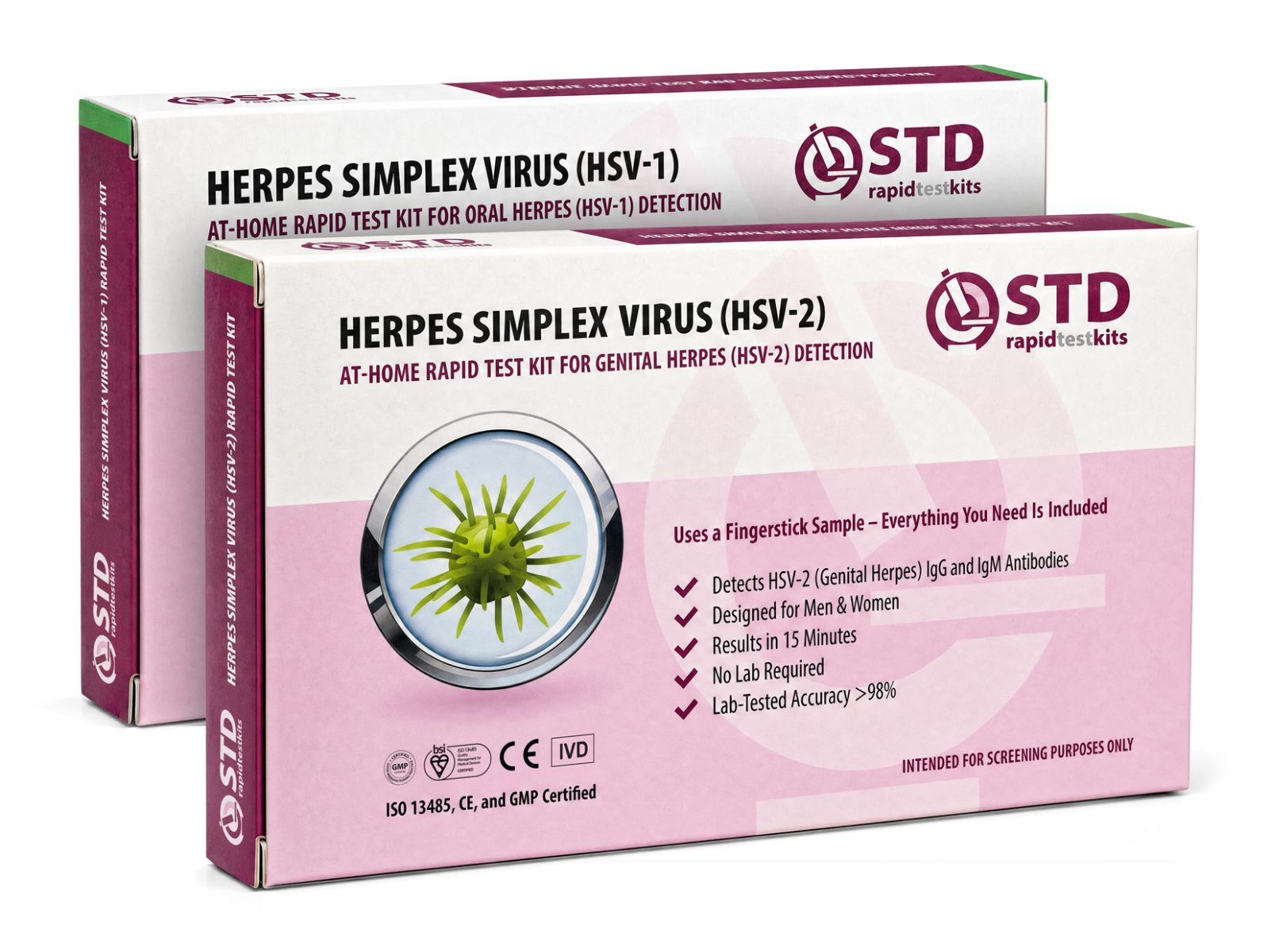
An estimated 520 million people aged 15 to 49 worldwide have HSV-2 infection. Most HSV infections are asymptomatic or unrecognized.
What If You Test Positive
You see two lines on the cassette, one at C and one at T, and the next minute feels like an hour. A positive antibody test opens a conversation about next steps; it does not close the case on your health.
A positive home rapid test means your immune system has produced HSV-2 antibodies, which means at some point you have been exposed to the virus. It does not tell you when you were exposed, from whom, or whether you are currently shedding the virus. According to the CDC 2021 STI Treatment Guidelines for genital herpes, the next clinical step is confirmation with a type-specific lab assay (commonly an HSV-2-specific IgG ELISA, with a Western blot reserved for borderline screening results or low pretest probability). The reason for confirmation is straightforward: home rapid tests are screening tools, and any positive screen on a YMYL health condition deserves a confirmatory lab test.
If confirmation comes back positive, daily suppressive antiviral therapy (acyclovir, valacyclovir, or famciclovir) reduces outbreak frequency and lowers transmission risk to partners. Episodic therapy at the first sign of an outbreak shortens the episode. Many people on suppressive therapy go years without an outbreak; some never have a visible outbreak at all. Herpes is common, well-studied, and clinically manageable, even if the cultural stigma around it has not caught up to the medical reality.
- Confirm the result with a type-specific lab assay (most commonly HSV-2-specific IgG ELISA, with Western blot reserved for borderline screens).
- Discuss antiviral therapy options with a clinician. Daily suppressive therapy reduces outbreak frequency and lowers transmission risk to partners.
- Notify recent sexual partners so they can choose to test. Many state public-health departments offer free anonymous partner-notification services.
Testing for Other STIs at the Same Time
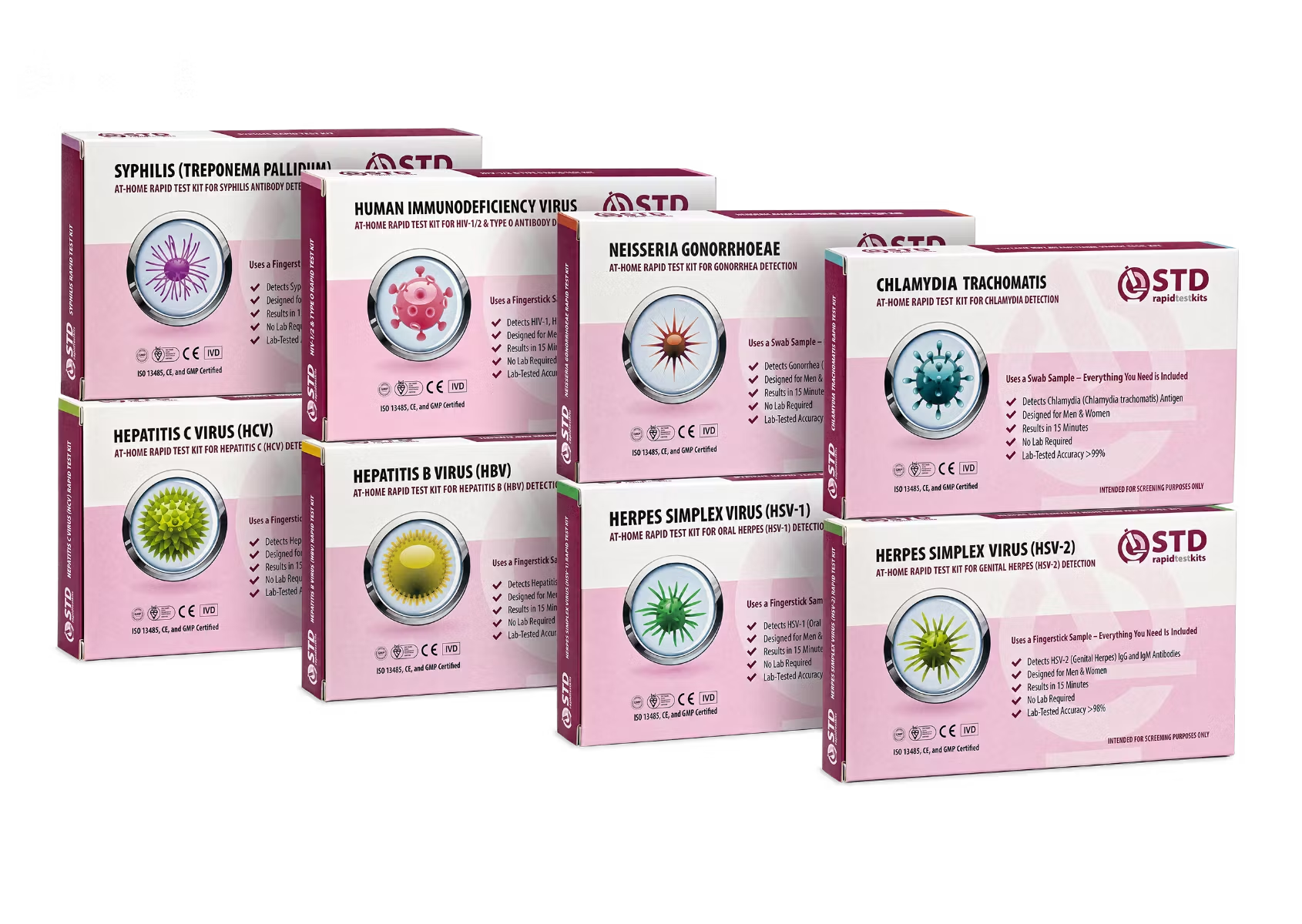
A positive home herpes result often raises the same question that brought you to the kit in the first place: what else might be worth checking? Co-screening for the most common bacterial and bloodborne STIs is a clinically reasonable next step, particularly after a known exposure event. An 8-in-1 home kit covers HIV, syphilis, hepatitis B, hepatitis C, herpes, chlamydia, gonorrhea, and trichomoniasis in a single session, which is more efficient than ordering separate kits for each infection.
Disposal, Privacy, and Emotional Aftercare
Once you have read the result, photographed it for your records, and recorded the date, dispose of the test materials safely. The lancet and the cassette have come into contact with blood, so seal them inside a small plastic bag (an opaque ziplock works well) before placing the bag in your household trash. Do not flush any component. Do not leave the cassette exposed where a roommate or visitor might handle it.
If privacy from a roommate, partner, or family member is part of why you tested at home, you can wrap the kit waste in a layer of tissue or paper towel inside the sealed bag before discarding. Some kits include opaque disposal pouches; if yours did not, a small black bin liner serves the same purpose. Most at-home kits also ship in unmarked outer packaging (no brand logos, no "STD" wording on the label), which makes the delivery itself low-visibility from the outside.
And then there is the emotional cleanup. A negative result can still leave you shaken, especially if symptoms are still bothering you. A positive result can trigger a wave of questions about partners, future relationships, and self-image. Both reactions are normal. If you can, talk to someone you trust before the next online search spiral begins. A clinician, a sex-positive therapist, or a peer-support helpline can help untangle the medical facts from the cultural noise around herpes.
Frequently Asked Questions
- Does a faint T line count as positive?
- Any visible mark at the T position counts as positive. The chemistry that produces the line requires actual HSV-2 antibodies in the sample, so a pale or ghost-like band is not ambiguous; it is just a band on the lighter end of the detectable range. Follow up with a type-specific lab assay before acting on a faint positive, because confirmatory testing separates true positives from the small false-positive rate that rapid screens carry.
- How soon after exposure can I take the test?
- HSV-2 IgG antibody tests look for an immune response that takes weeks to build. CDC screening guidance states that current antibody tests can take up to 16 weeks or more after exposure to detect infection. Many people seroconvert sooner, but testing inside the first two weeks of a known exposure carries a real risk of a false negative. If you test early and the result is negative, plan a retest at 6 weeks and again at 12 to 16 weeks before treating the negative as conclusive.
- There is no line at C at all. What happened?
- If the control line does not appear, the test did not run correctly. The cassette may have been expired, the buffer volume may have been off, or environmental factors (high humidity, direct heat) may have disrupted the chemistry. The result is invalid regardless of what shows at T. Discard the cassette and use a fresh kit. Many brands offer replacement for confirmed defective lots, so save the lot number stamped on the foil pouch if you contact customer support.
- Can I test positive even if I have never had symptoms?
- Yes, and this is common. The WHO notes that most HSV infections are asymptomatic or unrecognized. Some people never develop outbreaks; others have outbreaks so mild (a small razor-burn-like irritation, an ingrown-hair-shaped bump) that they are misattributed to something benign. A positive antibody test indicates exposure to the virus at some point. It does not necessarily indicate current symptoms or recent transmission.
- What if my result line only appears after 15 minutes?
- Lines that appear outside the valid read window (typically 10 to 20 minutes, depending on the kit) are evaporation lines, not antibody-driven lines. They form because the cassette chemistry dries unevenly after the reaction window closes. Evaporation lines have no diagnostic meaning. Always read the result inside the window specified in your kit's instructions, and disregard anything that develops afterward.
- I tested negative but I still have symptoms. Now what?
- Persistent symptoms after a negative result point in two directions: the cause may be something other than HSV-2 (a yeast infection, bacterial vaginosis, contact irritation, another STI) or it may be HSV-2 inside the window period. Two practical next steps: retest for HSV-2 at 6 weeks past suspected exposure, and see a clinician for a same-day swab of any active lesions so they can test the lesion directly with PCR rather than waiting for antibodies.
- Can a home herpes test be wrong?
- Rapid antibody tests have known limitations. False negatives can occur if you test inside the window period before antibodies have developed. False positives can occur from cross-reactivity, low pretest probability of infection, or assay-specific issues. The FDA has published safety communications noting that HSV-2 serologic assays can produce false reactive results, which is why confirmation with a type-specific lab assay is the standard next step after any positive home result.
- How should I tell a partner if I test positive?
- Direct and unembellished works best: "I just got tested and the result was positive for HSV-2. I want to talk through what that means for us." Bring facts the conversation can rest on (transmission risk reduction with daily antivirals, condom use, suppressive therapy options) rather than apologies. Many state public-health departments offer free anonymous partner-notification services if you prefer to inform past partners without identifying yourself.
How We Sourced This Article: We combined current guidance from the most prominent public health and medical organizations with practical advice on how the test cassette actually behaves at home. Sources include the CDC 2021 STI Treatment Guidelines, CDC screening recommendations for genital herpes, the WHO HSV fact sheet, and the NHS and Mayo Clinic patient-facing overviews. The result is a practical guide for reading a rapid herpes test, understanding the window period, and deciding the next step after a positive or negative result.
- U.S. Centers for Disease Control and Prevention. Screening recommendations and rationale for genital herpes (HSV), including the statement that current antibody tests can take up to 16 weeks or more after exposure to detect infection.
- U.S. Centers for Disease Control and Prevention. Genital Herpes section of the 2021 STI Treatment Guidelines, covering diagnosis, type-specific serologic testing, antiviral therapy, and partner management.
- World Health Organization. Herpes simplex virus fact sheet, source for the 520 million HSV-2 global prevalence estimate and the note that most HSV infections are asymptomatic or unrecognized.
- NHS. Genital herpes overview including transmission, symptom patterns, and the testing pathway for suspected infection.
- Mayo Clinic. Genital herpes diagnosis and treatment overview, covering antibody testing, viral PCR of lesions, and antiviral therapy options.
