
Published: November 2025 | Last updated: April 2026 | Editorial review and quality control: Martina N.
Testing positive for gonorrhea is jarring, even when the symptoms are mild or completely absent. The next question is rarely about treatment cost or the antibiotic name. It is whether you can still have sex, when, and how to handle the next few weeks without panic, shame, or a second round of infection. This guide walks the timeline from positive result to safely resuming intimacy, using the steps the CDC and other public-health agencies actually recommend, and lays out where at-home testing helps and where it does not.
When is sex safe again after a gonorrhea diagnosis?
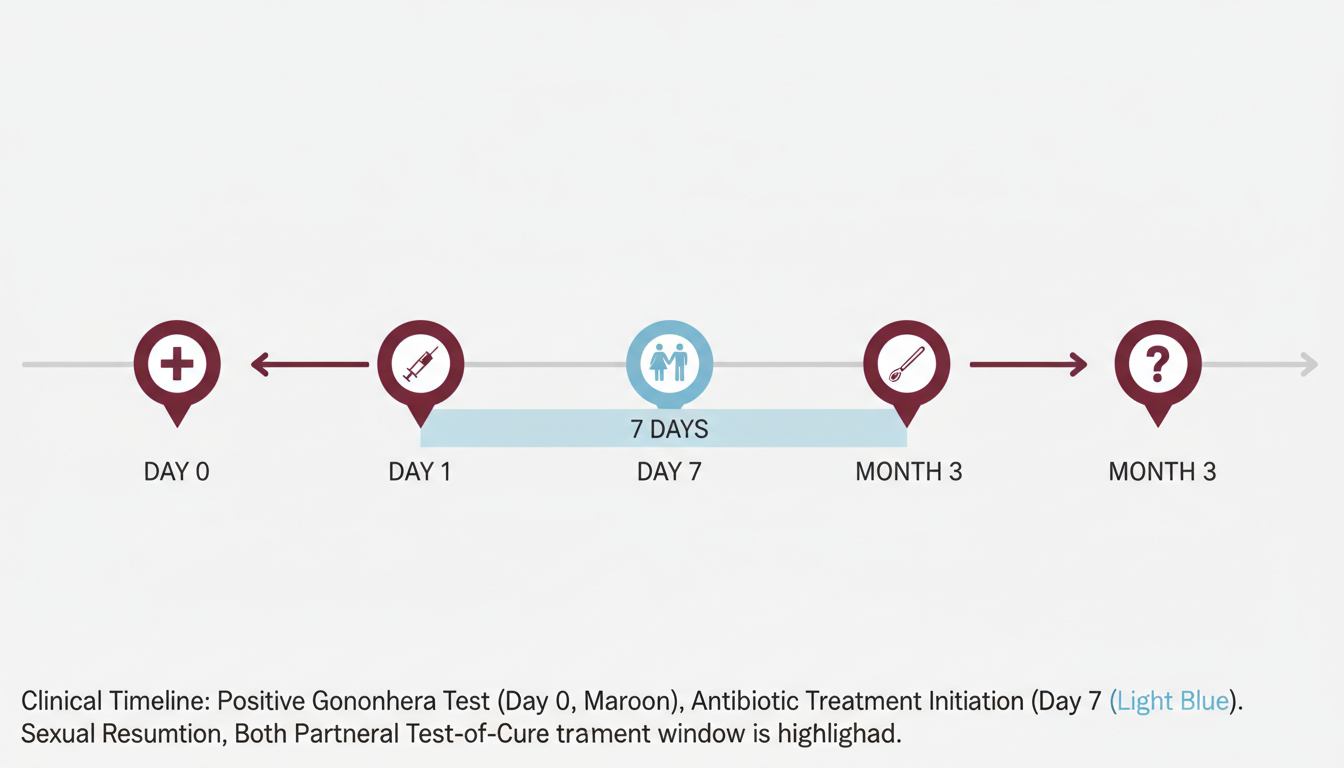
Wait at least 7 full days after completing antibiotic treatment before any sexual contact, including oral, anal, and vaginal. Both you and any recent partners must finish treatment and be symptom-free first. The CDC currently recommends a single 500 mg intramuscular dose of ceftriaxone for uncomplicated genital, rectal, or pharyngeal gonorrhea, with a retest at three months because reinfection within months is common.
Key Takeaways
- Wait at least 7 full days after completing antibiotics before resuming sexual contact, and only if symptoms are gone and recent partners have been treated.
- Plan a retest at three months. Even after a fully effective treatment, reinfection within months is common, especially when a partner was missed.
Day Zero: What to Do in the First 24 Hours
The first 24 hours after a positive result are about action, not about solving everything. The standard public-health response is built around three things that should happen in the same day or the day after, and they line up below.
Two common reactions make the next week harder. The first is panic, which leads to ghosting partners, searching for herbal cures, or assuming a positive result means something is permanently broken. The second is freezing, hoping the result is a fluke and quietly ignoring it. Neither helps. Untreated gonorrhea can spread to other sites in the body, including the throat, rectum, eyes, and reproductive tract, and continues to be transmissible to partners. The good news is that the standard treatment is fast, effective, and free or low-cost in most public-health clinics.
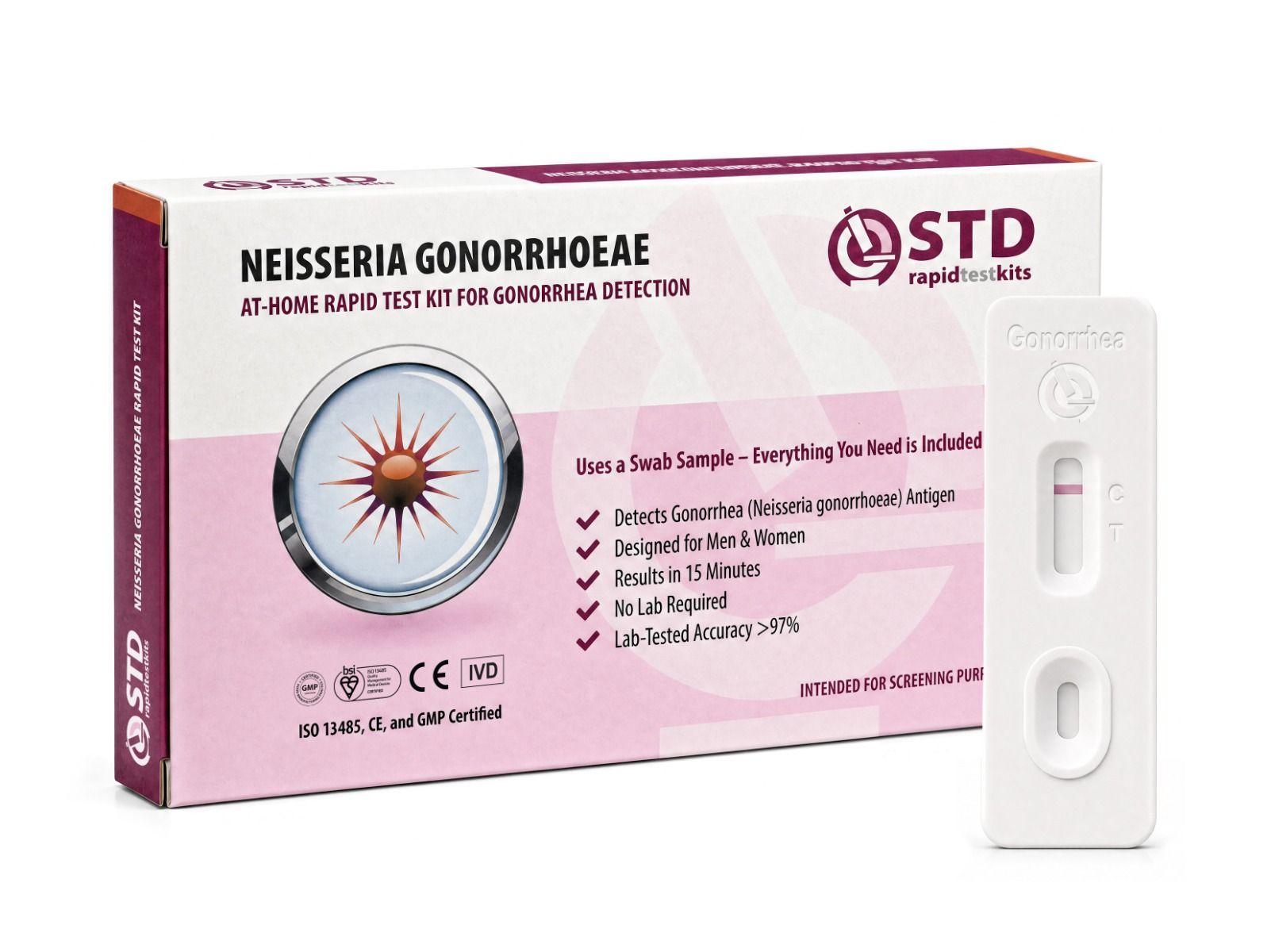
If you used an at-home rapid test, the first job is making sure the result was read correctly before acting on it.
First-day action list
- Pause all sexual contact, including oral and anal. Gonorrhea transmits through any mucosal contact, and ejaculation is not required.
- Book or fill the antibiotic prescription same-day if possible. Telehealth, urgent care, public-health clinics, and many primary-care offices can prescribe.
- Write down anyone you have had sexual contact with in the last 60 days. Each person on that list will need to be told and probably treated.
Was the Test Really Positive?
On a lateral-flow rapid test, a single visible control line means negative. Two lines, regardless of how faint the second one is, count as positive. A test with no visible control line is invalid and needs to be repeated with a fresh kit. Misreads happen most often during the early window period, when bacterial DNA or antigen levels are still rising. A positive test taken less than 5 days after exposure is more likely to be ambiguous; a positive test taken more than 7 to 14 days after exposure is generally trustworthy.
Laboratory testing for gonorrhea is dominated by nucleic acid amplification testing, or NAAT, which detects bacterial DNA from a urine sample or a swab. NAAT is the laboratory gold standard. At-home rapid tests use lateral-flow chemistry, which is fast and private but less analytically sensitive than lab NAAT, especially in asymptomatic infections. The two technologies are complementary, not equivalent. A positive home result is worth confirming with a clinician-collected lab test when possible, but the home result is enough to start treatment in the meantime.
| Test type | Sample | Window period | Use case |
|---|---|---|---|
| Lab NAAT | Urine or swab | About 5 to 14 days post-exposure | Confirmation, screening, asymptomatic detection |
| At-home rapid lateral-flow | Self-collected swab | About 7 to 14 days post-exposure | Private screening, fast result, follow-up with NAAT if positive |
| Bacterial culture | Clinician-collected swab | Up to 5 days for results | Antibiotic-resistance testing when standard treatment fails |
Treatment: What the CDC Actually Recommends in 2024-2025
The 2020 CDC update changed first-line gonorrhea treatment to a single 500 mg intramuscular dose of ceftriaxone for uncomplicated genital, rectal, or pharyngeal infection. People weighing more than 150 kg get 1 gram. If chlamydia coinfection has not been ruled out, doxycycline 100 mg twice daily for 7 days is added, because dual infection is common. Earlier dual-therapy with azithromycin was retired due to resistance concerns (CDC STI Treatment Guidelines, gonococcal infections in adolescents and adults).
Side effects from the injection are usually mild: a sore site, a brief headache, occasional nausea. The injection itself is over in seconds, and most people describe it as easier than expected. If a clinic visit is hard to access, telehealth providers in many regions can prescribe and arrange administration through a partner pharmacy or urgent care, and some public-health departments offer same-day walk-in treatment.
Leftover antibiotics, partner antibiotics, or over-the-counter remedies are not a substitute for the prescribed ceftriaxone injection. Subtherapeutic dosing accelerates antibiotic resistance and rarely clears the infection.
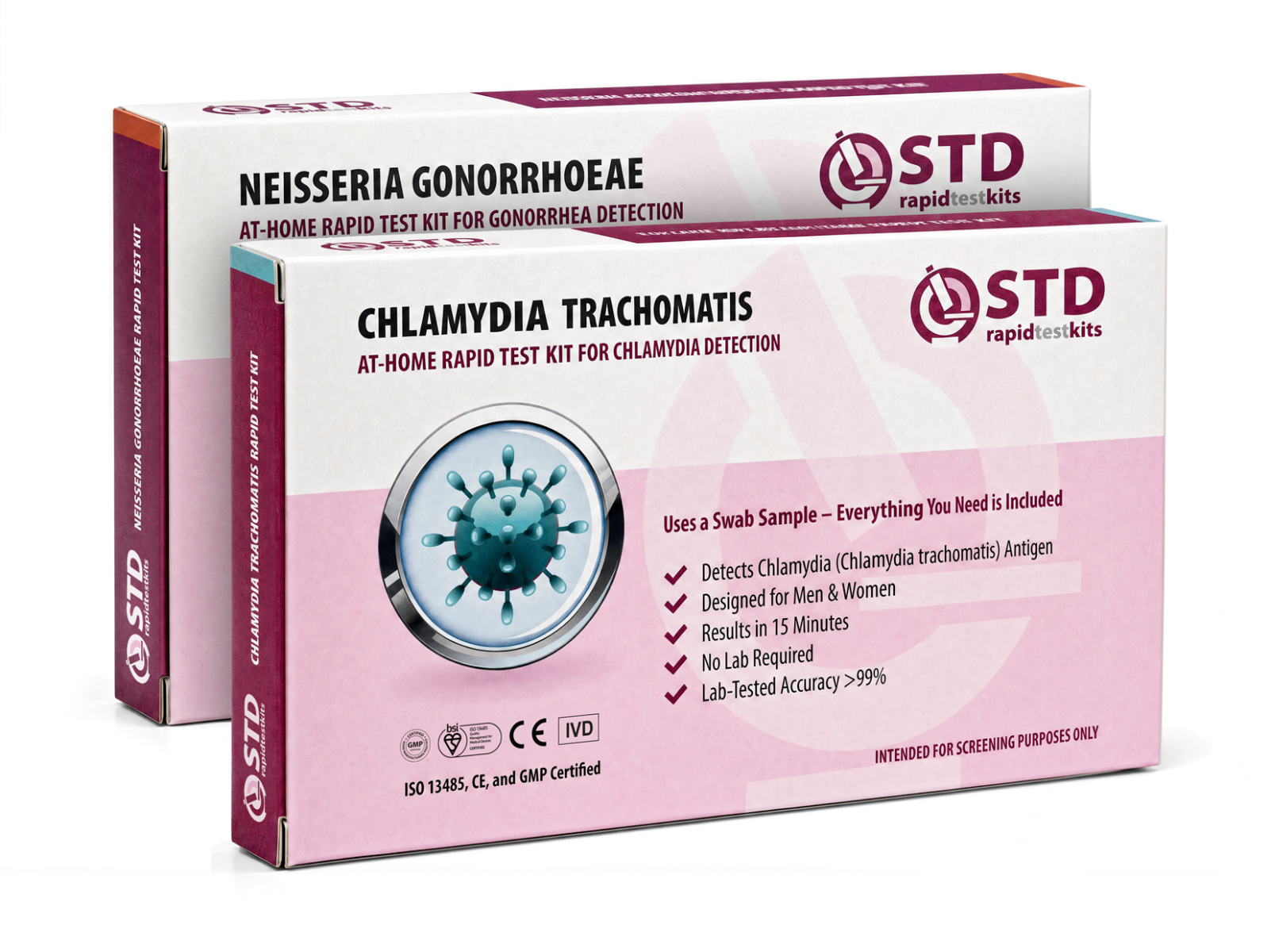
Our rapid gonorrhea kit is a self-collected vaginal or penile swab for genital screening. It is not designed for throat or rectal sampling. If the exposure was oral or anal, ask a clinic for a site-specific NAAT swab, and ask them to test for chlamydia at the same time, since the two infections frequently travel together.
When Is It Safe to Have Sex After Gonorrhea Treatment?
The short answer is the same answer the CDC gives clinicians: at least 7 full days after completing antibiotic treatment, and only if symptoms have resolved AND recent partners have completed treatment. Resuming sex inside the 7-day window is the most common cause of partner reinfection that doctors see in clinic, and it is preventable.
The 7-day mark is a clearance window, not a courtesy. It is the minimum interval for the antibiotic to fully clear the bacteria from infected tissues. If burning, discharge, pelvic pain, or testicular pain are still present at day 7, that is a signal to call a provider before resuming sex. Persistent symptoms after a full course of ceftriaxone could mean a missed coinfection (often chlamydia), reinfection from an untreated partner, or, rarely, an antibiotic-resistant strain that needs a different drug.
The same rule applies to oral sex and anal sex, which are both efficient transmission routes for gonorrhea. Condoms reduce risk during the recovery window but do not eliminate it: gonorrhea can transmit through skin or mucosal contact that condoms do not cover, particularly during oral sex.
Disclosure: this article is published by stdrapidtestkits.com, which sells at-home rapid STI tests. The kit option below reflects that, and is recommended on fit-for-purpose grounds for the situation described above.
| Scenario | Safe to resume sex? | Why |
|---|---|---|
| You finished antibiotics 2 days ago | No | The 7-day clearance window has not passed |
| Symptoms gone, but your partner has not been treated yet | No | An untreated partner reinfects you immediately |
| Both partners completed treatment 10 days ago and feel fine | Yes | The minimum window has passed and clearance is complete |
| You finished antibiotics 8 days ago but still have discharge | No | Symptoms past day 7 need a follow-up call, not resumed sex |
Talking to Partners Without Shame
The CDC recommends notifying any sexual partner from the 60 days before symptoms began or before the test, since gonorrhea can be carried asymptomatically for weeks. The conversation does not need to be a confession. It needs to be specific: the result, the recommendation that the partner gets tested and treated, and the timeline for resuming contact.
A simple text often works as well as a phone call: "Hey, I just tested positive for gonorrhea. I have started treatment. You should get tested and probably treated too, even if you feel fine. We can compare timelines once you have a date." Many state and city health departments offer anonymous partner notification services, and tools like TellYourPartner.org will send an anonymous text on your behalf if a direct conversation feels unsafe.
Untreated gonorrhea matters. In people with a uterus, ascending infection causes pelvic inflammatory disease (PID), which can scar the fallopian tubes and contribute to chronic pelvic pain, ectopic pregnancy, and infertility. In people with testicles, untreated infection can cause epididymitis. In rare cases, gonorrhea spreads systemically to joints (disseminated gonococcal infection). Telling a partner is partly about respecting their autonomy and partly about preventing those downstream complications.
In most U.S. states, a clinician can prescribe antibiotic treatment for a sexual partner without that partner needing a separate appointment first. CDC endorses EPT specifically for chlamydia and gonorrhea exposure (<a href="https://www.cdc.gov/sti/hcp/clinical-guidance/expedited-partner-therapy.html" target="_blank" rel="noopener">CDC Expedited Partner Therapy</a>). Of the levers available to break the back-and-forth reinfection cycle, EPT is the most reliable. Ask the prescribing clinician whether EPT is legal in your state and whether they offer it.
Retesting: Two Different Windows, Two Different Reasons
After gonorrhea treatment, two separate follow-up tests serve different purposes, and the timing for each is different. Confusing the two is one of the more common mistakes after a positive result.
The first is the test of cure: a follow-up test to verify that the antibiotic actually cleared the infection. The CDC recommends a test of cure for pharyngeal (throat) gonorrhea 7 to 14 days after treatment, because pharyngeal gonorrhea is harder to clear than genital gonorrhea. For uncomplicated genital or rectal gonorrhea treated with ceftriaxone, a routine test of cure is NOT recommended; the standard treatment is reliable enough that a clearance test rarely changes management.
The second is the retest for reinfection: a screening test about three months after treatment. This one applies to everyone who tested positive, regardless of site. The CDC's reasoning is straightforward: reinfection within months is common, often from a partner who was missed in notification, and reinfection is associated with higher rates of complications like PID. A negative retest at three months is a meaningful all-clear before moving into a new sexual chapter.
Use a NAAT-based test when possible at retest, either through a clinic or via an at-home swab kit that ships the sample to a lab. A rapid lateral-flow at-home test can also serve as a screen, with a clinic-confirmation step if it is positive.
Gonorrhea Reinfection: How to Break the Cycle
Reinfection within 12 months happens in roughly 7 to 12 percent of people previously treated for gonorrhea, according to the 2020 update to CDC's treatment guidelines (MMWR, Update to CDC's Treatment Guidelines for Gonococcal Infection, 2020). There is no immunity after a gonorrhea infection. Antibodies do not protect against the next exposure, and the bacteria's surface proteins shift over time, which is part of why a vaccine has been so hard to develop.
Most reinfections trace back to a handful of fixable patterns:
- The partner was not actually treated. Either the partner skipped the appointment, or the antibiotic was incomplete, or only one partner of two was contacted. Confirm explicitly that any recent partner has finished a full course before resuming contact.
- Sex resumed inside the 7-day window. Even one encounter at day 4 or day 5 can restart the infection loop, particularly if the partner was treated on a different day.
- A new partner introduced a new infection. A partner who appears healthy can be asymptomatically carrying gonorrhea, particularly in the throat. A regular STI screening cadence (every 3 to 6 months for sexually active people with new or multiple partners) catches these earlier than waiting for symptoms.
Condoms reduce, but do not eliminate, transmission, particularly during oral sex where mucosal contact bypasses the latex barrier. They are useful in the post-treatment window for cutting per-act risk while you and your partner finish the antibiotic course and confirm clearance with the three-month retest covered above.
If Treatment Does Not Seem to Work: Antibiotic Resistance
Antibiotic-resistant gonorrhea, sometimes called "super gonorrhea," is rising globally and is one reason the WHO listed gonorrhea among the priority pathogens for new antibiotic development (WHO sexually transmitted infections fact sheet). Most cases in the U.S. still respond to a single ceftriaxone injection, but resistance to older drugs (penicillin, tetracycline, ciprofloxacin, azithromycin) has been documented for years, which is why CDC dropped azithromycin from first-line treatment in 2020.
If symptoms persist or return within a few weeks after a full ceftriaxone dose, the next step is a clinic visit, not a second self-treatment. The clinician will repeat the test, often using a culture to allow antibiotic susceptibility testing, and may treat with a higher-dose or alternative regimen depending on the result. Reinfection from an untreated partner is statistically more common than true resistance, so partner status is the first question the clinician will ask.
Most people see symptoms ease within 3 to 7 days of the ceftriaxone injection. Call the prescribing clinician sooner rather than later if any of these happen: discharge or burning has not started to ease by day 7, symptoms resolved and then returned, fever or joint pain or skin rash develops (signs that infection may have spread), or pelvic pain worsens. Each of these signals a different cause, and a different fix.
The Mental Health Side of a Diagnosis
The infection is bacterial. The shame is cultural. Both are real, and both deserve attention.
A positive STI result can stir up anxiety, anger at a partner, self-blame, or grief about a relationship that suddenly feels less stable. None of those reactions mean something is wrong with the person feeling them. Sexual-health stigma is built into U.S. health education, and it does not vanish the moment the antibiotic clears the bacteria. People recovering from a gonorrhea diagnosis often describe the emotional recovery as longer than the physical one.
A few practical supports work well: a single therapy session focused on the diagnosis (rather than long-term treatment), peer-support spaces like the American Sexual Health Association's online community, and a frank conversation with one trusted person who is not the source partner. The American Sexual Health Association maintains a directory of low-cost or free counseling resources for STI-related stigma, and many local health departments offer the same.
If the diagnosis is leading to avoidance of testing, of future partners, or of medical follow-ups in general, raise that with a provider or counselor at the next visit. Risk-avoidance after a single STI episode can persist for years if no one names it.
Persons treated for gonorrhea should be retested 3 months after treatment, regardless of whether they believe their sex partners were treated.
Resuming Your Sex Life with Confidence
Yes, you can have sex again after a gonorrhea diagnosis. The path is short and followable: finish the antibiotic, wait the full seven days, confirm any recent partners have also been treated, and plan a retest at three months. Bodies clear the infection on this schedule.
A diagnosis changes the conversation around intimacy more than it changes access to it. Many people describe a more intentional sex life after their first STI: more honest pre-sex conversations, more frequent screening, fewer assumptions about what "clean" or "safe" mean without testing. Those changes serve future partners, future relationships, and long-term reproductive health.
The most useful single piece of equipment for that next chapter is regular at-home or clinic-based STI screening: every three to six months for sexually active people with new partners, once a year for everyone else who is sexually active, with site-specific testing for any oral or anal exposures.

Frequently asked questions
- How long do I have to wait before having sex again?
- At least 7 full days after completing antibiotics. Both you and any recent partners need to be treated and symptom-free before resuming. If symptoms (burning, discharge, pelvic or testicular pain) are still present at day 7, call a clinician before resuming sex; that is a signal to investigate, not to push through.
- My partner tested negative. Do they still need treatment?
- Usually yes. They may have tested too early, or the test may have missed an infection at a different anatomical site (throat, rectum). The CDC recommends presumptive treatment for any recent partner of a confirmed case, often through expedited partner therapy where a clinician can prescribe medication without a separate appointment. Treating both partners simultaneously is the single most effective step against reinfection.
- Can I have sex if we use condoms during treatment?
- No. Condoms reduce but do not eliminate gonorrhea transmission, especially during oral sex where mucosal contact happens outside the latex barrier. The 7-day rule applies to all sexual contact, condoms included. Once the window has passed and both partners are treated, condoms are a strong layer of protection going forward.
- Can you catch gonorrhea twice?
- Yes, easily. There is no immunity after a gonorrhea infection. Reinfection within 12 months happens in roughly 7 to 12 percent of previously treated patients, almost always because a partner was untreated or because of new exposure. That is why the CDC recommends a routine retest at three months after treatment.
- Can gonorrhea affect fertility?
- Yes, if left untreated. Gonorrhea that reaches the reproductive tract can cause pelvic inflammatory disease, which raises the risk of infertility, ectopic pregnancy, and chronic pelvic pain. Prompt antibiotic treatment sharply lowers that risk, which is why early testing matters even more than feeling fine.
- Does gonorrhea live in the throat?
- Yes, and pharyngeal gonorrhea is often asymptomatic. It can transmit through oral sex without anyone knowing they were exposed. Most clinics do not test the throat by default, so request a pharyngeal swab specifically if oral exposure is on the table. Pharyngeal gonorrhea is harder to clear with antibiotics than genital gonorrhea and warrants a follow-up test of cure 7 to 14 days after treatment.
- I finished antibiotics, but symptoms are still there. Now what?
- Call the clinician who prescribed your treatment, same day or next day rather than wait-and-see. Three causes account for most cases: a chlamydia coinfection that the gonorrhea regimen did not cover, reinfection from a partner who did not finish treatment, and (less often) ceftriaxone resistance that needs a different drug. Each calls for a different clinical response, so the prescriber needs to assess which applies before any further treatment.
- Do I need to retest if I feel completely fine?
- Yes. Feeling fine and being clear of the infection are not the same thing, particularly for pharyngeal or rectal infections that often cause no symptoms at all. The CDC recommends a retest at about three months after treatment for everyone treated for gonorrhea, regardless of how confident they are that partners were treated. A negative retest is the cleanest all-clear before a new sexual chapter.
- U.S. Centers for Disease Control and Prevention. About Gonorrhea: transmission, symptoms, complications, prevention, and post-treatment guidance.
- U.S. Centers for Disease Control and Prevention. STI Treatment Guidelines: gonococcal infections among adolescents and adults, including the 500 mg ceftriaxone first-line regimen and three-month retest recommendation.
- U.S. Centers for Disease Control and Prevention. Expedited Partner Therapy clinical guidance: how clinicians can prescribe for partners of patients with chlamydia or gonorrhea without a separate appointment.
- World Health Organization. Sexually Transmitted Infections fact sheet: global prevalence, treatment, and antibiotic-resistance trends for gonorrhea.
- U.K. National Health Service. Gonorrhoea: symptoms, testing, treatment, and partner notification guidance.
- Mayo Clinic. Gonorrhea: symptoms, causes, diagnosis, treatment, and complications.
- St. Cyr S, Barbee L, Workowski KA, et al. Update to CDC's Treatment Guidelines for Gonococcal Infection, 2020. Source for the 7 to 12 percent reinfection-within-12-months figure cited in this article.
