Published: November 2025 | Last updated: May 2026 | Editorial review and quality control: Martina N.
A recent line of HIV antibody research has surfaced an uncomfortable reality: experimental antibody-based treatments and vaccine candidates do not work equally well against every strain of HIV circulating around the world. The virus mutates quickly, and antibodies that neutralize one regional strain can miss another entirely.
That is genuine bad news for vaccine development timelines. It does not, however, change what you can do today. Rapid HIV tests detect the virus by looking at structural components that all strains share, not the highly variable surface proteins where most regional variation lives. A test you take this weekend works the same way whether the virus came from Mumbai, Manchester, or Manhattan.
Key Takeaways
- Experimental HIV antibody treatments and vaccine candidates show uneven protection across regional strains, one of the reasons there is still no licensed HIV vaccine.
- Standard rapid HIV tests detect infection regardless of strain, so testing remains the most reliable HIV screening tool available right now.
Why This Matters Even If You're Nowhere Near a Lab
If you are reading this from a college dorm in Texas, a shared flat in Nairobi, or a small town in rural Maharashtra, the science applies to you. HIV is not frozen in time or place. The virus copies itself sloppily, and over decades that sloppiness has produced multiple HIV-1 subtypes alongside HIV-2, with different subtypes more common in different parts of the world. The U.S. National Institute of Allergy and Infectious Diseases (NIAID) describes ongoing work on multi-antibody combinations precisely because no single broadly neutralizing antibody covers the full diversity of circulating strains (NIAID HIV/AIDS research).
That regional variation matters most for vaccines and antibody injections, which try to lock onto specific viral proteins. The proteins on the outside of the virus, particularly the envelope glycoprotein, are exactly the parts that mutate the most. An antibody designed to grip the envelope of a strain common in one region might slip right past a strain dominant elsewhere.
Diagnostic tests work differently. A rapid HIV antibody test does not try to neutralize the virus. It checks whether your immune system has produced antibodies against any HIV variant, and modern tests are validated to detect responses across all major HIV-1 groups (M, N, O, P) and HIV-2. The CDC's testing guidance notes that current rapid tests are designed to catch infection across global strain diversity (CDC HIV testing).
HIV's outer envelope proteins are the most variable region of the virus. An antibody designed against one regional strain may bind weakly to another. That is why bNAb research focuses on antibody combinations rather than single-antibody products, and why diagnostic tests target stable internal viral markers and antibody responses instead of the shifting envelope.
Do regional HIV strain differences affect at-home testing?
No. Rapid at-home HIV tests are designed to detect antibodies against HIV-1 (groups M, N, O, P) and HIV-2 across all major subtypes. Strain variation matters for vaccine and bNAb antibody-treatment research, where regional adaptation is required, but it does not affect the accuracy of a properly timed at-home antibody test. Take the test after the appropriate window period (about 12 weeks for rapid antibody tests) and the result is interpretable regardless of where the virus came from.
What an HIV Test Actually Looks For
Not all HIV tests look at the same thing, and that single fact explains why timing and accuracy can feel confusing. There are three categories worth knowing.
Antibody tests measure your immune response to the virus. These are the most common at-home rapid tests and the ones built for fingerstick or oral-fluid samples. They are quick, inexpensive, and reliable once your body has had enough time to produce detectable antibodies.
Antigen/antibody combination tests add detection of the p24 protein, a piece of the virus itself that appears in the bloodstream before antibodies form. These tests typically run in a clinical lab. Their earlier detection window is one reason clinicians often order them after a recent suspected exposure.
Nucleic acid tests (NAAT, sometimes called PCR) look for the virus's RNA directly. They are the most analytically sensitive of the three and are used in confirmatory testing and for very early detection. NAATs are run in labs, not at home.
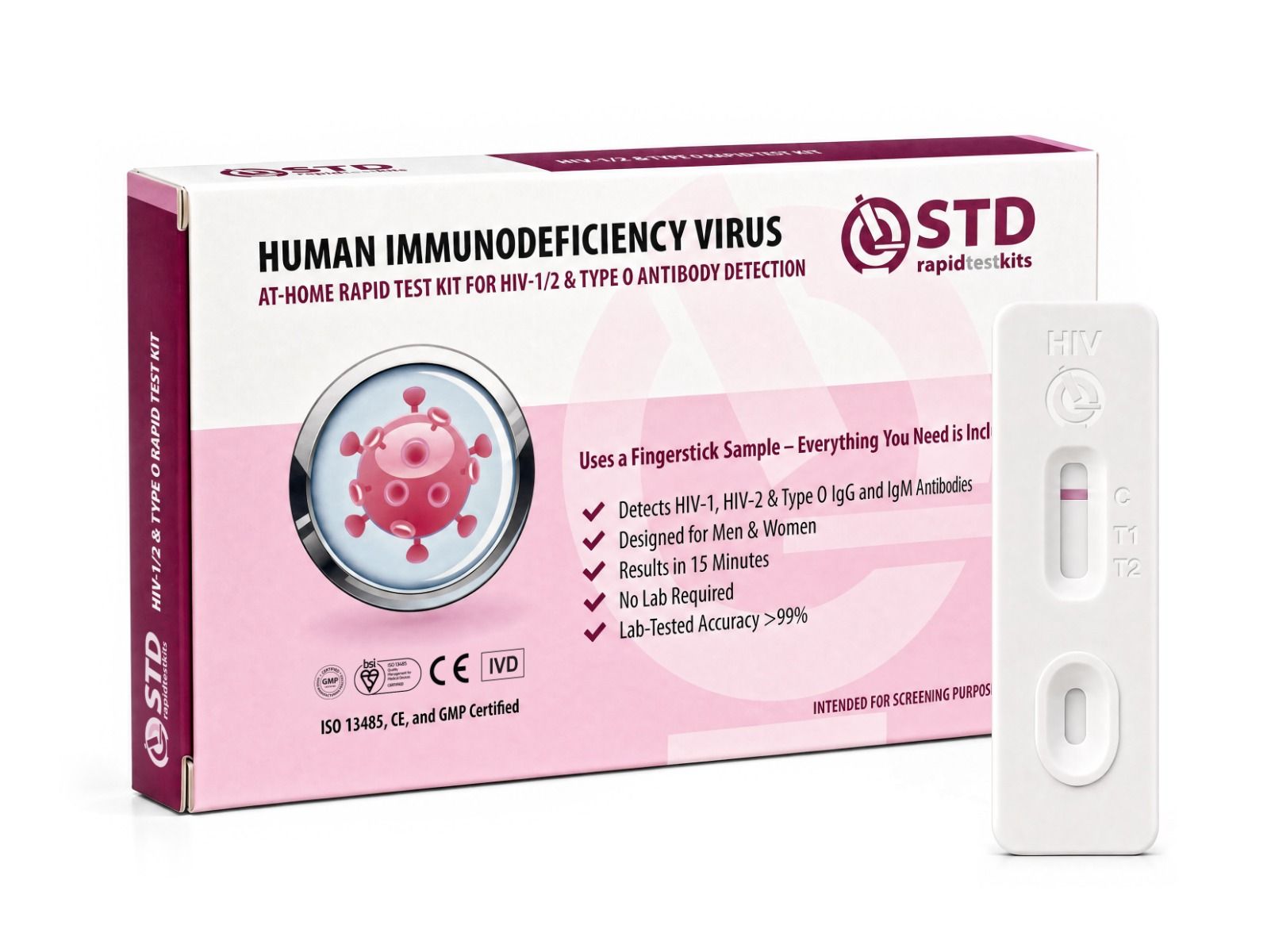
For at-home use, the dominant option is the rapid antibody lateral-flow test: a fingerstick, a drop of blood, a buffer solution, and a result line within about 15 to 20 minutes. Mail-in lab kits exist as well, where you collect a sample at home and ship it for processing, returning lab-grade results in a few business days.
| HIV Test Type | What It Detects | Sample Type | Earliest Detection | When Result Is Most Reliable |
|---|---|---|---|---|
| Antibody-only rapid test (at home) | HIV antibodies | Fingerstick blood or oral fluid | 23 to 90 days after exposure | 12 weeks after exposure |
| Antigen/antibody combo (clinic lab) | p24 antigen plus antibodies | Venous blood | 18 to 45 days after exposure | About 45 days after exposure |
| NAAT / PCR (clinic lab) | Viral RNA | Venous blood | 10 to 33 days after exposure | About 4 weeks after exposure |
Window Periods Set the Accuracy Clock
The window period is the gap between exposure and the moment a test can reliably detect the infection. It exists because the body needs time either to produce antibodies (for antibody tests) or to build up enough viral material (for antigen and NAAT tests) for a test to register a positive.
For at-home rapid antibody tests, the CDC publishes a window of 23 to 90 days, depending on individual immune response (CDC HIV testing). The practical takeaway: a rapid antibody test taken five days after a possible exposure is not informative. A negative result that early tells you very little about whether you are actually negative.
If you need an answer sooner than the antibody window allows, a clinic-administered antigen/antibody combo or a NAAT is the right tool. These shorten the window to roughly 18 to 45 days and 10 to 33 days respectively. For at-home users, the cleanest path is to wait through the window and then test, or to test now for a baseline and again at the recommended follow-up point.
Rapid at-home antibody test: most reliable at about 12 weeks after exposure. Antigen/antibody combo (clinic lab): about 45 days. NAAT (clinic lab): about 4 weeks. Earlier negatives are not conclusive; retest at the appropriate point for your test type.
Why Antibody-Based Treatments Still Lag Behind Testing
Researchers have spent more than a decade trying to harness broadly neutralizing antibodies, or bNAbs, for HIV prevention and treatment. These are rare antibodies that can lock onto multiple HIV strains, and a handful have shown real promise in clinical trials. The catch is in the word "broadly". Broadly is not the same as universally. Different bNAbs cover different swaths of the global strain landscape, and the swaths overlap unevenly.
Trials of bNAb candidates have shown that protection rates can shift substantially between populations infected with different HIV subtypes. NIAID describes ongoing work on multi-antibody combinations precisely because no single bNAb covers every strain reliably. That same regional-strain diversity is part of why an HIV vaccine has been so hard to make. The envelope protein, the most useful target for inducing protective immunity, is also the most variable region of the virus. Successful vaccine candidates likely need to either present multiple envelope variants or trigger antibody types broad enough to cover most circulating subtypes.
None of that affects how a diagnostic test reads a sample. Testing remains your fallback because it does not need to neutralize the virus.
Disclosure: stdrapidtestkits.com sells the at-home HIV rapid tests referenced below. Product recommendations in this article are made on fit-for-purpose grounds, not commercial promotion.
Most rapid tests detect HIV antibodies and require time after exposure for the body to make enough antibodies for the test to read positive.
When to Retest, and How Often
Retesting is not an admission that something went wrong. It is the way the window-period system is designed to work. If you tested early after a possible exposure and got a negative result, the next step is to retest at the appropriate follow-up point: about three to four weeks for a NAAT in a clinic, about six weeks (roughly 45 days) for an antigen/antibody combo, or roughly twelve weeks for a rapid antibody test.
Outside of post-exposure scenarios, the CDC recommends at least once-yearly HIV testing for any sexually active adult, and every three to six months for people at higher ongoing risk: multiple partners, partners of unknown status, men who have sex with men, people who inject drugs, or those whose partners are HIV-positive (CDC HIV testing recommendations). PrEP users are typically tested every three months as part of routine PrEP follow-up.
Recent travel to a region with high HIV prevalence after a sexual exposure is another reason to test. After travel to a high-prevalence region with a possible exposure, schedule a test at the appropriate window for the test type you use.
Recommended HIV testing frequency
- Once per year for any sexually active adult.
- Every 3 to 6 months for higher-ongoing-risk groups (multiple partners, partners of unknown status, MSM, people who inject drugs).
- Every 3 months for PrEP users as part of routine follow-up.
- Retest at the appropriate window after any possible exposure (about 12 weeks for at-home antibody tests).
Privacy and Discreet At-Home Testing
The phrase "HIV test" still carries weight that other lab tests do not. Even now, the act of walking into a clinic for an HIV blood draw feels different from getting a strep test, both because of stigma and because of the perceived consequences of the result. At-home rapid tests address that gap directly.
You do not have to schedule an appointment, take time off work, or sit in a waiting room. The kit arrives in plain, unmarked packaging. Inside is everything you need: a sterile lancet, a buffer solution, a test cassette, and clear instructions. You collect the sample, run the test, and read the result. The entire process takes about 15 to 20 minutes.
Privacy also means flexibility. You can take the test on a weekend morning, with a partner in the next room, or alone in your kitchen. You can take it before disclosing test results to anyone, or you can take it as part of a conversation with a partner about each other's status. Shipping is typically 24 to 72 hours within the U.S., with international options available depending on destination.
At-home rapid tests use lateral-flow chemistry, the same technology behind home pregnancy tests. They are not laboratory NAAT or PCR tests. They are designed for screening, and a positive result should always be confirmed in a lab.

Picking a Kit That Fits Your Situation
The right kit depends on what you are trying to answer.
Single-infection rapid kit. Best for a known recent concern about HIV specifically: a partner has just tested positive, you had a higher-risk exposure outside your usual partner, or you are starting or maintaining PrEP. The HIV-1 and HIV-2 fingerstick test gives a fast, focused answer.
Combination rapid kit. Best when you want broader screening in one sitting. Combination kits cover HIV alongside syphilis, hepatitis B, hepatitis C, and (in some kits) chlamydia, gonorrhea, and herpes components. This is usually the right call for periodic check-ins, after a new partner, or when you want to rule out multiple infections after a single concerning event.
Mail-in lab panel. Best for confirmatory testing, very early detection (within about 10 days of exposure), or detailed lab results across many infections. Mail-in panels run lab-grade tests and return results in a few business days. They are not strictly at-home: you collect the sample at home, but a lab does the analysis. We do not sell mail-in panels; for those, major commercial lab services and telehealth STI providers carry them.
| Kit Type | What It Covers | Sample | Result Time | Best For |
|---|---|---|---|---|
| HIV 1 & 2 rapid | HIV-1 and HIV-2 | Fingerstick blood | 15 to 20 minutes | Focused HIV screening, PrEP follow-up |
| 7-in-1 combo rapid | HIV, syphilis, hep B, hep C, chlamydia, gonorrhea, herpes | Fingerstick blood plus self-collected swab | 15 to 25 minutes | Broad screening after a new partner or exposure event |
| Mail-in lab panel | Up to 12 infections (panel-dependent) | Urine, swab, or fingerstick | 2 to 5 business days | Lab-grade detail and earliest detection windows |

What to Do If a Result Comes Back Positive
A positive result on an at-home rapid test is a signal, not a final diagnosis. The standard next step is a confirmatory test in a clinic or lab, typically a NAAT or a confirmatory immunoassay. Confirmation matters: rapid tests can produce false positives, particularly in populations with low HIV prevalence, and the confirmatory test is what determines treatment decisions.
If the confirmatory test is positive, modern HIV care looks very different from the way it looked even fifteen years ago. Antiretroviral therapy (ART) suppresses the virus to undetectable levels in most people who take it consistently. Once viral load is undetectable and stays that way, HIV cannot be transmitted sexually. In practice this means a partner on stable ART with a consistently undetectable viral load carries effectively zero risk of sexual transmission to an HIV-negative partner, a finding now summarized as "Undetectable equals Untransmittable" or U=U (NIH HIVinfo). Life expectancy for someone on consistent ART approaches that of the general population.
Partner notification is the other piece. Most U.S. state and local public health departments offer free, confidential partner-notification assistance. Contact your local health department directly, or ask the clinic that confirms your result; staff there can often notify partners on your behalf without revealing your name.
If your result is negative but a partner has just tested positive, the relevant action is to test now and again after the appropriate window. Post-exposure prophylaxis (PEP) is also worth discussing with a clinician within 72 hours of a known exposure. PrEP becomes the prevention strategy of choice if ongoing exposure risk is likely.
1. Confirmatory test. NAAT or confirmatory immunoassay at a clinic, urgent care, sexual-health clinic, or commercial lab. Public-health departments offer this free of charge in most U.S. jurisdictions.
2. Partner notification. Local public-health departments provide free, confidential partner-notification services. Staff can contact partners on your behalf without disclosing your identity.
3. ART consultation. Many providers can connect you with same-day or next-day antiretroviral therapy. Consistent ART suppresses the virus to undetectable levels and approaches normal life expectancy.
FAQs
- Does an at-home HIV rapid test detect every strain of HIV?
- Modern rapid tests are validated to detect antibodies to HIV-1 (groups M, N, O, P) and HIV-2 across all major subtypes. Strain differences affect experimental antibody treatments and vaccine candidates, not standard diagnostic tests.
- How long after exposure should I take an at-home HIV test?
- For an at-home rapid antibody test, wait at least 12 weeks (about 90 days) after possible exposure for the most reliable result. The CDC reports detection windows of 23 to 90 days for antibody tests. If you need an earlier answer, a clinic-administered NAAT can detect HIV in roughly 10 to 33 days.
- What's the difference between an at-home rapid test and a lab NAAT?
- At-home rapid tests use lateral-flow chemistry to detect antibodies. Lab NAATs (sometimes called PCR tests) detect viral RNA directly, which means they can return a positive result much earlier after exposure and offer higher analytical sensitivity. The two are complementary: rapid for screening at home, NAAT for confirmation and early-window detection.
- Will broadly neutralizing antibodies replace HIV vaccines?
- Probably not, but they may become a regular prevention tool alongside vaccines. Long-acting bNAb injections are in clinical testing as a quarterly or biannual alternative to daily oral PrEP. Strain-coverage limits mean future products will likely combine multiple bNAbs to cover the global strain landscape.
- Should I retest if my first HIV test was negative?
- Yes, when the timing of your test fell inside the window period for that test type. A negative rapid antibody test taken five days after exposure is not conclusive; retest at twelve weeks. Ongoing-risk testing every three months is also recommended for people on PrEP or with multiple partners.
- Can I take an HIV test if I'm on PrEP?
- Yes, and you should. PrEP follow-up includes routine HIV testing every three months because PrEP can mask early infection signals. Both clinic and at-home testing fit into PrEP follow-up, though your prescribing clinician will usually order specific tests as part of the regimen.
- What's the best at-home HIV test for asymptomatic screening?
- For HIV alone, a single-infection rapid antibody test (HIV-1 and HIV-2) is the simplest option. For broader screening when you have no specific symptoms but want to know your overall STI status, a combination kit covering HIV alongside syphilis and hepatitis is a more efficient choice.
- Where can I get a confirmatory test if my home result was positive?
- A primary-care provider, an urgent-care clinic, a sexual-health clinic, a public-health department, or any major commercial lab can perform a confirmatory NAAT or immunoassay. Most jurisdictions in the U.S. offer free confirmatory testing through public-health services, and providers can connect you with care immediately if the confirmatory result is positive.
How We Sourced This Article: This article synthesizes current guidance from the CDC, the National Institutes of Health, the World Health Organization, and Mayo Clinic, alongside research summaries from NIAID on HIV vaccine and broadly neutralizing antibody development. We do not provide clinical diagnosis. For symptoms or possible exposures that concern you, see a licensed clinician or public-health service.
- U.S. Centers for Disease Control and Prevention. HIV testing overview, including window-period ranges (23 to 90 days for antibody tests; 18 to 45 days for antigen/antibody; 10 to 33 days for NAAT) and recommended testing intervals.
- U.S. Centers for Disease Control and Prevention. About HIV: overview of HIV transmission, treatment with antiretroviral therapy, and prevention strategies.
- National Institute of Allergy and Infectious Diseases. HIV/AIDS research overview covering vaccine development and broadly neutralizing antibody (bNAb) clinical work.
- World Health Organization. HIV/AIDS topic page covering global epidemiology, clinical management, and prevention.
- National Institutes of Health HIVinfo. Patient-oriented background on HIV diagnosis, treatment options, the Undetectable equals Untransmittable (U=U) evidence base, and prevention strategies including PrEP and PEP.
- Mayo Clinic. HIV/AIDS diagnosis and treatment overview written for general at-home readers.
