Published: November 2025 | Last updated: May 2026 | Editorial review and quality control: Martina N.
Blood donation and sexual health collide in ways most people have never had explained to them clearly. The common assumption is that any STD history automatically means 'no' at the donor desk. The opposite assumption, that the blood bank tests for everything anyway so it does not really matter when you show up, is just as widespread. Both are wrong, and both have real consequences. One sends healthy, eligible donors home unnecessarily. The other puts the person at the end of that blood bag in a position nobody intended.
The reality is more useful than either assumption. Blood donation rules are built around a single biological question: can this infection travel through donated blood to another person? That is the line. Two factors decide everything: whether the infection is blood-borne, and whether you are still inside the window period where it might not yet be detectable. Your diagnosis count, sexual history, and partner number do not enter the equation.
Key Takeaways
- Chlamydia, herpes, and HPV do not disqualify you from donating blood. HIV, hepatitis B, and hepatitis C create permanent ineligibility because they are blood-borne.
- Syphilis and gonorrhea require a 3-month wait from the last day of completed treatment, not from the date of diagnosis or when symptoms cleared.
Which STDs Actually Disqualify You from Donating Blood?
Picture filling out the donor questionnaire and hitting the sexual health section. The instinct for a lot of people is to freeze up, assume the worst, and quietly leave. That reaction makes sense emotionally, but it is not how the system actually works. The questionnaire is not a moral audit of your sex life. It is a biology screen, and once you understand the biology, the rules become much less frightening.
The infections that create serious problems for blood donation are the ones with established blood-borne transmission potential. HIV is the clearest example. It can circulate in the blood, and even with modern nucleic acid testing, there is a gap between exposure and reliable detection. According to the World Health Organization, all donated blood must be screened for HIV, hepatitis B, hepatitis C, and syphilis before release for clinical use. These are the four classic transfusion-transmissible infections that blood systems worldwide are built around. A confirmed positive for HIV, hepatitis B, or hepatitis C means lifelong donor ineligibility.
Hepatitis B and C sit in the same permanent-deferral category as HIV. Both can be present in blood at levels capable of infecting a recipient through transfusion. The CDC notes that hepatitis B can spread through blood even in microscopic amounts, and hepatitis C spreads when blood from an infected person enters the body of someone who is not infected, making it highly efficient at transmitting through transfusion even in trace amounts. A confirmed diagnosis of any of these three means there is no 'wait six months and come back' option. The deferral is permanent.
Syphilis and gonorrhea land in a different position. They create a concrete waiting period rather than a permanent ban, and the specific timeline is covered in its own section below. The infections most people wrongly assume will disqualify them, chlamydia, herpes, and HPV, do not behave like blood-borne infections at all, which changes the picture completely.
| Infection | Eligibility Impact |
|---|---|
| HIV | Permanent ineligibility. HIV-positive status or any HIV treatment medication means you cannot donate. |
| Hepatitis B | Permanent ineligibility. A confirmed hepatitis B diagnosis means lifelong deferral. |
| Hepatitis C | Permanent ineligibility. A confirmed hepatitis C diagnosis means lifelong deferral. |
| Syphilis | 3-month deferral after completing treatment. Syphilis antibodies persist in blood tests for life, but this does not permanently block donation. |
| Gonorrhea | 3-month deferral after completing treatment. Eligibility typically restores fully after this window. |
| Chlamydia | No deferral required if you feel healthy and meet all other eligibility requirements. |
| Herpes (HSV-1 and HSV-2) | No deferral for HSV history. Active outbreak or antiviral treatment at time of donation is a reason to wait until it resolves. |
| HPV | No deferral. HPV infects surface tissue and does not create a blood transmission risk. |
Can You Donate Blood with Chlamydia, Herpes, or HPV?
It is the night before a donation drive and the question forms at 1 a.m. with the phone glow lighting your face. You have herpes, or chlamydia, or both, and you genuinely do not know if showing up tomorrow is responsible or reckless. Here is the direct answer.
Chlamydia, HPV, and genital herpes do not automatically disqualify you from donating blood. Per American Red Cross eligibility criteria, chlamydia, venereal warts (HPV), and genital herpes are not a cause for deferral as long as you are feeling healthy, meeting all other requirements, and have no active symptoms at the time of donation. These infections do not circulate through the blood the way HIV or hepatitis viruses do.
Chlamydia is a bacterial infection that lives in mucosal tissue: the urethra, cervix, rectum, and throat. It does not behave as a blood-borne pathogen, which is why it sits in a completely different eligibility category than HIV or hepatitis. If you have chlamydia that has been treated and you feel well, donation eligibility is not the issue. Your sexual partners' health is a separate and more urgent concern, but that is a different conversation.
Herpes requires a little more nuance. HSV-1 and HSV-2 establish themselves in nerve tissue after infection, which is why they cause outbreaks at the skin or mucous membrane surface rather than circulating in the blood like a transfusion-transmissible virus. Having a history of herpes does not mean your blood is unsafe. The single exception: if you are currently in the middle of an active outbreak with visible sores and active antiviral treatment, wait until it has fully resolved before donating. Having a lifetime herpes diagnosis does not affect blood safety; donating during an active outbreak does.
HPV infects epithelial surface tissue and does not circulate in the blood in any way that poses a transfusion risk. Blood banks do not even test for it, because it is not a transfusion-transmissible infection.
The 3-Month Rule: Syphilis and Gonorrhea
Syphilis and gonorrhea are the two common bacterial STDs that trigger a concrete waiting period. The rule is specific and federally standardized: you must wait 3 months after completing treatment before donating. That timeline comes directly from FDA donor history questionnaire requirements and is applied consistently by the American Red Cross, Vitalant, Gulf Coast Regional Blood Center, and other major U.S. blood systems.
Three months from the date treatment is completed. The countdown runs from the last day of the treatment course, not from when symptoms cleared or when the prescription was finished. This matters because outdated sources still circulate the old 12-month figure, which was replaced by the current 3-month standard several years ago. If you finished treatment for gonorrhea or syphilis more than 3 months ago, feel well, and meet all other criteria, eligibility is restored.
There is one important wrinkle with syphilis specifically: even after successful treatment, syphilis antibodies remain detectable in blood tests for life. The persistent antibodies are a laboratory artifact the screening system is designed to account for, and blood centers interpret a positive antibody result in light of the donor's history. A past syphilis diagnosis that was properly treated and resolved more than 3 months ago does not permanently block you. What it does mean is that honesty on the donor questionnaire matters, because the screening system needs that information to interpret the test correctly.
Gonorrhea does not carry the same lifelong antibody persistence as syphilis. After the 3-month post-treatment window passes, donor screening sees no residual marker from the prior infection.
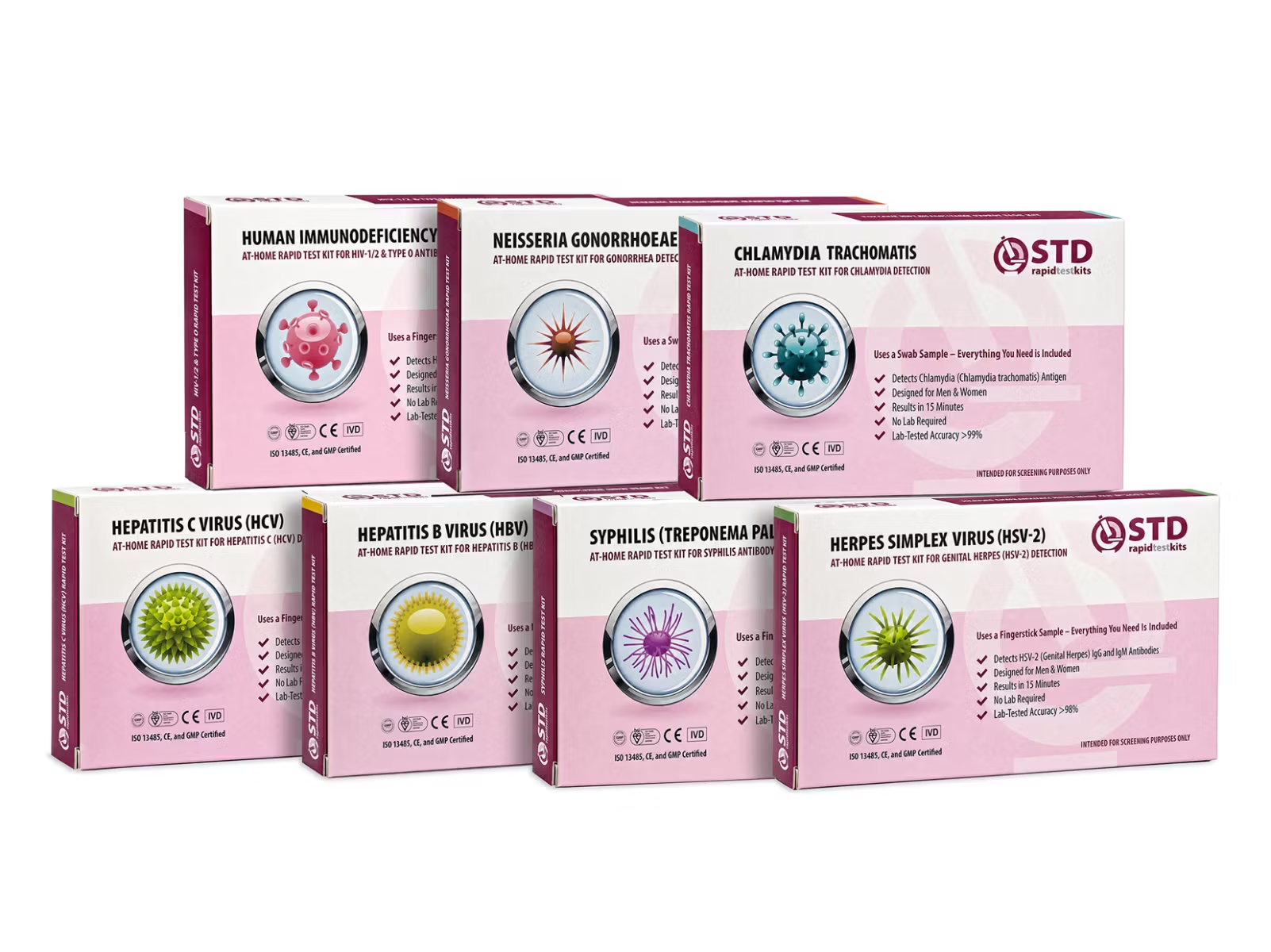
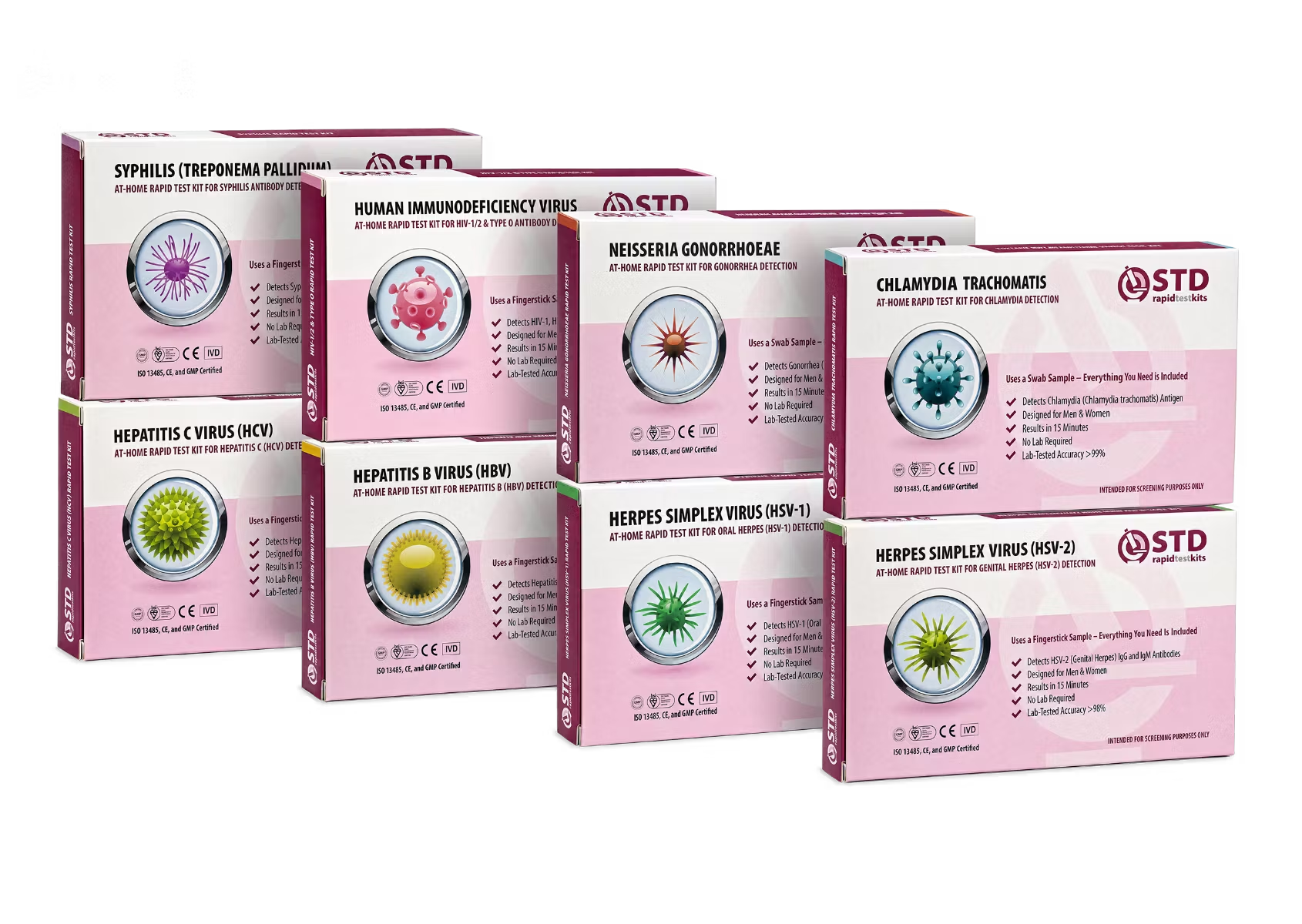
STD Rapid Test Kits sells at-home rapid tests for the infections covered in this article. We recommend products based on fit for the reader's situation, not commercial benefit.
Two Rules Most Sexually Active People Have Never Heard Of
Beyond specific STD diagnoses, there are two additional eligibility rules that affect a significant portion of sexually active adults, and almost nobody knows about them until they are already sitting in the donor chair being asked questions they did not anticipate.
The first is the anal sex behavioral deferral. In 2023, the FDA replaced its previous policy, which had specifically targeted men who have sex with men through a blanket deferral, with an individual donor assessment approach that applies to everyone, regardless of gender or sexual orientation. Per AABB donor eligibility guidance, any person who has had a new or multiple sexual partners in the past three months and also had anal sex during that period is asked to wait 3 months from their most recent anal sex contact before donating. Risk-based behavioral screening applies equally to everyone regardless of sexual orientation. The data consistently show that anal sex carries a statistically higher HIV transmission risk per act than other types of sex, which is why the behavior remains in the screening criteria.
The second is the PrEP and PEP deferral, and this one genuinely surprises people. If you are taking medication to prevent HIV, either pre-exposure prophylaxis (PrEP) or post-exposure prophylaxis (PEP), you are temporarily deferred from donating blood. The driver here is what the medication does to HIV detectability on screening tests. According to AABB guidance, PrEP and PEP can suppress HIV viral replication in a way that makes the virus undetectable on standard blood donation screening tests, even if a breakthrough infection has occurred. Blood systems cannot absorb that gap. The current deferral is 3 months from the last oral dose of PrEP or PEP, and 2 years from the last injection of long-acting PrEP.
Many people on PrEP are otherwise healthy, in monogamous relationships, and would be excellent donors under any other measure. People on PrEP face this deferral solely because the medication affects HIV test detectability, with no judgment implied about their behavior. Until HIV screening technology catches up with the way PrEP suppresses viral signals, that gap has to be covered by deferral.
| Situation | Deferral Period |
|---|---|
| Syphilis, treatment completed | Wait 3 months after the last day of treatment |
| Gonorrhea, treatment completed | Wait 3 months after the last day of treatment |
| New or multiple sexual partners plus anal sex in past 3 months | Wait 3 months from most recent anal sex contact |
| Oral PrEP or PEP, last dose | Wait 3 months from last oral dose |
| Injectable long-acting PrEP, last injection | Wait 2 years from last injection |
| HIV-positive or on HIV treatment medications | Permanently ineligible |
| Hepatitis B or C, confirmed diagnosis | Permanently ineligible |
| Chlamydia, resolved, feeling well | No deferral required |
| Herpes, no active outbreak | No deferral required |
| HPV | No deferral required |
Why 'They Test the Blood Anyway' Is Not a Valid Reason to Show Up Uninformed
This is the reasoning that trips more people up than any other. Blood donation centers do test every unit: HIV, hepatitis B, hepatitis C, and syphilis all screened before anything reaches a patient. So the logic goes: why does your personal knowledge of your status matter if the lab is going to check regardless?
Because of window periods. Every blood-borne infection has one, a stretch of time after exposure during which a person can be infected, can transmit the virus, and yet a screening test will not yet return a positive result. According to AABB transfusion-transmitted infection guidance, even with modern nucleic acid testing, hepatitis B still carries an approximate 2 to 3 week window during which an infected donor may not be detected by blood donation screening. For HIV, the window with current NAT technology is roughly 9 to 11 days, meaning a donation made in those early days after infection could pass all laboratory checks and still contain live virus.
The questionnaire closes what the lab cannot. The two operate as separate lines of defense, and both are necessary because neither one alone is sufficient. The CDC's annual STI surveillance data show millions of new chlamydia, gonorrhea, and syphilis cases are diagnosed each year in the United States. A significant number of people are in early, undiagnosed infection at any given moment. Most of them feel completely fine. Asymptomatic early infection looks and feels the same as no infection at all, and a properly timed test is the only way to tell the difference.
Donation should also never be used as a way to find out your status. The screening tests do not cover all infections, cannot reliably catch very early infections, and will not deliver the kind of clear, timed, medically actionable answer that personal testing provides. Donation screening was built as a safety net for recipients, not a diagnostic service for donors, and it cannot play both roles reliably.
All donations of blood should be screened for HIV, hepatitis B virus, hepatitis C virus, and syphilis before release for clinical use.
STD Testing Windows That Determine When You Are Actually Clear to Donate
The testing windows below are not arbitrary recommendations. They reflect the biology of detection, either how long it takes for an infection to replicate to detectable levels, or how long the immune system takes to produce the antibodies a test measures. Taking a test before these windows close is the medical equivalent of checking whether bread has risen before putting it in the oven. You might get some data back, but it is not a reliable answer.
For chlamydia and gonorrhea, nucleic acid amplification testing (NAAT) looks for bacterial genetic material rather than waiting for an immune response. These tests are more sensitive than older methods, but they still need sufficient bacterial replication before detection is reliable. Chlamydia is testable from 14 days after exposure; gonorrhea from 3 weeks. A negative result before either window closes can miss an active infection that is genuinely there.
For syphilis, HIV, herpes, and the hepatitis viruses, the tests are blood-based and detect immune markers rather than the pathogen directly. The immune system takes time to mount a response, and that is exactly why testing too early in this category is especially unreliable. Syphilis: test from 6 weeks after exposure. HIV: test at 6 weeks for a first indicator, retest at 12 weeks for certainty. Herpes HSV-1 and HSV-2: from 6 weeks. Hepatitis B: from 6 weeks. Hepatitis C: from 8 to 11 weeks.
If you want to test at home before making any donation decision, the Complete 7-in-1 At-Home Rapid Test Kit covers the most critical infections in one panel. For a targeted check on the single highest-priority concern, the HIV 1 and 2 At-Home Rapid Test Kit gives you a clear answer on the infection blood systems are most structured around preventing. Either way, testing on the right timeline gives you something real to act on.
How Long After an STD Can You Donate Blood Again?
'After an STD' can mean a lot of different things biologically, and the timeline for returning to eligibility depends entirely on which infection it was.
For chlamydia, there is no formal deferral period tied to the diagnosis itself. If you have been treated, confirmed the infection has cleared, feel well, and meet all other criteria, there is nothing blocking you from donating. The practical move is to resolve the infection and verify it is gone, but the diagnosis alone does not trigger a hold.
For gonorrhea and syphilis, the clock starts on the last day of the completed treatment course, not the diagnosis date and not when symptoms cleared. The countdown runs for 3 months. After that window, eligibility is typically restored, and you can walk in like any other donor.
For HIV, hepatitis B, and hepatitis C, there is no eligibility restoration timeline. A confirmed diagnosis of any of these creates permanent ineligibility. These are the infections blood systems worldwide are built to exclude; the transfusion risk is persistent and cannot be eliminated by treatment the way a bacterial infection can be cleared.
The cleanest practical rule: base your eligibility decision on a confirmed test result taken at the right window, the specific rules for that infection, and the applicable waiting period if one applies, not on how you feel or a rough sense that enough time has passed.

What the Donor Questionnaire Is Actually Trying to Do
If you have ever filled out a blood donation form and thought the sexual health questions felt intrusive, you are not wrong that they are personal. There is a precise reason behind every one of them, and understanding it makes the whole process less frustrating.
Blood banks are trying to identify risk before testing even begins, because the safest donation is the one that never enters the system if there is unresolved uncertainty attached to it. Lab screening is powerful, but it is not instantaneous, and it is not immune to the biology of early infection. The questionnaire is the first line of defense. The laboratory is the second. Together, they reduce to near-zero the chance that a blood-borne infection gets through during its earliest, most dangerous window.
The questions about recent sexual partners, new relationships, anal sex, and prevention medications are not there to police behavior. They are there to identify people who may have had a recent new exposure to an infection that current tests cannot yet reliably detect. As the AABB explains in its donor assessment guidance, if a donor has recently acquired an HIV or hepatitis infection, current testing methods may not pick it up, which is precisely why the questionnaire is critical to blood supply safety.
The lab catches what is biologically detectable. The questionnaire catches what is not yet detectable. Both layers are required; neither works alone.
FAQs
- Can you donate blood if you have an STD?
- It depends on which one. Chlamydia, HPV, and herpes will not stop you from donating as long as you are otherwise healthy and have no active symptoms. Syphilis and gonorrhea require a 3-month wait after finishing treatment. HIV and hepatitis B or C mean you cannot donate at all, permanently.
- Will I be turned away if I admit I had an STD?
- Only if the biology calls for it. If your infection is not blood-borne, or if any applicable waiting period has passed, honesty on the questionnaire is what makes your donation safe for the recipient. The disclosure itself does not disqualify you; the underlying eligibility rules do.
- Can you donate blood with chlamydia?
- Yes. Chlamydia lives in mucosal tissue, not your bloodstream, which means it does not create blood transfusion risk. As long as you feel well and meet all other eligibility criteria, a chlamydia diagnosis or history is not a donor disqualifier.
- Can you donate blood if you have herpes?
- Yes, in most circumstances. Herpes lives in nerve tissue and causes surface outbreaks; it does not circulate in blood the way transfusion-transmissible infections do. The exception is an active outbreak at the time of donation, which is a reason to wait until it has fully resolved.
- How long do you have to wait after syphilis before donating blood?
- Three months after completing treatment, counted from the last day of the treatment course, not from the diagnosis date. After that window, eligibility is typically restored. Be aware that syphilis antibodies remain in the blood for life after a treated infection, but this does not permanently prevent you from donating.
- Does being on PrEP disqualify you from donating blood?
- Temporarily, yes. If you are on oral PrEP or PEP, the deferral is 3 months from your last dose. Injectable long-acting PrEP carries a 2-year deferral. These medications suppress HIV viral replication in a way that can mask a breakthrough infection on standard blood screening tests, creating a detectability gap the blood system cannot absorb.
- Do blood banks screen donated blood for STDs?
- Yes. Every donation is tested for HIV, hepatitis B, hepatitis C, and syphilis before it can be used. The limitation is the window period: very recent infections may not be detectable even with modern nucleic acid testing. The donor questionnaire is designed to cover that biological gap.
- Is blood donation a reliable way to check my STD status?
- No. Donation screening is built to protect recipients, and it cannot reliably double as a diagnostic tool for donors. It does not cover all infections, cannot reliably detect very early infections, and will not produce the clear, timed result that a proper STD test gives you. If you want to know your status, test directly.
Know Your Status, Then Donate with Confidence
Blood donation is one of the most straightforward acts of help available to a healthy person. But 'healthy' in this context means actually knowing your status, not assuming it based on the absence of noticeable symptoms. The STDs that matter most for donation eligibility are predominantly asymptomatic in their early stages. Feeling fine is a completely unreliable guide to whether it is safe to donate.
If there is any real chance of a recent exposure, test first, at the right time for the right infections. The HIV 1 and 2 At-Home Rapid Test Kit is the most targeted option when HIV exposure is the primary concern. The Complete 7-in-1 At-Home Rapid Test Kit covers all the major infections relevant to donation eligibility in a single panel. If you are specifically trying to confirm your status on the three bacterial infections with deferral periods, the Chlamydia, Gonorrhea and Syphilis 3-in-1 Home Test Kit gives you direct answers without a clinic visit.
Test at the right time, understand what your result actually means, and you are in a position to donate knowing your blood is genuinely safe for the person who receives it. Explore all options at STD Rapid Test Kits.
Our article was constructed based on current advice from the most prominent public health and medical organizations, and then molded into simple language based on the situations that people actually experience, such as treatment, reinfection by a partner, no-symptom exposure, and the uncomfortable question of whether the infection 'came back.' In the background, our pool of research included more diverse public health advice, clinical advice, and medical references, but the following are the most pertinent and useful for readers who want to verify our claims for themselves.
- World Health Organization. Standards on blood donation testing requirements, including universal screening for HIV, hepatitis B, hepatitis C, and syphilis before clinical use.
- American Red Cross. Blood donor eligibility requirements, including the rule that chlamydia, HPV (venereal warts), and genital herpes do not require deferral if the donor is symptom-free and otherwise healthy. (Page returns HTTP 403 to automated fetchers; loads normally in a browser.)
- Centers for Disease Control and Prevention. Clinical testing guidance for blood safety, listing the disease markers screened on every donation (HIV, hepatitis viruses, syphilis, and others) and the rationale for layered defenses against transfusion-transmissible infections.
- Centers for Disease Control and Prevention. Viral hepatitis overview, including the blood-borne transmission characteristics of hepatitis B and C.
- AABB. FAQs about blood and blood donation, covering window-period limitations on screening tests, the 2023 shift to individual risk-based donor assessment including the 3-month anal sex deferral, and the rationale for the PrEP/PEP deferral.
- Centers for Disease Control and Prevention. Sexually transmitted infections annual surveillance data, including national case counts for chlamydia, gonorrhea, and syphilis.
