Published: November 2025 | Last updated: May 2026 | Editorial review and quality control: Martina N.
Taking valacyclovir and wondering whether it just affected your STD test result? You are not the only person typing that into a search bar at 2 a.m. The fear behind the question is rarely about pharmacology. It is about trust. Can you believe the number on the screen?
The short version: valacyclovir does not erase infection, wipe antibodies from your bloodstream, or make laboratory tests blind. It interferes with viral replication, primarily in herpes simplex virus (HSV-1 and HSV-2). That distinction shapes everything that follows. In most situations, what people blame on medication is actually a timing problem: the gap between exposure and the window when your immune system has produced enough antibodies for a test to detect them.
Key Takeaways
- Valacyclovir does not affect blood antibody tests for herpes, HIV, syphilis, or hepatitis. Once IgG antibodies form, they remain measurable whether you are on antivirals or not.
- The most common cause of a false-negative result is testing inside the window period, not the medication in your hand. For herpes IgG, the confirmation window is roughly 12 weeks after exposure (per CDC guidance).
What Valacyclovir Actually Does in the Body
Valacyclovir is a prodrug. After you swallow it, your liver converts it into acyclovir, which then interferes with viral DNA synthesis. In plain language, it makes it harder for the herpes simplex virus to copy itself once it tries to replicate. Fewer copies means shorter outbreaks, less viral shedding, and lower risk of transmission to partners.
What valacyclovir does not do is eliminate the virus. Herpes establishes latency inside sensory nerve cells, and no current oral antiviral reaches that reservoir well enough to clear it. The medication keeps the virus quieter, not gone. Once you stop taking it, the virus is still there, just no longer actively suppressed.
That distinction is where testing confusion begins. People assume that if a drug suppresses a virus, it must also hide it from diagnostics. The biology says otherwise. Antiviral suppression of replication is a different system from the immune memory your body builds after infection. See the CDC STI Treatment Guidelines: Genital Herpes for the clinical framework.
Valacyclovir suppresses viral replication. It does not clear the latent virus from nerve cells, and it does not erase the IgG antibodies already circulating in your blood.
Which STD Tests Are Affected, and Which Aren't
Not all STD tests measure the same thing. Some look for the pathogen itself: viral DNA, bacterial DNA, or viral protein. Others look for your immune response to that pathogen, primarily the IgG antibodies your B-cells produce after exposure. Whether valacyclovir touches a result depends entirely on which of those two things the test reads.
For herpes specifically, the question splits into two pathways. A swab PCR test taken directly from a lesion looks for viral DNA at the surface of that sore. If antivirals have already started reducing viral shedding, less DNA is available to amplify. A blood IgG test, by contrast, ignores the lesion entirely and reads circulating antibodies. Those antibodies are immune memory, not active viral particles, and the medication does not erase them.
| STD | Common Test Type | What the Test Detects | Does Valacyclovir Affect It? |
|---|---|---|---|
| Herpes (HSV-1/2) | Swab (PCR) from sore | Active viral DNA | Possibly, if viral shedding is already reduced |
| Herpes (HSV-1/2) | Blood antibody test | Immune antibodies (IgG) | No, antibodies remain detectable |
| HIV | Antigen/antibody test | Viral antigen plus antibodies | No |
| Chlamydia | NAAT/PCR urine or swab | Bacterial DNA | No |
| Gonorrhea | NAAT/PCR urine or swab | Bacterial DNA | No |
| Syphilis | Blood antibody test | Antibodies | No |
Why Timing Causes More False Negatives Than Medication
If you test for herpes antibodies one week after exposure, your body has not yet produced enough IgG to be detectable. That is not because of valacyclovir. That is biology. The immune system needs time, weeks at minimum, to mount a measurable antibody response to a new infection.
The same logic applies across nearly every STD blood test. HIV antigen/antibody combination tests reach reliable sensitivity around 18 to 45 days after exposure, per CDC HIV testing guidance. Chlamydia and gonorrhea NAATs need bacterial DNA at detectable levels, which generally requires about a week to two weeks of replication. Syphilis treponemal antibody tests usually become reliable around 3 to 6 weeks. Test before those windows close and a negative result reflects timing, not absence of infection.
If you are worried that your negative result is not real, the more useful question is rarely "was I on antivirals?" It is "when did I test compared with my exposure date?" That second question changes the entire interpretation, and it is usually where the actual answer lives.
Does valacyclovir cause false-negative STD test results?
In most situations, no. Valacyclovir can lower viral shedding from active herpes lesions, which may reduce the sensitivity of a swab PCR taken from a rapidly healing sore. It does not affect blood antibody tests for HSV IgG, HIV, syphilis, hepatitis B, hepatitis C, chlamydia, or gonorrhea. If your blood test comes back negative after the full window period, the medication is not secretly masking the result.
| STD | Typical Window Period | Main Cause of False Negative | Role of Valacyclovir |
|---|---|---|---|
| Herpes (IgG blood) | 3 to 12 weeks | Testing before antibodies form | Minimal to none |
| Herpes (swab PCR) | During active outbreak | Lesion already healing, low viral material | May reduce viral load if taken early |
| HIV (Ag/Ab combo) | 18 to 45 days | Testing during early window | None |
| Chlamydia (NAAT) | 7 to 14 days | Testing before bacteria replicate | None |
| Syphilis (antibody) | 3 to 6 weeks | Early antibody absence | None |
| Hepatitis B (HBsAg) | 4 to 10 weeks | Antigen not yet detectable | None |
Suppressive Therapy and Long-Term Testing
Daily suppressive therapy is a different scenario from someone who just started medication after a new exposure. People on long-term valacyclovir typically take 500 mg or 1 g once daily as prescribed for suppressive therapy, per CDC STI Treatment Guidelines. That is the medication doing its job: reducing outbreak frequency and lowering transmission risk to partners.
What suppressive therapy does not do is erase immune history. If you have had herpes long enough to seroconvert, those IgG antibodies are part of your body's long-term memory, similar to the antibodies left behind after chickenpox. They persist whether or not you are currently medicated. Blood-based IgG tests read this memory, not active viral particles, so the result remains positive even after years of suppressive therapy.
This is the most common point of confusion. Patients sometimes ask whether retesting on antivirals will produce a different (negative) result, hoping the medication has effectively cleared the infection. It will not. Antivirals affect viral activity. They do not edit immune memory.
Can Valacyclovir Delay Antibody Development?
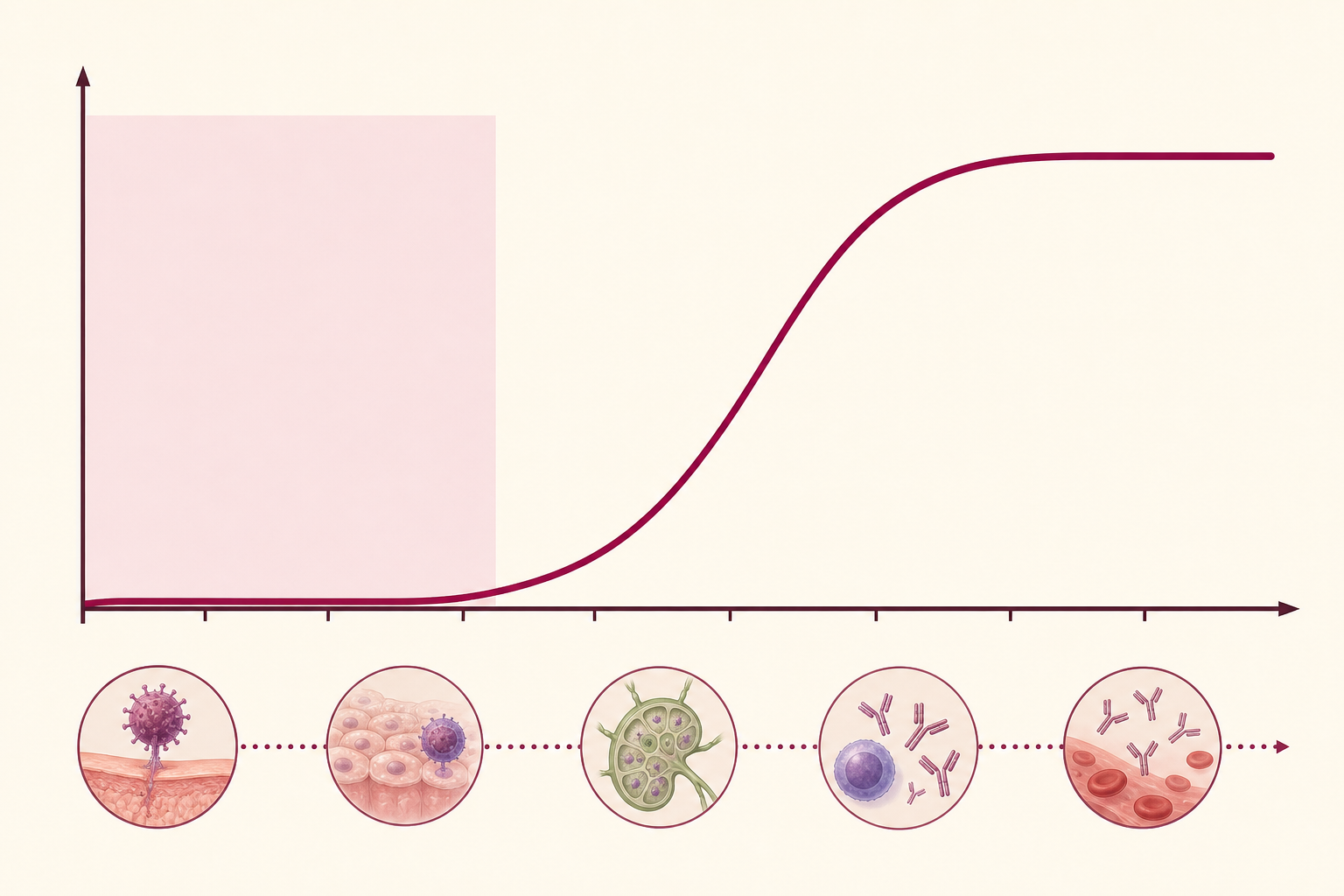
This is where the answer becomes more nuanced. A handful of small clinical observations suggest that starting antivirals very early in a first-ever (primary) herpes infection may slightly delay the rise of IgG antibodies. The proposed biological reason is straightforward: if viral replication is suppressed quickly, total antigen exposure to the immune system is lower, so the antibody response builds more slowly.
Important caveats. "Delay" is not the same as "erase." It does not mean permanent false negatives, and it does not mean the virus disappears from detection forever. Antibodies still form, just sometimes on a slightly stretched timeline. The effect is small enough that it does not change the practical retesting plan.
The clinical response is the same as for anyone testing for herpes after a recent exposure: if the initial blood test is negative inside the window period, retest at 12 weeks. The CDC STI Treatment Guidelines specifically recommend repeat type-specific antibody testing 12 weeks after the presumed time of acquisition. Antivirals do not change that timeline meaningfully for the vast majority of people.
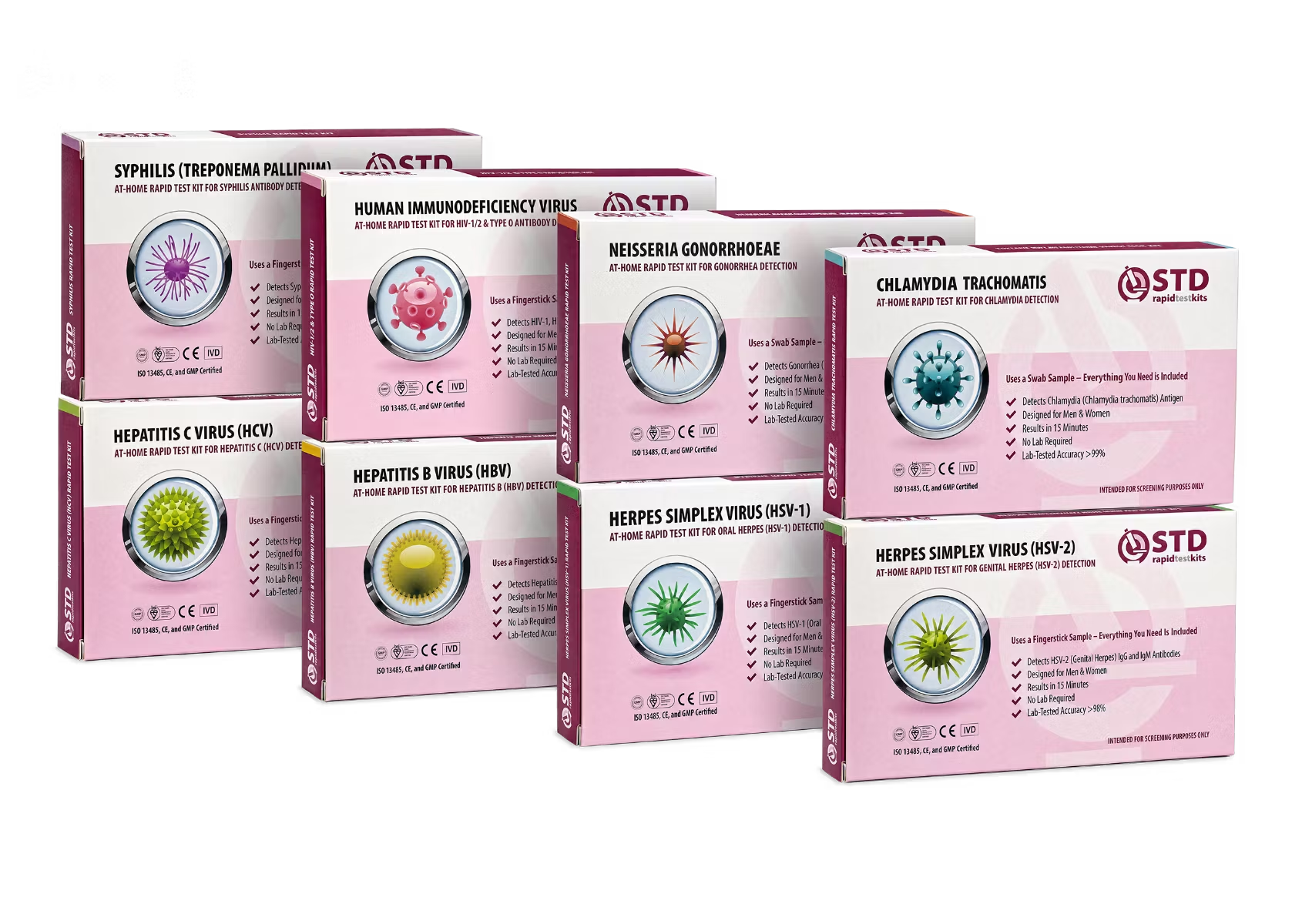
This site sells at-home rapid STD test kits; the panel below is one of the products we offer. We recommend kits based on fit for the reader's concern, not commercial benefit.
Swab Tests During an Outbreak
This is the one situation where valacyclovir could meaningfully shape the outcome of a test. Swab tests for herpes, particularly PCR-based assays, depend on viral DNA being present at the surface of an active lesion. If someone starts antivirals at the very first tingle, the sore may heal so quickly that the viral load at the surface drops below the detection threshold.
That does not mean the swab will automatically be negative. PCR is highly sensitive and can pick up small amounts of DNA. But if a lesion is already crusting, scabbing, or visibly healing, detection becomes harder no matter what medication is involved. The biggest factor in swab accuracy is the stage of the lesion at the moment of collection, not the pill you took this morning.
Clinical labs recommend collecting from the freshest, fluid-filled lesion possible (a vesicle or recently unroofed ulcer), unroofing closed vesicles before swabbing, and pressing firmly enough to collect cellular material rather than just surface fluid. Lesion stage and collection technique matter more than whether antivirals were started two days earlier.
HIV Testing, PrEP, and the Antiviral Confusion
One source of confusion deserves its own paragraph. Valacyclovir does not interfere with standard HIV testing in any way. The antigen/antibody combination tests used in clinics and at-home kits detect HIV-specific p24 antigen and HIV-specific antibodies. Neither has anything to do with the herpes replication machinery valacyclovir targets.
The confusion usually comes from conflating different antiviral categories. Antiretroviral therapy (ART) for HIV, and HIV pre-exposure prophylaxis (PrEP) using tenofovir/emtricitabine, can blunt the HIV antibody and antigen response in some scenarios. Those drugs directly suppress HIV replication and can extend the window period of HIV diagnostic testing, which is why PrEP users follow specific testing protocols.
Valacyclovir is in an entirely different drug class with an entirely different target. If you are only taking valacyclovir for herpes, your HIV test accuracy is not altered by the medication. The same applies to syphilis, hepatitis B, hepatitis C, chlamydia, and gonorrhea testing.
Valacyclovir targets herpes replication. Antiretrovirals (ART and PrEP) target HIV replication. The two drug classes do not overlap, and valacyclovir does not alter HIV test sensitivity in any way.
What Actually Causes a False-Negative STD Test
When "valacyclovir false negative STD test" turns up in a search history, the underlying feeling is usually distrust of the result. The medication is the convenient scapegoat. The actual causes of false negatives in modern STD diagnostics look very different.
| Cause | How It Happens | Medication Involved? |
|---|---|---|
| Testing too early | Body has not yet produced detectable antibodies or viral load | No |
| Poor sample collection | Insufficient swab contact, wrong site, or improper timing | No |
| Healing lesion | Low viral shedding at the surface during swab | Sometimes, but mostly biology of the lesion stage |
| Lab processing issue | Rare technical or storage problem | No |
| Early antivirals during first infection | Possible slight delay in antibody formation | Potentially minor effect |
IgM vs IgG: Why the Internet Makes This Confusing
If you have spent any time researching herpes test accuracy online, you have probably stumbled into the IgM versus IgG debate. IgM is the antibody class your immune system produces first during a new infection. IgG is the longer-term memory antibody that develops later and persists for life.
For HSV, IgG type-specific antibody testing is the standard of care. IgM testing for HSV is widely considered unreliable. It cross-reacts between HSV-1 and HSV-2, can be falsely positive during reactivation of an established infection, and frequently produces results that do not correspond to clinical reality. Most professional guidelines, including the CDC STI Treatment Guidelines, do not recommend routine IgM testing for HSV diagnosis.
Valacyclovir does not selectively erase IgG antibodies once they have formed. If your body has mounted a measurable IgG response, that signal stays detectable. The medication calms outbreaks. It does not reach back into your B-cell memory and delete antibodies you already have.
For HSV, IgG type-specific testing is the standard of care. IgM testing is not recommended by the CDC or most clinical guidelines. It cross-reacts between HSV types and can produce false positives during reactivation of an existing infection.
Should You Stop Valacyclovir Before Testing?
This is one of the most common practical questions, and the answer is almost always no.
For blood-based antibody tests (herpes IgG, HIV antigen/antibody, syphilis treponemal, hepatitis B and C), stopping valacyclovir does not change anything meaningful. If antibodies are present, they are present whether you took a pill this morning or not. Stopping the medication will not make antibodies appear if you are still inside the window period either, because antibody development is driven by exposure timing, not by whether you are currently medicated.
For swab PCR testing during an active outbreak, timing of the lesion matters more than discontinuing medication. If a lesion is fresh, uncrusted, and actively shedding, PCR detection is strong even with a few doses of valacyclovir on board. If the lesion is already healing, stopping the medication will not magically restore peak viral shedding levels.
The clinical guidance is consistent: stopping antivirals solely to "improve" test accuracy is rarely useful and should only be done under medical supervision. If you are unsure, ask your prescriber rather than self-discontinuing.
Stopping valacyclovir before a blood antibody test does not improve accuracy. Antibody levels reflect immune history, not current medication status. The pill you took this morning does not change what a blood draw finds.
Building a Smart Retesting Timeline
If you are taking valacyclovir and wondering when to test or retest, the framing that helps most is the timeline of your specific exposure, not the medication schedule. Map the dates first, then pick the test window that matches.
| Scenario | Initial Test Timing | Recommended Follow-Up |
|---|---|---|
| Recent herpes exposure (no symptoms) | At 3 to 4 weeks | Repeat IgG at 12 weeks for confirmation |
| Swab during outbreak while on antivirals | As soon as a fluid-filled lesion appears | If negative but suspicion remains, follow with IgG at 12 weeks |
| On long-term suppressive therapy | Any time past established infection | No medication pause needed for IgG testing |
| Worried about false negative from early testing | Within first 2 to 3 weeks | Retest after full window period (12 weeks for HSV IgG) |
Both type-specific and type-common antibodies to HSV develop during the first weeks after infection and persist indefinitely.
The Bigger Picture: Medication Doesn't "Hide" STDs
A persistent fear circulates online that antivirals can hide infections from detection. That fear bleeds into adjacent searches like "can medication hide STD symptoms" or "rapid STD test accuracy on medication." Most of the time, the worry is misplaced.
Antivirals reduce viral replication. They do not make laboratory diagnostics blind. Modern PCR detects viral genetic material at vanishingly small concentrations, and antibody testing reads immune memory that exists independently of current viral activity. If someone tests negative well after the appropriate window period, the result deserves trust. If someone tests early, the right next step is retesting after the window has fully passed, not stopping a medication that is doing its job.
If you are stuck in uncertainty, taking action beats sitting with the doubt. That might mean repeating a herpes IgG test at 12 weeks, screening more broadly with a multi-infection panel, or talking to a clinician about your specific exposure and risk factors. The medication you took to protect yourself is not secretly working against your test results. The science of antibody timing is the part actually worth respecting here, and that science gives you a clear retesting plan rather than a reason to second-guess every negative number you see.
Frequently Asked Questions
- I started valacyclovir right away. Did I ruin my herpes test?
- No. Starting antivirals early may calm the virus down quickly, but it does not erase infection or wipe out antibodies. If your blood IgG test was done after the full 12-week window period and it is negative, that result is reliable. If you tested earlier, retest at 12 weeks for confirmation.
- Is a negative result more likely from medication or from testing too soon?
- Almost always, it is timing. The body needs weeks to build detectable antibodies. Valacyclovir does not make labs blind. Testing at week two and expecting week-twelve certainty is the most common source of confusion, and it has nothing to do with the pill.
- Can valacyclovir make a swab test come back negative even if I have herpes?
- It can lower viral shedding from a lesion, yes. But the bigger factor is the stage of the sore. Swabs work best on new, fluid-filled lesions. If the sore is already healing or crusting, with or without medication, there may not be enough virus left to detect. The lesion biology drives this more than the medication.
- Do I need to stop taking valacyclovir before my test to make it more accurate?
- In most cases, no. Stopping medication does not suddenly boost antibody levels or make virus appear on a swab. Accuracy comes from timing relative to exposure, not from withdrawing the medication. If you have a specific reason to consider stopping, ask your prescriber first.
- Can antivirals hide other STDs like chlamydia or gonorrhea?
- No. Valacyclovir only targets herpes viruses. It does not treat or suppress bacterial infections like chlamydia or gonorrhea, and it does not interfere with their PCR or NAAT tests. Different organisms, different mechanisms, different tests.
- I tested negative for herpes at 6 weeks. Is that reliable?
- It is a good sign, but not the finish line. Many people develop detectable IgG antibodies by six weeks, but the standard window for confidence is around 12 weeks per CDC guidance. A negative at six weeks is encouraging; the twelve-week result is the one to act on.
- Could daily suppressive therapy make my herpes blood test turn negative over time?
- No. Suppressive therapy reduces outbreaks and transmission risk. It does not reverse your immune system's memory. Once IgG antibodies are established after seroconversion, they generally remain detectable for life.
- Does valacyclovir affect HIV testing in any way?
- No. Different virus, different drug target. Standard HIV antigen/antibody combination tests are not altered by herpes antivirals. If you are taking PrEP or HIV-specific antiretroviral therapy, that is a separate conversation with its own testing protocol, but valacyclovir alone does not interfere.
How we sourced this article: Our article was constructed based on current advice from prominent public health and medical organizations (CDC, WHO, and NHS), peer-reviewed studies on herpes serology and antiviral pharmacology, and current HIV diagnostic testing guidance. We summarize that literature into plain-English explanations for at-home testing decisions; we do not provide clinical diagnosis. For symptoms or testing decisions specific to you, see a licensed provider.
- U.S. Centers for Disease Control and Prevention. Genital Herpes: About Genital Herpes. Overview of HSV-1 and HSV-2, transmission, and prevention.
- U.S. Centers for Disease Control and Prevention. STI Treatment Guidelines: Genital Herpes. Diagnostic testing recommendations (type-specific IgG, swab PCR), 12-week retesting guidance, and suppressive therapy dosing.
- World Health Organization. Herpes simplex virus fact sheet. Epidemiology and clinical course of HSV-1 and HSV-2.
- U.S. Centers for Disease Control and Prevention. HIV Testing Overview. Window periods for antigen/antibody combination tests, antibody-only tests, and NAT.
- NHS. Genital herpes: symptoms, diagnosis, and treatment.
