
Published: August 2025 | Last updated: May 2026 | Editorial review and quality control: Martina N.
At-home sexually transmitted infection testing is fully legal in Ireland, and for most people it is the fastest way to get a private, valid result. The Health Products Regulatory Authority (HPRA) cleared CE-marked self-tests for personal sale and use, kits arrive in plain packaging within a few days, and your result data stays under your control. The catch is that timing and sample collection still matter as much as the kit itself. This guide covers how to pick a legal kit, when to test after a possible exposure, what to do with the result, and how the at-home route compares with HSE clinic care.
If you have ever delayed a test because the clinic felt too public, the appointment too far away, or the conversation too awkward, you are exactly the reader this article was written for. The HSE remains the right choice for many situations, especially after a positive result, for under-25s eligible for free home-testing services, or when you need contact tracing and treatment in one place. The aim here is simply to walk you through what at-home testing can and cannot answer, so you can act sooner rather than later.
Key Takeaways
- CE-marked at-home STI kits are legal to sell and use in Ireland under HPRA medical-device rules, and they often return results faster than waiting for an HSE clinic appointment.
- Test timing drives accuracy more than test brand. Window periods run from about a week for chlamydia and gonorrhea to six weeks or more for HIV and syphilis.
Who Is Choosing At-Home Testing in Ireland, and Why?
Consider a common scenario. Someone in their late twenties starts seeing a new partner after a long break from dating. There are no symptoms, but a quiet voice keeps asking when they last actually tested. Booking an HSE clinic in Galway, Cork, or Dublin can mean a wait of two weeks or more during peak periods, and walking into a local centre carries the small but real chance of running into someone they know. So the test gets put off again. And again.
This kind of delay is exactly what public-health teams in Ireland worry about. According to the Health Protection Surveillance Centre's STI surveillance data, chlamydia, gonorrhea, and syphilis notifications have all climbed in recent years. The problem is access, not apathy. People who put off testing typically lack a private, shame-free route to care, especially in counties without a full-service clinic.
HSE clinics matter. They offer free testing and treatment, contact tracing, and clinical follow-up, which no at-home kit can replicate. The challenge is geography. Most full-service genitourinary medicine clinics are concentrated in Dublin, Cork, Galway, and Limerick. If you live in Offaly, Sligo, Donegal, or rural Kerry, you may face long travel, capped appointment numbers, and rotating opening hours. At-home kits are a complement to that infrastructure rather than a replacement for it, useful when the public route stalls or feels too exposed.
The other groups reaching for at-home tests are couples testing together at the start of a relationship, polyamorous and queer communities testing on a routine cadence, and travellers wanting a screen after a holiday with new partners. None of those situations strictly require a clinic visit unless something turns up positive.
Full-service genitourinary medicine clinics are concentrated in Dublin, Cork, Galway, and Limerick. Residents in Offaly, Sligo, Donegal, or rural Kerry typically face longer travel, capped appointment numbers, and rotating opening hours. At-home testing fills the gap when the public route stalls.
What Counts as a Legal STI Test Kit in Ireland?
An old rumour still floats around Irish forums and social-media threads claiming that self-testing for STIs is illegal here. That has not been true for some time. The Health Products Regulatory Authority issued guidance confirming that CE-marked STI self-tests can be sold and used in Ireland under EU medical-device rules, provided they ship with clear instructions and meet the relevant performance standards. You can read the regulator's overview at the HPRA medical devices page.
What that means in practice: if you order a kit from a reputable provider with CE-marking shown on the box and the instructions, you are using a regulated diagnostic device. You are not cutting corners. Most at-home tests in Ireland fall into two categories. The first is rapid lateral-flow tests that you read yourself at home in 15 to 20 minutes, similar in look and feel to the COVID-19 antigen tests you have probably used. The second is mail-in lab tests, where you self-collect a sample (a swab, a fingerstick blood drop, or in some kits a urine sample) and post it back to a partner laboratory using a prepaid envelope. Both pathways are legal and valid. The trade-off is speed versus method.
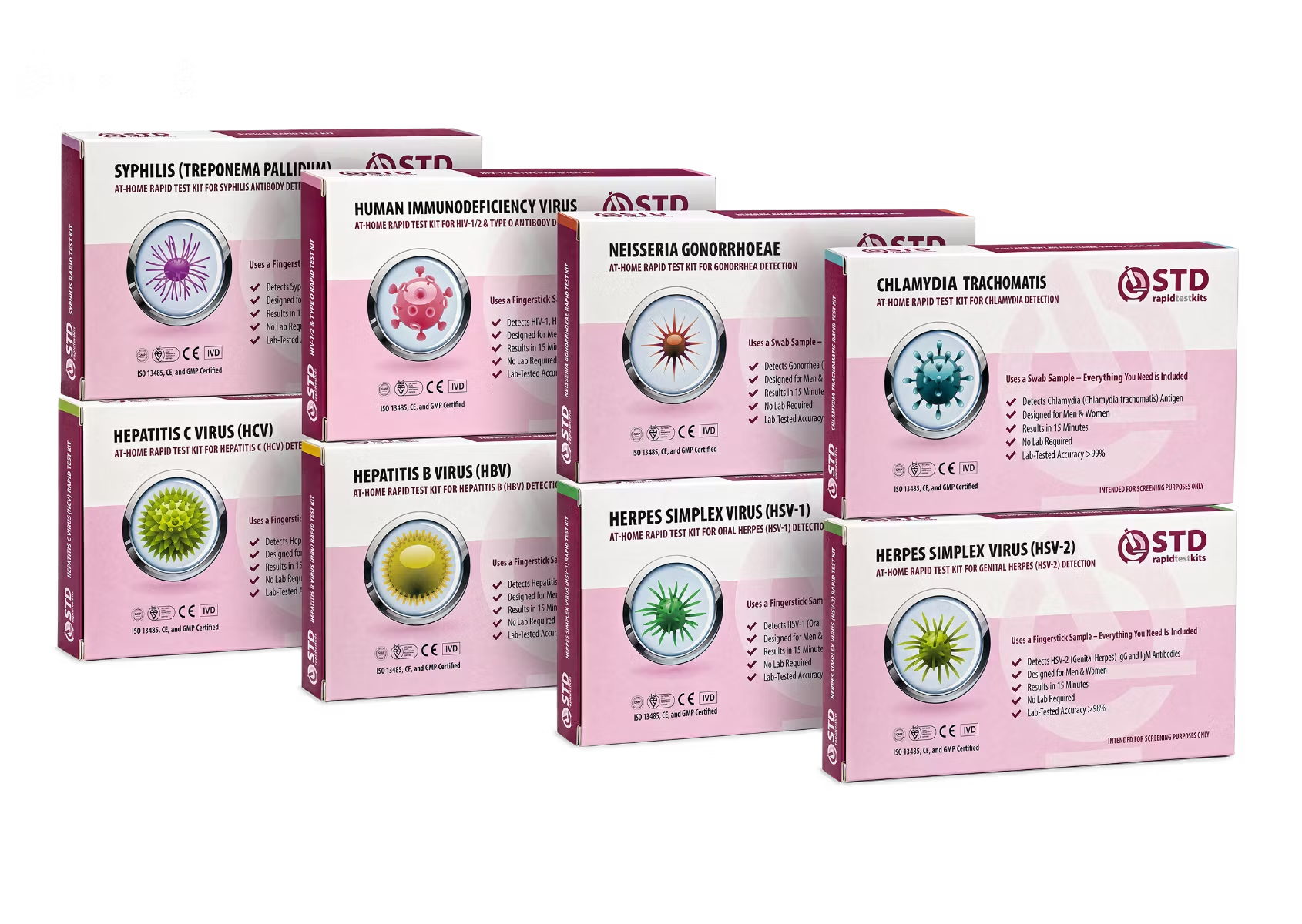
Self-collection kits for chlamydia, gonorrhea, HIV, and syphilis are now the most common at-home options. Combination kits cover several infections from one set of samples. STD Rapid Test Kits ships discreetly across Ireland, including the 6-in-1 and 8-in-1 panels described later in this guide.
Our 10-in-1 kit is validated for vaginal self-swab only. If you specifically need a male-compatible test for trichomoniasis or HPV, see a clinic for those particular infections. The other panels we carry work for any gender.
Two legal at-home pathways
- Rapid lateral-flow: self-collected sample, read at home in 15 to 20 minutes.
- Mail-in lab: self-collected sample posted to a partner laboratory, encrypted result in 2 to 3 working days.
- Both must carry CE marking on the box and instructions to be sold legally in Ireland.
From Order to Result: How At-Home Kits Actually Work
Picture the process from start to finish. You place an order on a Tuesday morning. The package arrives in plain, unbranded packaging by Thursday or Friday, often within 48 to 72 hours even outside the larger cities. Inside the box you find the sealed test, an instruction sheet with diagrams, the collection equipment for your particular kit (a sterile swab, a single-use lancet for blood-based tests, or a urine cup), and a buffer or transport tube where required. There is no clinic, no waiting room, no questions across a counter.
If you ordered a rapid lateral-flow kit, you collect the sample, follow the timing instructions on the leaflet, and read the result yourself in roughly 15 to 20 minutes. Two visible lines (a control line plus the test indicator) means a reactive (presumed positive) result. One line on the control alone means non-reactive (negative). A faint line is still a line and should be treated as reactive until confirmed.
If you ordered a mail-in lab test, you seal the sample in the prepaid envelope, drop it in the post, and the partner lab returns your result through an encrypted portal in two to three working days. Some providers offer a free telehealth consult if the result comes back reactive. The lab pathway tends to use molecular methods such as NAAT, which have higher analytical sensitivity than lateral-flow strips. The two technologies are complementary rather than equivalent. Lateral-flow is faster and simpler. NAAT is the laboratory gold standard, used by clinics for confirmatory testing.
| Test Type | Typical Use | Result Time | Follow-Up Needed? |
|---|---|---|---|
| Rapid At-Home Test | Lateral-flow strip read at home for HIV, syphilis, hepatitis, herpes antibodies | 15 to 20 minutes | Confirmatory clinic test if positive |
| Mail-In Lab Test | Self-collected swab or fingerstick sample posted to a partner lab | 2 to 3 business days | Optional follow-up unless reactive |
| HSE Clinic Test | In-person visit with swabs or blood draw and clinical assessment | 3 to 14 days depending on backlog | In-person review if positive |
What the HSE Capacity Reports Tell Us
The HSE has published reviews of national sexual health service access, with one of the most cited subsections covering testing capacity shortfalls. The headline finding is that demand is growing faster than the public system can absorb, particularly among under-35s and rural populations. Wait times for some clinics during peak periods stretch into multiple weeks.
The quieter finding is that a meaningful share of Irish residents are now testing outside the clinical setting altogether, either through pharmacy-supplied home kits or online providers shipping CE-marked devices. HPSC surveillance data tracks notification trends, but at-home testing happening outside the clinical pathway is harder to measure. What is clear is that the cultural shift normalized by COVID-19 antigen testing, where ordinary people learned to swab themselves and read a strip, has carried over to STI testing.
Stigma has not disappeared. Irish readers still report worrying that ordering a kit makes them look irresponsible, or that doing this quietly means doing it wrong. The opposite is closer to true. Catching an asymptomatic infection at home and acting on it within a few days is among the most responsible health choices you can make for yourself and your partners. A large share of new chlamydia and gonorrhea infections cause no obvious symptoms in the first weeks, per CDC screening guidance, so waiting for a sign before testing means many cases are caught only after they have spread.
Demand has outpaced HSE testing capacity, particularly among under-35s and rural populations. Some HSE clinics see waits of multiple weeks during peak periods. For asymptomatic screening, an at-home kit is often the faster route to a result.
When Should You Test After a Possible Exposure?
Imagine waking up on a Sunday morning replaying the night before. There was protection, but not the entire time. Or the condom broke. The impulse to know now is real, but biology does not yield to urgency. Testing too early simply produces a false negative, which is the worst possible outcome because it offers reassurance that is not real.
The window period is the time between exposure and the point at which a test can reliably detect the infection. It varies by pathogen and by test technology. As a general rule, if it has been fewer than 5 days since exposure, the recommendation is to wait. Exceptions are if you are experiencing severe symptoms, have been sexually assaulted, or have a known partner who has just tested positive. In those cases, walk into a clinic or A&E for in-person care today rather than ordering a home kit.
By day 7 to 10 you are in a kind of testing limbo. Lab NAAT for chlamydia and gonorrhea may already be detectable, but a negative at this point still warrants a retest at two weeks. Once you reach the two-week mark, most at-home and lab-based tests can return reliable results for chlamydia and gonorrhea. HIV and syphilis follow a longer timeline. Consider a hypothetical reader who tests on day 5 after a worrying encounter, gets a negative, and feels symptoms creep in by day 15. He retests. The result is positive for gonorrhea. The first test had not failed. It had simply been too early.
If timing is uncertain or exposure is ongoing, test once within the relevant window and again after it passes. Two data points are more reliable than one. A discreet kit is one order away if you want to start there.
| Infection | Window Period | Best Time to Test | Retest Needed? |
|---|---|---|---|
| Chlamydia | 7 to 14 days | 14+ days | Yes, if tested early or partner tested positive |
| Gonorrhea | 7 to 14 days | 14+ days | Yes, if symptoms develop or change |
| HIV | 2 to 6 weeks | 6 weeks (Ag/Ab), or 10+ days (NAAT) | Yes, at 12 weeks for confirmation |
| Syphilis | 3 to 6 weeks | 6 to 12 weeks | Yes, if exposure was recent |
| Trichomoniasis | 5 to 28 days | 2 to 4 weeks | Case by case |
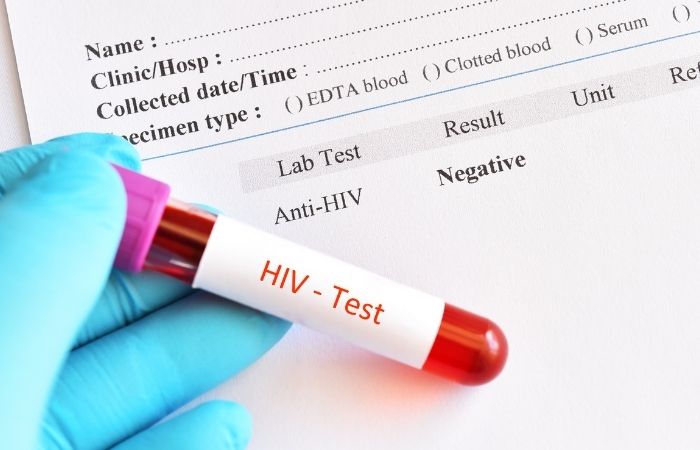
Should You Retest After Treatment or a Negative?
Retesting is one of the most misunderstood parts of STI care, especially with at-home testing. People assume one negative means they are safe forever, or one positive that has been treated closes the chapter. In reality, retesting is sometimes a necessary step rather than a redundant one.
Consider a hypothetical reader, a university student in Cork who tests positive for chlamydia on a home kit, gets a course of antibiotics from her GP within a week, and wants to test again the next day to confirm a cure. The clinic tells her to wait at least 3 to 4 weeks. Why? Because after treatment, your body can still shed traces of bacterial DNA for a short period, and a NAAT or rapid test that detects that residue may register as positive even though the infection itself is cleared. Retesting too early risks a confusing, falsely reactive result that does not represent active infection.
The general rule of thumb is to wait at least 3 weeks after completing treatment before retesting to confirm cure for chlamydia or gonorrhea. The CDC's screening recommendations also suggest a routine three-month retest for both partners, since reinfection from an untreated partner is common. If you tested negative initially but a partner has since tested positive, or if symptoms persist or develop, retest. Routine screening every 3 to 6 months is reasonable for anyone with multiple or new partners, and the WHO's global STI guidelines back the same cadence.
Wait at least 3 weeks after completing treatment before testing for cure. Earlier positives may reflect residual bacterial DNA rather than active infection. For routine follow-up, retest both partners at the 3-month mark to catch any reinfection.
Privacy, Delivery, and What “Discreet” Actually Means
The most common Irish-reader question on this topic is straightforward: will the postman, my flatmate, or my partner be able to tell what is in the box? The short answer is no. Reputable providers ship in plain packaging with no health-related branding, no clinic name on the label, and no sender details that read as medical. Card statements and bank-app entries usually show a generic merchant name rather than “sexual health test”.
Most users in Ireland report kits arriving within 48 to 72 hours, even in rural counties. That means you can plan a test around a quiet weekend at home, a study break, or a midweek evening when the house is empty. If you live in shared housing, several providers now offer parcel-locker delivery or PO-box options for additional control over who handles the package.
Your results stay just as private. Most providers use encrypted result portals or SMS-only updates, with email used only if you opt in. You decide whether to speak to a clinician, retest, or share the result with a partner. There is no automatic notification to your GP and, for at-home rapid tests that you read yourself, no record at all unless you create one. Notifiable infections such as syphilis or HIV are reported by laboratories at an aggregate, anonymized level when confirmed at a lab; that reporting protects population-level surveillance without identifying you. The Citizens Information overview covers the wider regulatory landscape.
What Happens If You Test Positive at Home?
First, breathe. Most STIs are treatable, and many are curable with a short course of antibiotics. Only HIV, herpes, and HPV require longer-term management, and even those are far more manageable than they were a generation ago. A reactive home result opens a pathway to care; the fact that you tested at all is the action that protects your health and your partners' health.
If your at-home test reads positive, the next steps depend on the infection and your local options. The general flow is consistent. Confirm the screen with a clinic-administered test or a lab NAAT where possible, since at-home rapid tests are screening tools and reactive screens warrant confirmatory testing. Most GPs in Ireland will accept a printed result or a portal screenshot as the basis for a same-week follow-up appointment. Some at-home providers include a free telehealth consult or a written referral letter with a positive result, which speeds the GP visit.
If confirmed, get treated. Bacterial infections like chlamydia, gonorrhea, and syphilis are treated with antibiotics. HIV care begins with linkage to a specialist clinic and a discussion of antiretroviral therapy; modern regimens allow most people on treatment to reach an undetectable viral load and stop transmitting the virus. Talk to recent partners. The HSE offers anonymous partner notification through clinic teams, and several at-home providers offer partner-notification messaging that lets you tell someone without revealing your identity. Browse the full kit range if you and a partner want to test together as a follow-up step.
Self-testing has the potential to expand access to testing services and improve testing coverage, particularly among populations facing barriers to in-person services.
You Deserve Answers, Not Assumptions
If you have ever put off testing because you were worried about what someone else might think, you are in good company. Most people delay not because they do not care, but because they are working through some combination of shame, exhaustion, or the cultural hush around sexual health that still lingers in parts of Irish life. Testing does not mean you have done something wrong. It means you are paying attention.
Common bacterial, viral, or parasitic infections circulate through partner contact regardless of relationship style or partner count. They show up in monogamous couples and in people with many partners. They show up in cities and in rural counties. Complications like pelvic inflammatory disease, infertility, and onward transmission arise from infections that go undetected, regardless of how many partners someone has had.
You deserve answers without a lecture, without a judgmental glance from a stranger, and without a waitlist that makes your anxiety worse. Order a kit when the question first comes up, follow the timing rules in the table above, and bring the result to a clinic if it reads positive. That is the practical workflow at-home testing makes available in Ireland today, with the HSE remaining the backstop for diagnosis, treatment, and care.
1. Order a CE-marked kit once the question comes up. 2. Observe the relevant window period before testing. 3. If the result is reactive, bring it to a GP or HSE clinic for confirmatory testing and treatment. The HSE remains the backstop for diagnosis, treatment, and partner notification.
FAQs
- Is at-home STI testing legal in Ireland?
- Yes. The Health Products Regulatory Authority confirmed that CE-marked STI self-tests can be sold and used in Ireland under EU medical-device rules. Buy from a provider that shows CE marking on the box and the instruction leaflet, and you are using a regulated diagnostic device. No prescription, no doctor's note, no workaround needed.
- How accurate are at-home STI kits compared with HSE clinic tests?
- Accuracy depends on two things: timing relative to exposure, and how cleanly you collect the sample. Modern CE-marked rapid kits report sensitivity figures in the mid-to-high 90s for the infections they screen for, but they are screening tools. Lab NAAT used in HSE clinics has higher analytical sensitivity, which is why a positive at-home screen is normally confirmed at a clinic. Test too early and you can get a false negative on either route.
- How quickly can I get results from a home kit in Ireland?
- Rapid lateral-flow kits give you a result in 15 to 20 minutes once you have collected the sample correctly. Mail-in lab tests typically come back through an encrypted portal or SMS within 2 to 3 working days after the lab receives your sample. Either pathway is faster than the multi-week wait that some HSE clinics see during peak periods.
- What should I do if my home test reads positive?
- Book a GP or HSE clinic appointment promptly. Most will see you within the week if you have a result to show. Bacterial infections (chlamydia, gonorrhea, syphilis) are treated with a short antibiotic course. HIV links you to a specialist clinic, where antiretroviral therapy can bring viral load to undetectable. Notify recent partners so they can test too. Many providers offer anonymous partner-notification messaging if naming yourself feels too much.
- Will the package or my bank statement give it away?
- Reputable Irish-supplying providers ship in plain, unbranded packaging with no health-related markings on the outside. Card statements and banking app entries typically show a generic merchant name rather than anything sexual-health-related. If you are in shared housing, several providers also offer parcel-locker or PO-box delivery for extra control over who handles the package.
- Should I test if I have no symptoms?
- Yes, especially if you have new or multiple partners. A large share of new chlamydia and gonorrhea infections produce no symptoms in the first weeks, particularly in people with vaginas, so symptom-watching is not a reliable screening strategy. Routine asymptomatic screening every 3 to 12 months catches infections that would otherwise be detected only after complications develop.
- How often should I retest if I am sexually active?
- There is no single rule. A reasonable cadence is once every 6 to 12 months if you are seeing new partners occasionally, every 3 months if you are very sexually active or in a non-monogamous setup, and as soon as makes sense (after the relevant window period) if a partner has tested positive or symptoms appear. The CDC's screening guidance and the WHO's STI guidelines both back this kind of risk-tiered cadence.
- Do I still need to see a doctor at some point?
- For routine asymptomatic screening or peace of mind, not necessarily. At-home tests are designed to give you that answer on your terms. For a positive result, yes: confirmatory testing and treatment require clinic involvement, whether through your GP or an HSE clinic. Think of at-home testing as the first move that brings the right question to the clinic faster, not as a replacement for clinical care.
How We Sourced This Article: We made this guide useful, kind, and accurate by drawing on current advice from leading public-health bodies, peer-reviewed clinical literature, and Irish regulatory guidance. Every numeric claim and timing rule cited inline links to the source page.
- Health Protection Surveillance Centre Ireland. STI A-Z page covering surveillance methodology and notification trends for chlamydia, gonorrhea, and syphilis in Ireland.
- Health Products Regulatory Authority. Medical devices and CE-marking guidance for in-vitro diagnostic self-tests sold in Ireland.
- U.S. Centers for Disease Control and Prevention. STI screening recommendations including who should test, how often, and asymptomatic-infection statistics.
- U.S. Centers for Disease Control and Prevention. STI treatment guidelines covering window periods, retest cadence, and post-treatment cure-confirmation timing.
- World Health Organization. Sexually transmitted infections guidelines covering global testing recommendations and screening cadences.
- Health Protection Surveillance Centre Ireland. Root portal for national notifiable-disease surveillance, including chlamydia, gonorrhea, syphilis, and HIV trend data.
- Citizens Information Ireland. Sexual health overview covering reporting, confidentiality, and access pathways for STI care in Ireland.
