How Accurate Are At-Home HSV-2 Rapid Tests Compared With a Lab Test?
An at-home HSV-2 kit and a lab blood test look for the same thing: antibodies. Their published numbers look similar, but they were not measured the same way, and neither test can tell you what a sore is. Here is how the figures compare, where each test goes wrong, and which one suits your situation.
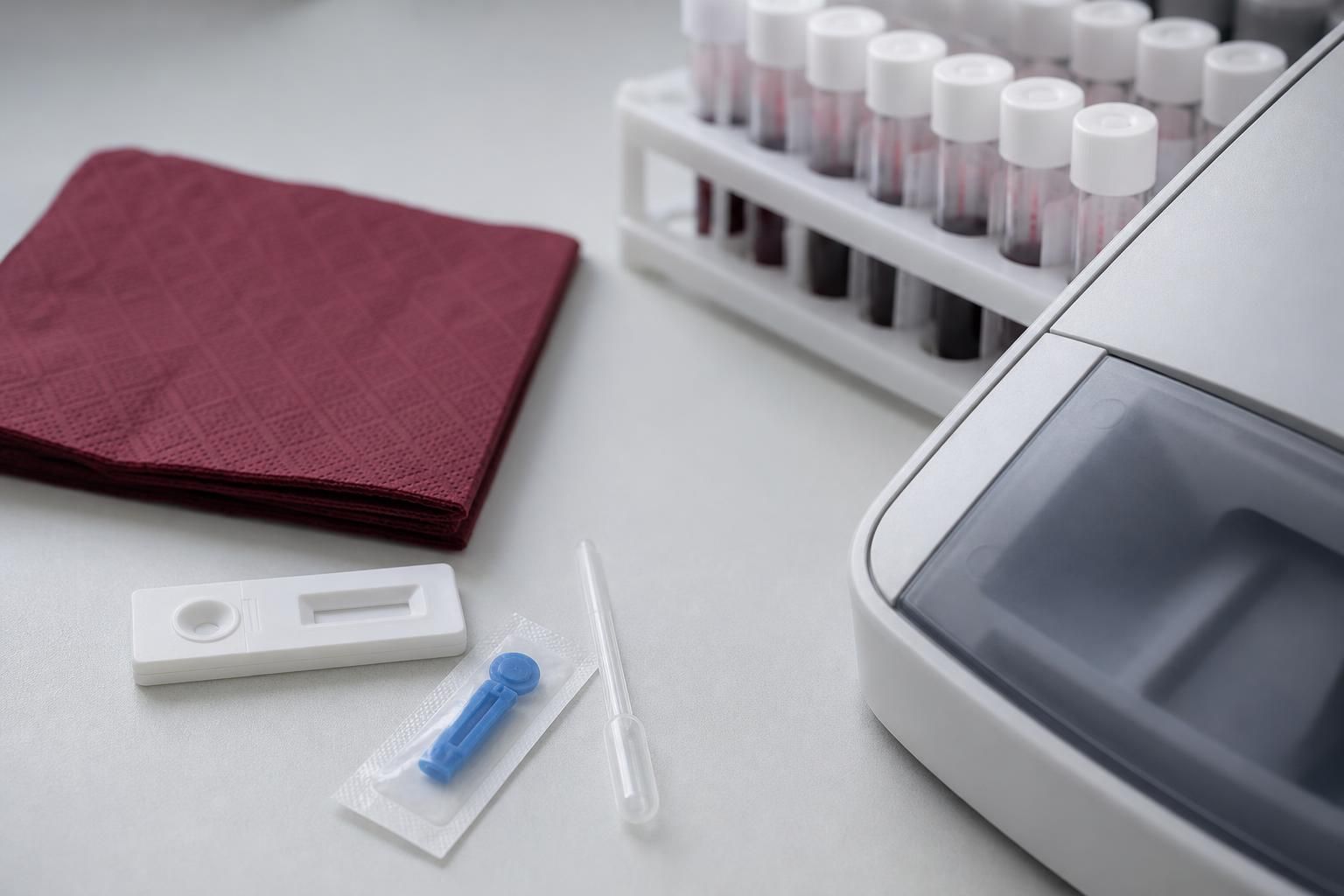



- The home kit's 98% figures measure agreement with a lab antibody test on clinician-collected blood. They are not a head-to-head result against the best available confirmation, and the manufacturer publishes no figure for home-collected samples.
- Lab HSV-2 blood tests also miss infections and give false positives. The CDC advises second-method confirmation of lab EIA positives, particularly at low index values; confirm a home-kit positive with a clinician. A sore needs a swab, not a blood test.
Published: October 2026 | Last updated: October 2026 | Editorial review and quality control: Martina N.
How accurate is a home HSV-2 rapid test compared with a lab test?
The at-home HSV-2 rapid kit's insert lists 98.0% sensitivity and 98.3% specificity against a lab ELISA on clinician-collected fingerstick blood; the manufacturer publishes no figure for home-collected samples. Lab type-specific blood tests range from 80% to 98% sensitivity, <a href="https://www.cdc.gov/std/treatment-guidelines/herpes.htm">according to the CDC</a>, measured on a different basis. A positive from either needs confirming, and only a swab of the sore (NAAT or culture) can say whether it is herpes.
Any herpes test is only as good as the question you ask it. A home HSV-2 rapid kit and the type-specific IgG test a lab runs both answer one question: does your blood contain antibodies to herpes simplex virus type 2? On paper the home kit's insert figures look as good as the lab's, and sometimes better. That comparison is less direct than it looks, because the two sets of figures were not measured the same way.
Below, the numbers sit side by side, with what each figure was measured against, why lab antibody tests have accuracy problems of their own, and when a swab of a sore is the better test than any blood test. For how rapid cassettes work and how long antibodies take to appear, see how accurate herpes rapid tests really are.
Three different tests get called a “herpes test”
When people compare a home test with a lab test, they usually picture the same kind of test done in two places. For herpes there are actually three tests, and they answer different questions.
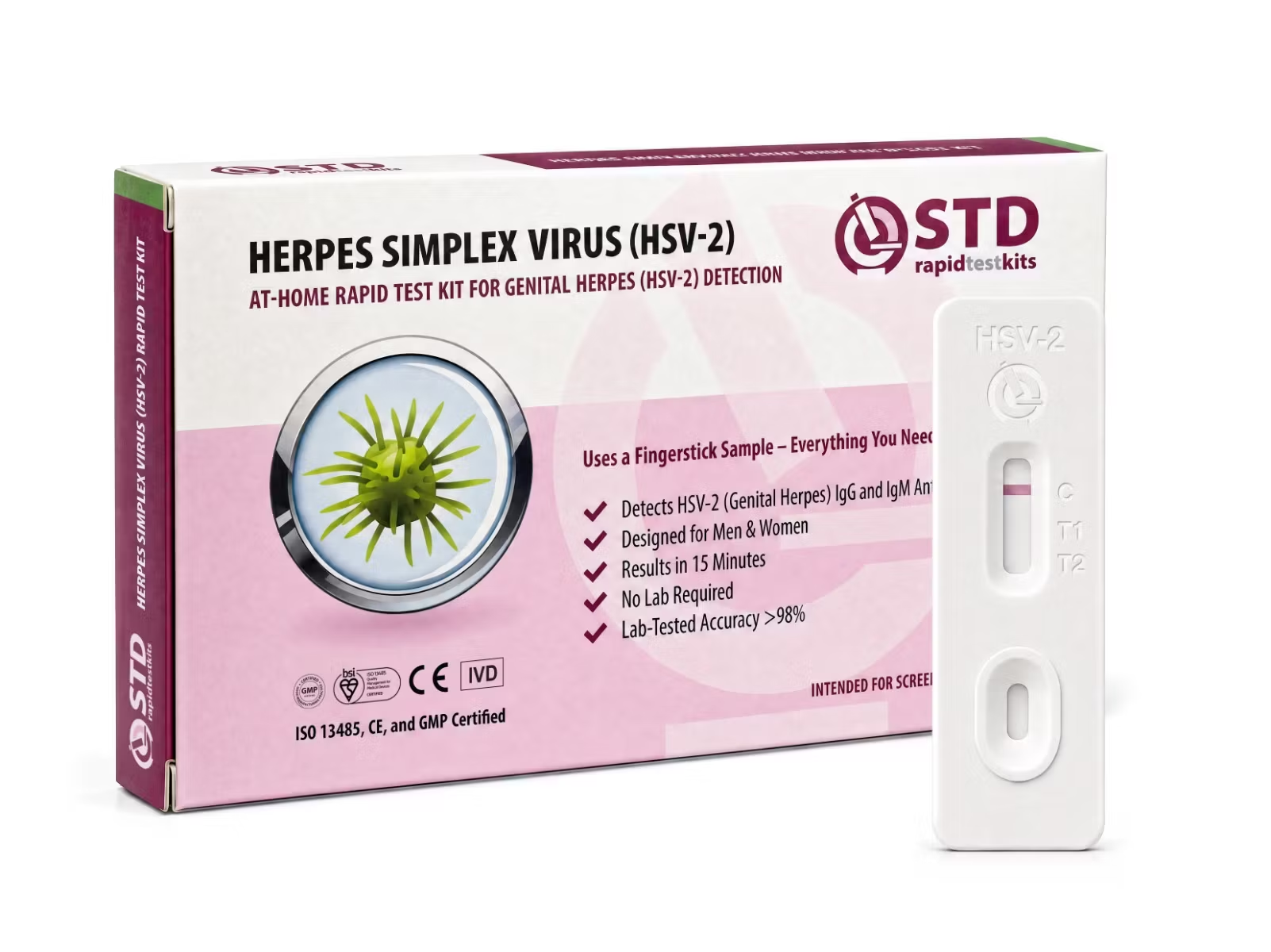
- The at-home HSV-2 rapid kit is a lateral-flow cassette. It reads a drop of fingerstick blood and shows whether HSV-2 antibodies are present, in about 15 minutes.
- A lab type-specific IgG blood test also looks for antibodies. It reports HSV-1 and HSV-2 separately, often with a numeric index value that helps a clinician judge borderline results.
- A lab swab NAAT (PCR) tests fluid from an active sore for the virus's genetic material. It is the only one of the three that tells you whether a specific sore is herpes.
The two blood tests can show an infection you have never noticed. Neither can say who you caught it from, when, or whether a bump you can see is herpes. The CDC's genital herpes overview states plainly that a blood test “cannot tell you who gave you the infection or when you got the infection.” If you are unsure which virus type you need to test for, our guide to the difference between HSV-1 and HSV-2 home kits walks through it.
At-Home HSV-2 Rapid Kit vs Lab Blood Test vs Lab Swab
| Feature | At-home HSV-2 rapid kit | Lab type-specific IgG blood test | Lab swab NAAT (PCR) |
|---|---|---|---|
| What it detects | HSV-2 antibodies | HSV-1 and HSV-2 IgG antibodies, reported separately | HSV genetic material in fluid from a sore |
| Sample | Fingerstick blood, collected yourself at home | Blood drawn at a clinic or lab | Swab of an active sore, taken by a clinician |
| Published sensitivity | 98.0% against a lab ELISA on clinician-collected fingerstick blood (manufacturer insert); no figure for home-collected samples | 80% to 98% (CDC) | 90.9% to 100% (CDC) |
| Published specificity | 98.3% against the same ELISA (manufacturer insert) | HerpeSelect EIA, the most commonly used assay: falsely positive at low index values; one study reported 57.4% overall (CDC) | Considered highly specific (CDC) |
| Works without a sore? | Yes | Yes | No, needs an active sore |
| Tells you a sore is herpes? | No | No | Yes, for the sore sampled; a negative from an older or healing sore does not rule herpes out |
| Next step after a positive | Clinician lab testing to confirm | Second-method confirmation (Biokit or Western blot) at low index values (CDC) | Treatment and counseling decisions with a clinician |
| Time to result | About 15 minutes at home | After lab processing | After lab processing |
Both blood tests answer “have I been infected?”. Only the swab answers “is this sore herpes?”
What the home kit's 98% figures were measured against
This article is published by stdrapidtestkits.com, which sells at-home STI test kits, including the at-home HSV-2 rapid test discussed here. Its manufacturer's insert reports 98.0% sensitivity and 98.3% specificity. Those numbers come from a comparison with an ELISA, a laboratory antibody test, run on fingerstick whole blood collected by clinicians. In plain terms, the cassette agreed with the lab antibody test about 98 times in 100, both on samples the lab called positive and on samples it called negative.
Three details matter when you compare that with a lab result.
The reference was another antibody test. A cassette that matches an ELISA closely inherits the ELISA's own blind spots. If the lab test misses an early infection or flags a false positive, a cassette that agrees with it does the same. The insert figure measures how well the cassette matches one lab method. It does not measure the cassette against the more definitive confirmatory tests described below.
The study samples were collected by clinicians. The kit is sold for private self-testing at home. The manufacturer publishes no figure for blood you collect yourself or for a result you read yourself. A small or smeared blood drop, or a faint line read in poor light, are home-use errors the study did not measure.
It is a preliminary screen. A positive needs confirming with a clinician. A negative does not rule infection out, especially if the exposure was recent. The kit cannot stage an infection, track it over time or say whether a sore is herpes.
The CDC's 80% to 98% range summarizes several type-specific antibody assays, and the page does not give the reference method behind it. The kit's insert figure is agreement with a single ELISA on clinician-collected fingerstick blood. The two numbers were not measured in a head-to-head comparison, so a figure on the insert that is as high or higher does not show the cassette outperforms a lab test.
Lab HSV-2 blood tests are not a perfect yardstick either
Many people assume a lab result settles the question. For herpes antibodies it often does not. The CDC's STI treatment guidelines put the sensitivity of glycoprotein-based type-specific HSV-2 tests at 80% to 98%, and note that false negatives are more frequent early in infection.
False positives are the bigger issue. The lab assay used most often reports a numeric index, and results just above the cutoff are unreliable. The same guidelines cite one study that found 57.4% overall specificity, falling to 39.8% for index values of 1.1 to 2.9. For that reason the CDC advises a confirmatory test using a second method, either the Biokit assay or a Western blot, before a low-positive result is interpreted. Where confirmation isn't available, clinicians are told to explain the testing limits to patients before ordering the test.
So a lab test's real advantage over a home cassette is not a guaranteed right answer. It is the extra information: an index value that shows whether a positive is strong or borderline, and access to confirmation when it is borderline. A cassette shows a line or no line. It cannot show where a result falls on that scale.
The most commonly used test, HerpeSelect HSV-2 enzyme immunoassay (EIA), often is falsely positive at low index values (1.1–3.0).
Why a positive from either test needs a second look
A specificity figure tells you how often a test correctly comes back negative in people without the infection. It does not tell you how likely your own positive is to be real. That depends just as much on how common HSV-2 is among people like you. In a group where few people carry the virus, even a test with high specificity can produce a fair share of false positives. When there is a known exposure or a history of sores, a positive is more likely to be true. Either way, confirm it with a clinician.
HSV-2 is common. The World Health Organization estimates that 520 million people aged 15 to 49, about 13% of that age group worldwide, have HSV-2 infection. Prevalence varies widely by country, age and sexual history. The CDC does not recommend HSV-2 serologic screening for the general population.
Many readers' biggest worry after a positive result is HIV. The WHO states that HSV-2 infection raises the risk of acquiring and transmitting HIV, and puts the risk of acquiring HIV at roughly three times higher. That is a reason to get tested, not a reason to panic. A herpes result says nothing about whether you have HIV, and HIV testing is quick. The WHO recommends offering HIV testing to people with symptoms of genital herpes. An at-home HIV test (a preliminary screen: a negative soon after an exposure does not rule HIV out, and a positive needs confirming with a clinician) or a clinic test can check this.
Common Misreadings of HSV-2 Blood Test Results
Myth: A lab blood test is always right, so it settles what a home kit can only guess at.
Fact: Lab HSV-2 antibody tests miss some infections and give false positives at low index values. Their advantage is the index value and access to a second-method confirmation, not certainty.
Myth: A test with 98% specificity means my positive is 98% likely to be real.
Fact: How likely a positive is to be real depends on how common HSV-2 is in people like you, not on specificity alone. Confirm any positive with a clinician.
Myth: A positive blood test means the bump I have now is herpes.
Fact: Antibodies can come from an infection that is active now or one from the past. Only a swab of the sore can say whether that sore is herpes.
Myth: An IgM test shows whether the infection is new.
Fact: The CDC does not recommend HSV IgM testing. IgM tests are not type-specific and can be positive during recurrent outbreaks.
If you have a sore, a clinic swab beats any blood test
Blood tests are designed for people without symptoms. Once a blister or ulcer appears, the most useful test is a swab of that sore. The NHS describes a clinician using a small swab to take fluid from a blister or sore, and notes the swab test cannot be done once no sores are visible.
The CDC calls HSV NAAT the most sensitive herpes test, with sensitivity of 90.9% to 100%, and describes these tests as highly specific. Viral culture, the older swab method, misses many cases, especially in recurrent sores and as a sore starts to heal. MedlinePlus likewise describes PCR as faster and more accurate than culture. Timing is the catch: go while the sore is fresh, not after it has crusted over. A negative swab, especially from an older or healing sore, does not rule herpes out; the CDC notes a clinician may then use a type-specific blood test.
A positive blood test, whether from home or a lab, can't stand in for this. A bump could be herpes, an ingrown hair, irritation or another infection such as syphilis, and the antibodies in your blood could date from an infection you caught years ago. We don't sell a swab test for herpes sores. For a sore, see a clinic. For more on how sample types differ, see blood versus swab herpes testing at home.
Cost, speed and privacy: where each route wins
Leaving symptoms aside, the trade-off between home and lab testing comes down to cost, time and how much detail you get back.
- Cost. A home kit is one flat price: no visit fee, no separate lab charge, no copay, and nothing on an insurance statement. A lab test usually means a visit plus a lab fee, and the total varies widely with the clinic and your coverage.
- Speed. The cassette reads in about 15 minutes at your kitchen table. A lab result comes back after the sample has been processed.
- Detail. A lab reports an index value, tests HSV-1 and HSV-2 separately, and gives you a clinician who can order confirmation. The cassette shows a line.
- Who it suits. A home screen fits someone with no sores and no symptoms who wants a private first check and will follow up on a positive. A lab test fits anyone with an unclear past result, a pregnancy, or a partner with diagnosed herpes.
Cheaper is not automatically worse here, but the two routes do give you different information. Our comparison of cheap and accurate herpes tests covers price ranges in more depth.
Which herpes test fits your situation
The right test depends on what you need to find out, not on which one has the higher number. Work through the steps below in order and stop at the first one that applies to you.
Home HSV-2 Kit, Lab Blood Test or Clinic Swab?
Do you have a blister, sore or ulcer in the genital or anal area, or genital symptoms such as tingling, burning or itching, pain when peeing, or unusual discharge?
Yes: See a clinician now rather than relying on a blood test. If there is a sore, go while it is still fresh and ask for a swab NAAT (PCR). No blood test, home or lab, can tell you whether that sore is herpes.
Are you pregnant, or has a sexual partner been diagnosed with genital herpes?
Yes: Talk to a clinician. A lab type-specific test with confirmation, plus advice for your pregnancy or relationship, will serve you better than a home screen. Go sooner if any sore appears.
Was your possible exposure less than 12 weeks ago (or less than 16 weeks, if you plan to use the home kit)?
Yes: Antibodies may not have formed yet. The CDC advises repeating lab type-specific testing 12 weeks after a suspected recent infection, and the kit's catalog product information gives 16 weeks as its retest point, so a negative before then is not a clearance. If a sore appears in the meantime, get it swabbed at a clinic.
Do you have no sores or symptoms and want a private first check?
Yes: A home HSV-2 rapid kit is a reasonable preliminary screen, unless you are pregnant or a partner has been diagnosed (see step 2). The CDC does not recommend HSV-2 serologic screening for the general population, and blood tests can give false positives, so decide whether the answer would change anything for you. If it is positive, see a clinician for lab testing with second-method confirmation. If it is negative, it does not fully rule out infection.
No: If you have symptoms, see a clinician now rather than relying on a blood test. If you have no symptoms and no specific concern, skipping the test is a reasonable choice; the CDC does not recommend HSV-2 serologic screening for the general population.
Guidance only. A clinician can advise on your specific history, results and risks.
FAQs
- Does the HSV-2 rapid kit also detect HSV-1?
- No. It looks only for HSV-2 antibodies. A separate HSV-1 kit and a combined kit exist, but the manufacturer publishes no performance figures for the HSV-1 test. Even in a lab, the CDC notes that HSV-1 blood tests cannot tell an oral infection from a genital one, so an HSV-1 result says little about genital herpes.
- I'm pregnant. Should I use a home herpes test?
- Talk to your prenatal clinician instead (see step 2 above). The CDC does not recommend routine HSV-2 screening in pregnancy.
- My home test was negative six weeks after sex. Am I in the clear?
- Not yet. The kit's catalog product information gives 16 weeks as the retest point, and the CDC advises repeating lab testing 12 weeks after a suspected recent infection. Retest at 12 weeks for a lab test, or 16 weeks for the home kit. If a sore appears before then, get it swabbed at a clinic rather than waiting for a blood result.
This article summarizes current guidance from the U.S. Centers for Disease Control and Prevention (CDC), the World Health Organization (WHO), the NHS and MedlinePlus. Each specific figure or recommendation links to the page that states it, and every page used is listed under Sources with what it supports. It is general health information written by our editorial staff, not a diagnosis or a treatment plan; how we choose topics and use sources is described in our editorial policy.
- U.S. Centers for Disease Control and Prevention. Sexually Transmitted Infections Treatment Guidelines, 2021: Genital Herpes. Type-specific HSV-2 serology sensitivity of 80% to 98%; false positives at HerpeSelect index values of 1.1 to 3.0; 57.4% overall specificity (39.8% at index 1.1 to 2.9) in one study; Biokit or Western blot confirmation; NAAT sensitivity of 90.9% to 100%; low sensitivity of viral culture; IgM testing not recommended; no general-population or routine pregnancy screening; repeat testing 12 weeks after presumed acquisition; HSV-1 serology does not distinguish oral from genital infection.
- U.S. Centers for Disease Control and Prevention. About Genital Herpes. A herpes blood test cannot tell you who gave you the infection or when you got it; a blood test may be used when no sores are present.
- World Health Organization. Herpes simplex virus fact sheet (May 2025). An estimated 520 million people aged 15 to 49 (13%) have HSV-2; HSV-2 raises the risk of acquiring HIV roughly three-fold; HIV testing should be offered to people with symptoms of genital herpes.
- NHS. Genital herpes. Diagnosis by swabbing fluid from a blister or sore; the swab test cannot be done once no sores are visible.
- MedlinePlus, U.S. National Library of Medicine. Herpes (HSV) Test (updated August 2025). Swab PCR is faster and more accurate than viral culture; HSV antibodies can reflect a current or past infection.