
Published: October 2025 | Last updated: May 2026 | Editorial review and quality control: Martina N.
A recent exposure, an unfamiliar sore, or a partner's diagnosis can make the question of herpes testing feel urgent, and the practical answers harder to find than they should be. The questions that drive most people to test at home are the same: what sample the kit needs, whether it finds the virus or the body's response, how long to wait before testing is reliable, and what the result actually means once you have it.
This guide walks through how at-home herpes testing works in plain language, drawn from current CDC, WHO, and NHS guidance. It covers the two distinct test methods (blood-based and swab-based), the timing rules that make or break accuracy, and how to interpret a positive or negative result without spiraling into worst-case readings of either.
Key Takeaways
- Blood tests detect HSV antibodies once your body has produced them, typically 4 to 12 weeks after exposure. Swab tests detect live virus, but only from an active, unhealed sore.
- Testing too early is the single most common cause of false-negative herpes results. Match the test type to your situation rather than to your urgency.
Why people test for herpes at home
The path to a herpes test usually starts the same way. Someone notices a tingling sensation, an unfamiliar bump, or remembers a recent unprotected encounter, and the questions stack up faster than answers. At-home testing exists to fill that gap. The reasons people reach for it are practical: privacy, convenience, and the ability to test on their own schedule without booking a clinic visit.
Herpes draws disproportionate at-home testing interest because it carries social weight that outpaces the medical reality. The WHO estimates that around 64% of people under 50 worldwide have HSV-1 and 13% of people aged 15 to 49 have HSV-2. Most people who carry the virus never get a formal diagnosis because they either have no symptoms or have symptoms so mild they assume the cause is something else.
That gap between how common herpes is and how heavily it gets discussed in public is part of why people want a private way to find out. An at-home test removes the friction of explaining yourself to a clinician you don't know, or sitting in a waiting room while you are already on edge. It lets you move from "what if" to a concrete answer without involving the rest of your life.
The trade-off is that at-home testing puts more judgment on you. A clinician normally picks the test type, decides the timing, and interprets the result in context. At home, those calls are yours.
Two test types, two different questions
There are two distinct ways to test for herpes, and they answer different questions. Confusing them is the most common reason people end up with an unclear result.
A blood test looks for antibodies, the proteins your immune system makes after it has been exposed to a virus. A positive blood test confirms past or current infection somewhere in the body, but it does not tell you when the infection happened, where in the body it is, or whether you will ever develop symptoms.
A swab test (formally a viral culture or PCR) looks for the virus itself, collected directly from fluid in an active sore. A positive swab confirms an active infection at that location, at that moment. Labs treat swab-based PCR as the most sensitive test during an outbreak, per Mayo Clinic diagnostic guidance.
These two tests do not substitute for each other. A blood test cannot diagnose what a specific sore is. A swab test cannot detect infection in someone with no current symptoms. At-home herpes products on the consumer market are almost all blood-antibody tests. Swab testing typically happens in a clinic because it needs a clinician to inspect the lesion, collect the sample correctly from a fresh sore, and send it for lab analysis.
| Test Type | What It Detects | Best Used When | Where It Happens |
|---|---|---|---|
| Blood antibody test | Antibodies to HSV-1 or HSV-2 | No current symptoms; past suspected exposure | At home or clinic |
| Swab (culture or PCR) | Active virus from a sore | Visible, fresh blister or ulcer | Usually clinic-collected |
How does at-home herpes testing actually work?
At-home herpes test kits are fingerstick blood antibody tests. They detect whether your body has produced antibodies to HSV-1 or HSV-2, which usually takes 4 to 12 weeks after exposure. They cannot diagnose an active sore directly; for that, a clinic-collected swab and PCR test is the appropriate tool. Timing the test correctly matters more than which brand you pick.
Timing and the window period
Timing is the biggest source of false-negative herpes results. The reason is biological. An antibody test cannot find antibodies that the body has not yet produced.
After first exposure to HSV, the immune system typically needs several weeks to build antibodies at detectable levels. Most clinical guidance places the reliable testing window at 4 to 12 weeks, with a small subset of people taking up to 16 weeks for full antibody development depending on the assay used. The practical implication: a blood test done less than 4 weeks after a suspected exposure can come back negative even when infection is present.
Retesting at 12 weeks (or later) is the standard recommendation when the first result is negative but the exposure is recent and concerning. Swab tests follow a completely different timing rule: the sore should be fresh, ideally within the first 48 to 72 hours, before the lesion starts healing and viral shedding drops below the detection threshold.
The most common pattern people fall into goes like this. Exposure happens, anxiety spikes within a few days, a blood test is taken at one or two weeks, the result is negative, and the worry quiets down. Several weeks later, symptoms appear, and the whole testing process restarts from zero.
If you want one definitive result, wait the full window. If you want a faster read with the option of follow-up, plan on retesting at the 12-week mark even if the early test is negative.
| Time after exposure | What is happening biologically | Test reliability |
|---|---|---|
| 0 to 7 days | Virus incubating; no antibody response yet | Too early for blood test |
| 1 to 3 weeks | First symptoms possible; antibodies starting | Swab works if a fresh sore is present |
| 4 to 12 weeks | Antibodies typically detectable | Blood test becomes reliable |
| 12 to 16 weeks | Antibody response complete in most people | Standard re-test point for negatives |
Blood test or swab: matching the test to your situation
The choice between blood and swab is not about which test is better in the abstract. It is about which test answers your specific question.
Use a swab when:
- You have a visible sore, blister cluster, ulcer, or active lesion you suspect could be herpes.
- The sore is recent, ideally within 2 to 3 days of first appearing.
- You can get to a clinic that can collect and send the sample to a lab while the lesion is still active.
Use a blood test when:
- You have no current symptoms but want to know whether you have been exposed.
- You are past the window period (4 to 12 weeks since the suspected exposure).
- You want a clear HSV-1 or HSV-2 baseline separate from any current symptom.
- A regular partner has been diagnosed with herpes and you want to know your own status.
One distinction often gets missed: a negative blood test does not rule out a very recent infection if you tested inside the window period, and a negative swab does not rule out herpes if the sore has already started to heal.
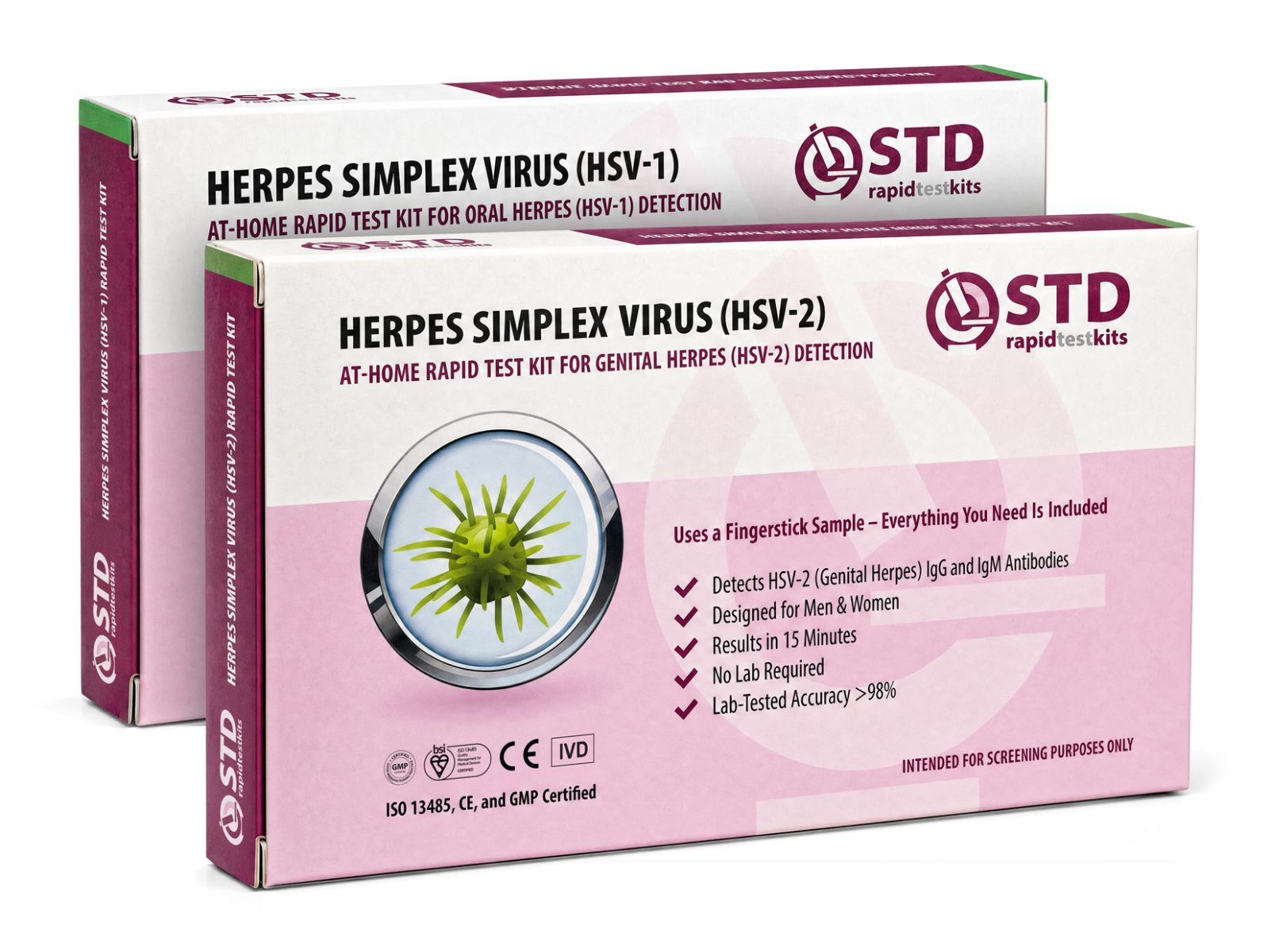
Our at-home herpes test is a fingerstick blood antibody test, not a swab. It can answer whether you have been exposed to HSV-1 or HSV-2 in the past. It cannot tell you whether a sore you are looking at right now is herpes. For that question, a clinic swab and PCR is the right tool.
What a herpes result actually tells you
A herpes blood result is more nuanced than a binary yes or no. Here is what each outcome means in practice.
Positive blood test for HSV-2. Your immune system has produced antibodies to HSV-2. You have been infected at some point. The test cannot tell you when, who from, or where in the body the infection sits. HSV-2 has a strong association with genital herpes but does not always cause symptoms. The CDC estimates that most people with HSV-2 do not know they carry it, because symptoms are absent, mild, or mistaken for something else.
Positive blood test for HSV-1. You have been exposed to HSV-1. Most people with HSV-1 have it as oral herpes (cold sores), often acquired in childhood through non-sexual contact. Genital HSV-1 from oral-to-genital contact is also possible, per the WHO HSV fact sheet. A positive HSV-1 result alone does not tell you where the infection sits.
Negative blood test. No detectable antibodies were found. Either you have not been infected with that HSV type, or the infection is too recent and your antibodies have not yet developed (the window-period scenario).
Positive swab test. Active virus was found in the sore sample. This is an immediate diagnosis of an active herpes outbreak at that location.
Negative swab test. No active virus was found. Either the sore was not herpes, or the sore had healed enough that viral shedding had dropped below the detection threshold. A negative swab with strong clinical suspicion may need a follow-up blood test once the window period has passed.
One point most people miss: a positive antibody test does not mean you are currently infectious or about to have an outbreak. It means your body has seen the virus. Many people with antibodies live their entire lives without significant symptoms.
- Positive HSV-2 blood: antibodies confirmed; type strongly associated with genital herpes, timing unknown.
- Positive HSV-1 blood: antibodies confirmed; could be oral or genital, location not specified by serology.
- Negative blood: no antibodies found, or the test was taken inside the window period.
- Positive swab: active virus in the sore; an immediate, location-specific diagnosis.
- Negative swab: no active virus found; either the sore was not herpes or it had healed past the detection threshold.
How accurate are at-home herpes tests
Accuracy in any antibody-based test is measured in two ways. Sensitivity is how well the test detects true positives. Specificity is how well it avoids false positives. Most commercial type-specific HSV antibody assays report high sensitivity and specificity when used outside the window period and read correctly; consult the specific kit's Instructions for Use for the validated figures for that product.
Published accuracy figures assume three things hold: the sample is collected correctly, the reader interprets faint lines and timing instructions correctly, and the test is taken outside the window period. Where accuracy in real life breaks down is usually one of those three points failing, not the chemistry of the test itself.
The CDC has noted that type-specific HSV serologic tests can produce false-positive results, particularly in low-prevalence populations. This is why a positive at-home result is generally worth confirming with a clinic blood test before treating it as a final diagnosis, especially for HSV-2.
This matters because the consequences of a wrong result are not just medical. A wrong positive can affect relationships and mental health. A wrong negative can lead to unprotected transmission. Treat at-home testing as a useful screening step that narrows down what is going on, and confirm any positive with a clinic test before acting on the result long-term.
Most HSV infections are asymptomatic, with infected persons unaware of their infection.
Testing when you have no symptoms
The CDC does not recommend universal herpes screening for the general population. The reasoning is straightforward. A positive result in someone with no symptoms and no known exposure has limited clinical action attached to it, and false positives are more common in low-prevalence groups. That said, the CDC and most clinical guidelines do recommend HSV blood testing in specific situations:
- A regular partner has been diagnosed with genital herpes.
- You have had recurring genital symptoms that have never been formally diagnosed.
- You are entering a new relationship and want a clear baseline.
- You are pregnant and have a history of genital herpes or a partner with herpes.
For asymptomatic people outside those scenarios, the value of a blood test is mostly psychological. Knowing your status gives you a basis to plan around. That is a legitimate reason to test, as long as you understand what the result will and will not tell you.
A blood test in this scenario can confirm prior exposure but cannot pinpoint when or how it happened. That uncertainty can be frustrating, especially when the result surfaces questions about a past partner. The honest answer is that herpes serology is not a forensic tool. It tells you that your body has seen the virus, and nothing about timing.
If a current partner has been diagnosed with HSV-2 and you want to know your own status, blood testing is more clinically useful. Knowing you already carry the same type the partner has changes the conversation entirely. Knowing you do not carry it opens up a conversation about reducing transmission risk: avoiding contact during outbreaks, using barriers, and considering antiviral suppressive therapy, which has been shown to meaningfully lower partner transmission.

Where at-home herpes testing usually goes wrong
Most at-home herpes test problems come down to a small set of avoidable issues. None of them are about the chemistry of the test failing.
- Testing too early. The most common single mistake. A blood test at one or two weeks post-exposure cannot detect antibodies that have not yet formed.
- Swabbing too late. A scabbed-over or healing sore has dramatically less viral material than a fresh lesion. A swab taken several days into healing can come back negative even when herpes was the cause.
- Misreading faint lines. Rapid lateral-flow tests have a control line and a result line. A faint result line should be read as positive, but anxiety often makes people second-guess what they are seeing. Photograph the result and re-read it after the manufacturer's specified read window.
- Picking the wrong test for the question. Using a blood test to identify a current sore. Using a swab to find out whether you have ever been exposed. Both routes produce results that do not answer the question you asked.
- Not retesting after a negative early result. A negative blood test taken inside the window period is not a final answer. Retesting at 12 weeks is part of the standard protocol when the exposure is recent.
- Treating a positive antibody result as confirmation without follow-up. Positive at-home antibody results, especially for HSV-2 in low-prevalence groups, are worth confirming with a clinic-run test before treating them as definitive.
The pattern across all six is the same: people rush the process or stop halfway through it.
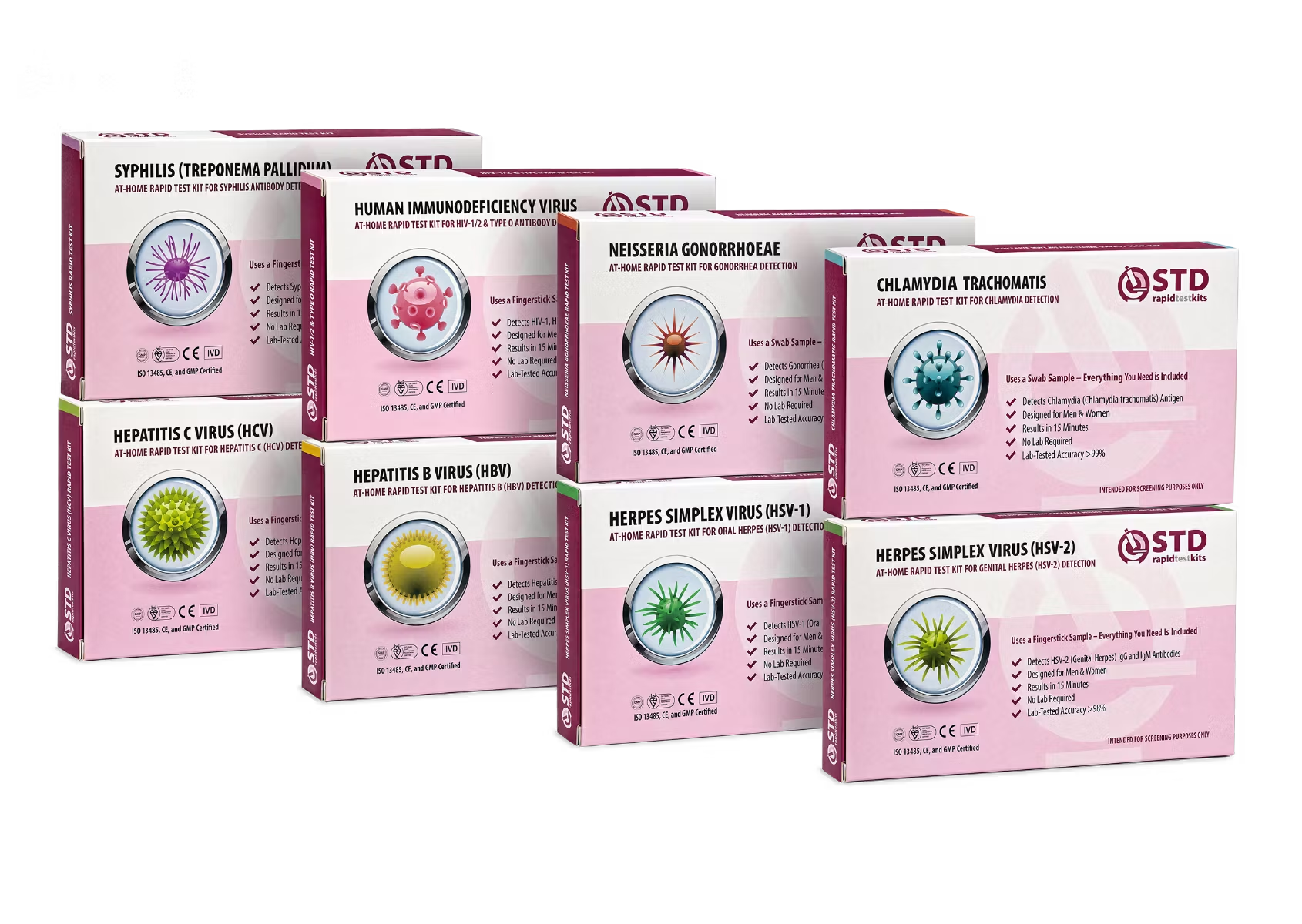
If the exposure event that brought you here carried risk beyond herpes (a new partner with an unclear STI history, condomless contact, or symptoms that could fit several infections), a broader panel avoids a second round of separate tests.
| Mistake | Why it happens | What it leads to |
|---|---|---|
| Testing immediately after exposure | Urgency and anxiety | False negative inside window period |
| Ignoring or dismissing mild symptoms | Assumption that it is something else | Missed window for an accurate swab |
| Using the wrong test for the question | Confusion between blood and swab | Inconclusive or misleading result |
| Not retesting after early negative | Relief after first result | Missed detection at full window |
What to do after the result
A result is information, not a destination. What you do with it depends on what came back.
Negative, and you tested at the right time. You have a reasonable answer for this exposure window. If new symptoms appear later, treat that as a new event and test again.
Negative, but you tested early. Plan a retest at the 12-week mark. In the meantime, treat the result as inconclusive rather than as a clean bill of health.
Positive. The next step is a clinic follow-up. A clinician can confirm the result with a second test, discuss which HSV type is involved, and walk through management options. Daily antiviral suppressive therapy is available and is well studied for both reducing outbreaks and lowering the risk of transmitting the virus to a partner. Mayo Clinic guidance notes that antivirals can also be taken episodically when outbreaks occur, depending on how frequent and severe symptoms are.
If you have a current partner. Most people benefit from talking through the result with a current sexual partner once the picture is clear. The conversation is easier when you have specific information (HSV type, whether it is active, what management options are available) than when you are still in the "what if" stage.
A positive herpes diagnosis is manageable. It is one of the most common viral infections on the planet, and the practical impact on day-to-day life is generally much smaller than the social weight attached to it suggests.
- Negative on time: tested at least 12 weeks after exposure with no symptoms; treat as a meaningful answer for that exposure window.
- Negative inside the window: retest at the 12-week mark; do not yet treat it as final.
- Positive (blood or swab): book a clinic follow-up for confirmatory testing, HSV-type clarification, and a conversation about antiviral suppressive therapy.
Choosing clarity over guessing
The reason people start looking up at-home herpes testing is almost always the same: uncertainty that has stopped feeling abstract. A test replaces that uncertainty with a result you can plan around.
If you have a sore right now, see a clinic. If you have no symptoms but want a clear answer about past exposure, an at-home blood antibody test, taken at the right time, can give you that.
FAQs
- How long after exposure is an at-home herpes blood test reliable?
- The standard window is 4 to 12 weeks. Most people are detectable well before the 12-week mark, but the exact timing varies by individual and by assay; a small subset takes up to 16 weeks. If you want one definitive answer, retest at the 12-week mark even if the earlier test was negative.
- Does an at-home herpes test detect a sore directly?
- No. At-home herpes test kits are blood antibody tests that detect whether your body has produced antibodies to HSV-1 or HSV-2. To test a specific sore directly, you need a clinic-collected swab sent for viral culture or PCR analysis.
- Can a herpes test tell me when I got infected or who from?
- No. Antibody tests confirm exposure at some point in the past but cannot date the infection or identify a source. This is true of any HSV serology, both at-home and clinic-based. Serology is not a forensic tool.
- Can I have herpes without ever having symptoms?
- Yes. Asymptomatic carriage is the norm for HSV-2, not the exception. The majority of infected people have either no symptoms or symptoms so minor (a brief tingle, mild redness, a small bump that fades) that they never connect them to herpes. The only way to know your status without symptoms is a blood antibody test taken outside the window period.
- What is the difference between HSV-1 and HSV-2 tests?
- Type-specific tests detect antibodies to one virus type at a time. Most at-home herpes panels run both HSV-1 and HSV-2 antibody tests in parallel. Standalone HSV-1 and HSV-2 tests also exist if you are specifically concerned about one type.
- Should I confirm a positive at-home herpes test with a clinic test?
- Yes, especially for HSV-2 in low-prevalence groups, where false positives are more common. Confirmatory testing at a clinic is the standard step before treating the result as a final diagnosis, and it lets a clinician walk through management.
- Is herpes serious if I test positive?
- It is manageable. Herpes is one of the most common viral infections worldwide. Daily antiviral suppressive therapy can reduce outbreak frequency and lower transmission risk to partners. Most people with herpes live entirely normal lives, and the social weight of a positive result is usually heavier than the medical reality.
- If my partner and I both have HSV-2 antibodies, do we still need protection?
- For the same HSV type, transmission between two already-infected partners is not a concern for that virus. But other STIs and the possibility of additional HSV types (HSV-1, for example) remain. A broader STI panel is a useful baseline before changing barrier practices.
How we sourced this article. This guide summarizes current advice from major public-health and medical organizations (CDC, WHO, NHS, Mayo Clinic, Johns Hopkins) on at-home herpes testing, antibody window periods, sample-type selection, and result interpretation. Where guidance varies between sources, we note the variation rather than picking one without context. We are a medical writing team, not clinicians; for symptom evaluation or confirmation of a positive at-home result, see a licensed provider.
- U.S. Centers for Disease Control and Prevention. About Genital Herpes: signs, symptoms, transmission, and prevalence in U.S. adults.
- U.S. Centers for Disease Control and Prevention. STI clinical guidance hub: treatment guidelines, partner therapy, and clinical-care standards for STI prevention and management.
- World Health Organization. Herpes simplex virus fact sheet, global HSV-1 and HSV-2 prevalence estimates, asymptomatic carriage data.
- National Health Service (UK). Genital herpes: patient-facing diagnosis, testing, and treatment overview.
- Mayo Clinic. Genital herpes diagnosis and treatment, including viral culture, PCR, and antiviral suppressive therapy.
- Johns Hopkins Medicine. Herpes (HSV-1 and HSV-2) clinical overview, transmission routes, and management.
