Published: October 2025 | Last updated: May 2026 | Editorial review and quality control: Martina N.
How accurate is a herpes rapid test, really?
Taken at least 12 weeks after a possible exposure and read on time, a type-specific HSV rapid test reports sensitivity in the high 80s to high 90s of percent and specificity in the high 90s for HSV-2, with HSV-1 a few points lower. A negative is then reliable; confirm any positive at a lab.
At-home herpes testing has moved from clinical curiosity to mainstream option in only a few years. Rapid antibody kits give a result in roughly fifteen minutes from a fingerstick of blood, no clinic visit required. This matters for a virus this widespread: an estimated 3.8 billion people under 50 carry HSV-1 globally, and another 520 million people aged 15 to 49 live with HSV-2, according to the World Health Organization. The question most people actually want answered is whether the result can be trusted.
The short answer is that modern rapid antibody tests for HSV are reasonably accurate when used at the right time and read correctly, though accuracy is not a single number. It shifts with how recently exposure happened, which kit was used, and how carefully the instructions were followed. Performance also looks different for HSV-1 versus HSV-2, and the U.S. Centers for Disease Control and Prevention has published meaningful caveats about herpes serology that any reader should know before they prick their finger. This article walks through all of that in plain English.
Key Takeaways
- Type-specific HSV rapid antibody tests typically report sensitivity in the high 80s to high 90s of percent and specificity in the high 90s, when used after the antibody window period.
- A single negative result is most reliable at 12 weeks after the most recent possible exposure, and any positive should be confirmed with a laboratory IgG assay before drawing conclusions.
What a Herpes Rapid Test Actually Measures
A herpes rapid test does not detect the virus itself. It looks for antibodies, the proteins your immune system produces after meeting HSV-1 or HSV-2. Once produced, these antibodies stay in your bloodstream for life, which is why a positive result indicates past or present infection rather than an active outbreak right now.
This is fundamentally different from a PCR swab, which detects viral DNA from an active sore. PCR is the right tool when there is a visible lesion. An at-home herpes antibody blood test is the right tool when you want to know whether you have been infected at some point, even without symptoms. The two methods answer different questions and are not interchangeable.
Most modern rapid kits target type-specific antibodies, particularly antibodies to a viral protein called glycoprotein G (gG). The HSV-1 and HSV-2 versions of gG are different enough that a well-designed assay can distinguish them. Older non-type-specific tests cannot reliably tell HSV-1 and HSV-2 apart, and the CDC has historically discouraged their use because of cross-reactivity.
Sensitivity and Specificity in Plain English
Two numbers describe how well a diagnostic test performs: sensitivity and specificity. Sensitivity is the chance the test correctly identifies someone who is truly infected. Specificity is the chance the test correctly identifies someone who is not infected. Both are reported as percentages, and both matter for interpreting any result.
For type-specific rapid HSV antibody tests, manufacturers and validation studies typically report sensitivity in the high 80s to high 90s of percent and specificity in the high 90s (see published validation data for our HSV rapid kits for one example; ranges reflect typical published performance, and your kit's package insert carries the exact validated figures) when the test is used at the correct time and read within the manufacturer's read window. There is meaningful variation across kits, which is why product packaging quotes a range rather than a single number. Performance for HSV-1 detection tends to be slightly lower than for HSV-2 in many type-specific assays, and the CDC's laboratory guidance notes that the HSV-1 antibody response is generally weaker and more variable. The typical ranges are summarized below.
| Metric | What it means | Typical range for type-specific HSV rapid tests |
|---|---|---|
| Sensitivity (HSV-2) | Correctly identifies people with HSV-2 antibodies | About 87% to 98% |
| Specificity (HSV-2) | Correctly identifies people without HSV-2 antibodies | About 96% or higher |
| Sensitivity (HSV-1) | Generally lower than HSV-2 in many type-specific assays | Often around 70% to 90% |
| Specificity (HSV-1) | Generally similar to HSV-2 specificity | Around 95% or higher |
Two Practical Lessons From Those Numbers
Sensitivity is usually a few percentage points lower than specificity, which means false negatives tend to be more common than false positives. Test too early and that gap widens further, because the antibody titer has not had time to climb. The other lesson hides in the math of low-prevalence screening: even a high-specificity test produces a meaningful number of false positives in absolute terms when the true prevalence in the screened group is low.
Here is the math, briefly. If true HSV-2 prevalence in a screened group is 5%, a test with 96% specificity will produce a false positive in roughly 4 out of every 100 uninfected people screened. In that group, a positive result has a positive predictive value of only about 56%, meaning almost half of positives are false. The same test in a high-prevalence symptomatic population has a positive predictive value above 95%. This is the math behind the CDC's caution against routine asymptomatic herpes screening, and it is the reason any positive home test should be confirmed at a lab.
If 5% of a screened population truly carries HSV-2, a test with 96% specificity returns a positive predictive value of roughly 56%. In that group, almost half of all positive results are false. Apply the same test to a high-prevalence symptomatic population and the positive predictive value rises above 95%. Same test, same chemistry, very different real-world meaning depending on who is being screened.
The Window Period: Why Timing Changes Everything
Antibody tests cannot detect what is not there yet. After exposure, your immune system needs time to recognize HSV and produce IgG antibodies in quantities a rapid test can pick up. This delay is called the window period, and it is the single biggest reason home tests give wrong results.
Most people seroconvert, meaning they develop detectable IgG antibodies, within several weeks of exposure, but the timing varies between individuals and between HSV-1 and HSV-2. Some people produce detectable antibodies within 2 to 3 weeks. Others, particularly for HSV-2, take up to 16 weeks. CDC laboratory guidance and the published seroconversion literature generally support 12 weeks after the most recent possible exposure as the point at which a single negative antibody test is most reliable.
HSV Antibody Seroconversion Window
- Week 0 Exposure
Virus transmits, but there is no detectable IgG yet, so a negative result means very little.
- Week 3 Early window
Some people start to seroconvert while many have not. A positive is meaningful; a negative is not yet conclusive.
- Week 6 Most detectable
The majority of cases reach detectable IgG. Most negatives at this point are reliable.
- Week 12 Reliable negative
Essentially all cases that will seroconvert have done so. This is the standard re-test point for a confident negative.
- Week 16 Outlier seroconverter
A rare HSV-2 case finishes seroconverting here. Re-test if an earlier result was negative.
A negative result is most reliable at 12 weeks; a minority of HSV-2 cases take up to 16.
IgG vs IgM: The Most Common Testing Mistake
Some at-home herpes test providers offer an IgM test, sometimes alongside IgG, sometimes by itself, marketed as an early-detection option. The pitch is intuitive: IgM antibodies appear before IgG, so an IgM test should catch a brand-new infection sooner. IgM testing for HSV is, however, widely considered unreliable for a specific reason.
IgM tests for HSV produce a high rate of false positives, can cross-react with other herpesviruses including varicella zoster, Epstein-Barr, and cytomegalovirus, and cannot reliably distinguish HSV-1 from HSV-2. In practice, that means an IgM positive often does not mean what the test report says it means.
The CDC recommends type-specific IgG over IgM for herpes diagnosis. If a home kit advertises early detection through IgM, treat that claim with skepticism. Wait at least 12 weeks for IgG to fully develop, then test.
If a home herpes kit's selling point is early detection through IgM testing, walk away. CDC guidance recommends against IgM for HSV diagnosis because of high false-positive rates and cross-reactivity with other herpesviruses.
Reading Your Result Without Misreading the Strip
Faint lines are the single most-asked question in home-testing forums, and the answer is genuinely nuanced. Every test result has two lines: a control line, which confirms the test ran correctly, and a test line, which appears when the sample contains the targeted antibodies. A clear, defined test line of any visible darkness within the manufacturer's read window is a positive result. A line that appears only after the read window has expired is not a valid positive. It is a drying artifact called an evaporation line.
Three rules cover almost every faint-line scenario. Set a timer when the sample hits the cassette. Read at the time the manufacturer specifies, usually somewhere between 10 and 20 minutes. Do not photograph the strip and zoom in two hours later looking for hidden lines, because reagent drying produces ghost marks that mean nothing diagnostically. If a faint but clearly visible line is present within the valid window, treat it as a preliminary positive and confirm with a laboratory IgG test rather than retesting at home.
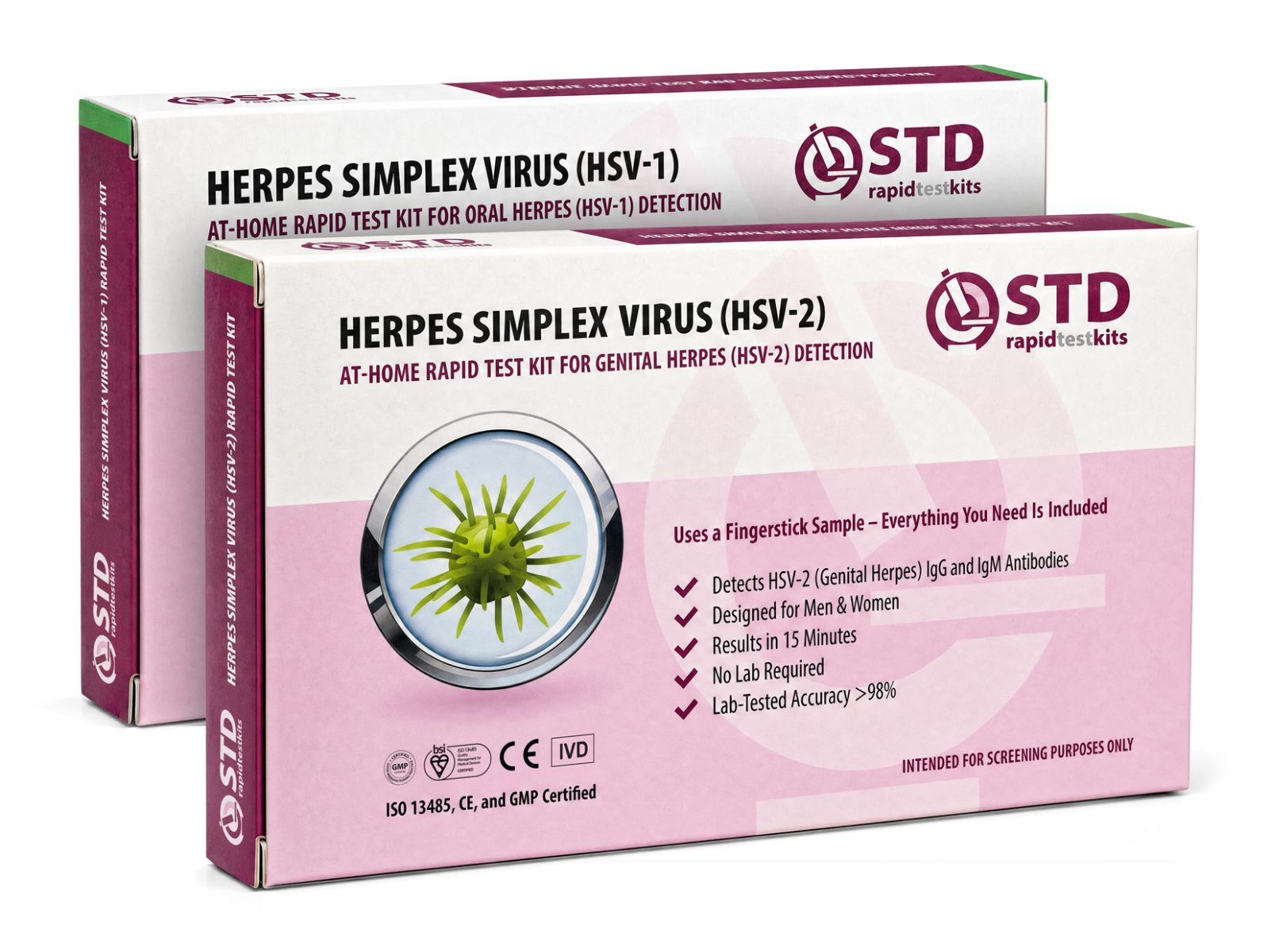
stdrapidtestkits.com sells the at-home rapid HSV antibody tests described in this article. Product recommendations reflect fit for the reader's question, not commercial benefit. The guidance here is the same we apply to our own results: a rapid test is a reliable screening tool when used at the right time and confirmed at a lab when positive.
Why False Positives Happen and How to Handle One
False positives on type-specific HSV antibody tests do happen, and the most thoughtful framing is that they are uncommon but not negligible, especially in lower-risk populations. The mechanism is usually cross-reactivity, where antibodies from another infection, an autoimmune condition, or rarely a recent vaccination bind weakly to the test antigen and produce a faint positive line.
The U.S. Food and Drug Administration has explicitly cautioned that some HSV-2 antibody tests have produced false-reactive results in clinical practice, particularly when the assay's index value sits just above the cutoff. The CDC similarly notes that the predictive value of a positive HSV-2 antibody test is lower in populations with low underlying prevalence, even when the test itself has high specificity. This is one of the main reasons routine asymptomatic herpes screening is not recommended.
If a home antibody test comes back positive, the laboratory tools that resolve it are a type-specific IgG assay run on an ELISA platform and, in harder cases, the Western blot. The Western blot is the most analytically precise HSV serology in routine use, although it runs at fewer reference labs than ELISA does.
HSV-2 tests for genital herpes can produce false reactive results. Health care providers should counsel patients about the limitations of testing before ordering it and perform confirmatory testing for reactive results.
Rapid Tests Compared to Laboratory Methods
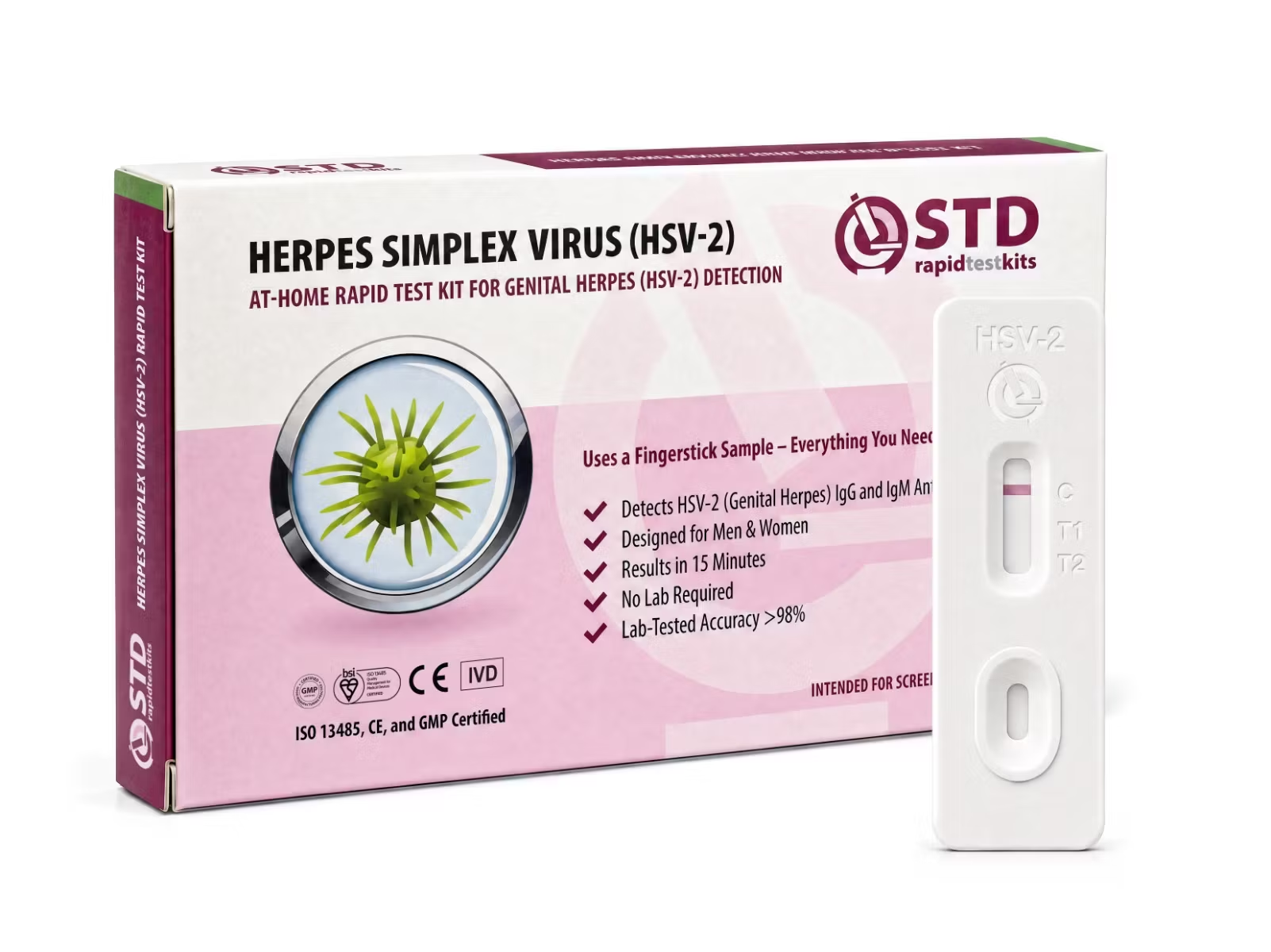
Three diagnostic approaches dominate herpes testing. Rapid antibody tests give a fast answer at home from a fingerstick. Laboratory IgG antibody assays use venous blood and run on automated analyzers in a clinical lab. PCR, or less commonly viral culture, detects active virus directly from a swab of a sore.
The performance differences between rapid and laboratory antibody tests are real but often smaller than people expect, especially when both are used after the window period has fully passed. Rapid kits are lateral-flow immunoassays. Laboratory IgG assays use ELISA chemistry, which lets them quantify antibody levels rather than simply detect their presence above a threshold. The clinical implication is that a borderline rapid result is often best resolved with a laboratory assay rather than a repeat rapid test, because the laboratory test reports an index value that helps distinguish a strong positive from a weak signal.
| Test type | What it detects | Best use case | Approximate accuracy |
|---|---|---|---|
| Home rapid antibody test (fingerstick) | Type-specific HSV antibodies (lateral-flow) | Convenient at-home screening, after the antibody window period | Sensitivity high 80s to high 90s, specificity high 90s for HSV-2 |
| Laboratory IgG antibody test | Type-specific HSV antibodies with quantitative index value | Confirming a positive home test; differentiating HSV-1 and HSV-2 | Sensitivity around 95% or higher, specificity around 96% or higher |
| PCR or viral culture from swab | Active HSV viral DNA from a lesion | Diagnosing an active outbreak with visible sores | PCR sensitivity above 95%; the gold standard for active infection |
Picking the Right Test for the Right Question
None of the three approaches is universally best. Each answers a different question. If you have a visible sore right now and want to know what is causing it, a clinic-administered PCR swab is the right call, because antibody tests cannot tell you whether a specific lesion is herpes. If you have had possible exposure but no symptoms and want to know whether you have been infected, a rapid antibody test, with confirmation if positive, is reasonable. If your rapid test gave a confusing result, a laboratory IgG assay can tie-break it.
Most adults already carry HSV-1 antibodies, often from childhood non-sexual exposure that produces oral cold sores. A positive HSV-1 antibody test does not, on its own, tell you whether the infection is oral or genital, or whether it is recent or decades old. If you specifically want to know whether a current oral or genital lesion is HSV, a clinic-administered PCR swab of the lesion is the test to ask for.
Which test for which question
- Visible sore right now: clinic-administered PCR swab of the lesion.
- Possible past exposure with no symptoms: rapid antibody test at 12 weeks or later.
- Positive rapid result or borderline reading: laboratory type-specific IgG assay for confirmation.
When an At-Home Rapid Test Is a Good Fit
Rapid testing earns its place in one common situation: you had a possible exposure at least 12 weeks ago, you have no active sore, and you want a private answer without booking a clinic visit. In that window, a well-timed type-specific result is reliable enough to act on, and testing at home removes the friction that keeps a lot of people from testing at all. Uptake of at-home STI testing has grown sharply since 2019, and herpes is among the most-requested panels.
Cost is the most concrete advantage. A home kit is a flat, upfront price with no clinic copay, no separate lab fee, and no insurance paperwork that a policyholder might later see on an explanation of benefits. Privacy and speed follow close behind. You collect a fingerstick sample yourself and read the strip in about fifteen minutes, with no waiting room and no appointment. For someone whose partner has just disclosed an HSV diagnosis, or who lives far from a sexual health clinic, that convenience is often the difference between testing now and putting it off indefinitely.
The honest limits still apply. A rapid kit screens; it does not diagnose an active sore, and a positive result should be confirmed at a lab.
When You Should See a Clinician Instead
There are scenarios where a home blood test is the wrong tool, and the biggest one is an active sore. Blood tests measure your antibody response to past infection. They cannot tell you whether the blister or ulcer you are looking at right now is herpes. For that, a clinician needs to swab the lesion within a few days of it appearing and send the sample for PCR testing. A negative blood test in this scenario can falsely reassure you, and a positive blood test still does not confirm that the sore in front of you is the cause of your symptoms.
If you have a new sore, especially one that is painful, weeping, or preceded by tingling or burning before it appeared, get it swabbed. The UK NHS genital herpes guidance and U.S. CDC consumer guidance both direct people with active sores to clinic-based testing rather than home blood tests. We do not sell a herpes swab kit, so for an active lesion a clinic is the right place to start.
Pregnancy is another scenario where clinic care matters. Genital herpes acquired late in pregnancy carries a real risk of neonatal transmission, and decisions about delivery method or antiviral suppression are not ones to make from a home test result alone. If you are pregnant and concerned about herpes exposure, talk to your OB rather than relying on an at-home blood test alone.
When to skip the home test and call a clinic
- Visible, painful, or weeping sore right now: get a clinic-administered PCR swab, not a blood test.
- Pregnant with a suspected new exposure: contact your OB directly rather than acting on an at-home antibody result.
- We do not sell a herpes swab kit; our blood antibody tests answer a different question from what is causing this specific sore.
Five Mistakes That Most Skew Home Test Results
The science behind rapid HSV testing is solid. The variability in real-world performance comes mostly from preventable user-side mistakes. These five show up most consistently in usability studies and manufacturer feedback.
1. Testing too early after exposure
Antibodies do not develop immediately after exposure. Testing within the first three weeks frequently produces false negatives because there is nothing yet for the test to detect. If recent exposure is the reason you are testing, plan a re-test at 12 weeks regardless of the early result.
2. Reading outside the time window
Most rapid lateral-flow strips have a valid read window of 10 to 20 minutes. Lines that appear after that window are not valid positives. They are evaporation artifacts as the reagent dries on the strip. Set a timer when you apply the sample and read at the time printed in the instructions.
3. Collecting too little blood
The chemistry of the test depends on a sufficient sample volume mixing with the buffer in the right ratio. A drop that is too small produces a weak or invalid result. The instructions specify a fill mark or a number of drops. Match it exactly.
4. Storing the kit poorly before use
Lateral-flow strips are sensitive to heat and humidity. A kit that has been sitting in a steamy bathroom or in a hot car loses analytical sensitivity over time. Keep unopened kits at room temperature in a dry place and use them before the printed expiration date.
5. Testing during acute illness or shortly after vaccination
Active infections, recent illnesses, and recent vaccinations can transiently alter antibody profiles in ways that occasionally produce weak cross-reactivity. If you have been ill in the past two weeks or recently received a vaccine, consider waiting a couple of weeks before testing.
Testing within the first 3 weeks after exposure accounts for the majority of false-negative home results. If you are testing because of a specific recent exposure, plan a re-test at 12 weeks regardless of what the early result said.
When to Retest and What to Do with a Positive Result
Retesting comes up most often after an early negative or after a positive, and the right next step is different in each case. For an early negative, repeat the test at 12 weeks after the most recent possible exposure. For a positive, skip the repeat home test and go straight to a laboratory type-specific IgG antibody assay, which can resolve whether the signal is genuine or cross-reactive.
If you have a known specific exposure event, count the 12 weeks from that date. If your exposure is more general, like a new partner over a span of weeks, count from the latest contact. This timing gives the immune system enough time to seroconvert in essentially all true infections. Most primary care providers and sexual health clinics can order a confirmatory test. Ask specifically for a type-specific IgG, and request the index value if your lab provides it.
A positive home herpes test is not a diagnosis you have to absorb alone. Once confirmation comes back, a telehealth visit gives you clinical context and a prescription path if suppression makes sense. Most people do not need treatment between outbreaks, but daily antiviral medication can reduce both symptom frequency and transmission risk to partners. Disclosure to current and future partners is part of the picture too, and it is more routine than the stigma suggests given how common HSV is worldwide. The Western blot remains the most specific HSV serology available when an ELISA result sits close to the cutoff and you want a more definitive answer.

The Limits No One Talks About
Even at their best, herpes tests have blind spots that the marketing rarely admits. The first is that IgG cannot tell you when you were infected. A positive HSV-1 result on a 30-year-old could be from kindergarten, from a college relationship, or from last year. Antibodies persist for life, so a test confirms exposure but does not date it.
The second blind spot is location. A positive HSV-2 antibody result tells you the virus is somewhere in your body but does not tell you whether the infection is genital, oral, or both. Most HSV-2 infections are genital, but the antibody test alone cannot confirm the anatomic site.
The third is that asymptomatic shedding, when the virus is briefly active on the skin without producing visible symptoms, is not detectable by any antibody test. People with HSV can transmit the virus during shedding episodes, and a clean recent IgG result does not change that risk profile. This is one reason current CDC guidance does not recommend routine HSV screening in people without symptoms. For someone with a confirmed diagnosis, daily antiviral suppressive therapy can reduce shedding frequency, and a clinician can help decide whether suppression fits your situation.
What an antibody test cannot tell you
- When you were infected. Antibodies persist for life, so a positive IgG confirms exposure but does not date it.
- Where the infection is. A positive HSV-2 result does not distinguish genital from oral infection.
- Whether you are shedding right now. Asymptomatic shedding is invisible to any antibody test.
The Bottom Line on Herpes Rapid Test Accuracy
Rapid HSV antibody tests are reasonably accurate, with several real and important caveats. They detect type-specific antibodies and not the virus itself, so they tell you about past or current infection but not whether a specific sore was caused by HSV. They work best when taken after the antibody window has fully passed, typically 12 weeks after the most recent possible exposure. They have meaningful sensitivity and specificity in that window, though performance for HSV-1 is often lower than for HSV-2.
The home rapid kit is a screening tool. It is not, on its own, a diagnostic verdict. A negative result taken at the right time is reassuring. A positive result deserves a confirmatory laboratory test before you draw any final conclusion, especially if you have no symptoms or known specific exposure. Used this way, the rapid test is a fast, private first step that fits well into informed sexual health care.
One final piece of context worth knowing. The CDC does not recommend routine HSV antibody screening for asymptomatic people without specific risk factors, partly because of the false-positive math in low-prevalence populations and partly because a positive result has limited clinical impact for someone with no symptoms. That does not mean home testing is wrong. It means the result should be interpreted with the same care a clinic would apply, and any positive should lead to a clinical conversation rather than a self-diagnosis.
1. Use it 12 weeks or later after the most recent possible exposure, not before. 2. Confirm any positive with a laboratory type-specific IgG assay before drawing conclusions. 3. The CDC does not recommend routine asymptomatic herpes screening; interpret a positive in the context of symptoms, exposure history, and prevalence rather than as a stand-alone verdict.
Your Next Step, Based on Where You Are
Do you have a visible sore, blister, or ulcer right now?
Yes: Skip the home antibody test and book a clinic visit for a PCR swab of the lesion within a few days of it appearing. Antibody tests cannot diagnose an active outbreak.
Has it been at least 12 weeks since the most recent possible exposure?
Yes: A type-specific IgG rapid kit is reasonable. Read the strip inside the manufacturer's timed 10 to 20 minute window. Treat any positive as preliminary and book a confirmatory laboratory type-specific IgG assay before drawing conclusions.
No: Wait until at least 12 weeks after the most recent possible exposure before testing. Earlier negatives are not reliable because the antibody titer has not had time to climb. If a clinical concern is urgent, see a clinician now rather than waiting on a home test.
Guidance only. A licensed clinician can advise on your specific situation.
Frequently Asked Questions
- How accurate is a herpes rapid test really?
- If you test at 12 weeks or later after the most recent possible exposure, the result is reliable enough to act on: a negative is genuinely reassuring, and a positive warrants lab confirmation rather than panic. HSV-2 sensitivity runs in the high-80s-to-high-90s range, and HSV-1 sits a few points lower. For most users, kit brand matters less than timing relative to exposure.
- How long after exposure should I wait before testing?
- For a confident negative result on a single test, 12 weeks after the most recent possible exposure is the commonly cited threshold, with some sources extending to 16 weeks for full HSV-2 seroconversion. Earlier negatives are not reliable. A positive can be interpreted earlier, though it should still be confirmed at a lab because the chance of cross-reactivity does not go away just because the test happened to return a result.
- What does a faint line on a herpes rapid test mean?
- A faint line that appears during the 10-to-20-minute read window printed in the instructions counts as a preliminary positive. Treat it as one and confirm with a laboratory IgG assay. Any line that shows up after that window has closed is a drying artifact with no diagnostic value. Set a timer when the sample hits the cassette and do not re-read the strip later.
- Is the IgM test reliable for early herpes detection?
- No. IgM tests for HSV are widely considered unreliable. They produce false positives, can cross-react with other herpesviruses such as Epstein-Barr and cytomegalovirus, and cannot distinguish HSV-1 from HSV-2. The CDC recommends type-specific IgG over IgM for herpes diagnosis. Avoid kits that lead with IgM as their early-detection feature.
- Can I get a false positive on a herpes home test?
- Yes, false positives happen. They are uncommon but not negligible, especially in low-prevalence populations. The mechanism is usually cross-reactivity from another infection, an autoimmune condition, or sometimes a recent vaccination. The FDA has specifically cautioned that some HSV-2 antibody tests produce false-reactive results when the assay's index value is just above the cutoff. This is exactly why a positive home result should be confirmed at a lab.
- Should I get my positive home test confirmed at a lab?
- Yes. A positive home antibody test should always be confirmed with a laboratory type-specific IgG assay before you draw any final conclusion. Many primary care providers and sexual health clinics can order it. The Western blot offers the highest analytical precision, though it is less widely available than ELISA-based IgG. Asking for the index value gives you a number you can interpret in context.
- Will a rapid test tell me whether I have HSV-1 or HSV-2?
- Most modern rapid kits use type-specific antigens (typically antibodies against glycoprotein G, which differs between HSV-1 and HSV-2) and can distinguish the two. Older non-type-specific tests cannot, and the CDC has historically discouraged their use. Check the kit's packaging to confirm it claims type-specific detection. If type identification is your main reason for testing, a laboratory IgG assay reports it most cleanly.
- Why does the CDC say not to screen everyone for herpes?
- The CDC does not recommend routine HSV antibody screening for asymptomatic people without specific risk factors, mostly because of two issues. First, in low-prevalence populations, even high-specificity tests produce a meaningful number of false positives, which can cause unnecessary distress. Second, a positive antibody result in someone with no symptoms has limited clinical impact, because there is no curative treatment and management decisions rarely change. The recommendation is not against testing per se. It is about screening universally without a clinical reason.
Our article was constructed based on current advice from the most prominent public health and medical organizations, and then molded into simple language based on the situations that people actually experience. Sources include the U.S. Centers for Disease Control and Prevention, the World Health Organization, the U.S. Food and Drug Administration, the UK National Health Service, and Mayo Clinic, alongside FDA-cleared assay package inserts. Specific sensitivity and specificity ranges reflect typical published performance for type-specific HSV rapid antibody tests; for any individual kit, consult the manufacturer's package insert for the exact validated figures.
- U.S. Centers for Disease Control and Prevention. Genital herpes overview, including symptoms, transmission, prevention, and a testing summary.
- U.S. Centers for Disease Control and Prevention. Sexually Transmitted Infections Treatment Guidelines, including the genital herpes section on serologic testing, confirmation, and why routine screening of asymptomatic people is not recommended.
- U.S. Food and Drug Administration. Letters to Health Care Providers, including the 2016 communication to clinical laboratory staff and health care providers warning that HSV-2 antibody tests can produce false reactive results and advising counseling on test limitations plus confirmatory testing.
- World Health Organization. Herpes simplex virus fact sheet, source for the 3.8 billion HSV-1 (under 50) and 520 million HSV-2 (ages 15 to 49) global prevalence estimates cited in the opener.
- UK National Health Service. Genital herpes overview, covering symptoms, when to seek care, swab-based testing, and treatment options.
- Mayo Clinic. Genital herpes symptoms and causes page, covering presentation, transmission, and an outline of clinical diagnostic methods including blood tests and lesion sampling.
