
Published: October 2025 | Last updated: May 2026 | Editorial review and quality control: Martina N.
Most sore throats clear up on their own within a week. Viral infections cause the vast majority, with strep throat (a bacterial cousin) accounting for another slice of cases. So if your throat is sore today and you're wondering whether it might be a sexually transmitted infection, here's the short version: probably not, but a handful of STIs can cause throat symptoms, and the picture changes when the soreness lingers past two weeks or follows a specific oral sexual exposure.
This article walks through which STIs realistically cause throat symptoms, how the patterns differ from common viral sore throats, when testing makes sense, and what we can and cannot screen for at home with rapid tests. Throat-based STI tests use a pharyngeal swab that has to be collected at a clinic. Our at-home kits cover the blood-detectable infections (HIV, syphilis, herpes antibodies) plus self-collected genital swabs for chlamydia and gonorrhea. We will be specific about the difference throughout.
Key Takeaways
- Roughly four in five sore throats in adults are caused by common viruses that resolve on their own within a week. Soreness that lasts past two weeks, or follows a known oral sexual exposure, deserves a clinical evaluation.
- Pharyngeal gonorrhea, oral herpes, oral syphilis, and acute HIV seroconversion can all present with throat symptoms. Home rapid tests can answer the HIV, syphilis, and herpes questions from a fingerstick blood sample; a pharyngeal gonorrhea or chlamydia swab requires a clinic visit.
How common are STI-related sore throats, really?
Most sore throats have nothing to do with sex. According to the UK National Health Service and the U.S. Centers for Disease Control and Prevention, the overwhelming majority of adult sore throats are caused by ordinary viruses: rhinovirus, adenovirus, influenza, mononucleosis (Epstein-Barr virus), and the SARS-CoV-2 virus that causes COVID-19. Group A streptococcus, the bacterium behind strep throat, accounts for a smaller share of adult cases, somewhere in the mid-single-digit to low-teens percentages depending on the population.
Sexually transmitted infections sit further down the differential list. When they do cause throat symptoms, it is almost always after direct oral contact with an infected partner: receptive oral sex on a penis, vagina, or anus, or deep kissing in the case of oral herpes. The infections worth considering are:
- Pharyngeal gonorrhea, the most common STI cause of throat symptoms
- Oral herpes simplex (usually HSV-1, occasionally HSV-2)
- Pharyngeal chlamydia (often asymptomatic; rarely causes throat soreness directly)
- Primary oral syphilis (a chancre on the tongue, tonsillar pillar, or lip)
- Acute HIV seroconversion (a flu-like syndrome that often includes a sore throat)
- Oral candidiasis ("thrush"), which is common in untreated HIV due to immune suppression
Each is covered in detail below. The throat findings differ enough from typical viral pharyngitis that a clinician can often narrow the picture quickly, though at home the cues are subtler.
Around four out of five adult sore throats are caused by ordinary viruses that resolve on their own within a week. Bacterial strep accounts for another single-digit slice. STIs sit further down the differential list and are usually worth investigating only when soreness lingers past two weeks or follows a known oral sexual exposure.
Which STIs can actually cause throat symptoms?
Pharyngeal gonorrhea
Pharyngeal gonorrhea is the STI throat infection clinicians see most often. It is transmitted by receptive oral sex with an infected partner, and per CDC gonorrhea guidance a large proportion of pharyngeal infections are asymptomatic. When symptoms do appear, the throat can show bilateral tonsillar redness with a thick yellow-green purulent exudate (pus) on the tonsillar pillars, sometimes with regional lymph node tenderness. The soreness is usually mild and easy to mistake for an ordinary bacterial throat infection. The diagnosis requires a clinic-collected pharyngeal swab processed with a nucleic acid amplification test (NAAT), because oral fluid antibody tests do not exist for gonorrhea.
Pharyngeal chlamydia
Pharyngeal chlamydia behaves like its gonorrhea cousin but is even less likely to cause noticeable throat symptoms. Most cases are silent and detected only through routine screening of people at elevated risk. The same clinic pharyngeal swab catches both gonorrhea and chlamydia.
Oral herpes (HSV-1 and HSV-2)
According to the CDC herpes pages, HSV-1 most often causes oral herpes (cold sores) and HSV-2 most often causes genital herpes, but either virus can establish at either site. An initial oral herpes infection can include a sore throat with painful clustered fluid-filled vesicles on the lips, gums, or tongue, fever, and lymph node swelling. Recurrent outbreaks are usually limited to the lips and are less severe. A herpes-related sore throat is typically accompanied by visible lesions on or around the mouth, which is the single biggest clue distinguishing it from gonorrhea or strep.
Primary oral syphilis
Primary syphilis presents as a chancre at the site of inoculation, usually genital but occasionally oral if exposure was through oral sex. An oral syphilis chancre is a single round painless ulcer with a raised firm border, most often on the tongue, tonsil, or lip. Per CDC syphilis guidance, the chancre appears roughly 10 to 90 days after exposure and heals on its own within a few weeks, even though the infection itself progresses untreated. The painless quality is what often gets it missed.
Acute HIV seroconversion
Two to four weeks after HIV exposure, somewhere between half and two-thirds of newly infected people experience an "acute retroviral syndrome" that the CDC HIV section describes as a flu or mononucleosis-like illness. A sore throat is one of the most commonly reported symptoms in that window, along with fever, fatigue, swollen lymph nodes, body aches, and sometimes a rash on the trunk. The throat soreness is usually mild and resolves on its own, which is part of why early HIV is so often missed clinically. The acute section below covers this in more depth.
Oral candidiasis (thrush)
Oral candidiasis is a fungal overgrowth that appears as white curd-like plaques on the tongue, inner cheeks, or soft palate, often with a burning sensation rather than a typical sore-throat ache. It is common in babies, denture wearers, people on antibiotics or inhaled steroids, and people whose immune systems are compromised. In the context of an STI workup, thrush in an otherwise healthy adult can be an indirect sign of untreated HIV-related immune suppression and is worth flagging to a clinician.
Can a sore throat be a sign of an STI?
Yes, but uncommonly. Around four in five sore throats in adults are caused by ordinary viruses. The STIs that can present with throat symptoms after oral sexual exposure are pharyngeal gonorrhea, oral herpes, primary oral syphilis, and acute HIV seroconversion. A pharyngeal gonorrhea or chlamydia swab requires a clinic visit. The HIV, syphilis, and herpes questions from the same exposure event can be answered with a home rapid blood-antibody panel, with attention to window periods (HIV about 23-90 days, syphilis 3-6 weeks, herpes IgG up to 12-16 weeks).
How STI-related throat findings look and feel different
A typical viral sore throat tends to hurt fairly evenly across the back of the throat, often with a runny nose, mild cough, and a low fever that all start and resolve together over five to seven days. Strep throat tends to come on more abruptly with a higher fever, swollen front-of-neck lymph nodes, and white patches on the tonsils, usually without a cough or runny nose. STI-related throat findings break that mold in specific ways.
Pharyngeal gonorrhea is often quieter than its appearance suggests. The throat can look impressively inflamed on exam while the patient reports only mild irritation. Onset is usually insidious and traces back to a specific oral exposure days to weeks earlier rather than to a household contact who recently had a cold. Oral herpes brings a sore throat plus visible lip or mouth blisters, frequently preceded by a tingling or burning sensation 24 to 48 hours before the lesions appear. An oral syphilis chancre is painless, which is the single most distinguishing feature: a single round ulcer that the patient may not have noticed until a partner or clinician points it out.
Acute HIV throat soreness is typically part of a broader flu-like illness with fever, swollen lymph nodes across multiple sites, fatigue, and sometimes a trunk rash. The throat itself usually does not look dramatically abnormal on exam, which is part of why this presentation slips past so many first-pass clinical assessments.
The table below sets out the distinguishing patterns side by side.
| Pattern | Common viral | Strep throat | Pharyngeal gonorrhea | Oral herpes | Acute HIV |
|---|---|---|---|---|---|
| Onset | 1-3 days after viral exposure | Sudden, often abrupt | Insidious, days to weeks after oral exposure | Tingling, then vesicles within 24-48 hours | 2-4 weeks after exposure |
| Pain level | Mild to moderate | Moderate to severe | Often mild or absent | Moderate, worse with visible sores | Often mild to moderate |
| Visible findings | Diffuse red throat | Red tonsils with white patches | Bilateral tonsillar redness with yellow-green pus | Clustered lip or oral vesicles | Throat often unremarkable on exam |
| Other symptoms | Runny nose, cough, mild fever | High fever, neck lymph nodes, no cough | Few systemic symptoms | Fever, mouth sores, lymph nodes | Fever, fatigue, body rash, lymph nodes |
| Time-of-year clue | Higher in winter virus season | Year-round, more common in children | Linked to specific sexual exposure | Triggered by stress, illness, or new infection | Linked to specific sexual exposure |
Acute HIV and sore throat: why this matters most
Of the STI causes of a sore throat, acute HIV deserves its own section. It is the lowest-prevalence of the group but the highest-stakes if missed, because antiretroviral treatment started early gives the best long-term outcome and dramatically reduces onward transmission risk.
The CDC's HIV information pages describe an "acute retroviral syndrome" that occurs in roughly half to two-thirds of newly infected people, beginning about two to four weeks after exposure. The illness lasts a few days to a couple of weeks and resolves on its own as the immune system mounts an initial response. The most commonly reported symptoms are:
- Fever (often the most striking complaint)
- Fatigue and general malaise
- Sore throat
- Swollen lymph nodes in the neck, armpits, and groin
- A non-itchy rash on the trunk
- Muscle aches and joint pain
- Night sweats
- Mouth ulcers
None of these are unique to HIV. They look exactly like a moderate flu or a case of mononucleosis. The clue is the timing relative to a known exposure: condomless sex with a new or untested partner, a needle-sharing event, or a known partner whose status is uncertain. When a flu-like illness shows up two to four weeks after that kind of exposure, an HIV test is a reasonable next step, even if you feel better by the time you get around to ordering one.
The window-period rules matter here. Fourth-generation lab antigen-antibody tests can detect HIV as early as about 18 to 45 days after exposure. Most rapid antibody-only home tests need closer to 23 to 90 days for a reliable negative. The reason for the spread is that everyone's immune system seroconverts at a slightly different speed. A negative test taken inside that window is reassuring but not definitive, so a repeat test at the back end of the window is part of the workup.
When and how to get tested
Two questions decide the timing and the method: what was the exposure, and how long ago was it?
If the concern is the throat itself
If you have a sore throat that has lasted more than two weeks, or one that started shortly after a known oral sexual exposure, the right next step is a clinic visit. A pharyngeal swab processed by a NAAT lab is the test that detects gonorrhea and chlamydia at the back of the throat. We do not sell that test as a home kit and neither does any other consumer brand at the time of writing: the lab method requires the sample to reach a properly equipped facility within a specific transport window, and at-home lateral-flow chemistry has not been validated for pharyngeal samples. A primary-care visit, an urgent care clinic, or a sexual health clinic can all do the swab.
If the concern is the exposure event
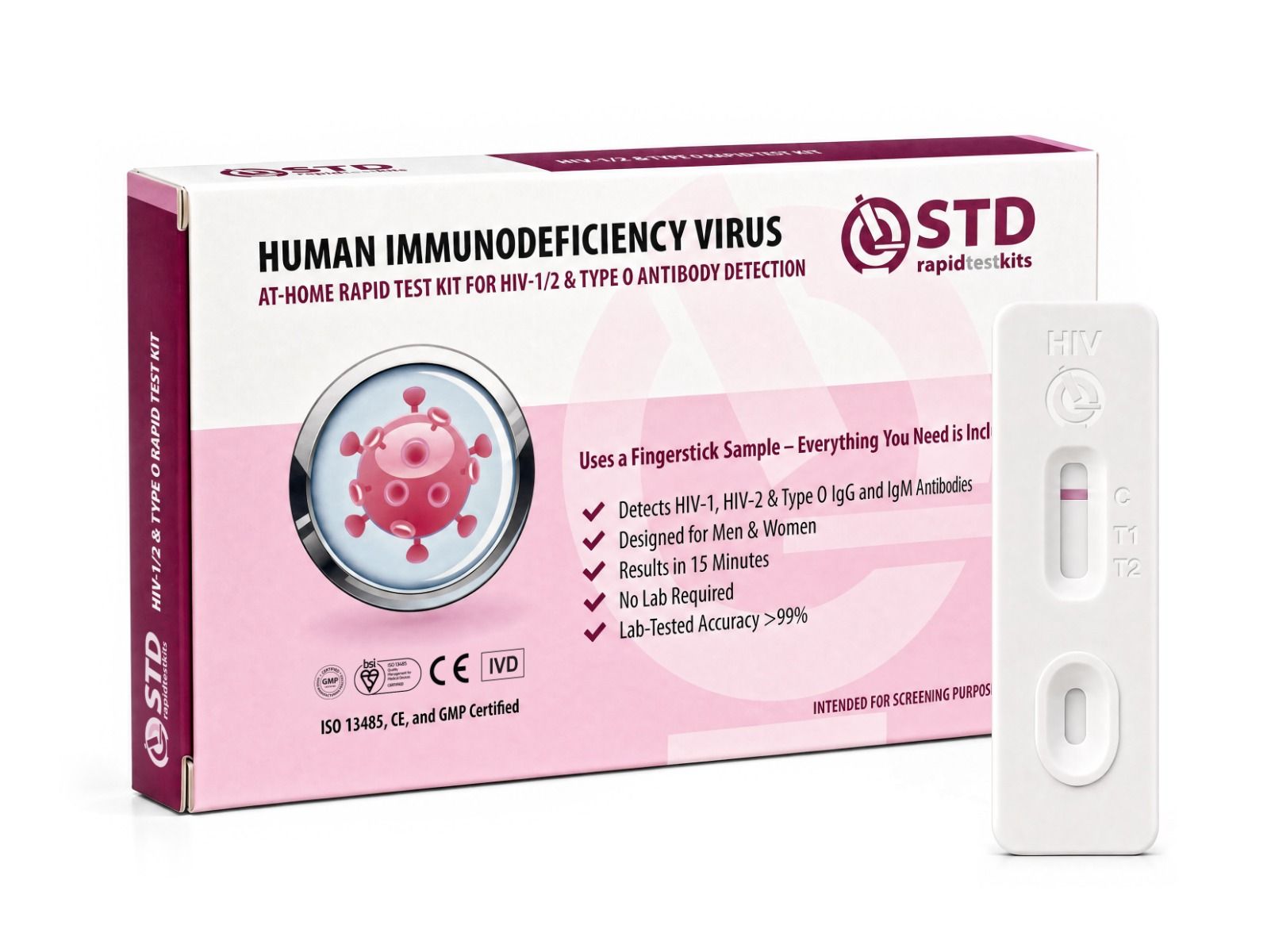
If your sore throat is mild and what you really want answered is "did the exposure two to four weeks ago give me an infection," the home rapid panel covers the blood-detectable infections from the same event. That includes HIV antibodies, syphilis antibodies, and HSV-1 and HSV-2 antibodies. These look at systemic seroconversion, not local infection at any anatomical site. Window periods:
- HIV antibody (rapid): about 23 to 90 days for a definitive negative
- Syphilis treponemal antibody: about 3 to 6 weeks for the antibody response to develop
- HSV-1 and HSV-2 IgG antibodies: about 12 to 16 weeks after first infection for a definitive negative; many people seroconvert by 6 to 8 weeks
Per CDC general STI testing guidance, testing once at the early end of the relevant window gives you an initial answer, and a repeat at the back end of the same window confirms it if the first read was negative.
What our home rapid tests can (and cannot) answer
Honesty matters here, both because misrepresenting a test's scope is a regulatory issue and because false reassurance on YMYL health questions causes real harm. Here is the actual coverage map.
Our at-home kits are rapid lateral-flow tests. The four swab tests (chlamydia, gonorrhea, trichomoniasis, HPV) are self-collected genital swabs. Trichomoniasis and HPV are validated for vaginal self-swab only. The blood-based tests (HIV, syphilis, hepatitis B, hepatitis C, HSV-1, HSV-2, combined herpes panel) use a fingerstick blood sample to look at antibodies (or, for HIV, antibodies and the p24 antigen depending on the kit). Combination panels mix and match from these.
What we do not sell: pharyngeal swab tests, rectal swab tests, urine-sample tests, or lab-processed mail-in NAAT panels. If your specific concern is a pharyngeal gonorrhea or chlamydia infection, the at-home option does not exist and we are not going to pretend otherwise. A clinic pharyngeal swab is the correct test.
A common exposure pattern looks like this: someone had unprotected oral sex with a partner whose status is uncertain. The throat is sore three weeks later. A clinic pharyngeal swab answers the gonorrhea and chlamydia questions for the throat. A home rapid panel answers the HIV, syphilis, and herpes questions for the same exposure event from a single fingerstick.
For a pharyngeal gonorrhea or chlamydia swab, see a clinic. We don't offer a home version of that test, and at-home lateral-flow chemistry hasn't been validated for pharyngeal samples by any provider on the market. Our rapid blood panel can answer the HIV, syphilis, and herpes questions from the same exposure event, which is the complementary half of a workup after oral exposure.
Most people with pharyngeal gonorrhea have no symptoms. Routine screening of the throat in people at increased risk is recommended because untreated pharyngeal infection contributes to onward transmission.
When to see a doctor or urgent care, not just test
Tests are useful when the question is "do I have this infection." They are not the right tool for a throat that hurts severely or is making it hard to breathe. The American Academy of Otolaryngology and the NHS both flag a specific set of symptoms as reasons to seek in-person evaluation rather than starting with a test kit. The list below summarizes those warning signs.
Drooling, severe difficulty swallowing, and stridor can indicate epiglottitis or a peritonsillar abscess and should prompt an urgent care or emergency department visit. A persistent rash on the palms or trunk during a sore-throat illness, especially two to eight weeks after an unprotected exposure, raises the question of secondary syphilis and warrants a clinician's eye.
For everything else, the typical path is to try basic supportive care for a few days (fluids, salt-water gargles, throat lozenges, rest), see a primary care provider if symptoms persist past one to two weeks, and pair the visit with appropriate STI testing if there is any relevant exposure history.
Reasons to see a clinician in person, not start with a test kit
- Severe sore throat that lasts more than a week
- Difficulty swallowing or breathing
- Drooling or inability to handle saliva
- A high-pitched whistling sound on each breath (stridor)
- Fever above 38.3 °C / 101 °F that persists beyond a couple of days
- Joint pain, ear pain, or a stiff neck along with the sore throat
- A rash, especially on the trunk or palms
- Blood in your saliva or mucus
- Hoarseness that lasts more than two weeks
- Lumps in the neck or significant swelling of the face
- Inability to open the mouth fully
Frequently asked questions
- Can kissing someone give me an STI sore throat?
- Deep kissing can transmit HSV-1 oral herpes, which can include a sore throat during a first outbreak. Gonorrhea, chlamydia, syphilis, and HIV are not generally transmitted by kissing. Pharyngeal gonorrhea and chlamydia almost always require receptive oral sex on a penis, vagina, or anus. HIV requires exchange of blood, semen, vaginal fluid, or rectal fluid through a mucosal surface or broken skin; saliva alone does not transmit it.
- How long after oral sex would an STI sore throat appear?
- Pharyngeal gonorrhea and chlamydia, when they cause symptoms at all, typically appear days to a couple of weeks after exposure. Oral herpes vesicles usually appear within 2 to 12 days after infection. A primary oral syphilis chancre develops 10 to 90 days after exposure. Acute HIV throat soreness, as part of a flu-like illness, appears about 2 to 4 weeks after exposure.
- Will antibiotics for strep also treat pharyngeal gonorrhea?
- Possibly, but not reliably and not by design. The first-line strep antibiotics (penicillin or amoxicillin) are not the recommended treatment for pharyngeal gonorrhea, which the CDC currently treats with an injection of ceftriaxone. Pharyngeal gonorrhea has shown rising resistance to several antibiotic classes, which is one reason a confirmed test result matters: clinicians prescribe the right agent at the right dose based on what the swab actually found.
- Can a home HIV test detect acute HIV during the sore throat phase?
- Sometimes, but not reliably. Rapid antibody-only home tests need roughly 23 to 90 days from exposure for a definitive negative; antibodies are still developing during the acute symptomatic window. A reactive test in that window is a strong signal, but a non-reactive test is not yet conclusive. If you have a high-risk exposure followed by an acute flu-like illness, the right pathway is clinical evaluation plus a fourth-generation lab antigen-antibody test, which detects HIV earlier than rapid antibody-only home tests.
- Is oral thrush always a sign of HIV?
- No. Oral thrush is common in babies, denture wearers, people on antibiotics or inhaled steroids, people with poorly controlled diabetes, and anyone whose immune system is temporarily suppressed. In an otherwise healthy adult with no obvious risk factor, persistent oral thrush is worth flagging to a clinician because it can occasionally point to undiagnosed immune suppression, including from untreated HIV. The diagnosis there is HIV testing, not jumping to conclusions from thrush alone.
- Can I use a home swab kit to test my own throat for gonorrhea?
- No. Our chlamydia and gonorrhea home swabs are validated for self-collected genital samples only, and at-home lateral-flow chemistry has not been validated for pharyngeal samples by any manufacturer. The clinical standard for pharyngeal gonorrhea and chlamydia is a clinic-collected pharyngeal swab processed by NAAT at a lab. Use a clinic for the throat swab; our home panel for the parallel HIV, syphilis, and herpes questions from the same exposure event.
- If my sore throat goes away on its own, do I still need to test?
- If you had a relevant sexual exposure, yes. Pharyngeal gonorrhea can become asymptomatic without clearing the infection, which means the throat may feel fine while the bacteria continue to live there and contribute to onward transmission. Untreated syphilis and HIV both progress quietly even after the initial symptoms resolve. The reassurance from feeling better is not the same as a confirmed negative test.
- How often should sexually active adults screen for throat STIs?
- The CDC recommends at least annual testing for sexually active gay and bisexual men, with more frequent testing (every 3 to 6 months) for those with multiple or anonymous partners, and routine extragenital (throat and rectal) testing based on exposure history. For other sexually active adults, the right cadence depends on number of partners, condom use, and partner status. Anyone with a new partner, a partner whose status is uncertain, or a known exposure is a candidate for testing regardless of the schedule.
- U.S. Centers for Disease Control and Prevention. Sexually Transmitted Infections section, used here for general STI testing guidance and screening recommendations.
- U.S. Centers for Disease Control and Prevention. Gonorrhea pages, used here for pharyngeal gonorrhea presentation, asymptomatic rate, and current recommended treatment.
- U.S. Centers for Disease Control and Prevention. HIV basics and symptoms, used here for acute retroviral syndrome presentation and testing window periods.
- U.S. Centers for Disease Control and Prevention. Herpes information pages, used here for HSV-1 and HSV-2 presentation, including initial oral outbreak features and antibody testing.
- U.S. Centers for Disease Control and Prevention. Syphilis information, used here for primary chancre timing and presentation including oral chancre features.
- UK National Health Service. Sore throat information, used here for typical viral and bacterial sore throat epidemiology and self-care advice.
