
Published: August 2025 | Last updated: May 2026 | Editorial review and quality control: Martina N.
Gender-affirming care is in a clinical moment. More providers are trained, more hormones are accessible, more surgical options exist than a decade ago. But one corner of trans health keeps getting skipped at the appointment: routine STI screening. Patients walk out with hormone-level checks, kidney-function panels, and lipid orders, yet leave without being asked a single question about sex.
That gap shows up clearly in published guidance, and it has real consequences for people whose risk of getting an infection is no different from any other sexually active adult. This guide walks through why the gap exists, what to ask for, how anatomy-based screening actually works, and where at-home testing fits when the clinic visit feels like one obstacle too many.
Key Takeaways
- CDC screening guidance for transgender and gender-diverse persons notes that STI screening is routinely missed in gender-affirming care, even for patients who are currently sexually active.
- Hormones and surgery do not lower your STI risk. They can change how symptoms look, which is why anatomy-based screening matters more than what's on your chart.
Why trans patients fall through the screening cracks
Several forces converge to make STI screening the part of trans care that gets skipped most often. The first is bandwidth: gender-affirming visits already cover hormone titration, mental health screening, lab monitoring, and surgical referrals. Sexual health gets squeezed out of the appointment, even when the patient would welcome the conversation. The second is assumption. Some providers assume early-transition patients are not sexually active, or that someone uncomfortable with their body must also be uncomfortable with sex. Both assumptions are wrong often enough that they should not be the basis of a screening decision.
The third is paperwork. Intake forms still ask about "male" or "female" anatomy without space for nuance. Some lab order systems reject a vaginal swab if the patient is registered as male in the EHR, or refuse to process a prostate-specific antigen test if registered as female. Patients have to either out themselves repeatedly or accept being routed to the wrong test. The CDC's STI treatment guidelines for transgender and gender-diverse persons openly acknowledge that screening is routinely missed in this population and call for an anatomy-based, behavior-based approach rather than chart-based defaults.
These patterns add up to a systemic gap, not a string of one-off oversights. Trans patients routinely leave gender-affirming visits with cardiovascular workups, bone density scans, and mental-health follow-ups, but rarely a chlamydia swab. HIV risk makes the cost of that gap concrete: the World Health Organization estimates transgender people are roughly 13 times more likely to be living with HIV than other adults of reproductive age, which makes routine fingerstick blood testing more urgent, not less.
Appointment bandwidth: hormone titration, lab work, and mental health crowd sexual health out of the visit.
Provider assumptions: early-transition patients and those with body dysphoria are wrongly assumed to be sexually inactive.
EHR gender markers: lab order systems still tie test eligibility to the gender on file, blocking the right swabs for the body that is actually in the room.
How hormone therapy can change the picture
Hormone therapy does not protect against sexually transmitted infections. What it does do is change tissue in ways that can subtly affect both transmission risk and how symptoms present.
For transmasculine people on testosterone, vaginal or front-hole tissue can thin over time and produce less natural lubrication. The mucosa becomes more prone to small tears during penetrative sex, which can raise the per-act transmission risk of infections that travel through compromised tissue, including chlamydia, gonorrhea, and HIV. Many people on testosterone also describe new patterns of irritation that get attributed to atrophy when the actual cause is a treatable infection.
For transfeminine people on estrogen and anti-androgens, the picture is different. The neovagina (when surgically constructed from penile or scrotal tissue) is lined with skin, not native vaginal mucosa, which means it lacks the typical microbiome and immune defenses of a cisgender vagina. Estrogen does not change that. Anal tissue, often used during sex regardless of surgical status, remains thin and prone to micro-injury at any hormone level.
None of this changes the testing logic. What changes is the index of suspicion: clinicians who do not regularly see trans patients may miss obvious findings because the tissue does not match the textbook image. The table below summarizes the most common hormone-therapy effects relevant to STI risk and presentation.
| Hormone Therapy | Possible Effects on STI Risk or Symptoms |
|---|---|
| Testosterone (transmasculine) | Vaginal or front-hole thinning, less natural lubrication, more frequent microtears during penetrative sex; can raise per-act transmission risk for chlamydia, gonorrhea, and HIV |
| Estrogen + anti-androgens (transfeminine) | Neovaginal tissue (when present from penile inversion) is skin, not mucosa, so lacks typical immune defenses; rectal tissue remains thin regardless of hormone level |
| No hormone therapy | Tissue defenses unchanged from baseline; risk is determined by behaviors and exposure routes, not gender identity or expression |
When STI symptoms get blamed on hormones, healing, or "normal changes"
The most damaging consequence of skipped screening is delayed diagnosis. Symptoms that would prompt a same-day swab in a cisgender patient often get explained away in a trans patient. Burning during urination becomes "atrophy from testosterone." Discharge becomes "expected after vaginoplasty." A pelvic ache becomes "adjusting to your new hormone level." In each case, the differential narrows before any sample is collected.
This is not a hypothetical pattern. Reviews of transgender sexual health published in the journal Clinical Infectious Diseases describe repeated cases in which trans patients presented with chlamydia, gonorrhea, or pelvic inflammatory disease that had been initially attributed to hormone side effects, post-surgical changes, or non-specific irritation. By the time the correct test was ordered, infections had often been present for weeks or months.
Bad intent is rarely the driver here. Most clinicians genuinely want to help, but medical training rarely covers what a testosterone-affected vaginal infection looks like, or how chlamydia presents in a neovagina, or which symptoms in a post-phalloplasty urethra deserve a same-day swab. Without that training, clinicians fall back on the most familiar explanation, and "side effect of hormones" is usually closer at hand than "new infection."
The fix is straightforward, even if implementing it is not: when a sexually active trans patient describes a new genital, urinary, or rectal symptom, the default should be to swab first and rule out infection, then attribute it to hormone effects only after testing is negative.
Burning during urination often attributed to testosterone atrophy. Default: swab for chlamydia and gonorrhea first.
Discharge after vaginoplasty often attributed to expected post-surgical healing. Default: swab first, attribute later.
Pelvic ache on hormones often attributed to hormone adjustment. Default: rule out infection or pelvic inflammatory disease before attributing to therapy.
Anatomy-based screening, not gender-based screening
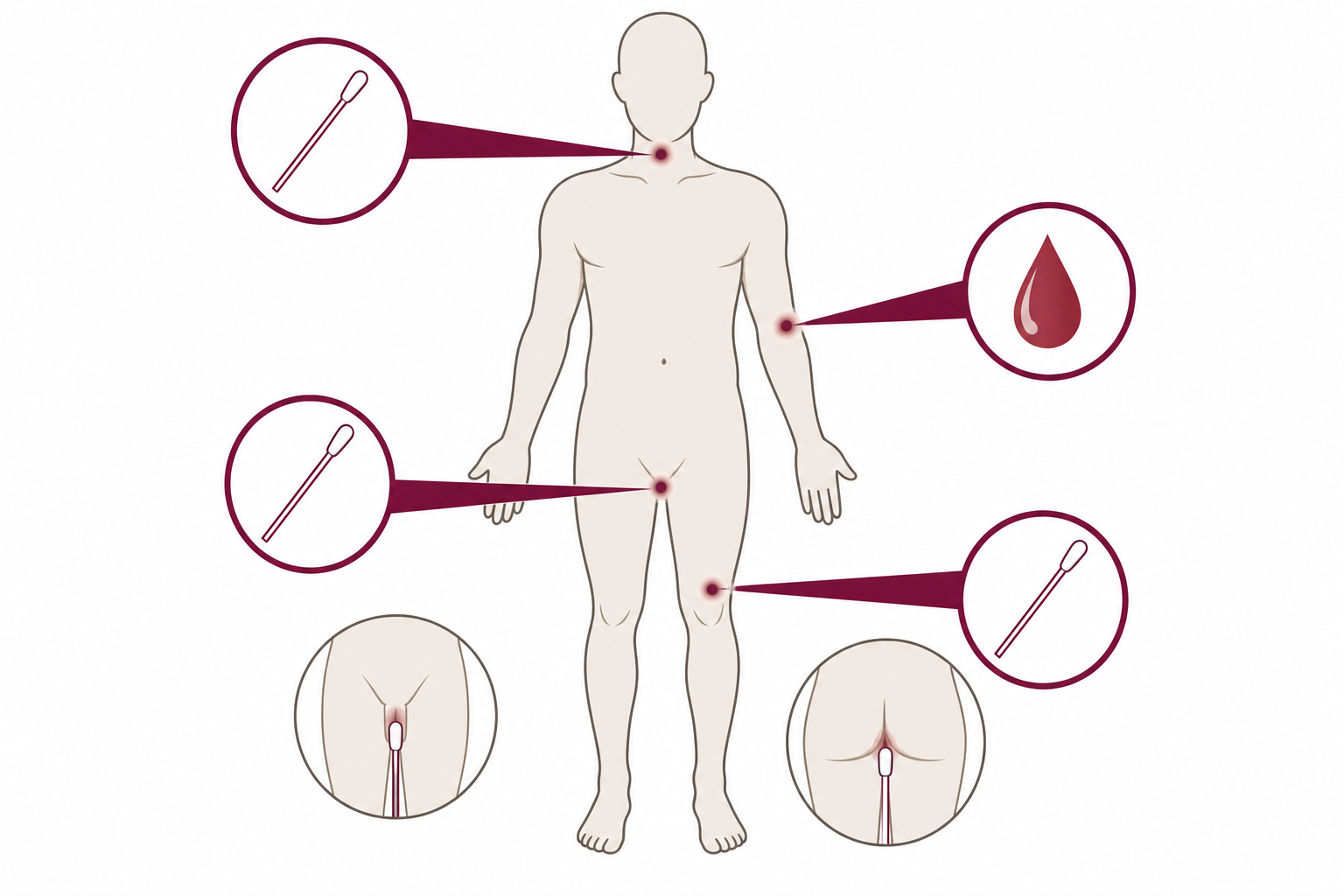
The CDC's STI treatment guidelines for transgender and gender-diverse persons recommend that providers remain aware of symptoms consistent with common STIs and screen for asymptomatic infections on the basis of the patient's sexual practices and anatomy. Translated into a clinic workflow, that means screening based on the body parts a person has and the kinds of sex they have, not the gender on their chart. Someone with a cervix who has receptive vaginal sex needs a cervical or vaginal swab, regardless of whether they identify as male, female, nonbinary, or anything else. Someone with a neovagina who has receptive sex with a penis-bearing partner needs swab testing tailored to that anatomy. Someone who has receptive oral sex needs a throat swab whether or not anything else is going on.
This sounds obvious. In a clinic that has invested in trans-inclusive forms and staff training, it works smoothly. In most clinics it does not. Many EHRs still tie test eligibility to the gender marker, which means transmasculine patients on testosterone can be denied a vaginal swab order because the system thinks they don't have one. Transfeminine patients can be denied a syphilis screen because the system thinks they are post-menopausal and "low risk."
The diagram below maps the four most common screening sites against the exposure routes that put them at risk. The pattern is simple: tests follow tissue, not identity.
Match the test to the exposure
The simplest way to think about screening is to list the body sites that were involved in recent sex and the sample type each one needs. This works regardless of identity, hormone status, or surgical history. The table below summarizes the most common exposure routes and the samples each one calls for, plus the situations where that sample is most likely to be skipped in clinical practice.
Three patterns are worth flagging. First, oral sex carries a real risk of pharyngeal (throat) gonorrhea and chlamydia, but throat swabs are almost never offered unless the patient specifically requests one. Second, rectal infections are frequently asymptomatic, which means a rectal swab is the only way to detect them. Third, fingerstick blood tests for HIV, syphilis, and hepatitis are independent of which body parts had contact with which, because these infections travel through the bloodstream rather than presenting at a specific anatomical site.
| Exposure Route | Sample Needed | Commonly Skipped In Trans Care? |
|---|---|---|
| Receptive vaginal or front-hole sex | Vaginal or front-hole swab (urine sample is a less sensitive backup) | Often skipped if patient is on testosterone or registered as male in the EHR |
| Receptive anal sex | Rectal swab | Frequently skipped unless patient explicitly discloses anal sex |
| Receptive oral sex | Throat swab | Rarely offered unless patient specifically requests it |
| Any sex with a new partner (last 3 months) | Fingerstick blood test for HIV, syphilis, hepatitis B, hepatitis C | Sometimes skipped if patient is assumed to be "low risk" based on hormone or surgical status |
| Shared toys or skin-to-skin genital contact | Site-specific swab where contact occurred | Almost always skipped if no penetration is reported |
If you want one kit that covers the common ground
For people who do not want to deal with a clinic visit at all, or who want to fill in the gaps a recent clinic visit left behind, a combination at-home kit covers the most common screening targets in one delivery. The 8-in-1 panel below is validated for both men and women, uses fingerstick blood for the bloodborne infections and self-collected swabs for the others, and ships discreetly. It is a reasonable starting point for someone who has had any recent new-partner exposure and wants a private baseline. Disclosure: the at-home test kits referenced below are sold by this site.

Testing after bottom surgery: what changes, what doesn't
Bottom surgery changes which sample types apply and which clinical team should weigh in on interpreting results, but it does not eliminate infection risk. Whatever tissue is present can be exposed during sex, and any exposed tissue can host an infection.
For trans women who have had vaginoplasty, the neovagina (whether constructed by penile inversion, sigmoid colon graft, or peritoneal flap) can host skin-to-skin infections like herpes and syphilis, and in some cases chlamydia or gonorrhea depending on the surgical technique. Oral and anal sex carry their own independent risks regardless of what was done below. A throat swab after receptive oral sex and a rectal swab after receptive anal sex remain the right tests; what changes is the swab used at the neovaginal site, which should be discussed with the surgical team and the screening provider.
For trans men who have had phalloplasty or metoidioplasty, urethral lengthening creates a new route for urinary-tract symptoms and for site-specific infections. Urine samples and urethral swabs may both be useful depending on the symptom. If the vagina or front-hole is still present (which it is in many post-phalloplasty patients who do not opt for vaginectomy), the same swab considerations apply as for non-operative trans men.
The table below summarizes the most common post-surgical considerations for screening. It is meant as a starting point for a conversation with a provider who knows your specific anatomy, not a substitute for one.
| Surgical Status | STI Risks Still Present | Testing Usually Indicated |
|---|---|---|
| Post-vaginoplasty | Oral, anal, and neovaginal skin-to-skin contact (herpes, syphilis); HIV and hepatitis serology unchanged | Fingerstick blood for HIV/syphilis/hepatitis, throat swab if oral exposure, rectal swab if anal exposure, neovaginal swab per surgical team's guidance |
| Post-phalloplasty or metoidioplasty (with urethral lengthening) | Urethral, oral, and anal exposure; vaginal exposure if vagina is still present | Urine or urethral swab, throat/rectal swabs by exposure, blood panel; vaginal/front-hole swab if applicable |
| No bottom surgery | All body sites used during sex | Anatomy-based testing per exposure route (see table above) |
The emotional cost of having to ask
For many trans and nonbinary people, the hardest part of STI testing is not the swab. It is the asking. Asking means outing yourself again, sometimes to a receptionist, sometimes to a phlebotomist, sometimes to a provider who suddenly seems uncomfortable. It can mean correcting an intake form, explaining a post-surgical anatomy to a stranger, or hearing the wrong pronoun for the third time in one visit. People avoid testing because the anticipatory exhaustion of another clinical encounter that may go badly outweighs the clinical urgency they feel in the moment. Indifference to health is rarely the driver; the mental cost of being seen, corrected, or misunderstood by yet another stranger is.
That emotional toll is documented in the research literature. Studies of healthcare experiences for trans patients consistently find that perceived discrimination and the anticipation of misgendering predict delayed care, including delayed STI screening. The longer testing is delayed, the more time infections have to spread to partners or progress to complications that would have been preventable.
At-home testing solves part of this problem by removing the audience. No intake form, no waiting room, no person touching your body. For someone who has been laughed at or talked over in a clinic, that privacy can be the difference between testing and not testing.
Peer-reviewed studies of trans patients' healthcare experiences consistently find that perceived discrimination and anticipated misgendering predict delayed care, including delayed STI screening. Lower-friction options that remove the audience (at-home sample collection, telehealth follow-up, LGBTQ-affirming clinics with trained staff) demonstrably increase the share of trans patients who test on schedule rather than waiting for symptoms to force a visit.
What you can do, even if your doctor won't
The systemic fix is straightforward in theory: every gender-affirming visit should include a brief, non-judgmental anatomy-based sexual-history check, and the screening that follows should be ordered the same way it would be for any other sexually active adult. In practice that fix is years away in most clinics. While the system catches up, individual patients have options.
Reframe testing as routine maintenance, not crisis response. If you are sexually active with new or multiple partners, screening every three to six months is reasonable for most people. If your activity is lower or with a long-term partner, once a year is usually enough. After a specific exposure you are worried about, test at the appropriate window for each infection (roughly two weeks for chlamydia and gonorrhea swabs, six to twelve weeks for HIV antibody tests, four to twelve weeks for syphilis).
You do not have to explain your whole body to a stranger to do this. You can request site-specific testing at a clinic, you can choose an at-home option, or you can combine both. The 7-in-1 panel below covers a slightly different mix of infections and is a useful alternative or follow-up to a single-infection kit. Whichever route you choose, the goal is the same: get the test that matches your exposure, on your own schedule, without the appointment becoming the whole story.

FAQs
- Does hormone therapy change my STI risk or my need to test?
- Hormones do not block any sexually transmitted infection. Testosterone and estrogen are not protective, and there is no evidence either lowers the risk of getting chlamydia, gonorrhea, HIV, syphilis, herpes, or HPV. In some cases the opposite is true: testosterone-related mucosal thinning and neovaginal tissue made from skin can modestly raise the per-act transmission risk because the tissue is more vulnerable to microtears. If you are sexually active in any way (oral, vaginal, anal, frontal, skin-to-skin), testing belongs in your routine the same way it would for anyone else.
- How do I figure out which tests fit my body?
- Match the test to the body sites you actually use during sex. Receptive oral sex calls for a throat swab. Receptive anal sex calls for a rectal swab. Receptive vaginal or front-hole sex calls for a vaginal or front-hole swab (urine is a backup but less sensitive). A fingerstick blood test covers HIV, syphilis, and hepatitis regardless of which body parts were involved.
- I've had bottom surgery. Do I still need STI testing?
- Yes. Surgery changes which sample types apply, not whether infections can happen. Neovaginal and post-phalloplasty tissues can host infections the same way native tissue can. The right tests depend on your specific surgical technique and your current sexual practices; the tables in this article are a starting point for a conversation with a provider who knows your anatomy.
- Why doesn't my gender-affirming clinic bring up STI testing?
- It's a common pattern: gender-affirming visits focus on hormones, lab monitoring, and mental health, and sexual health falls off the agenda. Sometimes it's training (the clinician was never taught what to swab in a transmasc patient on testosterone). Sometimes it's the EHR (the system blocks orders based on gender marker). Sometimes it's discomfort. Whatever the reason, you can ask directly, or test from home.
- What if my clinic's EHR blocks the test I need?
- It happens often. Lab order systems still tie test eligibility to the gender marker on file, so a transmasculine patient registered as male can be blocked from a vaginal swab order, and a transfeminine patient can be blocked from a syphilis or PSA panel. Three workarounds: ask the provider to override the gender marker for the specific order, request the test at an LGBTQ-affirming clinic where the workflow is built around this, or use an at-home kit that is sample-driven rather than chart-driven.
- Can STI symptoms look different on hormone therapy?
- Yes. Testosterone-related vaginal thinning, estrogen-related discharge patterns, and post-surgical healing can all mimic or mask STI symptoms. Burning gets blamed on dryness. Discharge gets blamed on healing. The safer default is to swab first and rule out infection, then attribute symptoms to hormones or surgery only after testing is negative.
- How often should I be testing?
- Quick guide: every 3 to 6 months with new or multiple partners; once a year in an established monogamous partnership; sooner if your partner just tested positive or you have new symptoms. After a specific exposure you are worried about, test at the right window for each infection (about two weeks for chlamydia and gonorrhea swabs, six to twelve weeks for HIV antibody, four to twelve weeks for syphilis) rather than waiting for the next routine check.
- Can I use these at-home kits if I'm nonbinary?
- Yes. At-home tests are based on what sample you collect, not on the gender marker on your ID. The 8-in-1 panel is validated for any-gender use; some single-infection kits (like our trichomoniasis and HPV swabs) are validated for female anatomy only and that scope is stated on the product page. If you have a body part the test is validated for and the exposure to match, you can use it.
How we sourced this article: We combined current screening guidance from the CDC, WHO, and Planned Parenthood with peer-reviewed research on transgender sexual health and the documented gaps in gender-affirming clinical practice. The clinical patterns described are drawn from research literature and published treatment guidelines, not from individual patient anecdotes.
- U.S. Centers for Disease Control and Prevention. STI Treatment Guidelines, Transgender and Gender Diverse Persons section. Source for anatomy-based screening recommendations and the documented pattern of missed screening in gender-affirming care.
- U.S. Centers for Disease Control and Prevention. STI Screening Recommendations. Age-based and exposure-based screening intervals for chlamydia, gonorrhea, syphilis, HIV, and hepatitis.
- U.S. Centers for Disease Control and Prevention. Taking a Sexual History: A Practical Guide for Clinicians. Source for the recommendation that screening be driven by anatomy and behavior rather than gender identity.
- World Health Organization. Global HIV, Hepatitis and STIs Programmes: Transgender People. Source for the figure that transgender people are roughly 13 times more likely to be living with HIV than other adults of reproductive age.
- Planned Parenthood. STDs, HIV & Safer Sex category page. Source for general patient-facing screening guidance applicable across populations.
- U.S. National Institutes of Health, MedlinePlus. Sexually Transmitted Infections topic page. Source for general infection-by-infection symptom and window-period information.
