
Published: October 2025 | Last updated: May 2026 | Editorial review and quality control: Martina N.
How soon after a hookup should I test for STIs?
Chlamydia and gonorrhea: reliable from 1 to 2 weeks post-exposure. HIV (fourth-generation antigen/antibody): detectable from 18 days, confident by 45 days, per <a href="https://www.cdc.gov/hiv/testing/index.html" target="_blank" rel="noopener noreferrer">CDC guidance</a>. Syphilis antibody: 6 to 12 weeks. Herpes HSV-2 IgG: 12 to 16 weeks. Testing before the window risks a false negative; timing matters more than speed.
This question lands at strange hours. Two in the morning, after the bar. Five in the morning, when sleep gives up. Sometimes the next afternoon, when a perfectly normal text from the person you slept with reads strange in your head. The body feels fine. The brain wants a plan.
The short answer is yes: testing after a new partner is the right call, and timing matters more than speed. Testing on day two of a worry is too soon to catch most infections, and a clean result then can hide one that is still building up. The decisions worth making are when to test, what to test for, and what to do with the result. The rest of this article walks through each of those, with the timing math, the citations behind them, and a few paragraphs about the symptoms that almost certainly are not an STI.
Key Takeaways
- After a new partner, plan a test 10 to 14 days post-exposure for chlamydia and gonorrhea, a follow-up around 45 days for HIV with a fourth-generation antigen and antibody test, 6 to 12 weeks for syphilis, and 12 to 16 weeks for a herpes HSV-2 antibody result.
- Chlamydia, gonorrhea, and early HIV typically cause no symptoms, so a body that feels normal can still be carrying and transmitting an infection, which is exactly what routine testing is designed to catch.
Why feeling fine is not a clean bill of health
Most STDs do not announce themselves. CDC screening guidance describes the majority of chlamydia and gonorrhea infections as silent in the people carrying them, which is why the CDC recommends routine annual screening for sexually active people under 25 and for anyone with new or multiple partners. WHO data on STIs echoes this for trichomoniasis and the human papillomavirus. Genital herpes outbreaks are commonly mistaken for ingrown hairs, razor burn, or yeast irritation. Many people who carry HPV will never see a single visible sign before it surfaces in a Pap smear or a partner's diagnosis years later.
That makes “I feel fine” the worst diagnostic tool in the kit. Waiting for a symptom is roughly equivalent to waiting for a burglar to ring the doorbell on the way in. By the time something obvious shows up, the infection has often had weeks or months to spread to a partner, climb the reproductive tract, or, in the case of syphilis and untreated HIV, move into a stage that is harder to treat. Routine testing fills that gap.
This is also why a partner saying “I'm clean” is not the same as you being clear. They might be telling you the truest version of what they know. They might also have only ever been tested for the small set of infections that show up symptomatically in their partners, while carrying something they have never been screened for. Asymptomatic chlamydia and gonorrhea are common in both women and men, and trichomoniasis behaves similarly; people often discover the infection only after a partner is diagnosed and reaches out.
STIs are often asymptomatic. When symptoms occur, they can be non-specific.
The window period: why day two is too soon
A window period is the gap between exposure and the point when a test can reliably detect an infection. The length of that gap depends on what the test is actually looking for. Tests that look for the pathogen's own genetic material (NAAT tests) can detect chlamydia and gonorrhea about a week after exposure. Tests that look for the body's antibody response, including the rapid blood tests for HIV, syphilis, and herpes, take longer because antibodies need time to build up to detectable levels.
If you sleep with someone on a Saturday and test on Sunday, the result mostly reflects your immune status from the days before Saturday night. The new exposure has not had time to register, so any result that early is reading a prior state, not the current one. This is the single most common testing mistake people make: someone tests early, feels relieved by a negative, and finds out weeks later that something was already building the whole time.
The detection windows below are typical planning ranges. CDC HIV testing guidance sources the HIV figures specifically: roughly 10 to 33 days for a NAAT and 18 to 45 days for a fourth-generation antigen and antibody lab test. The chlamydia, gonorrhea, syphilis, hepatitis B, and herpes windows reflect general clinical reference ranges from CDC STI resources and standard test-kit specifications. Specific timing depends on the test technology and on individual immune response, so treat these as planning ranges rather than guarantees.
Which test does what, and when each one earns its keep
Not every STD test is the same machine pointed at the same thing. STI tests fall into three broad categories by what they detect, and each category has a different detection window.
NAAT (nucleic acid amplification tests) look for the pathogen's own DNA or RNA. These are the laboratory gold standard for chlamydia, gonorrhea, and trichomoniasis. They are highly sensitive and turn positive earliest in the window period. The trade-off is that they go to a lab, so turnaround is days rather than minutes.
Antibody tests look for the immune response your body makes to an infection. Most rapid blood tests done at home (HIV, syphilis, hepatitis B, hepatitis C, herpes) are antibody-based or combined antigen and antibody. They can give a result in about 15 minutes from a fingerstick, and they need time after exposure to be accurate because the antibodies they detect take weeks to build up.
Antigen tests look for parts of the pathogen itself, like the HIV p24 antigen. Fourth-generation HIV blood tests combine antigen and antibody detection, which is what shortens the HIV window to roughly 18 to 45 days for most people, per CDC HIV testing guidance.
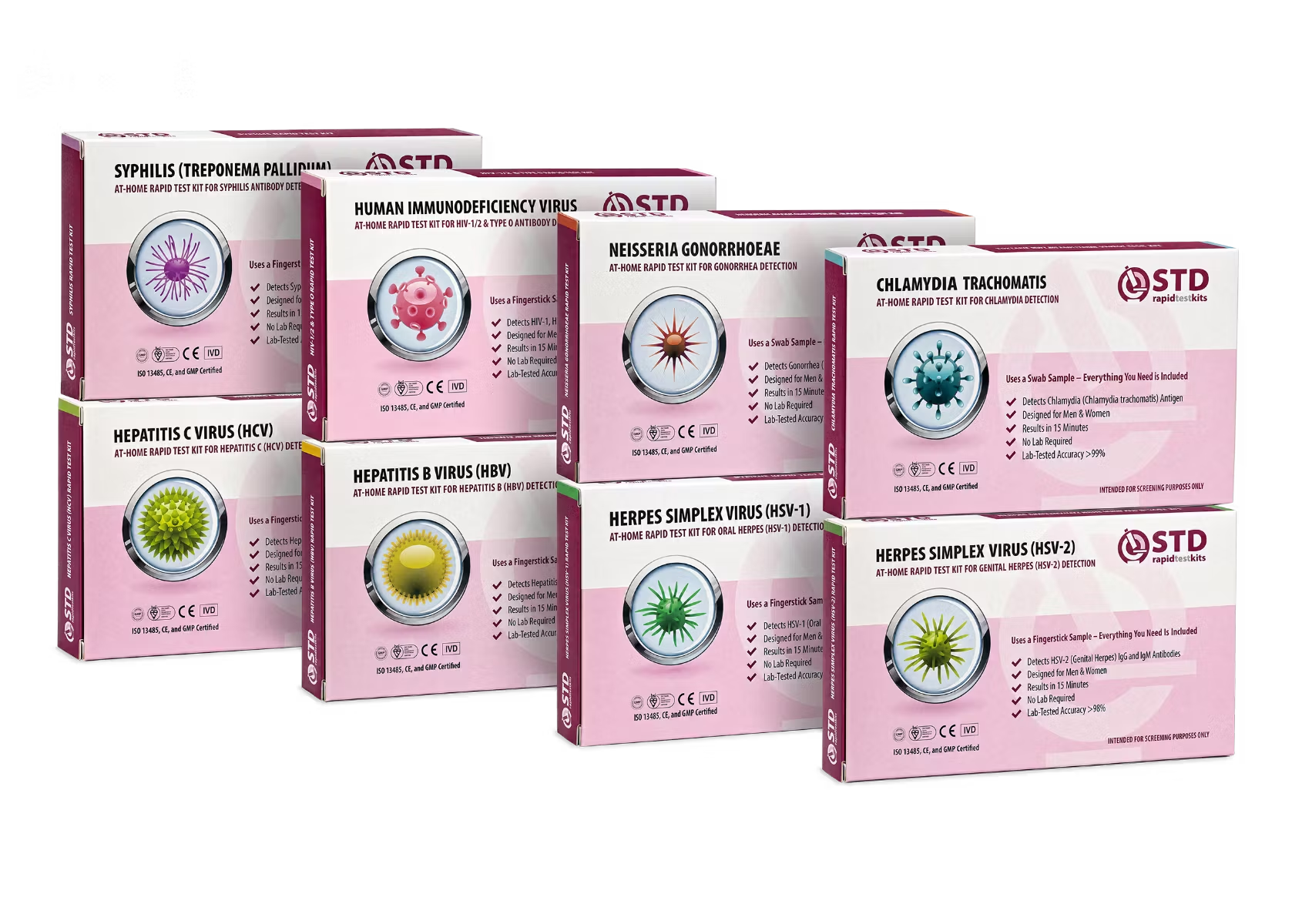
The at-home rapid STI test kits, including the panels below, are lateral-flow immunoassays. They are not lab NAATs or PCR, and the two technologies are complementary rather than equivalent: a home lateral-flow result during the right testing window is reassuring for screening, while a lab NAAT offers higher analytical sensitivity for very early infections. A positive home result is a clean enough signal to begin treatment-planning with a clinician, with a confirmatory clinic test. This article is published by stdrapidtestkits.com, which sells the at-home kits linked below; we recommend products based on fit for the reader's concern, and they complement rather than replace clinic testing for symptomatic or high-risk situations.
| Test type | Time to result | Privacy | Best for |
|---|---|---|---|
| At-home rapid lateral-flow | 10 to 20 minutes | High (private collection) | Routine screening, post-exposure check after the window has cleared |
| Mail-in lab NAAT or antibody panel | 2 to 5 days | High (discreet shipping) | Full panel screening, early-window NAAT detection for chlamydia and gonorrhea |
| In-clinic testing | Same day to a week | Moderate | Symptomatic visits, treatment, insurance-covered care |

Risk does not depend on the kind of sex you had
There is a common assumption that only penetrative sex counts. It does not. Several infections spread through skin-to-skin contact, which means oral, manual, and brief genital contact can pass them along. The CDC notes that herpes (both HSV-1 and HSV-2), syphilis in its primary chancre stage, and HPV can transmit through skin contact with no penetration at all (CDC guidance on genital herpes).
Gonorrhea and chlamydia can also infect the throat through oral sex. A pharyngeal infection usually produces no symptoms, which is exactly why someone who “only had oral” can still carry and pass on the bacteria. Hepatitis B transmits efficiently through unprotected sex even without ejaculation, and the risk of HIV from oral exposure, while low, is not zero when there are open sores or fresh dental work.
So the qualifiers people reach for (“it was only oral,” “we used a condom most of the time,” “we stopped before anything happened”) lower the risk without erasing it. Any unprotected genital, oral, or anal contact with a new partner is a reason to put a test on the calendar at the windows above.
A throat infection requires a pharyngeal swab. The at-home rapid kits here test self-collected genital swabs and fingerstick blood, not throat samples. If a high-risk oral encounter is your main worry, a clinic pharyngeal swab is the right tool for that specific question. A home panel still covers the genital and bloodwork side of the same exposure event.
Skin-to-skin infections (herpes, HPV, syphilis primary chancre) can transmit through any genital, oral, or anal skin contact, with or without penetration. Condoms reduce but do not eliminate this risk.
Fluid-borne infections (HIV, gonorrhea, chlamydia, hepatitis B, trichomoniasis) transmit through body fluids during unprotected sex. Condoms are highly effective here when used consistently.
The wait between exposure and your first test
Knowing the right testing window does not make the wait less uncomfortable. People who otherwise sail through a normal week describe the days between a hookup and a test as a low-grade hum of catastrophizing. Every itch becomes evidence. Every twinge of pelvic tightness gets reinterpreted. The body feels normal, and the brain spirals anyway.
The simplest move is to put the test on the calendar the day after the exposure, the way you would book a dentist appointment. The callout below has the specific dates by infection. Once that date is on the calendar, the question moves out of your head and into a logistics list.
Skip the early test if you can. Testing at day three almost always feels productive in the moment and almost always gives a result that is not actually informative. People who test that early tend to test again on day 14 anyway. The pattern wastes a kit and adds two more weeks of “but what if the first one was wrong” to the wait.
If the encounter was unprotected and very recent (within 72 hours) and you are worried about HIV in particular, urgent care or sexual-health clinics can do an exposure assessment and discuss post-exposure prophylaxis (PEP). PEP requires a clinical prescription and only works if it starts within 72 hours of exposure, so this matters when the worry is fresh and the risk profile is high.
- Day 14: chlamydia and gonorrhea
- Around day 45: HIV (NAAT or fourth-generation antigen and antibody test)
- 6 to 12 weeks: syphilis antibody
- 12 to 16 weeks: herpes HSV-2 IgG, for full antibody coverage
If the encounter was within 72 hours and the risk profile is high, get to urgent care or a sexual-health clinic the same day to ask about PEP, which requires a clinical prescription.
How often to test if you hook up regularly
Roughly every three months is the right cadence for most sexually active adults with new or multiple partners. CDC screening recommendations set this as the baseline for sexually active people under 25, men who have sex with men, and anyone with multiple partners or whose partners have multiple partners.
If you are on PrEP for HIV prevention, your prescribing clinician will already have set up roughly quarterly STI screening as part of routine PrEP follow-up. That cadence catches most asymptomatic chlamydia and gonorrhea before it can be passed on, and it is the model worth copying even if you are not on PrEP.
Some triggers move the next test up the calendar regardless of how recently you last tested: a condom that broke or slipped, a new partner whose status you do not know with confidence, a partner who later tells you they tested positive, or a symptom that does not fit any other obvious cause.

New partners deserve a new baseline
“They said they got tested” lands differently a few months in than it does on the first night. Once you start to like someone, the conversation about testing gets harder to bring up, not easier. The longer you wait, the more it can feel like an accusation rather than a baseline check. The cleanest move is to do it early, before there is anything to lose.
Frame it as your habit, not as their problem to solve. Most people who handle the question well are already comfortable with their own testing rhythm. People who flinch at the suggestion are giving you useful information about how they think about sexual health, regardless of what their last test said.
“I tested negative six months ago” also is not the same as “I tested negative this week.” Testing windows clear in weeks. Sexual histories add up in months. The honest re-baseline for a new partnership is a fresh test from both of you within a few weeks of becoming sexually active together. The American Sexual Health Association has a useful framing for this conversation if you want a script that does not come from your own head.
“I get tested every few months as a baseline thing, and I usually re-test when I'm sleeping with someone new. Want to do it together, or just compare results once we both have them?”
Short, low-stakes, and rooted in your own habit rather than their behavior.
Talking about your status, not just theirs
The conversation about testing also runs the other way. If you have been recently treated for an STI, or you are living with a chronic infection like HSV-2 or HIV, what you say to a new partner matters as much as what you ask. The framing that lands best is information, not confession.
If you are still inside a window period after a recent exposure: “I was tested last month. I am doing a follow-up in a couple of weeks because the timing of my last exposure was tight.” For past infections that were treated: “I had chlamydia after my last relationship. It was treated, I tested clear, and I am regular about screening.” For HSV-2 or HIV on treatment: “I have HSV-2. I take suppressive medication, and we can talk about how that changes risk for you.” Most partners can engage with this calmly when it is delivered as a fact rather than an apology.
There is no script that fits every relationship. Aim for the calmest version of the conversation you can manage, even when the topic feels heavy in your throat before you say it.

Yes, one time can be enough
The single most common rationalization in reader emails takes some form of “but it was only once.” That logic is comforting, and it is also wrong. Bacteria and viruses do not count rounds. Per-exposure transmission probability varies by infection and by route, but it is well above zero for chlamydia, gonorrhea, herpes, syphilis, and HPV from a single unprotected encounter. HIV transmission per single exposure is lower in absolute terms than the others, and it is the higher-stakes outcome of the bunch.
The practical implication: a one-time encounter with someone whose status is unknown is enough to put a test on the calendar. Once at the 10 to 14 day mark for chlamydia and gonorrhea, then a follow-up around 45 days for HIV (with a fourth-generation test) and 6 to 12 weeks for syphilis. A herpes HSV-2 antibody test needs 12 to 16 weeks for confident coverage if that is something you want to rule out. After those test points come back clear, the situation is closed.
If the encounter was unprotected, high-risk, and within the last 72 hours, the right move is a same-day clinician visit to discuss HIV PEP rather than a rapid kit at home. PEP starts a clock that closes fast. It is the only intervention that meaningfully reduces HIV risk after the fact, and it is only available through a clinical prescription.
Not every post-hookup symptom is an STI
Most of the symptoms that send people Googling at 2 a.m. have non-infectious explanations. The post-hookup version of your body is also a stressed-out, sleep-deprived, hyper-vigilant version of your body, and that combination notices sensations the calmer version would ignore.
Burning during urination can be a urinary tract infection or simple dehydration after a long night. New discharge can be a yeast infection, bacterial vaginosis, or a reaction to a new lubricant or condom material (Mayo Clinic lists these alongside STI presentations for comparison). A bump near the genital area can be an ingrown hair, a clogged sebaceous gland, or a friction blister from skin rubbing on skin. An itchy patch can be contact dermatitis from a new soap, a new detergent, or a new condom brand.
Stress complicates this further. Cortisol disrupts the vaginal microbiome and can trigger yeast overgrowth. Sleep loss flares skin conditions. Hyper-vigilance after a regretted hookup makes you notice sensations your body had been producing all along but you had not paid attention to.
None of this means an STI is impossible. It means the right move is to test on the proper window, evaluate any symptom that lasts more than a few days regardless of what it looks like, and not draw a diagnosis from a forum thread. If a symptom is severe, see a clinician promptly rather than waiting on a home test.
A high fever with pelvic or testicular pain. A visible ulcer or sore that has not healed in a week. Severe abdominal pain. Heavy unusual bleeding. Painful swollen lymph nodes in the groin alongside flu-like symptoms. These can indicate infections that need same-day evaluation and treatment, and the right tool is a clinician's workup, not a home screen.
Stigma, not access, is what makes people wait
One consistent finding in sexual-health research is that the biggest barrier to testing is rarely cost or distance. It is shame and the fear of being judged. The result is that people who could test cheaply and quickly often wait until symptoms are impossible to ignore, by which point an infection that would have been a single antibiotic dose has had more time to do damage or to reach another partner.
The way to interrupt that pattern is to treat testing as routine maintenance rather than a confession. People who screen on a schedule, after any new partner, or after a condom failure normalize it for themselves and for everyone they sleep with. A regretted hookup is one of many ordinary reasons to test, sitting alongside “we are moving in together” and “we are trying to conceive.” The bacteria that cause chlamydia do not care how you were exposed, and your immune system does not care about your emotional state, so the testing windows run the same whether the encounter was planned or regretted.
People who screen on a schedule normalize testing for themselves and for everyone they sleep with. Framing it as routine care rather than a response to regret makes the conversation easier every time it comes up.
Reinfection from the same partner is not unusual
Ping-pong reinfection is one of the more frustrating patterns in STD treatment. You test positive for chlamydia. You take antibiotics. You retest negative. You go back to having sex with the same partner who never got treated, and the infection comes back. The clinical guidance is consistent: when one person in a sexual partnership tests positive for chlamydia, gonorrhea, or trichomoniasis, both people should be treated at the same time, and both should wait the recommended interval before having sex again.
The CDC recommends waiting at least seven days after the start of treatment before resuming sex, and a follow-up test about three months later. That three-month retest is designed to catch reinfection, not to confirm the cure, because a test of cure run too soon can pick up residual non-viable DNA and read as a false positive. If your partner is vague about whether they finished their course, or whether they were treated at all, treat the situation the way you would treat a fresh exposure: schedule a re-test about three weeks out and proceed from there.
The reason synchronized treatment matters is biological. The same contact that introduced the first infection is perfectly capable of reintroducing it if only one person finishes treatment.
Both partners take the antibiotic course at the same time. Both wait at least 7 days after starting treatment before resuming sex. Both retest about three months later, per <a href="https://www.cdc.gov/std/treatment-guidelines/screening-recommendations.htm" target="_blank" rel="noopener noreferrer">CDC screening recommendations</a>, to confirm the infection cleared and was not reintroduced. Skipping any of these steps is the most common reason a treated infection appears to come back.
If the result comes back positive
A positive result is data about a treatable medical condition, not a verdict on your character. Most STDs are treatable, and all of them are manageable with current medicine. Here is roughly what happens next.
For bacterial infections (chlamydia, gonorrhea, syphilis, trichomoniasis), treatment is usually a short course or a single dose of antibiotics. A clinician confirms the home result with a lab NAAT before prescribing, because antibiotic choice depends on the confirmatory result. Most people are non-infectious within days of starting treatment, and current guidelines recommend abstaining from sex for at least 7 days after starting a single-dose regimen.
For viral infections, the picture is more nuanced and substantially less catastrophic than older messaging suggested. People with HIV on consistent antiretroviral therapy can achieve an undetectable viral load and live a normal lifespan; CDC guidance on HIV treatment states that with an undetectable viral load you will not transmit HIV through sex, the principle commonly summarized as U=U. Genital herpes is managed with antiviral medication that reduces outbreak frequency and lowers transmission risk to partners. Hepatitis C is curable in most cases with direct-acting antivirals. HPV is monitored, and most strains clear on their own.
Partner notification is part of the care plan for several of these infections. You can do it yourself, anonymously through services like TellYourPartner.org, or through a public health department for some reportable conditions. The point of notification is to interrupt onward transmission and to make sure your past partner gets the treatment or counseling they may need. None of this needs to be done the day of the result; a calm version of the conversation, once treatment has started, is fine.
Bacterial (chlamydia, gonorrhea, syphilis, trichomoniasis): a clinician confirms the home result with a lab NAAT, prescribes a short course or single dose of antibiotics, and most people are non-infectious within days. Abstain from sex for at least 7 days after a single-dose regimen.
Viral (HIV, herpes, hepatitis B, hepatitis C, HPV): HIV is managed with daily antiretroviral therapy that brings the virus to an undetectable level (the principle summarized as U=U: undetectable equals untransmittable). Herpes is managed with antiviral medication. Hepatitis C is curable with direct-acting antivirals in most cases. HPV is monitored, and most strains clear on their own.
When a retest is the right move
Not every clean result needs a follow-up. A test taken in the right window for the right infection, with a clear result, is usually the end of the story. Three situations are worth a second test even after a negative.
You tested early. A day-3 or day-5 negative does not rule out chlamydia, gonorrhea, HIV, syphilis, or herpes. If the early test was a calming-down check rather than a definitive read, plan a second one inside the proper window for whatever you are checking for.
The exposure was high-risk and recent. Unprotected sex with a partner of unknown status, especially anal sex, raises the case for a structured test plan: NAAT for chlamydia and gonorrhea at 14 days, fourth-generation HIV at 45 days, syphilis at 6 to 12 weeks, and herpes HSV-2 antibodies at 12 to 16 weeks if you want full coverage.
Symptoms have started since the negative. A new symptom in the days or weeks after a clean test does not automatically mean the test was wrong. It can mean the infection had not yet built up to detectable levels at the time of the first test. New symptoms (discharge, sores, painful urination, unexplained pelvic pain, a flu-like illness with rash that fits acute HIV) earn a fresh visit and a fresh test.
A negative inside the right window, with a plan to retest if symptoms appear, is a closed loop. Anything else is worth a follow-up before you stop thinking about it.
Three situations where a retest earns its keep
- Your first test was inside the window period (day 3 or day 5). Plan a follow-up at day 14 to 21 for chlamydia and gonorrhea, and around day 45 for HIV with a fourth-generation test.
- The exposure was high-risk and recent (unprotected sex, anal sex, a partner of unknown status). Run a structured plan through the full window for each infection.
- A new symptom appeared after a clean test. Discharge, sores, painful urination, unexplained pelvic pain, or a flu-like rash earn a fresh clinical visit, not a second home strip.
Should You Test After This Hookup?
Was the encounter unprotected (no condom, or the condom broke) and within the past 72 hours?
Yes: See a clinician or urgent care today to discuss HIV post-exposure prophylaxis (PEP). Then schedule STI testing at the detection windows listed above.
Did you have any genital, oral, or anal contact with a new or casual partner?
Yes: Put tests on the calendar: day 14 for chlamydia and gonorrhea, around day 45 for HIV, 6 to 12 weeks for syphilis, and 12 to 16 weeks for herpes HSV-2 if you want full antibody coverage. An at-home rapid lateral-flow kit covers the genital swab and fingerstick blood tests once the window has cleared.
No: If there was no genital, oral, or anal contact, testing for this specific encounter is likely unnecessary. Resume your routine screening schedule.
General guidance only. A healthcare provider can advise based on your specific situation.
FAQs
- Can you actually get an STD from oral sex?
- Yes. Herpes (HSV-1 and HSV-2), gonorrhea, syphilis, chlamydia, and HPV can all be transmitted through oral contact. Pharyngeal gonorrhea and pharyngeal chlamydia in particular are common in people who give oral sex and are usually completely asymptomatic. Our at-home rapid kits test the genital and bloodborne presentations of these infections; for a throat-specific check after a high-risk oral encounter, ask a clinic for a pharyngeal swab, which we do not sell as a home kit.
- How soon after a hookup can I test?
- It depends on the infection. Chlamydia and gonorrhea usually need 7 to 14 days post-exposure, and HIV antigen and antibody tests need 18 to 45 days depending on the test generation. Testing in the first 48 hours mostly reflects your status from before the encounter. If you are spiraling, put the test on the calendar at the right detection date and treat the wait as a logistics problem rather than an open question. Earlier testing is a reasonable comfort step only if you plan to retest in the proper window.
- My partner said they got tested. Do I still need to?
- Yes, almost always. A previous test is a snapshot of someone's status at a single moment. It says nothing about exposures that have happened since, and it depends on what panel they were tested with and whether the timing was within the right window for each infection. A fresh test for both of you after a few weeks of being sexually active together is the cleanest way to set a real shared baseline.
- We used a condom the whole time. Isn't that enough?
- Condoms reduce risk substantially but do not eliminate it. They work best for fluid-borne infections (HIV, gonorrhea, chlamydia, hepatitis B, trichomoniasis). Skin-to-skin infections (HSV, HPV, and syphilis chancres on areas the condom does not cover) can still transmit even with consistent condom use. Condoms plus periodic testing is the layered approach that the CDC and most sexual-health clinics recommend.
- I have no symptoms. Do I really need to test?
- Yes. The CDC and WHO both describe most chlamydia, gonorrhea, trichomoniasis, and early HIV infections as asymptomatic in the people carrying them. In people with vaginas, an undetected chlamydia infection is a leading preventable cause of pelvic inflammatory disease and tubal-factor infertility. Testing is what catches the infections that hide behind a body that feels fine.
- My early test was negative but I am still worried. Should I retest?
- If the first test was inside the window period (for example, day 5 for chlamydia or before day 18 for HIV), a follow-up test at the end of the proper window is sensible. Many people test once for early reassurance and then retest at day 14 to 21 for chlamydia or gonorrhea, and at day 45 for HIV with a fourth-generation antigen and antibody test. The first result was not necessarily wrong; it was just taken in a window where a negative is not yet definitive.
- Can I get reinfected by the same partner after treatment?
- Yes, and it is one of the more common reasons a chlamydia or gonorrhea infection appears to come back. Both partners need to be treated, and both need to wait the recommended interval (typically at least 7 days after the start of treatment) before resuming sex. A follow-up test at about three months is the CDC's standard recommendation; it catches reinfection rather than confirming the original cure, since a test run too soon can detect residual non-viable DNA.
- What if the test comes back positive?
- Three steps in order: confirm the home result with a clinician's lab test, begin the prescribed treatment, and notify recent partners so they can be tested and treated. For bacterial infections (chlamydia, gonorrhea, syphilis, trichomoniasis), the lab confirmation is a NAAT and treatment is usually a short course or single dose of antibiotics. For HIV, daily antiretroviral therapy brings the virus to an undetectable level, which means it is not sexually transmitted (U=U). Herpes is managed with antiviral medication; hepatitis C is curable with direct-acting antivirals in most cases. Partner notification can go through a clinician, a public health department, or an anonymous service like TellYourPartner.org.
How we sourced this article: The window-period figures and screening cadences come from the U.S. Centers for Disease Control and Prevention and the World Health Organization. General test-format categories (blood, swab, and urine) are described by MedlinePlus, and Mayo Clinic informs the section on distinguishing STI symptoms from non-infectious causes. NAAT, fourth-generation antigen-and-antibody, and IgG terminology is drawn from CDC HIV testing guidance and from the technical specifications of FDA-cleared rapid lateral-flow kits. The U=U treatment-as-prevention framing is drawn from CDC HIV treatment guidance. Framing around new-partner conversations and routine testing rhythm is informed by the American Sexual Health Association. We summarize current public-health guidance for general readers; we do not provide clinical advice or substitute for a clinician visit.
- U.S. Centers for Disease Control and Prevention. STI screening recommendations by population and risk factor. Source for the every-three-months and annual screening cadences, the asymptomatic-infection framing for chlamydia and gonorrhea, concurrent-treatment guidance, and the three-month retest-for-reinfection recommendation.
- U.S. Centers for Disease Control and Prevention. HIV testing: window periods of roughly 10 to 33 days for a NAAT and 18 to 45 days for a fourth-generation antigen and antibody lab test, and the source for NAAT, antigen, and antibody terminology.
- U.S. Centers for Disease Control and Prevention. HIV treatment: source for the antiretroviral therapy, undetectable viral load, and treatment-as-prevention (U=U) framing used in the positive-result section.
- U.S. Centers for Disease Control and Prevention. About genital herpes: skin-to-skin transmission of HSV-1 and HSV-2, asymptomatic transmission, and the oral-to-genital route via oral sex.
- World Health Organization. Sexually transmitted infections fact sheet. Source for the asymptomatic-rate framing across STIs and the verbatim quoted line on non-specific symptoms.
- Mayo Clinic. Sexually transmitted diseases (STDs): symptoms, causes, and reference for distinguishing STI symptoms from non-infectious causes such as yeast infection, bacterial vaginosis, and contact dermatitis.
- U.S. National Library of Medicine MedlinePlus. STI test formats: blood, swab, and urine tests, categories and turnaround.
- American Sexual Health Association. Getting tested for STIs: practical decisions and conversation framing for sexually active adults.
