

Published: September 2025 | Last updated: April 2026 | Editorial review and quality control: Martina N.
Wondering how often you should get tested for STDs is one of those questions almost everyone asks at some point and almost no one gets a straight answer to. Annually? After every partner? Only when something feels off? The truthful answer is that your testing schedule depends on your sex life, your last potential exposure, and how each infection actually behaves in the body.
This guide gives you a real schedule by scenario, the window periods that decide when a result is reliable, and what a complete STD panel should actually cover. The goal is clarity. By the end, you should know exactly when to test, what to test for, and why timing changes whether your result means anything at all.
How often should you get tested for STDs?
Sexually active adults should test at least once a year as a baseline. If you have new or multiple partners, test every 3 months. After a specific risk event, wait until the relevant window period has passed: roughly 2 weeks for chlamydia and gonorrhea, 6 weeks for syphilis, and 90 days (about 13 weeks) for full HIV certainty on a rapid antibody home test. The CDC recommends annual chlamydia and gonorrhea screening for all sexually active women under 25 and for men who have sex with men.
Key takeaways
- Your testing rhythm should match your real exposure: yearly for stable mutually monogamous relationships, every 3 months if you have new or multiple partners, and a specific retest after the relevant window period for any single risk event.
- A complete STD panel needs both swab or NAAT testing (chlamydia, gonorrhea) and blood testing (HIV, syphilis, hepatitis, herpes). Skipping either category leaves real infections undetected.
The honest answer depends on your sex life, not a calendar rule
The biggest misconception about STD testing is that it follows a universal rule, like a yearly physical or a dental cleaning. In reality, your testing frequency tracks how often your body could plausibly be exposed to an infection. Sexually transmitted infections do not appear randomly; they require a transmission event, and every new partner or unprotected encounter resets the clock.
Picture a common situation. You meet someone new, things move quickly, and protection is not consistent. A few days later, nothing feels wrong. The mental questions start anyway. This is exactly where timing matters: most infections do not cause symptoms right away, and most are not detectable on a test for at least a couple of weeks.
So instead of asking how often you should test in the abstract, the more useful question is how often you are potentially exposed. That shift turns testing from a vague routine into a specific strategy. Someone in a long-term mutually tested relationship and someone with three new partners in three months are not on the same schedule, and they should not be.
The table below maps the most common situations to a sensible testing rhythm. These are practical defaults grounded in CDC and WHO screening guidance for sexually active adults, not hard rules. Adjust based on your last exposure and any specific risk events that fall outside these scenarios.
| Situation | Recommended testing rhythm |
|---|---|
| Mutually monogamous relationship, both tested negative | Once per year, plus a retest after any change to the relationship |
| New partner introduced | Test once after the relevant window period has passed |
| Multiple new partners over a few months | Every 3 months |
| Single unprotected exposure event | At 2 weeks (chlamydia, gonorrhea), then again at 90 days (about 13 weeks) for HIV certainty |
| Symptoms present | Test immediately, with a retest at window if the first is negative |
| Pregnant or planning pregnancy | At first prenatal visit per CDC; chlamydia and gonorrhea added per risk |
Why your timeline and your body's timeline are not the same
One of the most frustrating things about STD testing is that the day you want answers and the day your body can give them are rarely the same day. You might want results 24 hours after a risky encounter. Biologically, that is not how infections work.
When an infection enters the body, it does not become detectable instantly. Bacteria like chlamydia and gonorrhea attach to mucosal cells and begin replicating; nucleic acid amplification tests (NAATs) need enough bacterial DNA present in the sample to produce a positive signal. Viruses like HIV trigger an immune response, and most rapid home antibody tests rely on detecting that response, which builds over weeks. According to CDC guidance on STI screening, accurate detection depends as much on testing inside the right window as it does on choosing the right test.
This is why someone can test negative on day five and positive at week three. The infection did not just appear; it finally crossed the line from undetectable to detectable. Test before that line and you get a negative result that means almost nothing. That is the technical definition of a false negative, and it is one of the most common mistakes people make when they panic-test the morning after.
Typical window periods for the most common tests look roughly like this:
- Chlamydia and gonorrhea (NAAT or rapid swab): from about 14 days after exposure
- Syphilis (antibody): from about 6 weeks
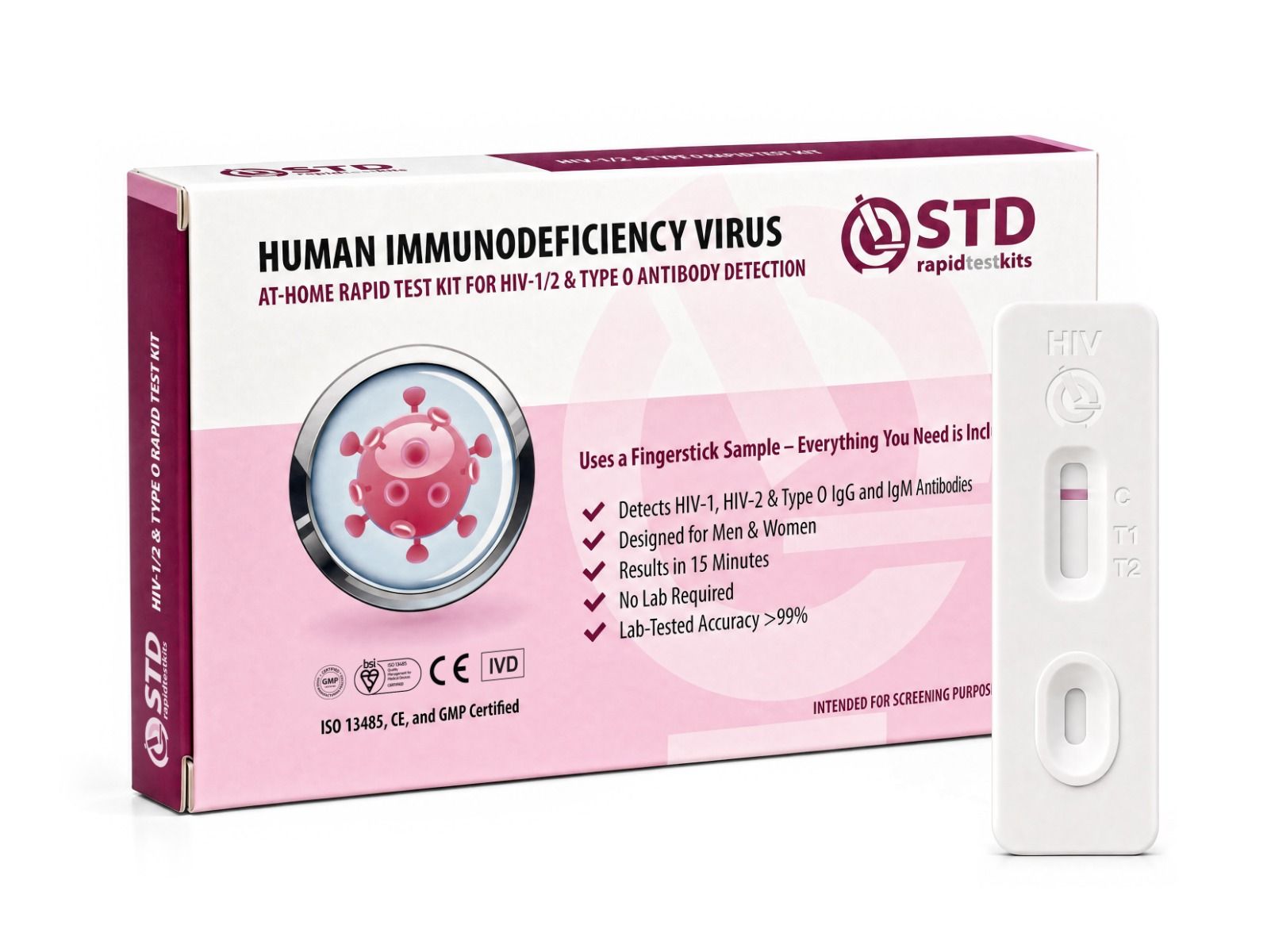
- HIV: 18 to 45 days for fourth-generation antigen and antibody lab tests; rapid antibody-only home tests are most reliable from about 90 days (roughly 13 weeks), which matches the CDC's outer 23 to 90 day antibody-test window
- HSV-2 (antibody): from about 6 to 12 weeks
- Hepatitis B (HBsAg): from about 6 weeks
- Hepatitis C (antibody): from about 8 to 11 weeks
Numbers vary slightly by assay and by whether you are using a lab NAAT or a home rapid test. The takeaway is the same: test inside the window and a negative result is reliable. Test before it and the result is mostly noise.

What a real STD test actually checks for
A second source of confusion is what an STD test actually includes. Many people walk into a clinic, ask to be tested for everything, and walk out assuming everything is covered. It usually is not. Different infections require different sample types, and missing the right method means missing the infection entirely.
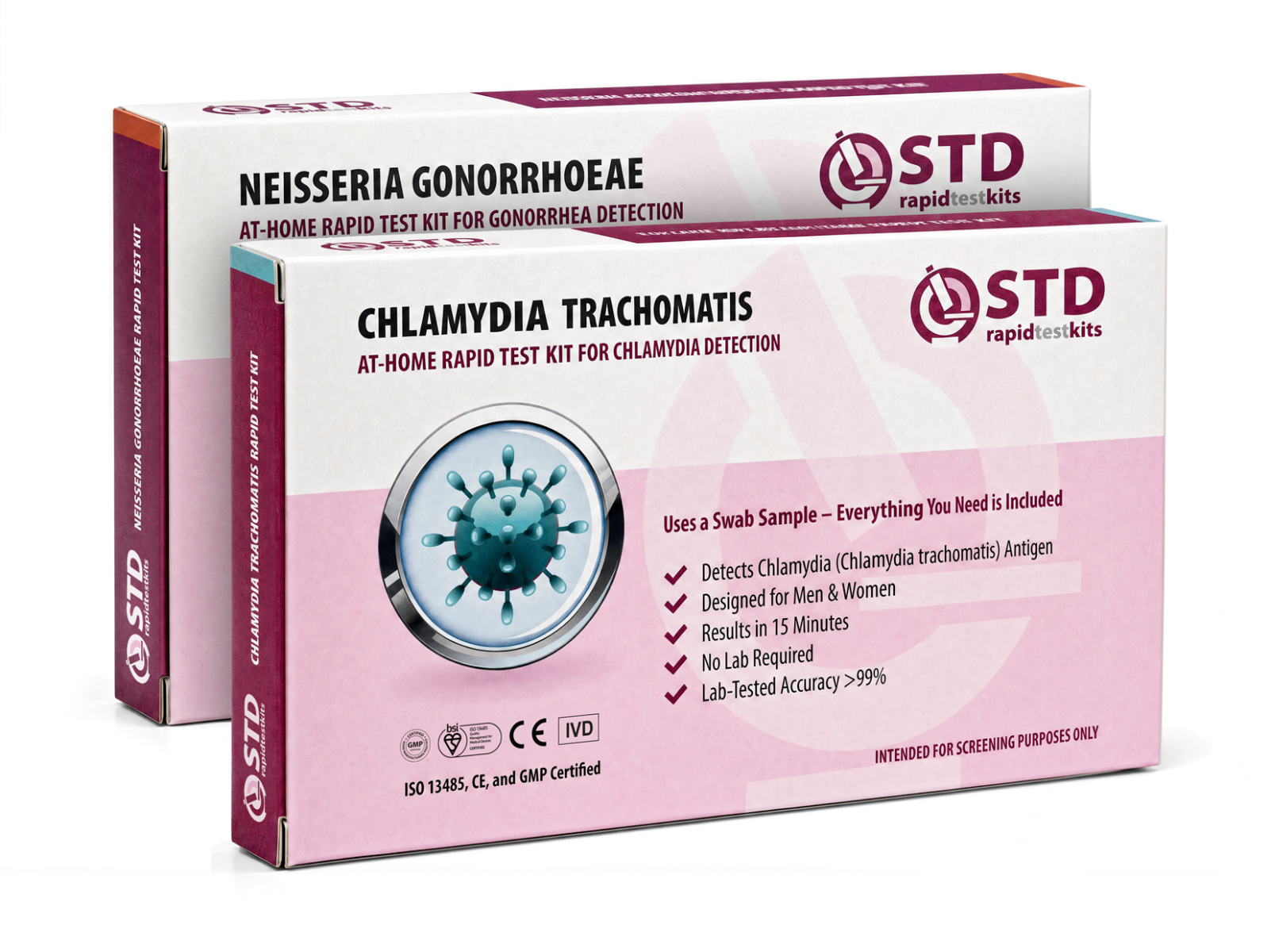
Bacterial infections like chlamydia and gonorrhea are typically tested using NAAT methods that look for the genetic material of the bacteria. Lab NAATs use urine samples or genital swabs and are the analytical gold standard. At-home rapid swab tests use lateral-flow chemistry on the same self-collected sample type. The two are not technically equivalent on sensitivity (lab NAATs are more sensitive), but the home rapid test gives you a screening answer in about 15 minutes without a clinic visit.
Viral infections behave differently. HIV, syphilis, hepatitis, and herpes are usually tested through blood, because the test is looking at your immune response (antibodies) or a viral protein (antigen) rather than the organism itself. That is why they need longer windows: the body has to produce a measurable response before a test can detect it.
The simple rule is two-category: swab or urine for chlamydia, gonorrhea, trichomoniasis, and HPV; blood for HIV, syphilis, hepatitis B, hepatitis C, HSV-1, and HSV-2. A complete screening typically needs both categories. If you only test urine or only test blood, you have only checked half the picture. This is exactly why people use combination kits or panels: the goal is one complete answer rather than four partial ones spread across appointments.
| Infection | Sample type | Detection method |
|---|---|---|
| Chlamydia | Genital swab or urine | NAAT (lab) or lateral-flow rapid (home) |
| Gonorrhea | Genital swab or urine | NAAT (lab) or lateral-flow rapid (home) |
| Trichomoniasis (women) | Vaginal swab | Lateral-flow rapid |
| HPV (women) | Vaginal swab | Lateral-flow rapid |
| HIV | Fingerstick blood | Antigen and antibody (lab) or antibody-only (home rapid) |
| Syphilis | Fingerstick blood | Antibody detection |
| HSV-1 and HSV-2 | Fingerstick blood | Antibody detection |
| Hepatitis B | Fingerstick blood | HBsAg surface antigen detection |
| Hepatitis C | Fingerstick blood | Antibody detection |
Groups the CDC says need testing more often
For some sexually active adults, annual is not enough. The CDC publishes specific screening intervals for groups with elevated exposure or biological risk, and these are worth knowing whether or not you fit the profile.
Sexually active women under 25 should be screened annually for chlamydia and gonorrhea, regardless of how many partners or how careful the protection. The reason is biological: cervical anatomy makes infection more likely to take hold and more likely to be asymptomatic, and untreated chlamydia is a leading preventable cause of pelvic inflammatory disease and tubal-factor infertility. Older women with new or multiple partners or other risk factors get the same recommendation.
Men who have sex with men face a higher baseline rate of HIV, syphilis, and gonorrhea, and the CDC recommends testing every 3 to 6 months depending on number of partners. Pharyngeal (throat) and rectal swab testing at a clinic is part of that recommendation; at-home rapid kits cover the genital and bloodwork side of the same screening interval, but not the throat or rectal swabs.
Pregnant people are screened for HIV, syphilis, and hepatitis B at the first prenatal visit, with chlamydia and gonorrhea added when there is risk. The screening protects the pregnancy as much as the parent.
Other higher-frequency groups include people who have shared injection equipment, those with a partner of unknown status, people who have experienced sexual assault, and anyone diagnosed with an STI in the past year. None of these are character judgments; they are exposure-pattern risk factors. According to the CDC's STI clinical guidance hub, matching your testing interval to your actual risk pattern is one of the most cost-effective infection-control measures available in primary care.
The case for testing when nothing feels wrong
A surprising amount of routine testing happens when there is no symptom at all. Most people assume the only reason to test is to confirm a suspicion. The opposite is closer to the truth: most STIs are silent for long periods, and the testing that catches them earliest is the testing done when nothing feels off.
Chlamydia is the textbook example. According to the CDC, the majority of chlamydia infections produce no noticeable symptoms, particularly in women, where the cervix is the primary site and inflammation often goes unfelt. Gonorrhea is similar. HIV can move through an early acute phase with mild flu-like symptoms that get easily attributed to a cold, then enter a clinically silent phase that lasts years. The World Health Organization fact sheet notes that millions of cases globally remain undiagnosed precisely because people wait for symptoms that never appear.
Routine testing is, in that sense, less about responding and more about staying ahead. If your sex life includes ongoing exposure (new partners, inconsistent protection, partners whose status you do not know with certainty), testing on a fixed interval keeps the gap between exposure and detection short. The alternative is finding out months or years later, which is harder on you, harder on a partner, and harder on the long-term outcome.
There is a quieter benefit too: routine testing detaches the act of testing from a specific scary moment. Instead of testing because something happened, you are testing because it is part of how you take care of yourself.
More than 1 million curable sexually transmitted infections (STIs) are acquired every day worldwide in people 15–49 years old, the majority of which are asymptomatic.
How at-home testing fits into your schedule
For a long time, getting tested meant a clinic visit, a waiting room, an awkward conversation, and a several-day wait for results. That model still exists and is still appropriate for some people. It is not the only model anymore, and the alternative changes how often testing actually happens.
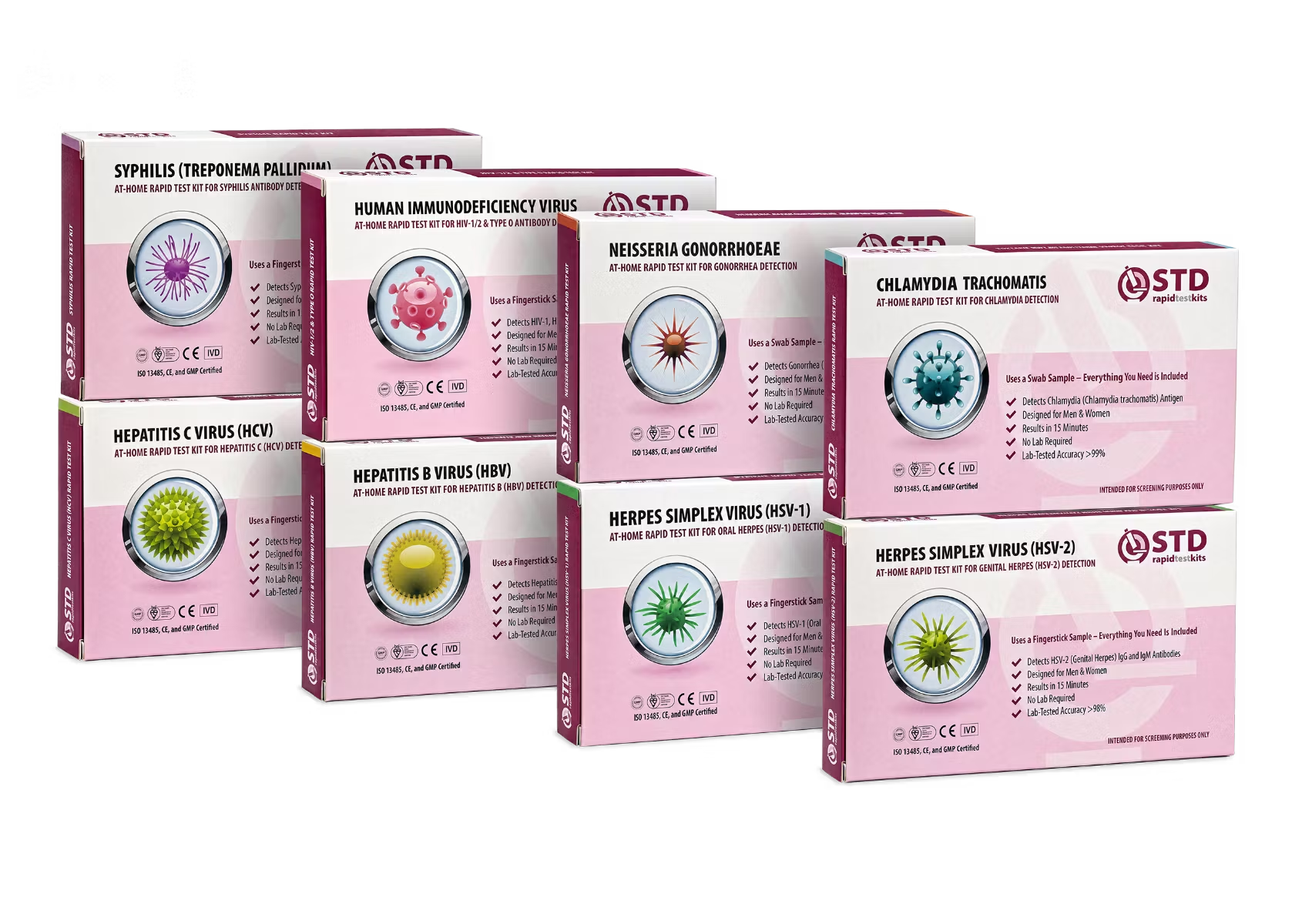
At-home rapid lateral-flow tests cover most of the common infections people screen for: chlamydia and gonorrhea (self-collected swab), HIV, syphilis, hepatitis B, hepatitis C, herpes (fingerstick blood), and HPV and trichomoniasis for vaginal self-swab. Sample collection takes a couple of minutes, results read in about 15 minutes, and the entire process happens in the bathroom rather than a healthcare setting.
These home tests are not technically equivalent to lab NAAT methods on sensitivity. Lab NAATs remain the analytical gold standard for chlamydia and gonorrhea, and any positive home result should be confirmed with a clinical test before treatment decisions get made. For the screening question (am I likely infected and is something detectable right now), a home test gives you a fast, private, low-friction answer.
The practical implication is that at-home testing makes the every-3-month schedule realistic for people who would otherwise skip a clinic appointment for time, cost, or privacy reasons. Convenience changes the actual behavior. A test that fits into a Sunday morning happens; a test that requires a Tuesday afternoon off work often does not.
A note on what this site sells: stdrapidtestkits.com offers rapid lateral-flow kits for the genital and bloodwork-side tests covered above. We do not sell pharyngeal (throat) or rectal swab tests; for those, a clinic remains the right route. If your exposure included oral or receptive anal contact and you want comprehensive coverage, plan a combined approach: a home rapid kit for the genital and blood-borne piece, plus a clinic visit for the throat and rectal swabs.
Building a personal testing rhythm you actually keep
The hardest part of routine testing is not deciding it is a good idea; it is sticking to a rhythm long enough that it becomes automatic. The schedules below are practical defaults you can adjust without overthinking each individual decision.
Three factors decide your rhythm: how often new partners enter the picture, what kinds of contact happen (oral, vaginal, anal, all of the above), and when your last specific risk event was. Combine those three and you arrive at one of three patterns.
If you are in a stable, mutually monogamous relationship where both partners have tested negative and there has been no outside exposure, once a year is enough. Add a test if anything changes (relationship structure, a new partner introduced, an event that resets the clock).
If you are sexually active with new or occasional partners every few months, a quarterly approach (every 3 months) is the cleanest schedule. It lines up well with the longest common window period (HIV at 90 days for rapid antibody home tests), so each test gives you a complete reliable picture of the previous quarter.
If you have just had a specific risk event and otherwise test annually, your schedule shifts temporarily: test once after the relevant window has passed, then return to your annual cadence. For most exposure types, that means testing roughly 2 weeks out for a first signal on chlamydia and gonorrhea and again at 90 days for the HIV-confirming endpoint.
The trick to keeping the rhythm is tying it to something you already remember. Many people use the start of each quarter, or recurring dates like the first of January, April, July, and October.
Three patterns to choose from
- Stable mutually monogamous relationship, both tested negative: once a year, plus a retest if anything changes.
- New or occasional partners every few months: every 3 months, which covers the full HIV antibody window.
- Single risk event on top of an otherwise annual cadence: retest at 2 weeks for chlamydia and gonorrhea and again at 90 days for HIV certainty, then return to your annual rhythm.
What you trade away when you skip routine testing
Not testing does not mean nothing is happening. It means you do not have visibility into what is happening. That distinction is the entire point of screening.
Many sexually transmitted infections are completely asymptomatic for long periods, sometimes years. During that window, an infection can be active, transmissible, and progressing internally without producing any noticeable signal. Untreated chlamydia in women, for example, is a leading cause of pelvic inflammatory disease and can compromise tubal patency long before any pain or discharge ever appears. Untreated syphilis quietly progresses through latent stages that can damage cardiovascular and neurological tissue years later. Untreated HIV continues to replicate and to be transmissible regardless of how someone feels.
The relationship factor is just as real. Without recent test results, you and a partner are operating on assumptions about each other. Trust matters in relationships, but biology runs on exposure and transmission, not on intent. A negative test result you both share is what turns an assumption into a fact.
A common pattern: someone feels fine for many months after a few new partners, decides everything must be okay, and skips a planned test. A year later, a routine screen finally happens and something turns up. The question is no longer what is this, but how long has this been here, and who else might have been exposed. That second question is much harder to answer.
Regular testing collapses that uncertainty. It shortens the gap between exposure and clarity.
This article is published by stdrapidtestkits.com, which sells at-home STI testing kits. We recommend products based on fit-for-purpose for the reader's concern, not commercial benefit. Where the right test is one we do not sell (such as a throat or rectal swab), we say so plainly.
Take charge of your testing schedule
The hardest part of STD testing is usually the uncertainty around it: when to test, what to test for, whether the timing is right. Once you have a schedule based on your real exposure and a clear list of which infections need which sample type, the rest is execution.
If you want a complete-coverage option, a multi-infection home kit handles both the swab and the blood components in one box. If you have a more specific concern (a single recent exposure, a single infection you want to rule in or out), single-infection kits give you a faster, cheaper answer. Either approach works; the right call depends on what you are actually testing for.
Testing produces information about your body, nothing more and nothing less. Once you have it, you can move forward without guesswork.
- Pick your rhythm based on exposure: yearly, quarterly, or post-event retest.
- Make sure your test or panel covers both swab (chlamydia, gonorrhea) and blood (HIV, syphilis, hepatitis, herpes) categories.
- After any single risk event, retest at the relevant window: 2 weeks for chlamydia and gonorrhea, 90 days for HIV antibody certainty.
FAQs
- How often should I actually get tested for STDs?
- Match your interval to your exposure pattern, not the calendar. Stable relationship with both partners tested negative: once a year is enough. New or occasional partners: every 3 months covers the full HIV antibody window. After a single risk event: test at 2 weeks for chlamydia and gonorrhea, then again at 90 days for HIV certainty, and return to your usual rhythm afterward.
- Do I really need to test after every new partner if everything felt safe?
- Yes. Infections can transmit through oral sex, skin contact, and imperfect condom use, even when nothing felt risky in the moment. The point of testing after a new partner is to close the loop with certainty rather than rely on how the encounter felt at the time.
- What if I feel completely fine, do I still need testing?
- This is where most people get caught off guard. Most STIs are asymptomatic for long periods, particularly chlamydia, gonorrhea, and the early stages of HIV. Feeling normal is not the same as being uninfected. Testing is the only way to know what is happening underneath.
- How soon after sex can I get tested without messing up the result?
- Different infections have different windows. Chlamydia and gonorrhea become detectable around 14 days after exposure. Syphilis, hepatitis B, and HSV-2 antibody tests reach reliability around 6 weeks. HIV antibody tests on home rapid kits are most reliable at 90 days (about 13 weeks), in line with the CDC's outer antibody window. Testing before the relevant window can produce a falsely negative result.
- What does a full STD panel actually include?
- A real full panel checks for chlamydia and gonorrhea (swab or NAAT), plus HIV, syphilis, hepatitis B, hepatitis C, HSV-1, and HSV-2 (blood). Trichomoniasis and HPV are usually only included for women. Some clinic full panels only include 4 or 5 tests by default; ask specifically what is covered before you commit.
- Is testing every 3 months overkill?
- Not if you have ongoing exposure. The 3-month interval lines up well with the HIV antibody window, which is the longest of the common tests. It also keeps the gap between any new exposure and your next reliable screen short, which is the entire goal of routine screening.
- What happens if I test too early because I panicked?
- A negative result before the window has passed is not reliable. The right move is to retest at the appropriate time. For chlamydia and gonorrhea, that means retesting at about 14 days; for HIV antibody, at 90 days for full certainty. Treat the early test as preliminary information, not a final answer.
- Should couples test together at the start of a relationship?
- A lot of couples find this useful. It removes assumption from the relationship and gives both partners a clear baseline. It is also a practical step before deciding to stop using barrier protection in a longer-term relationship, since many couples use that decision point as the moment to confirm both statuses.
- U.S. Centers for Disease Control and Prevention. STI overview, surveillance data, and clinical guidance hub.
- U.S. Centers for Disease Control and Prevention. STI clinical guidance hub for screening intervals by population and infection.
- U.S. Centers for Disease Control and Prevention. HIV testing methods, window periods (including the 23 to 90 day antibody-test window), and screening intervals.
- U.S. Centers for Disease Control and Prevention. Getting tested for STIs: at-home and clinic options.
- World Health Organization. Sexually transmitted infections (STIs) fact sheet, including the 1 million curable infections per day in people 15–49 statistic and asymptomatic-rate data.
- UK National Health Service. Sexually transmitted infections (STIs) overview and patient-facing testing guidance.
