
Published: November 2025 | Last updated: May 2026 | Editorial review and quality control: Martina N.
For many people, the hardest part of a herpes diagnosis isn't physical. It's the question that comes after: will anyone still want me? That fear shows up before lab results have settled, before any conversation has happened, before any real-world rejection. The voice is loud, but for most people it is also much louder than reality.
Herpes is one of the most common viral infections on the planet. The World Health Organization estimates that billions of people worldwide carry HSV-1 and hundreds of millions live with HSV-2. People with herpes date, partner, marry, and raise children every single day. The diagnosis changes a handful of conversations. It does not close the door on intimacy, connection, or long-term love.
This article walks through how to disclose a herpes diagnosis to a partner: when to do it, what to say, how to read the response, and how to keep the relationship steady once the words are out. Most of it is calmer than the fear suggests.
Key Takeaways
- Herpes is one of the most common viral infections worldwide; the WHO estimates billions carry HSV-1 and hundreds of millions live with HSV-2. It does not affect fertility, life expectancy, or long-term health for the vast majority of people.
- Honest, well-timed disclosure supports informed consent, can offer legal protection, and most often strengthens the connection. Daily antivirals plus condoms during higher-risk windows lower transmission risk substantially.
Why the Fear Feels Bigger Than the Virus Itself
Most people who delay disclosure aren't afraid of the virus. They are afraid of what the word 'herpes' carries socially: unclean, unsafe, broken, unworthy of love. Those messages run through pop culture, through stigma, and sometimes through our own self-talk. They are not an accurate description of the condition or of the people who live with it.
The clinical reality is much smaller than the cultural shadow. According to the Centers for Disease Control and Prevention, most people with genital herpes have no symptoms or very mild symptoms that get mistaken for something else. Outbreaks, when they happen, tend to become less frequent and less severe over time. Daily antiviral medication can suppress recurrences in people who get them often. Herpes does not affect fertility, life expectancy, or general health for the vast majority of people who carry it.
What does cause real damage in a relationship is the silence around it. When the topic stays hidden, every minor symptom becomes a secret, every potential partner becomes a potential rejection, and shame starts running the show. When the topic gets named clearly and calmly, almost all of that pressure deflates.
A herpes diagnosis is a piece of medical information. It says nothing about your character. It only says you carry a very common virus and need to mention it before sex.
When to Tell a Partner About Herpes
There is no universal right moment, but there is a useful range. Telling on the first date is rarely necessary and can feel performative. Telling after sex feels like betrayal to most people, even if no transmission occurred. The honest sweet spot sits between those two: disclose before sexual contact becomes part of the relationship, and disclose early enough that the other person has time to absorb the information without feeling cornered.
A reasonable rule of thumb: have the conversation once it is clear that sex is on the table, but before clothes start coming off. For some people that means the second or third date. For others it means a few weeks in. The exact timing matters less than the principle: your partner gets the information they need to make a fully informed choice.
For casual encounters, disclosure still applies. A short, direct sentence at the moment intimacy becomes likely is enough. You don't owe a stranger your full medical history, but you do owe them informed consent.
What if sex has already happened? Disclose as soon as possible. The conversation will be harder, and the other person may feel hurt, but the path forward is still honesty plus testing rather than continued silence. Owning the late disclosure (instead of defending it) tends to land better. Something like, 'I should have told you earlier and I'm telling you now. I want you to be able to test and decide what you want to do next.'
A number of US states have laws around STI disclosure, and several other countries treat knowing transmission as a civil or criminal matter. Honest, documented disclosure protects you as well as your partner.

What to Actually Say, and What to Skip
There is no perfect script, but there are patterns that work better than others. Strong disclosures share four traits: they are calm, specific, brief, and unapologetic. They sound like a person sharing useful information, not a person confessing a sin.
Start by signaling that you value the connection. Acknowledge that what you are about to say may be unfamiliar territory. State the fact plainly. Give a sentence or two of context about what it does and does not mean for the two of you. Then stop talking and let the other person respond.
What you don't need to do: apologize for existing, list every former partner, perform shame, or oversell how 'fine' you are. You also don't need to negotiate before you have heard the response. Let the moment breathe.
If the other person has questions, answer them honestly. If they need a few hours or days, give them that space. If they want to read about herpes themselves, point them at a reliable source like Planned Parenthood's overview or the CDC's herpes information page. Reading on their own often calms anxiety faster than any explanation you can offer in the moment.
Their response is information about them, not a verdict on you. A kind, curious response usually means you have found someone who can handle vulnerability. A cold or punitive response usually means they weren't ready for that conversation with anyone.
'I like where this is going, and before we get more physical I want to share something. I have herpes. It's a common virus, I manage it, and I want to be upfront with you. I'm happy to answer questions, and you don't have to react right away.'
Specific, brief, no apology. The pause that follows is your partner's turn.
Why Disclosure Often Brings Couples Closer, Not Apart
The conventional fear is that telling a partner about herpes will create distance. For many couples, the actual outcome is the opposite. Hard conversations are how trust gets built. A relationship that survives a hard conversation early tends to be more durable than one that avoided it.
There are a few reasons for this. When you disclose something difficult, you signal that you take honesty seriously and that the relationship is worth protecting. You also create an opening for your partner to bring up their own difficult topics later, whether that's a previous diagnosis, a mental health history, or a complicated family situation. The disclosure establishes a precedent: this is a relationship where true things can be said out loud and the connection holds.
Many people who have been through this say their post-disclosure sex life is more honest, more communicative, and more attentive than what came before. Two people agreed to be specific about what they want, what they are nervous about, and how to take care of each other. The virus did not create that conversation. The disclosure did.
This is not to say every disclosure goes well. Some don't. But framing the conversation as a relationship test rather than a confession changes how it lands, both for the person sharing and the person listening.
- Testing history gets named. Both partners get clear on when they last tested and for what, instead of assuming.
- Contraception and barrier choices become explicit. The talk moves from awkward avoidance to specific decisions about condoms, dental dams, and antivirals.
- Outbreak planning happens early. Naming prodrome symptoms and trigger patterns up front means future pauses in sex don't need a separate awkward conversation each time.
Common Fears vs. the Evidence
After disclosure, the silence that follows can feel longer than it is. Every micro-expression on the other person's face gets read as judgment. Internal questions tend to spiral: will they leave, will they tell their friends, will they ever touch me again? Most of those questions have clearer answers than the fear suggests.
The table below pairs the most common post-disclosure fears with what the medical and relational evidence shows. None of this guarantees a particular response from a particular partner. It puts the worry next to the evidence so the gap is visible.
| The fear | What the evidence shows |
|---|---|
| They won't want to sleep with me anymore | Most partners stay open to sex once they have absorbed the information. Daily antivirals plus condoms during higher-risk windows lower transmission, and many couples settle into a steady pattern within weeks. |
| They will think I cheated | Herpes can stay latent for years and is often passed by partners who didn't know they had it. Most clinicians counsel partners explicitly that a recent positive result does not imply recent infidelity. |
| This ruins my chances at a long-term relationship | People with herpes form long-term partnerships at the same rate as anyone else. The diagnosis tends to filter relationships earlier; it doesn't end them in aggregate. |
| They will tell other people | Disclosing your medical information without consent is a violation of trust, and in some jurisdictions a legal one. Partners who can't handle this kind of confidence usually reveal that pattern early, in other ways too. |
| Sex will feel unsafe forever | Sero-discordant couples (one positive, one negative) navigate this with antivirals, condoms, and outbreak awareness. Most report that sex starts feeling more honest once the conversation is open. |
When the Conversation Doesn't Go Well
Not every disclosure ends with a hand-holding scene. Some end in distance, panic, anger, or what feels like cruelty. The first instinct when this happens is often to apologize, soften, or try to convince the other person to stay. None of those moves usually help, and most of them cost something internally.
A few principles to lean on if the response is poor:
If the response is poor
- You shared honest medical information about a common condition. That is not something to apologize for.
- The other person is allowed to need time. They are not allowed to threaten, demean, or weaponize what you told them.
- You can end the conversation if it turns cruel. 'I shared this in good faith. I'm going to step away while you think about it' is a complete sentence.
- What they do with the information after the conversation tells you who they are. People who gossip about a confidential disclosure rarely limit that pattern to one topic.
If They Want to Talk Again Later
If your partner reacts badly and later wants to revisit the conversation, you get to decide whether that's a door you want to reopen. Sometimes the second conversation is much better than the first because the initial reaction was pure surprise. Sometimes the first reaction was the honest one. You don't owe a second chance, and you also don't have to refuse one.
For support during this stretch, the American Sexual Health Association maintains a herpes-and-relationships resource hub with practical scripts and reader letters. A therapist familiar with sexual-health disclosure can also help if the rejection lands hard.
Reducing Transmission Risk Together
The practical math on herpes transmission is more reassuring than most people expect, especially for couples who plan deliberately. Risk varies by who is positive (some studies show higher transmission from men to women than from women to men), whether daily antivirals are in use, and whether sex happens during the prodromal or active outbreak phase.
Three steps lower risk meaningfully when used together: daily suppressive antiviral medication for the partner with HSV-2, barrier methods (condoms or dental dams) during sex, and avoiding sexual contact during active outbreaks and the prodromal symptoms that precede them. Daily suppressive valacyclovir has been shown in randomized trials to roughly halve HSV-2 transmission to a susceptible partner, in part by lowering asymptomatic viral shedding (Mayo Clinic, Genital herpes). The table below summarizes each step.
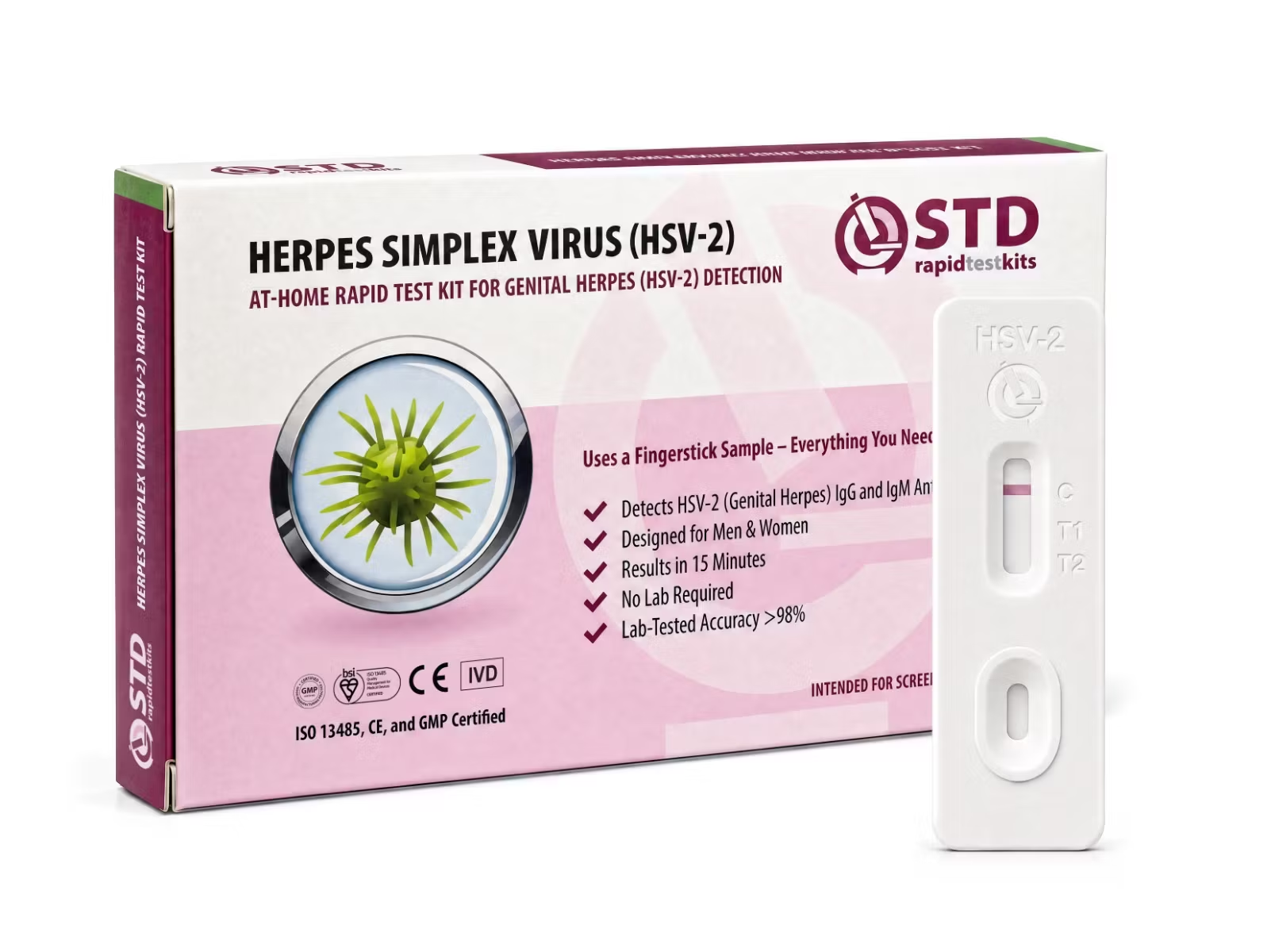
If you don't already know your own HSV-2 status, getting clear on that baseline makes the rest of the planning simpler. An at-home antibody test can confirm status in about fifteen minutes and avoids an awkward clinic visit. This article is published by stdrapidtestkits.com, which sells at-home STI testing kits; recommendations here are based on fit for the reader's concern, not commercial benefit.
| Step | How it helps |
|---|---|
| Daily suppressive antiviral medication (valacyclovir or acyclovir) for the HSV-2 positive partner | Randomized clinical trials have shown daily valacyclovir reduces HSV-2 transmission to a susceptible partner by roughly half. It also reduces asymptomatic viral shedding, which accounts for most transmissions. |
| Condoms or dental dams during sex | Consistent barrier use lowers HSV-2 acquisition risk, particularly important during the early months of a partnership and during higher-risk windows. |
| No sex during prodrome or active outbreak | Transmission risk is highest during outbreaks and the prodromal phase (tingling, itching, soreness before a visible sore). Pausing sex during these windows is the single highest-leverage step. |
| Open communication about symptoms and triggers | Stress, illness, hormonal shifts, and friction can trigger outbreaks. Naming triggers helps partners plan around them and avoids surprises. |
What If You're the One Hearing the News?
Now flip the role. Your partner just told you they have herpes. You might feel shocked, blindsided, or scared. Those feelings are reasonable. How you respond in the first thirty seconds matters.
The most useful thing you can do is breathe and acknowledge. Something as simple as 'Thank you for telling me, that took courage' lowers the temperature instantly. You don't need to have answers in the moment. You are allowed to say 'I appreciate you sharing this, can we talk more about what it means after I've had a chance to read about it?'
What to avoid: catastrophizing out loud, asking invasive questions about prior partners, or treating the disclosure as a betrayal. Most people get herpes from someone who didn't know they had it. Your partner is doing the responsible thing by telling you before sex becomes part of the picture.
Before the next conversation, do some reading on your own. The NHS overview and the CDC herpes information page are good starting points. Both will help you separate stigma from medicine. Coming back with informed questions instead of fear-driven ones makes the second conversation easier on both of you.
If you are not sure about your own status, especially if you have been with previous partners whose status you don't know, this is a reasonable moment to test. A clear baseline simplifies the rest of the planning.

Keeping Intimacy Alive (Yes, Sex Still Happens)
The most common myth about a herpes diagnosis is that it ends your sex life. For nearly everyone, it doesn't. It shifts the planning. Sero-discordant couples have satisfying long-term sex lives, and many couples report better communication around sex after disclosure than they had before.
Practical patterns from couples who manage this well:
- Track outbreaks together. The partner who experiences them usually notices tingling, soreness, or fatigue a day or two before a visible sore appears. Communicating that prodrome window lets you pause sex without it becoming a guessing game.
- Use the outbreak-free windows fully. Most people with HSV-2 have a small number of recurrences per year, particularly after the first year. There is much more time without outbreaks than with them.
- Expand the definition of intimacy during outbreak windows. Mutual touch, oral sex with barriers, and connection without genital contact all count. The point is closeness, in whatever form fits the moment.
- Use lubricant generously. Friction can trigger outbreaks in the partner with HSV-2, and small abrasions raise transmission risk for the susceptible partner.
- Talk about anxiety, not just logistics. Sex with herpes goes better when both people can say 'I'm a little nervous tonight' without it derailing the evening. Acknowledging fear is usually faster than pretending it isn't there.
One quiet upside many couples mention: a herpes diagnosis pushes the relationship into explicit consent and explicit care earlier than most relationships ever get there.
Most people who have genital herpes have no symptoms, or have very mild symptoms. Many people with herpes have mild symptoms or symptoms they don't recognize.
The Bottom Line
A herpes diagnosis changes a few conversations. It does not change your worth, your capacity for connection, or your ability to build a long-term partnership. The honest, well-timed disclosure is rarely the bomb people fear. Most often it is a moment of trust that the relationship absorbs and keeps moving.
If you are carrying the diagnosis right now, the fear you feel is real, and it is also bigger than the situation. Read up. Get clear on the basics: what herpes is, how transmission works, and how to lower risk. Then find the words that feel honest to you, pick a moment when there is time and space for the conversation, and have it. The first time is the hardest. After that, it becomes a script you have already rehearsed.
If you don't yet know your own herpes status and want clarity before a partner conversation, an at-home antibody test can give you that baseline in about fifteen minutes.
Frequently Asked Questions
- Do I have to tell every sexual partner I have herpes?
- Yes, everyone who is going to have sex with you needs the information to make an informed decision. In some US states and other jurisdictions, knowing transmission of an STI is also legally actionable.
- What if I was diagnosed years ago? Do I need to contact every former partner?
- Recent partners who may not know they were exposed should ideally be told so they can test. Anonymous notification services such as TellYourPartner.org allow you to send a heads-up by text or email without revealing your name. Partners from many years ago are usually outside the practical window.
- Can I date someone who doesn't have herpes?
- Yes, sero-discordant couples form long-term relationships every day. Daily antivirals, condoms, and avoiding sex during outbreaks lower transmission risk substantially. Published clinical-trial data on daily valacyclovir alone shows roughly a 50% reduction in transmission to a susceptible partner; layering condoms and outbreak awareness on top is generally understood to push the combined annual transmission rate into the low single digits, though no single trial measures all three precautions together.
- When is it safe to have sex again after an outbreak?
- Wait until the area is fully healed: no tingling, no rawness, no scabs. Daily suppressive antivirals between outbreaks add an extra layer of protection by reducing asymptomatic viral shedding.
- Can I still have children if I have herpes?
- Yes, pregnancy with herpes is common and well managed. Most obstetricians prescribe antivirals in the final weeks of pregnancy to suppress outbreaks at the time of delivery, and vaginal birth is generally safe when no active lesion is present at delivery. Talk to your prenatal provider about a plan.
- Is oral herpes (HSV-1) an STI?
- HSV-1 is most often spread non-sexually (kissing a relative as a child, sharing utensils), but it can also be transmitted through oral sex and cause genital outbreaks. Whether it counts as an STI depends on the route of transmission. Either way, mentioning it to a partner before oral sex is the right call if you have active or recent symptoms.
- How do I explain herpes to someone who doesn't know much about it?
- Try a short version: 'Herpes is a very common skin virus that can cause occasional sores. It's manageable with medication, most people barely notice it, and we can lower transmission risk with daily meds and condoms.' Then point them at the CDC or Planned Parenthood overview if they want to read more.
- What if someone walks away after I tell them?
- Then they weren't going to be your long-term match. Rejection is painful, but staying silent to avoid it costs more. The people who respond well after honest disclosure are the people you actually want to be with. The early filter saves time.
How we sourced this article: This guide combines current guidance from the CDC, WHO, NHS, Mayo Clinic, the American Sexual Health Association, and Planned Parenthood with the published clinical literature on HSV-2 transmission and disclosure outcomes. Where specific claims about transmission reduction with daily valacyclovir, condom effectiveness, and global prevalence appear, the figures come from the surveillance reports and clinical trials referenced in the source list below.
- U.S. Centers for Disease Control and Prevention. About Genital Herpes. Authoritative reference for HSV-1 and HSV-2 prevalence, symptoms, transmission, and clinical management cited throughout this article.
- World Health Organization. Herpes simplex virus fact sheet. Source for the global prevalence estimates of HSV-1 and HSV-2 used in the opening.
- NHS. Genital herpes overview, symptoms, treatment, and partner-protection guidance. Used for plain-English clinical framing of outbreaks and disclosure logistics.
- Planned Parenthood. Herpes overview. Reader-friendly reference recommended for partners who want to read about herpes on their own.
- American Sexual Health Association. Herpes and relationships. Practical resource hub with disclosure scripts, reader letters, and support communities for people navigating disclosure.
- Mayo Clinic. Genital herpes, symptoms and causes. Used for the role of daily valacyclovir in suppressing outbreaks and lowering transmission, and for general clinical guidance.
