

Published: November 2025 | Last updated: April 2026 | Editorial review and quality control: Martina N.
Gonorrhea in the eye sounds like a punchline until it happens. The infection is real, the consequences can be serious, and the symptoms move fast enough that the gap between assuming it is ordinary pink eye and reaching same-day care matters more than most people realize. This guide walks through what separates the two, what testing and treatment involve, and how to act on what you find without panic.
The short version: if your red eye comes with thick yellow or green pus, dramatic swelling, fast worsening, and a recent sexual exposure that fits the timeline, it deserves same-day evaluation by a clinician with a real swab, not another bottle of drops. The longer version below explains why.
Can you get gonorrhea in your eye, and how is it treated?
Yes. Gonorrhea can infect the eye when fluid carrying the bacteria reaches the conjunctiva, and the resulting infection (gonococcal conjunctivitis) progresses far faster than typical pink eye. The standard adult treatment per CDC guidance is a single intramuscular injection of ceftriaxone (500 mg for adults under 150 kg; 1 gram for those at or above 150 kg), not over-the-counter eye drops. Untreated, it can damage the cornea within days, so suspected cases need same-day medical evaluation.
Key takeaways
- Gonococcal conjunctivitis is a same-day-care infection that requires a systemic antibiotic injection, not eye drops alone.
- Thick yellow or green discharge, severe eyelid swelling, and rapid worsening within 24 to 48 hours are the signs that separate it from ordinary pink eye.
This is not the pink eye you grew up with
Pink eye is the everyday name for conjunctivitis, an inflammation of the thin membrane that covers the white of the eye. Most cases are viral or allergic. They produce watery discharge, mild redness, and resolve on their own within a week. Bacterial conjunctivitis caused by everyday germs like Staphylococcus or Haemophilus is also common, slightly stickier, and usually clears with basic antibiotic drops within a few days.
Gonococcal conjunctivitis is a different organism doing different damage. The bacterium is Neisseria gonorrhoeae, the same one that causes genital, rectal, and pharyngeal gonorrhea. The CDC's gonorrhea overview describes how the bacterium infects mucous membranes across multiple anatomic sites; once it reaches the conjunctiva, it does not just sit on the surface. It penetrates the tissue, replicates rapidly, and triggers an immune response strong enough to flood the eye with thick pus and swell the eyelid until it can be hard to open.
That speed and severity is what makes it a vision-threatening problem rather than an annoying inconvenience. Hyperacute bacterial conjunctivitis, the category gonococcal infection falls into, is widely treated as a same-day-care presentation in clinical practice because untreated cases can progress to corneal ulceration within days, and in severe presentations to corneal perforation and permanent vision loss.
Most people have never heard of this, and that is part of why it slips past readers and clinicians alike. A red eye with crusty lashes is not an obvious sexual-health story, so when symptoms appear after a recent sexual encounter, the connection rarely registers. Eye gonorrhea exists in adults, not just newborns, and cases occur alongside the broader rise in gonorrhea overall.
Gonococcal conjunctivitis can progress to corneal involvement within 24 to 48 hours. Hyperacute bacterial conjunctivitis is the category clinicians treat as a same-day-care presentation rather than a watch-and-wait one. If the symptom pattern below matches, do not delay evaluation overnight.
How to tell ordinary pink eye from gonococcal conjunctivitis
There is no way to confirm gonorrhea in the eye from the mirror. A laboratory test on a swab from the conjunctiva is the only way to be certain. But the pattern of symptoms gives clinicians, and you, strong clues. Three things separate gonococcal conjunctivitis from the everyday version: the speed of onset, the volume and color of discharge, and how the eye responds to standard care.
Ordinary pink eye builds slowly over one to three days. The discharge is watery (viral) or mildly sticky (mild bacterial), and the eyelid may have light crusting in the morning. Swelling is minimal. Pain is usually a low-grade itch or burn. Vision stays clear. Most cases improve within a week with basic hygiene, and bacterial cases are typically treated with a short course of antibiotic drops, as described in NHS guidance on conjunctivitis.
Gonococcal conjunctivitis can move fast enough that you notice the change between bedtime and breakfast. Discharge is profuse, thick, and yellow or green, with a tendency to keep returning within minutes of being wiped away. The eyelid swells dramatically, sometimes to the point that opening the eye is difficult. The pain is deeper, often described as pressure behind the eye rather than surface irritation. And basic eye drops do little or nothing to slow it down.
The discharge difference is biological, not cosmetic. Watery fluid is what an eye produces when the immune system is reacting to a virus or an irritant. Thick pus is what it produces when white blood cells are fighting an aggressive bacterial invader. The thicker and more persistent the pus, the more aggressive the infection driving it. The table below makes the contrast easier to see in one place.
| Symptom or sign | Ordinary pink eye | Gonococcal conjunctivitis |
|---|---|---|
| Discharge | Watery (viral) or mildly sticky (mild bacterial) | Thick yellow or green pus, often profuse and recurring |
| Onset speed | Gradual over 1 to 3 days | Rapid, often noticeably worse within 24 to 48 hours |
| Pain level | Mild irritation or itch | Moderate to severe ache, with pressure behind the eye |
| Eyelid swelling | Mild puffiness | Marked swelling, eyelid may be hard to open |
| Vision impact | Usually unchanged | Blurring possible if cornea is involved |
| Response to OTC drops | Often improves within a few days | Little to no improvement |
How the bacteria actually reaches your eye
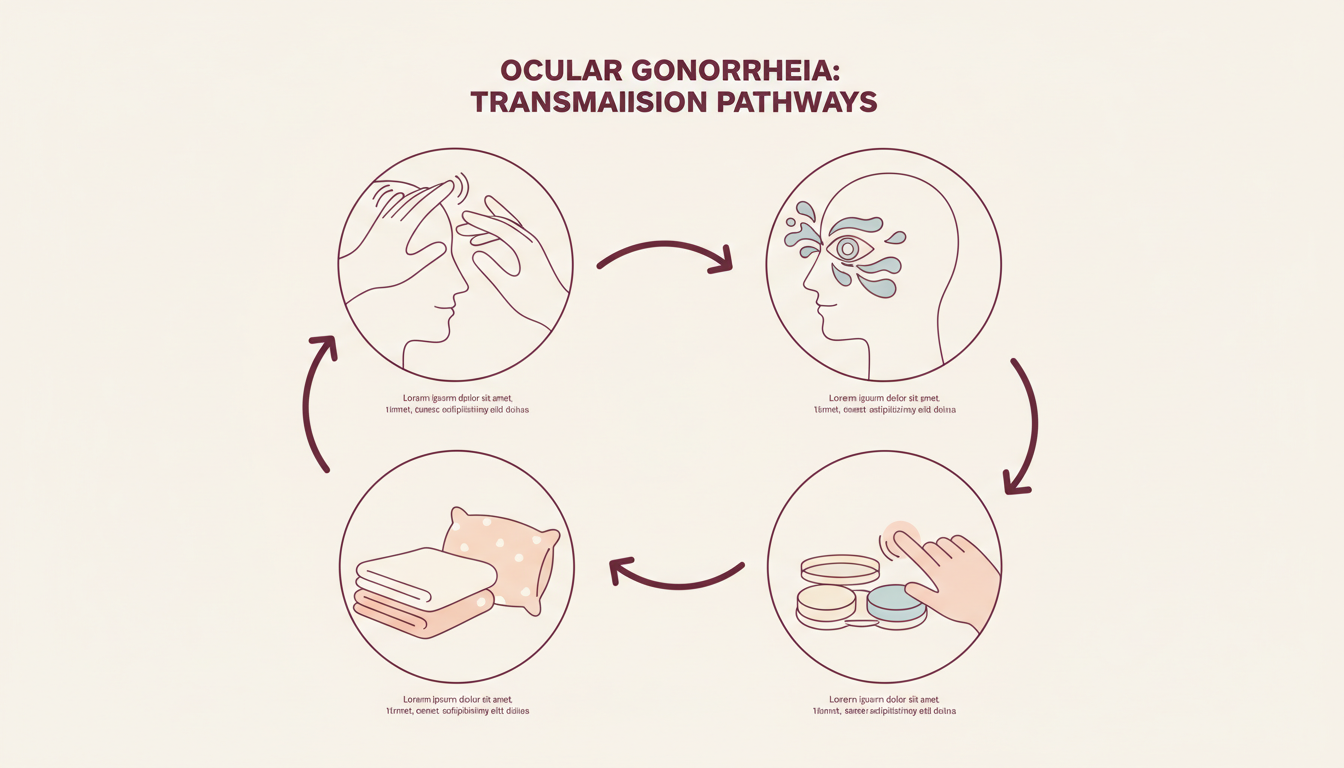
Gonorrhea infects mucous membranes, and the eye has them too. Transmission to the eye almost always involves direct contact with infected fluid, but the route is rarely as direct as people imagine. Most adult cases trace back to one of these pathways:
- Hand-to-eye contact after touching infected genital fluid, often without realizing the source person was infectious.
- Fluid splash during oral sex, particularly when ejaculation occurs near the face.
- Sharing a towel, washcloth, pillowcase, or makeup with someone whose hands or face have recently contacted infected fluid.
- Contact lens contamination, when an infected hand handles lenses or lens cases.
The CDC notes that gonorrhea often presents without symptoms in the throat and rectum, which means a person can pass it on without knowing they are infectious. That is the part that surprises most readers. A partner who feels fine, has had no genital symptoms, and tested negative on a urine sample alone can still carry the bacteria at another anatomic site, and a momentary touch is enough to bring it to your eye.
Newborn ocular gonorrhea is a separate scenario and follows a different prevention pathway. The CDC's pink eye in newborns guidance recommends antibiotic eye ointment at birth for all newborns to prevent ophthalmia neonatorum from a mother's untreated genital infection. This article is about adult cases, but the newborn protocol is worth knowing if anyone in your circle is pregnant.
The biological window from exposure to noticeable eye symptoms is typically a few days. The bacteria need time to multiply and trigger a visible immune response. So an eye that flares two to four days after a sexual encounter, especially one without a clear non-sexual explanation, is worth taking seriously rather than dismissing as coincidence.
Why eye drops alone will not cure it
It is reasonable to reach for over-the-counter or leftover prescription eye drops when an eye gets red and goopy. For ordinary bacterial conjunctivitis caused by surface organisms, that often works. For gonococcal conjunctivitis, it does not, and the reasons are worth understanding.
Depth is part of the problem. Neisseria gonorrhoeae burrows below the surface of the conjunctiva and into the underlying tissue, including the small blood vessels and lymphatics around the eye. Topical antibiotic drops are designed to act on the surface. They do not reach the deeper tissue at concentrations high enough to clear an invasive infection.
Resistance is the other piece. Gonorrhea has progressively developed resistance to most older antibiotic classes. The CDC STI Treatment Guidelines for gonococcal infections in adults now recommend a single 500 mg intramuscular injection of ceftriaxone, with a 1 gram dose specifically for adults weighing 150 kg or more, because lower-dose oral options no longer reliably clear the infection. The antibiotics in most commercial eye-drop formulations (such as polymyxin or fluoroquinolone combinations) are not the right tools for this organism in this location.
One more risk worth flagging is partial relief. Some drops can reduce surface inflammation enough to feel like progress for a day or two while the underlying infection continues to advance toward the cornea. If you are 24 hours into using drops and not seeing real improvement, especially if pain or swelling is increasing, that is a signal to escalate care rather than try a different bottle. Home remedies like tea-bag compresses or milk rinses can do the same thing in reverse: a temporary feel-better moment that delays the real treatment by days.
Topical steroid drops can suppress the local immune response and accelerate corneal damage in untreated bacterial infections. If a recent prescription contains a steroid (often a combination drop with a name ending in -dex or -pred), do not reuse it for a new eye complaint without a clinician's input.
What testing for eye gonorrhea involves
Diagnosing gonorrhea in the eye starts with the clinical picture (the pattern of symptoms plus exposure history) and then confirms with a swab. The gold standard for laboratory confirmation is nucleic acid amplification testing (NAAT), the same molecular method used for genital and oral gonorrhea. A clinician swabs the inner surface of the lower eyelid or the discharge itself, and the lab amplifies any bacterial genetic material to a detectable level.
Some clinics also run a Gram stain on the discharge as a same-visit indicator. Gram-negative diplococci inside white blood cells are highly suggestive of gonorrhea and are often enough for a clinician to start treatment before the NAAT result returns. Cultures take longer (typically two to three days) but can identify antibiotic-resistant strains, which matters in regions where resistance is climbing per the WHO gonorrhoea fact sheet.
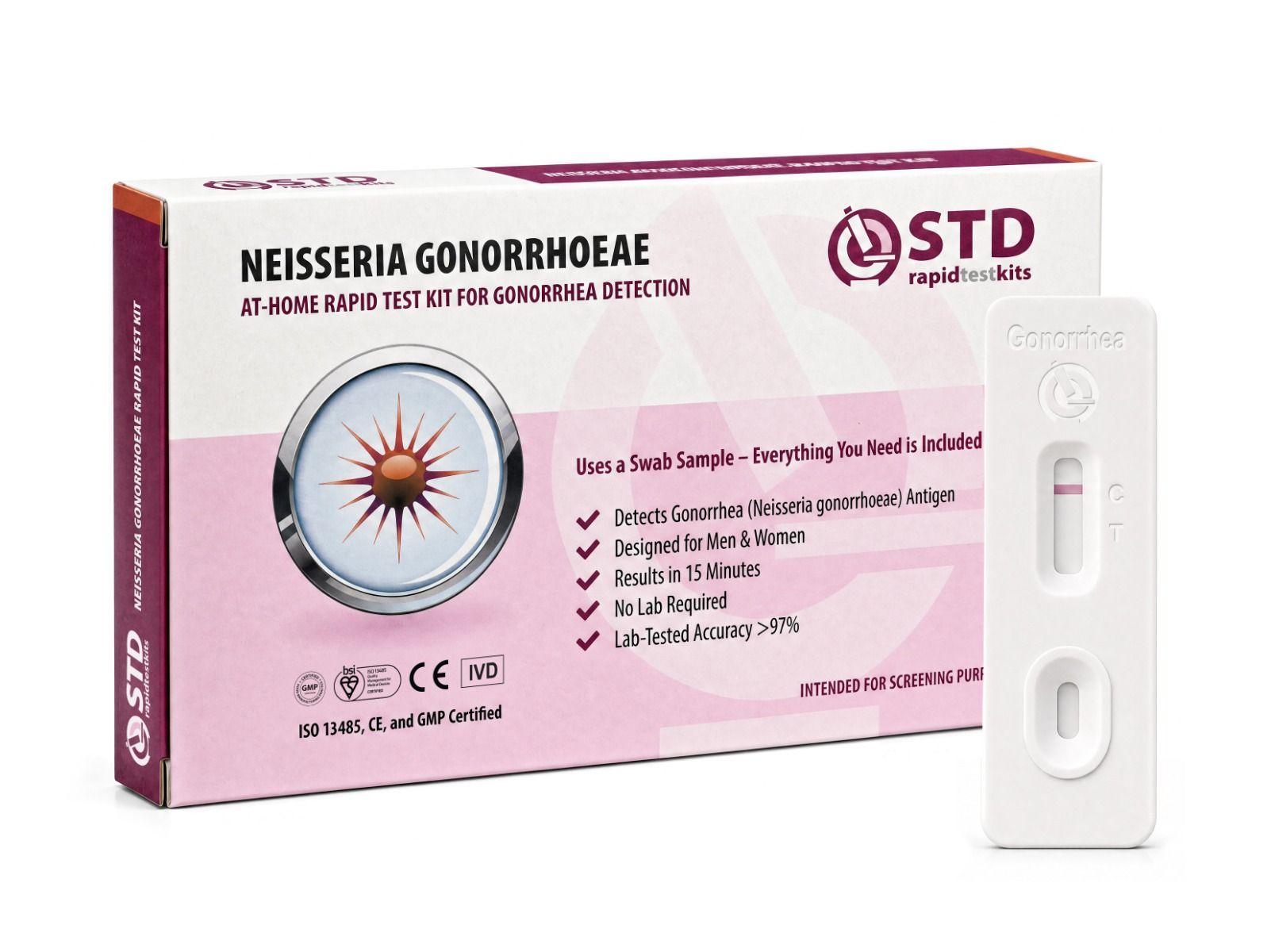
A practical limitation: at-home rapid STI test kits are validated for genital, and in some cases oral or rectal, sample types. They are not validated for ocular swabs, and using one on an eye sample is not reliable for diagnosis. If your eye is the primary symptom, an in-person clinic visit is the right entry point. The home kit is still useful as a parallel test for the suspected source site (genital or oral) of the exposure that may have led to the eye involvement; a positive there strengthens the clinical picture and speeds the eye-care decision.
The table below summarizes the main testing options and where each fits.
| Test | Where it fits | What it tells you |
|---|---|---|
| NAAT (eye swab) | Clinic or hospital, the gold standard for ocular samples | Detects gonorrhea genetic material with high sensitivity and specificity |
| Gram stain | Same-visit, performed in many urgent-care or eye clinics | Quick visual confirmation of gram-negative diplococci, less specific than NAAT |
| Culture | Used when antibiotic resistance is suspected | Identifies which antibiotics will work, results in two to three days |
| At-home rapid kit | Genital or oral self-test only, not for eye samples | Confirms exposure source if positive at the genital or oral site |
Treatment, recovery, and what to expect
The standard adult treatment per the CDC's STI Treatment Guidelines is a single intramuscular injection of ceftriaxone (500 mg for adults under 150 kg, 1 gram for those at or above 150 kg). For confirmed or strongly suspected gonococcal conjunctivitis, providers usually pair the systemic antibiotic with a saline eye lavage to flush the discharge, and sometimes with an additional topical antibiotic to reduce surface bacterial load while the systemic drug works.
If chlamydia coinfection is plausible, oral doxycycline 100 mg twice daily for seven days is added, since chlamydia is a common companion infection. The CDC withdrew its previous routine dual-therapy recommendation for gonorrhea itself in 2020 (specifically the azithromycin combination), but coinfection coverage with doxycycline remains standard practice when chlamydia has not been ruled out.
Severe cases (significant corneal involvement, suspected systemic spread, or immunocompromised patients) may require admission and intravenous antibiotics. This is the minority of cases, but it is why this is a same-day-care presentation rather than a wait-and-see one.
What recovery looks like in a straightforward case: the discharge meaningfully decreases within 24 to 48 hours of the injection, the swelling settles over three to five days, and the eye returns to baseline within one to two weeks. Vision recovers fully in most cases when treatment is started before the cornea is involved. Cases caught after corneal ulceration begins can still recover, but vision outcomes depend on the depth and area affected.
After the injection, avoid sharing towels, pillowcases, makeup, or contact lens supplies until the eye has been clear for at least 48 hours, since the discharge is loaded with bacteria; hand-wash carefully and avoid touching the unaffected eye, which is the most common route to a second infection on the other side.
A note on the product below: stdrapidtestkits.com sells the at-home tests referenced in this article. We recommend products based on fit-for-purpose for the reader's concern, not commercial benefit, and the eye itself still needs in-person clinical care no matter what a home kit shows.
Preventing eye gonorrhea in the first place
Most cases are preventable with a few habits that are also useful for general STI risk reduction. None of them are dramatic, and most are already inside good general hygiene.
Hand hygiene during and after sex, especially before touching the face or contact lenses, is the single most direct intervention. Gonorrhea on the hands does not cause symptoms, so the contact route is invisible until something downstream happens. Wash with soap for at least 20 seconds.
Barrier methods (condoms during oral sex and dental dams) reduce both genital and oral transmission, which in turn reduces the chance of a hand later carrying bacteria to the eye. Neither eliminates risk entirely. Both meaningfully cut the odds.
Routine screening matters more than most people think. The CDC recommends at least annual gonorrhea screening for sexually active women under 25 and for men who have sex with men, with three-site testing (urethral, pharyngeal, and rectal) where exposure has occurred. Asymptomatic carriers are common; the throat in particular often hosts an infection without symptoms. Treating an infection you did not know you had also prevents the eye involvement that might have followed.
Avoid sharing personal items that contact the eye area: makeup, contact lens cases, washcloths, and towels. Replace mascara every three to four months, and never share it. Replace contact lens cases every three months, and never top off old lens solution.
Quick prevention checklist
- Wash hands with soap before touching your face or contact lenses, especially after sexual activity.
- Use condoms or dental dams during oral sex to reduce both transmission and downstream eye risk.
- Get screened at the genital site at least annually if sexually active, and at the throat or rectum if those exposures have occurred.
- Do not share towels, pillowcases, makeup, or contact lens supplies.
When eye symptoms need same-day care
Most red eyes are not gonorrhea. But certain features push the situation from monitor-at-home into go-now-rather-than-tomorrow. The combination matters more than any single sign.
Reasons to seek same-day evaluation:
- Thick yellow or green pus that returns within minutes of being wiped away.
- Eyelid swelling severe enough that opening the eye is difficult.
- Eye pain that is deep or throbbing rather than scratchy, especially with pressure behind the eye.
- Any change in vision (blur, double vision, light sensitivity that was not there before).
- Symptoms that started after a recent sexual encounter, particularly within the last week.
- Symptoms that worsened over 24 hours despite over-the-counter eye drops.
Where to go depends on severity. A primary-care provider's same-day slot or a walk-in urgent-care clinic is the right entry point for most cases. If the eye is severely swollen shut, vision is changing, or the pain is intense, an emergency department or eye clinic is the safer choice because they can do a slit-lamp exam and start IV antibiotics if needed. Telehealth can be a useful first triage step, but a swab is needed for confirmation and most telehealth platforms cannot perform one.
Mild but suspicious symptoms: a primary-care same-day slot or a walk-in urgent-care clinic with on-site swabbing. Severe swelling, pain, or vision change: an emergency department or a dedicated eye-care clinic that can perform a slit-lamp exam and start IV antibiotics if needed. Telehealth: useful only as a triage step, since a swab is the confirmatory test and telehealth platforms cannot collect one.
Talking to partners and getting them tested
This is the part of the conversation people put off. The framing helps. A heads-up to a partner is not an accusation; it is information they need to make a health decision. Most cases involve someone who did not know they were infectious in the first place.
A simple version: "I had an eye infection that turned out to be gonorrhea. The clinic recommended you get checked at all the relevant sites, since one of us may have had it without symptoms. Here is the link to a clinic, or here is an at-home kit if that is easier." Pointing to a neutral resource takes the heat out of the moment.
Worth mentioning if the conversation needs more detail: gonorrhea clears with one injection in most cases, throat and rectal sites often carry it without symptoms (so a urine-only test misses them), and the CDC recommends partner treatment within seven days to prevent a back-and-forth reinfection cycle.
If you are the one receiving the call from a partner, get tested at the sites that match your sexual practices, not just one. A clean genital test does not rule out a throat infection if oral sex was part of the picture. The home option below covers both gonorrhea and chlamydia from a genital swab and pairs well with a separate clinic throat or rectal swab when those exposures apply.

If left untreated, gonorrhoea can lead to infertility in both men and women and other sexual and reproductive health complications. It also increases the risk of HIV infection.
Frequently asked questions
- Can over-the-counter eye drops alone treat gonorrhea in the eye?
- No. Topical drops do not reach the deeper tissue at high enough concentrations to clear an invasive infection like gonorrhea. The standard adult treatment per the CDC is a single intramuscular injection of ceftriaxone, sometimes paired with a supportive topical antibiotic and a saline eye lavage. Drops on their own can give a false sense of progress while the infection advances toward the cornea.
- How does gonorrhea even reach the eye?
- Through direct contact with infected fluid. The most common routes are hand-to-eye contact after touching infected genital fluid, fluid splash during oral sex, sharing towels or pillowcases with someone recently exposed, or handling contact lenses with contaminated hands. The eye has mucous membranes just like the genitals, throat, and rectum, and gonorrhea infects mucous membranes wherever it lands.
- How fast does gonococcal conjunctivitis get worse?
- Often within 24 to 48 hours. That speed is one of the strongest clinical clues. Ordinary pink eye usually builds gradually over a couple of days and stays roughly the same intensity, while gonococcal conjunctivitis can produce noticeably more swelling, more discharge, and more pain between bedtime and the next morning.
- Is the eye discharge contagious to other people?
- Yes. The discharge is loaded with bacteria. Touching the eye and then a doorknob, towel, or another person's belongings can transmit the bacteria. Hand-wash carefully, do not share towels or pillowcases, and avoid touching the unaffected eye. Stop wearing contact lenses until the eye has been clear for at least 48 hours after treatment.
- Can untreated eye gonorrhea cause blindness?
- It can, in untreated or severely delayed cases. Without prompt systemic antibiotics, the infection can produce corneal ulceration, scarring, and in rare cases corneal perforation, all of which can affect vision permanently. With prompt treatment, full visual recovery is the typical outcome. The difference between full recovery and lasting damage is mostly timing.
- Can I diagnose this with an at-home rapid STI kit?
- An at-home kit cannot confirm gonorrhea in the eye; ocular samples need a clinic swab. The kit is useful in parallel: a positive result on a genital or oral self-swab strengthens the case for ocular involvement and can speed the clinic's decision on whether to start treatment before the eye-swab result returns.
- How long does recovery take after the injection?
- In a straightforward case, discharge eases noticeably within 24 to 48 hours, swelling settles over three to five days, and the eye returns to baseline in one to two weeks. Vision typically recovers fully when treatment starts before the cornea is involved. A follow-up visit is usually scheduled to confirm clearance and to recheck for any subtle corneal change.
- Should partners get tested even if they have no symptoms?
- Yes. Many gonorrhea infections, particularly in the throat and rectum, carry no symptoms at all. The CDC recommends partner evaluation and treatment within seven days of a confirmed gonorrhea diagnosis to prevent a back-and-forth reinfection cycle. Three-site testing (genital, oral, and rectal where exposures occurred) is the most thorough approach.
- U.S. Centers for Disease Control and Prevention. About gonorrhea, including transmission, symptoms across anatomic sites, and complications.
- U.S. Centers for Disease Control and Prevention. STI Treatment Guidelines, gonococcal infections among adolescents and adults, including ceftriaxone dosing and chlamydia coinfection management.
- U.S. Centers for Disease Control and Prevention. Pink eye in newborns, including prophylactic eye ointment guidance to prevent ophthalmia neonatorum.
- World Health Organization. Gonorrhoea (Neisseria gonorrhoeae infection) fact sheet, including untreated-infection complications and antibiotic resistance trends.
- U.K. National Health Service. Conjunctivitis overview, including typical viral, bacterial, and allergic presentations and home-care guidance.
