Published: November 2025 | Last updated: May 2026 | Editorial review and quality control: Martina N.
Will antibiotics affect your STD test results?
Sometimes, yes. Antibiotics can affect bacterial STD tests for chlamydia, gonorrhea, syphilis, and trichomoniasis by lowering bacterial levels enough to cause a false negative, or by leaving residual DNA fragments that read positive after the infection is already cured. They do not affect viral STD tests for HIV, herpes, hepatitis B, or hepatitis C. For bacterial STDs, the rule of thumb is to wait 3 to 4 weeks after finishing the antibiotic course before retesting (per <a href="https://www.cdc.gov/std/treatment-guidelines/chlamydia.htm">CDC STI treatment guidelines</a>).
You started antibiotics for one reason. Now you are staring at a pill bottle and wondering whether the medicine just changed what your next STD test can find. Or you finished a course last week, the result came back negative, and it feels too convenient to fully trust.
The honest answer involves biology, timing, and the difference between bacterial and viral infections. The good news is reassuring: for most people, timing matters more than the antibiotic, and a properly timed retest clears up almost every confusing result.
Key Takeaways
- Antibiotics can change the result of bacterial STD tests (chlamydia, gonorrhea, syphilis, trichomoniasis), but they do not affect viral tests for HIV, herpes, hepatitis B, or hepatitis C.
- Wait at least 3 to 4 weeks after finishing antibiotics before retesting a bacterial STD, so bacterial levels stabilize and residual DNA clears.
How antibiotics actually affect STD testing
Antibiotics work by killing or slowing down bacteria. Modern STD tests for bacterial infections work by detecting bacteria, or more specifically, the genetic material they leave behind. When antibiotics enter the picture, the test target itself is changing in real time.
For chlamydia and gonorrhea, the standard laboratory test is a nucleic acid amplification test, or NAAT. NAAT looks for fragments of bacterial DNA or RNA in a swab or urine sample. It is extremely sensitive, which is good for catching low-level infections, and that same sensitivity is what makes timing tricky around antibiotics.
Two opposite problems can happen. The first is a false negative: bacterial levels are temporarily suppressed by the antibiotic, the sample contains too little genetic material to cross the detection threshold, and the test reads negative even though infection is still present. The second is a residual positive: bacteria have already been killed, but fragments of their DNA are still detectable in tissue for days or weeks afterward, and a NAAT picks up that genetic debris and reports it as positive even though the infection has cleared.
Both problems trace back to the same thing. NAAT measures genetic material, not whether bacteria are alive and multiplying. Antibiotics change when those measurements line up with the truth of your body. The right move is to wait until biology and technology agree on the same answer, which usually takes about 3 to 4 weeks after a course of antibiotics ends (CDC chlamydial infections treatment guidelines).
Antibiotics do not erase infections overnight, and they do not make your body invisible to a properly timed test. Symptom relief does not equal cure either. Discharge can stop and burning can fade within a day or two because antibiotics calm inflammation quickly, while the underlying bacteria can still be present at lower levels.
Antibiotics can distort a bacterial STD test in two opposite ways. False negative: suppressed bacterial levels fall below the test's detection threshold. Residual positive: dead bacterial DNA still triggers a NAAT after the infection is already cured. Both come from NAAT measuring genetic material rather than living bacteria.
Which STD tests antibiotics affect, and which they don't
Not every STD test responds the same way. The cleanest way to sort it: antibiotics target bacteria and parasites, not viruses. If your test is looking for a virus, antibiotics do nothing to the result. If it is looking for bacteria or a parasite, antibiotics can shift the picture. As NIH MedlinePlus puts it, antibiotics can treat STIs caused by bacteria or parasites, while infections caused by viruses are managed differently (NIH MedlinePlus on STIs).
Viral STDs detected through antibody or antigen tests, like HIV, herpes, hepatitis B, and hepatitis C, depend on your immune system or on viral surface proteins, not on bacterial load. Antibiotics do not change antibody production or antigen levels. The only timing variable that matters for those tests is the natural window period after exposure. The HIV.gov testing overview covers the standard windows for fourth-generation antigen-antibody and antibody-only HIV tests. HSV antibody testing has its own seroconversion window: type-specific HSV-2 antibodies are reliable approximately 12 weeks after presumed exposure, per CDC genital herpes treatment guidance.
Bacterial STDs detected through NAAT or PCR are the ones to watch. Trichomoniasis, caused by a protozoan parasite, responds to antiparasitic medications like metronidazole or tinidazole rather than the usual antibiotics, so most everyday antibiotic exposures will not meaningfully change a trich result. Syphilis sits in a partial middle ground: blood antibody tests can stay reactive for years even after a successful cure, and very early antibiotic exposure can delay antibody development. The table below summarizes the practical impact for the most common infections.
| STD | Caused by | Test type | Affected by antibiotics? | Why |
|---|---|---|---|---|
| Chlamydia | Bacteria | NAAT swab/urine | Yes | Antibiotics suppress bacterial load; residual DNA persists for weeks after cure |
| Gonorrhea | Bacteria | NAAT swab/urine | Yes | Same suppression and residual-DNA dynamics as chlamydia |
| Syphilis | Bacteria | Blood antibody (RPR/treponemal) | Sometimes | Early antibiotic use can delay antibody response; antibodies persist after cure |
| Trichomoniasis | Parasite | NAAT or rapid swab | Sometimes | Treated with antiprotozoals (metronidazole); most other antibiotics have limited effect |
| HIV | Virus | Blood antigen/antibody | No | Antibiotics do not affect antibody or antigen production |
| Herpes (HSV-1, HSV-2) | Virus | Blood antibody | No | Antibody response is unaffected by antibacterial treatment |
| Hepatitis B / C | Virus | Blood antigen/antibody | No | Viral markers are independent of antibiotic use |
How long after antibiotics should you test?
The most common practical question after starting or finishing antibiotics is: when can I trust a test result again? The short version is that timing depends on three things, the type of infection, why you took the antibiotics, and whether you are confirming a cure or screening after a possible new exposure.
For bacterial STDs that you suspect or were treated for, most clinical guidance points to waiting 3 to 4 weeks after the antibiotic course ends before retesting (CDC chlamydial infections treatment guidelines). That window gives bacterial levels time to rebound if treatment did not fully clear the infection, and it gives nonviable DNA fragments time to clear so a positive test actually reflects active disease.
For antibiotics taken for something unrelated, the calendar starts from your last possible STD exposure, not from the day the prescription ended. Bacterial levels of an STD that were suppressed by an unrelated antibiotic course can take a couple of weeks to climb back into detectable range.
For viral STD tests, antibiotics are simply not part of the equation. The relevant clock is the natural window period after exposure: roughly 18 to 45 days for fourth-generation HIV antigen-antibody testing on a lab venous draw, depending on the assay, per the HIV.gov testing overview; approximately 12 weeks for type-specific HSV antibody seroconversion per CDC guidance; and 6 weeks to 3 months for hepatitis B surface antigen screening depending on the test platform. Those numbers are independent of any antibiotic you happen to be on.
The table below puts the most common scenarios on one page so you can find yours and read across.
| Your situation | When to test for the most reliable result | Why this timing |
|---|---|---|
| You tested for a bacterial STD while still on antibiotics | Retest 3 to 4 weeks after finishing the course | Bacterial levels and residual DNA both need time to stabilize |
| You took antibiotics unrelated to STD treatment (UTI, sinus, acne) | Wait 3 to 4 weeks from your last possible exposure before testing | Suppressed bacterial load can rebound during this window |
| You were treated for a confirmed bacterial STD | Test of cure at 3 to 4 weeks if recommended; rescreen at 3 months for reinfection | Most early post-treatment positives are residual DNA, not failure |
| You are testing for HIV, herpes, or hepatitis while on antibiotics | Follow the standard window period from exposure, no extra delay needed | Antibiotics do not affect viral antibody or antigen tests |
| You have severe symptoms (pelvic pain, fever, testicular swelling, neurological signs) | See a clinician immediately, do not wait for a perfect testing window | Symptoms can indicate complications that need urgent care |
Why you might still test positive after treatment ends
This is the scenario that catches people off guard. You took every dose. You followed the advice, abstained from sex, waited a few days. You retest, and the result comes back positive. The instinct is to assume treatment failed. In most cases, that is not what is happening.
NAAT detects bacterial genetic material. It does not distinguish living, multiplying bacteria from fragments left behind after the bacteria are dead. After successful treatment for chlamydia, nonviable DNA can remain detectable in genital tissue for up to several weeks. Gonorrhea behaves similarly. Live bacteria drop fast on antibiotics, but residual DNA can linger for weeks, which is why retesting before week three risks confusing results in either direction. Even though the infection is functionally cured, the test sees the leftovers and reports them.
This is exactly why the CDC does not advise a routine test of cure for uncomplicated urogenital chlamydia in nonpregnant adults, unless adherence is in question, symptoms persist, or reinfection is suspected (CDC chlamydial infections treatment guidelines). The same logic applies to uncomplicated urogenital gonorrhea. Test of cure is reserved for pregnant patients and certain symptomatic or pharyngeal cases, where the timing is provider-directed precisely because of the residual-DNA problem above.
What about the three-month retest? That recommendation has nothing to do with treatment failure. It is about reinfection. Many people are reinfected within a few months because a partner went untreated, because the abstinence period after treatment was not fully observed, or because new exposure occurred. The three-month rescreen is a safety net against the exposure loop, not a check on the antibiotics.
Translating that into action: a positive test less than 3 weeks after finishing antibiotics is rarely a reliable signal of treatment failure. Wait, retest, and only then act on the result.
When you took antibiotics for something unrelated
This is a surprisingly common situation. Someone goes to urgent care for burning urination. The provider reasonably suspects a UTI and prescribes antibiotics on the spot. A week later, a partner texts about a positive chlamydia result, and now there is a tangle to sort out. Did the UTI antibiotics treat the chlamydia? Did they hide it? Should the previous test be trusted?
A few facts make this clearer. Many antibiotics used for UTIs (for example, nitrofurantoin or fosfomycin) have very limited activity against chlamydia or gonorrhea. They will not cure those infections, and they probably will not affect a NAAT result much either. Other antibiotics, such as tetracyclines like doxycycline or certain macrolides, do have activity against chlamydia and can suppress bacterial levels even at non-curative doses, like the low daily doses often used for acne (CDC chlamydial infections treatment).
The practical takeaway is that exposure timing matters more than the prescription. If your last possible STD exposure was within the past few weeks and you took any antibiotic in that window, the safer move is to test 3 to 4 weeks after that last exposure rather than counting from when the unrelated prescription ended. That way you catch any infection that was temporarily suppressed but not cured.
Common UTI antibiotics like nitrofurantoin and fosfomycin have very limited activity against chlamydia or gonorrhea and typically will not muddy a NAAT. Tetracyclines (such as doxycycline) and certain macrolides (such as azithromycin) do affect those bacteria and can suppress detection even at non-curative doses.
The three antibiotics people worry about most
Three medications dominate searches about antibiotics and STD testing: doxycycline, azithromycin, and amoxicillin. Each behaves differently, and the difference matters.
Doxycycline is widely prescribed for acne, prophylactically after possible exposure (called doxy-PEP in some sexual-health guidance), and as part of first-line treatment for chlamydia under the 2021 CDC guidelines. Someone on daily doxycycline who then contracts chlamydia may have actively suppressed bacterial replication. The infection might not clear instantly, and testing during that suppression phase can be hard to interpret. A retest 3 to 4 weeks after stopping doxycycline gives a much clearer picture.
Azithromycin used to be the one-dose option for chlamydia, but the 2021 CDC guidelines moved doxycycline ahead of azithromycin as the preferred first-line therapy for uncomplicated urogenital chlamydia. A single leftover azithromycin pill is not the same as a prescribed therapeutic dose. Partial dosing may calm symptoms without reliably clearing the infection, and that is the most common path to a confusing negative test taken too soon.
Amoxicillin is where a lot of confusion starts. It is prescribed for sinus infections, ear infections, and dental procedures. It is not first-line therapy for chlamydia, gonorrhea, or syphilis. Many people assume any antibiotic wipes out any STD; that assumption is wrong. Amoxicillin can affect bacterial counts temporarily and could theoretically nudge a test result, but it does not reliably treat the bacterial STIs most people are testing for.
A useful framing: antibiotics turn the bacterial volume down. They do not always shut the music off. If the test listens during a quiet moment, detection becomes less predictable. If the infection persists, the volume comes back up.
| Antibiotic | Common prescribed use | Activity vs chlamydia/gonorrhea | Likely effect on STD testing |
|---|---|---|---|
| Doxycycline | Acne, doxy-PEP, first-line chlamydia treatment | Active against chlamydia; partial activity against gonorrhea | Can suppress detection during and shortly after use |
| Azithromycin | Respiratory infections; formerly first-line for chlamydia | Active against chlamydia | Partial doses may suppress detection without curing |
| Amoxicillin | Sinus, ear, and dental infections | Limited activity against bacterial STIs | Unlikely to meaningfully change a NAAT result |
Rapid lateral-flow tests vs lab NAAT after antibiotics
When people ask whether a rapid home test or a lab test is more forgiving after antibiotic use, what they really want to know is which technology is more likely to still catch a suppressed infection. The answer is more nuanced than a single ranking.
Most clinic and mail-in lab tests for chlamydia and gonorrhea use NAAT technology, which amplifies bacterial genetic material until it can be detected. NAATs are highly sensitive analytically, meaning even small amounts of bacterial DNA can register a positive result. Rapid antigen-based home tests detect bacterial proteins on a lateral-flow strip, which sit at lower concentrations than the amplified genetic signal a NAAT picks up. If antibiotics have substantially reduced the bacterial population at the swab site, an antigen-based rapid test is more likely to miss a low-level infection than a lab NAAT.
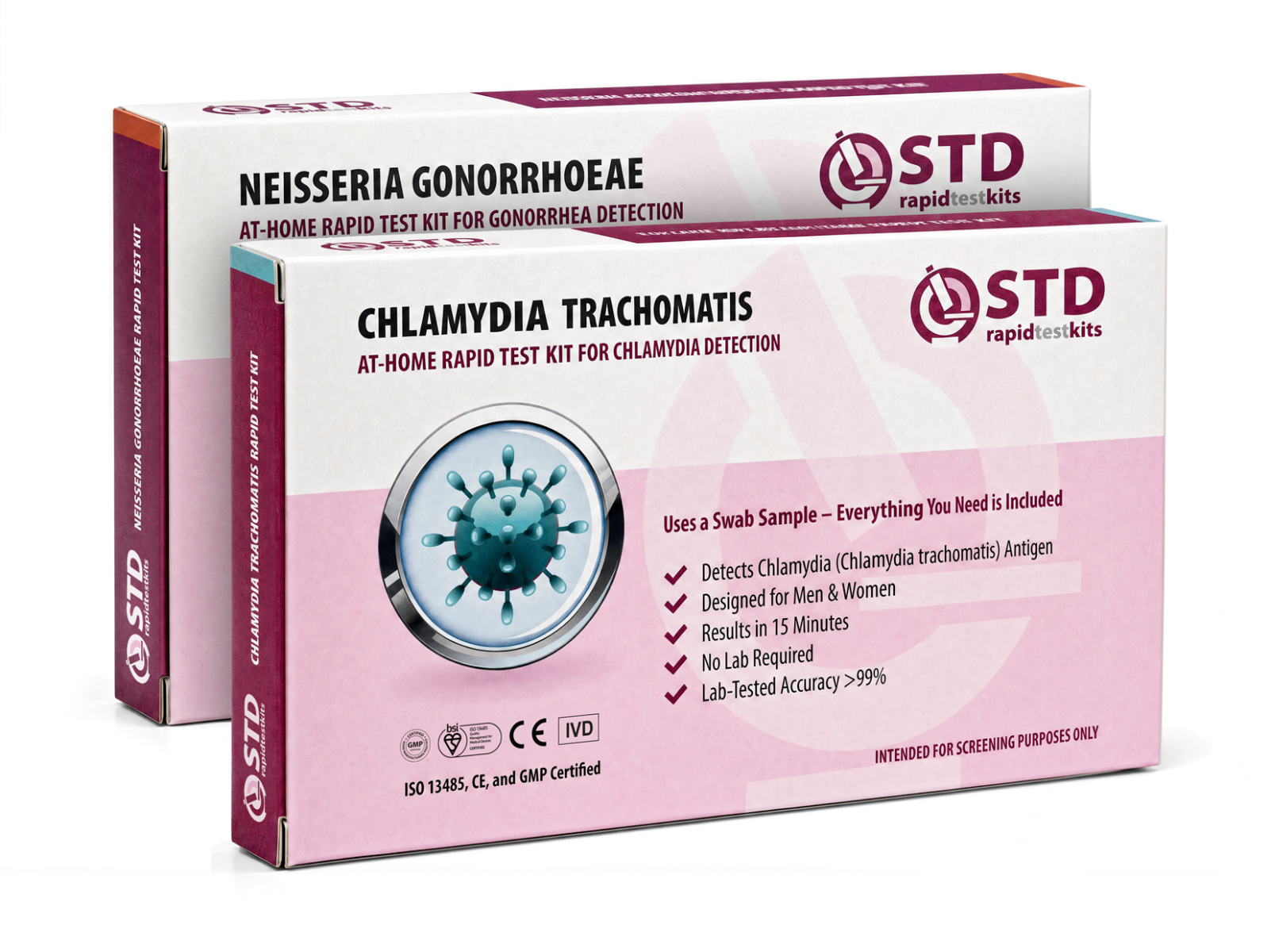
Our at-home rapid kits are lateral-flow immunoassays with their own validated sensitivity profiles. They are not NAAT-equivalent, and we say that plainly rather than implying otherwise. A positive rapid result is worth confirming with a lab NAAT when possible, and a negative result taken too early after exposure or during active antibiotic use deserves a retest at the peak window. The table below compares the two technologies side by side.
| Test type | What it detects | Sensitivity at low bacterial levels | Impact of recent antibiotics |
|---|---|---|---|
| Rapid antigen / lateral-flow (at-home) | Bacterial surface proteins | Moderate | More likely to miss infection if bacterial load is reduced |
| NAAT / PCR (laboratory) | Bacterial DNA or RNA | High | Less likely to miss low levels, but residual-DNA timing still matters |
| Viral antibody or antigen (HIV, HSV, Hep B, Hep C) | Immune response or viral proteins | High | No impact from antibiotics |
The leftover-antibiotics trap
Sometimes the antibiotics did not come from a clinician at all. Someone has a possible exposure, panics, finds an old half-finished bottle of doxycycline or amoxicillin in a drawer, and starts taking it as a kind of insurance policy.
Self-treating before testing creates three problems at once. First, an incomplete or wrong-dose course of antibiotics can partially suppress an infection without curing it, which makes a follow-up test harder to interpret. Second, it contributes to antibiotic resistance, which is a particular concern for gonorrhea, where resistance to many antibiotics has risen rapidly and reduced treatment options globally (WHO STI fact sheet). Third, it removes the chance for a confirmed diagnosis, which is what guides correct treatment, partner notification, and follow-up.
If you have already done this, the next step is to see a clinician, get tested at the appropriate window after your last exposure, and let an evidence-based plan take over. One stray pill rarely dooms anything, but stacking partial courses on top of each other does.
Incomplete or self-prescribed antibiotic courses contribute to multidrug-resistant gonorrhea, which the WHO flags as a major and growing public-health concern. If exposure is in question, test first and treat on confirmed results rather than dosing speculatively.
Reinfection vs treatment failure: how to tell the difference
Two fears tend to come up after antibiotics: that the medicine did not work, and that you caught the infection again. They feel identical at 2 a.m., but they are very different problems with very different solutions.
True treatment failure for uncomplicated chlamydia or gonorrhea is uncommon when first-line therapy is taken correctly. The CDC's current first-line treatment for gonorrhea is a single 500 mg intramuscular ceftriaxone dose, and for chlamydia it is a 7-day course of doxycycline (CDC gonococcal infections among adolescents and adults). When taken as prescribed, cure rates are high. In fact, the CDC notes that the majority of suspected treatment failures in the United States are likely reinfections rather than actual failures. Genuine failures do happen, particularly in pharyngeal gonorrhea or in the presence of antibiotic resistance, but they are not the most likely explanation when symptoms or test results return.
Reinfection is much more common. It usually traces back to an untreated partner, to resuming sex before both partners complete treatment, or to a new exposure in the interval. Guidelines generally recommend waiting at least 7 days after both partners complete treatment before resuming sexual activity, and confirming that any previously infected partner has also been treated.
If a positive result comes back weeks or months after a confirmed treatment, the questions to ask are: was every partner of the relevant exposure window also treated, was the abstinence period observed, and were any new partners introduced?
Men and women who have been treated for chlamydia should be retested approximately 3 months after treatment, regardless of whether they believe their sex partners were treated.
Window period vs antibiotic interference: two clocks, not one
One of the most common sources of confusion is treating the window period and antibiotic interference as the same thing. They can stack on top of each other, but the reasons behind them, and the fixes, are different.
Start with two clocks that begin at exposure. The first is the incubation period, the gap between exposure and when symptoms might appear. The second is the window period, the gap between exposure and when a test can reliably detect the infection. Symptoms and detectability are not the same milestone, which is why a test can miss an infection that has not yet caused a single symptom. The most common real-world mistake is testing too early, getting a negative, and then blaming the antibiotic for something the window period alone caused.
Counting from exposure, the reliable detection windows look roughly like this. Chlamydia and gonorrhea NAATs can pick up infection as early as 7 days and become reliable by about 2 weeks. Syphilis blood antibody tests start turning positive around 3 weeks and are reliable by about 6 weeks. Fourth-generation HIV antigen-antibody tests fall in the 18 to 45 day range on a lab venous draw, longer on a finger-prick sample, per the HIV.gov testing overview. Type-specific HSV-2 antibodies are reliable about 12 weeks after exposure. UK NHS guidance adds a practical rule for people with no symptoms: because some infections take up to about 7 weeks to show up, waiting roughly 7 weeks after unprotected sex covers the slower ones (NHS sexual health guidance).
Antibiotic interference is a separate layer. It is medication temporarily lowering bacterial levels, or with a NAAT, leaving residual DNA behind after treatment, so a result no longer reflects whether you currently have the infection. It applies only to bacterial and parasitic STDs, never to the viral ones.
The two often overlap. If you had a possible exposure on Monday and started antibiotics for bronchitis on Wednesday, then test the following week, you are inside both the window period for the STD and the suppression window for the antibiotic. A negative result in that situation says less than it appears to. The cleanest path forward is to count from the last possible exposure and test 3 to 4 weeks later, by which point the natural window has closed and the antibiotic effect has cleared. The bar below shows those detection windows side by side, all counting from exposure.
When you should not wait for the perfect testing window
The 3-to-4-week guidance assumes you are in a watch-and-wait situation. There are situations where waiting for the ideal testing window is not the right call.
If you have severe pelvic or testicular pain, fever, neurological symptoms, a rash, or any sign of systemic illness, see a clinician immediately. Testing strategy can be rebuilt later. What you cannot rebuild is delayed care for complications like pelvic inflammatory disease, epididymitis, or disseminated gonococcal infection.
If you are pregnant and were treated for chlamydia, providers usually recommend a test of cure approximately 4 weeks after treatment to confirm the infection has cleared, with repeat testing within 3 months (CDC STI screening recommendations). That timing is intentional and protective for both the patient and the pregnancy.
If symptoms persist or worsen after a course of antibiotics, that is a signal to be re-evaluated, not a reason to silently wait out a window. Lingering tissue irritation can take days to settle even after a successful cure, but new pain, new discharge, or new fever after treatment deserves a clinical look rather than another week of guessing.
Skip the testing-window math and seek clinical care now if you have any of these: severe pelvic or lower abdominal pain, testicular pain or swelling, fever, a new rash, or neurological symptoms after a possible exposure or antibiotic course. These can signal complications such as pelvic inflammatory disease, epididymitis, or disseminated gonococcal infection that need same-day assessment.
A simple framework for what to do next
If you are unsure whether to trust a recent result or when to retest, four questions cover almost every real situation. The list below captures them in the order they apply.
Four questions to run through
- Is the test bacterial or viral? Antibiotics affect chlamydia, gonorrhea, syphilis, and trichomoniasis testing. They do not affect HIV, herpes, hepatitis B, or hepatitis C testing.
- Did the test fall during, or close after, an antibiotic course? Within roughly 3 weeks of finishing antibiotics, a NAAT for a bacterial STD is harder to interpret in either direction.
- Are you counting from the right date? If antibiotics were taken for an unrelated reason during your exposure window, count 3 to 4 weeks from the exposure, not from the prescription end date.
- Was the partner treated and was the abstinence period observed? A positive retest at 3 months without those two confirmed is most often reinfection, not treatment failure.
FAQs
- I just started antibiotics. When can I get a reliable STD test?
- One day of antibiotics does not erase your ability to get an accurate result later. The first dose is not enough to clear most STDs, and a single day of suppression usually will not flip a NAAT to negative either. Finish whatever course you are on for its actual purpose, then retest 3 to 4 weeks after the course ends, counting from your last possible STD exposure. The same 3-to-4-week window applies for a test of cure after treatment for a confirmed bacterial STD, plus a routine rescreen at 3 months per CDC guidance. For HIV, herpes, and hepatitis, antibiotics are not part of the timing equation; only the natural window period from exposure matters.
- Can antibiotics actually cause a false negative on an STD test?
- Yes, for bacterial STDs. If antibiotics suppress bacterial levels below what the test can detect, the result can read negative even when infection is still present. This is why the CDC recommends waiting 3 to 4 weeks after a course of antibiotics ends before retesting bacterial STDs like chlamydia and gonorrhea. Viral tests for HIV, herpes, and hepatitis are not affected by antibiotics.
- Symptoms cleared after antibiotics. Does that mean I am cured?
- Not necessarily. Symptom relief often arrives within a day or two because antibiotics calm inflammation quickly, so discharge stops and burning fades. Bacteria, however, can linger at counts too low to cause symptoms but high enough to remain an active infection, especially after a partial or non-curative dose. The absence of symptoms is reassuring but it is not confirmation. Only a test taken at the correct window after exposure or after treatment can confirm the infection has cleared.
- I am on amoxicillin for strep throat. Will it affect my HIV test?
- No. Antibiotics do not interfere with HIV testing. They do not change antibody production or antigen levels. The only timing factor that matters for HIV testing is the natural window period after exposure, which is roughly 18 to 45 days for a fourth-generation antigen-antibody test on a lab venous draw, depending on the assay.
- I tested negative while still on antibiotics. Can I trust it?
- If the test was for a bacterial STD and you were taking antibiotics with activity against that infection, the negative result is less reliable than it looks. The safer move is to retest 3 to 4 weeks after the antibiotic course ends. If the test was for HIV, herpes, or hepatitis, antibiotics did not affect the result, so the only question is whether you were past the relevant window period from exposure.
- Do rapid home tests get affected more than lab tests?
- Sometimes. Rapid antigen-based home tests detect bacterial proteins on a lateral-flow strip, while lab NAATs amplify bacterial genetic material. If antibiotics have substantially reduced the bacterial load, a NAAT is more likely to still pick it up than a rapid antigen test. Even so, timing relative to exposure is usually the bigger variable. A perfectly timed rapid test is far more useful than an early lab test taken in panic.
- Can the antibiotics for a UTI accidentally treat or hide chlamydia?
- It depends on which antibiotic. Common UTI antibiotics like nitrofurantoin and fosfomycin do not have meaningful activity against chlamydia or gonorrhea. Tetracyclines like doxycycline and certain macrolides do, and a non-curative course of those can suppress bacterial levels enough to muddy a NAAT. If you are unsure, count 3 to 4 weeks from your last possible exposure and retest then.
- I took leftover antibiotics before getting tested because I panicked. Did I make things worse?
- Probably not catastrophically, but it complicates things. An incomplete or wrong-dose course can partially suppress an infection without curing it, which makes follow-up testing harder to interpret, and it can contribute to antibiotic resistance. The next step is to see a clinician, finish a properly prescribed course if needed, and retest 3 to 4 weeks after the course ends. Confirmed results from a planned retest are more useful than guesswork.
- Why might I still test positive a week after finishing antibiotics?
- Because NAAT detects bacterial DNA, not whether bacteria are alive. After successful treatment for chlamydia or gonorrhea, fragments of nonviable bacterial DNA can remain detectable in tissue for weeks. A positive result less than 3 weeks after a completed course is more often residual DNA than treatment failure. Retest at the 3-to-4-week mark before assuming the antibiotics did not work.
- U.S. Centers for Disease Control and Prevention. Chlamydial Infections section of the STI Treatment Guidelines: supporting the first-line doxycycline regimen, the test-of-cure not-advised guidance for nonpregnant adults, and the 3-month rescreen recommendation.
- U.S. Centers for Disease Control and Prevention. Gonococcal Infections Among Adolescents and Adults: supporting the 500 mg ceftriaxone first-line regimen and the statement that most suspected treatment failures are likely reinfections.
- World Health Organization. Sexually Transmitted Infections fact sheet: supporting the context that antimicrobial resistance in gonorrhea has risen rapidly and reduced treatment options.
- U.S. Department of Health and Human Services, HIV.gov. HIV Testing Overview: supporting the 18 to 45 day window for fourth-generation antigen-antibody testing on a venous draw and longer windows for finger-prick and antibody-only tests.
- U.S. National Institutes of Health, MedlinePlus. Sexually Transmitted Infections: supporting the core distinction that antibiotics treat bacterial and parasitic STIs while viral STIs are managed differently.
- UK National Health Service. Sexually transmitted infections (STIs) overview: supporting the practical asymptomatic-screening guidance of waiting about 7 weeks after unprotected sex.
