

Published: November 2025 | Last updated: April 2026 | Editorial review and quality control: Martina N.
You took the test. The result said negative. A few days or a few weeks later, something has not quite settled, a strange itch, an unusual discharge, a partner's text you cannot shake. You search for answers and find a phrase you have probably never heard before: window period.
The window period is the gap between exposure to a sexually transmitted infection and the moment a test can reliably see it. Most people assume STI testing is binary, that either you have something or you do not. The biology is messier. Bacteria and viruses need time to multiply, and the immune system needs time to respond. Tests look for those signals. Test before they exist, and the result reads negative even when an infection is taking hold.
This article walks through how those windows work for the most common infections, what each test type can and cannot catch, and the retest timing that actually protects you and the people you sleep with.
When can a negative STI test be wrong?
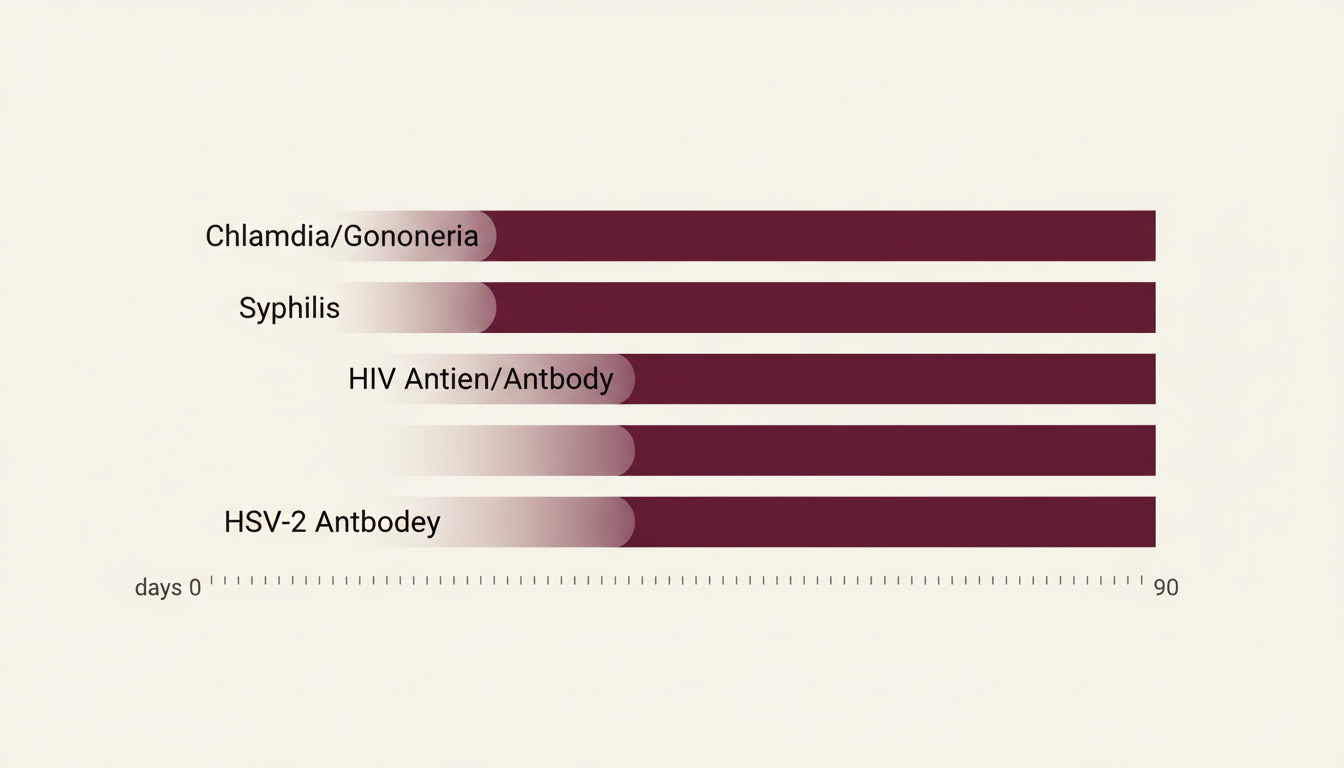
When it was taken inside the window period, the time between exposure and when an infection becomes detectable. Window periods range from about 1 to 2 weeks for chlamydia and gonorrhea, 3 to 6 weeks for syphilis, roughly 3 to 13 weeks for HIV rapid antibody tests, and 4 to 12 weeks for HSV-2 antibody tests. Retesting after the relevant window has closed is what turns a negative into a result you can trust.
Key Takeaways
- Each STI has its own window period: roughly 1 to 2 weeks for chlamydia and gonorrhea, 3 to 6 weeks for syphilis, roughly 3 to 13 weeks for HIV rapid antibody tests, and 4 to 12 weeks for HSV-2 antibody tests.
- After treatment for chlamydia or gonorrhea, the CDC recommends a retest at three months to catch reinfection from an untreated partner.
What "window period" actually means
The window period is the interval between exposure and when a test can reliably detect an infection. It exists for biological reasons that get easier to grasp once you see how the tests work.
Tests look for one of three signals. Some search for the genetic material of the bacteria or virus directly (NAAT and PCR tests, used in laboratories). Others look for antigens, the proteins on the surface of the organism. The third group looks for antibodies, the proteins your immune system produces in response to the threat. Each signal takes a different amount of time to reach a detectable level after exposure.
Genetic material accumulates as the organism multiplies, so tests that look for it can detect bacterial infections within roughly 1 to 2 weeks. Antigens appear early too, sometimes in the first 2 to 3 weeks. Antibodies are slower because the immune system has to recognize the threat and start producing them. For some infections this takes weeks. For HSV-2, antibody seroconversion typically completes by 12 weeks for most people, and the CDC notes that some current tests can take up to 16 weeks or more to reliably detect infection after exposure (CDC, Herpes Testing).
A negative result inside this window does not confirm you are uninfected. It confirms only that the test did not find what it was looking for at the moment it was taken. The distinction looks small in writing and feels enormous when symptoms show up later.
Genetic material (NAAT or PCR). Directly detects bacterial or viral DNA or RNA. Reaches detectable levels within roughly 1 to 2 weeks for bacterial STIs.
Antigens. Proteins on the surface of the organism. Detectable as early as 2 to 3 weeks; this is the early signal in 4th-generation HIV combo tests.
Antibodies. The immune system's response to the infection. The slowest signal, taking from 3 weeks (syphilis) to 12 or more weeks (HSV-2), depending on the infection.
How long the window is for each infection
The numbers below come from CDC and WHO testing guidance and reflect the typical performance of common laboratory and rapid point-of-care assays. Treat them as planning intervals, not as diagnostic thresholds. If you have symptoms that concern you, see a clinician regardless of where you sit on the timeline.
| Infection | Typical Window Period | Earliest Useful Test | When to Retest |
|---|---|---|---|
| Chlamydia | 1 to 2 weeks | NAAT (urine or swab) at day 14 | 3 months after treatment (CDC) |
| Gonorrhea | 1 to 2 weeks | NAAT (urine or swab) at day 14 | 3 months after treatment (CDC) |
| Syphilis | 3 to 6 weeks | Treponemal antibody at 3 weeks | 6 to 12 weeks after exposure if at risk |
| HIV (4th gen Ag/Ab combo, lab) | 18 to 45 days | Combination antigen/antibody at 18 days | 90 days for definitive result |
| HIV (rapid antibody only) | 23 to 90 days | Antibody at 23 days | 90 days |
| Hepatitis B | 4 to 10 weeks | HBsAg blood test at 4 weeks | 6 months |
| Hepatitis C | 8 to 11 weeks | HCV antibody at 8 weeks | 6 months |
| Herpes (HSV-2 antibody) | 4 to 12 weeks | Lesion swab during outbreak; antibody at 12 weeks | 12 weeks if initial antibody is negative |
| Trichomoniasis | 5 to 28 days | NAAT at 7 to 10 days | 2 to 4 weeks if symptoms persist |
Why that first negative felt like truth
There is a particular kind of relief that comes with a negative result, especially after a hookup that did not go quite right or a relationship ending you did not see coming. Trusting that relief is human. The trouble is the relief can be premature.
Research consistently finds that early-window testing misses meaningful numbers of true positives that later turn up. The exact percentage varies by infection and assay; the pattern does not. Time and biology, not the test itself, are doing the work that produces a reliable result.
The behavioral consequences of a false-negative read can stack up fast. People resume condomless sex with the partner they were worried about, or with someone new, on the assumption that they are clear. Treatment gets delayed because surely this symptom is something else. In the quietest pattern, there are no symptoms at all and an infection moves silently to the next partner.
Retesting at the right interval is the correction for that gap. The first test was right for the moment it was taken; timing and biology meant it had incomplete information about a moving target. Coming back to the question after the window has closed gives the same test technology a fair chance to work.
What each test can (and cannot) see
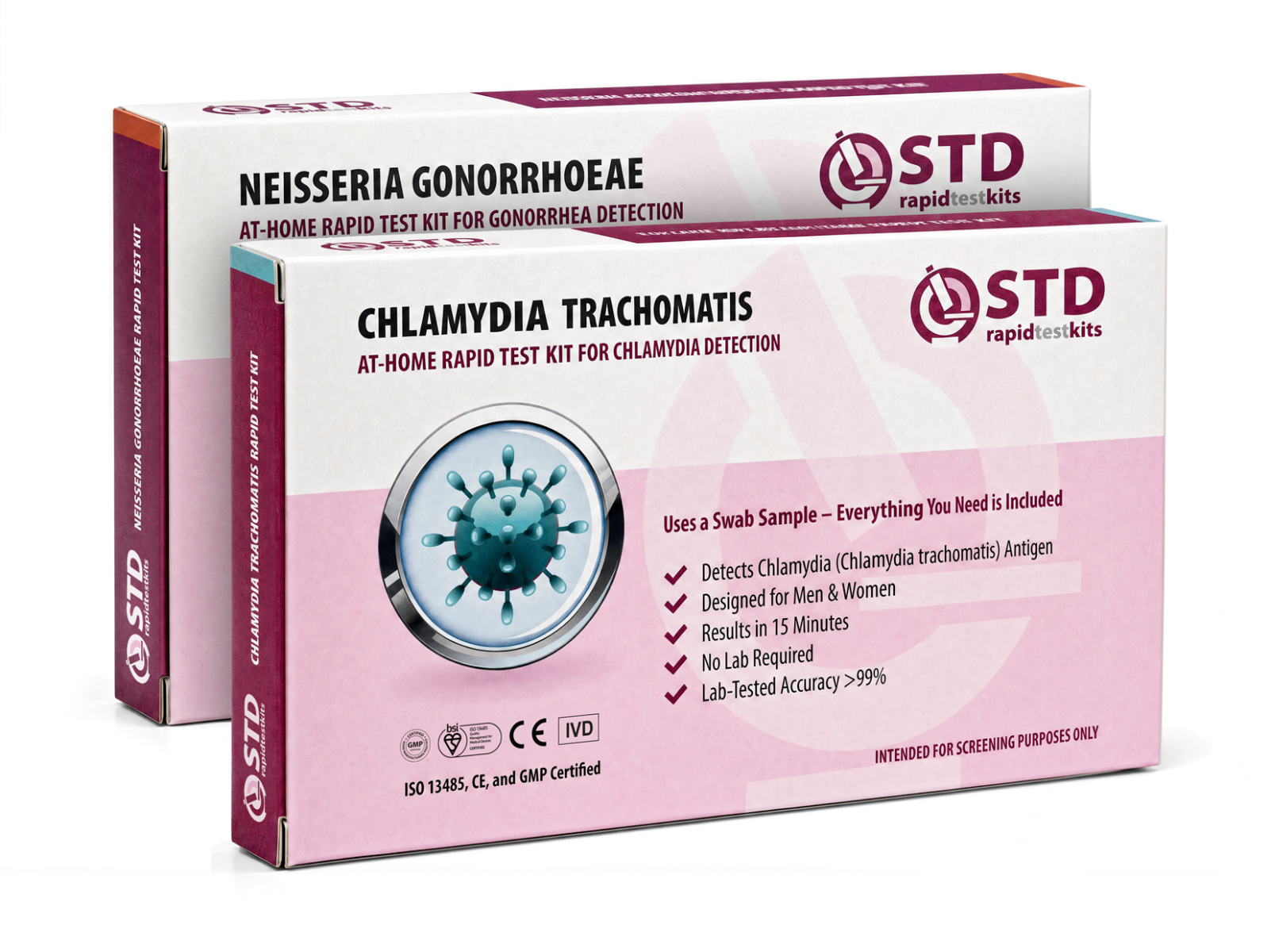
Different test technologies have different strengths and different blind spots. The home rapid lateral-flow tests sold on this site use the same fundamental chemistry as many point-of-care clinic tests: an immunoassay that detects antibodies or antigens on a paper strip. Laboratory NAAT tests look for genetic material directly and offer higher analytical sensitivity in the early window, especially for chlamydia and gonorrhea.
Neither approach is universally better. Lateral-flow rapid tests give you a result in 15 minutes at home; lab NAATs give you tighter sensitivity but require shipping or a clinic visit. The two are complementary, not equivalent. A positive on a rapid test is informative and usually warrants confirmation with a lab. A negative on a rapid test taken inside the window deserves a retest at the proper interval before you treat it as final (CDC, HIV Testing).
| Test Type | Best For | Earliest Useful Window | What It Can Miss |
|---|---|---|---|
| Lab NAAT or PCR | Chlamydia, gonorrhea, trichomoniasis | 1 to 2 weeks | Very early infections; misses sites not sampled (rectum, throat) |
| Rapid lateral-flow blood antibody | HIV, syphilis, hepatitis B and C, HSV | 3 to 12 weeks (varies by infection) | Pre-seroconversion infections still inside the window |
| Rapid lateral-flow swab | Chlamydia, gonorrhea, HPV, trichomoniasis | 1 to 2 weeks | Lowest bacterial loads in the earliest window |
| HIV 4th-generation Ag/Ab combo (lab) | HIV | 18 to 45 days | The first 17 days, when neither antigen nor antibody is detectable |
| Lesion swab (culture or PCR) | HSV during an active outbreak | Immediately during a visible lesion | Asymptomatic shedding; healed lesions; non-genital sites if not swabbed |
Retesting after treatment is not a trust issue
Treatment for bacterial STIs (chlamydia, gonorrhea, trichomoniasis, syphilis) typically clears the infection within days. The bacteria die. Symptoms resolve. The standard CDC recommendation, however, is to retest at three months after treatment for chlamydia or gonorrhea, regardless of whether you feel fine (CDC STI Treatment Guidelines).
The reason is not that the antibiotics fail. They almost always work. The reason is reinfection from an untreated partner. When two people share a bacterial STI and only one gets treated, the cycle restarts the next time they have sex. CDC surveillance data place reinfection rates among people treated for chlamydia in the high single digits to low double digits within a few months, depending on the population studied.
Two practical implications. First, partner notification matters more than most people realize. If recent sexual partners do not get treated at the same time, you can clear an infection and reacquire it the same week. Second, the three-month retest exists to catch exactly this scenario. The retest is the system working as designed; treat it as routine maintenance, not as a verdict on the original treatment.
For viral infections (HIV, hepatitis B and C, HSV), retesting after a positive serves a different purpose: confirmation of the diagnosis, monitoring of viral activity, and partner-status tracking. Your provider will guide that schedule.
One nuance worth knowing if you retest very early after treatment: highly sensitive lab NAAT tests can sometimes pick up residual bacterial DNA from organisms that have already been killed. A positive result in the first one to two weeks after treatment can occasionally reflect dead DNA rather than live infection. The three-month retest interval mostly side-steps this issue, which is part of why it is the recommended timing.
When a partner's treatment doesn't land
You can do everything correctly on your end and still end up reinfected. Common patterns: a partner who said they would take the antibiotics but never filled the prescription; a partner whose strain is one of the increasingly common gonorrhea variants with reduced antibiotic susceptibility; a new partner who was not part of the original notification.
A few approaches reduce the cycle. Many states allow expedited partner therapy, where a clinician can prescribe treatment for your sexual partner without seeing them in person. The CDC publishes a state-by-state list of where this is permitted. For partners outside that list, the practical workaround is a brief, honest conversation about timing: both of you finish the medication, both of you wait the recommended interval, both of you retest before resuming sex.
Abstaining from sex during the treatment window feels like a heavy ask, especially in a relationship where things otherwise feel fine. It is a far smaller cost than three more months of cycling the same infection back and forth, or finding out at the next test that what you thought was cleared was never cleared on the other person's side.
If you tested positive and your sexual partner cannot easily get to a clinic, ask the provider who treated you whether expedited partner therapy is available in your state. EPT lets a clinician prescribe treatment for your partner without an in-person visit, which removes one of the most common reasons partners do not get treated. Where it is available, EPT meaningfully lowers reinfection rates.
Tested negative but something still feels off
There is a recognizable kind of unease that arrives when a clean test result and a body that is signaling do not agree. A burning sensation that does not fit a UTI. A lingering itch that yeast cream is not touching. A change in discharge unlike anything you have had before. The mind wants to trust the test. The body keeps signaling.
When test and symptoms disagree, the right next move depends on timing. If the original test was inside the window period, retesting at the proper interval is the simplest answer. If the original test was outside the window and the symptoms persist, the question becomes whether you tested for the right thing at the right anatomical site.
A few patterns to consider. Bacterial vaginosis and yeast can produce symptoms similar to chlamydia or trichomoniasis but will not show up on STI panels. Mycoplasma genitalium causes urethritis and discharge in patterns that mimic chlamydia, and it is not part of standard test menus. Pelvic inflammatory disease can produce pain and fever that are not tied to a specific organism on a basic panel. Pharyngeal gonorrhea (throat) and rectal chlamydia or gonorrhea require swabs at those specific sites, which our home kits do not collect.
The practical point: a negative result from one panel does not rule out every cause. If something feels wrong, retesting, broadening the panel, or seeing a provider in person are all reasonable next steps. For specifically pharyngeal or rectal swab testing, see a clinic; we do not sell those sample types.
Inside the window period? Retest at the correct interval for the infection you are worried about, using the same test type or a more sensitive lab option.
Outside the window with persistent symptoms? Broaden the panel or see a clinician. Common alternatives that mimic STI symptoms include bacterial vaginosis, yeast, urinary tract infection, Mycoplasma genitalium, and pelvic inflammatory disease.
Symptoms localized to throat or rectum? The infection may need a site-specific swab not collected by home genital or fingerstick kits. See a clinic for pharyngeal or rectal sampling.
A realistic retest schedule
There is no single right cadence. The right schedule depends on how often you are having sex, with how many partners, with what protection, and whether you have been treated recently. The intervals below are CDC-aligned starting points, not rules. If your situation does not fit one of these rows, the underlying logic is the same: test once at the lower bound of the relevant window, then again after the upper bound has closed.
| Situation | Initial Test | Retest |
|---|---|---|
| Single recent exposure, no symptoms | Day 14 (NAAT for bacterial, rapid for early antibody) | 4 to 6 weeks for syphilis and HSV; 3 months for definitive HIV |
| Condom broke or no condom, partner status unknown | Day 14 | 6 weeks AND 3 months for full HIV coverage |
| Starting a new monogamous relationship | Both partners test before condomless sex | 6 to 12 weeks after starting |
| Treated for chlamydia or gonorrhea | Course of antibiotics | 3 months after treatment (CDC) |
| Multiple partners, ongoing | Every 3 to 4 months | Plus an extra test after any new exposure that concerns you |
| Tested negative inside the window, symptoms persist | Now, at any time | Repeat at 4 to 6 weeks; broaden the panel if still negative |
| Pregnant after treatment | Course of antibiotics | 3 to 4 weeks after treatment, again later in pregnancy |
Choosing a home test for the question you actually have
This article is published by stdrapidtestkits.com, which sells at-home STI testing kits. We recommend products based on fit-for-purpose for the reader's concern, not commercial benefit.
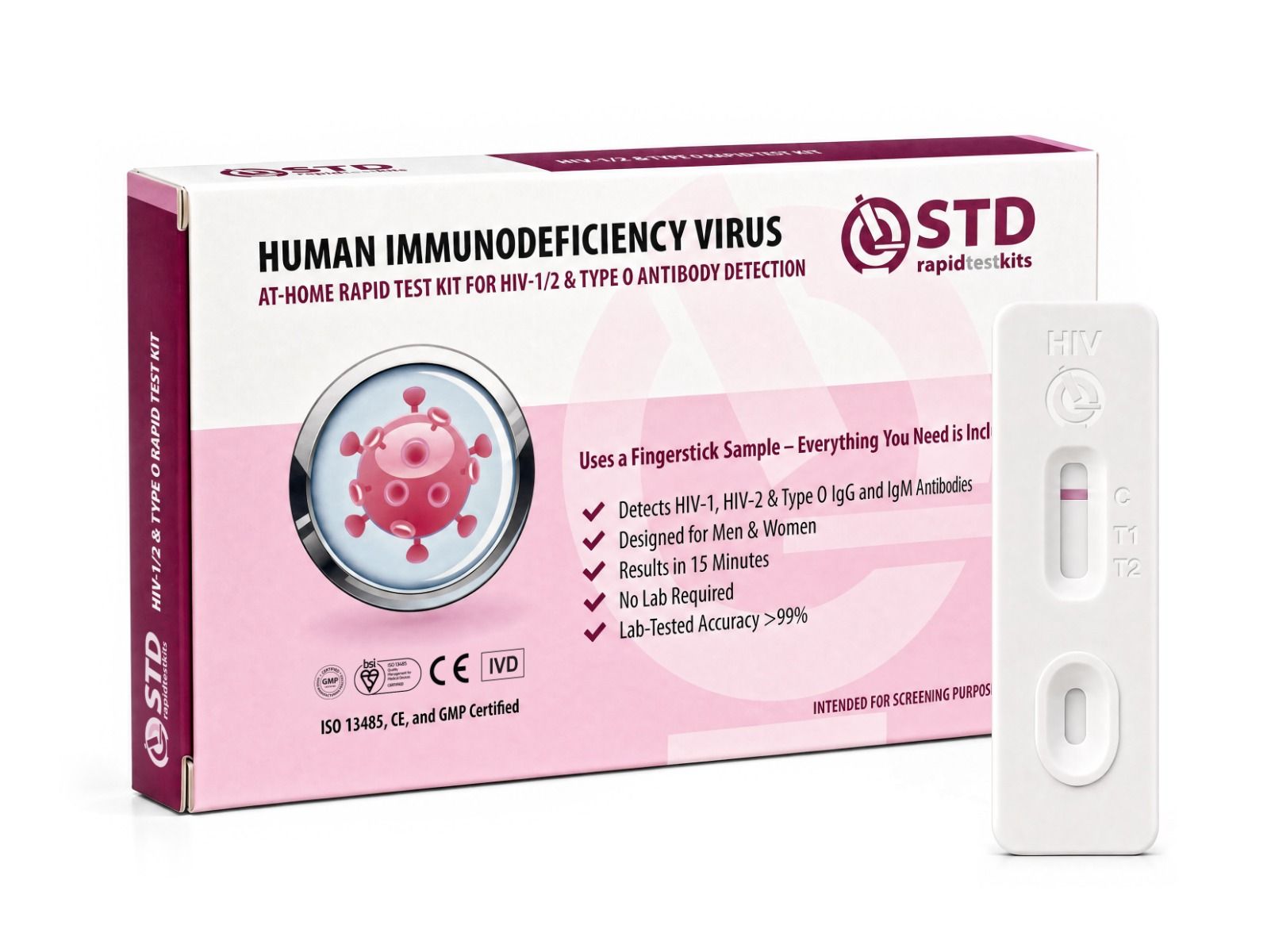
The home rapid kits we sell are designed for the moment when you have passed the relevant window, you have the question, and you want a quick, private answer. They are not a substitute for clinic-administered care when you are symptomatic, when a positive result needs confirmation, or when the route of exposure (rectal, oral, throat) calls for a sample we do not collect at home. For closing the question after a complete window has elapsed, they do what they are built to do: give you a 15-minute lateral-flow result you can act on.
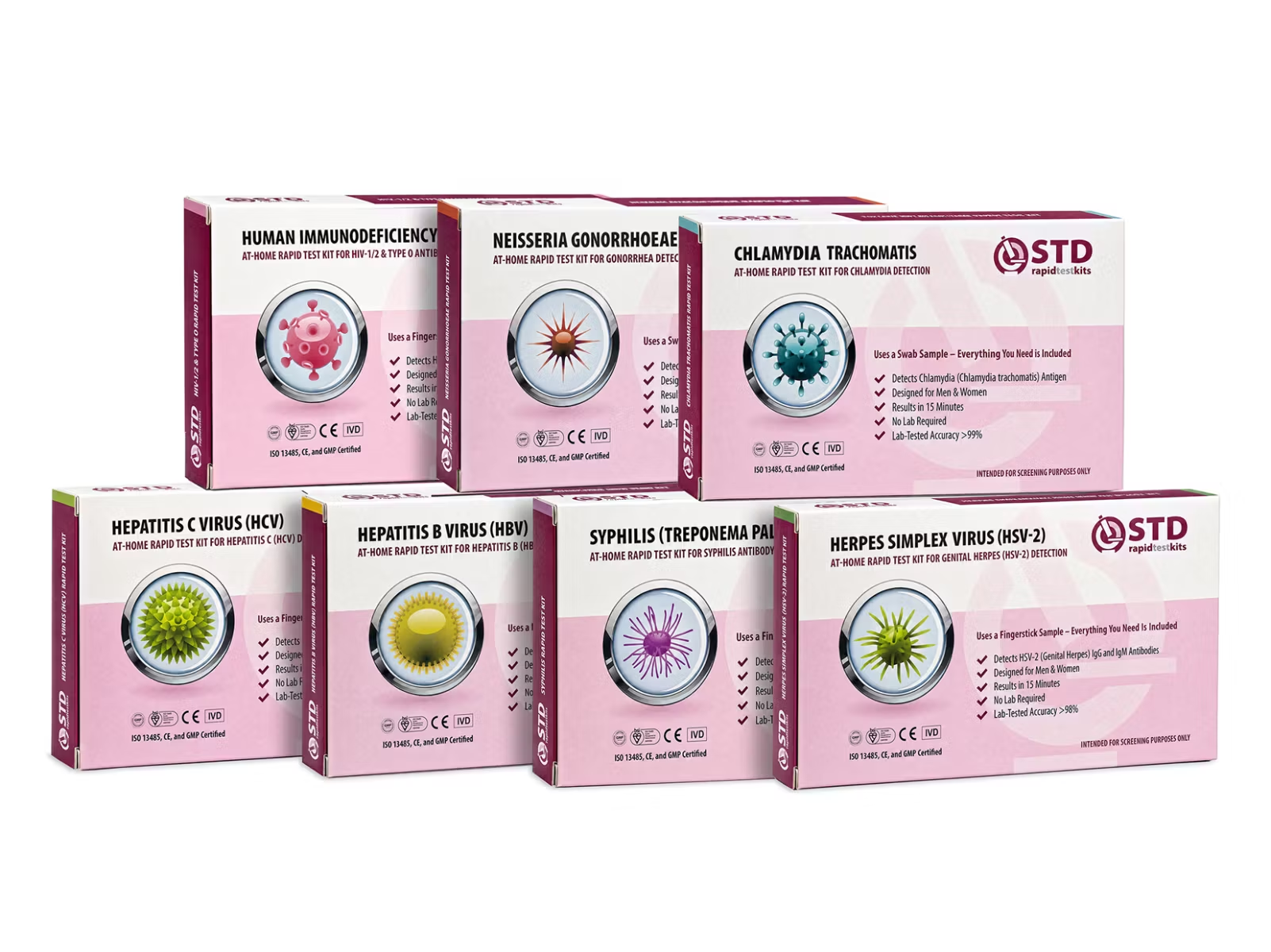
If you want to test for the most common bacterial STIs after a single exposure, a swab-based combo test for chlamydia and gonorrhea covers the high-frequency cases at the 14-day mark. If you want to clear a broader question after the longer windows have closed (HIV, syphilis, hepatitis B and C, herpes), a multi-infection combination kit gives you all the relevant strips in one box and covers the way retest situations typically play out.
What negative really means at the end of the window
Here is what changes when you retest after the relevant window has closed: the result becomes meaningful. A negative chlamydia NAAT at 3 weeks post-exposure is informative in a way that the same test at 3 days is not. A negative HIV antigen/antibody test at 45 days is much closer to definitive than the same test at 18 days. A negative HSV-2 antibody at 12 weeks tells you something the same test at 4 weeks could not.
Testing early gives you anxiety relief. Testing at the correct window gives you actual information.
Testing fits inside the rhythm of the rest of your sexual life. The window period is the part of that rhythm most people do not know exists, until they bump into a result that does not match how they feel. Once you know it is there, the math gets straightforward: test once on a reasonable timeline, retest after the window closes for the infection you are worried about, retest again 3 months after any treatment for chlamydia or gonorrhea, and trust your body when it tells you something has not finished.
No HIV test can detect HIV immediately after infection. That is because of the window period, the time between HIV exposure and when a test can detect HIV in your body.
Frequently asked questions
- How soon after sex can I take a reliable STI test?
- For chlamydia and gonorrhea, a NAAT or PCR test at 14 days post-exposure is reliable. For HIV with a 4th-generation antigen/antibody combo, 18 days is the earliest meaningful read and 45 days is high confidence. Syphilis treponemal antibody is informative from 3 weeks. HSV-2 antibody seroconversion can take up to 12 weeks. If you test before the lower bound of the relevant window, plan to retest after the upper bound has closed.
- Can a rapid home test give a false negative?
- Yes, especially when used inside the window period for the infection you are testing for. Rapid lateral-flow tests are sensitive when used at the right interval; tested too early, they can read negative for a true infection that has not yet built detectable levels of antigens or antibodies. The kit instructions list the recommended timing for each target.
- Do I really need to retest after antibiotics if I feel better?
- Yes. The CDC three-month retest catches reinfection from an untreated partner, which is the most common reason the same infection comes back. Antibiotics typically clear the original infection within days; the retest is checking what may have happened on the other person's side of the encounter, not whether the medication worked.
- What if I tested negative twice but still have symptoms?
- Two negatives outside the window suggest the cause might not be a standard-panel STI. Possible alternatives include bacterial vaginosis, yeast, urinary tract infection, mycoplasma genitalium, or non-infectious irritation. Pharyngeal or rectal infections can also be missed if a urine or genital swab is the only sample collected. A clinician can run a broader differential, including site-specific swabs.
- How long do herpes antibodies take to show up?
- Antibody seroconversion for HSV typically takes 4 to 12 weeks, with most people who are going to test positive doing so by 12 weeks. A swab of an active lesion is the more direct test during a visible outbreak; antibody testing is for the period between outbreaks or when the diagnosis is uncertain. Our HSV-2 kit is a fingerstick blood antibody test and is most informative 12 or more weeks after the exposure you are asking about.
- Is it safe to have sex while waiting for the retest?
- The conservative answer is to wait until both you and any recent partner have tested clear after the relevant window has closed. If that is not realistic, condoms reduce but do not eliminate risk for some infections (HSV and HPV can transmit through skin contact in areas a condom does not cover). If you are between treatment and the three-month retest, the lowest-risk choice is condoms with all partners until the retest comes back negative.
- Can stress, a UTI, or a yeast infection cause symptoms that mimic an STI?
- Yes. Stress can heighten your awareness of normal sensations. UTIs cause burning urination that overlaps with chlamydia and gonorrhea symptoms. Yeast and bacterial vaginosis cause discharge changes that resemble several STIs. Symptoms alone do not identify the cause; testing does. If a first STI panel is negative but symptoms persist, broaden the differential rather than assuming the result was wrong.
- How often should I get tested if I have multiple partners?
- The CDC recommends every 3 to 6 months for sexually active people with multiple or new partners, more often if condom use is inconsistent or if a partner's status is unknown. After any new exposure that concerns you, test at 14 days for the bacterial panel and again at the longest relevant window (90 days for HIV, 12 weeks for HSV-2 antibody) for full confidence.
- U.S. Centers for Disease Control and Prevention. Herpes Testing. Background on HSV antibody testing, including the timing required for current tests to reliably detect infection (the CDC notes some tests can take up to 16 weeks or more after exposure).
- U.S. Centers for Disease Control and Prevention. HIV Testing. Window periods for 4th-generation antigen/antibody combo tests (18 to 45 days), rapid antibody tests (23 to 90 days), and the rationale for confirmatory retesting at 90 days.
- U.S. Centers for Disease Control and Prevention. STI Treatment Guidelines landing page. Gateway to the 2021 clinical guidance on treatment, screening, and partner management for bacterial and viral STIs, including chlamydia, gonorrhea, and syphilis.
- World Health Organization. Sexually Transmitted Infections fact sheet. Global incidence figures and primer on STI testing principles.
- U.K. National Health Service. Sexually Transmitted Infections. Patient-facing summary of testing windows and when to retest after a possible exposure.
- HIV.gov. HIV Testing Overview. Detailed window-period table for the three main HIV test categories.
