Published: September 2025 | Last updated: May 2026 | Editorial review and quality control: Martina N.
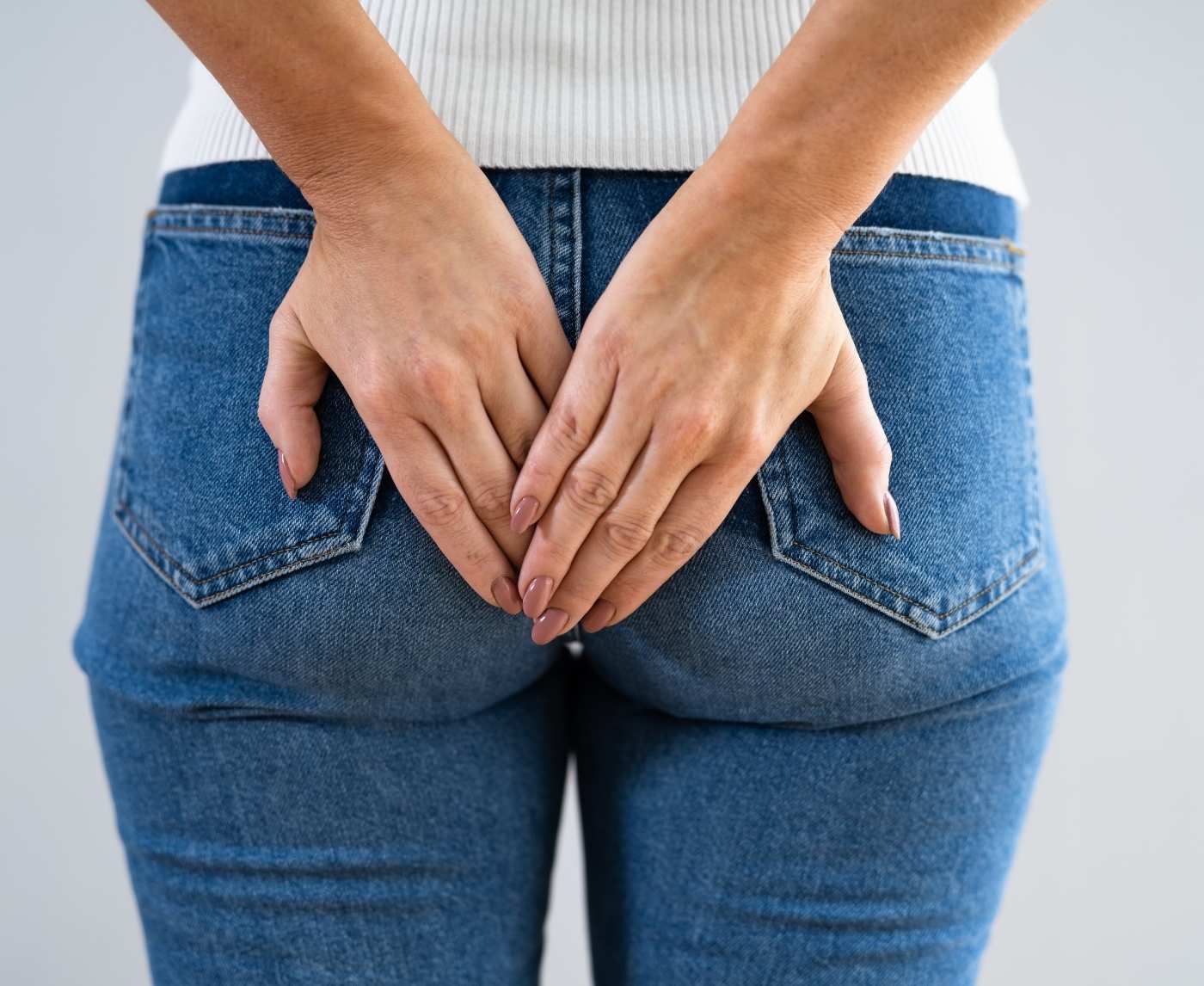
If you're reading this at 1 a.m. with one hand on the laptop and a vague soreness you can't quite explain, you're not the first. Anal pain that shows up without a single drop of blood is one of the quieter sexual-health questions people Google. The reassuring news is that most of the time, the cause is mechanical: friction from sex, a tight pelvic floor after a stressful week, constipation, or the body's normal response to a new toy or new position. Most of these settle on their own within a few days with rest, hydration, and a little patience.
The complication is that some rectal infections produce nothing more dramatic than that. Rectal chlamydia and gonorrhea can sit quietly with only mild soreness or a burning sensation during a bowel movement. Herpes can hurt before any visible sore appears. Syphilis can be silent for weeks. The absence of bleeding is not, on its own, a green light.
This guide walks through what the pain usually means, how to tell irritation apart from infection, and where the line sits between watching and testing. You don't need to spiral. You need information.
Key takeaways
- Anal pain without bleeding is most often friction, hemorrhoids, or muscle tension, and most cases resolve in two to three days with rest.
- Pain that lingers past a week, follows a new sexual partner, or worsens during bowel movements is the cue to test for rectal STIs rather than wait for more obvious signs.
What Anal Pain Without Bleeding Usually Means
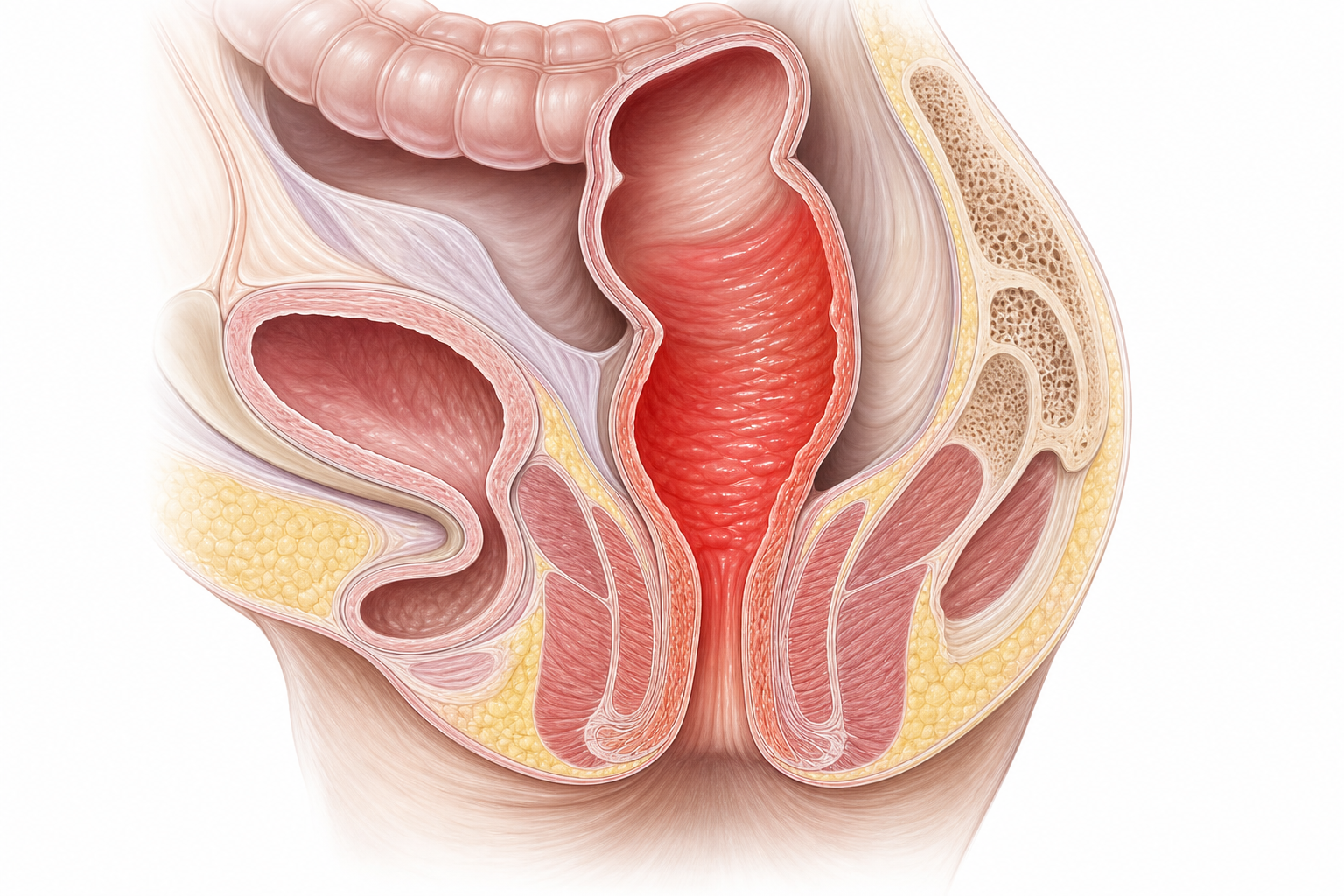
The tissue inside the anus and rectum is dense with nerve endings and reacts to small disturbances before any visible damage shows up. Pain can outrun visible injury by hours or days. So when nothing looks wrong externally and there's no blood, that doesn't rule much in or out by itself.
Most non-infectious causes fall into a short list:
- Friction from sex. Less lube than usual, a longer session, or a new angle can leave the rectal lining sore. The internal anal sphincter may also clench in response, producing a residual ache for a day or two.
- Internal hemorrhoids. They often feel like pressure or fullness rather than sharp pain, and they can hurt without bleeding, especially when small or recently inflamed.
- Pelvic floor tension. Long hours of sitting, stress, or constipation can cause the pelvic floor muscles to grip the rectum. The result is a dull, persistent ache that mimics inflammation.
- Constipation and straining. A hard stool can stretch and irritate the lining without tearing it. Pain can persist for a day or two after the next normal bowel movement.
Each of these has a typical trajectory: pain peaks within 24 to 48 hours, then steadily improves. If that arc is what you're seeing, the cause is almost certainly mechanical and home care is usually enough.
What changes the picture is timing relative to a sexual encounter, especially receptive anal sex without a condom or with a condom that slipped.
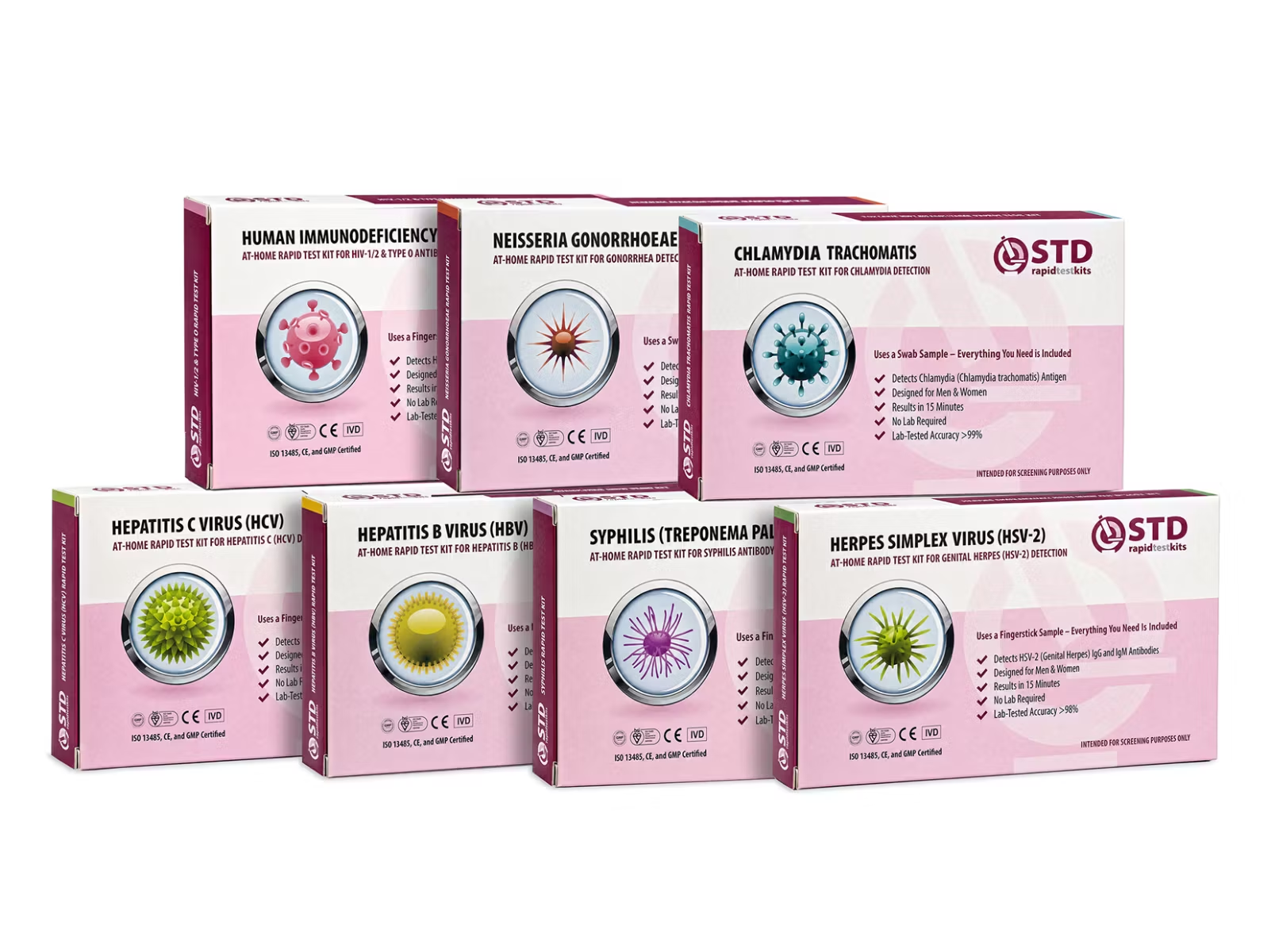
Our at-home kits do not include a rectal swab. If you specifically need a rectal NAAT for chlamydia or gonorrhea at the rectal site, that is a clinic test. Most public sexual-health clinics offer it free or low-cost and the swab itself takes seconds. What we can do is screen for the related infections in parallel: HIV, syphilis, hepatitis B, hepatitis C, and HSV-2 via fingerstick blood, and chlamydia or gonorrhea via genital self-swab. Many readers use both pathways together.
Friction, Hemorrhoids, or Infection? How to Tell the Difference
Three patterns to compare.
Friction pain has an event. You can usually point to the sex, the toy, the bowel movement, the long hike. It peaks fast and gets better. By 72 hours, most friction pain is fading. The sensation is surface-level, like raw skin. Gentle cleansing, a few days of softer foods, and rest are usually enough.
Hemorrhoid pain has a different rhythm. It's often worse with sitting and better with lying down. It can come with a sense of fullness, a feeling that something is in the way even when there isn't, and it can flare with constipation or a heavy meal. Bleeding is common with hemorrhoids but not universal; small or strictly internal ones may not bleed at all. The pattern tends to be episodic over days to weeks rather than a single arc of improvement.
Infectious pain behaves differently from both. It doesn't follow the steady-improvement curve of friction, and it doesn't have the sitting-trigger pattern of hemorrhoids. People describe burning during a bowel movement, a sense of pressure or urgency to pass stool when there's nothing there, a deep ache that doesn't sit on the surface, or, in herpes, sharp shooting pain that flares before any sore is visible.
The trajectory is the diagnostic clue. Mechanical irritation heals on its own. Infection plateaus or quietly escalates.
Time is also a strong signal. Bacterial rectal infections most often produce symptoms 5 to 14 days after exposure per the CDC's STI Treatment Guidelines. If your pain started within that window after a new partner, the prior probability of infection rises sharply, even without other symptoms.
A simple side-by-side helps.
| Possible cause | Typical pain pattern | Bleeding? | Other clues | Testing useful? |
|---|---|---|---|---|
| Friction or minor trauma | Sore after sex, improves over 1 to 3 days | Rare | Recent anal activity, low lube, dryness | No unless symptoms persist past a week |
| Muscle strain or pelvic floor tension | Dull ache, pressure, worse with sitting | No | Long sitting, stress, constipation | No |
| Internal hemorrhoid | Pressure or fullness, sometimes itching | Sometimes | Straining, constipation history | No unless severe or persistent |
| Rectal chlamydia | Burning, soreness, discomfort with bowel movements | Uncommon | May have mild discharge or none at all | Yes (clinic rectal swab) |
| Rectal gonorrhea | Pain, pressure, urgency to pass stool | Uncommon | Frequently asymptomatic | Yes (clinic rectal swab) |
| Rectal herpes (HSV) | Sharp pain or tenderness, sometimes before sores appear | Rare | Tingling or prodromal flu-like symptoms possible | Yes (clinic swab of lesion or blood antibody test) |
| Syphilis (rectal chancre) | Mild pain or painless lesion internally | Rare | May not notice the lesion at all | Yes (blood antibody test) |
Why Rectal Infections Often Hide
Rectal chlamydia and gonorrhea are routinely missed because they don't follow the textbook script. The CDC's STI Treatment Guidelines describe most rectal chlamydia infections as asymptomatic, with rectal gonorrhea also frequently producing mild symptoms or none at all. When symptoms do appear, they tend to be subtle: anal itching, mucus on stool, tenesmus (the sense of needing to pass stool when there's nothing there), or simply soreness.
Herpes operates by a different mechanism. In the rectum, lesions can form internally and stay invisible on a quick external check with a mirror. People describe a glass-like pain during bowel movements that doesn't match the dull soreness of friction. Prodromal symptoms (tingling, flu-like fatigue) can appear before any visible sore. The first episode is typically the most intense; recurrences tend to be milder and shorter, per the CDC's overview of genital herpes.
Syphilis is the most patient of the four. The primary lesion, called a chancre (a small, usually painless sore at the site of entry), can sit inside the rectum unnoticed. Without treatment, the infection moves to a secondary stage weeks later with rash, fatigue, and mucous-membrane lesions. CDC surveillance notes that syphilis rates in the United States have risen sharply over the past decade, with the steepest increase among men who have sex with men. Anal exposure is a known route.
Then there's proctitis, the umbrella term for rectal-lining inflammation. STIs are a common cause in sexually active populations. The CDC's treatment guidelines specifically recommend empirical antibiotic coverage for gonorrhea and chlamydia while waiting for test results in suspected sexually transmitted proctitis, because under-treatment leads to ongoing transmission and complications.
The pattern across all four is the same: visible signs lag the infection.
Rectal chlamydial infections are most often asymptomatic. Screening should be based on sexual behavior and exposure history rather than the presence of symptoms.
Testing Windows: When You Can Trust a Negative Result
Testing too early is the single most common reason people end up with a falsely reassuring result. Every STI has a window period, the gap between exposure and when detection becomes reliable. Test inside the window and a negative mostly tells you nothing.
The working windows the CDC's STI Treatment Guidelines and the CDC's HIV testing pages describe:
- Chlamydia and gonorrhea. NAAT (the lab gold standard) becomes reliable around 7 to 14 days after exposure. For people with symptoms after exposure, the CDC recommends testing at presentation and retesting around 14 days if the earlier test was negative.
- Herpes. Direct testing of an active sore is the most reliable diagnosis. Antibody blood tests (the kind home kits use for HSV-2) take longer for the body to make detectable antibodies, typically 4 to 12 weeks, with most cases detectable by 12 weeks.
- Syphilis. Treponemal and non-treponemal blood tests usually turn positive 3 to 6 weeks after exposure. A negative within the first three weeks after high-risk exposure should be repeated at 6 weeks and again at 3 months.
- HIV. Fourth-generation antigen-antibody lab tests detect HIV by roughly 18 to 45 days. Rapid antibody-only tests like the kind in home kits reliably detect HIV by 12 weeks (about 90 days). Receptive anal sex is among the higher-transmission routes, which is why HIV testing belongs on the list after that kind of exposure.
A practical rule: if you're testing within the early end of the window, treat the negative as preliminary. Plan a follow-up test at the late end if symptoms persist or if exposure was high-risk.
The trade-off is also straightforward. Test too early and a negative may be wrong. Wait too long and you're sitting in unnecessary anxiety. The honest middle: test now for a baseline and again at the recommended retest point.
| Infection | Earliest reliable testing window | Best time for accuracy | Retest recommended? |
|---|---|---|---|
| Chlamydia (rectal NAAT, clinic) | 7 days after exposure | 14 days after exposure | Yes, if first test was earlier than 14 days |
| Gonorrhea (rectal NAAT, clinic) | 5 to 7 days after exposure | 14 days after exposure | Yes, if symptoms persist |
| Herpes (HSV-2 blood antibody) | 4 weeks after exposure | 8 to 12 weeks after exposure | Yes, if initial test negative and symptoms continue |
| Syphilis (blood antibody) | 3 weeks after exposure | 6 weeks after exposure | Yes at 3 months for high-risk exposure |
| HIV (rapid antibody home test) | 23 days after exposure | 12 weeks (about 90 days) after exposure | Yes at 12 weeks to close the window |
When Anal Pain Is Your Only Symptom
Some readers arrive at this article without any other complaint: no discharge, no visible sore, no rash, no fever, no fatigue. Just persistent soreness. That can be exactly the right time to test, and it is also where most internet symptom-checkers get it wrong by demanding more visible evidence before recommending action.
A few framing points worth keeping straight:
- Absence of discharge does not rule out chlamydia or gonorrhea in the rectum. The majority of rectal cases are asymptomatic per CDC guidance. Some produce only soreness or itching, with no fluid at all.
- Absence of visible sores does not rule out herpes. Rectal lesions can hide above the anal opening. Pain can precede visible sores by hours to days.
- A negative urine test does not rule out a rectal infection. Urine NAAT samples the urethra. If receptive anal sex occurred, a rectal swab (clinic) is the correct test for chlamydia and gonorrhea at that site. A genital self-swab from a home kit tests the genital site, not the rectal one.
- A negative throat swab also does not rule out a rectal infection. The pharynx, urethra, and rectum are tested independently.
If pain has lasted more than a week, follows a new sexual encounter, or worsens during bowel movements, testing is not overreacting. It's matching the test to the exposure. The highest-yield combination for rectal exposure is a clinic rectal NAAT plus a home panel for the blood-borne infections that don't have a rectum-specific test in the first place.
Can you have a rectal STI with no discharge and no blood?
Yes. The CDC's STI Treatment Guidelines describe most rectal chlamydia infections as asymptomatic, and rectal gonorrhea also often presents with mild symptoms or none at all. When symptoms do appear, soreness or burning during a bowel movement is more common than discharge or bleeding. If pain has lasted more than a few days after receptive anal sex, testing is more useful than waiting for additional signs to appear.
What Home Testing Can and Can't Tell You About Rectal Risk
Honest scope is the only way to make at-home testing useful for this question.
What home testing covers well. Blood-borne infections (HIV, syphilis, hepatitis B, hepatitis C, HSV-2) via fingerstick, and genital chlamydia and gonorrhea via self-collected swab. These are rapid lateral-flow tests, not laboratory NAATs, and a positive result is worth confirming with a clinic lab test before starting treatment. The screening utility is real: speed, privacy, and zero clinic friction. The trade-off is that lateral-flow chemistry has lower analytical sensitivity than lab NAAT, so they are best understood as a high-quality first screen, not a one-and-done diagnostic.
What home testing doesn't cover. Rectal swab sampling. Our kits are not validated for rectal NAAT collection. If your concern is specifically rectal chlamydia or rectal gonorrhea, the clinic is the right path for that site. Most public sexual-health clinics offer rectal swab testing free or at low cost, and the swab itself takes seconds.
What a thoughtful approach looks like. If you had receptive anal sex and you're concerned, the highest-yield testing combination is a clinic visit for rectal NAAT plus a home panel for HIV, syphilis, hepatitis, and HSV-2. Many people find that combination cheaper, less stressful, and more thorough than either approach alone. The clinic covers the site-specific bacterial swab. The home kit covers the blood-borne infections in parallel without you having to come back twice.
On timing: the earliest the home blood panel becomes useful for HIV is around 23 days after exposure, with reliable detection by 12 weeks (about 90 days). Syphilis becomes detectable around 3 to 6 weeks. HSV-2 seroconversion typically takes 4 to 12 weeks. Genital chlamydia and gonorrhea self-swabs are reliable from about 7 to 14 days. A second test at 12 weeks closes most of the window risk for blood-borne infections.
For receptive anal exposure, run two tests in parallel. Clinic rectal NAAT covers chlamydia and gonorrhea at the rectal site, where home kits cannot sample. Home fingerstick panel covers HIV, syphilis, hepatitis B, hepatitis C, and HSV-2 from a single sample. Together they cover the infections most likely to follow anal exposure, without forcing you to wait for two separate clinic visits.
If You Test Positive, What Happens Next
A positive result for chlamydia or gonorrhea is routine to treat. The CDC's STI Treatment Guidelines recommend specific antibiotic regimens for each, and most providers will prescribe after a confirmatory test. Symptoms typically resolve within days. Partners from the past 60 days should be notified and treated, ideally through partner-services tools that many clinics offer free of charge.
A positive herpes result is more about long-term management than cure. Antivirals (acyclovir, valacyclovir, famciclovir) reduce outbreak frequency and lower transmission risk. With suppressive therapy plus barrier methods, per-act transmission risk drops substantially. Most people with HSV-2 live full sexual lives without incident.
A positive syphilis result is treated with penicillin, with the regimen depending on the stage. Early-stage syphilis (primary or secondary) typically resolves with a single injection. Later-stage infections require more. The CDC's syphilis treatment guidelines spell out each regimen.
A positive HIV result moves into a different pathway: confirmation testing, baseline labs, and the start of antiretroviral therapy. Modern ART suppresses viral load to undetectable in most patients, and undetectable means untransmittable through sex per the WHO and CDC consensus on viral suppression. The diagnosis is no longer the life sentence it once was, and starting treatment early protects long-term health.
Chlamydia and gonorrhea typically resolve within days of starting antibiotics. Syphilis responds to a single penicillin injection at the early stage. Herpes is managed with suppressive antivirals that lower outbreak frequency and transmission risk. HIV care now centers on once-daily antiretroviral therapy, with undetectable viral load preventing sexual transmission. Treatment is routine for all four.
Putting It Together: When to Watch and When to Test
If pain is fading by day three, no new partner, no fever: watch and let it heal. Try a softer-food day, more water, less prolonged sitting, and gentle hygiene. Mechanical irritation almost always resolves on its own within a week.
If pain has lasted past a week, followed receptive anal sex with a new partner, or is sharp and worsening during bowel movements: test. The pathway depends on what you can access. A clinic visit gets you a rectal NAAT for chlamydia and gonorrhea at the rectal site, which is the highest-yield test for rectal exposure. A home panel covers HIV, syphilis, hepatitis, and HSV-2 in parallel from a fingerstick. Many people use both.
The goal isn't to convince you that anal pain without bleeding is dangerous by default. Most of the time it isn't. The goal is to make the line clearer between watching and testing, so the decision feels evidence-based rather than anxious. Sexual health is maintenance. If something feels off, it deserves attention. If everything checks out, you get to stop wondering.
Frequently asked questions
- Can a rectal STI cause anal pain with no discharge and no blood?
- Discharge and bleeding are not required for a rectal STI to be present. CDC guidance categorises most rectal chlamydia infections as asymptomatic; when symptoms do appear, anal itching, mucus on stool, tenesmus (the urge to pass stool when there's nothing there), and burning during a bowel movement are far more common than discharge or bleeding. Gonorrhea follows the same pattern at the rectal site.
- How can I tell if my pain is just friction from sex?
- Friction pain follows a specific arc: it peaks within 24 to 48 hours and then steadily improves. By 72 hours most friction soreness is fading. If pain hasn't improved by day four or five, or feels deeper and more inflammatory than surface-level rawness, infection moves higher on the differential.
- I had a urine STI test that came back negative. Am I in the clear for a rectal infection?
- Not necessarily. Urine NAAT samples the urethra, not the rectum. If receptive anal sex occurred, the correct test for the rectal site is a rectal swab, performed at a clinic. Home kits cover genital and blood-borne infections, not the rectal site specifically.
- Can herpes cause anal pain without visible sores?
- Yes. Rectal herpes lesions can form internally above the anal opening and remain invisible on an external check. Many people experience tingling or sharp pain before any visible sore appears. If pain has a sharp, shooting quality during bowel movements and follows a sexual encounter, herpes belongs on the list of possibilities.
- My symptoms started two weeks after the encounter. Isn't that too late for an STI?
- No. Chlamydia and gonorrhea most commonly produce symptoms 5 to 14 days after exposure. Syphilis can take 10 to 90 days to produce a chancre. Herpes prodromal symptoms can take 2 to 12 days. Delayed onset is the rule for most rectal STIs, not the exception.
- What's the right window to test after receptive anal sex?
- Per CDC guidance: chlamydia and gonorrhea become reliably detectable around 7 to 14 days; HIV around 12 weeks (about 90 days) for rapid antibody tests and sooner for fourth-generation lab tests; syphilis around 3 to 6 weeks; HSV-2 around 4 to 12 weeks. For high-risk exposure, test now for a baseline and retest at the late end of the window.
- Should I treat it myself with over-the-counter creams while I wait?
- Topical hemorrhoid creams are reasonable for confirmed hemorrhoids, but they won't treat infection. Self-treating for weeks while an STI persists is the most common reason people delay diagnosis. If pain hasn't improved within a week, especially after a new sexual partner, the next step is testing, not another tube of cream.
- When does anal pain need urgent care, not a routine appointment?
- Severe pain, fever, significant swelling, inability to pass stool, large amounts of pus, or pain that rapidly worsens over 24 hours are reasons to seek same-day care. Most rectal STI symptoms are milder than that. Persistent low-grade soreness, burning, or pressure can wait for a routine appointment or for home test results to come back.
How we sourced this article: This guide synthesizes current advice from the major public-health bodies (CDC, WHO, NHS) and clinical reference material on rectal STIs, proctitis, hemorrhoids, and pelvic-floor pain. Window-period figures and screening recommendations come from the CDC's STI Treatment Guidelines and HIV testing pages. The framing of asymptomatic rectal infection is drawn from CDC summaries of rectal chlamydia and gonorrhea presentation patterns. We do not provide clinical diagnosis; for symptoms that concern you, see a licensed provider.
- U.S. Centers for Disease Control and Prevention. Sexually Transmitted Infections Treatment Guidelines. Covers screening, window periods, and empirical treatment recommendations for chlamydia, gonorrhea, syphilis, herpes, and proctitis.
- U.S. Centers for Disease Control and Prevention. Chlamydia: detailed fact sheet on symptoms, asymptomatic infection patterns, and testing.
- U.S. Centers for Disease Control and Prevention. Gonorrhea: detailed fact sheet on rectal, urogenital, and pharyngeal infection.
- U.S. Centers for Disease Control and Prevention. HIV testing: window periods for antibody and antigen-antibody assays after potential exposure.
- World Health Organization. Sexually transmitted infections (STIs) fact sheet: global epidemiology, transmission routes, and screening guidance.
- U.S. Centers for Disease Control and Prevention. Genital herpes: symptoms, prodromal patterns, and the role of antiviral suppressive therapy in reducing transmission.
