Published: October 2025 | Last updated: May 2026 | Editorial review and quality control: Martina N.
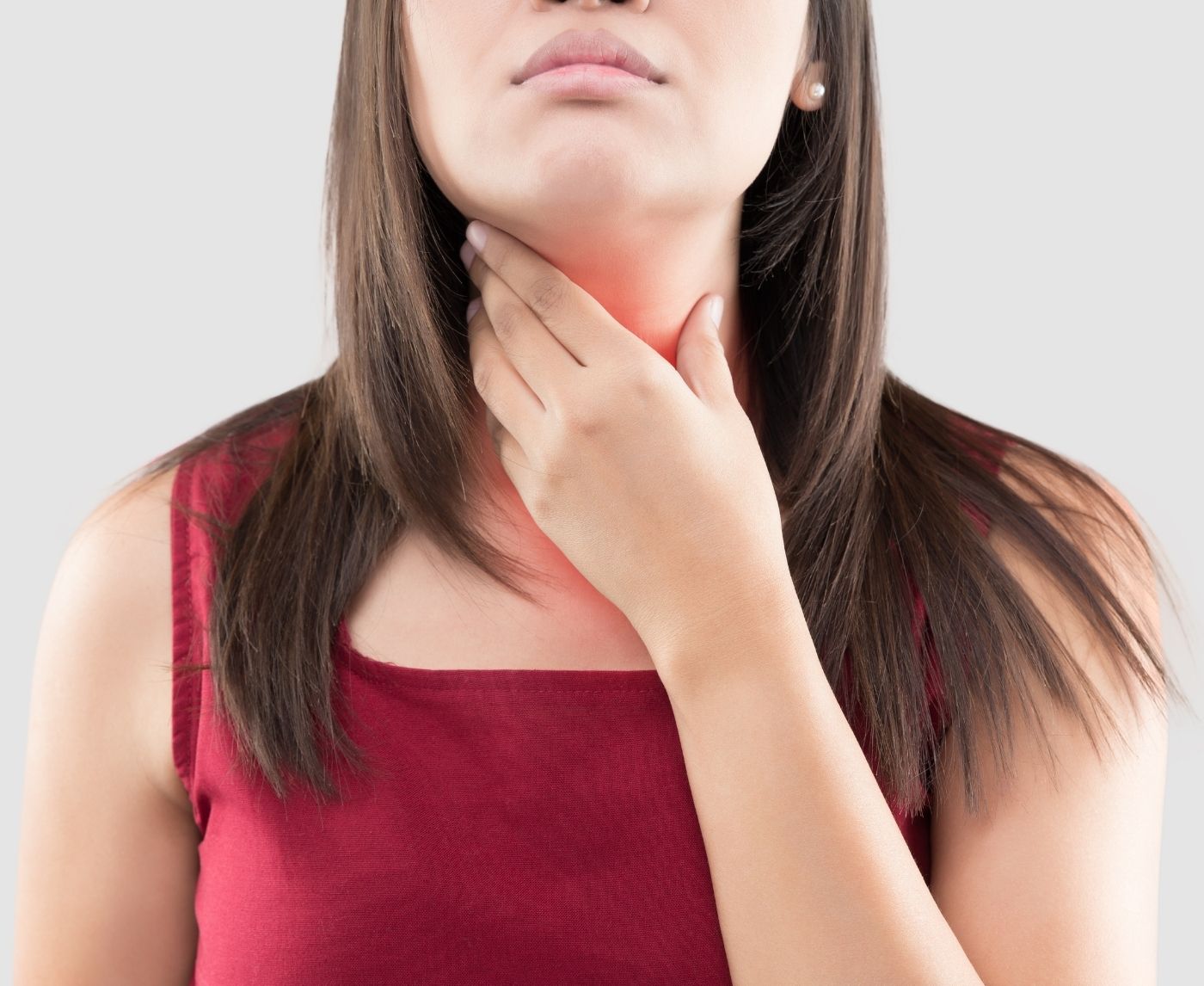
White spots at the back of your throat after oral sex can feel alarming. Before going further, here is the most reassuring fact: most white spots are not caused by a sexually transmitted infection. The usual culprits are everyday throat conditions like strep throat, tonsil stones, oral thrush, and viral sore throats. Oral STIs are real and worth understanding, but they sit lower on the probability list than most people fear.
This guide walks through what white spots can mean, when they suggest an oral STI, and how to find out what is actually happening. It also covers something a lot of sites gloss over: we sell at-home rapid tests for sexual health, but we do not sell throat-swab tests. If your worry is specifically about your throat, a clinic test is the right answer for that one swab. We can help with the rest of the testing the same exposure event raises, and we will explain how that works.
Key Takeaways
- Most white spots in the throat are not STIs. Strep throat, tonsil stones, oral thrush, and viral pharyngitis are far more common explanations.
- If spots persist beyond a week, appear with a painless ulcer or fever, or follow recent oral sex with a new partner, ask a clinician for a throat NAAT/PCR swab.
What White Spots in the Throat Actually Mean
The back of the throat is a busy place. The tonsils, the soft palate, and the posterior pharyngeal wall sit close together, all covered in mucous membrane, all exposed to whatever passes through your mouth on a given day. White spots, patches, or specks can be deposits of pus, food particles caught in the crypts on your tonsils, a fungal overgrowth, or in less common cases, sores from a viral or bacterial infection that arrived during oral sex.
The first thing clinicians want to know is what the spots look like and how they are behaving. A scattering of small white dots that come and go is very different from a single deep ulcer that has been there for two weeks. Discharge that wipes off with a tongue depressor, flat lesions that do not budge, raised blisters that hurt, painless ulcers that do not, each of these patterns points toward a different cause.
- Wipes off vs. fixed: creamy coating that comes off with a tongue depressor suggests thrush; patches that stay put suggest bacterial exudate or tissue change.
- Painful vs. painless: herpes and strep tend to hurt; a primary syphilis chancre is classically painless.
- Clustered blisters vs. single ulcer vs. patchy coating: blister clusters point to herpes, a solitary firm ulcer points to syphilis, patchy yellow-white exudate points to bacterial infection.
- How long it has been there: anything lasting more than 7 to 10 days deserves a clinical look.
The Most Likely Cause: It Probably Is Not an STI
Before walking through sexually transmitted causes, it helps to know the baseline. The vast majority of white spots in the throat come from causes that have nothing to do with sex. Knowing them by name takes some of the anxiety out of looking in the mirror.
Strep throat is caused by group A streptococcus bacteria. It often produces white or yellow patches on the tonsils, fever, painful swallowing, and tender lymph nodes in the neck. Per the CDC, strep is most common in school-aged children, though adults catch it too.
Tonsil stones (tonsilloliths) are calcified deposits that collect in the crypts on the tonsils. They look like firm white or yellowish lumps and often produce bad breath. They are harmless and can be gently dislodged with gargling or a cotton swab.
Oral thrush is a yeast infection caused by Candida overgrowth. It tends to appear as a creamy, cottage-cheese-like coating on the tongue, inner cheeks, or roof of the mouth, and is more common after antibiotic use, in people with diabetes, or in anyone whose immune system is suppressed.
Viral pharyngitis, a sore throat caused by a common cold or flu virus, can produce spots and patchy redness without involving any sexually transmitted organism. Mononucleosis, caused by Epstein-Barr virus, is especially known for producing dramatic white tonsillar patches and prolonged fatigue.
| Condition | Typical Throat Appearance | Common Clue |
|---|---|---|
| Strep throat | White or yellow patches on tonsils, red throat | Fever, painful swallowing, tender neck nodes |
| Tonsil stones | Firm white or yellow lumps in tonsil crypts | Bad breath, lumps can be gently dislodged |
| Oral thrush | Creamy cottage-cheese coating on tongue or cheeks | Recent antibiotic use, weakened immunity |
| Viral pharyngitis | Patchy redness with or without spots | Cold symptoms, runny nose, cough |
| Mononucleosis | Dramatic thick white tonsillar exudate | Profound fatigue, swollen glands, fever |
When White Spots in the Throat Are Actually an STI
Several sexually transmitted infections can present in the mouth or throat, although none of them produce a single signature appearance you can identify by eye alone. The clinical picture varies, and many people have no visible symptoms at all even when an infection is present.
Oropharyngeal gonorrhea is the most common bacterial throat STI. It can cause a sore throat, redness, mild swelling, or sometimes patchy white or yellowish exudate on the tonsils. The CDC's 2021 STI Treatment Guidelines note that pharyngeal gonococcal infection is often asymptomatic, which is one of the reasons routine screening is recommended for people who have receptive oral sex with new or multiple partners.
Oral syphilis can show up as a chancre: a single round, firm, usually painless ulcer that develops at the site of contact. The CDC's syphilis overview describes the primary sore as classically firm, round, and painless, lasting 3 to 6 weeks before healing on its own whether or not treatment occurs. On the lips or tongue, a chancre can look like a canker sore that just will not heal. Later stages of syphilis can also produce mucous patches inside the mouth.
Oral herpes (most often HSV-1, sometimes HSV-2) usually produces clusters of small painful blisters that break open into shallow ulcers and crust over. Outbreaks are commonly preceded by a tingling or burning sensation. The blisters are typically on the lips, but they can occur inside the mouth and at the back of the throat during a primary infection.
Oropharyngeal chlamydia is far less common than throat gonorrhea and usually produces no symptoms at all. When it does, the picture is non-specific: a mild sore throat with no other features. It is more often discovered by routine throat swab than by anyone noticing anything in particular.
| Infection | Possible Throat or Mouth Appearance | Notes |
|---|---|---|
| Oropharyngeal gonorrhea | Sore throat, redness, mild swelling, sometimes patchy white or yellow exudate | Often asymptomatic |
| Oropharyngeal chlamydia | Mild sore throat or no symptoms | Far less common than throat gonorrhea |
| Oral syphilis (primary) | Single firm, painless ulcer (chancre), sometimes with a gray or white base | Sore lasts 3 to 6 weeks and heals on its own with or without treatment |
| Oral herpes (HSV-1 or HSV-2) | Clusters of small painful blisters that ulcerate and crust | Often preceded by tingling or burning |
Why Oral Gonorrhea Is Often Silent
Oral gonorrhea deserves its own paragraph because clinicians spot it more often than people expect, and they spot it more often than the people who have it spot it themselves. Neisseria gonorrhoeae colonizes the back of the throat readily, but it does not always trigger a noticeable immune response there. Many infections sit quietly for weeks or months, contributing to onward transmission without anyone realizing.
The reasons matter for public-health policy. Untreated pharyngeal gonorrhea is one of the contexts where antibiotic resistance has been evolving fastest, partly because throat tissue is regularly exposed to low background antibiotic levels from prescriptions for unrelated infections, which selects for resistant strains. That is why the CDC's gonorrhea treatment guideline singles pharyngeal infection out as a category requiring a confirmatory test of cure 7 to 14 days after treatment.
Pharyngeal gonococcal infection is often asymptomatic.
Timing: When Symptoms Show Up After Exposure
Incubation periods (the gap between exposure and the first signs of infection) vary by organism. Knowing the typical timing can help you interpret a symptom, although timing alone is never enough to confirm or rule anything out. Many people with throat infections do not develop symptoms within the typical window at all; some never do.
| Infection | Earliest Reliable Test Window | Preferred Test |
|---|---|---|
| Gonorrhea (throat) | About 7 to 14 days after exposure | Throat swab NAAT/PCR (clinic-collected) |
| Chlamydia (throat) | About 7 to 14 days after exposure | Throat swab NAAT/PCR (clinic-collected) |
| Syphilis | 3 weeks, most reliable by 6 to 12 weeks | Blood test (RPR or treponemal) |
| HIV (antigen/antibody) | 18 to 45 days for most infections; 90 days for full reliability | Antigen/antibody lab test (blood from a vein) |
| Herpes (HSV antibodies) | Up to 12 weeks for full seroconversion | Blood antibody test, or lesion swab if a sore is active |
When to See a Clinician
Most sore throats clear on their own and do not need a clinic visit. Certain features make a visit worthwhile, especially if oral sex has been part of your recent history. The useful question is whether the clinical picture suggests something a swab or lab test can confirm.
Schedule a visit if:
- White spots, sores, or patches in your throat or mouth persist beyond seven to ten days.
- A single painless ulcer appears and does not heal.
- You have a fever above 38.5 C (101.3 F) along with throat symptoms.
- You have severe pain, trouble swallowing, or trouble breathing.
- You had recent oral sex with a new partner whose STI status you do not know.
- A partner has tested positive for an STI.
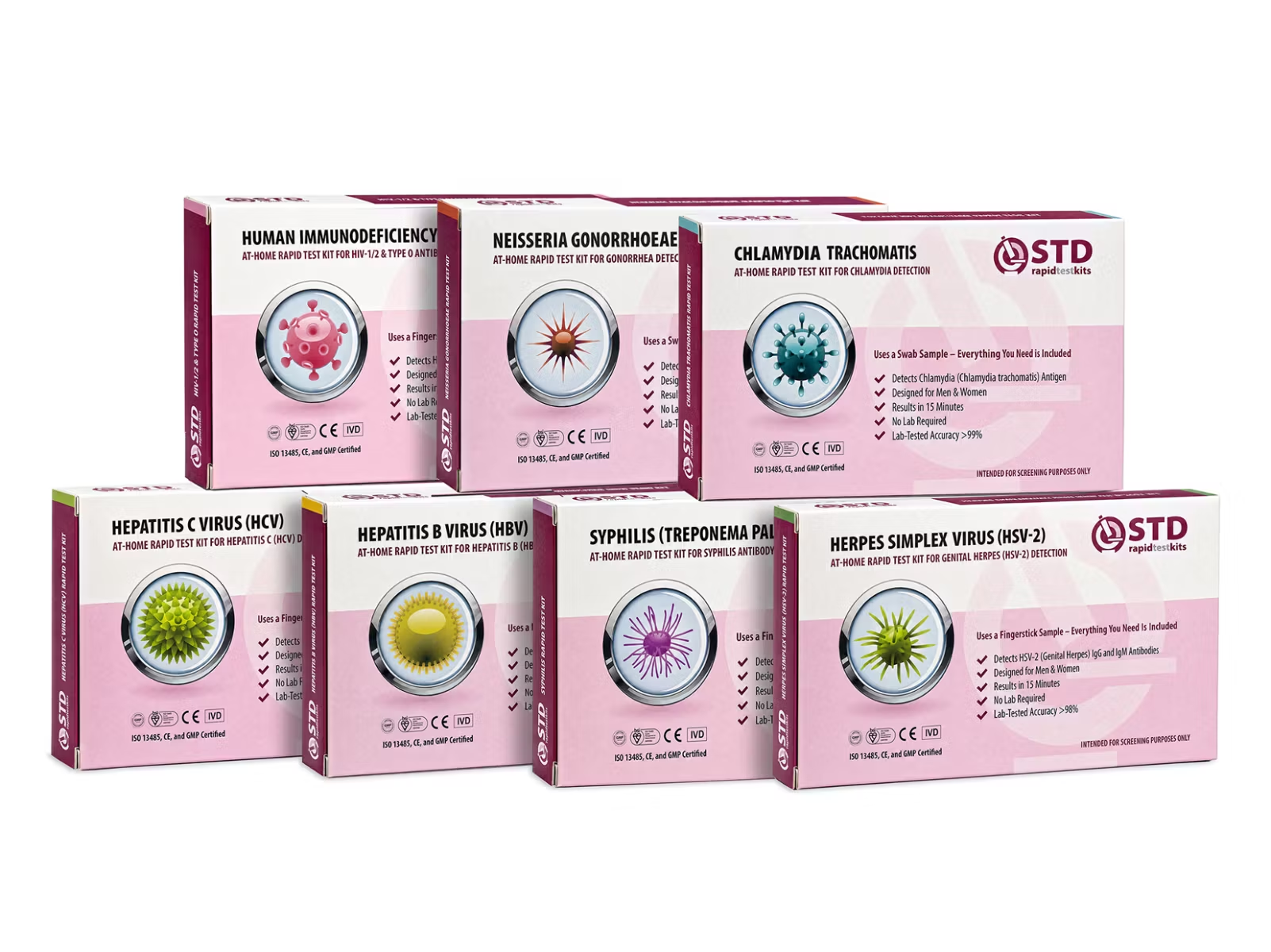
The right test for the throat itself is a swab collected by a clinician. The sample is run through nucleic acid amplification testing (NAAT or PCR), which has very high sensitivity for both gonorrhea and chlamydia. This is the gold standard recommended by the CDC's STI Treatment Guidelines.
You have severe trouble swallowing, drooling because you cannot manage saliva, a muffled or hot-potato voice, swelling that affects breathing, or a high fever combined with a stiff neck. These can indicate complications like peritonsillar abscess or meningitis, which are not STI-related but need same-day care.
How Throat Testing Actually Works (and What We Sell)
For an oral STI investigation, the test that matters most is a throat swab analyzed by NAAT or PCR. A clinician runs a sterile cotton-tipped swab across the tonsils and the back wall of the pharynx, the sample goes to a lab, and results come back within a few days. It is a quick procedure with very high accuracy, and it is the only way to confirm pharyngeal gonorrhea or chlamydia.
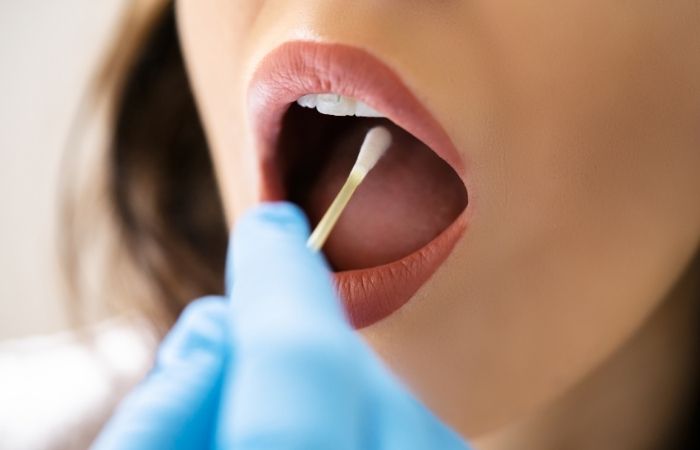
We do not sell an at-home throat-swab kit. The current at-home STI testing landscape, including our own catalog, focuses on genital self-swabs (for chlamydia, gonorrhea, trichomoniasis, and HPV) and fingerstick blood tests (for HIV, syphilis, hepatitis B, hepatitis C, and herpes antibodies). Oropharyngeal swab collection is harder to standardize at home, and clinical performance data is stronger for samples collected by trained staff. If your concern is throat-specific, a sexual-health clinic, primary-care doctor, or local urgent care can run that swab. Many public clinics offer it free or at low cost.
Beyond the Throat: Testing the Rest of the Exposure
This is the part most articles skip. If you had unprotected oral sex with a partner whose status you do not know, the resulting infection risk is not limited to your throat. A single encounter can transmit infections through several routes, and any other body site that was exposed deserves consideration too. Blood-borne infections (HIV, syphilis, hepatitis B and C) are tested through a blood sample regardless of where the exposure occurred. Genital infections, if there was genital contact, are tested by genital swab. Our home kits are designed to answer exactly those questions.
HIV is the fear that brings most readers to a page like this, so it is worth a paragraph of its own. Transmission through oral sex is possible but carries substantially lower per-act risk than receptive anal or vaginal sex. The CDC characterizes the per-act risk from oral sex as low compared with other sexual exposures, and the agency's HIV testing guidance applies regardless of which body site was exposed because the test is looking for the virus or your immune response in the blood. Risk rises when either partner has oral ulcers, recently bleeding gums, a sexually transmitted infection alongside HIV, or a high viral load.
Whichever single-infection test or combo panel you choose, the testing window matters. Bacterial infections like gonorrhea and chlamydia generally become detectable about 7 to 14 days after exposure. Syphilis blood tests are most reliable from 3 weeks onward, with the highest sensitivity by 6 to 12 weeks. The CDC notes that an antigen/antibody HIV test using blood drawn from a vein can detect most infections by 45 days, while antibody-only rapid tests have longer windows, with most results reliable by 90 days. Testing too early in any window can produce false negatives.
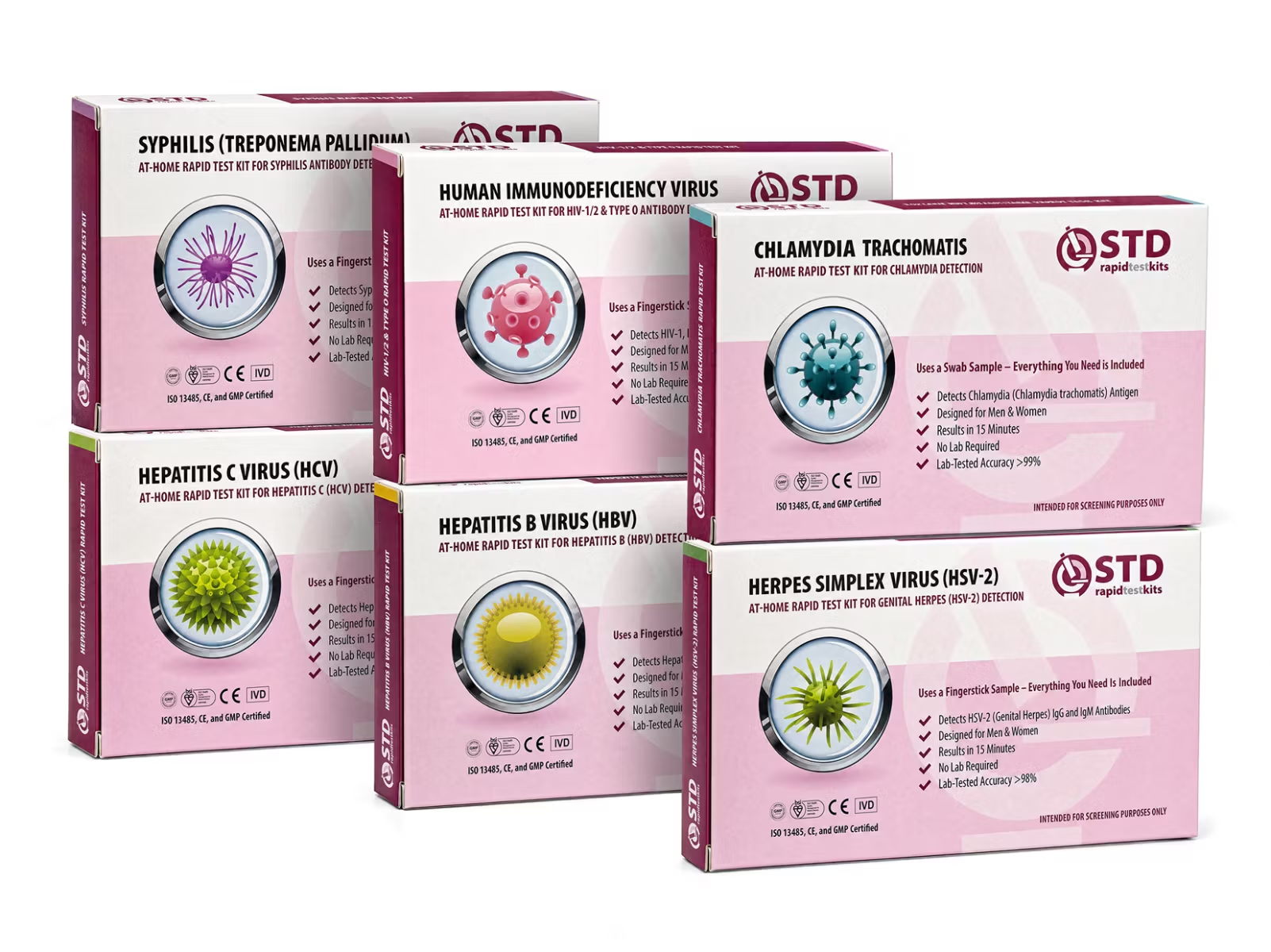
The combo kit below is designed for this situation: you want to screen the full panel without scheduling four separate tests. The kit uses a mix of fingerstick blood draws and genital self-swabs; instructions are step-by-step inside the box.
Treatment for Oral STIs
Treatment is straightforward and effective for every oral STI on this list. Bacterial infections (gonorrhea, chlamydia, syphilis) are cured with antibiotics. Per the CDC's current gonorrhea guideline, the recommended regimen for pharyngeal gonorrhea is a single 500 mg dose of intramuscular ceftriaxone, with a follow-up test of cure 7 to 14 days later to confirm clearance, because pharyngeal infection is harder to eradicate than genital. Chlamydia is treated with a 7-day course of doxycycline. Syphilis is treated with intramuscular penicillin G; the number of doses depends on the stage.
Oral herpes is managed rather than cured. Antiviral medications (acyclovir, valacyclovir, famciclovir) shorten outbreaks and reduce transmission risk. Most people experience fewer recurrences over time, and many go years between outbreaks once the initial infection has resolved.
The most important practical point: treating early protects partners. Untreated bacterial STIs continue to spread silently while the infected person feels fine, and partner notification is part of the standard treatment plan so anyone exposed can be tested and offered treatment too.
Treatment regimens at a glance
- Pharyngeal gonorrhea: single 500 mg intramuscular ceftriaxone dose; test of cure at 7 to 14 days.
- Chlamydia: 7-day course of doxycycline 100 mg twice daily.
- Syphilis: intramuscular penicillin G; number of doses depends on stage.
- Oral herpes: antivirals (acyclovir, valacyclovir, or famciclovir) to shorten outbreaks and lower transmission risk.
Bottom Line
White spots in your throat after oral sex are almost always something other than an STI. Strep throat, tonsil stones, viral pharyngitis, and oral thrush account for the overwhelming majority of cases. When white spots do turn out to be sexually transmitted, gonorrhea is the most likely culprit, and a clinic-administered throat swab is the test that confirms it.
Beyond the throat itself, the right move after any sexual encounter that worries you is to screen for the broader panel of STIs that share the same exposure event. Our at-home rapid kits cover the genital and blood-borne side of the picture; a clinic visit covers the throat. Either way, the testing windows above tell you when to act and what to book.
- If your concern is specifically the throat: book an appointment with a sexual-health clinic, primary-care provider, or urgent care for a clinician-collected throat NAAT/PCR swab. Many public clinics offer it free or at low cost.
- For the broader genital and blood-borne picture from the same exposure: use one of our at-home rapid panels (the 6-in-1 or 7-in-1 above) once you are inside the relevant test window for each infection.
Frequently Asked Questions
- Can white spots in my throat actually be an STI?
- Yes, but it is not the most likely cause. Most white spots come from strep throat, tonsil stones, oral thrush, or viral infections like mononucleosis. When they are caused by an STI, oropharyngeal gonorrhea is by far the most common possibility, followed less commonly by syphilis or herpes. The only reliable way to know is a throat swab analyzed at a lab.
- What STI causes white spots in the throat?
- Oral gonorrhea is the most common STI that can produce visible patchy white or yellowish material on the tonsils. Oral syphilis can produce a single firm painless ulcer (chancre), sometimes with a white or gray base. Herpes produces clusters of small blisters that crust over rather than coating areas with a flat white patch.
- Can you have an oral STI in your throat with no symptoms?
- Yes, frequently. The CDC notes that pharyngeal gonococcal infection is often asymptomatic. Pharyngeal chlamydia is also usually silent. That is why guidelines recommend periodic throat screening for anyone who has receptive oral sex with new or multiple partners, regardless of symptoms.
- Do you sell at-home throat-swab STI tests?
- No. Our catalog covers genital self-swab tests and fingerstick blood tests; we do not sell an at-home throat swab. Oropharyngeal sample collection has lower clinical performance when self-collected, so we recommend seeing a sexual-health clinic, primary-care doctor, or urgent care for a throat swab. Our kits can cover the blood-borne and genital infections that the same exposure event also raises.
- How long after oral sex should I get tested?
- It depends on the infection. Throat gonorrhea and chlamydia are usually detectable about 7 to 14 days after exposure by NAAT or PCR. Syphilis blood tests can turn positive from about 3 weeks after exposure but are most reliable by 6 to 12 weeks; testing before 6 weeks may miss some infections. Antigen/antibody HIV tests using blood drawn from a vein detect most infections by 45 days, with full reliability by 90 days. Testing too early in any window can return a false negative.
- If a sore throat shows up two days after oral sex, is it an STI?
- Probably not, simply by timing. Gonorrhea's earliest symptom window is 2 to 7 days, but most fast-onset sore throats are viral, related to dry air or environmental irritation, or strep. If the soreness persists past a week or appears alongside other red flags (a painless ulcer, swollen glands, fever, or a new sexual partner with unknown STI status), see a clinician for a throat swab.
- Do condoms or dental dams prevent oral STIs?
- Yes, when used consistently. Condoms during fellatio and dental dams during cunnilingus or analingus block direct mucosal contact, which is how most oral STIs transmit. Per the CDC, barrier methods significantly reduce risk of throat infection, although they do not eliminate it entirely for skin-to-skin viruses like HSV when uncovered skin still touches.
- Can oral STIs go away on their own?
- Bacterial STIs (gonorrhea, chlamydia, syphilis) do not reliably clear without antibiotics. They can persist silently for weeks or months and remain transmissible. Oral herpes outbreaks resolve on their own, but the virus stays in the body for life; antivirals shorten outbreaks and reduce transmission risk.
Our article was constructed based on current advice from the most prominent public health and medical organizations (CDC, WHO, NHS, Mayo Clinic), and then molded into simple language based on the situations that people actually experience. We pay particular attention to where home rapid testing fits in the overall STI testing picture, and we are explicit about the boundaries of what at-home kits can and cannot answer. For oropharyngeal swab questions specifically, the gold-standard test is a clinician-collected NAAT or PCR swab, which is not a service we offer.
- U.S. Centers for Disease Control and Prevention. 2021 Sexually Transmitted Infections Treatment Guidelines, including gonorrhea treatment and management of pharyngeal infection.
- U.S. Centers for Disease Control and Prevention. About Gonorrhea: transmission routes, symptom profile, throat infection and testing availability.
- U.S. Centers for Disease Control and Prevention. About Syphilis: stages of syphilis and characteristics of the primary chancre.
- U.S. Centers for Disease Control and Prevention. HIV testing windows, recommended test types, and antigen/antibody lab testing guidance.
- U.S. Centers for Disease Control and Prevention. Group A Strep: strep throat symptoms and age distribution.
- NHS. Gonorrhoea overview: symptoms, throat infection, treatment.
- World Health Organization. Sexually transmitted infections fact sheet: global prevalence, screening, treatment recommendations.
