






Quick Answer: You can test for high-risk strains of HPV at home using FDA-authorized self-sampling kits, but these are currently only approved for cervix-bearing individuals and should follow proper timing guidelines for accuracy.
Why People Are Turning to At-Home HPV Tests
We live in an era of self-checkout, self-diagnosis, and self-care, and STD testing is no exception. But HPV is a tricky one. Unlike chlamydia or gonorrhea, which can show up in urine samples or throat swabs, HPV usually doesn’t cause any noticeable symptoms. That means most people only discover it during routine screenings, or after it’s already caused problems like genital warts or abnormal cervical cells.
That’s where at-home HPV testing enters the chat. The appeal is obvious: you avoid the stirrups, the awkward small talk with a stranger while your legs are in the air, and the calendar gymnastics of trying to book a gynecologist weeks out. You get a test shipped discreetly to your door, collect a sample in private, and mail it back. But is it really that simple?
For many people, yes. But for others, especially those without a cervix, or those at risk for oral or anal HPV, the story gets more complicated. And then there’s the matter of accuracy, timing, and the emotional weight of getting a result without anyone to explain what it means.
What Types of At-Home HPV Tests Are Available?
Right now, most at-home HPV testing kits on the market are self-collection kits that detect high-risk strains of the virus from vaginal or cervical samples. That means they’re designed for people with a cervix. You take the sample yourself, usually with a soft brush or swab, and send it to a lab for analysis. Results come back in a few days via an online portal, email, or sometimes even text.
There are also mail-in kits that test for multiple STDs at once, including HPV. These may include finger-prick blood tests and swabs for other infections, but they still rely on cervical or vaginal sampling for HPV. None of these are true “rapid” tests like you’d see for COVID or HIV. The sample has to be processed in a lab. But they are home-based and often more private than going to a clinic.
Here’s a breakdown of what’s out there right now:
| Test Type | Sample Method | Who It's For | Turnaround Time |
|---|---|---|---|
| Self-collected HPV test | Vaginal/cervical swab | People with a cervix | 3–7 days (lab processed) |
| Multi-STD mail-in test | Blood + vaginal swab | Anyone at risk for multiple STDs | 5–10 days |
| Clinic-based Pap + HPV co-test | Cervical brush (done by provider) | People with a cervix, especially 25–65 years old | Depends on clinic/lab |
Figure 1. Summary of HPV testing options and their use cases.
As of late 2023, the FDA has approved a few self-collection devices for HPV testing, but they’re all lab-processed, not rapid-result. That means while you can collect the sample yourself, you still need to send it in for processing. Direct-to-consumer HPV tests are real, but they’re not instant.

People are also reading: Did They Cheat, or Did I Just Get Chlamydia Again?
Are At-Home HPV Tests Accurate?
Short answer: Yes, for the right people, at the right time, using the right method. But this isn’t a yes-or-no equation. Accuracy depends on how well you collect the sample, how recently you were exposed, and whether the virus is currently detectable in the area you're sampling from.
Let’s take a look at how different tests stack up on sensitivity (how well they detect HPV when it’s present) and specificity (how well they avoid false alarms).
| Test Type | Sensitivity (True Positives) | Specificity (True Negatives) | Notes |
|---|---|---|---|
| Self-collected HPV test (vaginal swab) | ~88–94% | ~85–90% | Comparable to Pap in high-risk detection |
| Clinician-collected HPV test | ~90–97% | ~90–95% | Gold standard, especially when paired with Pap |
Figure 2. Sensitivity and specificity estimates for HPV detection (based on large-scale comparative studies).
Some studies published in JAMA and NIH research show that self-collected HPV tests are nearly as accurate as those collected in clinics, especially for detecting high-risk strains like HPV-16 and HPV-18, which are most linked to cervical cancer. The key is proper sample collection, which many kits support with diagrams or video instructions.
Still, at-home tests are not a full replacement for in-person care. They don’t detect abnormal cervical cells the way a Pap smear can, and they may miss HPV infections in the mouth, throat, or anus if those sites aren’t sampled.
Check Your STD Status in Minutes
Test at Home with RemediumPapillomavirus (HPV) Test
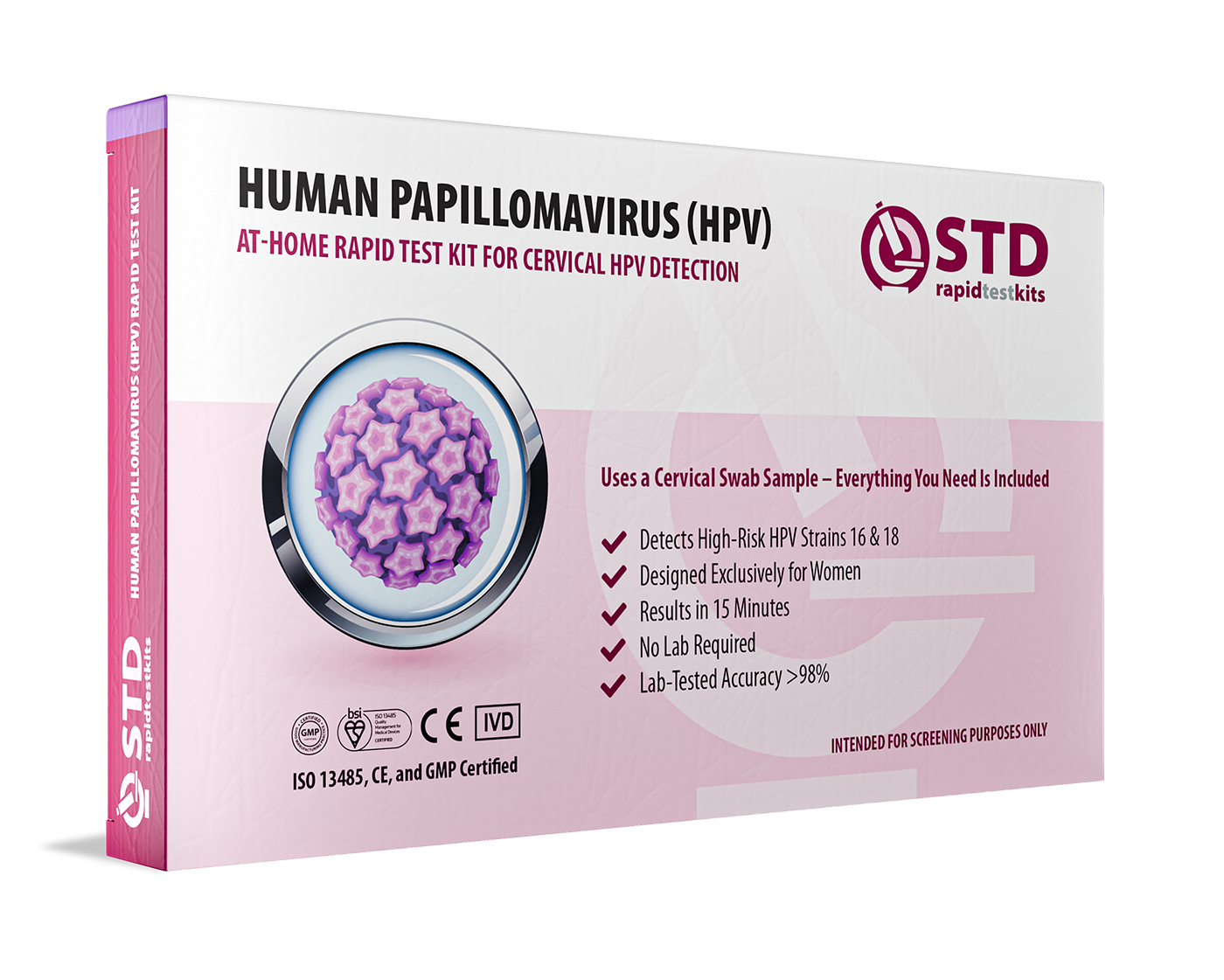
 For Women
 Results in Minutes
 No Lab Needed
 Private & Discreet
Order Now $33.99 $49.00
So, Should You Use an At-Home HPV Test?
It depends. If you’re a person with a cervix between the ages of 25 and 65 who struggles to get regular Pap tests, because of trauma, access, cost, time, or simply discomfort, then yes, an at-home HPV test can be a powerful tool. It gives you agency. It respects your privacy. And it’s a hell of a lot better than putting off screening entirely.
But it’s not for everyone, and that’s okay. If you’ve had abnormal Pap results in the past, you should stick with clinical follow-ups. If you're at high risk for anal or oral HPV, you may need additional tests that at-home kits don’t provide. And if you’re someone who needs emotional support with medical information, someone who spirals after reading "positive" on a screen, then consider using these kits in tandem with a provider you trust.
Think of these kits like home pregnancy tests. They’re useful, accessible, and often very accurate. But they’re not the end of the story, they’re the beginning. A starting point. A way to ask the next question, make the next call, or take the next step. If your head keeps spinning, peace of mind is one test away.
What If You Test Positive? Steps Without Panic
When Anna got her results, she didn’t know what to do. High-risk HPV. No details. No next steps. Just a PDF and a pit in her stomach. She thought about ghosting the info, pretending it never happened. But a week later, she called a local women’s clinic and booked a follow-up. Turns out, she didn’t have abnormal cells. Just a positive test, and a reminder to check back in a year.
This happens more than you think. A positive result doesn’t mean you’re broken. It doesn’t mean you’re sick. It means your body picked up a virus that most sexually active adults encounter at some point. It also means you now have the information, and the power, to monitor your health more closely.
If you test positive, here’s what usually comes next (narratively speaking, not as medical advice): you schedule a Pap or follow-up HPV co-test through a local clinic or telehealth platform. They may suggest a colposcopy if you’ve had abnormal results in the past. You might feel anxious, embarrassed, or confused. But you’ll walk away with a plan, and that’s where the fear starts to loosen its grip.
And if you’ve tested positive, you might be wondering about your partner. Do you tell them? Should they get tested? Will they blame you? Let’s talk about that next.
Telling Your Partner (Or Not): You Get to Decide
This is where things get real. HPV is unique among STDs because there’s no routine screening for people without a cervix, and no easy way to pinpoint when or from whom someone got it. That makes disclosure messy. And heavy.
But here’s the thing: disclosure isn’t just about guilt, it’s about care. If your partner has a cervix and hasn’t had a Pap or HPV test recently, your positive result might be the nudge they need to check in with their provider. If your partner has no cervix but engages in high-risk sex, they may want to discuss anal or throat screening.
There’s no one right script. You can keep it short: “I just got my HPV test back and it was positive. I’m following up with a provider, and I thought you should know.” Or you can keep it quiet, especially if the relationship is over and there’s no ongoing contact. Just remember, you’re not dirty. You’re not dangerous. You’re just informed. And that’s a gift, even if it feels like a burden at first.

People are also reading: Is My Test Wrong, or Is Something Still Going On?
Why This Isn’t Just About a Test
Let’s be honest, most people don’t Google HPV because they’re curious. They do it because something feels off. Or scary. Or unclear. Maybe their ex tested positive. Maybe a new partner asked the dreaded “when were you last tested?” Maybe they saw a TikTok about cancer risks and it set off a spiral. HPV lives in the shadows of all those little doubts, and testing, especially at home, shines a flashlight into the dark.
But the flashlight isn’t perfect. It’s shaped by anatomy, access, and a healthcare system that still centers some bodies more than others. If you’ve got a cervix, there are options, and they’re getting better. If you don’t, the gaps are glaring. And if you fall somewhere outside the binary, you’ve probably already felt the medical system look right past you. That’s why at-home testing matters. Not just for convenience, but for autonomy.
Still, autonomy without information can backfire. A test you don’t understand can feel worse than no test at all. That’s why we’ve written this entire guide, not to scare you, but to walk with you through the fog. To say: here’s what this result means. Here’s what it doesn’t. And here’s what you can do next, even if the next thing is just giving yourself a day to breathe.
Because here’s the truth, HPV is common. Nearly everyone who has sex will encounter it. And most people will never even know they had it. Your worth, your future, your health, they aren’t defined by a positive or a negative on a lab result. They’re shaped by what you choose to do with that information.
So if you’re here wondering whether you should get tested, whether you can do it at home, and whether the result will change everything, start with this: You deserve to know. Not because you're dirty. Not because you're broken. Because you're human. Because you care. And because taking that test, whatever it says, is an act of self-respect.
Whether you're swabbing alone in your bathroom or sitting in a clinic waiting room with sweaty palms, the point is the same. You’re showing up. You’re choosing truth over fear. And that’s one of the bravest things anyone can do.
If now feels like the right time, we’ve got tools to help. Order an FDA-authorized HPV test kit, read through your results with care, and follow up when it counts. And if you need a little more time before you swab, that’s okay too. This article will be here when you’re ready.
Take your time. Take the test. Take your power back.
FAQs
1. Can you really test for HPV at home?
Yes, and for a lot of people, it’s a game-changer. You can swab yourself in the privacy of your own space, mail it off, and get results without stepping foot in a clinic. The catch? These tests are only FDA-authorized for folks with a cervix, and they don’t give instant results, they still go to a lab. So yes, it’s real. But no, it’s not a pregnancy test style stick you pee on.
2. Are these tests as good as going to the doctor?
For high-risk HPV detection? Almost. The science shows self-swabs catch most of what clinic swabs do. But Pap smears also look for cellular changes, meaning they can see if HPV has already started messing with your cells. So if you're due for a Pap, don’t skip it. But if you're avoiding the stirrups like the plague, this is a solid step forward.
3. How soon after sex can I test?
Here’s the hard truth: not right away. HPV takes time to settle into your system. If you test too early, like within a week or two, you might get a false negative. Aim for at least 6 weeks post-exposure for best accuracy, and even then, don’t toss the results in a drawer and forget about them. A follow-up test down the road might still be worth it.
4. Is there a test for HPV in men?
Not really. And yeah, that’s frustrating. Right now, there’s no approved at-home HPV test for people without a cervix. But men, trans women, and nonbinary folks can still carry and pass HPV, especially through oral or anal sex. So even if you can’t swab yourself and send it in, you’re still part of the conversation. Watch for symptoms, get vaccinated if you haven’t, and talk to a provider if you’re high risk.
5. If I had the HPV vaccine, do I still need to test?
Yep. The vaccine is awesome, especially if you got it before becoming sexually active, but it doesn’t protect against every strain. Think of it like wearing a seatbelt. It drastically lowers your risk, but it doesn’t mean you can crash into things without consequence. Regular testing still matters.
6. What do I do if my test is positive?
First: breathe. It doesn’t mean you have cancer. It means the test picked up high-risk HPV DNA. From here, it’s all about follow-up. Schedule a Pap or colposcopy if needed, and don’t let shame drive the car. HPV is ridiculously common. You’re not alone. You’re just informed, and that’s power.
7. Can I get HPV from oral sex?
You sure can. HPV can live in the throat, mouth, and tonsils. There’s no routine screening for oral HPV, but it’s very much a thing. It’s why some people develop head and neck cancers linked to HPV. Using barriers during oral and getting vaccinated are both smart moves if you’re active in that department.
8. Can I trust these home test results?
Generally, yes. As long as you follow the instructions and collect the sample correctly, at-home HPV tests are surprisingly accurate for what they do. But if anything feels off, like the result doesn’t match your risk level or your body’s signals, don’t hesitate to double-check with a clinic test.
9. Do I need to tell my partner if I test positive?
Totally your call. There’s no legal rule about disclosing HPV. But if your partner has a cervix and hasn’t been screened in a while, sharing the info could help them stay ahead of potential risks. It's not about blame, it’s about having each other's backs, even when things feel awkward.
10. Will insurance cover this?
Sometimes. If you're going through a provider or telehealth service that writes a lab order, you might be able to use insurance. But if you're buying a kit directly online, it’s usually out of pocket. Still cheaper than some co-pays, and way more convenient than waiting three weeks for a clinic appointment.
You Deserve Answers, Not Assumptions
Let’s end where we started: in the dark, with the phone in your hand, typing “HPV” into the search bar. You’re not alone. Millions of people each year wonder if they should test, when to test, how to test, and whether their lives will change if they get a positive result.
The truth is, most people who test positive for HPV go on to live totally healthy, complication-free lives. The virus usually clears. Even if it doesn’t, regular monitoring and treatment make cancer prevention highly effective. What matters is awareness. Action. Following up when it counts.
You don't have to guess and Google all the time. You can order this private combo test kit to check for a number of STDs, such as HPV, at home. It's quick, private, and has been shown to work in clinical tests.
Don’t let fear be your compass. Let information be your next move.
How We Sourced This Article: We combined current guidance from leading medical organizations with peer-reviewed research and lived-experience reporting to make this guide practical, compassionate, and accurate.
Sources
1. Planned Parenthood: HPV Testing and Prevention
2. Screening for Cervical Cancer - CDC
3. Self‑Collection for Primary HPV Testing - CDC
4. Human Papillomavirus (HPV) Infection - STI Treatment Guidelines
5. HPV Tests with Self‑Collection in a Health Setting Approved - NCI
6. HPV Testing | Diagnosing HPV - American Cancer Society
7. Cervical Cancer: Screening - U.S. Preventive Services Task Force
9. Self‑Collected Vaginal Specimens for HPV Testing - PMC
About the Author
Dr. F. David, MD is a board-certified infectious disease specialist focused on STI prevention, diagnosis, and treatment. He blends clinical precision with a no-nonsense, sex-positive approach and is committed to expanding access for readers in both urban and off-grid settings.
Reviewed by: K. Murano, NP-C | Last medically reviewed: October 2025
This article is for information only and should not be used as medical advice.


