Published: July 2025 | Last updated: May 2026 | Editorial review and quality control: Martina N.
You finished your chlamydia antibiotics, your symptoms cleared up, and the follow-up test still came back positive. That moment lands hard. The treatment was supposed to work, the partner was supposed to be in the clear, and now the result on the screen says something different from what your body is telling you.
Here is what the science says about a repeat positive after chlamydia treatment, what it usually means, and when a second positive is worth worrying about. The short version is that most repeat positives in the first few weeks after treatment are not failed treatments. They are the test picking up genetic debris that takes time to flush out. The longer version, with the timing, the biology, and the questions to ask a clinician, is below.
Is my chlamydia test wrong, or am I still infected?
If you tested positive within about 3 weeks of finishing antibiotics, the most likely explanation is residual bacterial DNA, not active infection. Modern NAAT (nucleic acid amplification) tests detect chlamydia genetic material whether the bacteria are alive or dead, and the CDC recommends waiting at least 3 weeks before any test of cure to avoid this exact problem. A separate retest at 3 months catches reinfection from an untreated partner, which is the leading cause of true repeat positives later on.
Key Takeaways
- NAAT tests detect chlamydia DNA whether the bacteria are alive or dead, so a positive result inside the 3-week post-treatment window often reflects residual genetic material rather than active infection.
- The CDC's standard guidance is to retest about 3 months after treatment to catch silent reinfection, since untreated partners cause more repeat positives than failed antibiotics do.
How NAAT Tests Actually Work, and Why They Stay Positive Longer Than You Expect
Most chlamydia tests, whether you use a clinic, a hospital lab, or a lab-processed at-home kit, run on a method called nucleic acid amplification testing (NAAT). The test takes a swab or urine sample, isolates any chlamydia genetic material in it, and then copies that material billions of times until it is detectable. The amplification step is what makes NAAT so sensitive: it can find a few copies of bacterial DNA in a sample where older antibody or culture tests would have come up empty.
That sensitivity is also the source of post-treatment confusion. The test does not check whether the chlamydia bacteria are alive. It checks whether their DNA or RNA is present. After a course of doxycycline or azithromycin clears an active infection, the dead bacteria and their genetic remnants do not vanish overnight. Cells flake off, immune cells process the debris, and the body works through it on its own clock.
According to the CDC's STI treatment guidelines, residual chlamydia nucleic acid can stay detectable for two to three weeks after successful treatment in most people, and longer in a small minority. That is why the standard test-of-cure window is at least three weeks, and why a positive result inside that window does not automatically mean the antibiotics failed.
Why a Positive Result After Treatment Often Is Not a Failed Treatment
Three explanations cover the vast majority of confusing repeat positives. They each leave different fingerprints, and sorting them out usually comes down to checking the timing, the symptoms, and the partner situation.
- You tested too soon. The leading cause of confusing post-treatment positives. If you finished antibiotics less than 3 weeks ago and you retested, the result probably reflects leftover bacterial DNA, not living chlamydia.
- You were reinfected by an untreated or under-treated partner. Far more common than treatment failure. If a sex partner was not treated at the same time, or if you had unprotected sex before both partners completed therapy, you can catch chlamydia again from the same person without realizing it.
- The treatment genuinely failed (rare). Standard regimens like doxycycline 100 mg twice daily for 7 days have very high cure rates. Failure is uncommon, and when it happens it usually involves a missed dose, a vomited dose, or an interrupted course rather than antibiotic resistance.
Symptoms, dates, and partner history almost always point to which of these explains a confusing positive. A clean symptom picture, a partner who finished treatment, and a test taken in week 1 or 2 after antibiotics all point strongly toward residual DNA. Returning symptoms or a partner whose treatment status is uncertain push the explanation toward reinfection. A test taken at week 5 or 6 with no other complicating factors deserves a clinical conversation about treatment failure, since by then residual DNA explains less.
Quick triage: which cause is most likely?
- Test was less than 3 weeks after the last antibiotic dose, no symptoms, partner finished treatment: leans heavily toward residual DNA.
- Symptoms returned, or partner was untreated, treated late, or had other partners: leans toward reinfection.
- Test was 5+ weeks after the last antibiotic dose with no obvious reinfection risk: deserves a clinical conversation about treatment failure or a different infection.
When Should You Retest? The Timing That Matters Most
The single most useful number to know after chlamydia treatment is the gap between finishing antibiotics and any follow-up test. The CDC's clinical retesting guidance separates two distinct purposes for retesting, and the timing rules are different for each.
- Test of cure (only if specifically indicated). For non-pregnant adults with uncomplicated chlamydia, routine test of cure is not recommended. If a clinician asks for one, wait at least 3 weeks after completing antibiotics; some clinicians prefer 4 weeks to be conservative. Earlier than that, residual DNA can produce a false-positive NAAT in someone who is fully cured.
- Routine retest at 3 months. The CDC recommends repeat testing about 3 months after treatment for everyone treated for chlamydia, regardless of whether their partner was also treated. The purpose is catching silent reinfection, which is far more common than people expect.
- Earlier retest if symptoms return. If pelvic pain, abnormal discharge, painful urination, postcoital bleeding, or testicular pain come back inside the 3-month window, do not wait for the routine retest. See a clinician and get tested at that point, even if it is sooner than the standard schedule.
Pregnant patients, people with persistent symptoms, and patients treated for complicated infections may have a different schedule, and a clinician's specific advice should override the general timeline.
| Question | Test of cure (3-week test) | Routine retest (3-month test) |
|---|---|---|
| Purpose | Confirm the original infection cleared | Catch silent reinfection from a partner |
| Who needs it | Pregnant patients, complicated infections, or specific clinician request | Everyone treated for chlamydia, including those with no symptoms |
| Earliest reliable timing | At least 3 weeks (some clinicians prefer 4) after last antibiotic dose | About 3 months after treatment ends |
| What an early result means | Inside 3 weeks, a positive likely reflects residual DNA, not failed treatment | An earlier retest may miss a reinfection that has not yet built up to detectable levels |
| When to test sooner | Only on clinician advice | If symptoms come back, regardless of date |
How Long Does Chlamydia DNA Linger in Your Body?
The short version is two to three weeks for most people. The longer version explains why that range exists and why some people clear faster or slower than others.
Doxycycline and azithromycin kill chlamydia bacteria by disrupting protein synthesis or membrane integrity, but neither antibiotic instantly removes the bacterial corpses. The dead organisms stay where they are, in the urethra, cervix, or upper reproductive tract, until the immune system clears them and the affected mucosa sheds and renews. That clearance process is biological, not pharmacological, and it runs on its own schedule.
Several factors push that schedule one direction or the other. Bacterial load at the start of treatment matters: a heavier initial infection leaves more debris to clear. Immune function matters: someone with a healthy clearance response will flush dead organisms faster than someone whose immune system is suppressed. Sample site matters too. Cervical samples and urethral samples can hold residual material slightly longer than urine samples, because the swab picks up cells directly off the mucosal surface where the dead bacteria sit.
None of these factors signal failed antibiotics. They simply explain why a sensitive test sees the residue of a cleared infection. By day 21 in most people, the residual DNA has dropped below the detection threshold even on highly sensitive NAAT platforms.
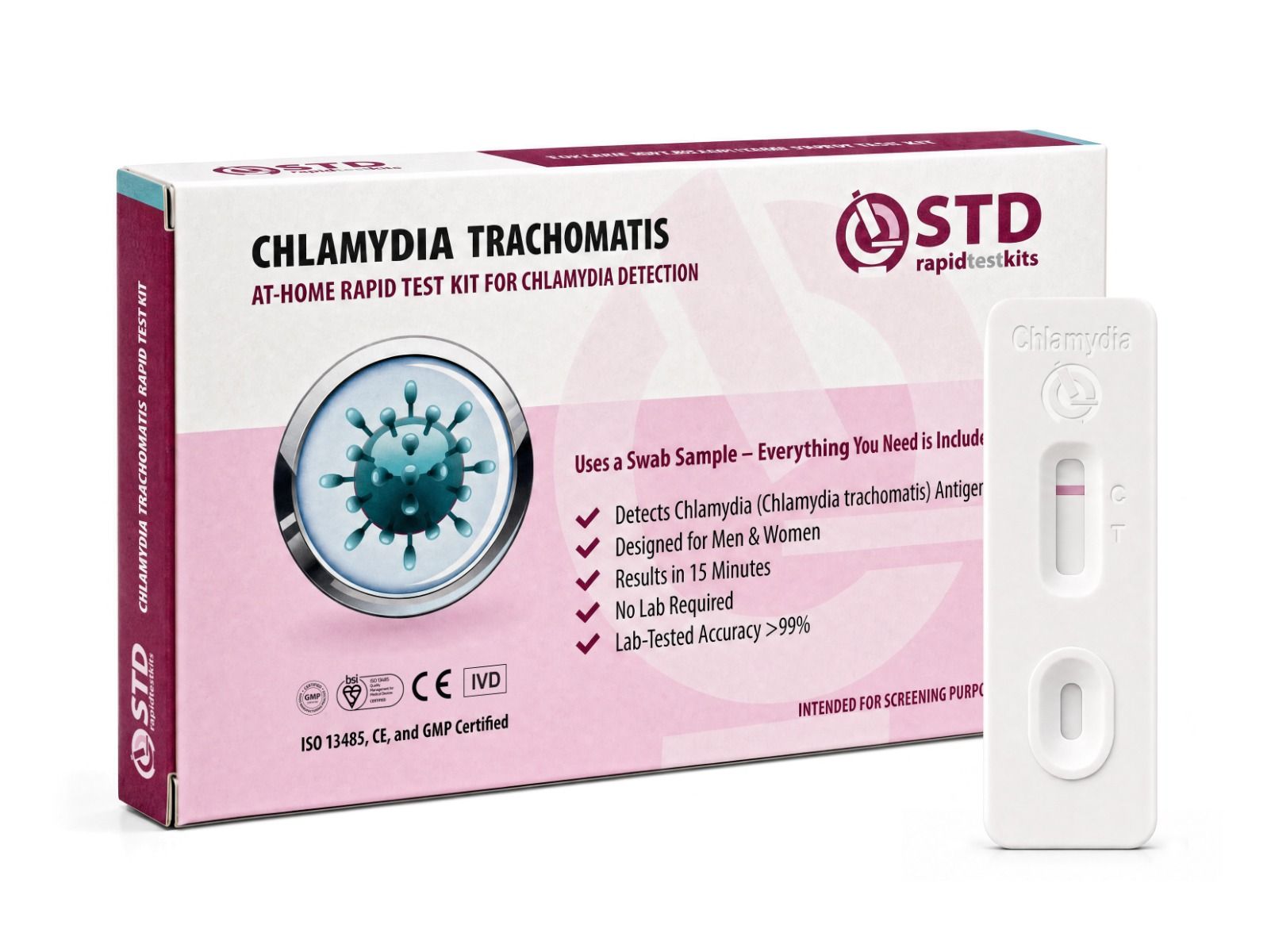
This article is published by stdrapidtestkits.com, which sells at-home STI testing kits. We recommend products based on fit-for-purpose for your situation, not commercial benefit. For test-of-cure conversations specifically, a clinician-ordered lab NAAT after the 3-week mark is the right tool. Our home kits below are designed for initial screening and for routine retesting at the recommended windows.
What a False Positive Actually Means in This Context
The phrase "false positive" gets used loosely. In testing terminology, a true false positive is when the test reports infection in someone who has never had chlamydia, has no current chlamydia DNA, and never did. By that strict definition, false positives on modern NAAT tests are rare. Per the CDC's 2021 STI Treatment Guidelines, NAAT specificity for chlamydia is high (typically reported in the high-90s percent range, depending on the platform and sample type).
What people usually mean by "my test was wrong" is something different. They mean the test reported a positive when no live infection is currently active. That is technically a true positive for genetic material but a meaningless positive for clinical purposes if the cause is residual DNA from a treated infection. The test is performing exactly as designed. Its job is to detect chlamydia DNA in the sample, and that is what it reported. The interpretive question is what that DNA is doing there.
- Residual DNA from a recently treated infection. Far and away the leading cause of confusing post-treatment positives in the 0 to 21 day window.
- True ongoing infection. Either treatment failure, missed doses, or reinfection from an untreated partner.
- Specimen contamination at collection or in the lab. Uncommon with modern handling protocols, but it happens occasionally.
- Cross-reactivity. Rare on current NAAT platforms; some older PCR designs cross-reacted with related bacteria, but most modern assays target chlamydia-specific sequences and avoid this issue.
For someone who has just finished treatment, the first item explains nearly all surprising positives. The remaining three account for a small minority of cases.
True false positive (rare): the test reports chlamydia in someone with no chlamydia DNA in their body at all. On modern NAAT platforms this is uncommon, because the assays target sequences specific to chlamydia.
Residual-DNA positive (common after treatment): the test correctly detects chlamydia DNA, but the bacteria are dead and the infection is cleared. The test is right about the DNA being present; the result is just clinically meaningless if it falls inside the 3-week post-treatment window.
The first is a flaw in the test. The second is the test working as designed and the timing being wrong for the question being asked. Most confusing post-treatment positives are the second kind, not the first.
Window Periods: Why Timing Matters Before Treatment Too
Window periods are the flip side of the post-treatment problem. They are the gap between exposure and the moment a test can reliably detect infection. A negative result inside the window does not rule infection out, just like a positive result inside the post-treatment window does not rule cleared infection out. Both situations come from the same root cause: a sensitive test running into the limits of biology.
- Chlamydia and gonorrhea: detectable on NAAT roughly 1 to 5 days after exposure for many people, but a follow-up test at 2 weeks is often recommended to confirm a true negative.
- HIV: per the CDC's HIV testing guidance, lab-based antigen/antibody tests detect HIV roughly 18 to 45 days after exposure; antibody-only tests detect HIV roughly 23 to 90 days after exposure; nucleic acid (NAT) tests detect HIV roughly 10 to 33 days after exposure.
- Syphilis: blood antibody tests can take up to 12 weeks after exposure to turn positive, since seroconversion is gradual. Some primary chancres are visible at the exposure site before the blood test catches up.
- Herpes (HSV-1 and HSV-2): per the CDC's STI Treatment Guidelines, Genital Herpes section, type-specific blood antibody tests can produce false negatives at early stages of infection, and the CDC recommends repeat testing about 12 weeks after a suspected new exposure to confirm.
- Hepatitis B and C: per the CDC's viral hepatitis testing guidance, antibody and antigen tests typically detect infection within 4 to 12 weeks after exposure, depending on the specific test design and the virus.
If a test was timed inside the window, a negative is not a clean bill of health, just an early read. The fix is the same shape as for post-treatment confusion: retest at the recommended interval and treat the early result as a placeholder, not a verdict.

When Anxiety Mimics Symptoms
Anxiety after a positive result, or in the wait between exposure and the test window opening, can produce sensations that feel exactly like infection symptoms. People notice tingling, mild itching, faint discharge, low-grade discomfort, or a vague sense that something is wrong. The sensations are real. The question is what is causing them.
- Heightened body awareness. Anxiety dials up the brain's attention to internal sensations. Normal background feelings that you would never notice on a regular Tuesday become impossible to ignore when you are checking for symptoms several times a day.
- Nocebo effect. Reading a list of possible symptoms makes those symptoms more likely to be reported, regardless of whether infection is present. The brain expects them, finds candidate sensations, and reports them as confirmation.
- Body-checking behavior. Repeated touching, examining, or watching for symptoms can produce minor irritation, redness, or sensitivity that feels like a symptom worth checking again. The checking creates the thing being checked for.
If the sensations fade between checks and only return during them, anxiety is doing more work than infection. If sensations are persistent, worsening, or accompanied by clear physical signs, retest and see a clinician rather than waiting it out.
Pick one set time of day for a self-check. Do it once. Then deliberately move attention elsewhere for the rest of the day. Track over a week: are sensations only present during checks, or are they steady through the day? Steady sensations, especially with visible rash, abnormal discharge, fever, lymph-node swelling, or painful urination, warrant a clinician visit. Sensations that fade between checks are usually anxiety, not pathology.
When to Push for More Testing or a Second Opinion
Sometimes a post-treatment positive really is meaningful. The combination of timing, symptoms, and partner history can point that direction even before any retest happens.
- Still positive past 4 weeks after treatment. Beyond the standard test-of-cure window, residual DNA explains less and less. A persistent positive at week 5 or 6 deserves clinical evaluation.
- Returning or new symptoms. Pelvic pain, dysuria, postcoital bleeding, abnormal discharge, or testicular pain in the weeks after treatment all warrant a clinic visit, regardless of test results.
- An untreated or reluctant partner. If a sex partner refused treatment, was treated late, or had partners of their own who were not treated, reinfection is the working assumption until proved otherwise.
- Symptoms that do not match chlamydia. Lingering discharge or pelvic pain after treatment may signal a different pathogen entirely (mycoplasma genitalium, ureaplasma, bacterial vaginosis, trichomoniasis) or a non-STI cause. The original test was answering a different question, and a broader workup is reasonable.
Questions worth asking a clinician at this point include what type of test was used, when the last sample was collected, whether a different antibiotic regimen would change the picture, and whether broader testing for non-chlamydia pathogens makes sense. Bringing dates, symptoms, and partner-status notes into the conversation makes the workup faster and the answers more accurate. Advocating for retesting or a different test is not paranoid; it is how patients with persistent symptoms eventually get correctly diagnosed.
For non-pregnant adults with uncomplicated chlamydial infection, test of cure is not routinely recommended. NAATs conducted less than 3 weeks after therapy can yield false-positive results because of the continued presence of dead organisms.
Are At-Home Tests Reliable After Treatment?
For initial diagnosis, lab-processed home test kits and clinic-collected NAATs perform similarly when timing is right. Rapid lateral-flow at-home tests run on different chemistry. They trade some analytical sensitivity for speed and convenience, and the FDA evaluates them on those terms.
For post-treatment use, the same window-period logic applies regardless of where the test is processed. A NAAT, whether collected at a clinic or shipped from a home-collection kit, will pick up residual DNA inside the 3-week post-treatment window. A rapid lateral-flow at-home test is built for screening and initial detection rather than test of cure. Using a rapid screening test inside the post-treatment window can produce the same residual-DNA-driven confusion that a lab NAAT would, with no informational gain.
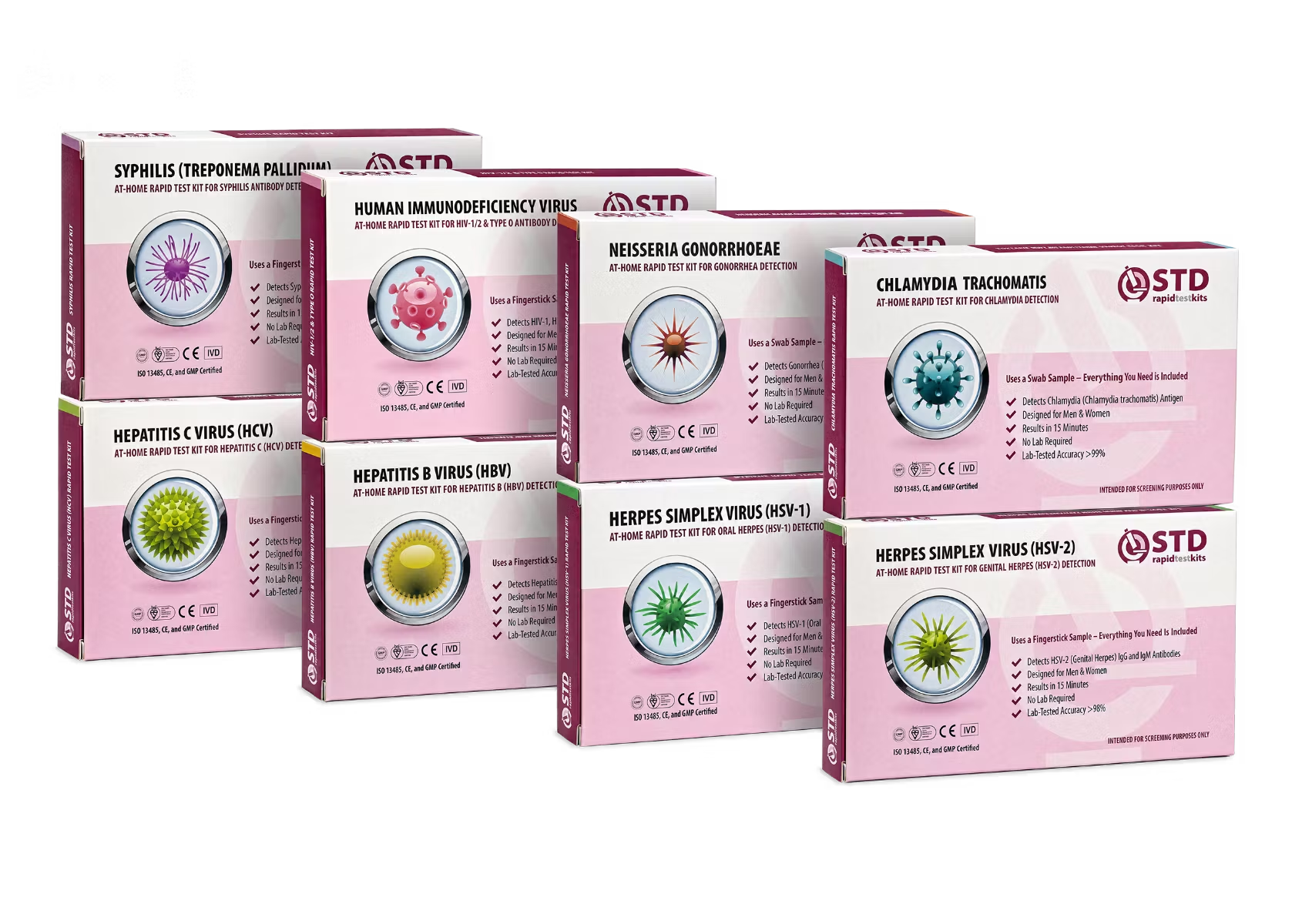
For routine 3-month repeat testing, or for initial screening of a new exposure, an at-home NAAT-collection kit or a rapid screening kit covers the ground at home. For post-antibiotic test-of-cure questions specifically, a clinician-ordered lab NAAT after the 3-week mark is the better tool, because borderline positives benefit from professional review and any retreatment decision should come from a clinician anyway. Combination panels are useful for people who want broader coverage in one shipment, especially partners testing together after a shared exposure.
Frequently Asked Questions
- How soon after antibiotics can I test again for chlamydia?
- For test of cure, wait at least 3 weeks after the last dose of antibiotics. Earlier than that, residual chlamydia DNA can produce a false-positive NAAT in someone who is fully cured. For routine retesting, the CDC recommends a separate test about 3 months post-treatment to catch silent reinfection from an untreated partner.
- Why is my test still positive 2 weeks after I finished my antibiotics?
- Most likely residual chlamydia DNA. NAAT tests detect genetic material whether the bacteria are alive or dead, and dead bacterial debris can stay detectable for 2 to 3 weeks after a successful course of antibiotics. A positive at this point usually does not mean the treatment failed, just that the test is reading the audit trail of the cleared infection.
- Can a NAAT detect dead chlamydia bacteria?
- Yes. NAAT tests amplify and detect chlamydia DNA or RNA, not living organisms. The test cannot distinguish between active infection and recently killed bacteria, which is why timing matters so much for post-treatment retesting and why the standard test-of-cure window is at least 3 weeks.
- Should I take another round of antibiotics if my test is still positive?
- Not automatically. Self-prescribing or asking for a second course before clarifying timing and reinfection status can mean unnecessary antibiotic use. Talk to a provider about the timing of your test, your symptoms, and your partner's treatment status before starting another regimen. The right next step is often to wait for the 3-week mark and retest, not to retreat blindly.
- Could this be reinfection from a partner instead of leftover DNA?
- Yes, and reinfection is more common than people expect. If your partner finished treatment after you did, was not treated at all, or had unprotected sex with someone else during your treatment window, reinfection is a realistic explanation. Returning symptoms (pelvic pain, abnormal discharge, dysuria) make reinfection more likely than residual DNA.
- How accurate are NAAT tests overall?
- NAAT tests have very high sensitivity and high specificity for chlamydia. Per the CDC's 2021 STI Treatment Guidelines, specificity is generally reported in the high-90s percent range depending on the platform and sample type, which means actual false positives in someone with no chlamydia DNA at all are rare. Most confusing post-treatment positives are not false positives; they are true positives for residual genetic material.
- Are at-home rapid tests as reliable as clinic NAATs?
- Lab-processed at-home NAAT collection kits perform similarly to clinic-collected NAATs when used at the right time. Rapid lateral-flow at-home tests are designed for fast screening rather than confirmatory testing, and a positive result on any home test is worth confirming with a clinic NAAT or a repeat test. For post-antibiotic test of cure specifically, a clinician-ordered lab NAAT after the 3-week mark is the better tool.
- What if I am still testing positive after 4 weeks and feel fine?
- That is the point at which residual DNA explains less of the result, and a clinical conversation makes sense. A provider can review your test history, ask about partner treatment status, and decide whether retreatment, broader testing for non-chlamydia infections, or a different antibiotic is appropriate. A positive at week 5 or beyond should not be ignored even without symptoms, since chlamydia can damage reproductive health silently.
Your Body Is Not Broken: A Bottom Line
A repeat positive after treatment can land like a slap, especially when you followed every instruction and assumed the work was done. Most of the time, that result is the test seeing what it was built to see: chlamydia genetic material, regardless of whether the bacteria are alive or dead. Inside the first 3 weeks after antibiotics, that material is almost always residue, not active infection.
The path to clarity is short. Wait at least 3 weeks before any post-treatment test. Confirm whether your partner finished their own treatment course. Watch for returning symptoms, particularly pelvic pain, abnormal discharge, or dysuria. Plan a routine retest at the 3-month mark. If a test outside the 3-week window still comes back positive, or if symptoms come back at any point, that is the moment to ask a clinician about treatment failure, reinfection, or a different infection entirely.
- U.S. Centers for Disease Control and Prevention. Sexually Transmitted Infections Treatment Guidelines, 2021. Provides chlamydia treatment regimens, the test-of-cure timing guidance underlying the 3-week window, and NAAT specificity data.
- U.S. Centers for Disease Control and Prevention. Chlamydia detailed fact sheet and retesting recommendations, including the 3-month reinfection retest schedule.
- U.S. Centers for Disease Control and Prevention. Genital Herpes section of the 2021 STI Treatment Guidelines. Used for the herpes serologic-testing window guidance referenced in the cross-STI window section.
- World Health Organization. Chlamydia fact sheet. Used for global epidemiology and confirmation of treatment-and-retesting principles.
- U.S. National Library of Medicine, MedlinePlus. Chlamydia infections topic page. Used for general clinical-symptom and diagnostic-testing context.
- NHS. Chlamydia overview and treatment guidance. Used for the standard doxycycline regimen and post-treatment partner-notification advice.
- U.S. Centers for Disease Control and Prevention. HIV testing and laboratory tests overview. Used for the HIV window-period figures referenced in the cross-STI window section.
- U.S. Centers for Disease Control and Prevention. Viral hepatitis testing and screening guidance. Used for the Hepatitis B and C window-period figures.
