
Published: October 2025 | Last updated: May 2026 | Editorial review and quality control: Martina N.
That moment when you notice something slightly off, a faint burning, a small itch, a sensation you can't quite name, is the moment that quietly decides everything else. Most people pause there. They tell themselves it's nothing, or that the body will sort itself out, or that overreacting will feel worse than ignoring it. The catch is that "wait and see" is one of the most common ways treatable infections turn into complicated ones.
This guide is for that moment of hesitation. It walks through what waiting actually costs, when watchful waiting is appropriate, and how to tell the difference between giving your body time and avoiding a problem that won't resolve on its own. If you're reading this because something feels off, that's a perfectly reasonable reason to keep reading.
Key Takeaways
- Most common STIs, including chlamydia, HPV, and early HIV, are silent or mild for many people, so the absence of symptoms is not the same as the absence of infection.
- Smart waiting is tied to a specific window period before testing; passive waiting just delays detection while bacteria and viruses keep progressing in the body.
Why "Wait and See" Feels Reasonable (and Why It Often Isn't)
Most people don't delay testing because they don't care. They delay because they're trying to manage uncertainty. There's a quiet internal negotiation between fear and logic, and the path of least resistance is usually a small, hopeful "give it a few days."
The problem is that infections don't operate on an emotional timeline. Bacteria like Chlamydia trachomatis and Neisseria gonorrhoeae can multiply quietly for weeks, while viruses like HIV establish themselves whether you feel anything or not. And the part people don't talk about enough: symptoms that fade do not mean the infection has gone. They often mean it has moved deeper into the body, where you won't see it until the complications show up.
The thoughts that lead to delay tend to sound something like this:
- "It's probably just irritation from a new partner."
- "If it gets worse, I'll deal with it then."
- "I'll wait a few days and see what happens."
- "I feel mostly fine, so it must be nothing."
When Symptoms Whisper Instead of Shout
Not every STI announces itself with a clear sign. Some of the most common ones are known for being subtle, inconsistent, or completely silent. The CDC's overview of sexually transmitted infections describes STIs as one of the most common health challenges in the United States, with a large share of those infections going undetected because they cause no noticeable symptoms.
That's the part of "wait and see" that backfires hardest. You aren't waiting for clarity; you're waiting for a signal that may never arrive. The table below shows how the most-dismissed sensations tend to be the ones worth taking seriously.
| Symptom | What People Assume | What It Could Be |
|---|---|---|
| Mild burning when urinating | Dehydration or a minor UTI | Chlamydia, gonorrhea |
| Light itching or tingling | Shaving irritation | Herpes, trichomoniasis |
| No symptoms at all | "I'm fine" | HPV, HIV, early syphilis |
| Symptoms that come and go | Temporary irritation | Ongoing untreated infection |
| Faint odor change or unusual discharge | Hormonal cycle | Chlamydia, gonorrhea, trichomoniasis |
The Science Behind Quiet Infections
Inside the body, things move whether you feel them or not. Bacteria replicate, viruses establish reservoirs, and the immune system tries to respond, sometimes successfully, often not.
Chlamydia is the textbook example. In many people it causes little to no symptoms early on. Left untreated, it can travel up the reproductive tract and cause pelvic inflammatory disease, chronic pelvic pain, and tubal damage that affects fertility, according to CDC chlamydia clinical guidance. That description comes straight from CDC clinical references on chlamydia complications, drawn from documented disease progression in untreated patients.
Syphilis works similarly. Its first stage often appears as a single painless sore that resolves on its own within a few weeks. Many people interpret that healing as the end of the story. In reality, Treponema pallidum is still in the body and progresses into a secondary stage with rashes and flu-like symptoms, then into a long latent phase that can quietly damage the cardiovascular and nervous systems years later, per CDC syphilis surveillance and treatment guidance.
Gonorrhea follows a related pattern. The WHO STI fact sheet notes that many sexually transmitted infections are often asymptomatic, which is one reason gonorrhea spreads silently and is often detected only after complications appear in the upper reproductive tract. Waiting does not pause any of this biology. Waiting just shifts when the body finally gets a chance to be checked.
Many sexually transmitted infections cause no noticeable symptoms, which is why routine testing matters even when nothing feels wrong.
Timing Matters: Test Smart, Not Test Late
Here is where things get nuanced. Waiting isn't always wrong. Testing too soon after a possible exposure can produce a false negative because the body hasn't had time to build a detectable antibody or antigen response yet. That gap between exposure and reliable detectability is called the window period, and it's different for every infection.
So "test smart" means matching your test timing to the biology of what you're worried about. The table below summarizes the most common window periods, drawn from CDC guidance and the manufacturer instructions for routine screening assays. One important nuance: the earliest-detection figures below reflect laboratory NAAT-based testing. At-home lateral-flow rapid kits typically achieve their best accuracy from day 7 onward for bacterial STIs and require longer windows for antibody-based detection of HIV, syphilis, and hepatitis.
| STI | Earliest reliable detection | Recommended retest window |
|---|---|---|
| Chlamydia | 1 to 5 days (lab NAAT); 7+ days (rapid kit) | 7 to 14 days |
| Gonorrhea | 2 to 6 days (lab NAAT); 7+ days (rapid kit) | 7 to 14 days |
| HIV (antigen/antibody) | About 18 days | 45 to 90 days |
| Syphilis | About 3 weeks | 3 to 6 weeks |
| Hepatitis B | 3 to 6 weeks | 8 to 12 weeks |
When Waiting Crosses Into Avoidance
There's a difference between informed waiting and avoidant waiting. Informed waiting has a date on the calendar, an infection-specific window, and a real plan to test. Avoidant waiting is the open-ended kind: you push it a few more days, then a few more, and three weeks later the question is still unresolved.
If you've had unprotected sex and something feels different, that's a cue to plan testing rather than negotiate with yourself. If symptoms appear, even mild ones, that's a cue. If nothing appears but the anxiety is real, the anxiety is also a cue. You don't need to be certain about anything to justify testing, and you don't need permission from anyone to start with discreet at-home options or a clinic visit.

The Silent Spread Affects More Than You
One of the harder parts of delayed testing is that it doesn't only affect you. Sexual partners, past and future, are part of the picture too. Most STIs don't require dramatic symptoms to spread, and many transmissions happen during periods when both people feel completely fine. Neither "I would have known" nor "they looked healthy" holds up as a reliable read on a partner's status, because asymptomatic transmission is documented as a primary driver of STI spread by the CDC, WHO, and NHS.
Honest disclosure to recent partners, paired with prompt testing on both sides, is the only way to break the cycle, and most clinicians will tell you patients describe the conversation as less awkward than they expected once they're on the other side of it.
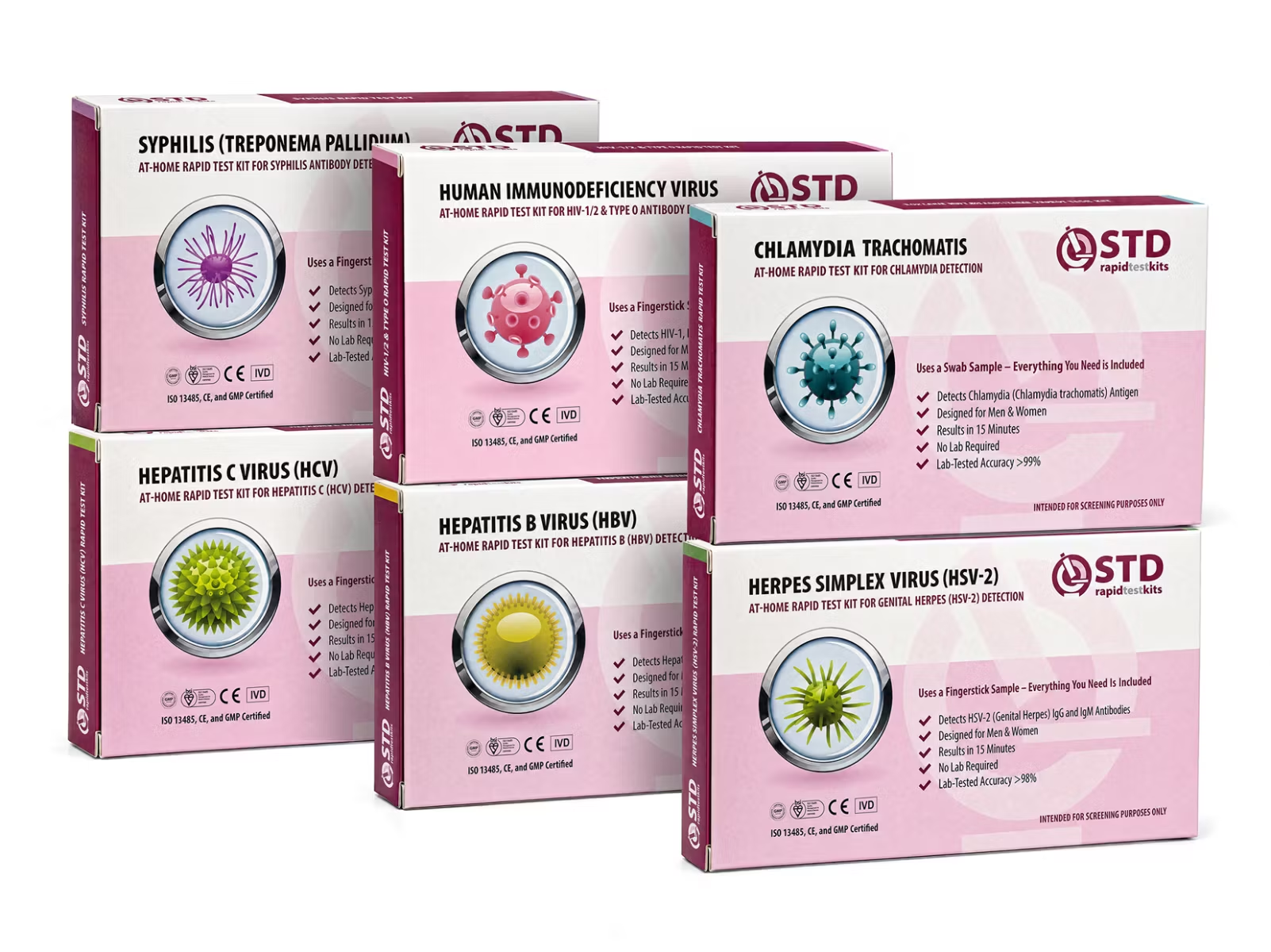
STD Rapid Test Kits publishes this article and sells the at-home lateral-flow tests linked below. We recommend specific products based on what fits the reader's concern, not commercial benefit. A clinic visit is also a valid path; the most important step is the one you'll follow through on.
When Symptoms Could Be Something Else
Not every uncomfortable sensation after sex is an STI. Sometimes it really is friction, a yeast infection, a urinary tract infection, or a temporary irritation from a new soap, lubricant, or condom material. The catch is that the symptoms overlap enough that guessing doesn't work well. Burning, itching, unusual discharge, and pelvic discomfort can belong to a long list of conditions, some minor and some that need prescription treatment.
Testing replaces guessing with a clear answer at a moment when guessing wrong carries real consequences, including passing an infection on or letting it progress in the body.
| Symptom | Could be something minor | Could also be an STI |
|---|---|---|
| Burning when urinating | UTI, dehydration | Gonorrhea, chlamydia, trichomoniasis |
| Itching or irritation | Yeast infection, shaving irritation | Herpes, trichomoniasis, pubic lice |
| Unusual discharge | Hormonal cycle, bacterial vaginosis | Chlamydia, gonorrhea, trichomoniasis |
| Pelvic or lower-abdominal discomfort | Cycle-related, muscular | Pelvic inflammatory disease from untreated chlamydia or gonorrhea |
| No symptoms | Genuinely nothing | HIV, HPV, early syphilis, chlamydia |
Symptoms That Vanish but the Infection Doesn't
One of the most misleading experiences in sexual health is the symptom that appears, lingers for a few days, and then disappears. Relief kicks in, the mental file closes, and you move on.
What's actually happening in many cases is that the visible symptom resolves while the underlying infection continues quietly. Some infections are cyclical. Others migrate to deeper tissues or move into a later stage that doesn't show on the skin at all.
Herpes is the classic example. An initial outbreak heals, sometimes within two weeks, and then the virus stays in a nearby nerve, where it can reactivate months or years later, according to NHS guidance on genital herpes. Syphilis, as covered earlier, can offer a similar false reassurance.
Herpes outbreaks heal and recur from nearby nerves. Syphilis sores resolve on their own while the bacteria persist into secondary and latent stages. Chlamydia symptoms can fade while the infection moves up the reproductive tract. Feeling better is genuine information, but it does not confirm the infection has cleared.
The Mental Load of Uncertainty
Set the biology aside for a moment. The emotional cost of waiting is real and often underestimated. The mental loop of "what if it's nothing, what if it's something" is exhausting. People start scanning their bodies more, second-guessing every sensation, avoiding intimacy, or engaging in it while carrying unspoken worry.
This isn't only about physical health. It's about mental bandwidth, sleep, confidence at work, and how present you can be with the people who matter to you. Testing produces a result, but it also produces something less talked about: a clean answer that closes the loop and lets the brain stop scanning.
Survey data from routine STI screening programs consistently show that people who test regularly carry less baseline health anxiety than people who avoid testing. Clarity replaces the running mental loop with a single concrete answer, even when that answer is positive and connects to a treatment plan.
What Smart Action Looks Like
Taking action isn't the same as overreacting. The threshold for action in sexual health is intentionally low because the cost of inaction tends to be higher than the cost of an unnecessary test.
The goal is to remove barriers between the moment of concern and the moment of clarity. At-home rapid kits, primary-care visits, and free public-health clinics all serve that goal; the right choice is whichever one you'll follow through on.
In practice, "not waiting blindly" looks like this:
- You notice a symptom: you don't try to diagnose yourself, you test for the relevant infections.
- You had a possible exposure: you plan testing based on the window period for what you're worried about, not based on how anxious you happen to feel that week.
- You feel fine but uncertain: you test anyway, because feeling fine is not a clinical screen.
- A current or recent partner has tested positive: you test on the timeline their clinician suggests, without waiting for symptoms.
- You've never had a baseline screen: you book one in the next two weeks so you have a starting point for future testing.
What Delayed Treatment Looks Like in the Long Run
This is not worst-case scaremongering. Most STIs are treatable, and many are simple to manage when caught early. What changes with delay is the difficulty curve: the longer an infection runs, the more it can spread within the body, develop antibiotic resistance, or cause complications that are harder to reverse.
The table below summarizes common outcomes when an infection is caught early versus left untreated, drawn from CDC and WHO clinical references.
| STI | What happens if caught early | What can happen if you wait |
|---|---|---|
| Chlamydia | Single course of antibiotics, full resolution | Pelvic inflammatory disease, chronic pelvic pain, tubal infertility |
| Gonorrhea | Quick antibiotic treatment, symptom relief in days | Spread to upper reproductive tract, joint infection, growing antibiotic resistance |
| Syphilis | Easily cured with penicillin in early stages | Cardiovascular and neurological damage in late stages |
| HIV | Antiretroviral therapy, near-normal life expectancy | Progressive immune damage, opportunistic infections, higher transmission risk |
The Myth: "If It Were Serious, I'd Feel It"
This belief shows up in conversations, online forums, and quiet personal logic after a hookup. On the surface it sounds reasonable. If something serious were happening, surely the body would send a clear signal.
That isn't how many STIs work. HIV can feel like a mild flu in the first weeks of acute infection, or like nothing at all. HPV often has zero symptoms while it persists in cervical or anal tissue, which is why routine screening matters more than waiting for a sign. Chlamydia is silent in a large share of cases, particularly in women. The absence of a big signal is poor evidence of safety; in many situations it is the exact reason infections go undetected for months.

Handling "Too Early or Too Late" Together
The most common testing stuckness sounds like this: test too soon and you might miss it, wait too long and a lot has already happened. The better answer is a small testing plan rather than one make-or-break moment.
A small testing plan replaces one open-ended wait with a sequence of concrete dates. It removes the make-or-break feeling and gives the in-between period some structure, which matters because that period is when the mind tends to scan for evidence and find ambiguous signals everywhere.
For a recent possible exposure, the steps look like this:
- Test early for a baseline, with the understanding that an early negative isn't conclusive yet.
- Retest at the end of the recommended window for each infection of concern (see the timing table above).
- Monitor symptoms in the meantime, but treat absence of symptoms as a non-result, not a green light.
Signs You Shouldn't Rely on "Wait and See"
If you're still weighing whether to test or give it more time, here's a grounded set of cues. In every situation listed below, testing gives you something passive waiting cannot: a clear answer you can act on. You shouldn't rely on watchful waiting alone if any of these apply:
- You notice any new symptom, however mild or inconsistent.
- You had unprotected sex with a new partner and feel uncertain about their testing history.
- Something feels different from your normal, even without a clear name for it.
- You're using "I feel fine" as your only data point.
- Someone you've been intimate with has tested positive for an STI and asked you to check.
- You've never had a baseline screen and you're sexually active with more than one partner.
Clarity Is the Opposite of Panic
There's a misconception that getting tested is something fearful people do. In practice, the people who test routinely report less day-to-day anxiety than people who avoid testing. Uncertainty is what keeps the mind scanning. It's what makes every minor sensation feel like evidence. Clarity interrupts the loop.
Whether your result is positive or negative, you walk away with information you can use. The next step is just a matter of follow-through, whether that's filling a prescription, scheduling a retest at the end of the window, or noting the date of your next routine screen.
A positive result connects you to treatment, often a single antibiotic course for bacterial infections or a daily medication that manages and reduces transmission for viral ones. A negative resets your routine-screening calendar and clears the running question. Either way, you walk away with a concrete next step instead of an open loop.
FAQs
- I noticed something off after sex. Can I just give it a few days?
- A few days easily becomes a few weeks. Some symptoms fade while the underlying infection continues, especially with chlamydia and syphilis. If your body is flagging something, the safer move is to plan a test within the appropriate window for the infection you're worried about, rather than wait for the signal to repeat itself.
- It barely burns when I urinate. Am I overthinking this?
- Mild burning is a common opening symptom of chlamydia and gonorrhea, and it's also a classic sign of a urinary tract infection. The overlap is the reason guessing doesn't work well. If the sensation is consistent enough that you're noticing it, a quick test will resolve the question faster than another week of wondering.
- The symptoms already went away. Am I in the clear?
- Not necessarily. Several STIs follow a pattern where the visible symptom resolves while the infection continues into a quieter stage, including syphilis after the first sore and herpes between outbreaks. Feeling better is a real sign of healing in some conditions, but it isn't a reliable all-clear signal on its own.
- How long is too long to wait before testing?
- Once you're past the recommended window for the infections you're concerned about, additional waiting doesn't help, it just extends the uncertainty. Most common STIs can be reliably detected within 1 to 6 weeks of exposure depending on the test, so waiting months only delays an answer that's already available.
- I tested early and the result was negative. Can I trust that?
- An early negative is reassuring but not definitive. It depends on which infection you tested for and how soon after exposure. The safer pattern is to retest at the end of the appropriate window, especially for HIV and syphilis, which have longer detection windows than chlamydia or gonorrhea.
- I feel completely fine. Do I still need to think about STIs?
- Yes, especially if you've had recent exposures with new partners. The CDC notes that a majority of people with chlamydia, HPV, and early HIV don't experience noticeable symptoms. Feeling normal is a snapshot, not a screen.
- We used a condom. Am I in the clear?
- Condoms substantially reduce risk but they don't eliminate it. Skin-to-skin transmission can still happen with herpes, HPV, and syphilis, and oral contact carries its own risk profile. Protection is one important layer; testing closes the rest of the gap.
- What's the smartest move right now if I'm unsure?
- Don't wait for certainty from your symptoms alone, the most common STIs simply don't deliver that. Pick a date based on the relevant window period, test once at home or in clinic, and retest if needed. That shift from open-ended worry to a small plan is where the stuckness ends.
Your Next Step
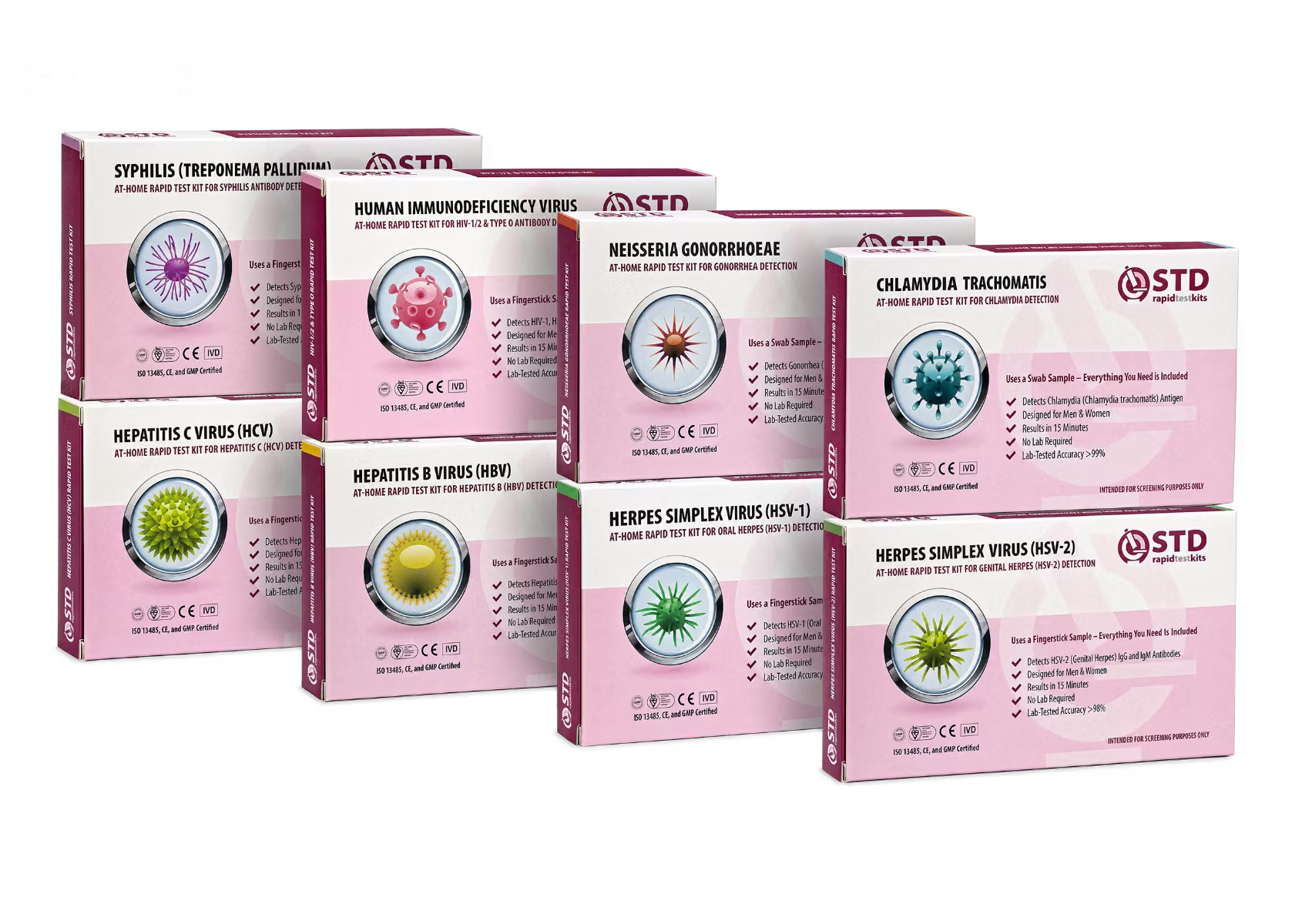
If something has felt off, or you've had an exposure that's been sitting in the back of your mind, you have more options than you probably realize. You can browse our complete range of at-home rapid STI test kits, or pick a single-infection panel if you already know what you're checking for. Whatever you choose, the goal is the same: replace waiting with knowing, on your own timeline, in your own space.
Three reasonable paths get you to the same place. Pick whichever one you'll follow through on this week:
- At-home rapid test kit: private, no appointment, results in roughly 15 minutes.
- Primary-care visit or sexual-health clinic: provider-supported testing, with treatment available in the same visit if needed.
- Free public-health clinic: confidential testing available in most U.S. cities and counties at no cost.
How We Sourced This Article: This guide combines current public-health advice from the CDC, WHO, and NHS on sexually transmitted infections, alongside peer-reviewed clinical references on how asymptomatic transmission and delayed diagnosis affect outcomes. The behavior patterns described, hesitation and watchful waiting that drifts into avoidance, are drawn from published patient-survey research rather than individual case anecdotes. All clinical claims are written in plain English with the original sources linked inline, so any reader can verify the specific guidance for themselves.
- U.S. Centers for Disease Control and Prevention. STIs overview and prevention guidance.
- U.S. Centers for Disease Control and Prevention. Chlamydia clinical guidance and long-term complications including pelvic inflammatory disease.
- U.S. Centers for Disease Control and Prevention. Syphilis stages, symptoms, and progression.
- U.S. Centers for Disease Control and Prevention. HIV testing, window periods, and detection timing for antigen/antibody and NAAT assays.
- World Health Organization. Sexually transmitted infections fact sheet, including the observation that many STIs are often asymptomatic.
- U.K. National Health Service. Sexually transmitted infections guide, including genital herpes reactivation pattern.
