
Published: September 2025 | Last updated: April 2026 | Editorial review and quality control: Martina N.
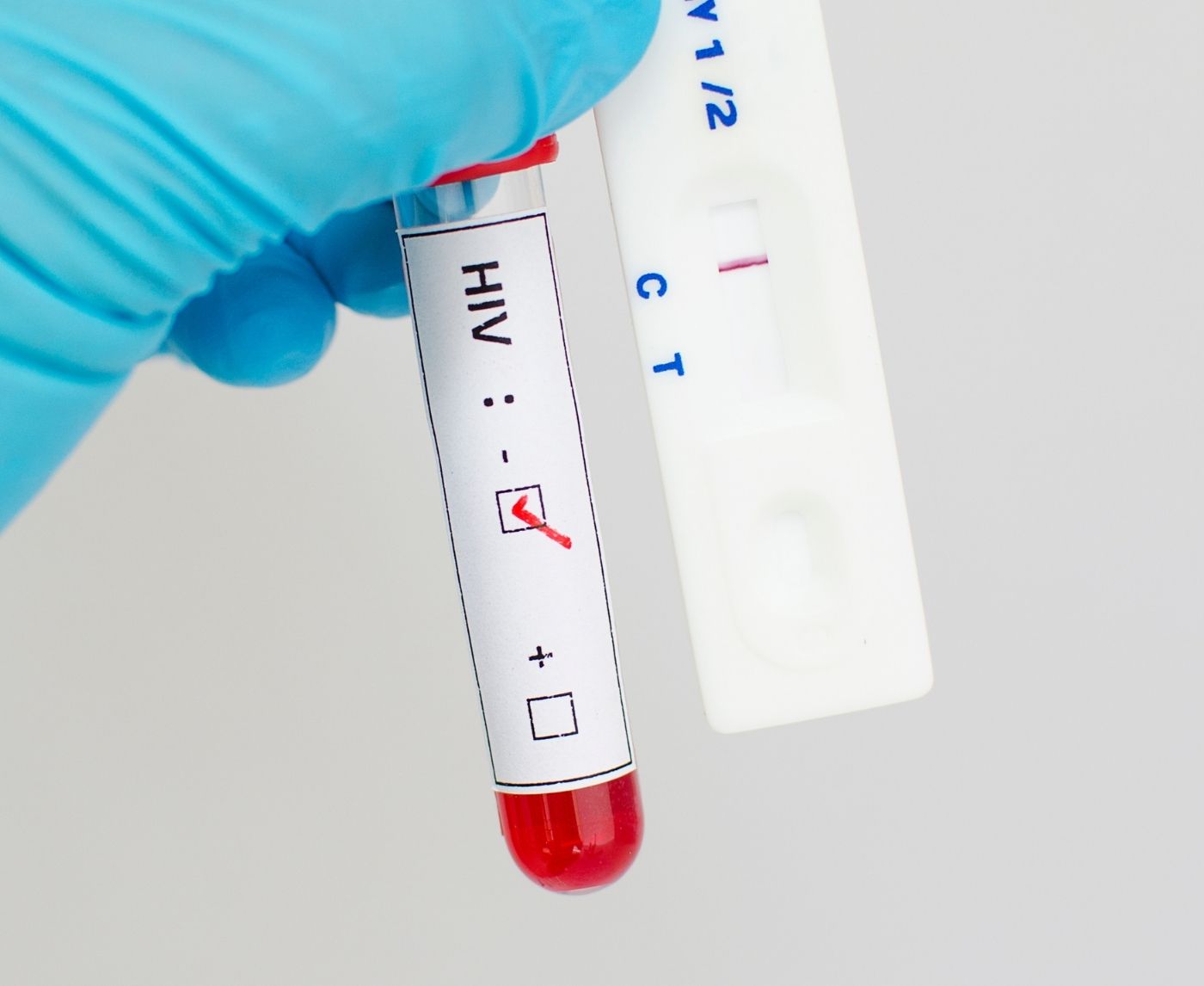
A negative result feels like an exhale. The screen says you are in the clear, the worry that has been sitting in your chest for days lifts, and you move on. Then a week later, a symptom shows up. Or your partner texts to say they tested positive. Suddenly the test you trusted feels less like an answer and more like a guess.
The uncomfortable truth is that a negative STI result is only as reliable as the timing of the test, the type of test you used, and whether the infection had time to grow into something a test can detect. This guide walks through how that works, what to do about a faint line, and how to plan a retest that actually settles the question.
How long after exposure should I retest if my first STI test was negative?
Rapid home tests reach reliable accuracy roughly 14 days after exposure for bacterial infections like chlamydia and gonorrhea, around 6 weeks for HIV (fourth-generation antigen-antibody assays), 6 to 12 weeks for syphilis, and up to 12 weeks for HSV-2 antibody tests. If your first test landed inside any of those windows, the right move is a second test once the window closes. Specific timing per infection is in the table below.
Key Takeaways
- Most STI tests have a window period of 1 to 12 weeks. A negative result inside that window can miss a real infection.
- If you tested early, still have symptoms, or your partner is positive, plan a follow-up test once the right window has passed.
Why timing changes the meaning of a negative result
The space between getting an infection and a test being able to spot it is called the window period. During that gap, the bacterium or virus is in your body but has not multiplied enough, or your immune system has not built enough antibodies for the test to find what it is looking for. A test taken inside that gap can read negative when the infection is genuinely present.
This is biology, not test failure. Different STIs have different windows because they grow at different speeds and tests look for different markers. A rapid antibody test for HIV is waiting for your immune system to seroconvert. A nucleic-acid test for chlamydia is waiting for enough bacterial DNA to amplify. A herpes IgG blood test is waiting for IgG-class antibodies to mature, which can take weeks to months.
Consider a common scenario: someone has unprotected sex on a Friday night, feels anxious by Monday, and orders a rapid home test that arrives Tuesday. They take the test on day five, see one line, and exhale. Two weeks later a burning sensation arrives and the retest is positive for chlamydia.
Window periods by common STIs
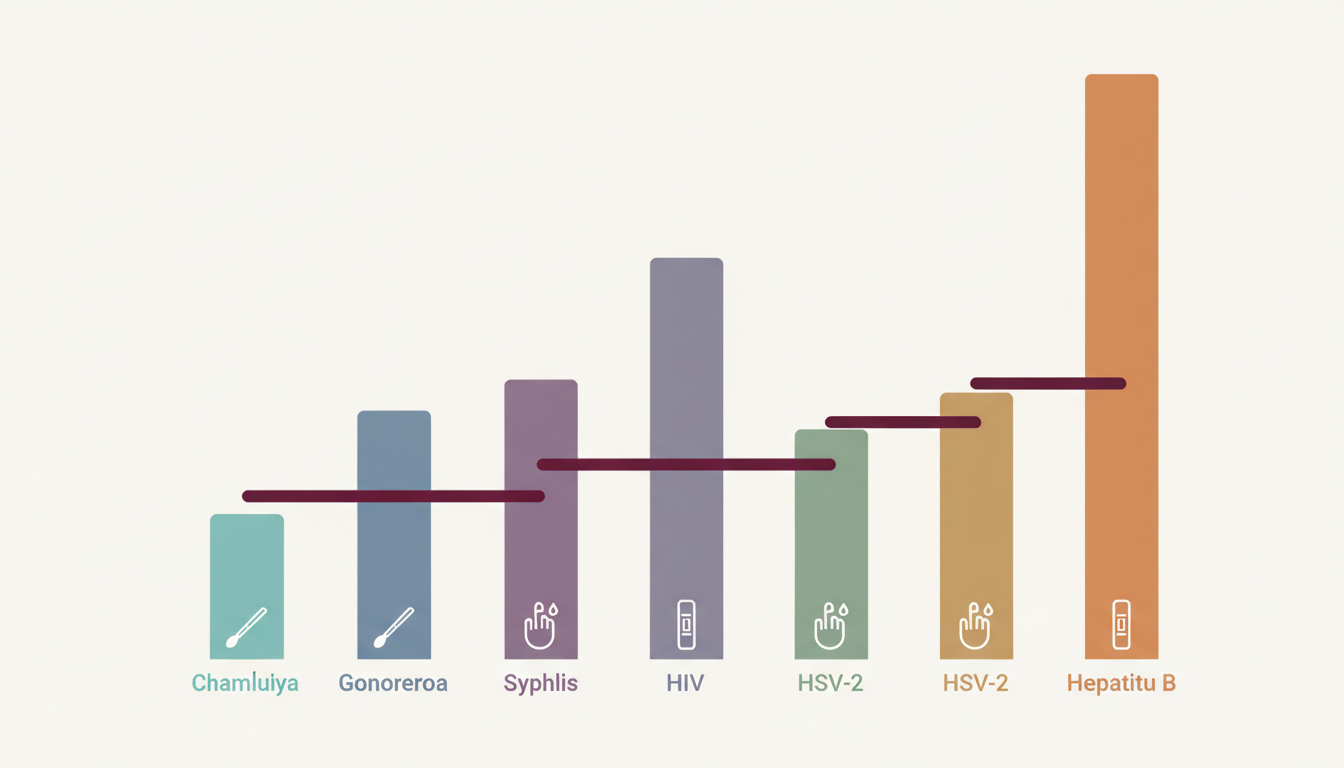
The table below shows where most major sexual-health bodies, including the U.S. Centers for Disease Control and Prevention, set the earliest reliable detection window for each infection, alongside a recommended retest point if your first test was earlier than that.
| Infection | Earliest reliable detection | Recommended retest if tested early |
|---|---|---|
| Chlamydia | 1 to 2 weeks | 14 to 21 days post-exposure |
| Gonorrhea | 1 to 2 weeks | 14 to 21 days post-exposure |
| Trichomoniasis | 1 to 4 weeks | 4 weeks post-exposure |
| HIV (4th-gen Ag/Ab lab) | 18 to 45 days | 6 weeks post-exposure |
| HIV (rapid antibody-only) | 23 to 90 days | 12 weeks post-exposure |
| Syphilis | 3 to 6 weeks | 6 to 12 weeks post-exposure |
| HSV-2 (IgG blood) | 6 to 12 weeks | 12 weeks post-exposure |
| Hepatitis B | 3 to 6 weeks | 9 to 12 weeks post-exposure |
| Hepatitis C | 4 to 10 weeks | 12 weeks post-exposure |
Notes on the window-period table
Earliest reliable detection means the earliest point a typical screening test will flag a true infection, not the first day a particularly sensitive lab assay can occasionally pick something up. Some nucleic acid tests can detect HIV as early as 10 to 33 days after exposure, but fourth-generation antigen-antibody lab tests typically need 18 to 45 days. A 6-week retest covers the vast majority of cases for Ag/Ab tests and is what most public-health guidelines recommend. Older HIV antibody-only rapid tests have a longer 23 to 90-day window because they wait on antibody seroconversion alone.
The same kind of differences apply to other infections. Lab NAATs catch chlamydia faster than antigen-based rapid tests because amplification chemistry detects much smaller amounts of bacterial DNA than a lateral-flow strip can. Lab syphilis serology can become reactive sooner than some rapid lateral-flow assays.
Choose your retest interval based on the specific test you used, not just the infection you are worried about. Lab NAATs, fourth-generation lab Ag/Ab assays, and rapid lateral-flow home assays sometimes have different windows for the same infection.
How home rapid tests actually work, and where they have limits
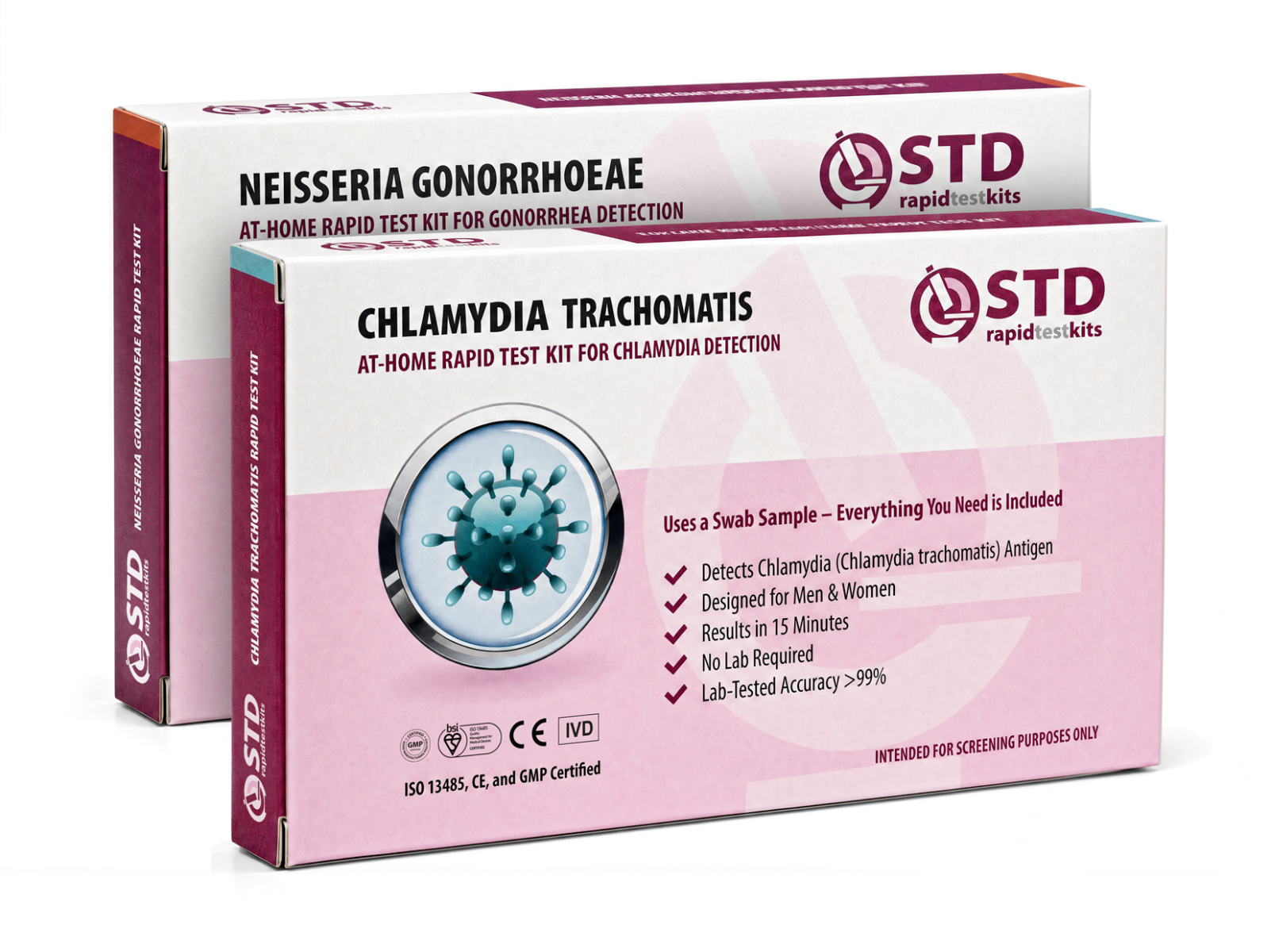
Most home STI tests, including the kits sold here, are lateral-flow immunoassays. The chemistry is the same family as a pregnancy test or a COVID-19 antigen test. A drop of fingerstick blood or a self-collected genital swab (depending on the infection) flows across a strip; if a target marker is present, a colored line appears at the test window. Result in roughly 15 minutes, no lab, no waiting room.
Lateral-flow tests are sensitive enough to be useful for at-home screening when used after the window period closes. They are different from a laboratory NAAT (nucleic acid amplification test), which uses PCR or similar amplification chemistry to detect tiny amounts of bacterial or viral genetic material. Lab NAATs are the screening gold standard for chlamydia and gonorrhea per the CDC because they pick up infections at lower bacterial loads than antigen-based rapid tests can. The two technologies are complementary, not equivalent.
In practical terms: rapid home tests are well suited to getting a screening answer at home, on your timeline, without a clinic visit. They are most reliable when used after the right window has passed. A positive result on a rapid test is worth confirming with a clinic-run NAAT or follow-up serology so the next clinical step rests on the strongest possible signal. A negative result inside the window is the situation that calls for retesting.
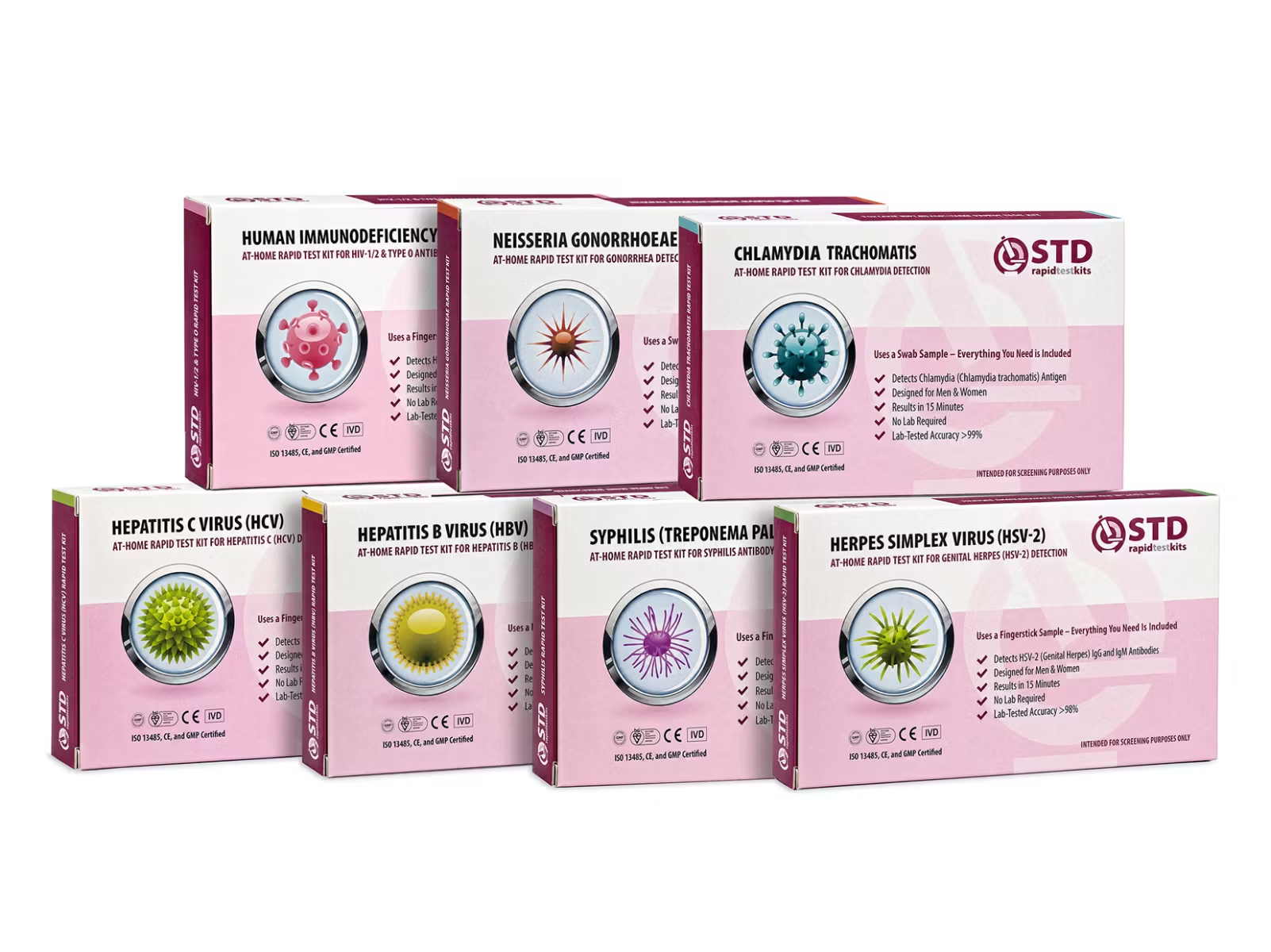
The kits below are sold on this site; any positive rapid-test result is worth confirming with a clinic before starting treatment.
| Test type | Sample | Detection method | Best use |
|---|---|---|---|
| Rapid home lateral-flow | Self-collected swab or fingerstick blood | Antibody or antigen detection | Private screening at home, after the window period |
| Mail-in lab NAAT | Self-collected swab or urine, mailed in | DNA/RNA amplification (PCR) | High-sensitivity confirmation when timing or symptoms call for it |
| Clinic-based NAAT or serology | Clinician-collected swab or venous blood | DNA/RNA amplification or full-panel serology | Symptomatic infection, post-treatment confirmation, or full STI panel |
What a faint line on a rapid test really means
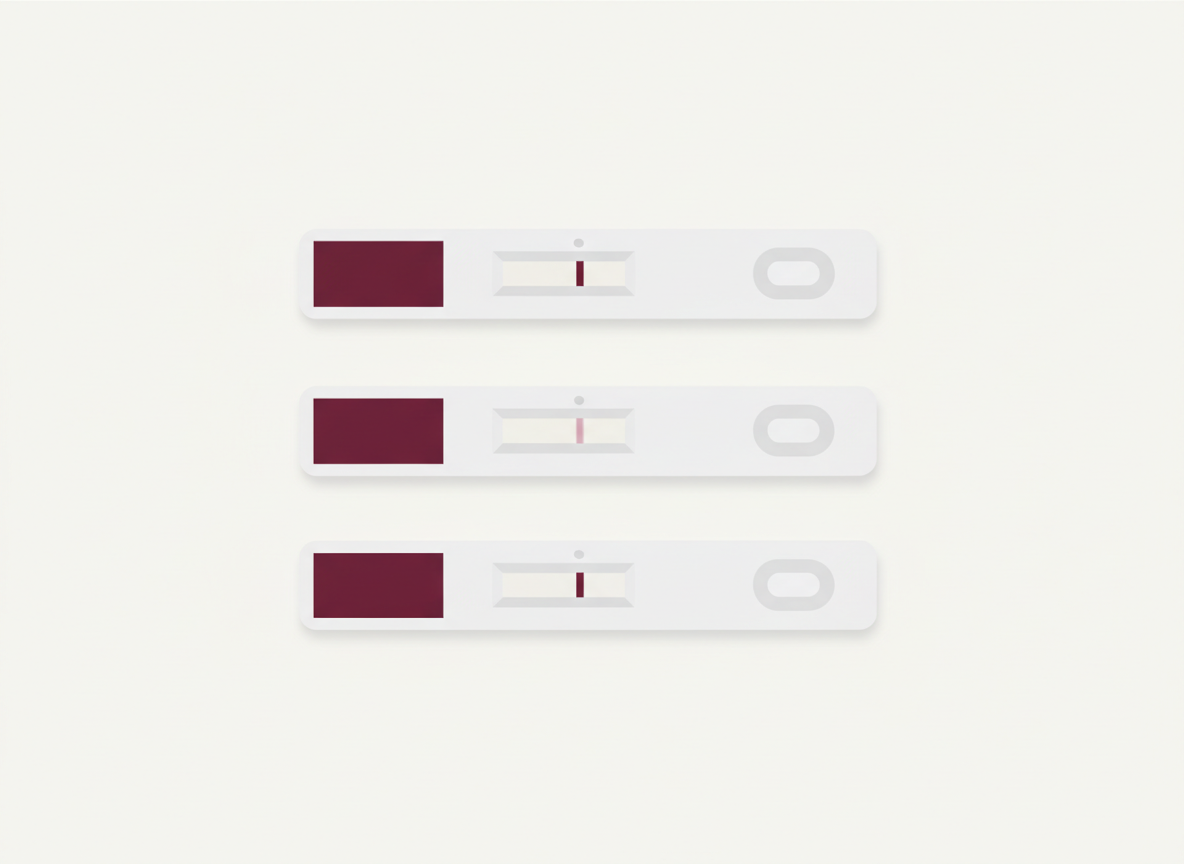
Most rapid-test instructions say the same thing: any visible line in the test window, even a faint one, should be read as a positive. In practice, faint lines are a common source of stress because the visual nature of the readout invites second-guessing. Lighting in your bathroom, the angle you hold the strip, even small differences in how much sample you used, all change what you think you see.
A faint line can mean several things. The infection may be early, with the bacterial or antigen load still rising toward the easy-to-see threshold. The sample may have been insufficient: a swab that did not collect enough material, or a fingerstick that produced too small a blood drop, can produce a faint or missing line even when infection is present. The test may have been stored too warm, or read past the time window in the instructions. Cross-contamination during self-collection is a less common but real possibility.
The right move when you see a faint line is to treat it as a positive flag and confirm it. That confirmation can be a second rapid test on a fresh sample taken three to seven days later (a true positive will usually be more visible as the infection progresses), or a clinic-run NAAT that uses DNA amplification to read past the ambiguity.
When your partner's timing throws yours off
You tested. Your partner tested. Both negative. The natural conclusion is that you are both clear. The trap is that timing can mismatch in ways that look fine on the surface.
Imagine one partner tests three days after the last shared encounter and the other waits two full weeks. The early tester is well inside any window period, so a negative result there means very little. The two-week tester gets a more reliable read for bacterial infections like chlamydia and gonorrhea, but is still inside the window for HIV, syphilis, and HSV-2. If either partner was carrying an infection that had not matured to detectable yet, both negatives can be true the day they are taken and still not protect either of you long-term.
The fix is to align retest timing to the relevant infection's window. If only one partner tested early, that one should retest after the window closes; the later-tester's result is usually more trustworthy on the day it was taken.
For bacterial STIs (chlamydia, gonorrhea, trichomoniasis): both partners retest at day 14. For HIV, syphilis, and HSV-2: both partners retest at the longer windows in the table above. If only one of you tested early, that partner is the one who should retest first.
Retesting after antibiotic treatment
If you tested positive in the past and finished a course of treatment, the question becomes when to retest to confirm the infection is gone. Testing too soon is the first trap. NAATs are sensitive enough to detect leftover bacterial DNA for weeks after viable bacteria are dead. CDC treatment guidelines recommend waiting at least three weeks after completing treatment for chlamydia or gonorrhea before a test of cure if one is needed. Trichomoniasis test of cure can usually happen at two weeks post-treatment, especially in patients with vaginas. CDC treatment guidelines recommend serologic follow-up for syphilis using changes in non-treponemal antibody titers, with a fourfold change considered clinically significant.
Reinfection is the second issue to plan around. CDC recommends a separate retest at three months after treatment for chlamydia and gonorrhea regardless of partner status, because reinfection from untreated partners or new exposures is the most common reason a negative-then-positive pattern shows up. Both timepoints serve different purposes: three weeks confirms the medication worked; three months catches reinfection from new or untreated partners.
Reinfection of patients with chlamydial infection occurs frequently, and repeat infection confers an elevated risk for pelvic inflammatory disease and other complications. Retesting approximately 3 months after treatment is recommended.
When ongoing exposure means routine, scheduled retesting
For some readers, retesting is not a one-time follow-up after a specific scare. It is a regular health rhythm because exposure is ongoing. CDC recommends screening every three to six months for several groups in particular:
- People taking PrEP for HIV
- Men who have sex with men with multiple or anonymous partners
- People with a recent STI diagnosis
- Sex workers
- People in non-monogamous arrangements without consistent partner testing
Routine screening does not have to mean a clinic visit every quarter. At-home rapid screening between in-clinic appointments can serve as an early-warning layer; positives go to a clinic for confirmation and treatment, and negatives keep the timeline running on schedule.
If you fall into one of the higher-risk groups above, plan a screen every 3 to 6 months. Mix at-home rapid kits with clinic visits so your timeline stays on schedule even when life gets busy.
When anxiety blurs with real symptoms
After a risky encounter, anxiety can produce real-feeling physical sensations: a sense of tightness in the pelvis, a sore throat that resolves and returns, fatigue, even mild burning. The body and the mind run on overlapping wiring, and a stressed nervous system can amplify ordinary signals into things that feel diagnostic.
The hard part is that genuine early STI symptoms can also be mild and non-specific, so telling the two apart from feeling alone is unreliable. The pragmatic answer is the same in both cases: test at the right window, and retest if symptoms persist after a negative.
If symptoms are continuous (burning that has not resolved over a week, discharge, sores, fever) regardless of test result, see a clinician. A negative rapid test does not rule out infection inside the window period, and it does not address conditions outside our test panel (like UTIs, yeast infections, or bacterial vaginosis) that need a clinical workup.
Ongoing symptoms plus a negative rapid test inside the window: retest when the window closes. Symptoms persisting after a window-correct negative: book a clinic visit for a NAAT or full STI panel.
Common mistakes when retesting
Five patterns show up over and over in conversations with people whose retest did not go the way they expected:
- Testing too early again. The same window-period rule that flagged the first test still applies to the retest. If your exposure was 10 days ago and the right window is 14 days, waiting another four days is the right call.
- Insufficient sample. A swab that did not collect enough material, or a fingerstick with too small a blood drop, can read negative even when infection is present. Follow the kit's collection step closely.
- Reading the strip outside the recommended window. Most lateral-flow tests have a 10 to 30-minute read window in their instructions. Reading at hour two can show evaporation lines that look like positives, or the real line may have faded.
- Using a sample type the test is not validated for. The home rapid tests we sell are validated for specific samples (vaginal or urethral swab for chlamydia, gonorrhea, trichomoniasis, and HPV; fingerstick blood for HIV, syphilis, hepatitis, and herpes). They are not validated for throat or rectal samples; for pharyngeal or rectal exposure a clinic NAAT is the right choice.
- Skipping the partner. Treatment without partner treatment leads to reinfection bouncing back and forth. Most public-health guidance recommends both partners be treated and both retest after the appropriate interval.
Most come down to reading the kit instructions before starting, not after.
Match retest timing to the longest relevant window for the infections you are screening for. Use the same sample type the kit is validated for. Read the strip inside the recommended time window. If a partner is involved, align timing across both of you so neither result is interpreted in isolation.
What a thoughtful retesting plan looks like
If you tested before the window period closed, plan a follow-up. If you tested after the window and have no symptoms, one negative is usually enough. If you tested after the window and still have symptoms, retest with a different sample type or seek a clinic NAAT. If you tested positive, treated, and your partner was not treated alongside you, plan a three-month reinfection screen.
Frequently asked questions
- Can I really still have an STI after a negative test?
- Yes, especially if the test was taken inside the infection's window period. The bacterium or virus may be in your body but not yet at a level the test can detect. A retest after the right window has passed is what closes that uncertainty.
- How long should I wait before retesting if my first test was too early?
- The safest rule is to retest at the longest window relevant to your exposure. HSV-2 and hepatitis C need the full 12 weeks; chlamydia and gonorrhea clear the bar at 14 days. If you are unsure which infection you were exposed to, waiting 12 weeks covers all of them. The full per-infection table is in the article above.
- What if I still have symptoms after a negative test?
- Trust the symptoms. A negative test inside the window period does not rule out infection, and even outside the window, no rapid test is 100 percent sensitive. If burning, discharge, sores, or fever persist, see a clinician for a clinic-run NAAT or full STI panel. They can also rule in or out non-STI causes like UTIs or yeast infections.
- Does using a condom mean I do not need to retest?
- Condoms substantially reduce transmission risk for most STIs but they are not a forcefield. Skin-to-skin infections like herpes, HPV, and syphilis can transmit through areas a condom does not cover. If exposure happened (broken condom, oral contact, skin contact in the genital area), the risk is real enough to warrant a test at the right window.
- Why might I get a positive test right after antibiotic treatment?
- Highly sensitive lab tests like NAATs can detect leftover bacterial DNA for several weeks after the bacteria themselves are dead. This is why CDC treatment guidelines recommend waiting at least 3 weeks after finishing treatment before a test of cure for chlamydia or gonorrhea. Testing earlier than that risks a false positive that is just dead DNA.
- Should I retest if I have no symptoms?
- Yes, if your first test was inside the window period or you have ongoing exposure. Many STIs, chlamydia and gonorrhea in particular, are commonly asymptomatic. Per CDC, most chlamydia infections produce no symptoms, which is why screening based on exposure timing rather than symptoms is the recommended approach.
- Are at-home rapid tests as accurate as clinic tests?
- At-home rapid tests are lateral-flow immunoassays. They are well suited to screening at home after the window period closes, and a clean negative outside the window is meaningful. Clinic tests, especially NAATs, use DNA amplification and pick up infections at lower bacterial loads, which makes them the screening gold standard for chlamydia and gonorrhea per CDC. The two are complementary: rapid test for convenience and timing flexibility, lab test for highest sensitivity and confirmation of any positive.
- Should my partner and I retest together?
- Aligning retest timing makes both results easier to interpret. If one of you tested early after the shared exposure and the other waited longer, the early tester's result is the less reliable one. Picking a shared retest date that lands after the relevant window closes for both of you keeps the timeline simple and the results comparable.
- U.S. Centers for Disease Control and Prevention. Getting tested for HIV, including window periods for fourth-generation antigen-antibody lab tests, antibody-only rapid tests, and nucleic acid tests.
- U.S. Centers for Disease Control and Prevention. STI treatment guidelines, including post-treatment retesting recommendations for chlamydia, gonorrhea, trichomoniasis, and serologic follow-up for syphilis.
- U.S. Centers for Disease Control and Prevention. Chlamydia detailed fact sheet, including symptoms, screening recommendations, and reinfection guidance.
- U.S. Centers for Disease Control and Prevention. Genital herpes information page covering HSV-1 and HSV-2 diagnosis, including the role of blood antibody testing.
- U.S. Centers for Disease Control and Prevention. Syphilis treatment guidelines, including the use of non-treponemal antibody titer changes to monitor treatment response.
- World Health Organization. Sexually transmitted infections fact sheet, summarizing global screening and follow-up guidance.
