What STDs Have Celebrities Really Had?
Real disclosures, real lawsuits, and why the 'herpes list' isn't data




- Verifiable celebrity STI disclosures include Charlie Sheen (HIV, 2015), Magic Johnson (HIV, 1991), Pamela Anderson (hepatitis C, 2002), and Eazy-E (AIDS, 1995). Most of what circulates as a celebrity 'herpes list' is unverified gossip, not confirmed diagnoses.
- WHO estimates roughly 520 million adults age 15 to 49 carry HSV-2 (genital herpes) worldwide, about 13% globally, and CDC notes most people with herpes do not know they have it. Asymptomatic infection is common across most STIs, which is why testing matters more than appearances.
Published: July 2025 | Last updated: May 2026 | Editorial review and quality control: Martina N.
Celebrity STI stories tend to break in one of two ways. Someone speaks up on a podcast or a stage, or a court filing leaks. Either way, the public reaction follows a predictable arc: sympathy for some, scorn for others, and a wave of speculative gossip that outlasts the actual news cycle.
Strip away the tabloid varnish and these stories say something useful. Sexually transmitted infections show up in famous bodies at roughly the same rate they show up in everyone else's. The shame that follows a public disclosure is a smaller version of the shame that keeps regular people away from a clinic. And the testing surge that follows a celebrity announcement is hard evidence that more of us would test if we felt less judged for doing it.
Key Takeaways
- Verifiable celebrity STI disclosures include Charlie Sheen (HIV, 2015), Magic Johnson (HIV, 1991), Pamela Anderson (hepatitis C, 2002), and Eazy-E (AIDS, 1995). Most of what circulates as a celebrity 'herpes list' is unverified gossip, not confirmed diagnoses.
- WHO estimates roughly 520 million adults age 15 to 49 carry HSV-2 (genital herpes) worldwide, about 13% globally, and CDC notes most people with herpes do not know they have it. Asymptomatic infection is common across most STIs, which is why testing matters more than appearances.
Who Has Actually Confirmed What
Not every name attached to an STI rumor is a confirmation. To keep things honest, here are the disclosures that came from the celebrity themselves or from a verifiable public source, not from a Reddit thread.
Charlie Sheen announced on the Today Show in November 2015 that he was HIV-positive, after years of being blackmailed by people who threatened to leak his status. “I have to put a stop to this onslaught, this barrage of attacks,” he told Matt Lauer. The disclosure had a measurable public-health side effect: rapid-test sales and online searches for HIV testing both spiked in the days that followed, an effect researchers later named the “Charlie Sheen Effect” (summary in Global News of the Prevention Science 2017 analysis).
Magic Johnson announced his HIV-positive status in November 1991 and retired from the NBA the same day. He has been open about how treatment access shaped his outcome. On antiretroviral therapy, his viral load has been undetectable for decades. Per CDC guidance on HIV treatment, a person with a sustained undetectable viral load will not transmit HIV through sex, the medical basis of the U=U (Undetectable = Untransmittable) public-health framework.
Pamela Anderson disclosed in 2002 that she had hepatitis C, which she attributed to sharing a tattoo needle with then-husband Tommy Lee. “I didn't do anything wrong. I just didn't know,” she said at the time. Modern treatment now cures more than 95% of hepatitis C patients, usually within 8 to 12 weeks, per CDC's About Hepatitis C page, a major shift from the interferon-era options Anderson first faced.
Eazy-E, the rapper and co-founder of N.W.A., publicly disclosed his AIDS diagnosis in March 1995 and died about a week later. His statement landed at a moment when AIDS was still widely misunderstood, and it pushed the conversation beyond the demographic groups the public had been used to associating with the virus.
Pink has spoken publicly about an abnormal Pap smear and an HPV scare, framing the experience as something that pushed her toward consistent screening. HPV is the most common STI in the United States; CDC's About HPV page states that nearly everyone will get HPV at some point in their lives, with more than 42 million Americans currently infected with disease-causing types and about 13 million new infections each year.
Which STIs have celebrities actually confirmed?
The verifiable list is short: Charlie Sheen (HIV, 2015), Magic Johnson (HIV, 1991), Pamela Anderson (hepatitis C, 2002), Eazy-E (AIDS, 1995), and Pink (an HPV scare, no specific strain confirmed). Most other celebrity STI stories come from court filings, including Usher (herpes allegations) and FKA Twigs's lawsuit against Shia LaBeouf, where the celebrity in question has not publicly confirmed a diagnosis. The “herpes list” that circulates online is gossip, not data. WHO estimates about 13% of adults age 15 to 49 carry HSV-2 globally (around 520 million people), and CDC notes most are unaware of their infection, so the realistic answer to “who has it” is statistically a lot of people, most without symptoms.

When Lawsuits Force the Conversation
Voluntary disclosure is one path. The other is a court filing. The Usher herpes lawsuits, which began surfacing publicly in 2017 and continued through several civil cases, are the most-cited recent example. Multiple women alleged that the singer had exposed them to herpes without informing them; court records described visible lesions during sexual encounters. One case reportedly settled for around $1.1 million in 2012, with the documents resurfacing in 2017 and triggering a wave of public reaction. Usher has never publicly confirmed a herpes diagnosis, and several of the later cases were dismissed.
The legal context matters more than the celebrity gossip. Many U.S. states allow civil claims for negligent or intentional transmission of an STI, and some states have specific statutes criminalizing knowing HIV exposure without disclosure. Herpes and HPV disclosure can carry civil liability in negligence claims in several states. The takeaway is straightforward: not disclosing a known status can carry real legal exposure on top of any health or ethical implication.
Singer FKA Twigs sued actor Shia LaBeouf in 2020 alleging, among other claims, that he gave her a sexually transmitted infection during their relationship. The litigation has moved through U.S. courts since. As with the Usher allegations, “alleged” is doing real work in that sentence; the conversation here is about disclosure rules, not who is medically guilty of what.
Lawsuits make these stories visible. They are also, however, a brutal venue for an intimate medical conversation, and not a framework any reasonable person would choose to learn from when deciding whether to test.
Many U.S. states allow civil claims for negligent or intentional STI transmission. Some states criminalize knowing HIV exposure without disclosure. Specifics vary by state and by infection type, so 'what is required' is not a single answer. If you know your status, telling a partner before sex is the safer position both ethically and legally.
The “Herpes List” Is a Stigma Engine, Not a Source
Every few years, a screenshot circulates on Reddit or X claiming to be a leaked document naming celebrities with herpes. Names rotate: Paris Hilton, Drake, Jamie Foxx, Britney Spears, Rihanna, take your pick. The lists almost always trace back either to a paparazzi rumor or a misread court document. None of the people most commonly named have publicly confirmed a diagnosis.
Two things are true at once. First, casually naming a private person as positive for a stigmatized condition can be defamatory, and several of the named celebrities have made that point through their representatives. Second, the actual prevalence of herpes is high enough that the list mechanic is statistically pointless. WHO's herpes simplex virus fact sheet puts HSV-2 prevalence among adults age 15 to 49 at about 13% globally, or roughly 520 million people. The CDC's About Genital Herpes page reports an estimated 572,000 new U.S. infections in 2018 among people age 14 to 49, and notes that most people with herpes do not know they have it because symptoms are mild, mistaken for something else, or absent entirely.
At those numbers, picking specific celebrities out of a hat is a coin flip with no public-health value. What the list does instead is two harms. It frames a common, manageable condition as a scandal worth ranking people on. And it pushes the people who do test positive deeper into silence, because the social cost of being publicly named feels like a reason to delay treatment, hide from partners, and avoid screening.
~520 million adults age 15 to 49 carry HSV-2 worldwide (about 13% globally) per WHO. ~572,000 new U.S. genital herpes infections in 2018 among people age 14 to 49 per CDC. Most people with herpes do not know they have it.
Most STIs Don't Look Like Anything
The single most useful thing celebrity disclosures have done for public understanding is undermine the “I'd know if I had it” assumption. The data is unambiguous: most STIs are asymptomatic for most people most of the time.
Chlamydia often has no symptoms, per the CDC's About Chlamydia page, but it can cause serious health problems even without them. Untreated infection can progress to pelvic inflammatory disease and fertility problems, and it does this silently in most cases.
Gonorrhea also often has no symptoms, per the CDC's About Gonorrhea page, which notes that most women with gonorrhea do not have any symptoms. Pharyngeal and rectal infections are even more likely to go unnoticed than genital ones.
Genital herpes is the textbook example. CDC states that most people do not know they have a herpes infection, because the first outbreak was missed, dismissed as razor burn or an ingrown hair, or never occurred at all.
HPV usually clears on its own within a year or two without symptoms; CDC notes that 9 out of 10 HPV infections resolve within two years. Persistent infection with high-risk strains is what drives almost all cervical cancer and a rising share of oropharyngeal cancers. Most people who clear HPV never know they had it.
HIV can be asymptomatic for years before any clinical signs appear. Acute infection produces a short flu-like illness in many people, but the symptoms are nonspecific and frequently misread as something else.
What this means in practice: appearance, partner count, hygiene, fame, and assumed monogamy are all bad predictors of status. A blood test or a swab is the only reliable answer.
Most people with genital herpes have no symptoms or have very mild symptoms. You may not notice mild symptoms or you may mistake them for another skin condition, such as a pimple or ingrown hair.
The “Charlie Sheen Effect” Was Measurable
The clearest evidence that a celebrity disclosure changes behavior comes from the days after November 17, 2015, when Charlie Sheen confirmed his HIV-positive status on national television. A team of public-health researchers, publishing in Prevention Science in May 2017, used Google search trends, news coverage volume, and rapid HIV-test sales as proxies for behavior change. Their analysis, summarized in Global News coverage of the Prevention Science paper, found a 417 per cent spike in HIV-related Google searches on the day of Sheen's announcement, with searches for HIV signs and HIV testing up 540 and 214 per cent respectively, and condom-related searches up 75 per cent. The elevated search activity stayed at record highs for three days.
At-home HIV-test sales followed the same pattern. The week of the disclosure coincided with a near-doubling of at-home HIV-test sales for one major retailer, described as an all-time high, and sales remained significantly elevated for the following three weeks.
Magic Johnson's 1991 announcement produced a similar but lower-resolution version of the same pattern, with HIV-test demand at counseling centers reportedly rising in the weeks that followed. The same pattern showed up around cervical-cancer screening after Farrah Fawcett's 2009 disclosure of anal cancer linked to HPV; specialist clinics reported call surges. Public disclosure makes testing feel less shameful for everyone watching, and behavior shifts in measurable ways.
The Charlie Sheen Effect, by the numbers
- 417% spike in HIV-related Google searches on 17 November 2015, the day Charlie Sheen disclosed his HIV-positive status.
- Searches for 'signs of HIV' and 'HIV testing' rose 540% and 214%, respectively; condom-related searches rose 75%.
- At-home HIV-test sales nearly doubled the same week, an all-time high for one major retailer, and stayed elevated for three weeks.
- Source: Prevention Science (Ayers et al., 2017), summarized in Global News.
Get Clarity Without the Spectacle
The reason most celebrity stories don't apply directly to your life is that you don't have a publicist, a Today Show camera, or a court filing. What you have is the same biology, roughly the same statistical risk profile, and access to the same testing technology, often at lower cost and with more privacy than the celebrities in question had in their era.
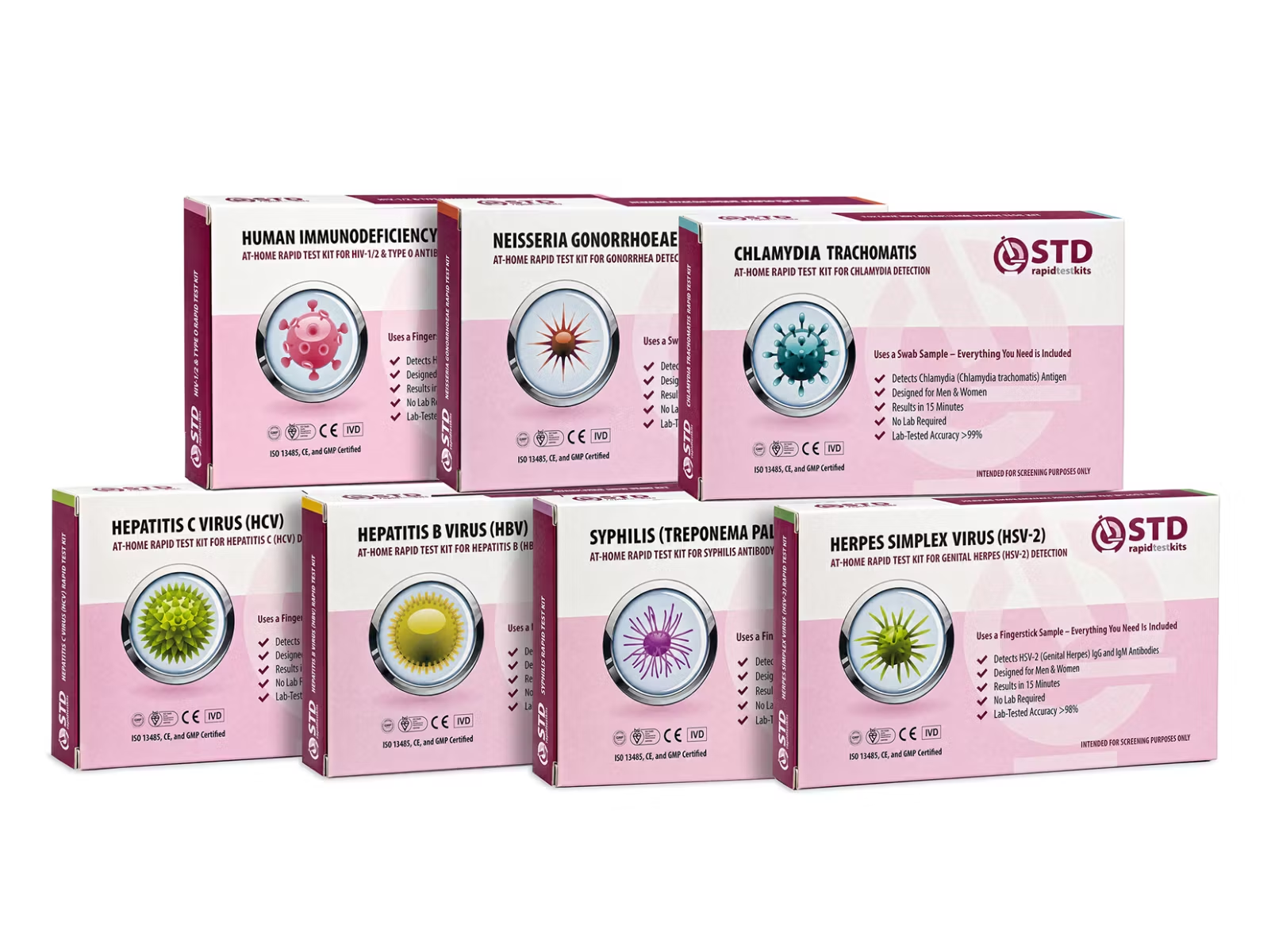
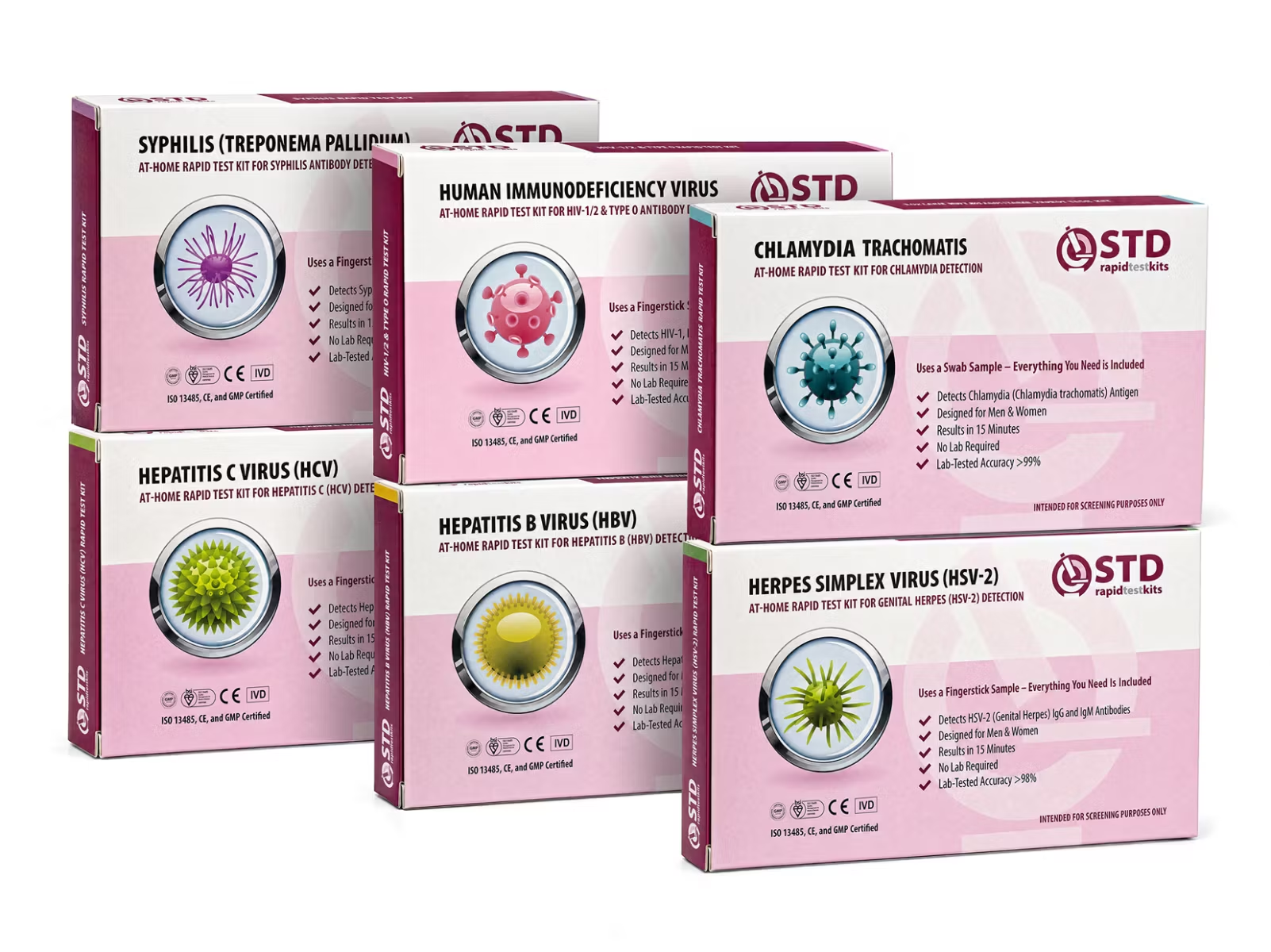
This site sells at-home rapid STI test kits; the options below are products we stock. They are screening tools, not lab NAATs, and a positive result is worth confirming at a clinic.
Three practical points worth knowing:
- Window periods matter. An HIV test taken three days after exposure won't catch a new infection. Per CDC's HIV testing page, antibody tests typically detect HIV 23 to 90 days after exposure; rapid antigen/antibody tests, 18 to 90 days; antigen/antibody lab tests, 18 to 45 days; and nucleic-acid (NAT) tests, 10 to 33 days.
- Symptoms aren't a screening tool. A negative test in a window-cleared period is more useful than a “no symptoms” check-in.
- Different sample types catch different infections. Chlamydia and gonorrhea use a swab. Syphilis, HIV, and the hepatitis viruses use a blood test (fingerstick at home, or venous blood at a lab). HSV-2 home tests are blood-antibody tests, useful for confirming long-term infection roughly 12 weeks or more after exposure once the body has produced detectable antibodies; an active sore is better evaluated by a clinic-administered PCR swab.
At-home rapid lateral-flow tests cover most common single-infection cases and the typical combo concerns. They are not the same technology as a lab NAAT, the molecular-amplification method that is the gold standard for chlamydia and gonorrhea, but they are reasonable screening tools that catch most positives within the right window, with a positive worth confirming at a clinic when feasible.
What These Stories Should Change For You
The celebrities who disclosed willingly, Sheen, Johnson, Anderson, Eazy-E, did the most useful thing a public figure can do with a stigmatized diagnosis: they used the moment to make screening feel like a normal adult decision. The celebrities who got pulled into the conversation through litigation, Usher most prominently, did something less voluntary but arguably equally clarifying. Their cases put a price tag on non-disclosure and made it visible that the legal cost of pretending to be negative when you know you are positive is real.
What none of these stories support is the idea that STIs are a moral judgment, a marker of recklessness, or something that happens to other people. CDC and WHO data are clear on every infection covered here: prevalence is high, asymptomatic carriage is common, and most diagnoses come from someone deciding to test, with visible symptoms playing a smaller role than people assume.
If you've had a new partner, an unprotected encounter, or even a low-grade worry that won't go away, the useful response is the same one these disclosures keep nudging the rest of us toward: test, treat if anything turns up, and tell partners with the dignity you would want extended to you. The shame that delays that sequence is the same shame the gossip cycle profits from.

Your Next Step Is Smaller Than It Feels
If reading this far has surfaced a specific worry, the action that closes the worry loop is concrete and small. Identify which infections fit your exposure window. Pick the test or combo that covers them. Take it. Read the result. If anything is positive, get the confirmatory test and start treatment. If everything is negative within the proper window, you've answered the question that was sitting in the back of your head.
For most readers concerned about a recent unprotected encounter, a combination kit covers the realistic risk profile, with a single retest at the relevant window length to catch any infection the body had not yet produced detectable antibodies to at the first attempt. Privacy is one of several reasons people choose at-home testing, but it is a meaningful one: there is no waiting room, no front-desk question, and no follow-up flag in a chart someone else might see.
Whatever you decide, decide. Knowing your status is the only piece of this conversation that actually changes outcomes for you and for anyone you sleep with.
Frequently Asked Questions
- Which celebrities have publicly confirmed an STI?
- Charlie Sheen (HIV, 2015), Magic Johnson (HIV, 1991), Pamela Anderson (hepatitis C, 2002), and Eazy-E (AIDS, 1995) are the most-cited verifiable disclosures. Pink has spoken publicly about an HPV scare following an abnormal Pap smear. Other names, including those most often attached to herpes rumors, have not publicly confirmed a diagnosis.
- Did Usher actually have herpes?
- Court filings in civil lawsuits from 2017 onward alleged that Usher exposed multiple partners to herpes, and reporting referenced a 2012 settlement for around $1.1 million. Usher has not publicly confirmed a diagnosis, and several of the later cases were dismissed. The legal allegations are part of the public record; the medical history is not.
- Is the “herpes list” of celebrities real?
- There is no verified celebrity herpes list. The screenshots that circulate online are typically misread court documents, paparazzi rumors, or fabrications. Naming specific people as positive for a stigmatized infection can be defamatory. The realistic answer to “who has herpes” is statistical: WHO estimates about 13% of adults age 15 to 49 carry HSV-2 globally (around 520 million people), and CDC notes most are unaware they are infected.
- Can someone be sued for not disclosing an STI to a partner?
- Yes. Many U.S. states allow civil claims for negligent or intentional transmission, and some states have specific statutes criminalizing knowing HIV exposure without disclosure. Specifics vary by state. Usher's cases are the most-cited recent civil examples; the practical point is that nondisclosure of a known status carries legal exposure in addition to the health and ethical concerns.
- Can you tell if someone has an STI by looking at them?
- No. CDC fact sheets across chlamydia, gonorrhea, syphilis, HIV, HSV, and HPV all describe asymptomatic infection as common. A blood test or a swab is the only reliable answer. Visual cues like “looking clean,” partner counts, or hygiene assumptions are not screening tools.
- What did the “Charlie Sheen effect” actually show?
- Researchers publishing in Prevention Science in May 2017 found a 417 per cent spike in HIV-related Google searches on the day of Sheen's November 2015 announcement, with searches for HIV signs and HIV testing up 540 and 214 per cent. At-home HIV-test sales nearly doubled the same week, an all-time high for one major retailer. It is evidence that public disclosure by a visible figure lowers the friction of testing for the broader population.
- Are at-home STI rapid tests as accurate as lab tests?
- At-home rapid lateral-flow tests typically report sensitivity and specificity in the mid-to-high 90s when used after the correct window period. Lab NAAT (nucleic acid amplification testing) remains the gold standard for chlamydia and gonorrhea and is more sensitive in early or low-viral-load infections. A positive at-home result is worth confirming with a clinic NAAT or blood draw; a negative result at the proper window is generally reliable for screening.
- How often should I get tested if I'm sexually active?
- CDC recommends at least annual screening for sexually active adults under 25, and at least annual or more frequent screening for adults with new or multiple partners, men who have sex with men, and anyone with a specific exposure or symptom. Every three to six months is reasonable with higher-frequency partner change. A new exclusive relationship, pregnancy, or any unprotected exposure are also natural test points.
- U.S. Centers for Disease Control and Prevention. About Genital Herpes: U.S. incidence estimates and asymptomatic-infection context.
- World Health Organization. Herpes simplex virus fact sheet, including global HSV-2 prevalence among adults age 15 to 49 (~520 million, ~13%).
- U.S. Centers for Disease Control and Prevention. HIV Testing: window periods by test type (antibody, antigen/antibody, nucleic-acid tests).
- U.S. Centers for Disease Control and Prevention. About Chlamydia: asymptomatic-infection note and complications.
- U.S. Centers for Disease Control and Prevention. About Gonorrhea: asymptomatic-infection note and complications.
- U.S. Centers for Disease Control and Prevention. About HPV: prevalence figures (42+ million currently infected, ~13 million new infections/year).
- U.S. Centers for Disease Control and Prevention. HIV Treatment: antiretroviral therapy and the Undetectable = Untransmittable (U=U) framework.
- U.S. Centers for Disease Control and Prevention. About Hepatitis C: cure rates with current treatment (>95%).
- Global News coverage of the Prevention Science analysis (Ayers et al., 2017) on HIV-test sales and search behaviour following Charlie Sheen's November 2015 disclosure.