
Published: September 2025 | Last updated: May 2026 | Editorial review and quality control: Martina N.
Modern dating moves fast. The chemistry feels right, the connection feels real, and somewhere between the third dinner and the first sleepover, a quieter question starts pressing: how do you know whether a new partner is healthy?
That question has nothing to do with how someone looks, where they work, or how recently they last said the word 'clean.' It has everything to do with whether either of you has been tested for the right things, at the right time, and whether the two of you can talk about it without the room going cold. This article walks through what most people get wrong about asymptomatic infections, how to bring testing up without making it weird, and what a calm, mutual approach to sexual health looks like in 2026.
Key Takeaways
- Most common STIs cause no visible symptoms in many of the people who carry them. 'He looks clean' is not a signal of who is or isn't infected; only testing is.
- Asking a new partner to test before sex is a normal part of modern dating, not an accusation. Bringing it up early, calmly, and as a shared decision protects both people without drama.
When Symptoms Aren't the Signal
Here is what nobody tells you when you start dating in your 30s: just because someone looks healthy, smells good, and has a gym membership doesn't mean they are STI-free. Many infections never announce themselves. Some never produce symptoms at all. Visible signs are not a reliable signal of infection status, and assuming otherwise is the most common mistake in early-relationship sexual health.
The numbers back this up. The CDC's chlamydia fact sheet states that chlamydia often causes no symptoms, with women in particular frequently unaware they are infected. The same is true of genital herpes, where viral shedding can occur during periods when no sores are visible. HPV often clears on its own but can persist silently for years before any clinical sign appears. Gonorrhea can colonize the throat or rectum without producing pain, discharge, or any other warning. So when people say 'he looked fine,' that statement carries no diagnostic weight at all.
This is the single concept that reshapes how careful daters approach new partners. Once you accept that visible health and self-reported history are unreliable, the only honest path forward is mutual testing on a known timeline, ideally before sex, with confirmation tests at the right window for the specific infections being checked.
| Belief | Reality |
|---|---|
| 'He looks clean, so he's probably safe.' | Many STIs, including chlamydia and HPV, cause no visible symptoms in many of the people who carry them. |
| 'If he had something, he'd know.' | Infections can sit silently for months or years. Only testing confirms current status. |
| 'You'll feel it if something's wrong.' | Gonorrhea and trichomoniasis often produce no pain or discharge in early infection, especially in throat or rectal sites. |
| 'We used a condom, so we're good.' | Condoms reduce risk substantially but don't eliminate it. Skin-to-skin infections like herpes and HPV can still spread from areas a condom doesn't cover. |
Office Dating Is Where This Conversation Gets Awkward
Workplace dating is far more common than HR posters suggest. Workplace romance surveys have consistently found that a substantial share of U.S. workers have dated, or are currently dating, someone they met at work. The dating pool is your Slack channel, the after-hours drinks crowd, the late conference-room sessions. The mood gets intimate while the social rules stay corporate.
That dynamic creates a specific kind of pressure. Office relationships are expected to look 'professional' from the outside, even after they have become physical in private. People avoid anything that risks awkwardness with someone they will see every day at the standup. Bringing up STI testing before the second date can feel like introducing a bureaucratic process into something that is supposed to feel spontaneous, especially with a colleague.
The result is predictable: testing conversations get pushed past the point where they would protect either person. By the time someone notices a sore, a discharge, or a routine clinic visit flags something, they have already had the kind of intimacy where infection passes both ways.

What Real Trust Looks Like in Modern Dating
One of the most common reasons people skip the testing conversation is the belief that asking implies distrust. 'If I really trusted them, I wouldn't need a test.' That framing is backwards. Shared transparency is what trust looks like when it is working. Both people check, both people disclose, and neither is left inferring health status from the absence of obvious symptoms.
According to CDC prevalence research, roughly one in five U.S. adults carries a sexually transmitted infection at any given time, and many of them do not know it. That is not a number describing strangers; it describes the dating pool. Asking a partner to test before sex is not an accusation about their past. It is a recognition that infections are common, that asymptomatic carriage is the norm rather than the exception, and that the only way to make a genuinely informed decision about exposure is to have data on both sides.
Couples who handle this calmly often describe a similar pattern: one person raises it without preamble, the other initially blinks, and then the conversation reframes itself as something they are doing together. The relationship usually becomes closer afterward, not more clinical, because both partners have already practiced handling a non-trivial conversation as a team.
Many people who have an STI do not know it. Routine testing is one of the most important things you can do to protect your health and the health of your partners.
Three Approaches to Sexual-Health Trust
Most people fall into one of three patterns when a new relationship is heading toward sex. The first two are common but expensive. The third takes more nerve up front and produces a more stable foundation.
| Approach | How It Sounds | What It Builds |
|---|---|---|
| Blind trust | 'They seem responsible. I'm sure they're clean.' | Comfort built on assumptions, which can quietly hide real exposures. |
| Fear-based avoidance | 'I don't want to ask, it'll ruin the mood.' | Short-term peace, replaced by weeks of low-grade anxiety after sex. |
| Test-first transparency | 'I'd feel better if we both got tested before we go any further.' | Mutual respect, shared responsibility, and a relationship that can hold harder conversations later. |
How One Infection Becomes Two: A Composite Case
To see how easily asymptomatic infection slips into a new relationship, consider a composite case drawn from patterns documented in CDC clinic reports and from common stories in the at-home testing community.
A 31-year-old professional has just started dating a senior colleague at her consulting firm. They wait three dates, use condoms, and he tells her he 'got tested last year' at a routine physical. A few weeks after sex, she develops a painful genital sore she initially mistakes for an ingrown hair or shaving irritation. By the time her doctor confirms it, the diagnosis is HSV-2, a lifelong viral infection.
When she tells her partner, his reaction is sincere. He has had no symptoms, no idea, and assumed his last physical screened 'for everything.' It did not. Many standard STI panels skip herpes serology unless the patient specifically requests it, and many providers do not order it without a clinical reason such as visible symptoms or known exposure. He had no reason. So he had no test.
This pattern repeats constantly, in different forms, across the country. A patient feels healthy, infers from that feeling that they are infection-free, and passes that inference to a new partner as fact. The partner accepts it because the alternative requires a harder conversation. Neither person is lying. Both are simply working from a flawed assumption about what their last clinic visit actually screened for.
Before sex, ask exactly what was tested, when, and what kind of sample was taken. That converts an inherited assumption into actual data. 'I got tested' is a different statement from 'I tested negative for the specific infections we are about to potentially share.'
Many patients assume their annual physical screened them 'for everything.' Most standard STI panels do not include herpes serology by default. Providers typically do not order HSV antibody tests on asymptomatic adults without a clinical reason, and patients rarely know to ask. The result: someone can pass an annual physical, believe they are infection-free, and unknowingly carry HSV-1 or HSV-2 for years. If herpes coverage matters to you, request it by name (HSV-1 and HSV-2 antibody tests) rather than assuming a 'full panel' included it.
How to Start the STD Conversation
Most people do not know how to bring up testing because nobody has modeled it for them. Movies skip it, parents avoid it, and sex-ed often treated it as a punishment for behavior rather than a routine adult task.
Frame it as a team decision, said calmly and without preamble. Signal intent without pressure, normalize testing as routine rather than punitive, and invite the other person to participate rather than respond to an accusation.
Keep the tone the same as you'd use to discuss birth control, condoms, or any other shared decision. If the response is defensive, mocking, or dismissive ('you're killing the mood,' 'you're being dramatic'), pay attention. That reaction is information about how this person handles inconvenient health conversations, which matters far more than the test result itself.
Plenty of couples now test together as a normal pre-sex step. Some swap results almost as part of the flirtation, which lands as bonding rather than clinical.
'I really like where this is going, and I'd feel more comfortable if we both got tested before we sleep together. I've done it before. It's just part of how I date.'
Calm, direct, no apology, no preamble. The wording is less important than the tone, which should be matter-of-fact rather than tentative.
Why At-Home Testing Has Changed the Stakes
For most of the last few decades, getting an STI test meant booking a clinic visit, taking time off work, sitting in a waiting room, and either paying out of pocket or filing a claim that flagged the visit on insurance paperwork. The friction was the point of failure. Plenty of people who fully intended to test simply never did.
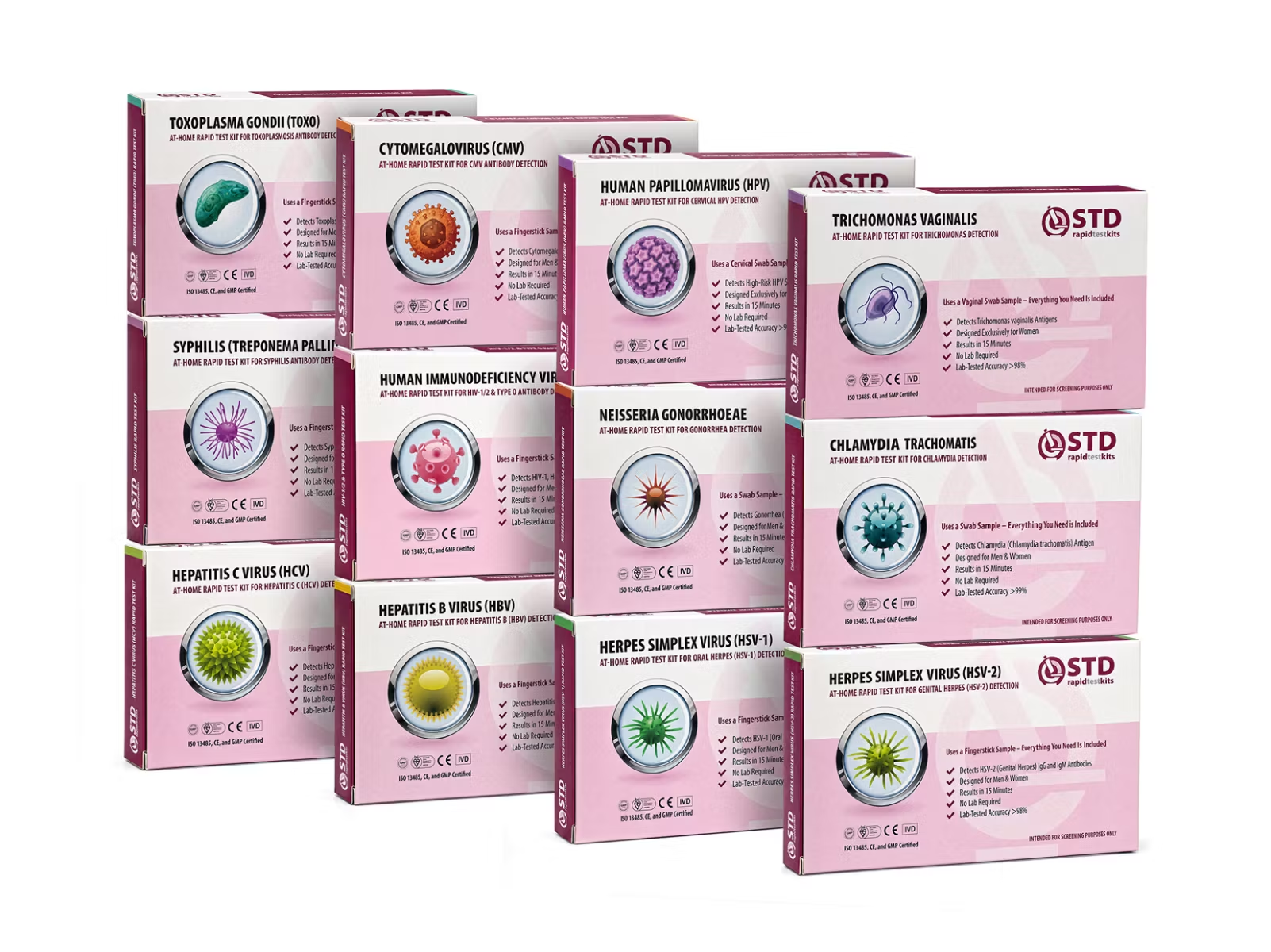
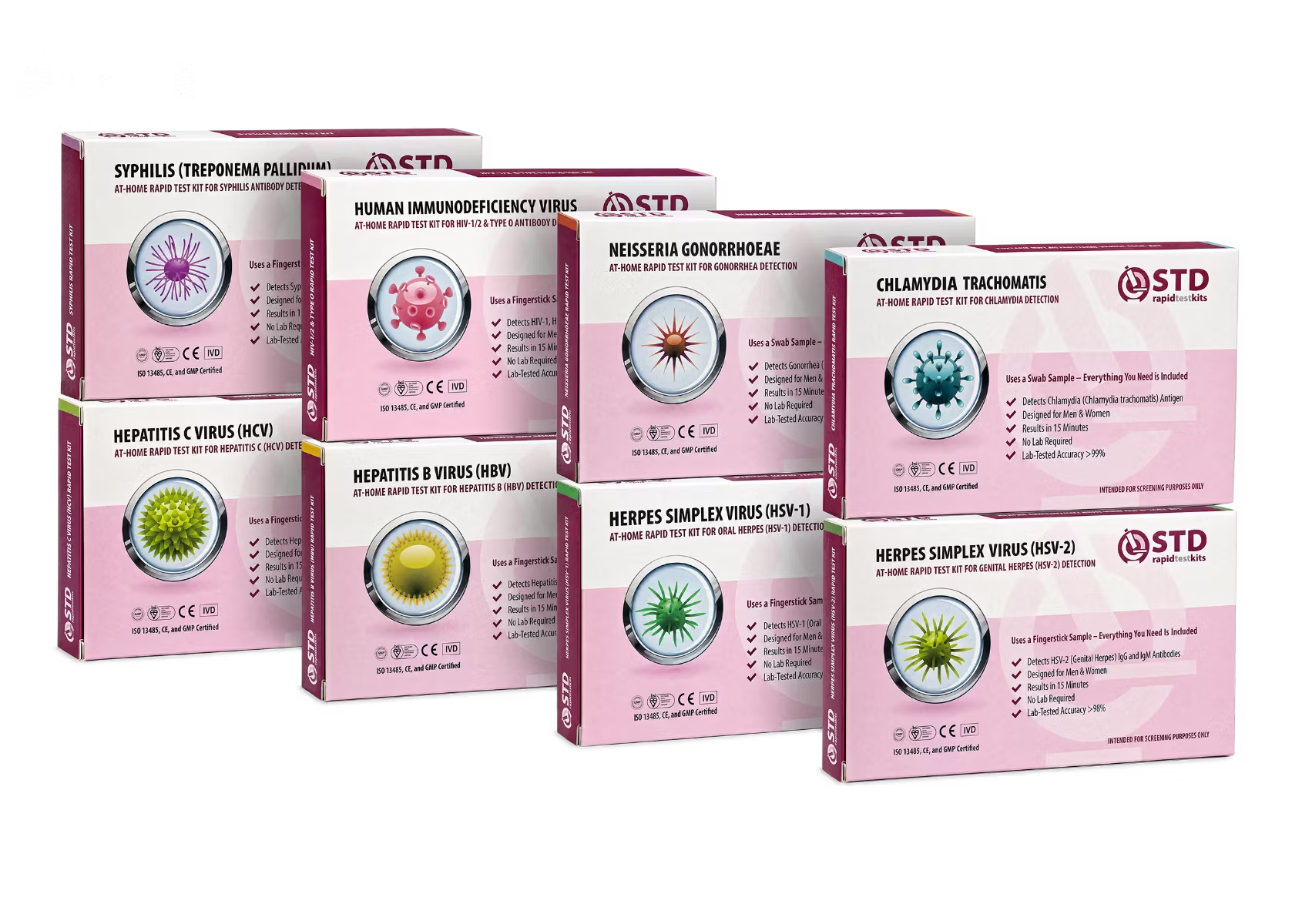
At-home rapid lateral-flow tests have changed the math. Discreet packaging, no clinic visit, no insurance trail, and results in roughly 15 minutes mean that 'let's both test before we sleep together' is now something a couple can do over a weekend without rearranging their lives. Single-infection kits exist for chlamydia, gonorrhea, herpes, HPV, HIV, syphilis, hepatitis B, and hepatitis C. Combination kits screen for several at once. None of them require a doctor's note. These are screening tools, not lab-grade NAAT confirmation; a positive at-home result is worth confirming with a clinic-administered test, but the screening function is exactly what most early-relationship conversations need.
The women's 10-in-1 panel below is validated for vaginal self-swab and fingerstick blood, so it is not designed for male anatomy. Men needing comparable coverage should see the 8-in-1 mixed-anatomy kit further down the page, or visit a clinic for sample types we don't sell at home (urine, throat, rectal).
Window Periods: Why Test Timing Matters
Even when both partners agree to test, timing changes the answer. Every infection has a 'window period,' the gap between exposure and the moment a test can reliably detect it. Test too early, and the result can be negative even if the person is infected. That is how false reassurance enters the relationship.
The general windows for the most common infections are roughly: chlamydia and gonorrhea become detectable on most rapid lateral-flow tests about 1 to 2 weeks after exposure; HIV antigen-antibody tests typically detect infection from around 18 to 45 days post-exposure, with the longest reliable window around 90 days for some test formats; syphilis is usually detectable from 3 to 6 weeks; hepatitis B and C antibody seroconversion can take 3 to 12 weeks; and herpes blood antibody tests may take 6 to 16 weeks to become reliably positive after a new infection, with most people converting by 12 weeks (per assay labelling; confirm with your kit's instructions for use). These ranges shift slightly between assays, so the specific kit's instructions for use are the authoritative source for any single test.
HIV transmission risk varies sharply by exposure type. Receptive anal intercourse with an untreated HIV-positive partner is the highest-risk consensual exposure at roughly 1.4% per act, while many other exposures are an order of magnitude lower. When the HIV-positive partner is on effective antiretroviral therapy with a sustained undetectable viral load, the transmission risk through sex is effectively zero (the U=U principle). After a high-risk exposure, post-exposure prophylaxis (PEP) is effective when started within 72 hours and continued for 28 days; a clinic or emergency room can prescribe it.
A test taken yesterday after a possible exposure last week may say 'negative' even if it isn't. People who want full reassurance often test twice, once shortly after the exposure event and again once the longest relevant window has passed.
So how do I know if my new partner is 'clean'?
You don't, by looking. The only reliable signal is a recent test for the specific infections that matter, taken after the right window period for each one. 'He got tested last year' doesn't cover any new partner he had since then. Bring it up early, frame it as a shared decision, and if either of you tested recently, ask exactly what the panel included. Most standard panels do not screen for herpes or HPV unless specifically requested.

Why This Hits Differently for Women and LGBTQ+ Daters
STI stigma does not land evenly. For straight cis men, asking for a test can feel 'extra,' a request they have rarely had to field. For women and LGBTQ+ daters, the conversation is often closer to a survival skill. The risks are not symmetric, the social cost of asking is not symmetric, and the long-term physical consequences of an untreated infection are not symmetric either.
Many queer daters, particularly trans women and men who have sex with men, face higher infection rates, more provider gatekeeping when seeking screening, and partners who are less practiced at open conversation about exposure history. The community-level public-health response has shifted dramatically in the past decade, with pre-exposure prophylaxis (PrEP, a daily antiretroviral pill that prevents HIV transmission), expanded HIV self-testing, and broader screening recommendations all part of the toolkit. The early-relationship conversation still depends on individuals being willing to ask plainly. Routine testing is part of how that community has historically protected itself when institutions did not.
Women carry a disproportionate share of the long-term consequences of untreated bacterial STIs. Pelvic inflammatory disease, infertility, ectopic pregnancy, and chronic pelvic pain are downstream complications of asymptomatic chlamydia and gonorrhea infections that were never caught. Persistent HPV infection drives the great majority of cervical cancers globally, per WHO data. Untreated syphilis carried into pregnancy can devastate a newborn. Women who push for testing before sex are making an informed calculation about consequences that fall disproportionately on them.
Being the person who initiates the conversation isn't aggressive. It's informed, and every time it happens, it makes the next conversation, with the next partner, slightly easier for everyone involved.
Persistent infection with high-risk HPV strains causes nearly all cervical cancers, per <a href="https://www.who.int/news-room/fact-sheets/detail/cervical-cancer" target="_blank" rel="noopener">WHO data</a>. The infection itself is common in both sexes and usually clears on its own, but the long-term oncology risk falls overwhelmingly on women, which is why routine cervical screening (Pap and HPV co-testing) is built into women's health care and why detecting persistent HPV early matters more for women than for men.
Testing Is Becoming the New Normal
The dating culture is slowly rewriting itself around this question. In a world where ghosting is routine, swiping outpaces speaking, and the distance between matched and intimate is sometimes measured in days, the act of pausing for a shared test is one of the clearer signals of care anyone can send. 'I want to know we are both safe before we move forward' communicates more than any string of date-night gestures.
That cultural shift covers serious relationships, casual workplace dating, post-divorce returns to dating in your 40s, and everything in between. The right time to introduce testing as part of how you date is now, before any specific situation makes it feel like an accusation.
FAQs
- Can someone give me an STI even if they feel totally fine?
- Yes, and it happens routinely. Many of the most common infections (chlamydia, gonorrhea, herpes, HPV, even early HIV) cause no symptoms in a large fraction of the people who carry them. The CDC chlamydia fact sheet specifically notes that chlamydia often causes no symptoms. 'Feeling fine' is not a diagnostic signal; mutual testing on a known timeline is.
- How do I bring up STI testing without making things weird?
- The goal is to make it mutual, not interrogative. Raise it while you are still in the flirting-but-not-yet-physical phase, frame it as your standard practice, and invite the other person to participate rather than comply. The specific words matter less than the tone. Calm and matter-of-fact works better than tentative or apologetic.
- What if they say they got tested last year? Is that enough?
- Usually not. STI testing is a snapshot of a moment, not a permanent certificate. If they have had a new partner since the last test (even oral, even with a condom), the snapshot is out of date. Also, most standard panels do not include herpes or HPV unless specifically requested, so 'I got tested for everything' is rarely literally true.
- I'm embarrassed to test. What if it comes back positive?
- Most STIs are treatable, and all of them are manageable. Catching an infection early gives you the option to treat it, manage onward transmission, and tell future partners truthfully.
- Is oral sex really risky enough to worry about?
- Yes, more than most people assume. Pharyngeal gonorrhea is genuinely common, syphilis can transmit through oral contact, and HSV-1 (commonly oral) and HSV-2 can cross between mouth and genitals in either direction. 'We didn't have intercourse' does not mean 'we didn't have an exposure that should be tested for.'
- What do I do if they refuse to get tested?
- Treat the refusal as data. Phrasing like 'you're being dramatic' or 'you're killing the mood' is a tell that this person handles inconvenient health conversations by making them your problem. That pattern rarely improves later in a relationship.
- Do at-home tests actually work, or is this expensive wishful thinking?
- They work as screening tools when you follow the directions and respect the window period. At-home rapid lateral-flow tests are not as analytically sensitive as lab-run NAATs, but they detect infections at clinically meaningful levels for most situations. A positive at-home result is worth confirming with a lab test; a negative result taken inside the right window is genuinely informative.
- I tested negative. Am I good forever?
- No. 'Negative' describes your status at the moment the sample was taken, for the specific infections the test covered, after the appropriate window. New exposures reset the clock. If you have had sex since the last test, or your last test was many months ago, it is time to retest. Most public-health bodies recommend regular STI screening for sexually active adults under 25 and for anyone with new or multiple partners.
- U.S. Centers for Disease Control and Prevention. Sexually Transmitted Diseases (STD). Public-health portal used here as the general CDC STI reference.
- U.S. Centers for Disease Control and Prevention. About Chlamydia. Source for the 'chlamydia often causes no symptoms' statement and screening guidance.
- U.S. Centers for Disease Control and Prevention. About Genital Herpes. Source for asymptomatic shedding and HSV transmission patterns.
- U.S. Centers for Disease Control and Prevention. HIV Testing. Source for HIV antigen-antibody testing window periods.
- World Health Organization. Cervical cancer fact sheet. Source for the persistent-HPV link to cervical cancer.
- U.K. National Health Service. Sexually transmitted infections (STIs). General-public reference for STI symptoms, screening cadence, and the asymptomatic-carriage point.
