
Published: October 2025 | Last updated: May 2026 | Editorial review and quality control: Martina N.
You've just opened the foil pouch on your at-home trichomoniasis test, and now you're not sure what to do next. Maybe the result is sitting in front of you and you're trying to decide whether that faint line counts. Maybe you haven't started yet and want to know what to expect. This guide walks through every part of the process: how to prep, how to run the test correctly, how to read what shows up on the cassette, what to do when something looks wrong, and where to go from there.
One quick note on scope before we begin: our at-home trichomoniasis rapid test is validated for vaginal self-swab only, so it is intended for people with vaginas. If you have a penis and you want to confirm or rule out trichomoniasis, see a clinic; lab-processed NAAT on a urine sample or urethral swab is the right tool for that. The reading-and-result steps below apply to any lateral-flow trich kit, but the sample-collection guidance assumes the vaginal-swab version.
Key takeaways
- A positive result shows two lines: one at C (control) and one at T (test). Even a faint test line counts. A test line with no control line is invalid regardless of what the test line shows.
- Trichomoniasis has a 5 to 28 day incubation window per the CDC. Testing in the first week after exposure can produce a false negative, so retest at the two-week mark if symptoms persist or you had a known exposure.
What's inside the trichomoniasis test kit
The moment you open the foil pouch, it's easy to feel overwhelmed by the parts inside. Knowing what each component does ahead of time turns five small unfamiliar items into a clear sequence.
Most home trichomoniasis lateral-flow kits include a sealed cassette device (the result reader, similar in shape to a pregnancy test), a sterile vaginal self-collection swab, a buffer solution in a small dropper bottle or tube, a transfer dropper for moving the sample mixture onto the cassette, and a printed instruction leaflet. Some kits include a small adhesive timer sticker; others assume you'll use your phone.
The cassette is where the result will appear. It has a sample well (a small opening where the buffer mixture is dropped) and a result window with two horizontal labeled positions, C (control) and T (test). The control line confirms the test ran correctly. The test line indicates whether trichomonas antigens were detected in your sample. Faint test lines are still meaningful, and we'll come back to how to read them.
Store the kit between roughly 2 and 30 degrees Celsius (about 36 to 86 degrees Fahrenheit), away from direct sunlight and moisture. Heat and humidity damage the antibodies on the test strip and can make a kit fail or produce unclear lines. Check the expiration date on the outer pouch before you open it. If the foil is torn, the cassette is damaged, or the kit is past its date, do not use it; contact the seller for a replacement. A compromised kit is the most common cause of an invalid result that is not your fault.
- Cassette: the result reader, with a sample well and a C/T result window
- Sterile vaginal self-collection swab
- Buffer solution in a small dropper bottle or tube
- Transfer dropper for moving the sample mixture onto the cassette
- Printed instruction leaflet (timing and drop count vary by brand)
Prep first, panic less
The single biggest predictor of a clean result is how you set up before you start. Rapid lateral-flow tests are sensitive to timing, contamination, and sample handling, and getting those right takes about three minutes of preparation.
Wash your hands with soap and warm water and dry them on a clean towel. Find a flat, dry surface (a bathroom counter or a small table works) and set out the cassette, buffer, swab, dropper, instructions, and a phone or watch for timing. Keep the cassette flat throughout: tilting it can affect how the sample flows across the strip.
Skip vaginal sex, vaginal creams, lubricants, douching, and tampons for 24 to 48 hours before the test. These can wash away the parasite, dilute the sample, or coat the swab with substances that interfere with antigen detection. You do not need to hold your urine for a vaginal swab; that rule belongs to urine-based testing. Avoid scheduling the test during heavy menstrual flow if you can, because blood can dilute the sample and obscure the test line. A few days after the period ends gives the cleanest sample.
If symptoms are severe and you cannot wait, you can still test; just understand that a borderline read is harder to interpret. Read the instructions twice. Different brands ask for different things: some need two drops of mixture in the sample well, others need three or four; some read at 10 minutes, others at 15. Set a timer the moment you add the first drop. Reading the cassette before the timer is up or more than 20 minutes after can both produce a misread, and most kits print a hard cutoff (often 20 to 30 minutes) past which the result is no longer valid.

Step-by-step: running the test
Every brand has its own quirks, but the basic sequence for a vaginal-swab trichomoniasis rapid test follows the same five steps. The walk-through below sticks to actions you can verify as you go. If anything in your kit's leaflet contradicts what's here, follow your kit.
Start by getting comfortable. Sit on the edge of the toilet, a chair, or in a squat, whatever lets you reach. Hold the swab by the plastic stick, not the cotton tip; touching the tip can contaminate it. Gently insert the swab about 5 cm (2 inches) into the vagina and rotate it against the vaginal walls for 15 to 20 seconds. The goal is to coat the cotton head with vaginal secretions, not to scrape deeply. It should not hurt.
Remove the swab and immediately place it into the buffer solution. Swirl the swab in the buffer for the time the leaflet specifies (typically 15 to 30 seconds), then press the cotton tip against the inside wall of the tube as you remove it to squeeze the fluid out of the swab. This is the step most people rush, and an under-mixed sample is a common cause of faint or absent lines.
Cap the buffer tube with the dropper top. Hold it vertically over the cassette's sample well and add the number of drops your leaflet specifies (usually two to four). Set your timer for the indicated wait (often 15 minutes) and leave the cassette flat and untouched. Read the result at the exact time the leaflet specifies. Reading 30 seconds early can hide a faint positive; reading 10 minutes late can produce false faint lines from evaporation.
| Step | What to do | Why it matters |
|---|---|---|
| Prepare workspace | Clean surface, open components, wash hands | Reduces contamination and sample mix-ups |
| Collect sample | Insert swab 5 cm, rotate 15 to 20 seconds | Coats the swab with enough secretion for the antigen test |
| Mix with buffer | Swirl 15 to 30 seconds, squeeze swab against tube wall | Releases antigen into the buffer fluid |
| Apply drops | 2 to 4 drops into the sample well, per the leaflet | Wrong volume changes how the sample flows across the strip |
| Wait and read | Read at the exact time the leaflet specifies | Reading too early or too late produces misreads |
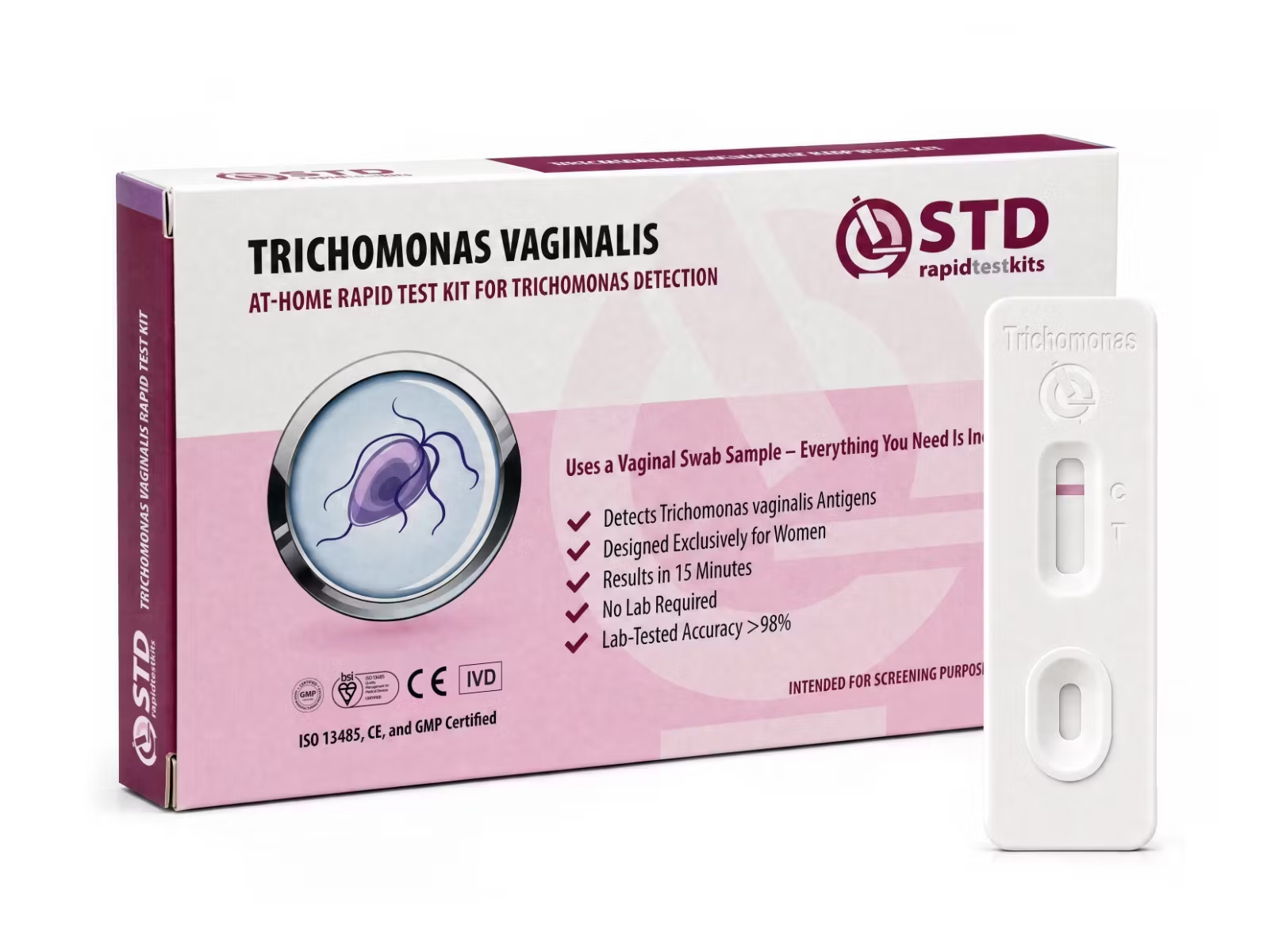
Reading the result: one line, two lines, or none
The waiting is the hardest part. Fifteen minutes can feel longer than that when you're watching a cassette. Once your timer goes off, the question becomes how to read what's actually on the strip.
Every trichomoniasis cassette has two indicators: a C line (control) and a T line (test). The control line is the first thing to look for. If C is visible, the buffer flowed correctly across the strip and the chemistry worked. No control line means the test failed for some reason (insufficient sample, buffer dropped in the wrong well, expired kit, damaged strip), and you need to discard it and use a new one. The test line tells you whether antigens from Trichomonas vaginalis were captured by the antibody on the strip. Any visible test line, even a very faint one, counts as positive.
The intensity of the line does not measure how sick you are. Lateral-flow chemistry works on a binding event at the molecular level: once enough antigen molecules accumulate at the test line, the colored line appears. A faint line typically means lower antigen quantity in the sample, which can happen with very early infection, suboptimal sample collection, or dilution from menstrual blood or cervical mucus. It does not mean a milder infection or a maybe-positive. Treat any faint line as positive and confirm with a lab NAAT (the more sensitive laboratory test that clinics use to confirm trichomoniasis) or contact a clinician for treatment.
How do you read a trichomoniasis rapid test?
A positive result shows two visible lines on the cassette: one at C (control) and one at T (test). Any visible test line, including a very faint one, counts as positive. A single line at C only is negative. A test line with no control line, or no lines at all, is invalid and you'll need to use a new kit. Read the cassette at the exact time your leaflet specifies, usually 15 minutes after the buffer mixture is added.
| Result appearance | Meaning | Next step |
|---|---|---|
| One clear line at C only | Negative | Retest at 14 days if exposure was recent or symptoms continue |
| Two lines: C and T (any intensity) | Positive | Confirm with a lab NAAT or start treatment with a clinician |
| No lines at all | Invalid | Discard and use a new kit |
| Only a T line, no C | Invalid | Test malfunctioned; use a new kit |
What can go wrong (and how to fix it)
Even when you follow the leaflet, things can drift off course. A kit can have been mishandled in shipping. The buffer might be off. The swab might miss the right area. Below are the most common ways a home trichomoniasis test produces a wrong or unreadable answer, and what each one means for your next step.
The biggest source of a false negative is timing. Trichomonas vaginalis has an incubation window of roughly 5 to 28 days from exposure per the CDC, and antigen-based lateral-flow tests need enough parasite material in the sample to produce a visible line. Testing within the first 5 to 7 days after exposure can show a negative even when infection has started. If you're testing because of a specific exposure, the two-week mark is a practical retest point derived from the 5 to 28 day incubation window; most infections that would have been missed in the first week will be detectable by day 14.
Sample-collection problems are the next-largest source of confusion. Inserting the swab too briefly, not rotating it against the vaginal walls, or not squeezing the swab into the buffer can leave the antigen too dilute for the test to detect. Touching the cotton tip with your fingers (which is hard to avoid in a small bathroom) can also introduce contamination that creates a streaky line or a false faint band. If you suspect a sampling problem, retest cleanly with a new kit rather than second-guessing the read.
Reading the cassette outside the leaflet's window is a third common issue. Most kits become invalid after 20 to 30 minutes; the strip can develop a ghost line from drying that looks like a faint positive but isn't. If you missed the window, do not interpret the result. Use a new kit and time it correctly.
False positives on trichomoniasis rapid tests are uncommon but not impossible. Blood contamination, other vaginal infections like bacterial vaginosis, and rarely a manufacturing defect can produce a faintly positive read that NAAT later disagrees with. If you have a positive home result and no symptoms, a confirmation NAAT at a clinic is reasonable before starting treatment. If you have symptoms and a positive home result, most clinicians will treat without waiting for confirmation because the cost of delay is higher than the cost of a single antibiotic course.
- Timing: tested within the first 5 to 7 days of exposure; antigen levels still too low
- Sampling: swab not rotated long enough, or fluid not squeezed into the buffer
- Reading window: cassette read after the leaflet's cutoff (often 20 to 30 minutes), producing a ghost line
- False positive: rare, but blood contamination or other vaginal infections can mimic a faint band
Disposal, privacy, and discreet handling
Once the result is read, there's the question of what to do with the components. Used trichomoniasis test parts are not biohazardous waste in any meaningful sense, but most people prefer to dispose of them discreetly, especially in shared living situations.
Wrap the swab, cassette, dropper, and buffer tube together in a few sheets of toilet paper or a tissue, drop the bundle into a small plastic bag (a sandwich bag or a produce bag both work), tie it tight, and put it in your normal trash. If you share a bin and want extra discretion, bury it under other waste or wait until you're already taking the trash out. Most kits have no smell and no leakage risk once the components are wrapped.
Do not flush any of the components. Swab sticks and plastic strips clog plumbing, and the cassette is not biodegradable. Unless your local hazardous-waste rules specifically include used home test kits (this is very rare for non-prescription point-of-care tests), regular trash disposal is appropriate.
On packaging and billing: STD Rapid Test Kits ships in plain unmarked boxes with no medical labeling on the outside, and the charge on your card and bank statement reads as a neutral merchant name rather than anything that identifies the product. If you live with family, roommates, or a partner you'd rather not loop in, you can order without leaving an obvious paper trail.

Troubleshooting: did the test fail or was it just too soon?
If your result feels off, the question is usually one of three things: timing (you tested too early in the window), user error (a step went wrong during the run), or kit failure (the strip itself didn't work). Sorting between them changes what you should do next.
If you tested within 5 to 7 days of exposure and got a single C-line negative, that result is provisional rather than definitive. Trichomonas can take up to four weeks to be reliably detectable on antigen-based home tests. Retest at the two-week mark if you have symptoms or known exposure; the 14-day point is a practical milestone derived from the 5 to 28 day incubation window, since most infections that would have been missed in the first week will be detectable by day 14. If symptoms persist after a second negative home test, see a clinician for NAAT, which is more sensitive than lateral-flow chemistry and can pick up infections that home tests miss.
If your cassette shows odd patterns (a smudge that runs sideways, a wash of color across the whole window, lines that look like dirt rather than ink, or any result that bears no resemblance to the photos in the leaflet), that is a kit failure rather than a real reading. Toss it, note any details (lot number, expiration date, where you stored it) in case you want to ask the seller for a replacement, and use a new kit. A kit kept on a hot shelf, in a car, or near a heater for an extended period can degrade silently and produce nonsense results that look superficially valid.
If you missed a step (forgot the buffer, used the wrong number of drops, swabbed too briefly), the result is not interpretable and you'll need to repeat with a new kit. Do not try to salvage a mishandled run, even if a faint line is visible. Lateral-flow chemistry is unforgiving about deviations from the protocol.
| Issue | Likely cause | What to do |
|---|---|---|
| No lines appear | Missed buffer step, kit failure, or expired kit | Discard, check expiration, retest with a new kit |
| Only C line shows | True negative, or tested too early in the window | Retest at 14 days if exposure was recent or symptoms continue |
| Only T line shows | Test never activated | Discard, use a new kit |
| Both lines, faint T | Positive, possibly early infection | Start treatment with a clinician or confirm via lab NAAT |
| Smudged or partial lines | Contamination, delayed reading, or kit degradation | Invalid; do not interpret, use a new kit |
Your next step depends on what you saw
If your result was clearly negative and you have no symptoms, you can move on. If you have symptoms, schedule a clinic visit for NAAT regardless of what the home test showed, because antigen-based home tests catch most infections but not all of them. If your result was positive, the next step is treatment: trichomoniasis is curable with a short course of oral metronidazole or tinidazole, and the CDC's STI treatment guidelines say all current sexual partners should be treated at the same time to prevent reinfection.
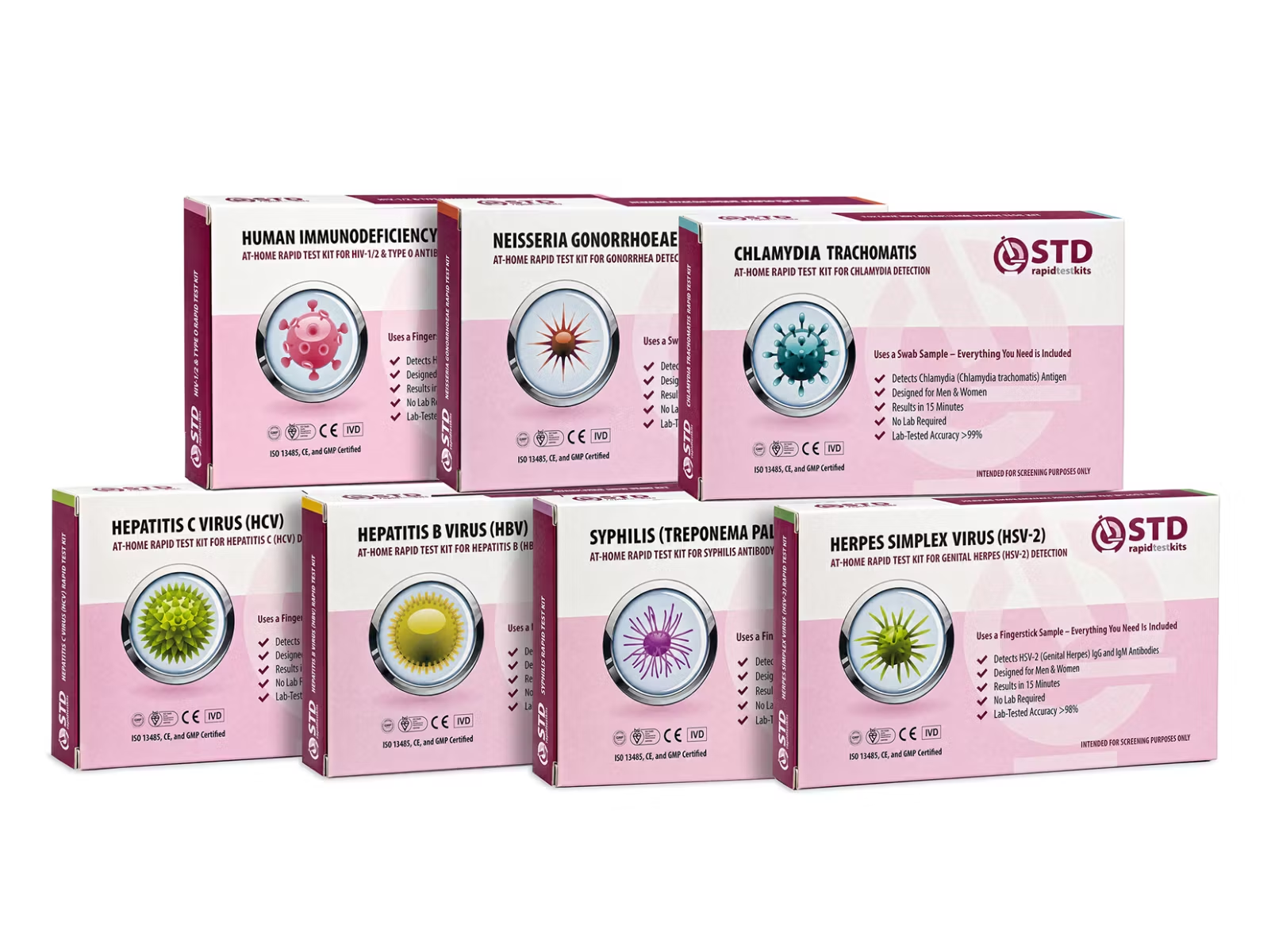
One other thing worth considering after a positive trich result: co-infection screening. Trichomoniasis often travels with other curable STIs picked up from the same exposure event, and the wet-prep and antigen-based tests for trich do not check for any of them. If you tested positive on a single-infection kit and the exposure was recent, broadening to a combo screen for the most common co-infections (chlamydia, gonorrhea, syphilis, HIV, hepatitis B, hepatitis C) is a reasonable next move before, or alongside, your clinic visit.
Trichomoniasis is one of the most common curable STIs worldwide, and most people who carry it have no idea. The fact that you tested at all is the meaningful action here; the result tells you what to do next, but the willingness to check is what matters. If you're unsure about any part of the process, retest with a new kit, see a clinician, or both. The cost of a clarifying lab test is low compared with the cost of leaving an infection untreated for months.
Most people with the parasite cannot tell they are infected. Although symptoms vary, infected people who do not have symptoms can still pass the infection on to others.
FAQs
- Can I use a home trichomoniasis test during my period?
- You can, but the result is harder to interpret. Blood can dilute the sample and obscure or wash out the test line, which leads to false negatives or borderline reads. If you can wait a few days past your heaviest flow, do; if symptoms are bad and you cannot, run the test anyway and consider a confirmation NAAT at a clinic regardless of what the cassette shows.
- Is a faint line really a positive?
- Yes. Lateral-flow chemistry is binary at the molecular level: antigens either bind to the antibodies on the test line or they don't. A faint line means the antigens did bind, just in lower quantity, often from early infection, partial sampling, or dilution. Treat any visible test line as positive. If you're unsure, confirm with a lab NAAT.
- How soon after exposure can I test?
- Trichomonas has a 5 to 28 day incubation window per the CDC. Testing within the first week of exposure can produce a false negative because antigen levels haven't built up yet. The 14-day mark is a practical retest point derived from that 5 to 28 day window; testing earlier can miss infections still in early buildup. If symptoms persist after a 14-day negative home test, see a clinician for NAAT, which is more sensitive than home antigen tests.
- Can men use this at-home trichomoniasis test?
- Not the one we sell. Our trichomoniasis rapid kit is validated for vaginal self-swab only, so it's intended for people with vaginas. If you have a penis and want to confirm or rule out trich, see a clinic for lab-processed NAAT on a urine sample or urethral swab. Trichomoniasis is often asymptomatic in men but still transmissible, so testing matters when a partner has tested positive.
- Why did my test come out completely blank?
- No lines at all means the strip never ran. The most common causes are a missed buffer step (the sample wasn't mixed before drops were added), too little fluid in the sample well, or a kit that was damaged or expired. The result isn't interpretable. Discard it and use a new kit, checking the expiration date and storage history this time.
- Should I still test at a clinic if my home result was positive?
- It's worth it, especially if you have no symptoms or want documentation for treatment. Home antigen tests are useful screening tools, but clinics use NAAT for higher analytical sensitivity. A clinic confirmation locks in the diagnosis, lets the clinician prescribe treatment in the same visit, and produces a result you can share with a partner for their own treatment.
- How is trichomoniasis treated?
- Oral metronidazole or tinidazole clears trichomoniasis in most people. The CDC's 2021 STI treatment guidelines updated the preferred regimen for cisgender women to 500 mg of metronidazole twice daily for 7 days, because the older single-dose protocol had higher recurrence rates in that group. Avoid alcohol while taking either medication and for 24 to 72 hours after, because the combination causes nausea and flushing. Current sexual partners should be treated at the same time to prevent reinfection.
- Will at-home testing show up on my medical record or insurance?
- No. Buying a kit and running it at home doesn't create a medical record, and the charge on your card statement reads as a neutral merchant name rather than naming the product. Only if you bring the result to a clinic, pursue treatment, or use insurance to pay for confirmation testing does anything enter your medical record. The home test itself is private.
How we sourced this article: This guide reflects current public-health guidance from the U.S. Centers for Disease Control and Prevention, the UK NHS, and MedlinePlus (a service of the U.S. National Library of Medicine), combined with manufacturer-published instructions on lateral-flow antigen-based rapid tests. The author is a medical writer, not a clinician; this article is educational and is not a substitute for professional diagnosis or treatment. For a confirmed diagnosis or for treatment, see a licensed provider.
- U.S. Centers for Disease Control and Prevention. About Trichomoniasis: incubation window (5 to 28 days), symptoms, and asymptomatic transmission.
- U.S. Centers for Disease Control and Prevention. STI Treatment Guidelines, Trichomoniasis: preferred metronidazole regimen and current-partner treatment guidance.
- UK NHS. Trichomoniasis: symptoms, when to test, and treatment.
- MedlinePlus (U.S. National Library of Medicine). Trichomoniasis test: sample types, wet prep as first-line testing, NAATs as more sensitive follow-up tests, and home-testing context.
- MedlinePlus (U.S. National Library of Medicine). Trichomoniasis topic overview: symptoms, causes, and reinfection prevention.
