Published: September 2025 | Last updated: May 2026 | Editorial review and quality control: Martina N.
Is eye discharge after sex an STD or just pink eye?
Usually it is ordinary viral or allergic pink eye, not a sexually transmitted infection. Lean toward chlamydia or gonorrhea when thick yellow-green discharge, deep eye pain, and recent oral or genital contact line up, typically 1 to 14 days after exposure. Test for both from day 7 to 14. For severe pain, swelling, or any vision change, seek same-day care.
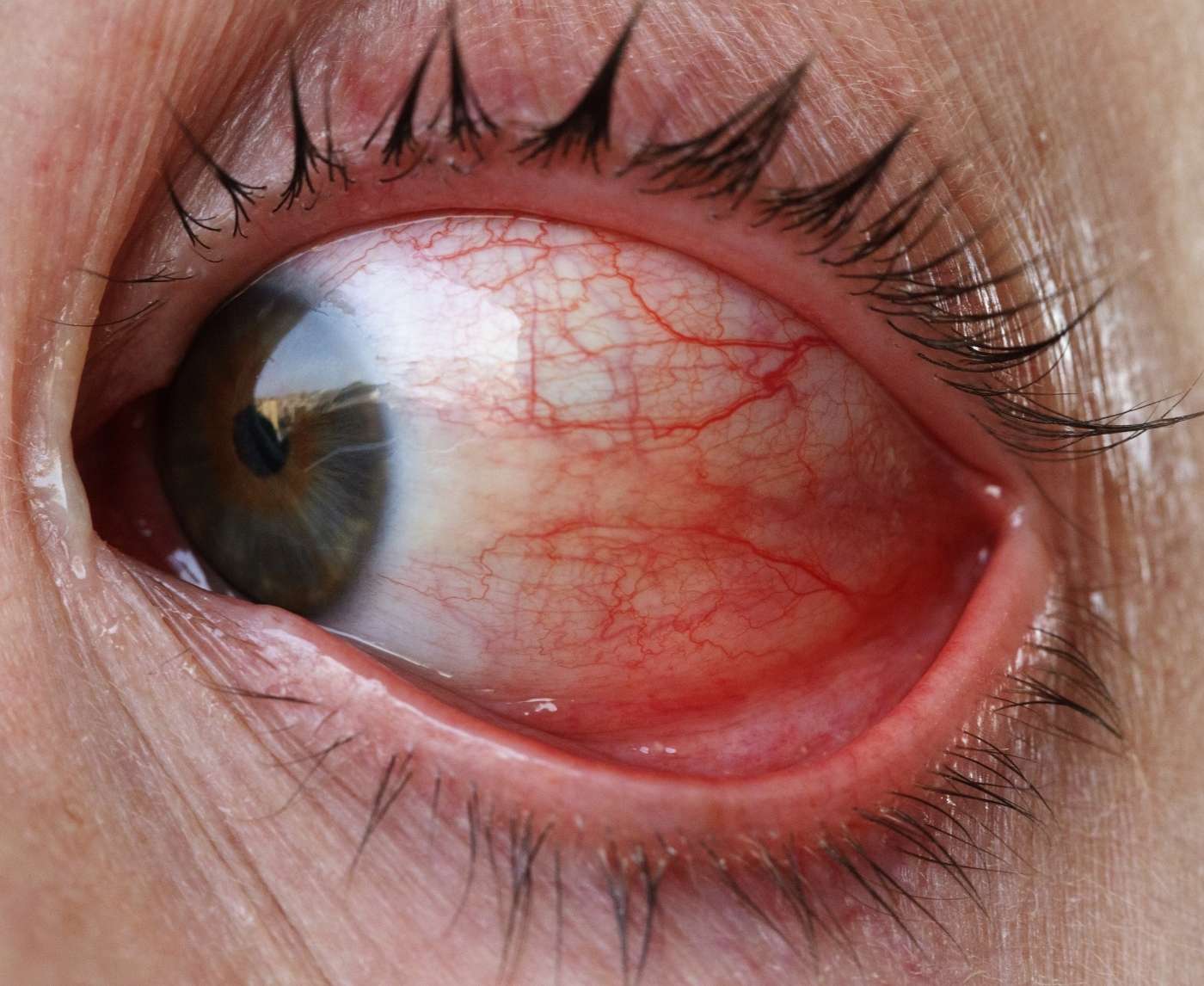
Most people never connect a crusty, watering eye with their sex life, and ordinarily the two have nothing to do with each other. If you woke up to a sore, red eye with unusual discharge a few days after oral or genital sex and now you are running the math on what caused it, the worry is understandable. Chlamydia and gonorrhea, the two most common bacterial sexually transmitted infections, can both inflame the eye in a way that looks a lot like ordinary pink eye in the first hours.
Here is the reassuring part. Most red, watering eyes are viral or allergic pink eye, and those clear on their own within about two weeks (NHS, conjunctivitis). The small share that come from sexually transmitted bacteria need different care, sometimes urgently. Telling them apart comes down to three things: how thick and discolored the discharge is, how much it hurts, and whether you had recent sexual contact that could plausibly explain it. This guide walks through each signal, the symptoms that warrant a same-day visit, and how at-home testing fits in.
Key takeaways
- Most red, watering eyes are ordinary viral or allergic pink eye. Suspect chlamydia or gonorrhea when thick yellow-green discharge, deep pain, and recent sexual contact line up, usually within 1 to 14 days.
- Gonococcal eye infection can damage the cornea within days. If you have severe eye pain, swelling, light sensitivity, or any vision change after recent sexual contact, seek same-day medical care rather than waiting to test.
How an STI Reaches the Eye
The clinical name for inflammation of the thin membrane covering the white of the eye and the inside of the eyelid is conjunctivitis. When sexually transmitted bacteria cause it, the route is almost always direct contact between infected fluid and the eye surface. The conjunctiva is a mucous membrane, the same tissue type that lines the throat, urethra, vagina, and rectum, so bacteria that thrive on those warm, moist surfaces settle on the eye just as readily.
The fluid does not have to land squarely in the eye. The common paths in adults are a splash of semen or vaginal fluid onto the face during oral, vaginal, or anal sex; rubbing the eye with a hand that just touched genitals, a partner's mucous membranes, or a sex toy; and sharing damp items like towels, washcloths, or eye makeup with someone who has an active infection. Oral sex is an especially underestimated route, because the throat can carry chlamydia or gonorrhea silently, and that reservoir can move to a partner's eye on hands or secretions (CDC, STI risk and oral sex).
Transmission is never automatic, even when fluid reaches the eye. The other person has to have an active, untreated infection, which is why uncertainty about a partner's status is a more useful reason to test than the contact itself. Newborns are the other group at real risk: a baby born to a parent with untreated chlamydia or gonorrhea can develop conjunctivitis in the first days of life, which is why many countries place a prophylactic antibiotic ointment in newborn eyes shortly after delivery (CDC, chlamydial infections treatment guidelines).
- Direct fluid contact during oral, vaginal, or anal sex, when semen or vaginal fluid reaches the face.
- Hand-to-eye transfer after touching genitals, a sex toy, or a partner's mucous membranes, then rubbing the eye.
- Shared damp items such as towels, washcloths, or eye makeup used by someone with an active genital or eye infection.
Kissing, casual closeness, and simply being in the same room during sex without fluid contact do not transmit it.
STD Eye Infection vs Ordinary Pink Eye
In the first hours, every conjunctivitis looks similar: a pink or red eye, mild light sensitivity, watery tearing, and the feeling of grit under the lid. The differences sharpen as the infection settles in, and three of them carry most of the weight.
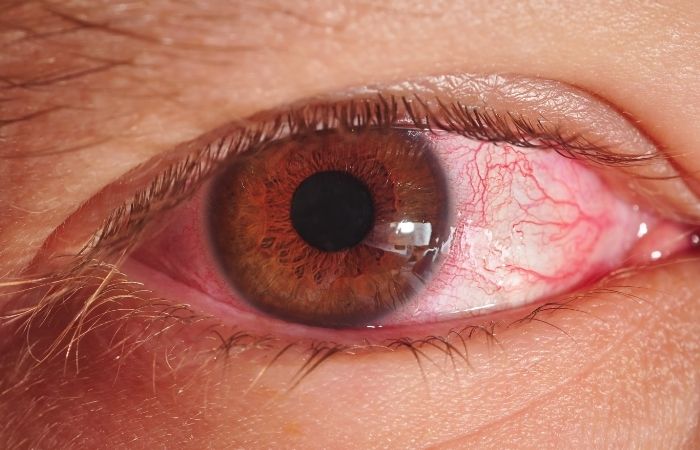
Discharge is the first. Sexually transmitted conjunctivitis, gonococcal especially, tends to turn into thick yellow-green pus that refills the eye within minutes of being wiped. The CDC describes this purulent discharge matting the eyelids together (CDC, conjunctivitis clinical overview). Viral and allergic pink eye usually stay watery. Pain is the second. A deep, burning ache that worsens through the day points to bacterial inflammation, while itch without much pain is more typical of allergy, and a gritty feeling paired with cold symptoms suggests a virus. Crusting on waking is the third: STD-related cases often produce so much exudate overnight that the lashes seal shut.
Which eye is involved adds a clue. Sexually transmitted infection usually starts in one eye and may spread to the second over a day or two. Allergic pink eye almost always hits both eyes at once, because the trigger reaches them equally. Viral pink eye often starts in one eye and spreads within a day or two, frequently alongside a cold or sore throat in the household. None of these signs alone confirms an STI, but pairing thick, fast-moving discharge with a recent exposure shifts the odds enough to test rather than wait.
Pink Eye vs Gonococcal vs Chlamydial Eye Infection
| Feature | Common pink eye | Gonococcal eye infection | Chlamydial eye infection |
|---|---|---|---|
| Onset speed | Gradual over 1 to 3 days | Rapid, often 1 to 2 days | Slower, 5 to 14 days |
| Discharge | Watery or light mucus | Thick yellow-green pus, refills fast | Persistent stringy mucus |
| Eyelid swelling | Mild to moderate | Often pronounced | Mild to moderate |
| Pain | Gritty or itchy | Often severe, burning | Mild foreign-body feeling |
| Crusting on waking | Light to moderate | Heavy, lashes seal shut | Moderate |
| Typical exposure | Hand-to-eye, respiratory, allergens | Direct sexual fluid contact | Direct sexual fluid contact |
| Course if untreated | Self-limiting in 7 to 14 days | Can ulcerate the cornea within days | Can persist weeks to months |
Most pink eye resolves on its own; gonococcal infection is the one that escalates fastest and needs urgent care.
Symptoms to Watch For After Sexual Contact
If you are trying to read your own eye, it helps to have a concrete checklist rather than a vague sense of dread. The signs below lean toward a sexually transmitted cause when they appear together and within a couple of weeks of oral or genital contact. A single mild symptom on its own usually means ordinary irritation. The more of these that stack up, and the faster they escalate, the stronger the case for testing.
Keep in mind that the eye is often not where the infection started. Many people with throat or genital chlamydia or gonorrhea have no symptoms at those sites and only notice the eye, so the absence of genital symptoms does not rule an STI out.
Eye and Linked Symptoms That Point Toward an STI Cause
Having one or more of these does not confirm infection. Only a test can do that, and severe symptoms need same-day care regardless of the cause.
- Thick yellow-green discharge that refills within minutes of wiping Common
- Heavy crusting that seals the lashes shut overnight Common
- Deep burning eye pain rather than a mild itch Common
- Redness that starts in one eye, sometimes spreading to the second Common
- Eyelid swelling, occasionally severe enough to limit opening the eye Less common
- Light sensitivity or any change in vision, such as blurring, halos, or floaters Less common
- A scratchy or burning sore throat after oral sex that does not feel like a cold Less common
- Burning on urination, unusual genital discharge, or new pelvic discomfort Less common
Which Infections Cause Eye Symptoms
Four pathogens account for most adult cases, and each behaves differently once it reaches the eye. Recognizing the pattern early is the difference between a quick recovery and lasting damage.
Gonorrhea is the most aggressive. Gonococcal conjunctivitis usually appears within 1 to 5 days of exposure and produces copious, thick, yellow-green pus that refills almost as fast as it is wiped, with marked eyelid swelling and severe pain. Without prompt systemic antibiotics it can ulcerate the cornea within days and threaten vision, which is why clinicians treat it as an ocular emergency (CDC, gonococcal infections among adults).
Chlamydia is the slower cousin. Onset runs 5 to 14 days after exposure, and the picture is usually stubborn redness in one eye with stringy mucus and a foreign-body sensation. Allergy drops do not help, and untreated it can linger for weeks. In newborns, chlamydial conjunctivitis classically develops 5 to 12 days after birth (CDC, chlamydial infections treatment guidelines).
Herpes simplex virus (HSV-1 or HSV-2) can cause keratitis when fluid from a cold sore or genital lesion reaches the eye, often via fingers. It tends to bring burning, light sensitivity, blurred vision, and small branching ulcers a clinician can see with fluorescein dye. It is treated with antivirals such as acyclovir, and flares can recur. Syphilis is rarer at the eye and more deceptive: ocular syphilis often shows up as inflammation inside the eye, called panuveitis, along with blurred vision or floaters rather than discharge, and it can cause permanent vision loss if missed (CDC, syphilis treatment guidelines).
Symptom Onset vs Testing Window
Two timelines get confused constantly, and mixing them up leads to wasted clinic trips or false reassurance. Incubation is the time from exposure to the first symptom. The testing window is the time from exposure to when a test can reliably detect the infection. They overlap, but they are not the same. You can feel something before a test turns positive, and you can have no symptoms yet still test positive a week later.
Eye symptoms from gonorrhea usually arrive within the first week, while chlamydia takes longer, often between days 5 and 14. Symptoms that surface weeks or months after a known exposure point more toward syphilis or a recurrent herpes flare and need a different work-up. For detecting the infection at the throat or genitals, standard clinical practice is to wait at least 7 to 14 days before testing with a nucleic acid amplification test (NAAT), the laboratory gold standard for both organisms, and to retest if symptoms persist after an early negative (CDC, chlamydial infections treatment guidelines). If your eye started bothering you the morning after sex, that is more likely irritation than infection, because bacteria need time to multiply. Testing on day two will not give a reliable answer; testing on day 10 to 14 will.
When to Test After Exposure
- Day 0 Exposure
Bacteria deposited; nothing detectable yet and usually no symptoms
- Day 2 Early irritation
Possible redness, but bacterial load is usually too low to detect. Severe symptoms still need same-day care
- Day 5 Gonorrhea peaks
Gonococcal eye symptoms often peak; chlamydia may begin. Still early for a reliable test
- Day 7 Window opens
Throat and genital testing becomes reliable from here
- Day 14 Peak sensitivity
Highest detection sensitivity; test now if you have not already
Symptoms can show before a test turns reliably positive. Severe symptoms need care regardless of the day count.
Eye Symptoms Rarely Travel Alone
An ocular STI usually coexists with infection somewhere else, because the bacteria that reached the eye came from a partner's throat, urethra, vagina, or rectum, and the same exposure that splashed the eye may have reached your own mucous membranes too. Testing only one site rarely answers the whole question.
Worth checking alongside the eye: a scratchy or burning sore throat that does not feel like a head cold, which can signal pharyngeal gonorrhea or chlamydia; burning during urination, increased urgency, or cloudy urine; and unusual genital discharge, mild pelvic discomfort, or bleeding between periods. Most men with urethral gonorrhea notice discharge or burning, while women are more often asymptomatic. When the eye comes paired with any of these after a recent oral encounter, the sensible move is multi-site testing, ideally throat plus the genitals, rather than a single swab. If the eye is the only symptom and there was no plausible fluid exposure, the odds lean heavily toward ordinary pink eye.
An eye symptom paired with any of these strengthens the case for testing at more than one site:
- A scratchy or burning sore throat that does not feel like a cold (a pharyngeal sign).
- Burning or increased urgency when you urinate (a urethral sign).
- New genital discharge, mild pelvic discomfort, or bleeding between periods (a genital sign).
When the picture is a cluster like this, throat plus genital testing tells you more than a single swab.
When an Eye Needs Same-Day Care
Most ordinary pink eye can wait until morning. An STD-related eye infection often cannot. The signals that move a case from monitor to see-someone-today are about how fast and how badly the eye is being affected: pain that worsens hour by hour, especially a deep ache that keeps you awake; pus that refills within seconds of wiping; eyelid swelling severe enough that the eye will not fully open; light that hurts indoors; and any change in vision, including blurring, halos, or floaters. Those last symptoms suggest the trouble has reached deeper than the surface.
Anyone with severe eye pain, copious pus, and recent unprotected sex needs a same-day evaluation for gonococcal conjunctivitis. The testing-window math does not apply in that situation, because a clinician can swab the eye directly and start antibiotics on the same visit. A newborn with a red, swollen, or discharging eye in the first month of life is a separate non-negotiable: seek care urgently regardless of anyone's sexual history, because untreated neonatal infection can permanently damage sight.
- Severe eye pain, especially a deep ache, after recent unprotected oral or genital contact
- Thick yellow-green pus that refills within seconds of wiping
- An eyelid so swollen the eye will not fully open
- New blurred vision, floaters, or sensitivity to ordinary indoor light
- Any eye redness or discharge in a newborn under one month old
Go to urgent care, an ophthalmologist, or an emergency department the same day, and mention your sexual history on arrival even if it feels awkward. It changes the work-up.
Common Myths, Especially About Oral Sex
Stigma drives a lot of misinformation here, and a few wrong beliefs lead people to either panic or wrongly relax. Oral sex carries a stubborn myth that it is safe enough to skip testing. It is lower-risk than vaginal or anal sex for HIV, but it sits squarely in the path of gonorrhea, chlamydia, syphilis, and herpes. The WHO notes that more than 30 bacteria, viruses, and parasites spread through vaginal, anal, and oral sex, and chlamydia alone accounted for an estimated 129 million new infections worldwide in 2020 (WHO, sexually transmitted infections). The corrections below clear up the beliefs that most often send readers in the wrong direction.
What People Get Wrong About Eye STIs
Myth: Oral sex is safe enough that I do not need to test.
Fact: Oral sex transmits gonorrhea, chlamydia, syphilis, and herpes. Pharyngeal infections are often silent, and the throat can seed a partner's genitals or, rarely, an eye on later contact. If oral sex is part of your life with new partners, periodic screening belongs in routine care.
Myth: Semen got in my eye, so I must be infected.
Fact: Not automatically. Semen can sting and redden the eye through its proteins and pH alone. Transmission needs active, untreated bacteria from the partner. Rinse with clean water or saline, watch for a few days, and test if symptoms develop or you are unsure of your partner's status.
Myth: My partner tested negative recently, so I am fine.
Fact: A test taken inside their own window period can read falsely negative. If you have eye symptoms after exposure, your own test answers the question more reliably than theirs does.
Myth: I can tell pink eye from an STI eye infection just by looking.
Fact: Early on they look alike. Discharge thickness, pain, and timing relative to sex narrow it down, but only a swab confirms the cause, which is why severe cases get tested and treated rather than guessed.
How Clinicians Diagnose and Treat Eye STIs
A clinician working up a possible STI eye infection usually does three things. First, they ask focused questions about recent sex, partners, condom use, and any genital symptoms; mentioning oral sex matters, because it is both the most common and the most under-disclosed route. Second, they swab the eye for a NAAT, the same molecular test used for genital chlamydia and gonorrhea and the most sensitive option for both (CDC, chlamydial infections treatment guidelines). Third, when gonorrhea is likely, they may add a culture, because culture allows antibiotic-susceptibility testing as resistant gonococcal strains spread.
Treatment is pathogen-specific and almost always works when started promptly. For adult gonococcal conjunctivitis the CDC regimen is a single 1 gram intramuscular dose of ceftriaxone plus a one-time saline rinse of the eye, and because adult ocular cases are uncommon and the evidence base is thin, the guidelines suggest consulting an infectious disease specialist (CDC, gonococcal infections among adults). Chlamydia is treated with oral doxycycline, commonly 100 mg twice a day for seven days, or single-dose azithromycin. Herpes keratitis is managed with antivirals, often alongside an ophthalmologist, and ocular syphilis is treated like neurosyphilis with intravenous penicillin. Two follow-through steps matter even as symptoms ease: partners from the exposure window need testing and treatment to prevent reinfection, and a repeat test a few weeks out can confirm the infection has cleared.
Because gonococcal conjunctivitis is uncommon and data regarding treatment of gonococcal conjunctivitis among adults are limited, consultation with an infectious disease specialist should be considered.
How At-Home Testing Fits In
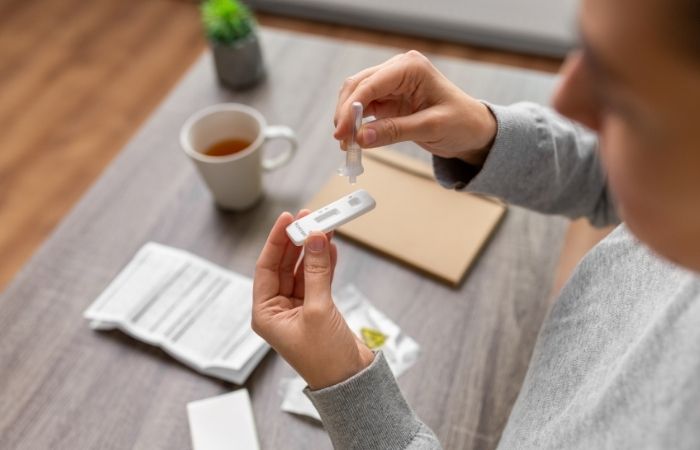
At-home rapid tests do not replace an in-person eye exam. The eye itself needs a clinician's swab and a slit-lamp look, and the medications for ocular STIs are prescription-only. Where home testing helps is upstream, by confirming or ruling out the genital or throat infection that likely seeded the eye. You do not need to swab your own eye to answer the underlying question, because the bacteria are detectable in a genital sample even when the eye is the symptom that scared you. A positive home result for chlamydia or gonorrhea is concrete information you can hand to whichever clinic you visit, and it shortens the path to the right treatment.
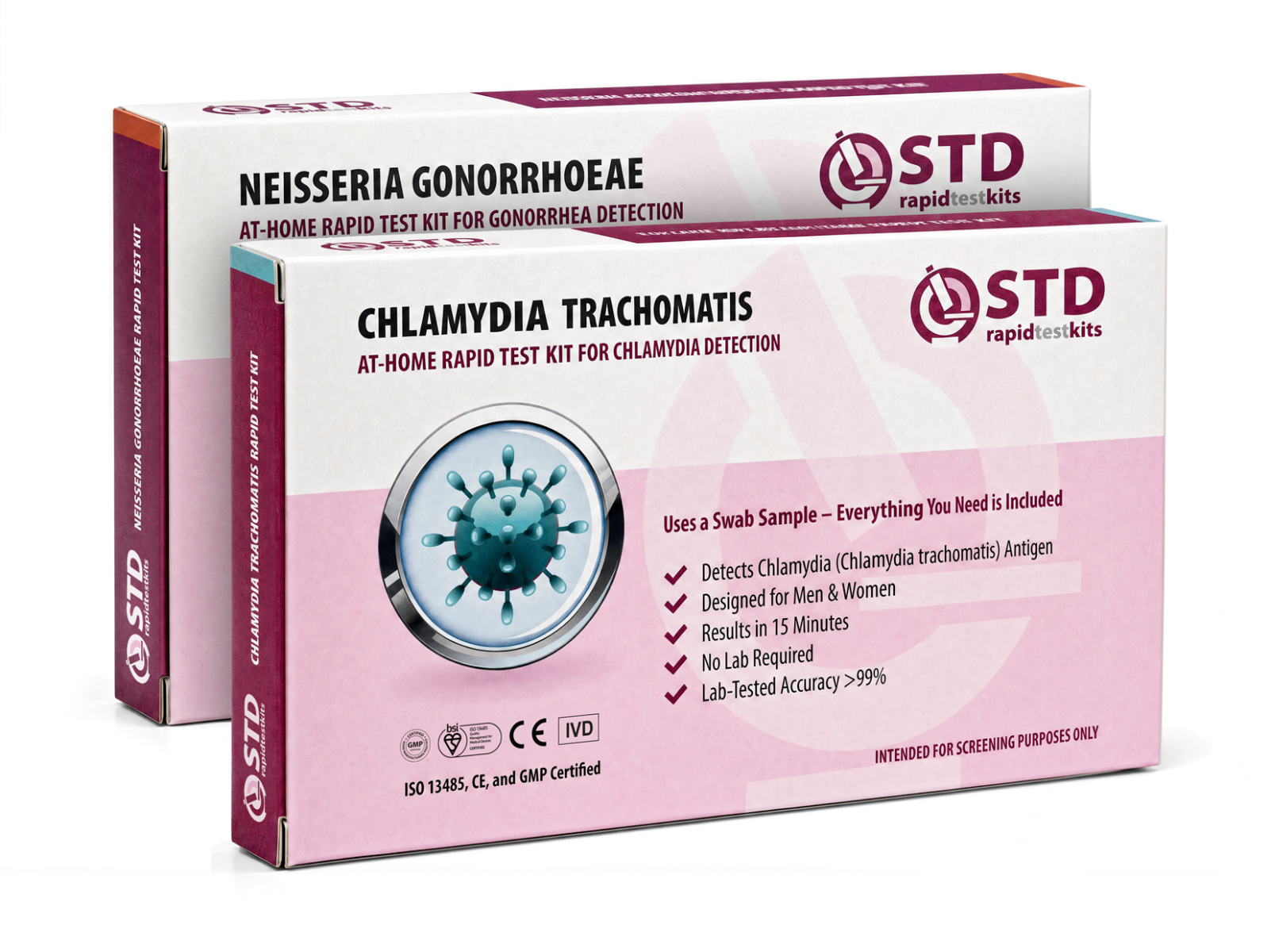
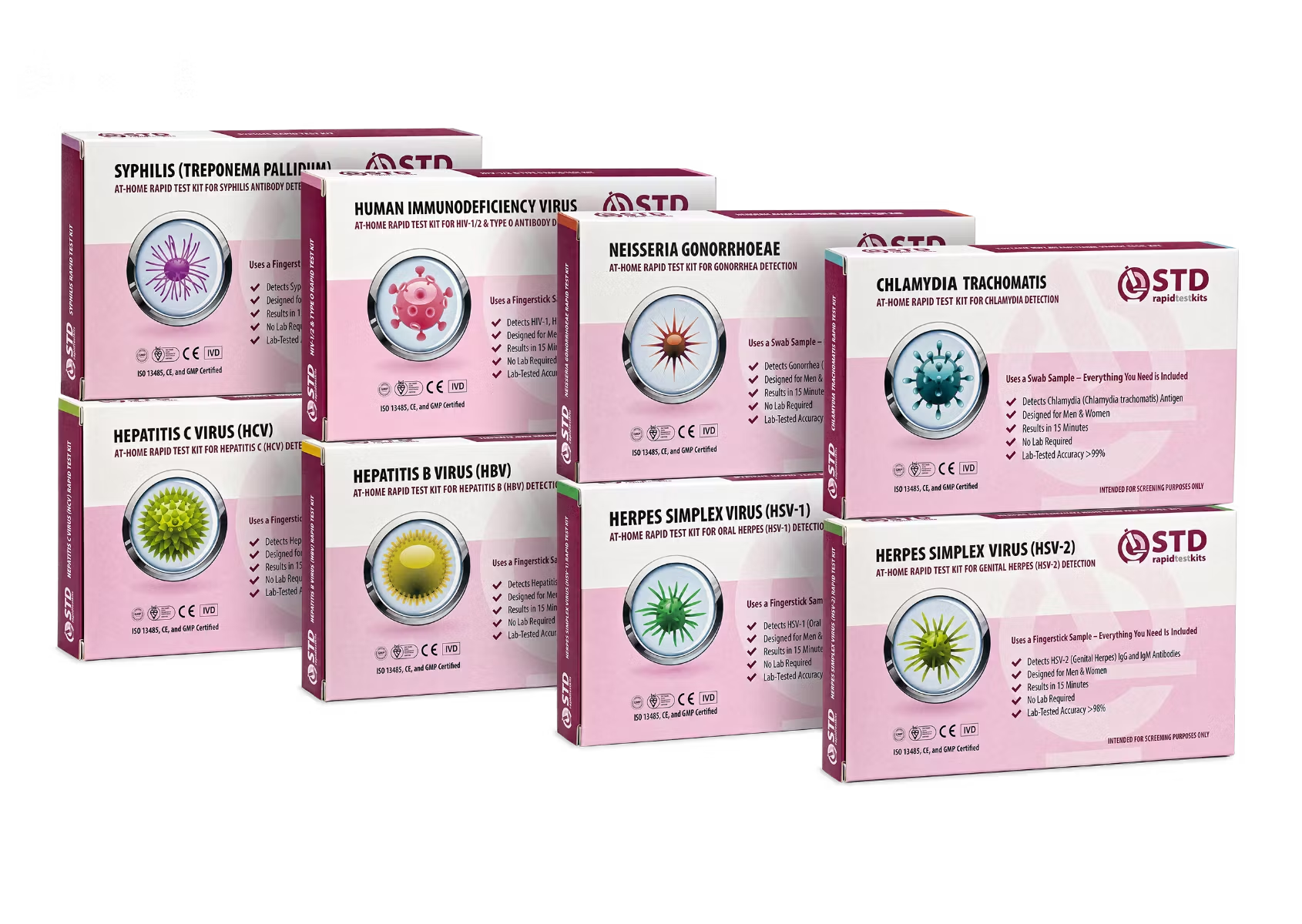
These are lateral-flow tests, not laboratory NAATs, so they are screening tools, and any positive is worth confirming in clinic. This article is published by stdrapidtestkits.com, which sells at-home STI testing kits. Product recommendations here are based on fit for the reader's concern, not commercial benefit. If you want to screen at home, our at-home STI test kits cover the infections most likely behind an eye infection, and which one fits depends on how much you want to check.
- Your eye symptoms fit a recent unprotected encounter and you want data before booking a clinic visit.
- Local clinic access is slow, and a positive result would move you up the queue for urgent eye care.
- You have already been treated and want a quiet way to confirm weeks later that the infection cleared.
For severe pain, swelling, or any vision change, skip the home step and seek same-day care.
Partners, Reinfection, and Practical Hygiene
However the bacteria reached the eye, an STI eye infection rarely stays contained. Chlamydia and gonorrhea live well on moist mucous membranes and on damp shared surfaces, so touching the affected eye and then someone's face, sharing a towel or pillow, or handling contact lenses after rubbing the eye can all spread it. Because eye involvement usually rides along with a genital or throat infection, partners are exposed on more than one front.
A few steps shorten the chain. Notify partners from the relevant window so they can test and treat; many health departments offer anonymous notification if a direct conversation feels unsafe, and many regions allow expedited partner therapy, where a prescriber supplies a partner's medication without a separate visit. Replace contact lenses, lens cases, and any eye makeup that may have been contaminated. Use freshly laundered or disposable face cloths rather than shared linens during treatment. Avoid sex until you have finished treatment and a clinician clears you, usually about seven days after a single-dose regimen. Most STI eye infections stop being contagious within days of the right antibiotic, but the system around them, the partners and shared items and the original genital or throat source, still needs follow-through.
- Notify partners from the exposure window so they can test and treat; anonymous notification options exist if a direct conversation feels unsafe.
- Replace contact lenses, lens cases, and any eye makeup that may have been contaminated.
- Use freshly laundered or disposable face cloths rather than shared linens during treatment.
- Avoid sex until you finish treatment and a clinician clears you, usually about seven days after a single-dose regimen.
If Your Test Comes Back Positive
A confirmed infection behind an eye problem removes most of the guesswork. The adherence advice splits by pathogen. For chlamydia, finish the full doxycycline course even after symptoms ease, since stopping early feeds treatment failure and reinfection. For gonorrhea, the single ceftriaxone injection makes adherence simple, so the bigger downstream risk is catching it again from an untreated partner (CDC, gonococcal infections among adults). Either way, replace eye-area items that may have been contaminated, including mascara, eyeliner, contact lenses, and lens cases.
Follow-up testing works in two directions. A re-test for the same infection about three months after treatment catches reinfection early, since modern antibiotics clear the original infection in nearly all cases. A broader screen is also worth running, covering HIV, syphilis, and hepatitis B and C, because STIs cluster and one positive often surfaces a coinfection. If eye symptoms come back weeks after a treated infection, a new infection or an unrelated cause like allergic conjunctivitis, dry eye, or blepharitis is more likely than a treatment failure, and a clinician can sort that out.
A Practical Path Forward
Eye discharge after sex carries a particular dread, partly because the eye feels personal and partly because the everyday story of pink eye is so firmly non-sexual. The reframe is simple: bacteria do not respect geography. Most cases turn out not to be STIs, and the ones that are need different care than a drugstore drop can give. If the timing fits and the symptoms are severe, treat it as worth ruling out.
If the eye is severe, painful, or producing thick pus, prioritize a same-day clinic visit and bring an honest sexual history. If the picture is milder and you are mainly deciding whether to worry, an at-home chlamydia and gonorrhea test used after day seven can settle it. Either path beats sitting on the question for a week while the eye gets worse.
What Should I Do About My Eye Right Now?
Severe eye pain, pus that refills in seconds, eyelid swelling, or any vision change after recent sexual contact?
Yes: Get same-day care at urgent care, an ophthalmologist, or the ER. Mention the exposure on arrival; it changes the work-up.
Mild redness or stringy discharge that has not improved in a few days, plus a recent unprotected oral or genital encounter?
Yes: Book a clinic visit within 24 to 48 hours, and consider an at-home chlamydia and gonorrhea test once you are past day 7.
Watery, itchy eyes, often both at once, with cold or allergy symptoms and no recent risky exposure?
Yes: Treat it as ordinary pink eye with warm compresses, clean hands, and no contact lenses for a few days. Reassess if it worsens within a week.
No: If none of these quite fit, a clinic visit is the fastest way to clear up the uncertainty.
Guidance only. A clinician can advise based on your specific situation.
Common questions about eye discharge and STIs
- Can chlamydia or gonorrhea actually cause an eye infection?
- Yes, though eye involvement is uncommon next to genital infection. If eye symptoms began within a week of unprotected oral or genital contact, gonorrhea is the more urgent one to rule out first, with chlamydia the slower possibility a week or two later. Either way the care differs from ordinary pink eye, so the cause matters.
- How do I tell an STD eye infection from regular pink eye?
- Thick pus that refills within seconds of wiping, paired with deep pain rather than itch, is the clearest separator. Add the timing of recent sexual contact and the tendency to start in one eye, and the picture sharpens. Watery, mild, slowly improving symptoms more often mean viral pink eye, allergies, or simple irritation.
- Can you get an eye STI from oral sex?
- Yes, and it is one of the more common routes. The throat can carry chlamydia or gonorrhea silently and pass bacteria along via secretions or hands, and even a smear from a finger that touched genitals can reach the eye. Transmission is not automatic, though; the partner needs an active, untreated infection.
- Semen got in my eye. Am I now infected?
- Not automatically. Semen can sting and redden the eye through its proteins and pH alone, with no infection involved. Transmission requires active bacteria from an untreated partner. Rinse with clean water or saline, watch symptoms over the next few days, and test if anything develops or you are unsure of your partner's status.
- If I tested negative on day 5, am I in the clear?
- Probably not yet. Day 5 is early for peak sensitivity, especially for chlamydia, so a negative is reassuring but not final. Retest at day 14 if symptoms persist or you remain uncertain. Standard practice puts the reliable window at 7 to 14 days after exposure.
- My partner says they tested negative recently. Can I relax?
- It depends on when they tested relative to their own last exposure. A test taken inside their window period can come back falsely negative. If you have eye symptoms after exposure, your own test answers the question more reliably than relying on theirs.
- What counts as an emergency rather than a wait-and-test situation?
- Severe eyelid swelling, pain that worsens hour by hour, light sensitivity, vision change, or thick pus that returns within minutes of wiping are same-day-care symptoms. CDC guidance recommends specialist consultation for adult gonococcal conjunctivitis, and the testing window does not apply when symptoms are this severe; a clinician can swab the eye and start treatment on the spot.
- Can I test from home if getting to a clinic is hard?
- You cannot swab your own eye at home, but you can test for the likely source infections, chlamydia and gonorrhea, with a self-collected genital swab. A positive home result is strong support for in-clinic eye treatment and shortens the time to a prescription. Use the kit after day 7 post-exposure for a reliable result.
How we sourced this article: We summarized current guidance from the U.S. Centers for Disease Control and Prevention, the World Health Organization, the UK National Health Service, and MedlinePlus, then translated it into plain language anchored to the situations readers actually face when an eye problem follows recent sexual contact. Diagnostic-window timing reflects standard clinical practice for NAAT testing at the throat and genital sites. We do not provide diagnosis; for symptoms that concern you, see a licensed clinician.
- U.S. Centers for Disease Control and Prevention. Conjunctivitis (pink eye) clinical overview, used to anchor the comparison between viral, bacterial, and allergic pink eye, the purulent discharge that mats the eyelids, and the self-limiting course of most cases.
- U.S. Centers for Disease Control and Prevention. STI treatment guidelines, gonococcal infections among adolescents and adults, used for the single 1 gram intramuscular ceftriaxone regimen for adult gonococcal conjunctivitis and the recommendation to consult an infectious disease specialist.
- U.S. Centers for Disease Control and Prevention. STI treatment guidelines, chlamydial infections, used for doxycycline and azithromycin treatment, NAAT as the most sensitive test, and chlamydial conjunctivitis appearing 5 to 12 days after birth.
- World Health Organization. Sexually transmitted infections fact sheet, used for transmission through vaginal, anal, and oral sex and the global new-infection estimate for chlamydia in 2020.
- UK National Health Service. Conjunctivitis, used for the typical two-week self-limiting course, sticky-pus bacterial presentation, and the watery non-contagious pattern of allergic pink eye.
- MedlinePlus (U.S. National Library of Medicine). Pink eye, used as a plain-language reference for the bacterial, viral, and allergic causes of conjunctivitis.
