
Published: August 2025 | Last updated: May 2026 | Editorial review and quality control: Martina N.
Can you get an STD in a monogamous relationship?
Yes. Many sexually transmitted infections stay silent for months or years, so a fully faithful partner may still carry an infection acquired before the relationship began. Window-period gaps, and partial panels that skipped herpes or HPV, can also explain a new positive. The CDC recommends annual STI screening for sexually active adults, including those in monogamous relationships.
You trust your partner. Neither of you has been with anyone else since the two of you got together. So why would you ever need an STD test? It feels like a question with an obvious answer.
The honest answer is more layered. Monogamy lowers your exposure to new infections, and that part is real. It does not erase what either of you brought into the relationship, and it does not undo the way diagnostic tests can miss recent exposures. Millions of new sexually transmitted infections occur each year in the United States, and a large share of those people have no idea, according to the U.S. Centers for Disease Control and Prevention. Plenty of those people are in committed, faithful relationships.
This guide explains, in plain terms, why STIs sometimes show up in monogamous relationships, which infections most often travel quietly into long partnerships, what testing windows actually look like, when to retest, how to bring up screening with your partner so it lands as care, and what to do if a result comes back positive.
Key Takeaways
- Monogamy lowers your exposure to new infections, but it does not undo dormant or asymptomatic STIs that one partner may have brought into the relationship from earlier in life.
- A shared baseline test in the first few months of the relationship plus an annual screen afterward catches nearly all the hidden infections that surface in long-term couples, per CDC guidance.
Why “Exclusive” Is Not the Same as a Test Result
Monogamy is an agreement between two people about who they have sex with. It describes a behavior; it says nothing about what either partner carried into the relationship, and the act of becoming exclusive does not retest either of you.
Surveys of relationship dynamics consistently find that couples talk about exclusivity more than they talk about screening. Many people stop using condoms within weeks of becoming exclusive without ever exchanging a recent test result, and some have never been screened for the infections that matter most in long-term relationships, herpes and HPV in particular. The two pieces of information get folded into one feeling of safety. That feeling is well-meaning. It is also incomplete.
When couples do talk about testing, the phrases “I get checked” and “I am clean” cover a wide gap in actual practice. One partner might mean a recent full panel through a clinic or home kit; the other might mean an annual physical that did not include any STI screen at all. Closing that gap takes specifics about which infections were tested, which sample types were used, and how recently, because the words people use are imprecise even when the people saying them are not.
The exclusive agreement protects against new outside exposures. The test result tells you whether the relationship started clean. Both pieces matter, and the second one needs evidence.
Compare it with the way long-term couples handle other shared health behaviors. Couples who have been together for years still book annual dentist visits, blood pressure checks, and vaccine updates without anyone reading those routines as suspicion. STI screening fits the same category, a routine maintenance check rather than an accusation. When testing is treated as routine, it gets done; when it is treated as a moment of doubt that has to be earned, it gets postponed for years while silent infections sit untreated.
The exclusivity agreement covers new exposures from this point forward. It does not retest either partner for what came before. Both pieces matter, and the second one is what an annual panel is for.
How a Faithful Couple Can Still Get an Unexpected Diagnosis
The single biggest reason a monogamous couple gets a surprise positive result is straightforward: one partner brought the infection into the relationship from before, and routine medicine never caught it. Several factors line up in favor of this happening.
Most general checkups do not include STI screening unless the patient specifically asks. Annual physicals cover blood pressure, cholesterol, sometimes a urinalysis, and that is often the limit. Herpes serology is simply not part of the standard annual physical in most U.S. clinics, and routine HSV-2 antibody screening is not universally recommended for asymptomatic adults, so a clean checkup says nothing about herpes status.
Most STI infections are quiet. The NHS puts it plainly: many STIs have no symptoms, so the only way to know for sure is to get tested (NHS). Chlamydia often has no symptoms, per the CDC chlamydia fact sheet. Most genital HPV infections never produce visible warts and clear silently, while a portion persist for years before showing up on a Pap smear, per the CDC HPV fact sheet. Most people with genital herpes do not know they have it, per the CDC herpes fact sheet, because outbreaks can be mild, mistaken for razor burn or a yeast infection, or absent for long stretches.
Latency periods stretch detection across years. Syphilis can pass through latent stages of months to decades. HIV can sit at low viral load for years before symptoms appear. High-risk HPV strains can take years to cause cervical cell changes that prompt a colposcopy, per the CDC HPV fact sheet linked above.
The downstream cost of these silent infections falls more heavily on women. Per the WHO STI fact sheet, untreated chlamydia and gonorrhea are linked to pelvic inflammatory disease and infertility in women. Almost all cervical cancers are caused by HPV, per the CDC cervical cancer page. The infections themselves may produce no symptoms in either partner, but the asymmetry of consequences is real, and it argues for screening even when both people feel fine.
Stack these together and an everyday scenario shows up: two people meet, both think they are clean because nothing hurts and they had a basic checkup last year, neither was specifically screened for herpes or HPV, and one of them is silently positive. Months or years into the relationship a routine Pap smear, a blood donation, or a mild flare brings the diagnosis.
| Infection | Often asymptomatic? | How long it can stay hidden | Where it usually surfaces |
|---|---|---|---|
| Chlamydia | Yes, in most cases | Months to years | Routine screening, pelvic pain, complications |
| Gonorrhea | Yes, especially in men | Months untreated | Routine screening, mild urinary symptoms |
| HSV-2 (genital herpes) | Yes, in most carriers | Years; the virus stays dormant in nerve tissue for life | First recognized outbreak, blood test on request |
| HPV (high-risk strains) | Yes (most cases) | Years before cellular changes | Pap smear, colposcopy, occasional warts |
| Trichomoniasis | Yes, especially in men | Months if untreated | Discharge, routine screening |
| HIV | Yes early on | Years at low viral load | Routine screening, late symptoms |
| Syphilis | Yes during latent stage | Months to decades | Late symptoms, blood donation, blood screen |
The STIs Most Likely to Travel Quietly
A handful of infections account for almost every “but I have been monogamous” diagnosis. Each behaves differently, and each has a meaningful testing pathway.
Chlamydia and gonorrhea are the most common asymptomatic carriers in monogamous couples. The CDC chlamydia fact sheet notes that most chlamydia infections in women cause no symptoms, and a substantial share of cases in men are also silent. Untreated, both infections can ascend the female reproductive tract and cause pelvic inflammatory disease, scarring, and tubal-factor infertility. In men they can cause epididymitis (painful inflammation of the tube behind the testicle). Both are curable with a short course of antibiotics, so detection genuinely changes the outcome. An at-home chlamydia and gonorrhea rapid test screens for both in one self-collected swab.
Trichomoniasis, a curable parasitic infection, follows the same quiet pattern as most STIs: many infected men notice no symptoms at all, and women often have only mild or nonspecific discharge, so it can ride into a relationship undetected. A single course of antibiotics clears it, which is why catching it early matters.
HPV is the most common sexually transmitted infection in the United States, per the CDC HPV fact sheet, with most infections clearing on their own within two years. The minority that persist, especially high-risk strains such as types 16 and 18, are responsible for almost all cervical cancers per the CDC cervical cancer page, along with a meaningful share of head, neck, and anal cancers. HPV vaccination is recommended routinely through age 26, with shared clinical decision-making through age 45 per current ACIP guidance (the Advisory Committee on Immunization Practices, the U.S. body that sets vaccine schedules). Cervical cancer screening, a Pap smear or HPV test on the schedule a clinician recommends, remains the primary safety net.
Genital herpes (HSV-1 and HSV-2) is the textbook example of a latent infection. Outbreaks can be absent for long stretches, and asymptomatic shedding (transmission without visible sores) is well documented in the CDC herpes fact sheet linked above. HSV-1, traditionally associated with oral cold sores, is increasingly responsible for new genital herpes cases via oral-genital contact, according to the same CDC herpes fact sheet. Antiviral suppression therapy reduces both outbreak frequency and transmission risk to a partner.
HIV testing windows are short. Fourth-generation antigen-antibody lab tests can detect HIV by roughly 18 to 45 days after exposure, and rapid antibody tests by approximately 23 to 90 days, per the CDC HIV testing page. The reason HIV still appears unexpectedly in monogamous couples is the same as everything else above: the infection was acquired before the relationship and never tested for. Treatment is highly effective. People on consistent antiretroviral therapy with an undetectable viral load do not transmit the virus sexually, a principle known as U=U (Undetectable equals Untransmittable).
Syphilis cases have been rising for several years in the United States, including among heterosexual adults. The primary chancre (a single painless ulcer at the site of inoculation) is easy to miss, especially when it is internal. After the primary stage resolves, syphilis enters a latent phase that can last years before later complications. A simple blood test detects all stages, and treatment with a single penicillin injection cures early infection.
Hepatitis B and hepatitis C can be transmitted sexually but more commonly arrive through other routes. Chronic hepatitis B and chronic hepatitis C both quietly damage the liver over decades and can lead to cirrhosis or liver cancer. Both have effective treatments now: hepatitis B is suppressible long-term, and hepatitis C is curable with direct-acting antivirals.
If your annual physical did not include a herpes blood test or HPV cervical screening, it almost certainly did not catch the two infections most likely to travel undetected into a long-term relationship. Both need to be asked for by name. A general checkup that returned “normal” covers blood pressure and cholesterol; it does not stand in for an STI panel.
Serial Monogamy: The Chain You May Not Be Counting
There is a related pattern worth naming separately, because it traps people who consider themselves careful. Serial monogamy is the standard modern shape: one exclusive partner at a time, no overlaps, breakups in between, eventually a new exclusive partner. Each commitment feels like a clean slate.
The slate is only clean if testing happened in the gap. An infection picked up early in the chain (sometimes years earlier) can ride forward unnoticed from one faithful relationship to the next, especially when the carrier never had symptoms and never had a reason to test. Three relationships in, four relationships in, the original infection is still there. None of the partners involved feel they did anything wrong, and clinically they did not. They just inherited a missing data point.
A full-panel test in the gap between relationships, taken before barriers come down with a new partner, is the step most people skip.
Test in the gap, before barriers come down with the next partner. Annual screening after that catches anything new. If you have not tested since your last relationship change, today is a reasonable day to fix that.
Window Periods and Why Early Negatives Can Mislead
Even when both partners do test at the start of the relationship, timing matters. A test taken too soon after exposure can come back negative while the infection is still incubating. This is called the window period, and it is one of the most underappreciated parts of STI care.
Take a simple example. A person has unprotected sex with someone three days before meeting a new partner. They start dating, get tested two weeks later, and the chlamydia result is negative. They drop barriers. Months later, the partner tests positive for chlamydia, and the original carrier retests and turns positive. Nobody lied. The first test fell inside the chlamydia window, before the bacterial load was high enough to detect.
Different infections have different windows. The gap between earliest detectable and most reliable can be weeks long, especially for HIV, syphilis, and HSV-2. Antibody-based tests need time for the immune system to mount a measurable response. The chart below shows how those windows stack up.
Non-Sexual Routes Are Real, Just Rare
Most STIs spread through sexual contact. A handful of cases do not. These routes are not the most common explanation when a couple gets a surprise diagnosis, and they should not become the default assumption. They do account for a slice of unexpected diagnoses in long-term monogamous relationships, so they belong in the conversation.
Skin-to-skin contact transmits HSV-1, HSV-2, and HPV without intercourse. Cold-sore HSV-1 from kissing can transfer to the genital area through oral sex, producing a genital herpes diagnosis without anything most people would call infidelity, per the CDC herpes fact sheet cited earlier. Many adults also carry HSV-1 antibodies from a non-sexual childhood exposure (a relative with a cold sore, a shared cup, an early kiss from a family member), which can show up on a serology test long after the original event.
Vertical transmission, from parent to child during pregnancy, birth, or breastfeeding, can pass HIV, syphilis, hepatitis B, and herpes. An adult diagnosed with hepatitis B today may have acquired it as an infant from a parent.
Bloodborne sharing through unsterile tattoo or piercing equipment, or shared razors and toothbrushes with a positive household member, can pass hepatitis B, hepatitis C, and HIV in rare cases. These routes still appear on standard STI panels because sex is one of several possible transmission paths for these viruses; the partnership status does not change what the panel detects.
A standard couples' STI panel is built around the same viruses (hepatitis B, hepatitis C, HIV, HSV) that travel through these rare non-sexual routes. The same annual test that checks for sexually acquired infection also picks up an infection acquired as an infant or from a non-sterile tattoo years ago. You do not need a separate panel for these scenarios.
Reinfection Loops Inside a Couple
There is a separate problem that catches monogamous couples specifically: ping-pong reinfection.
It happens when one partner is treated for a curable infection (chlamydia, gonorrhea, trichomoniasis, syphilis) and the other partner either is not tested, tests too early, or never finishes treatment. The treated partner clears the infection, has unprotected sex with the still-positive partner, and gets reinfected within weeks. The pattern can repeat for months and create the impression that the antibiotics did not work.
The fix requires both partners to be tested and treated on the same timeline, both waiting the recommended interval (typically 7 days for a single-dose course, longer for multi-dose courses) before resuming barrier-free sex, and both retesting at three months per CDC guidance for chlamydia and gonorrhea, since reinfection from any source is the most common cause of a repeat positive in the first year.
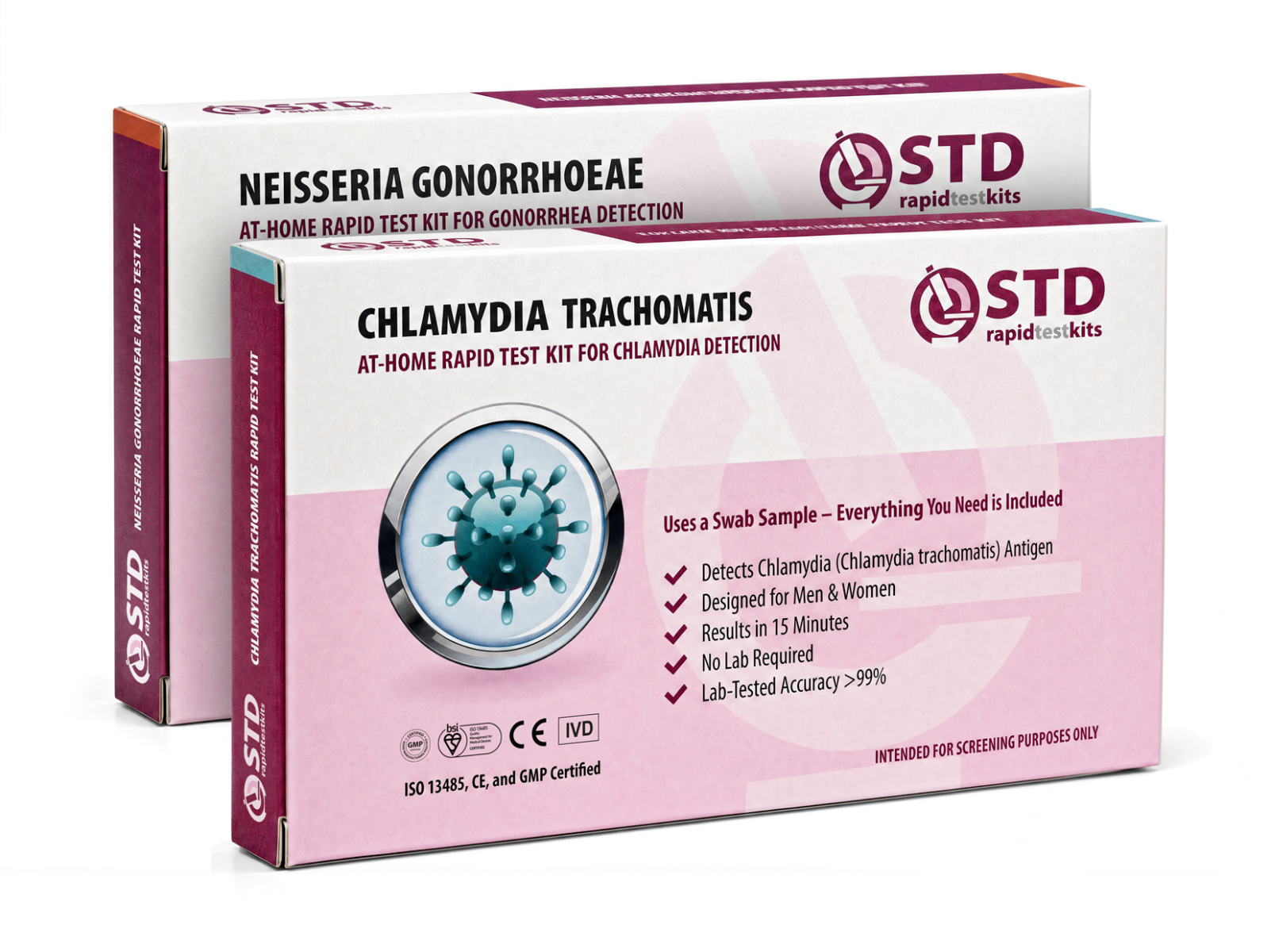
Treating one partner for a curable STI without testing or treating the other is the single most common cause of a repeat positive in the first year. If either of you tests positive for chlamydia, gonorrhea, trichomoniasis, or syphilis, the other partner should be tested and treated on the same timeline, not after the next flare. This site sells rapid home STI tests; the kit below is one option for the three-month retest described above.
Five Myths Worth Clearing Up
A handful of beliefs about monogamy and STIs come up in almost every couple's conversation. They are worth addressing directly, because each one keeps people from testing when testing is what would actually help. The most persistent of them, the assumption that symptoms would announce any infection, runs against the evidence: as MedlinePlus notes, STIs do not always cause symptoms, so it is possible to have one and not know it.
Common Misconceptions About Monogamy and STIs
Myth: We were both tested before the relationship, so we are set.
Fact: Pre-relationship testing is valuable, but it only catches infections that had passed their detection window at the time of the test. An infection acquired in the weeks just before a baseline test can read falsely negative and only become detectable months later. A repeat test 3 to 6 months into the relationship covers that gap.
Myth: We have been together ten years, so nothing could surface now.
Fact: Time does not clear the latent reservoir of HSV, HPV, hepatitis B, hepatitis C, or syphilis. Several of these infections produce no signs for many years. The longer a relationship has gone without a baseline test, the more value a single shared test has, not less.
Myth: At-home tests are not accurate enough to trust.
Fact: Modern at-home rapid lateral-flow tests are built to clinical performance standards. A negative result is meaningful when the test is taken outside the relevant window period, and a positive result deserves a confirmatory lab test, which is how clinic rapid tests are normally handled too.
Myth: If I had something, I would know.
Fact: Asymptomatic carriage means the absence of symptoms by definition. Chlamydia, HPV, HIV, HSV-2, and trichomoniasis can all replicate quietly for months or years, so symptom-watching cannot detect what produces no signs. A test is the only reliable way to know, which is why this belief is the costliest one on the list.
Myth: Suggesting a test means I do not trust my partner.
Fact: Suggesting a test means you understand how the infections work. Most STIs in long-term couples reflect acquisition from before the relationship, so the request is about catching old infections, not policing current behavior. Couples who frame it this way generally find the conversation lands as care, not suspicion.
How to Bring Up Testing With Your Partner
Wording the conversation matters more than the timing. The two phrasings that consistently land well share a common shape: they treat testing as a shared health step, and they place the recommendation on something outside the relationship rather than on either partner. The callout below has the exact wording that tends to land cleanly.
What tends to land badly: opening with “I read an article that scared me.” That can come across as anxiety transfer. Better to skip the prelude and propose the action with a concrete time and place: a home kit arriving Friday, both of you sitting down with it Saturday morning, results read together over coffee.
If your partner pushes back hard on the idea of testing, the resistance is data. It is usually not evidence of cheating. It is more often discomfort, shame, or a belief that asking means accusing. That is a conversation worth having gently, and worth having before you drop condoms or try for a pregnancy.
Shared milestone: “I want us to be solid. Can we both knock out a panel together? It feels like the grown-up thing to do before we drop barriers.”
Third party: “My doctor flagged that we should both get screened annually if we are sexually active. I would feel better if we did it together.”
If You Test Positive in a Monogamous Relationship
A positive result delivers information about your body. The first hour after a positive test feels heavy. The next steps, summarized in the callout below, are not. Walk through them in order and avoid relitigating the past sexual history of either of you in the first conversation. The diagnosis is the immediate problem; the rest can wait until a calmer moment.
Take care of your mental health while you handle the medical side. A diagnosis lands hard, and most people get through it with treatment, follow-up, and support from the people closest to them. A positive result is not a moral verdict. For most of the infections discussed here, latency means the virus or bacterium may have been present for years before the relationship started, often before either of you met.
1. Confirm the result. If the positive came from a rapid or at-home test, send it to a clinic or mail-in lab for confirmatory testing. HIV, syphilis, and herpes especially need a second-tier test to distinguish a true positive from a cross-reactive antibody finding. A positive HSV-1 antibody result, for example, may reflect a non-sexual childhood exposure rather than a recent sexual contact, and the lab follow-up will say which.
2. Tell your partner with calm facts. A simple opener: “I tested positive for [infection]. I do not know yet how long it has been in my body. We both need to test, and I would like us to do that together this week.”
3. Treat. Chlamydia, gonorrhea, syphilis, and trichomoniasis are curable in a single dose or short course. HIV, HSV, HPV, and hepatitis B and C are not curable but are highly manageable; HIV on suppressive therapy reduces transmission risk to effectively zero (the U=U principle).
4. Retest at three months for any treated bacterial infection, per CDC guidance. Reinfection from any source is the most common cause of a repeat positive in the first year.
How Our Home Kits Fit In, and Where a Clinic Is the Right Call
The following section describes the rapid at-home kits sold on this site; it is product information, not independent clinical advice.
Our kits use lateral-flow rapid technology, the same chemistry as a pregnancy test or a rapid COVID test, with results in roughly 15 minutes. They are screening tools. Laboratory NAATs (nucleic acid amplification tests) and PCR are the analytical reference standard for chlamydia and gonorrhea, with higher sensitivity especially in asymptomatic infections. The home rapid test is convenient and private, and a positive home result is worth confirming through a lab when possible. Window periods apply to home tests exactly as they apply to clinic tests; a sample taken inside the window can return a falsely negative result.
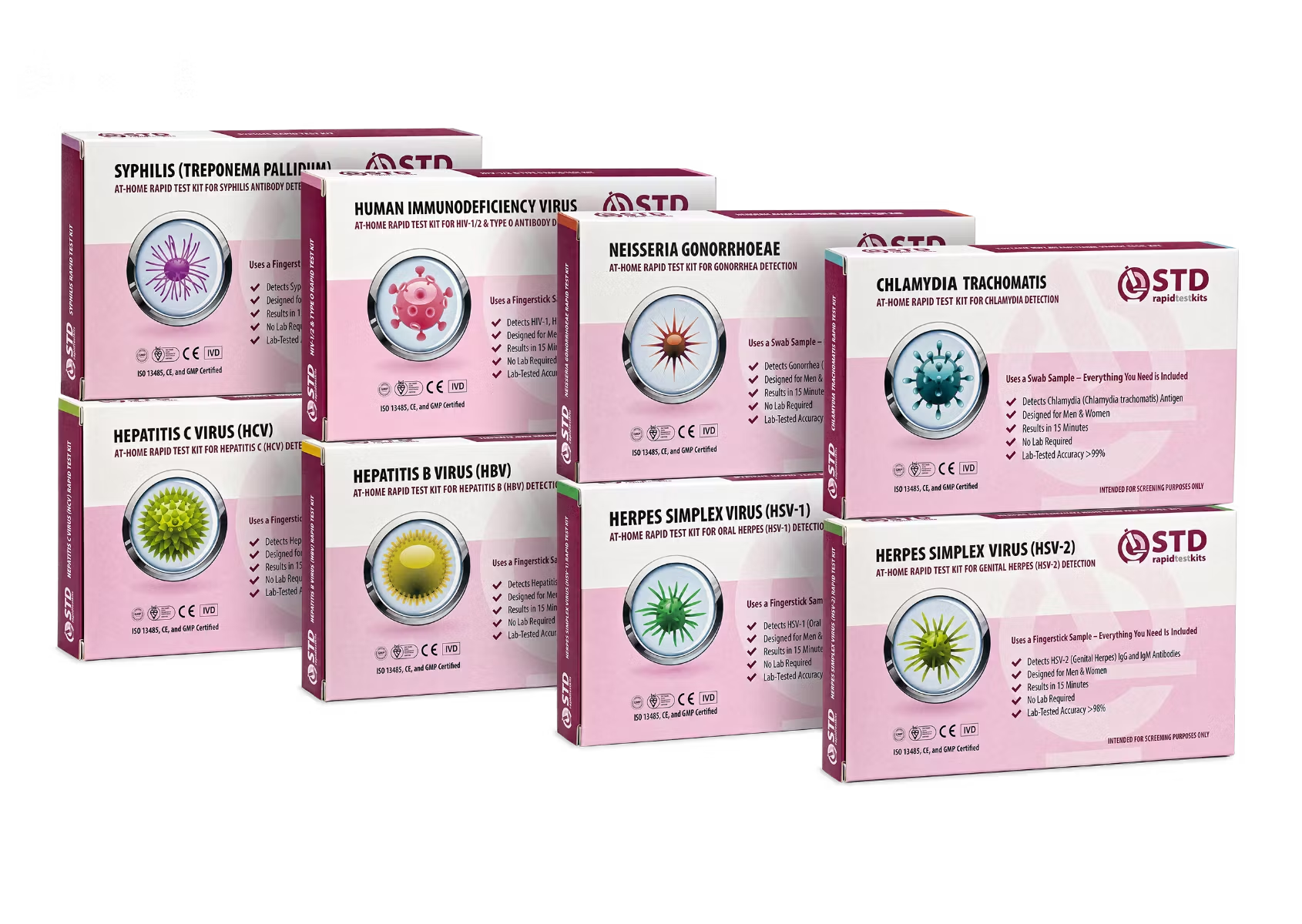
Coverage matters. Our standard rapid panels for any-gender use cover chlamydia, gonorrhea, herpes (HSV-2), HIV, syphilis, hepatitis B, and hepatitis C. Our trichomoniasis and HPV rapid swabs are validated for vaginal self-collection and are women-only kits. We do not currently sell a male-compatible trich or HPV home test, so a male-anatomy partner who needs trich or HPV testing should see a clinic. Each partner needs their own single-use kit; the lancets, swabs, and cassettes are designed for one use by one person, and reusing them returns invalid results.
We also do not sell pharyngeal (throat) or rectal swab kits. If your screening conversation involves a recent oral or anal exposure that warrants those samples, that is a clinic visit, not a home kit. The home panels still cover the genital and bloodborne risk from the same encounter.
| Attribute | At-home lateral-flow | Lab NAAT or PCR |
|---|---|---|
| Result speed | About 15 minutes | 1 to 5 days |
| Sample collection | Self-swab or fingerstick at home | Clinic visit or mail-in collection |
| Analytical sensitivity | High; lower than NAAT for asymptomatic chlamydia and gonorrhea | Highest available; reference standard |
| Best use | Asymptomatic screening; couple-wide baseline; annual check | Confirmation of a positive screen; symptomatic diagnosis |
| Pharyngeal / rectal swabs | Not available in our catalog | Available at most sexual-health clinics |
STIs are very common, and many people who have one do not know it. Anyone who is sexually active should talk to their healthcare provider about STI testing, even if they feel healthy.
Should You and Your Partner Test Now?
Have you started a new exclusive relationship in the last six months, or dropped condoms without a shared recent panel?
Yes: Book a baseline panel together now, then retest at three to six months to clear any window-period gap from before the relationship.
Has either of you tested positive for a curable infection such as chlamydia, gonorrhea, trichomoniasis, or syphilis?
Yes: Both partners test and treat on the same timeline, wait the recommended interval before barrier-free sex, and retest at three months per CDC guidance.
No: Schedule a shared annual screen going forward, which the CDC recommends for sexually active adults regardless of relationship status.
Guidance only; a healthcare provider can advise based on your specific situation.
FAQs
- Can I really get an STD if neither of us has cheated?
- Yes. The most common explanation is that one partner had an undiagnosed infection from before the relationship that never showed symptoms. Herpes, HPV, and chlamydia are particularly good at staying quiet for months to years. A positive result inside a faithful relationship is more often a timing artifact than evidence of infidelity.
- We tested at the start of the relationship and were both negative. Are we covered for life?
- No. A single early test does not account for window periods (some infections take weeks to become detectable) and does not cover infections acquired from any new exposure since. The CDC recommends annual screening for sexually active adults regardless of relationship status, plus a repeat test 3 to 6 months into a new relationship to clear any pre-relationship window gap.
- How do I bring up testing without making my partner feel accused?
- Propose it as a shared errand rather than a conversation about trust. Pick a specific day, order a home kit, and suggest the two of you take it the same morning. A logistics plan sidesteps the accusation read more reliably than any particular form of words. If your partner pushes back, it is more often shame or discomfort talking than a sign of infidelity.
- How long can an STI stay hidden?
- The practical answer for couples is that the HSV-2 antibody window, 12 to 16 weeks for a reliable result, is the longest gap to plan around at the start of a relationship. Chlamydia can persist months untreated, and high-risk HPV can take years to show up on a Pap smear. The window-period chart earlier in this article summarizes each infection's specific timeline.
- Do at-home rapid tests actually work?
- Yes, when taken after the window period closes. Lateral-flow rapid tests return results in about 15 minutes and are reliable as screening tools. Sensitivity is lower than lab NAAT in asymptomatic infections, so confirm any positive result at a clinic before acting on it.
- Can we share one test kit between us?
- No. Each person needs their own single-use kit. The components (lancets, swabs, cassettes) are designed for one use and one person; reusing them returns invalid results. A couple ordering together should order two kits, one per partner.
- We are treating chlamydia and it keeps coming back. Why?
- The most common reason is that one partner was not treated at the same time, so the cleared partner gets reinfected during the next unprotected sex. Both partners need to be tested and treated simultaneously, and both should wait the recommended interval before resuming barrier-free sex. Retest at three months per CDC guidance.
- What if I have symptoms but my last test was negative?
- Test again. A negative result taken inside the window period (before the infection is detectable) can flip positive a few weeks later as the bacterial or viral load rises. Symptoms that do not match the previous negative warrant a fresh sample, ideally with the longer-window infections (HIV, syphilis, HSV-2) included this time.
- What if our concern is a throat or rectal exposure?
- Our home kits do not cover pharyngeal or rectal swabs, so for those specific samples a clinic visit is the right call. The home panels still cover the genital and bloodborne risk from the same encounter.
- U.S. Centers for Disease Control and Prevention. About Sexually Transmitted Infections, including overall U.S. burden of new infections and the asymptomatic share.
- U.S. Centers for Disease Control and Prevention. HIV testing guidance, including the 18-45 day window for fourth-generation antigen-antibody tests and the 23-90 day window for rapid antibody tests.
- U.S. Centers for Disease Control and Prevention. About Genital Herpes fact sheet, including the proportion of carriers who do not know they have HSV-2, asymptomatic shedding, and oral-to-genital HSV-1 transmission.
- World Health Organization. Sexually Transmitted Infections fact sheet, including global burden, asymptomatic prevalence, and downstream complications such as pelvic inflammatory disease and infertility in women.
- UK National Health Service. Sexually Transmitted Infections (STIs) overview, including that many STIs have no symptoms and that testing is the only reliable way to know.
- MedlinePlus (U.S. National Library of Medicine). Sexually Transmitted Infections, including that STIs do not always cause symptoms and that testing is recommended for sexually active adults.
