
Published: November 2025 | Last updated: April 2026 | Editorial review and quality control: Martina N.
Sexual-health guides have a trans problem. Most of them were written assuming a cisgender body, a cooperative provider, and a clinic that won't misgender you before you sit down. For trans and nonbinary readers, none of those assumptions hold reliably, and the consequences are concrete: STDs go undetected, wrong tests get ordered, and symptoms get misread or dismissed. This guide closes that gap. It covers how infections actually present in trans bodies, which tests you need based on your anatomy and exposures, when to test after a possible exposure, and how to get accurate answers without setting foot in a clinic that makes you feel invisible.
What STD tests do trans and nonbinary people actually need?
Test by anatomy and exposure, not gender identity. If you have a cervix and have not had a vaginectomy, a cervical swab is required (urine alone misses cervical chlamydia and gonorrhea). After receptive anal sex, add a rectal swab. After oral sex, add a throat swab. HIV, syphilis, hepatitis B, and hepatitis C are blood tests regardless of anatomy. At-home rapid kits cover this combination of swab plus blood samples privately, with results in about 15 minutes per test.
Key Takeaways
- The relative risk of acquiring HIV is roughly 20 times higher for transgender women than the wider adult population globally, driven by structural inequity rather than individual behavior (UNAIDS 2024 Global AIDS Update).
- Standard urine-only STI panels miss the majority of throat, rectal, and cervical infections in trans bodies; CDC treatment guidelines call for site-specific swabbing matched to anatomy and sexual practice.
Why Trans and Nonbinary People Face Elevated STD Risk (and Why It's Not About Behavior)
The numbers are stark, and they need context. According to UNAIDS 2024 surveillance, the relative risk of acquiring HIV is roughly 20 times higher for transgender women than for the general adult population globally, up from 11 times higher in 2010. Numbers like that are not explained by individual choices. They reflect a system that has consistently failed to provide trans people with accessible, accurate, informed care.
The factors driving elevated STD risk in trans communities are structural. Housing instability, employment discrimination, and the push toward survival sex work compound risk. Medical trauma (being misgendered, turned away, or examined by providers who have never seen a trans body) keeps people out of clinics even when something feels wrong. And then there is the testing gap itself: most routine STD screenings were designed around cisgender anatomy, so a trans person who does reach a clinic may still leave with an incomplete or incorrect test.
Trans men face a separate but equally real data problem. Group-level HIV prevalence among trans men has historically been reported at lower absolute rates than in trans women, but those group averages obscure real risk for trans men who have sex with cisgender men. More critically, data on bacterial STIs in trans men is severely limited because research has historically focused almost entirely on trans women.
- Housing instability and employment discrimination push some trans people toward survival sex work, where exposure risk compounds.
- Medical trauma, including being misgendered, turned away, or examined by clinicians without trans-care training, keeps people out of clinics even when something feels wrong.
- Default screening protocols built around cisgender anatomy mean that trans people who do reach a clinic often leave with the wrong test or an incomplete one.
How HRT Changes STD Symptoms (and Why Standard Descriptions Miss the Mark)
Testosterone and estrogen don't just change how your body looks; they change the biological terrain on which infections take hold and how they signal their presence. For trans men and transmasculine people on testosterone, the most clinically relevant change is vaginal atrophy. Testosterone suppresses estrogen, which thins the vaginal epithelium and reduces lubrication, producing a tissue environment that more closely resembles a post-menopausal vagina. Microabrasions during sex become more likely, and those small tears increase vulnerability to infection. At the same time, the discharge pattern that would normally signal a chlamydia or gonorrhea infection may look different, or be absent entirely, because the tissue environment has shifted.
For trans women and transfeminine people on estrogen, the picture depends heavily on surgical history. Pre-surgery, the mucosal tissue of the penis and urethra remains the primary site of potential infection, but estrogen therapy can alter how symptoms present in ways that don't match cisgender-male patient guides. Post-vaginoplasty, the situation is more complex still and is covered in the testing-gap section below.
For nonbinary readers, the relevant biology depends on current anatomy and what hormones, if any, are part of care. There is no single "nonbinary STD symptom profile." The right question is always: what tissues are present, and what exposures have occurred? Binding can cause skin irritation and rashes on the chest that sometimes resemble herpes or contact dermatitis; both produce visible skin changes in sensitive areas, making them easy to confuse without a full exposure history to guide interpretation. Anyone noticing unusual skin changes should consider the full picture, including sexual exposure history, before concluding it is binding friction.
| HRT context | Key tissue change | Effect on symptom presentation |
|---|---|---|
| Testosterone (transmasc / trans men) | Vaginal atrophy, reduced lubrication, thinning epithelium | Discharge may be reduced or absent even with active infection; pain during sex may be mistaken for atrophy rather than infection |
| Estrogen, pre-surgery (transfem / trans women) | Softening of penile and scrotal skin, altered urethral sensitivity | Discharge and burning may present differently than in cis men; symptoms can be underreported |
| Estrogen, post-vaginoplasty | Neovaginal tissue (penile inversion, peritoneum, or sigmoid colon) | Discharge norms differ by surgical technique; abnormal discharge is hard to identify without a known baseline |
| No HRT (nonbinary or pre-HRT) | No hormone-driven changes beyond baseline anatomy | Symptoms align more closely with standard descriptions for assigned sex at birth, but testing-site gaps still apply |
STD Symptoms in Trans Bodies: What to Actually Watch For
The symptoms below apply broadly, but the relevant sites depend on your anatomy and sexual practices, not your gender identity. A trans woman who engages in oral and receptive anal sex needs to think about throat and rectal symptoms. A trans man with a cervix who has vaginal intercourse needs to consider cervical infection. The symptom that shows up, or doesn't, depends on where the exposure happened and what your tissue looks like now.
Unusual discharge is one of the most common signals, but its absence doesn't mean you are clear. Chlamydia and gonorrhea are widely understood in clinical practice to be asymptomatic in the majority of cases (this is established CDC general STI guidance, not a trans-specific finding), and the absence of symptoms may be even more pronounced in trans men, where testosterone-driven tissue changes can further mask presentation. A negative visual check tells you almost nothing. If you have had a relevant exposure, test. Don't rely on symptoms to flag the problem.
Pain or burning during urination can indicate a urethral infection from chlamydia, gonorrhea, or a urinary-tract infection. In trans men, this symptom is easy to attribute to vaginal atrophy, and sometimes that attribution is correct, but chlamydia and gonorrhea can both cause urethritis, and distinguishing them requires a test, not a guess. Lower abdominal pain or pelvic cramping in trans men with a uterus and fallopian tubes can signal pelvic inflammatory disease (PID) from an untreated chlamydia or gonorrhea infection. Any patient with a uterus who has vaginal intercourse and reports lower abdominal pain after a possible exposure should have PID in the differential, regardless of how the patient is gendered on the chart.
Sores, ulcers, or unusual bumps in the genital area, mouth, or anus deserve attention regardless of whether they are painful. A syphilis chancre, the sore that marks primary syphilis, is typically painless, which means it is easy to overlook. Herpes lesions can be painful but are also frequently mistaken for other irritation, especially in areas affected by binding, tucking, or friction from undergarments. If something appears that wasn't there before and doesn't resolve within a few days, treat it as a reason to test rather than wait.
Throat symptoms (sore throat, swollen lymph nodes, difficulty swallowing) can indicate pharyngeal gonorrhea or chlamydia after oral sex. These infections are overwhelmingly asymptomatic and routinely missed because most providers don't swab the throat unless they specifically ask about oral-sex history. If you have given oral sex and your provider doesn't mention throat swabbing, ask for it directly.

The Testing Gap: Why the Wrong Test Keeps Coming Back Negative
You could do everything right, show up at a clinic, ask for a test, and still leave with incomplete results, because the standard STD panel was not designed with trans anatomy in mind. This is one of the most underreported problems in trans sexual health, and it has a name in public-health research: the extragenital testing gap.
A 2025 review published in Topics in Antiviral Medicine stated the case directly: given the high prevalence of extragenital infections in transgender and gender-diverse individuals, the CDC recommends site-specific screening based on anatomy and sexual behaviors. That means swabbing the throat if oral sex has occurred. It means swabbing the rectum if anal sex has occurred. A urine sample alone, the default in most clinical settings, will miss rectal and pharyngeal infections entirely. The same review found that adding extragenital screening can increase detection of gonorrhea or chlamydia by anywhere from 6% to 50% versus urogenital screening alone, and the mismatch is even sharper in trans populations where default protocols and actual anatomy diverge most.
The cervical-swab gap is another underappreciated problem. For trans men who have not had a vaginectomy, CDC guidelines are explicit: genital STI testing must include a cervical swab, because a urine sample is insufficient to detect cervical infection. This matters because many clinics default to urine collection for patients they perceive as male, overlooking that a trans man may retain a cervix. If your provider orders only urine and you have a cervix, you may be walking out with a false sense of reassurance.
The situation for trans women who have had vaginoplasty is more complex still. The neovagina (whether constructed from inverted penile skin, sigmoid colon, or peritoneal tissue) has no cervix. Standard cervical HPV screening is therefore not appropriate. However, the inverted penile skin or mucosal tissue used in construction is susceptible to herpes, syphilis, and HPV, so lesions in the neovaginal area should prompt clinical assessment. For chlamydia and gonorrhea, both urine and neovaginal-swab testing should be considered; the evidence base on the optimal sampling method for neovaginal tissue is still limited. Trans women who have had vaginoplasty also retain the prostate, so infectious prostatitis belongs on the differential when symptoms align.
| Anatomy or situation | Exposure to consider | Tests required |
|---|---|---|
| Trans man with cervix, no vaginectomy | Vaginal intercourse | Cervical swab for chlamydia and gonorrhea (urine alone insufficient) |
| Trans man or nonbinary AFAB | Receptive anal sex | Rectal swab for chlamydia and gonorrhea |
| Trans woman, pre-surgery | Insertive or receptive anal or oral sex | Urethral (urine) test plus rectal swab and throat swab as exposure dictates |
| Trans woman, post-vaginoplasty | Receptive vaginal, anal, or oral sex | Neovaginal swab and/or urine; rectal and throat swab as exposure dictates; cervical HPV screening not applicable |
| Any trans or nonbinary person | Oral sex given or received | Throat swab for pharyngeal gonorrhea and chlamydia |
| Any trans or nonbinary person | Any sexual activity or higher-risk exposure | Blood tests for HIV, syphilis, hepatitis B, hepatitis C regardless of anatomy |
At-Home STD Testing for Trans People: What Works and How to Use It
You are in the shower, and you notice something: a sore, a discharge, a sensation that wasn't there last week. The instinct to Google it is universal. The follow-up instinct, for a lot of trans people, is to close the browser and hope it goes away, because the alternative is calling a clinic that will deadname you on the intake form, ask questions that don't match your body, and possibly send you home with the wrong test. At-home rapid STD tests exist specifically to remove that barrier. They work. For trans people navigating a healthcare system that was not built for them, they are often the fastest, most dignified route to an actual answer.
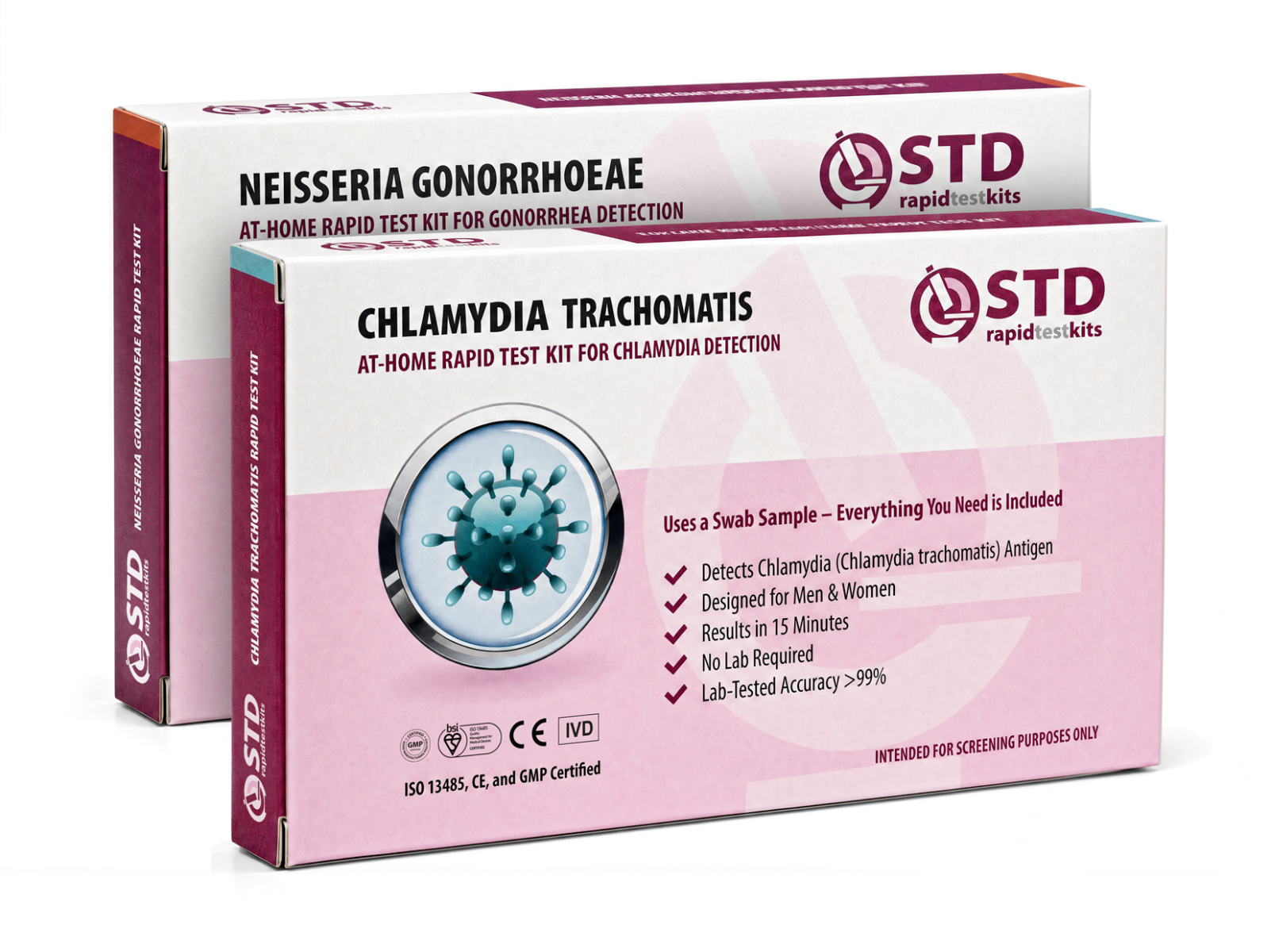
For broad coverage across the infections most relevant to trans risk profiles, the 8-in-1 rapid test kit covers HIV, syphilis, hepatitis B, hepatitis C, chlamydia, gonorrhea, HSV-1, and HSV-2 in one shipment. For trans men and nonbinary readers with a cervix who want targeted swab-based screening, separate chlamydia and gonorrhea swab kits cover the cervical and urethral sites where urine-based tests fall short. For ongoing quarterly testing, the 6-in-1 multi-STD kit covers the core mix at a lower per-test cost.
When choosing a kit, match the sample type to your actual anatomy and the exposures you have had. A urine sample tests the urethra. A vaginal or cervical swab tests for cervical and vaginal infection. If you have had anal or oral sex, rectal and throat swabs are the only way to catch those infections. No single sample type catches everything. If you are unsure what to collect, err toward the most comprehensive option and follow the kit instructions carefully on swab depth, rotation, and timing; even a 99% sensitivity rating depends on collecting the right sample from the right site.
Our at-home rapid tests are lateral-flow immunoassays, the same swab or fingerstick sample types laboratories use, processed at home for a result in about 15 minutes. Lab NAAT (nucleic-acid amplification testing) remains the analytical gold standard for confirmation, especially after a positive at-home result.
This article links to at-home test kits sold by STD Rapid Test Kits. Product recommendations are matched to the anatomy and exposure context discussed in each section.
Testing Windows: When to Test After Exposure
Testing too early after an exposure produces false negatives, not reassurance. Every infection has a window period: the time between exposure and when a test can reliably detect it. Testing before the window closes means an infection may be present but undetectable. If you have had a higher-risk exposure, the most useful thing you can do is note the date and plan testing around it.
| Infection | Test from | Notes for trans readers |
|---|---|---|
| Chlamydia | About 14 days post-exposure | Cervical swab required for trans men with a cervix; testosterone-thinned tissue can mask discharge even with active infection |
| Gonorrhea | About 3 weeks post-exposure | Throat and rectal sites swabbed separately; urine alone is insufficient for most trans anatomies |
| Syphilis | About 6 weeks post-exposure | A chancre may appear on neovaginal tissue, tucked genitals, or areas with reduced sensation, and is easy to miss |
| HIV | 6 weeks (early indicator); retest at 12 weeks for certainty | Trans women face elevated baseline risk; PrEP is safe with both estrogen and testosterone |
| HSV-1 and HSV-2 | Around 6 to 12 weeks post-exposure for antibody seroconversion | Lesions can be misread as binding irritation, tucking friction, or post-surgical healing |
| Hepatitis B | About 6 weeks post-exposure | Shared needles for self-injected hormones is a real transmission route |
| Hepatitis C | About 8 to 11 weeks post-exposure | Also bloodborne via shared injection equipment |
When Gender-Affirming Care Skips Sexual Health
There is a scenario that plays out constantly in trans healthcare: a person sees their gender-affirming provider for HRT monitoring, bloodwork, surgical follow-up, or a referral. Sexual health never comes up. No one asks about recent partners, exposure history, or whether STD screening would be useful. They leave with their hormones and a gap in their care that nobody mentions.
Research consistently shows this is not an isolated experience. A 2025 systematic review in Reproductive Health identified provider lack of training and assumptions about trans patients' sexual-health needs as recurring themes across the studies it reviewed. Providers often avoid the topic out of discomfort, lack of training, or the incorrect assumption that transition status changes risk. It does not. Hormones do not protect against sexually transmitted infections. Surgery does not protect against sexually transmitted infections. Sexual health is a separate, ongoing need that gender-affirming care does not automatically address.
That pattern compounds over time: trans people stop mentioning symptoms, stop asking for tests, and internalize that this part of their health is not something the medical system will help with, so they stop trying to access care for it. At-home testing matters precisely because it breaks the cycle: someone can get an answer without depending on a provider to ask the right question first.
1. "I'd like to talk about STI screening today. Can we go over what tests make sense based on my anatomy and sexual practices?"
2. "Do you offer throat and rectal swabs? I've been told urine alone isn't sufficient for my situation."
3. "I'm sexually active, and I want to stay on top of my sexual health. What does a complete screening look like for me?"
If the response is dismissal or visible discomfort, that is data about your provider, not about whether your request was reasonable. At-home testing and telehealth remain available alternatives.
Dysphoria, Medical Trauma, and the Real Reason Testing Gets Delayed
Studies on trans healthcare avoidance are consistent on one point: documented mistreatment in clinical settings produces rational, measurable avoidance afterwards. In one study cited by a 2025 systematic review in Reproductive Health, roughly 30% of trans men in New Zealand had delayed or skipped cervical cancer screening due to concerns about how they would be treated as a trans person. The same review documented broader patterns of avoidance among trans patients with histories of clinical mistreatment, especially around exams perceived as gendered or invasive.
Gender dysphoria can make genital self-examination, the first step in noticing that something might be wrong, genuinely difficult. You might notice a symptom and immediately not want to look at it, touch it, or think about what it means. That is not weakness or negligence. It is dysphoria, a real barrier to care that the healthcare system has largely refused to accommodate. At-home testing helps here because it lets you approach your body on your own terms, in your own space, without anyone else in the room making it worse.
Medical trauma compounds the problem. A trans person who has been misgendered by three receptionists, questioned about their anatomy by a nurse who seemed unsettled, then handed a test their provider admitted they were not sure was appropriate has a very rational reason to avoid repeating the experience. Trauma-informed sexual healthcare means asking permission before touching, using patient-preferred anatomical terms, framing STD testing as routine rather than judgmental, and recognizing that the exam itself may carry emotional weight that cisgender patients typically don't bring into the room.
If you are looking for a provider, or pushing back on one you already see, these are the concrete behaviors to expect (and to ask for by name):
- Patient-preferred anatomical terms, set at intake and used consistently in the room (front hole, chest, genitals, etc.).
- Permission before any touching, including positioning, draping, and sample collection.
- STD testing framed as routine, not as a moral check-in or a reason to question your relationships.
- The option to self-collect swabs (vaginal, rectal, throat) where the test allows it, instead of provider-collected samples.
- Explicit naming of the test sites ordered, so you can confirm they match your anatomy and exposure history before the visit ends.
The Data Gap: Why Trans-Specific STD Information Is Getting Harder to Find
In early 2025, journalism covering federal health policy reported that the CDC would no longer process transgender identity data across its major health-surveillance systems. The dedicated STI information page for transgender and gender-diverse persons was taken offline. The National HIV Behavioral Surveillance Among Transgender Women, one of the few systematic sources of US-level data on trans health outcomes, was affected. Federal infrastructure that tracked who was getting sick, in which communities, and at what rates is no longer collecting that information.
Public-health programs are built on surveillance data. When a population stops appearing in the data, the interventions designed to protect them do not get funded, updated, or prioritized. Providers who relied on federal guidelines for trans-specific screening recommendations now find those pages gone. Researchers who needed the data to design better tests, better protocols, and better care lose the evidence base. A community already underserved in the medical literature becomes harder to study and therefore harder to serve.
That makes independent, accessible resources more important than they were before. It also makes at-home testing more important: when federal guidance thins out and clinical knowledge lags, the ability to test privately, without depending on a provider to know the right protocol, becomes a practical necessity, not just a convenience.
- The CDC's dedicated STI information page for transgender and gender-diverse persons was taken offline.
- The National HIV Behavioral Surveillance Among Transgender Women, one of the few US-level systematic data sources on trans HIV outcomes, was affected by the policy change.
- Federal screening recommendations specifically calling out site-based testing for trans patients are harder to find through CDC channels than they were a year ago.
How Often Should Trans People Get Tested?
For sexually active trans people with new or multiple partners, screening every three months matches the interval recommended for anyone in a high-transmission network. That is more often than most trans people currently test, and covers more sample sites than most clinics currently offer. For monogamous relationships with no new exposures, annual testing at minimum is reasonable, with additional testing after any new exposure or condom failure. Trans people living with HIV should be screened for all STIs at least annually, and more frequently if sexually active with multiple partners, per CDC STI treatment guidelines. For trans women specifically, given the well-documented elevated rates of HIV and bacterial STIs, quarterly testing is a reasonable default if you are sexually active.
| Situation | Recommended frequency |
|---|---|
| Sexually active with new or multiple partners | Every 3 months |
| Trans women, given elevated baseline risk | Every 3 months if sexually active |
| Monogamous relationship, no new exposures | Annually at minimum |
| Trans person living with HIV | At least annually; every 3 months if sexually active |
| After a specific higher-risk exposure | At 6 weeks and again at 12 weeks post-exposure |
Given the high prevalence of extragenital infections in transgender and gender-diverse individuals, the CDC recommends site-specific screening based on anatomy and sexual behaviors.
FAQs
- Do I need STD testing if I'm on hormones?
- Yes. HRT does not protect against sexually transmitted infections. Testosterone and estrogen change tissue, alter symptoms, and shift how infections present, but they do not create any barrier to transmission. If you are sexually active, regular testing remains essential regardless of which hormones you take or what stage of transition you are in.
- Is a urine test enough for a trans person?
- Usually not. Urine only screens for urethral infections. It will miss rectal, pharyngeal, and (critically) cervical infections in trans men who retain a cervix. CDC guidelines are explicit: trans men who have not had a vaginectomy need a cervical swab, not urine alone. If your provider doesn't know this, ask specifically for site-based testing matched to your anatomy and sexual practices.
- Can trans women get STDs in a neovagina?
- Yes. Documented infections in neovaginal tissue include herpes, HPV/genital warts, chlamydia, gonorrhea, and bacterial vaginosis. The tissue used in vaginoplasty (penile inversion, sigmoid colon, or peritoneum) affects which infections are most likely and which screening is appropriate. Post-vaginoplasty, swab the sites that match your sexual activity: neovaginal, rectal, and throat as exposure dictates.
- Are at-home STD tests accurate for trans bodies?
- Yes. The accuracy of CE-marked or FDA-cleared rapid lateral-flow kits is not affected by gender identity or hormone status. Testosterone can thin vaginal tissue and reduce the sample collected on a swab, so following kit instructions on swab depth and rotation matters. If a result is inconclusive, quality kits include a second sample. Confirm any positive at-home result with a provider or telehealth service for treatment and lab confirmation.
- Is PrEP safe to take with HRT?
- Yes. PrEP does not interfere with estrogen or testosterone therapy, and HRT does not reduce PrEP's effectiveness. Some providers still incorrectly tell trans women on estrogen they cannot take PrEP. That information is wrong, and current CDC and WHO PrEP guidance both confirm compatibility with feminizing and masculinizing hormone regimens.
- Why didn't my gender clinic test me for STDs?
- Gender clinics are usually built around HRT monitoring and surgical follow-up; routine STI panels, multi-site swabs, and partner notification often sit outside their workflow. Some providers also default to assuming monogamy, or simply lack training in trans-specific screening protocols. If yours doesn't bring it up at your next visit, raise it directly, or use an at-home kit to handle screening on your own.
- How do I know which test sites to use?
- Base it on your anatomy and what sexual activities you have had. Oral sex given or received: throat swab. Receptive anal sex: rectal swab. Vaginal or front-hole sex: vaginal or cervical swab (cervical specifically if you retain a cervix). Insertive sex via penis: urine for the urethra. Multiple exposure types means multiple sample sites. No single site covers them all.
- What if I test positive at home?
- A positive result is a medical finding, not a moral judgment. Confirm it with a provider or telehealth service that can prescribe treatment. Most bacterial STDs (chlamydia, gonorrhea, syphilis) are treatable with antibiotics when caught early. Notify recent partners directly or through an anonymous notification service. Retest at three months after treatment to confirm clearance and to check for reinfection.
Get Tested on Your Terms
When the clinical route is unavailable, inaccessible, or simply not worth what it costs you emotionally, at-home testing is a real and accurate alternative. Trans people face documented barriers to sexual healthcare: inadequate testing protocols, providers without relevant training, and a shrinking federal evidence base. None of that is your fault, and none of it means you have to go without answers. Pick the kit that matches your anatomy and the exposures you have had, follow the sample-collection instructions, and read the result in your own space.

- U.S. Centers for Disease Control and Prevention. 2021 STI Treatment Guidelines: Transgender and Gender Diverse Persons. Source for CDC site-specific screening recommendations and the cervical-swab requirement for trans men with a cervix.
- UNAIDS 2024 Global AIDS Update: Transgender People. Source for the 20-times-higher relative HIV risk for transgender women globally compared with the wider adult population.
- Updates on Testing, Treatment, and Prevention of Sexually Transmitted Infections in the United States, 2025. Topics in Antiviral Medicine review covering extragenital screening yield (6% to 50% increase) and CDC anatomy-based recommendations for trans and gender-diverse populations.
- Barriers to Sexual and Reproductive Health Care Faced by Transgender and Gender Diverse People: A Systematic Review. Reproductive Health, 2025. Source for documented provider-side gaps in trans sexual-health screening and the New Zealand cervical-screening avoidance figure cited for trans men.
- Chlamydia trachomatis Infection of the Neovagina in Transgender Women. Open Forum Infectious Diseases. Source for documented bacterial-STI infection of neovaginal tissue and clinical implications for screening trans women post-vaginoplasty.
- STAT News (February 2025). CDC Will No Longer Process Transgender Data. Journalism reporting (not a primary government source) documenting the discontinuation of trans-specific surveillance and the offlining of CDC's transgender STI guidance pages.
