Published: July 2025 | Editorial review and quality control: Martina N.
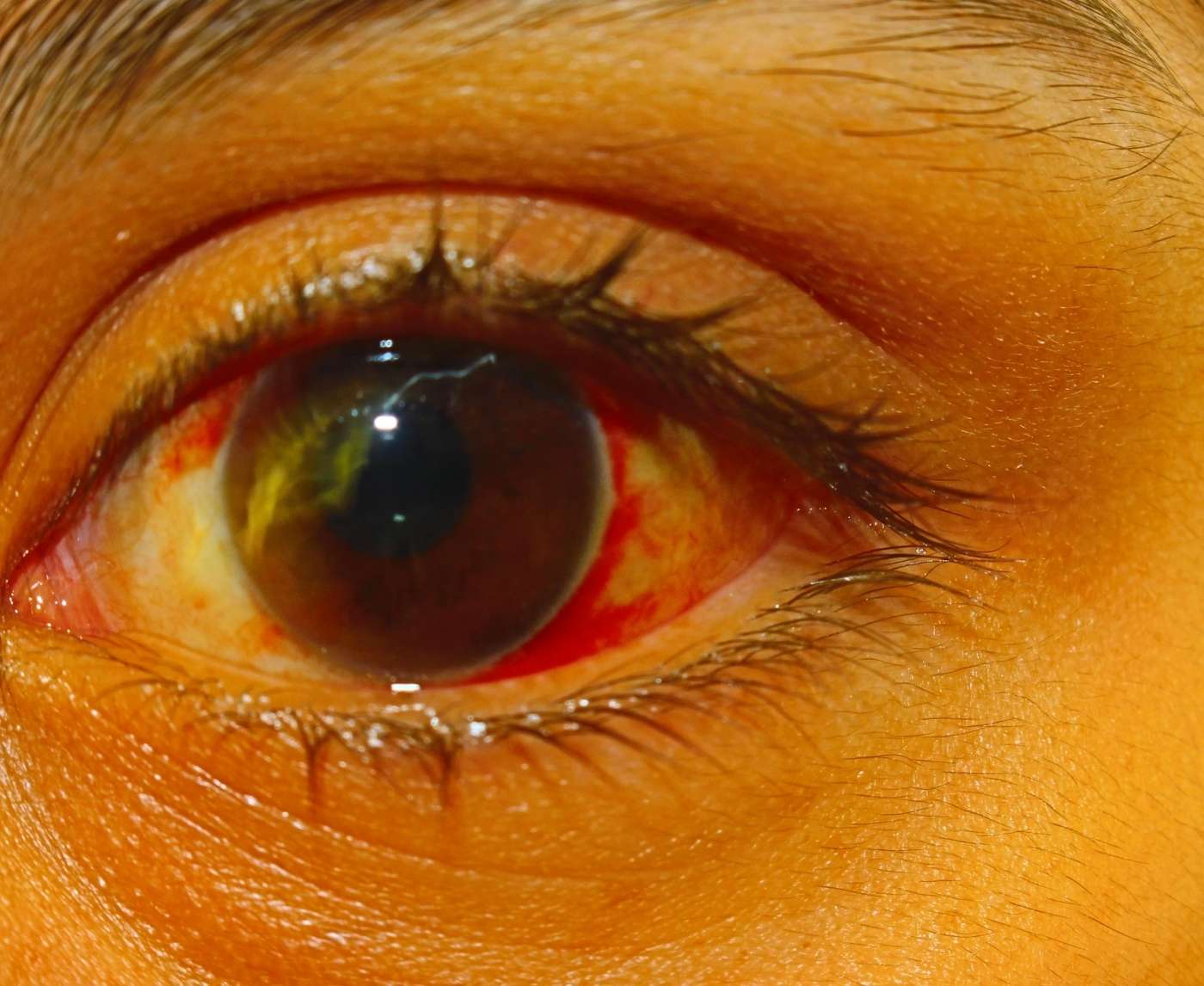
A sticky, swollen, painfully red eye that shows up the day after a sexual encounter is not a wait-and-see situation. Most pink eye is mild, viral, and clears on its own within a week or so. A small fraction of cases are something else entirely: a bacterial infection caused by Neisseria gonorrhoeae that can move from surface irritation to corneal ulceration in 24 to 48 hours.
This guide explains what ocular gonorrhea actually looks like, how it reaches the eye, why standard pink eye home care can let it progress, and what to do if your symptoms fit the pattern. Most readers will finish reassured that what they have is probably not gonococcal conjunctivitis. The minority for whom it might be will know exactly what to do next, and how fast.
Key takeaways
- Gonorrhea can infect the eye and cause vision-threatening damage within 24 to 48 hours, far faster than ordinary viral or allergic pink eye.
- Severe one-sided eye redness with thick yellow-green discharge after sexual exposure is a same-day medical emergency, not a home-remedy situation.
What ocular gonorrhea actually is
Ocular gonorrhea (clinically called gonococcal conjunctivitis or, in its most aggressive adult form, hyperacute bacterial conjunctivitis) is an eye infection caused by the same bacteria that drive genital and throat gonorrhea: Neisseria gonorrhoeae. The bacteria do not have a preferred body part. They colonize mucous membranes wherever they land, which includes the conjunctiva, the thin transparent tissue covering the white of the eye and the inside of the eyelids.
In adults, this presentation is uncommon enough that many primary care doctors will go entire careers without seeing it. The U.S. Centers for Disease Control and Prevention notes that gonococcal conjunctivitis among adults is rare and that the data on treatment outcomes are limited, which is why infectious disease specialist consultation is often recommended (CDC STI Treatment Guidelines, gonococcal infections among adults). Newborns can also acquire it during birth from an infected parent, which is why most U.S. hospitals routinely apply antibiotic eye ointment to babies right after delivery.
Adult-onset cases are different from neonatal cases in one important way: the adult eye has a fully formed cornea that the bacteria can erode through. The infection does not stay polite on the surface. Within a day or two it can produce ulceration, perforation, and permanent scarring of vision-critical tissue.
How gonorrhea reaches the eye
The path is almost always direct contact between infected fluid and the eye. The most common routes:
- Splash or facial contact. Semen or vaginal fluid that lands in or near the eye during oral sex, foreplay, or ejaculation directed at the face.
- Hand-to-eye transfer. Touching infected genital fluids during sex, then rubbing or wiping your eye before washing your hands.
- Shared contaminated items. Less common, but a fresh secretion on a towel, makeup applicator, or contact lens case can carry viable bacteria for a short window.
According to the U.K. National Health Service, eye infection from gonorrhea typically follows touching your eyes after contact with infected fluid (NHS, gonorrhoea). The route matters more than the sex act. People who never have penetrative sex can still develop ocular gonorrhea if there is fluid contact with the eye.
The person who transmits ocular gonorrhea may have no genital or throat symptoms at all. Throat infections are silent in the majority of cases, and a substantial fraction of female genital gonorrhea is asymptomatic too. The CDC notes that gonorrhea often produces no symptoms (<a href="https://www.cdc.gov/gonorrhea/about/">CDC, about gonorrhea</a>). Asymptomatic carriage is not the same as non-infectious carriage; the fluid still carries viable bacteria.
Symptoms: telling it apart from common pink eye
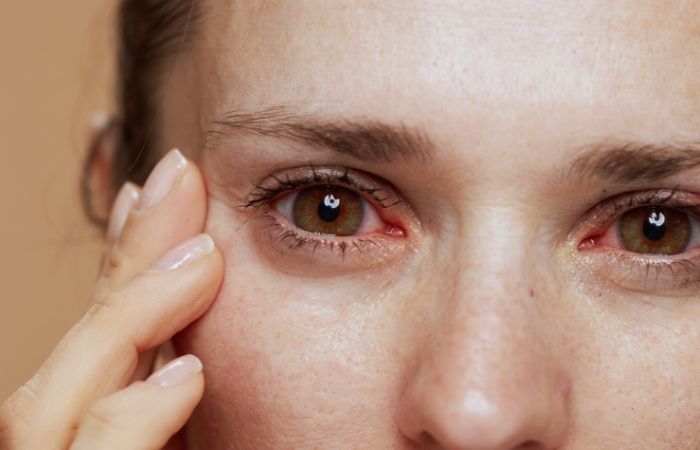
The reason ocular gonorrhea is so dangerous is that, in its first hours, it can look like a slightly worse-than-average case of conjunctivitis. The differences become obvious as it escalates, but by then the cornea may already be at risk. Symptoms typically begin within 1 to 5 days of exposure and intensify quickly.
Features that point toward gonococcal (or any severe bacterial) conjunctivitis rather than ordinary viral pink eye:
- One eye first, then sometimes the other. Viral pink eye often starts in one eye and spreads to the other within a couple of days. Hyperacute bacterial conjunctivitis usually stays one-sided but is much more intense.
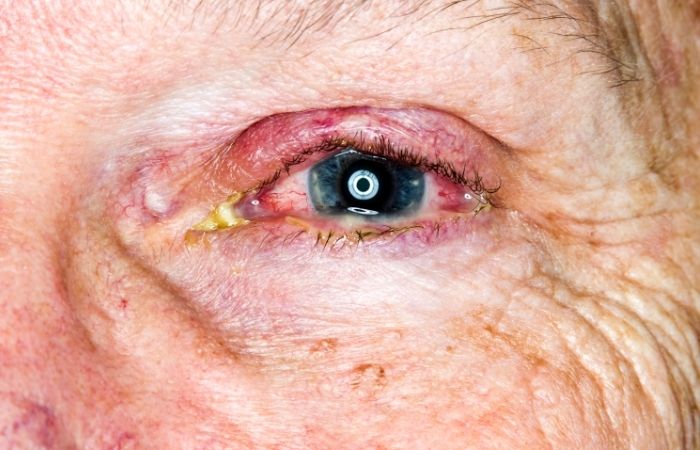
- Thick, copious, yellow-green discharge. Enough to glue the eyelids shut overnight, and it returns within minutes of being wiped away.
- Rapid eyelid swelling. The lids become puffy and tender within hours, not days.
- Severe pain and light sensitivity. Viral pink eye is typically itchy or scratchy. Hyperacute bacterial conjunctivitis is genuinely painful.
- Tender, swollen lymph nodes in front of the ear or under the jaw on the same side as the infected eye.
- Recent sexual exposure, especially involving oral or fluid contact with the face, in the prior 1 to 5 days.
For comparison: standard viral conjunctivitis tends to be itchy and watery with thin clear discharge. Allergic conjunctivitis is intensely itchy in both eyes, often paired with sneezing or nasal symptoms. Bacterial conjunctivitis from common organisms like Staphylococcus or Streptococcus can have yellowish discharge but progresses more slowly than gonococcal infection.
Stop reading and go to an urgent care, ophthalmology clinic, or emergency department today if you have any of: severe eye pain, copious thick yellow or greenish discharge that returns immediately after wiping, vision changes (blurring, halos, decreased acuity), corneal cloudiness, or marked swelling of the eyelid that is hot or extremely tender. Mention recent sexual exposure when you check in; the clinician needs that history to choose the right antibiotic class on the first try.
Why vision damage happens so fast
Most bacteria that infect the eye stay on the surface, where the immune system and a normal blink-and-tear cycle can hold them off until antibiotics finish the job. Neisseria gonorrhoeae is unusual in its ability to invade the cornea (the clear front window of the eye) directly through intact epithelium. Once it gets a foothold, the bacteria release proteases that break down the corneal stroma, the structural collagen layer that gives the cornea its strength.
The clinical sequence in untreated severe cases tends to follow a predictable pattern over 24 to 72 hours:
- Hour 0 to 24: rapidly worsening discharge, lid swelling, and pain.
- Hour 24 to 48: corneal infiltration and ulceration. The cornea may develop a visible whitish or yellowish patch.
- Hour 48 onward: risk of corneal perforation, where the eye can leak its inner fluids. This is a sight-saving emergency that can require surgical repair or, in extreme cases, a corneal transplant.
The number of cases that progress to perforation is small in absolute terms, mostly because adults who notice these symptoms get to a clinic. The real danger window is when the infection is mistaken for ordinary pink eye and treated with over-the-counter drops or wait-and-see home care for two or three days.
How doctors diagnose and treat it
If a clinician suspects gonococcal conjunctivitis, they generally do not wait for laboratory confirmation before starting treatment. The window between presentation and irreversible vision damage is short, and the standard antibiotic is well tolerated. Diagnosis usually involves:
- A focused sexual history covering the last week.
- Slit-lamp examination of the eye to look for corneal involvement.
- A conjunctival swab sent for culture and Gram stain. Gram stain can show the characteristic Gram-negative diplococci within hours.
- NAAT (nucleic acid amplification testing) of the conjunctival sample, which is the most sensitive lab method, plus simultaneous testing of the throat, urethra or cervix, and rectum based on exposure history.
The CDC's recommended treatment for gonococcal conjunctivitis in adults is ceftriaxone 1 gram given as a single intramuscular injection, plus a one-time saline lavage of the affected eye to mechanically reduce bacterial load (CDC STI Treatment Guidelines, gonococcal conjunctivitis section). Topical antibiotic eye drops are sometimes added to maintain local concentration, but they are not a substitute for systemic antibiotics. Because adult cases are uncommon and the data on treatment outcomes are limited, infectious disease consultation is often recommended.
If the cornea is already involved, an ophthalmologist becomes part of the care team to monitor for ulceration, ensure the structural integrity of the eye, and decide whether closer follow-up or hospital admission is needed. Severe cases may require IV antibiotics in addition to the IM dose.
Concurrent screening for chlamydia, syphilis, and HIV is standard. The same exposure that delivered gonorrhea to the eye almost certainly delivered other potential pathogens to the genitals, throat, or bloodstream.
What at-home testing can and cannot do
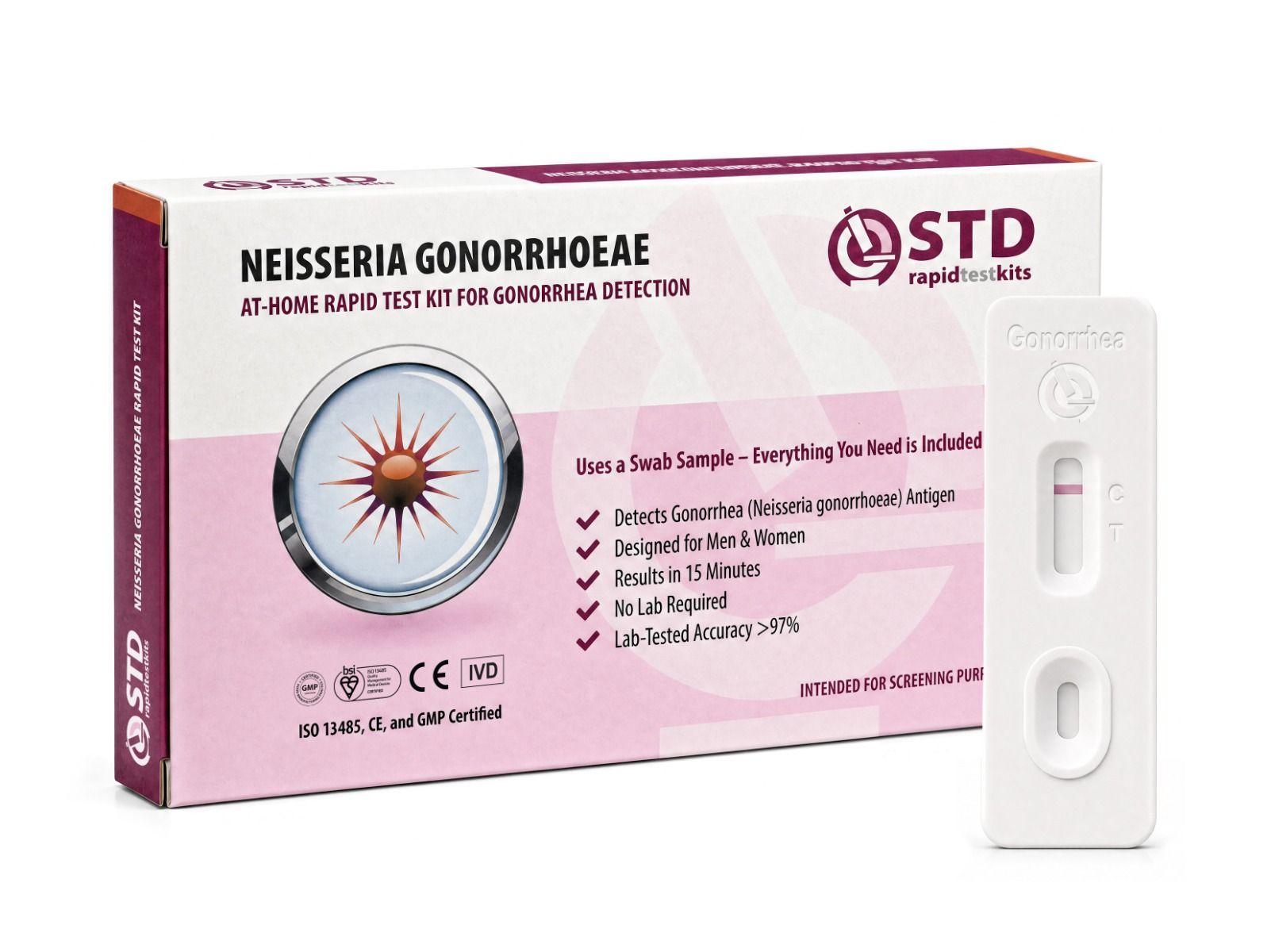
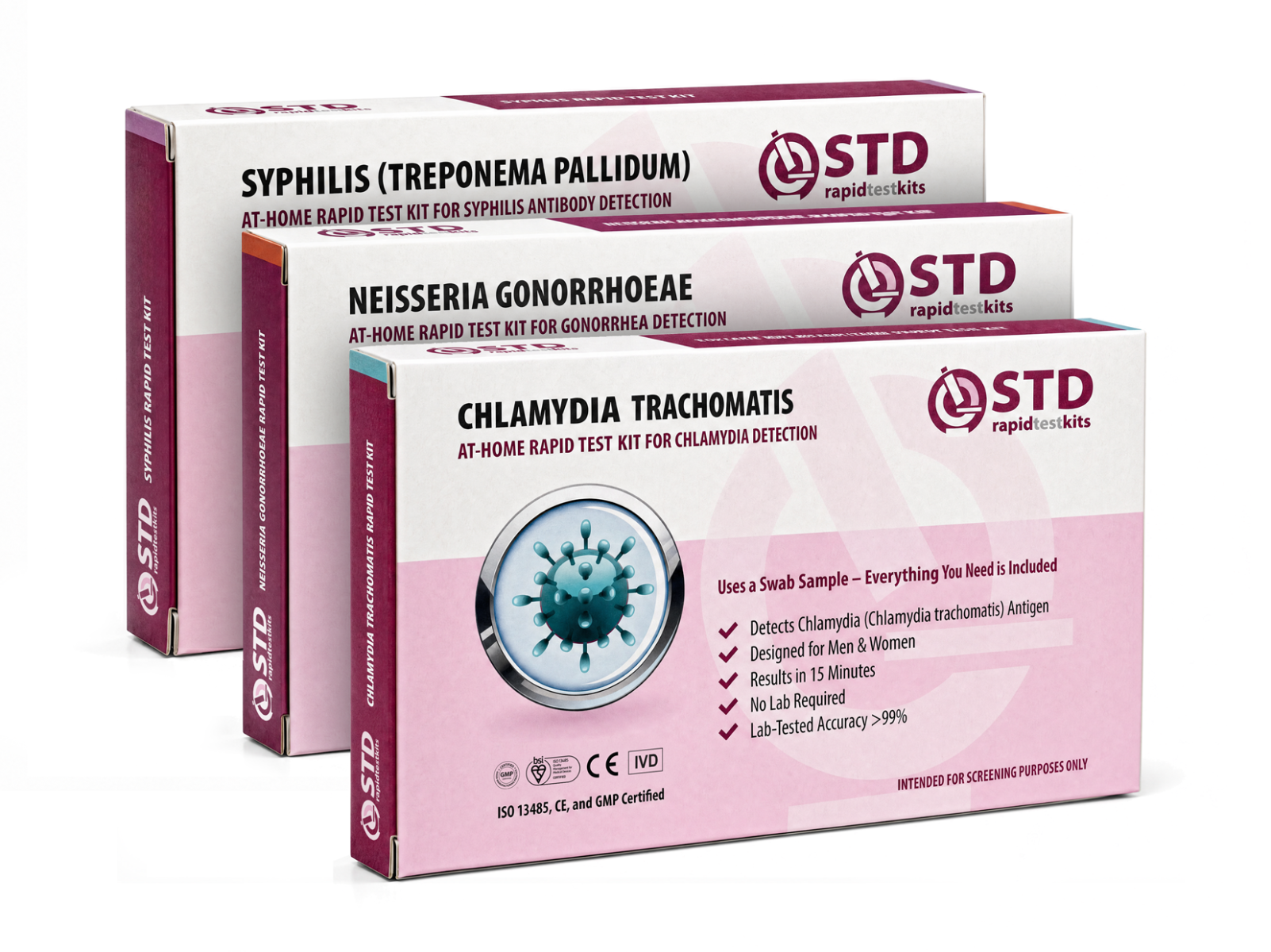
An at-home rapid test kit is a screening tool for genital or blood-based infection. It is not a treatment for an eye infection, and it cannot diagnose ocular gonorrhea. It should never delay an in-person eye exam for someone with active eye symptoms. This site sells rapid at-home STI test kits; the guidance below is written to help you decide when at-home screening is useful and when a clinic visit takes priority.
At-home testing has a real role in the broader picture. The encounter that exposed your eye almost certainly also exposed your genitals or throat. The CDC recommends concurrent testing across exposure sites whenever gonorrhea is suspected at any single site (CDC STI Treatment Guidelines). A rapid swab kit at home gives you a same-day yes-or-no on whether you also have a genital infection that needs treating, which is useful information for your prescribing clinician.
Two practical scenarios where a rapid kit helps:
- You have eye symptoms now. Go to a clinic for the eye today. Use a rapid swab on your genital sample at home in parallel, so that when you and your clinician discuss treatment, you both already know whether the genital screen is positive.
- You had an exposure that included facial fluid contact, but no eye symptoms have developed. Test the genital site at the appropriate window for gonorrhea (typically 7 to 14 days after exposure). A negative does not rule out asymptomatic colonization in the throat or rectum, so consider a clinic NAAT panel as well if the exposure was high-risk.
Antibiotic resistance in 2026
Gonorrhea has become one of the most active fronts in the global antibiotic resistance picture. The World Health Organization classifies drug-resistant Neisseria gonorrhoeae as a major threat, citing high rates of resistance to quinolones and azithromycin and rising resistance to extended-spectrum cephalosporins, the last-line treatment class (WHO, sexually transmitted infections fact sheet).
For ocular gonorrhea specifically, the practical implication is that the standard ceftriaxone regimen still works in the vast majority of U.S. and U.K. cases, but follow-up cultures are increasingly important to confirm cure. Resistant strains can require alternative or combination therapy, and treatment failure is more common than it was a decade ago.
Every current clinician guideline, CDC and WHO included, now recommends a test of cure or repeat NAAT a few weeks after gonorrhea treatment. Skipping that follow-up because symptoms have resolved is how resistant infections quietly persist and get passed on.
Because gonococcal conjunctivitis is uncommon and data regarding treatment of gonococcal conjunctivitis among adults are limited, consultation with an infectious disease specialist should be considered.
Common misconceptions worth clearing up
Several beliefs about ocular gonorrhea, repeated in older articles and casual sex-education materials, are wrong in ways that delay care.
“You cannot get an STI in your eye.” Yes, you can. Gonorrhea, chlamydia, herpes simplex, and syphilis can all infect ocular tissue under the right exposure conditions. Gonorrhea and herpes simplex are the two with the most aggressive course in adults.
“It is just pink eye, it will pass.” Most pink eye is viral and resolves on its own. Hyperacute bacterial conjunctivitis is the exception. The defining feature is the speed and severity of progression. If your symptoms doubled in severity overnight, it is not ordinary viral conjunctivitis.
“Only certain populations get this.” Gonococcal conjunctivitis is reported across all sexes, orientations, and age groups. Risk follows fluid exposure, not identity. Men who have sex with men have higher overall gonorrhea rates per CDC surveillance, but adult eye infection occurs in any group with the right exposure.
“If I had gonorrhea elsewhere I would know.” The honest answer is that you often would not. Throat infections are silent in the majority of cases, and a substantial fraction of female genital infections are asymptomatic too. The CDC explicitly notes that gonorrhea frequently has no symptoms (CDC, about gonorrhea).
“Over-the-counter drops or warm compresses will fix it.” They will not. They can mask early symptoms long enough for the cornea to be at real risk. Hyperacute bacterial conjunctivitis needs prescription systemic antibiotics, not topical lubricants.
How can I tell if my pink eye is actually gonorrhea?
Ordinary pink eye is itchy and watery, often clears in a week, and rarely produces severe pain. Gonococcal conjunctivitis hits one eye fast, doubles in severity within 24 hours, produces thick yellow-green discharge that glues the lids shut, and follows recent sexual exposure (often involving fluid contact with the face). If those features fit, treat it as a same-day emergency rather than a home-care issue.
Reducing the risk without catastrophizing
The absolute risk of any individual sexual encounter producing ocular gonorrhea is very low. CDC surveillance reported 543,409 gonorrhea cases in the U.S. in 2024, the third consecutive annual decline (CDC STI Surveillance, 2024 provisional). Adult ocular cases are a small fraction of that total. The point of taking the risk seriously is not to make every sexual encounter feel dangerous; it is to know which symptoms warrant a same-day clinic visit rather than a wait-and-see day.
Practical risk reduction:
- Wash your hands after any contact with genitals or genital fluids, before touching your face or eyes. This single habit prevents the most common transmission route.
- If fluid lands in or near your eye, irrigate with clean water or saline for several minutes immediately, and watch for symptoms over the next 1 to 5 days.
- Test regularly if you have new partners or multiple partners, and ask partners to do the same. Most genital and throat gonorrhea is asymptomatic; testing is the only way to know.
- Consider a multi-infection screen after a higher-risk exposure event, since gonorrhea travels in social contact patterns with chlamydia and syphilis.
If you do develop eye symptoms after an exposure, the goal is the same as with any acute infection: short delay between symptom and clinic. With gonococcal conjunctivitis, the antibiotic clears the infection in most cases; what cannot be undone is corneal scarring that forms while the infection is left untreated.
Frequently asked questions
- Can gonorrhea really infect the eye in adults?
- Yes, although it is uncommon. Adult ocular gonorrhea most often follows direct contact between infected genital fluid and the eye, either by splash or by hand transfer. The CDC notes that adult cases are rare enough that infectious disease specialist consultation is usually recommended.
- How fast can ocular gonorrhea damage vision?
- Symptoms typically appear within 1 to 5 days of exposure. Once symptomatic, the infection can progress to corneal ulceration in 24 to 48 hours. That is why it is treated as a same-day clinical emergency rather than something to manage at home.
- How is it different from regular pink eye?
- Ordinary viral pink eye is itchy or scratchy, with thin watery discharge, and resolves on its own in about a week. Gonococcal conjunctivitis hits one eye hard within hours, produces thick yellow-green discharge that returns within minutes of wiping, and is genuinely painful with marked eyelid swelling.
- Can I treat ocular gonorrhea with over-the-counter eye drops?
- No. Lubricant drops, allergy drops, and supermarket antibiotic creams are not effective against Neisseria gonorrhoeae and can mask early warning signs. Standard treatment is a single intramuscular injection of ceftriaxone, often combined with a saline eye lavage, prescribed in a clinical setting.
- Do I need a genital test if my only symptom is in my eye?
- Yes. The same exposure that delivered the bacteria to your eye almost certainly delivered them to the genitals or throat. Standard care includes concurrent screening across exposure sites for gonorrhea, plus testing for chlamydia, syphilis, and HIV.
- Will a rapid at-home swab diagnose ocular gonorrhea?
- No. At-home rapid lateral-flow tests are validated for self-collected genital swabs. They cannot diagnose an eye infection. If you have eye symptoms, see a clinician today; you can run the home swab on the genital sample in parallel for the broader picture.
- How can I lower the risk of getting it in the first place?
- Wash your hands after any contact with genitals or genital fluids before touching your face. If fluid lands in your eye, irrigate immediately with clean water for several minutes and watch for symptoms over the next few days. Regular STI screening for you and your partners is the single most effective protective habit, since most genital and throat gonorrhea is asymptomatic, including silent throat and rectal colonization.
- U.S. Centers for Disease Control and Prevention. About gonorrhea: symptoms, transmission, and screening overview, including the note that infection often produces no symptoms.
- U.S. Centers for Disease Control and Prevention. Sexually Transmitted Infections Treatment Guidelines, gonococcal infections among adults: dedicated section on gonococcal conjunctivitis recommending ceftriaxone 1 g IM plus one-time saline eye lavage and infectious disease specialist consultation.
- U.S. Centers for Disease Control and Prevention. Sexually Transmitted Infections Surveillance, 2024 (Provisional): 543,409 reported gonorrhea cases for 2024, the third consecutive annual decline.
- World Health Organization. Sexually Transmitted Infections fact sheet: documents resistance of Neisseria gonorrhoeae to quinolones and azithromycin and rising resistance to extended-spectrum cephalosporins.
- U.K. National Health Service. Gonorrhoea: lists eye redness, pain, and discharge as symptoms and notes that gonococcal conjunctivitis can occur after touching the eyes following contact with infected fluid.
