Drug-Resistant Gonorrhea: The STD Antibiotics Can't Treat
Where ceftriaxone resistance is rising and what to do next




- Ceftriaxone-resistant gonorrhea has been confirmed in clinical samples in China, Japan, Cambodia, the UK, France, and Australia, with the FC428 lineage as the most-tracked resistant strain.
- At-home rapid tests still detect gonorrhea and other STIs, but they don't tell you whether the strain is drug-resistant. Persistent symptoms 7 to 14 days after standard treatment are the signal to ask your provider about culture-based resistance testing.
Published: November 2025 | Last updated: May 2026 | Editorial review and quality control: Martina N.
Is gonorrhea really untreatable now, or is that headline hype?
Gonorrhea is still treatable in most cases. Ceftriaxone, the last reliable single-agent antibiotic, is under pressure. Confirmed resistant cases (mostly FC428 lineage) have appeared in China, Japan, Cambodia, the UK, France, and Australia. Per the CDC, no verified US treatment failures to date.
Gonorrhea was once a one-shot fix. A single antibiotic, taken once, and the infection cleared within days. That story is changing fast. The bacteria has progressively developed resistance to nearly every antibiotic class clinicians have ever used to treat it, and the U.S. Centers for Disease Control and Prevention now lists drug-resistant gonorrhea as one of its highest-priority antibiotic-resistance threats (CDC, drug-resistant gonorrhea page for healthcare providers).
This article walks through where ceftriaxone resistance has been confirmed, what the World Health Organization's 5 percent surveillance threshold actually means, what the WHO's 2026 to 2030 framework does about it, and how the shift affects what at-home rapid testing can and cannot tell you when treatment seems to fail.
Why drug resistance is turning STIs into superbugs
At the microbial level, resistance is simple: a genetic tweak that makes an infection tougher to kill. In real life, the picture is messier. Someone follows the rules, gets tested, takes the prescribed antibiotic, and the infection still hangs on. Or worse, it goes quiet and continues to spread to others undetected. That is how antimicrobial resistance, abbreviated AMR, operates. It works invisibly, stubbornly, and often without warning.
The most notorious offender is Neisseria gonorrhoeae. Once curable with a single shot, it now resists multiple drug classes including penicillins, tetracyclines, fluoroquinolones, and macrolides, leaving ceftriaxone as the only currently recommended first-line treatment in U.S. guidelines (CDC drug-resistant gonorrhea guidance). The WHO treats gonorrhea as a priority AMR pathogen, noting that the bacterium has developed resistance to every antibiotic class used against it over the past 80 years (WHO fact sheet on multi-drug resistant gonorrhoea). The bacterium is built to share genetic material with other strains, including other species in its genus, and new resistance mutations can spread through sexual networks in months rather than years.
While gonorrhea steals headlines, the same pressure is shaping other infections. Mycoplasma genitalium shows growing macrolide resistance globally. Treponema pallidum, the syphilis bacterium, has documented azithromycin resistance on multiple continents, which is why penicillin remains first-line in CDC and WHO guidance. Hepatitis B antiviral resistance is well established in patients on long-term nucleoside-analog therapy. HIV drug resistance to older non-nucleoside reverse-transcriptase inhibitors has driven WHO to recommend dolutegravir-based regimens as first-line therapy in most national programs.
What is scary is not only that these infections are getting harder to treat. It is that they still often look and feel the same as their treatable cousins, meaning a person can pass along a resistant strain without knowing it.
Antimicrobial resistance (AMR) is when a microbe develops genetic changes that let it survive a drug that used to kill it. For STIs, the strains that matter most right now are: Neisseria gonorrhoeae (broad multi-drug resistance, ceftriaxone-only first line), Mycoplasma genitalium (macrolide resistance), Treponema pallidum (azithromycin resistance), HIV (older NNRTI-class resistance), and hepatitis B (long-term nucleoside-analog resistance). A standard at-home rapid test detects infection but does not detect any of these resistance markers.
The 5 percent threshold: what WHO's resistance line means
WHO public-health guidance treats roughly 5 percent resistance in regional surveillance as the level at which a first-line antibiotic becomes unreliable for empirical treatment of gonorrhea. When at least 1 in 20 isolates in a region show resistance to a recommended antibiotic, public-health authorities are expected to update treatment guidelines, expand surveillance, or move to second-line therapy. The number is statistical, not magical, and it has real clinical consequences. A clinician handing out the standard dose without lab confirmation is, at 5 percent regional resistance, accepting that a small but predictable share of patients will leave the clinic still infected.
Ceftriaxone is the last single-agent option with broad regulatory backing for gonorrhea, and the second-line alternatives (gentamicin plus azithromycin, or spectinomycin where available) involve more side effects, longer regimens, or supply problems. The WHO's multi-drug-resistant gonorrhoea fact sheet documents resistance progression over the past 80 years, spanning sulphonamides, tetracyclines, macrolides, and fluoroquinolones before reaching ceftriaxone. Ceftriaxone remains effective for the large majority of infections in most regions per WHO surveillance, though case clusters showing decreased susceptibility are growing.
WHO considers a first-line antibiotic unreliable for empirical treatment once at least 1 in 20 isolates in a region show resistance. At that point, public-health authorities are expected to update treatment guidelines, expand surveillance, or move to second-line therapy. The threshold is a population-level trigger for action, not a personal-risk number for any individual patient.
Where ceftriaxone resistance has been documented
Country-level surveillance varies in quality, so this section combines well-documented case clusters (where ceftriaxone-resistant strains have been confirmed in clinical isolates and matched to known resistant lineages) with regional surveillance signals (where decreased susceptibility is rising even if outright high-level resistance remains under 5 percent). The pattern is regional, not global. Most of North America and Western Europe still report ceftriaxone resistance under 1 percent in routine national surveillance. The concerning signals concentrate in East and Southeast Asia, where the FC428 lineage of ceftriaxone-resistant N. gonorrhoeae has been confirmed repeatedly. Per CDC tracking in Emerging Infectious Diseases, FC428 has been detected in more than a dozen countries since its identification in Japan around 2015, often imported through international travel.
The table below lists places where ceftriaxone resistance has been credibly documented in clinical samples or where decreased susceptibility is approaching the 5 percent threshold in surveillance reports. The absence of a country from this list does not mean resistance is absent; many regions lack the laboratory infrastructure to detect ceftriaxone-resistant strains routinely.
| Country | What has been documented | Source / timeframe |
|---|---|---|
| China | Multiple FC428-lineage clinical isolates; decreased ceftriaxone susceptibility rising in metropolitan sentinel sites | CDC MMWR cluster report, 2022 onward |
| Japan | Index country for high-level ceftriaxone-resistant strains (H041, FC428); sporadic recent cases | WHO GASP / national surveillance |
| Cambodia | Reduced ceftriaxone susceptibility documented in clinical isolates; treatment-failure cases reported | WHO Western Pacific surveillance |
| United Kingdom | Imported high-level resistance cases (FC428 and related); overall routine surveillance still under 1 percent | UKHSA GRASP, 2018-2024 |
| Australia | FC428 isolates detected through molecular surveillance; small clusters of local transmission | AGSP, 2018-2022 |
| France | Travel-associated ceftriaxone-resistant cases in published clinical reports | Santé publique France, 2018-2024 |
What the WHO's 2026 to 2030 framework covers
The WHO's Integrated Drug Resistance Action Framework for 2026 to 2030 is more than a set of policy recommendations. It is the first global plan to combine HIV, viral hepatitis, and STI resistance work into one coordinated strategy instead of running each program in its own silo. The plan centers on five core domains, each aimed at stopping resistance from a different angle: prevention and response, monitoring and surveillance, research and innovation, laboratory capacity, and governance and partnerships.
Those categories sound abstract until you zoom into the situations they affect. Picture a clinic where the only available antibiotic has already been outpaced, or a country with no surveillance system where the first sign of a resistant outbreak is a cluster of treatment failures months after it started. A rapid test that flags infection but cannot say which drug will still work is the diagnostic reality for most patients in those settings today.
| WHO strategic domain | What it means for patients |
|---|---|
| Prevention and response | Earlier STI prevention, faster detection, and smarter antibiotic stewardship to slow new resistance from emerging. |
| Monitoring and surveillance | National systems that track resistance patterns so emerging threats are caught in weeks, not years. |
| Research and innovation | Funding for next-generation diagnostics, new antibiotics, and rapid resistance assays that work outside reference labs. |
| Laboratory capacity | Lab access and accuracy upgrades, especially in low-resource and decentralized settings where most testing happens. |
| Governance and partnerships | Coordination across health systems, governments, and global partners so the response stays unified across borders. |
Why this resistance crisis feels different
Antibiotic resistance is not new. Tuberculosis, methicillin-resistant Staphylococcus aureus, and resistant strains of E. coli have all dominated public-health headlines in past decades. Gonorrhea is harder to contain because the infection is widespread, often asymptomatic, and moves quickly through dense sexual networks before anyone realizes a cluster is forming. Social stigma around sexual-health diagnoses compounds this by delaying the testing and partner notification that would otherwise contain spread.
Public-health surveillance reports document the same pattern over and over. A patient is diagnosed with gonorrhea, follows every instruction, takes the prescribed dose, abstains from sex, and notifies partners. Three weeks later, the retest comes back positive. The strain turns out to resist ceftriaxone, the gold-standard antibiotic in U.S. and most international guidelines. This shows up more often in high-travel cities, sex-tourism hubs, and communities with disrupted access to care.
The WHO's Enhanced Gonococcal Antimicrobial Surveillance Programme (EGASP) reports that ciprofloxacin resistance is exceedingly high in many participating countries, with smaller but growing fractions showing decreased susceptibility to azithromycin and ceftriaxone. In some regions, access to resistance testing is so limited that cases go undetected for weeks or months, fueling silent transmission chains. The trend is not confined to gonorrhea. Hepatitis B treatment-resistant variants emerge regularly in patients on long-term nucleoside analog therapy. Hepatitis C resistance-associated substitutions reduce cure rates with certain direct-acting antiviral combinations. Syphilis resistance to macrolides like azithromycin has been reported on multiple continents. And in HIV, resistance patterns are why most national programs now lead with dolutegravir-based regimens instead of older NNRTI-based first lines.
What WHO surveillance shows about resistance trends
- Ciprofloxacin resistance is now exceedingly high in many EGASP-participating countries, which is why fluoroquinolones are no longer first-line for gonorrhea anywhere in current WHO and CDC guidance.
- Decreased susceptibility to azithromycin has been documented in a growing fraction of isolates across multiple WHO regions, reducing its usefulness as a second-line option.
- Decreased ceftriaxone susceptibility, while still rare overall, is being detected in more countries each surveillance cycle, with FC428-lineage clusters as the most-tracked signal.
How testing works, and what it cannot tell you
Most gonorrhea diagnosis in 2026 happens through nucleic acid amplification tests (NAATs) or rapid lateral-flow tests. NAATs are highly sensitive and specific. They detect the genetic signature of N. gonorrhoeae in urine, swab, or rectal samples with accuracy the CDC considers the laboratory gold standard. Rapid lateral-flow tests (the chemistry behind at-home swab kits) detect bacterial antigens directly. Lateral-flow tests are less sensitive than NAATs, especially in asymptomatic infections, but offer fast results and privacy with no clinic visit. Both methods answer one question: do you have gonorrhea, yes or no?
What neither method answers is the question that matters once resistance is on the table: is the strain ceftriaxone-resistant? Resistance testing requires culture-based susceptibility testing (growing the bacteria in the lab and exposing it to a range of antibiotics) or specialized molecular assays that detect specific resistance mutations. Culture is slower, requires viable bacteria, and is only routinely available in hospital labs or public-health laboratories. Most private clinics, telehealth services, and at-home kits cannot perform it. The CDC's drug-resistant gonorrhea page describes the Gonococcal Isolate Surveillance Project (GISP), which performs culture-based susceptibility testing on sentinel samples in the United States. GISP exists for population-level surveillance, not for individual patient care at most clinic visits.
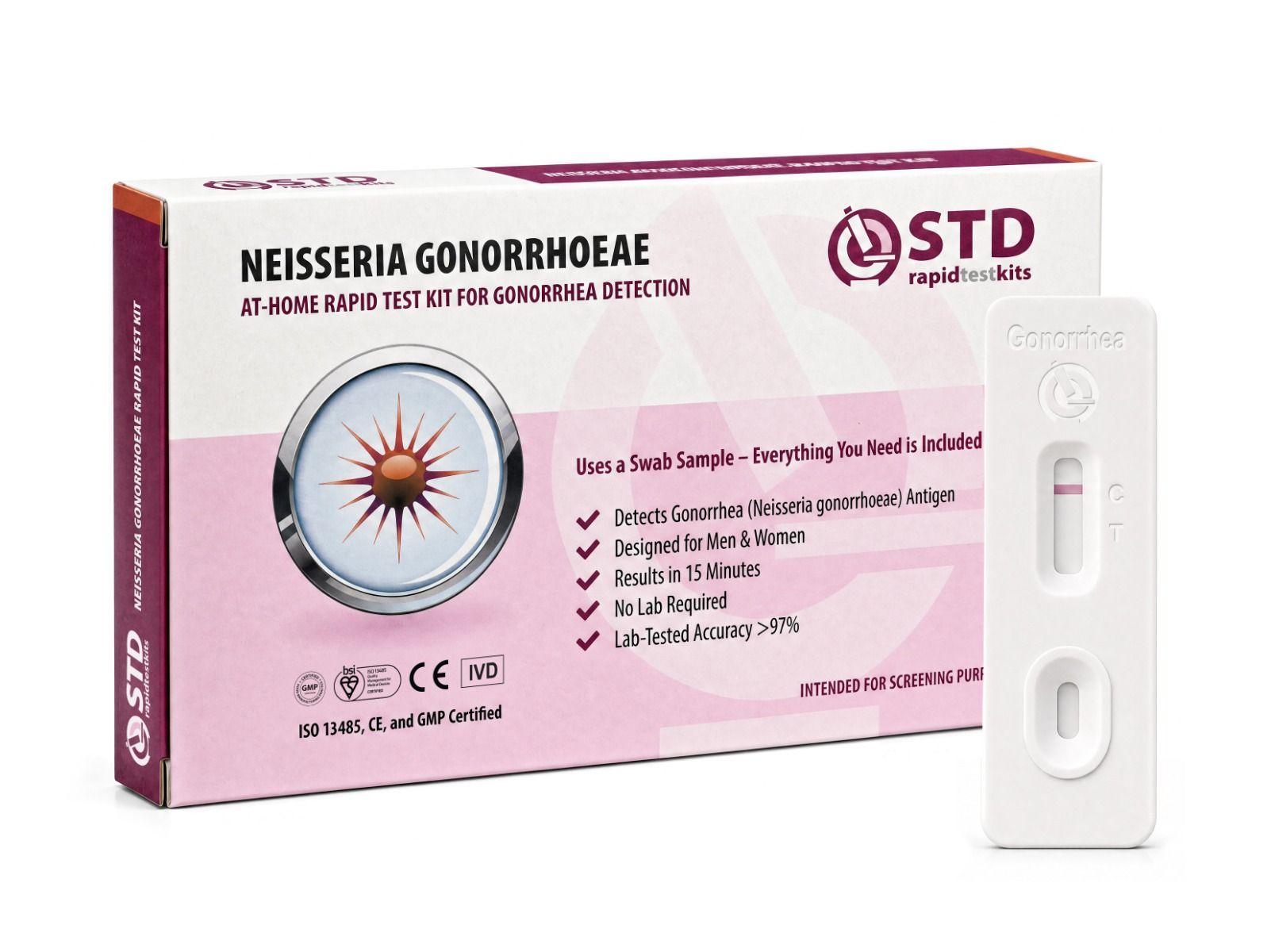
Stdrapidtestkits.com, the publisher of this article, sells at-home rapid gonorrhea swab tests; they are a useful screening and retesting tool, though they cannot detect resistance markers.
| Test type | Detects infection | Detects ceftriaxone resistance | Typical setting |
|---|---|---|---|
| NAAT (PCR-based) | Yes, high sensitivity | No | Clinical lab, telehealth, some home kits |
| Rapid lateral-flow test | Yes, moderate sensitivity | No | At-home, point-of-care |
| Culture and susceptibility testing | Yes, definitive | Yes | Hospital lab, public-health lab |
| Molecular resistance assay | Yes | Detects specific mutations | Reference and surveillance labs |
What happens if treatment doesn't work
Repeat treatment failures are an increasingly familiar pattern in clinical practice. Someone is treated for gonorrhea, the discomfort returns, they get a second dose, and symptoms still do not clear. When the provider eventually sends a sample for genotyping, resistance markers show up. That sequence (treat, fail, retreat, fail, genotype) plays out across countries each year as resistance spreads.
When antibiotics do not work, most people first assume they did something wrong. Maybe they missed a dose. Maybe a partner was not treated and reinfection happened. Sometimes that is genuinely the case. But increasingly the cause is a resistant strain that needs a different drug, a longer course, or even combination therapy. The WHO's framework encourages countries to make those second-line options easier to access, with clear protocols clinicians can follow when the standard regimen fails.
Until those systems are fully built, many patients get caught in a loop: treat, wait, hope, repeat. That is especially hard when stigma keeps people from speaking up, or when providers have not received updated training on how to recognize resistance failure. If you are reading this because something is not adding up (your symptoms are not gone, your partner's result does not match yours, or your gut is telling you this is not normal), you are not overreacting. You may be facing something the global health community is just beginning to track at scale.
When to suspect resistance vs reinfection
- Resistance is more likely if you completed the full prescribed course, partners were treated at the same time, no new exposures since, and symptoms still persist.
- Reinfection is more likely if a partner was untreated, treatment was incomplete, or new exposures happened during the recovery window.
- A negative rapid test plus persistent symptoms is its own category; repeat testing at the correct window, or switch to a NAAT, before assuming the kit was wrong.
- Either way, ask your provider whether resistance testing or a culture with susceptibility panel is appropriate before a third round of empiric antibiotics.
When standard treatment fails: what comes next
If you completed a course of ceftriaxone and your symptoms have not resolved within 7 to 14 days, that is reason to retest. The same is true if you are asymptomatic but a partner has signaled possible exposure or has tested positive after a treatment they thought worked. Persistent symptoms after standard treatment can mean three things: the original infection was never fully cleared (suggesting a resistant strain), you have been reinfected from an untreated partner, or you have a different condition (a urinary tract infection, a vaginal microbiome shift, or a non-STI cause) producing similar symptoms. The only way to sort these apart is a fresh test and, ideally, a clinical evaluation.
Where access permits, request culture-based susceptibility testing on a fresh sample. Many sexual-health clinics, especially in the UK, Australia, and parts of Europe, will perform culture as standard practice when treatment failure is suspected. The UK's NHS gonorrhoea guidance describes the standard single-dose antibiotic treatment and emphasizes follow-up testing as the recommended way to confirm clearance. In the United States, GISP-affiliated clinics and academic medical centers can usually arrange culture. Treatment for confirmed resistant strains typically moves to combination therapy, most commonly gentamicin (an injectable aminoglycoside) plus oral azithromycin or doxycycline. Spectinomycin is used in some countries but has limited availability in North America. Combination regimens carry more side effects than single-dose ceftriaxone and require more rigorous follow-up testing.
If you tested at home and the result is positive after standard treatment, bring that result to a clinical provider rather than redosing on your own. Buying additional doses of cephalosporins or self-medicating from international online pharmacies risks both adverse effects and a contribution to broader resistance.
- Wait at least 7 days (clinic NAAT) or 14 days (at-home rapid lateral-flow) before retesting; earlier than that, residual dead-bacterial DNA can produce a false positive.
- Document your symptoms in writing: when they started, how they feel now, and whether anything shifted after the treatment dose.
- If symptoms remain at day 7 and match the original infection, request culture-based susceptibility testing through a sexual-health clinic or your primary-care provider.
- If symptoms began fresh after a new partner exposure, you may have been reinfected rather than dealing with resistance, though the diagnostic workup is similar.
How resistance spreads across borders
Two factors drive the geographic spread of ceftriaxone-resistant gonorrhea: human mobility and asymptomatic carriage. Tourism, business travel, dating-app meetups in new cities, and sexual networks that cross national borders all carry the bacterium from places with rising resistance to places with little. A single FC428 import can seed a local cluster if it spreads within a sexual network before being caught. That does not happen routinely because most clinics in low-resistance countries assume their treatment works and do not perform culture confirmation; an asymptomatic resistant case can circulate for months in such an environment.
Asymptomatic carriage compounds the problem. Per CDC STI treatment guidelines for gonococcal infection in adults, asymptomatic infection is common in women's genital infections and in pharyngeal infections from oral sex. CDC and WHO clinical guidelines also note reduced efficacy of ceftriaxone in pharyngeal infections, which helps explain why throat-site infections are over-represented in cases of ceftriaxone treatment failure.
Routine throat-swab testing for sexually active people with new partners catches infections that genital-site testing alone would miss. Pharyngeal gonorrhea responds less reliably to ceftriaxone than genital infections do, so an undetected throat infection in someone treated only for a genital diagnosis can become a silent transmission source. Ask your clinician about pharyngeal swabbing if oral sex is part of your sexual history.
Talking to partners when standard treatment fails
If your treatment did not work, your partners need to know, both the recent ones and the ones who were in the same window of exposure. The conversation is harder than a standard STI notification because the message is not simply that you had gonorrhea and they should test. It is that you had gonorrhea, that standard treatment did not clear it, and that you would like them to test and to mention possible resistance to whoever treats them. That extra detail matters because it changes the kind of follow-up their clinician should order.
What works in these conversations is concrete and brief. State the diagnosis. State that standard treatment did not clear it. Recommend they test. Recommend they mention possible resistance to whoever treats them. Avoid framing the message as blame or contagion drama; this is a clinical update. If a direct conversation feels too high-stakes, anonymous partner-notification services (run by public-health departments in the United States, the UK, and parts of Europe) will deliver a notice on your behalf.
For partners who would prefer to test at home before deciding whether to visit a clinic, a rapid swab kit removes the friction of booking an appointment. A negative result still warrants follow-up culture if symptoms appear later, but a positive result gives them concrete information to bring to their provider. Disclosure conversations don't have to carry blame; they are a clinical update that protects everyone involved.
Currently, just one regimen is recommended as first-line treatment for gonorrhea: a single 500 mg dose of the injectable cephalosporin, ceftriaxone.

From resistance data to your next step
Drug-resistant STIs make headlines because fear gets clicks. Fear is not useful if it freezes you. The WHO's plan is built around calm, coordinated action: prevent infection where possible, detect resistance early, adjust treatment quickly, and support people while the system does its work. The European Centre for Disease Prevention and Control describes the situation as a rising threat to treatment efficacy across the EU/EEA region and calls for enhanced surveillance and clinical vigilance.
Think of resistance like a storm system moving across a map. You cannot stop the weather, but you can build stronger roofs, better drainage, and smarter evacuation plans. Health systems are updating their storm plans right now. In the meantime, individual choices still matter: testing after exposure, finishing the prescribed treatment, retesting when advised, and seeking help when something feels off.
If you are in the middle of uncertainty, testing again may be the most stabilizing first step. A discreet kit delivered to your door can give you direction while you sort out the next move. Used thoughtfully, at-home STI test kits are part of the global safety net the WHO is asking countries to expand.

You deserve answers, not guesswork
If there is one message inside the WHO's resistance framework, it is this: no one should feel lost after doing everything correctly. Testing, treatment, and follow-up should add clarity, not confusion. When results do not behave the way they should, that is a system signal, not a personal failure.
The next step might be a retest, a conversation with a partner, or scheduling a confirmatory clinic visit instead of waiting it out. Whatever it is, you do not have to navigate it alone. Retesting with a rapid kit and bringing the result to a provider is a reasonable first move when the picture is unclear.
- Retest at the right window. Wait at least 7 days after treatment for a clinic NAAT, or 14 days for an at-home rapid lateral-flow test. Earlier testing risks a false positive from residual DNA.
- Bring the result to a clinician. If you remain positive, ask whether culture-based susceptibility testing is available locally, or whether a referral to a sexual-health clinic is warranted.
- Notify partners. Share the diagnosis, the fact that standard treatment did not clear it, and the recommendation to mention possible resistance to whoever treats them. Anonymous notification services exist if a direct conversation feels too high-stakes.
Frequently asked questions
- What does WHO's 5 percent threshold mean?
- At 5 percent regional resistance, a clinician prescribing standard-dose ceftriaxone without lab confirmation will statistically fail 1 patient in 20. That is the trigger for WHO to call for updated treatment guidelines, expanded surveillance, or a switch to second-line therapy. It is a population-level signal for public-health action, not a personal-risk figure for any individual patient.
- Which countries have the highest documented ceftriaxone resistance?
- East and Southeast Asia, particularly China, Japan, and Cambodia, carry the highest documented burden of ceftriaxone-resistant gonorrhea. Most confirmed cases outside that region have been travel-associated. FC428 strains are typically imported rather than locally established in North America and Western Europe, so recent travel to high-resistance regions is a key factor clinicians consider when treatment failure is suspected.
- Can a drug-resistant STI just go away on its own?
- Not likely. These infections do not respond to time or hope alone, they respond to the right antibiotic. When standard treatment does not work, the bacteria has not packed up and left; it is still in the body, often still transmissible to partners. The fix is identifying the resistance pattern and switching to a regimen the strain has not learned to dodge.
- How do I know if it's resistance or reinfection?
- The difference is hard to tell from the outside. If you completed treatment correctly, your partners were treated, and you have not had new exposures since, persistent positive results lean toward resistance. If a partner was not treated, treatment was incomplete, or new exposures happened during the window, reinfection is more likely. The only way to be sure is retesting, ideally with a method that supports susceptibility testing if resistance is suspected.
- Can at-home rapid tests detect resistant strains?
- No. At-home rapid swab tests and standard NAATs answer whether you have gonorrhea, not whether the strain will respond to ceftriaxone. Resistance testing requires culture-based susceptibility testing in a hospital or public-health lab, or specialized molecular resistance assays available only at reference labs. Knowing you have gonorrhea is still valuable; it lets you start treatment and notify partners. If symptoms persist after standard treatment, that is the signal to request culture-based testing through a clinician.
- How long should I wait before retesting after treatment?
- Seven days minimum for a clinic NAAT, 14 days for a rapid at-home lateral-flow test. Earlier than that and residual dead-bacterial DNA can trigger a false positive. CDC guidance also recommends a separate retest around three months after treatment for chlamydia, gonorrhea, and trichomoniasis to catch reinfection (<a href="https://www.cdc.gov/std/treatment-guidelines/" target="_blank" rel="noopener noreferrer">CDC STI treatment guidelines</a>). If the early retest is still positive, request culture-based susceptibility testing on a fresh sample.
- How often should sexually active travelers test?
- For people having sex with new or multiple partners while traveling, especially in regions with documented ceftriaxone resistance, the CDC and most national guidelines recommend testing every 3 to 6 months. Test more often if you have new partners between scheduled tests or if you develop symptoms. Asymptomatic carriage is common, so the absence of symptoms is not the absence of infection.
- What backup treatments exist if ceftriaxone fails?
- The most common second-line regimen is gentamicin (an injectable aminoglycoside) combined with oral azithromycin or doxycycline. Spectinomycin is used in some countries where it remains available. These regimens have more side effects than single-dose ceftriaxone and require more rigorous follow-up testing. New antibiotics for gonorrhea are in development, but most are still in clinical trials or awaiting regulatory approval.
- Is resistant gonorrhea curable?
- Yes, in nearly all cases. Even strains resistant to ceftriaxone respond to combination therapy with gentamicin plus azithromycin or related regimens. The complication is that diagnosing resistance is slower (it requires culture), the backup treatments have more side effects, and partner notification becomes more important. Catching resistance earlier through prompt retesting if symptoms persist makes the treatment course shorter and easier.
Our article was constructed based on current advice from the most prominent public health and medical organizations (WHO, CDC, ECDC, UKHSA, NHS), the published surveillance literature on ceftriaxone-resistant gonorrhea and the FC428 lineage, and current clinical treatment guidelines. We synthesize these sources into plain-English explanations and do not provide individual diagnosis. Where specific numbers, time windows, or guideline statements appear, the inline links go to the public-health source that supports the claim. If your symptoms or results do not match what is described here, please follow up with a licensed provider.
- World Health Organization. Integrated drug resistance action framework for HIV, hepatitis B and C and STIs, 2026 to 2030. Used for the five strategic domains and the framework's emphasis on integrated surveillance and stigma-free care.
- U.S. Centers for Disease Control and Prevention. Drug-resistant gonorrhea, healthcare provider page. Used for ceftriaxone first-line guidance, U.S. cephalosporin treatment-failure status, GISP surveillance description, and the pull-quote on first-line treatment.
- U.S. Centers for Disease Control and Prevention. Sexually transmitted infections treatment guidelines, gonococcal infections in adults. Used for the recommendation to retest at three months for chlamydia, gonorrhea, and trichomoniasis, asymptomatic-carriage framing, and traveler testing cadence.
- World Health Organization. Multi-drug resistant gonorrhoea fact sheet. Used for EGASP surveillance findings on ciprofloxacin, azithromycin, and ceftriaxone susceptibility, and for the bacterium's history of resistance to every antibiotic class used against it over the past 80 years.
- European Centre for Disease Prevention and Control. Antimicrobial resistance in gonorrhoea: rising threat to treatment efficacy. Used for the EU/EEA regional surveillance framing.
- UK National Health Service. Gonorrhoea overview. Used for the standard single-dose antibiotic treatment in the UK and the emphasis on follow-up testing to confirm clearance.