Published: August 2025 | Last updated: May 2026 | Editorial review and quality control: Martina N.
About 13% of people living with HIV in the United States don't know they have it (HIV.gov U.S. statistics). That's roughly one in eight Americans with the virus walking around without a diagnosis. The gap exists because HIV's first symptoms feel like a passing flu and disappear within weeks, and the years that follow can feel completely normal even as the virus keeps replicating.
This article walks through how that happens: why the body's first response to HIV looks like a passing viral illness, why the next decade can feel uneventful, and why the only reliable way to know your status is a test taken on the right timeline. By the end you'll know which test windows actually catch the virus, what "undetectable" means for transmission today, and how to get clarity without a clinic appointment.
Key Takeaways
- About 1 in 8 people with HIV in the United States don't know they have it. The early flu-like symptoms usually disappear within a week or two.
- Without treatment, HIV typically advances to AIDS in about 10 years while it silently weakens the immune system. Testing on the correct timeline is the only reliable way to catch it early.
That week-long "flu" could have been HIV
In the earliest stage, what clinicians call acute HIV infection, your body reacts to the virus the way it reacts to any new invader. Roughly 2 to 4 weeks after exposure, about two-thirds of people develop a constellation of symptoms that HIV.gov describes as flu-like: fever, fatigue, swollen lymph nodes in the neck or groin, sore throat, muscle aches, and chills. A flat pinkish rash on the chest, torso, or arms is common. Mouth ulcers, night sweats, and nausea round out the picture for some people.
The trap is the timing. These symptoms typically last between a few days and two or three weeks, then resolve on their own. By the time you're back at your desk, back at the gym, back to a normal week, the urgency to investigate has dissolved with the symptoms. The virus, of course, hasn't gone anywhere. It has finished an explosive first round of replication, seeded reservoir tissue throughout the body, and settled into the long quiet stage that follows.
What makes acute HIV especially easy to misread is that nothing about it points at HIV specifically. Mononucleosis looks similar. So does seasonal flu, COVID-19, strep throat, and a half-dozen other ordinary viral infections. The clinical name for the package is seroconversion syndrome, the body's first measurable antibody response to the virus. But unless someone is consciously thinking about a recent sexual exposure, the experience just registers as "I got sick that week."
About a third of people don't notice anything at all during acute HIV. They never had a fever to remember. For them, the latency stage that follows feels like an ordinary year, then another, until something far more serious shows up.
Onset: 2 to 4 weeks after exposure (about two-thirds of people).
Common: fever, fatigue, swollen lymph nodes (neck or groin), sore throat, muscle aches, chills.
Sometimes: flat pinkish rash on the chest or torso, mouth ulcers, night sweats, nausea.
Duration: a few days to two or three weeks, then symptoms resolve on their own. About one in three people notice nothing at all.
How HIV slips into hiding
After the acute phase ends, HIV enters what the National Institutes of Health calls clinical latency. The virus is still active. It's still replicating, mostly in lymph tissue. It's still slowly killing CD4 T-cells, the immune system's coordinators. The pace is slow enough, though, that the body keeps up appearances. You feel fine. You look fine. Your routine lab work, if no one orders an HIV test specifically, comes back unremarkable.
Without treatment, clinical latency usually lasts about 10 years or longer before CD4 counts fall low enough to define AIDS, the late-stage syndrome where the immune system can no longer protect against ordinary infections. Some people stay in latency longer; a smaller group, called rapid progressors, gets there in 2 to 5 years. Either way, the years in between are when the virus does its damage to the immune system, and when most onward transmission happens, because most people transmit when they don't know they are positive.
This is the structural difference between HIV and the STIs people associate with obvious symptoms. Chlamydia and gonorrhea are also frequently asymptomatic, but when they do speak up, they speak loudly: painful urination, unusual discharge, pelvic pain. Genital herpes leaves visible sores. Primary syphilis leaves a painless but visible chancre. HIV doesn't bother with that kind of theater. It opens with a nondescript flu and follows up with years of silence; both stages work in the virus's favor.
Globally, more than 40 million people are currently living with HIV per WHO end-of-2024 data. In the US, the figure is roughly 1.2 million, and the gap between people who have HIV and people who know it is the central reason new infections keep happening at the rate they do.
| Infection | Symptom pattern | Typical presentation |
|---|---|---|
| HIV | Brief flu-like illness, then long silence | Fever and swollen lymph nodes for a few days, then years of feeling normal |
| Chlamydia | Often silent, can be loud | Painful urination, unusual discharge, pelvic pain when symptoms appear |
| Gonorrhea | Often silent, can be loud | Painful urination, discharge, pelvic pain when symptoms appear |
| Genital herpes | Visible sores | Painful blisters or ulcers in the genital area, usually recurring |
| Primary syphilis | Visible chancre | Single painless ulcer at the site of infection, lasts 3 to 6 weeks |
Why even clinicians miss it
One of the cruelest features of acute HIV is that nothing about it feels alarming. The body aches aren't sharp. The fatigue isn't disabling. The sore throat could be allergies. The symptoms feel ordinary, and ordinary feelings don't send anyone to urgent care.
Even when people do see a doctor during acute HIV, the diagnosis can get missed. Many primary-care providers don't take a sexual history unless directly prompted. If a patient doesn't fit an outdated mental picture of "HIV risk," the test may not be ordered at all. The CDC's response to this gap has been to recommend routine, opt-out HIV screening for everyone aged 13 to 64 at least once, regardless of perceived risk, with annual testing for anyone with new or multiple partners. The recommendation exists because clinicians, on average, do not ask.
The cost of missed acute HIV compounds. Viral load is at its absolute peak in the first weeks after infection, which makes a person significantly more contagious during the very window when they feel like they have a cold. Population-level modeling suggests that a meaningful share of new transmissions happen during this acute, undiagnosed window, before the body has even produced the antibodies most rapid tests look for.
The same gap shows up at the late end of the timeline. A substantial share of new US HIV diagnoses are already at stage 3 (AIDS) by the time the test happens. Most late diagnoses don't come from patients ignoring symptoms; they come from the patient, the partner, and often the clinic each taking years to think about HIV at all.
Some people have flu-like symptoms within 2 to 4 weeks after infection, but other people may not feel sick or notice any symptoms during this stage. Flu-like symptoms can include fever, chills, rash, night sweats, and muscle aches. These symptoms can last a few days to several weeks.
How long can HIV go undetected?
Without treatment, HIV typically stays in clinical latency for about 10 years before the immune system declines to AIDS, and some people remain in latency longer. About 13% of people with HIV in the US don't know their status. The early flu-like symptoms last only days to weeks and disappear on their own, which is why testing on a schedule, not by symptoms, is the only reliable way to catch HIV early.
The window period: when home tests can actually catch HIV
The "window period" is the time between exposure and when a test can reliably detect HIV. Test too early and you can get a negative result while the virus is multiplying in your blood. Different test technologies have different windows, and that difference matters when you are choosing between a clinic visit and a home test.
Antibody tests look for the antibodies your body makes in response to HIV. They are the technology behind most home rapid tests, including finger-prick and oral-fluid kits. Per the CDC, antibody tests can usually detect HIV 23 to 90 days after exposure. A negative result before 23 days is essentially uninformative; a negative result at 90 days is reliable for the great majority of people.
Antigen/antibody tests, also called fourth-generation or "combo" tests, look for both antibodies and a viral protein called p24. They are the standard at most clinics and labs in the US. The window for a lab-drawn antigen/antibody test is roughly 18 to 45 days; a finger-prick rapid version exists with a slightly longer window of 18 to 90 days.
Nucleic acid tests (NATs), also called HIV RNA tests, look for the virus itself rather than the antibody response. NATs can detect HIV as early as 10 to 33 days after exposure. They are the most sensitive option, but they are more expensive, less available, and reserved for situations where early detection matters most, like a recent high-risk exposure or symptoms of acute HIV.
The practical takeaway: if you are testing because of a specific exposure, note the date. A finger-prick antibody test taken at week six gives you useful information; the same test at week one does not. If the first test is negative and you are still inside the antibody window, plan a follow-up at three months for a definitive result. A reactive (positive) result on any of these tests should be confirmed with a follow-up lab test before treatment decisions.
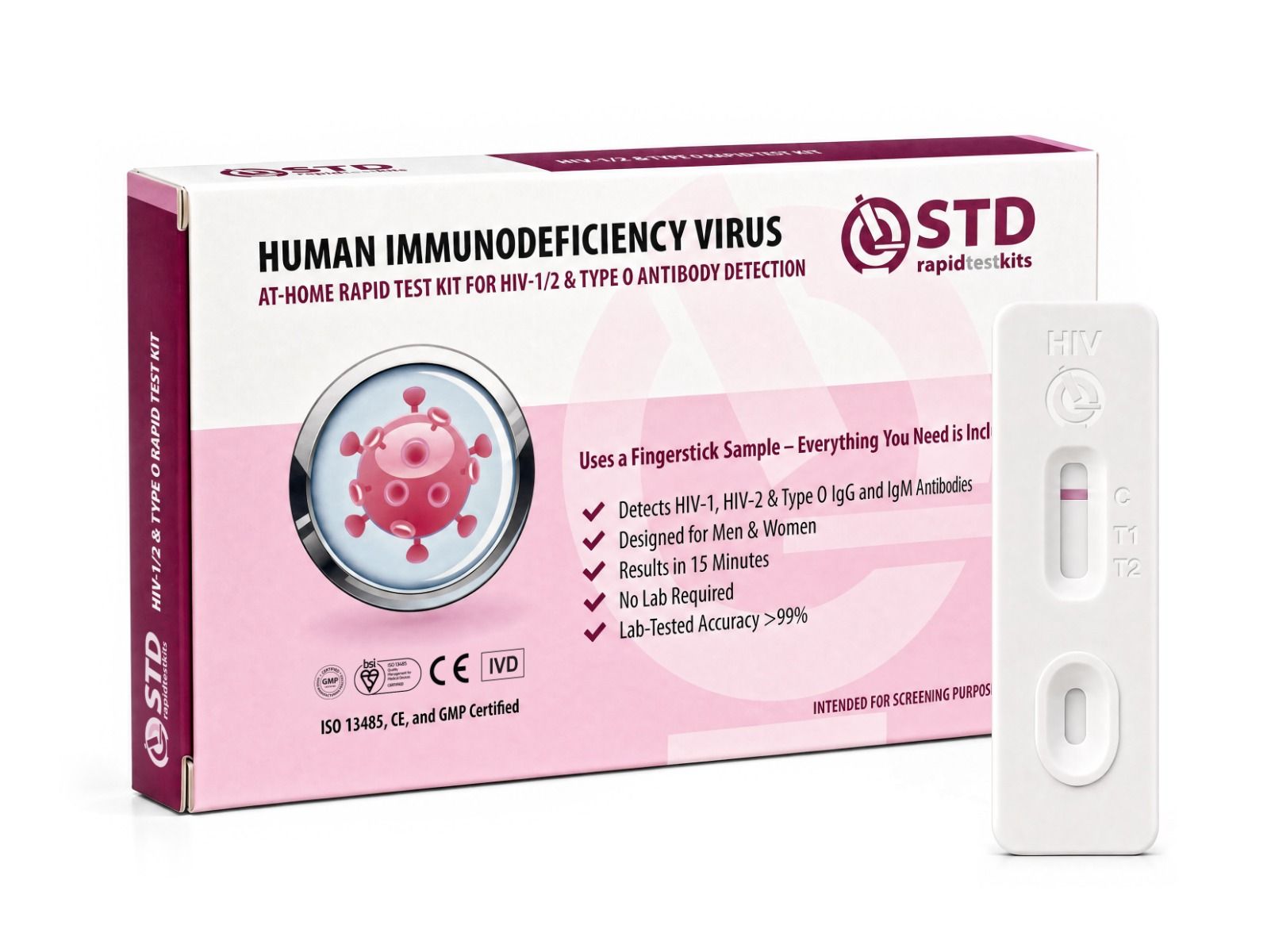
This article is published by stdrapidtestkits.com, which sells at-home STI testing kits. We recommend products based on fit-for-purpose for the reader's concern, not commercial benefit. The kit below is from our own catalog.
What an HIV diagnosis looks like in 2026
HIV care is unrecognizable from the HIV care of the 1990s. The standard treatment, called antiretroviral therapy or ART, is a once-daily combination pill, sometimes a long-acting injection, that suppresses the virus to undetectable levels in the blood within a few months for most people. Once the viral load is undetectable and stays there, the immune system stabilizes and gradually rebuilds.
The single most important sentence in modern HIV medicine is Undetectable equals Untransmittable, often shortened to U=U. The principle, summarized by UNAIDS, reflects more than a decade of evidence including the PARTNER and Opposites Attract studies, which followed thousands of mixed-status couples through tens of thousands of condomless sex acts and recorded zero linked transmissions when the partner with HIV was virally suppressed.
That changes the practical reality of an HIV diagnosis. People on treatment can have sex without passing the virus on. They can date, marry, conceive, and parent without HIV defining any of it. Life expectancy with effective ART approaches the population average; the people who lose the most years to HIV today are the people who were diagnosed too late, after the immune system was already badly damaged.
According to HIV.gov surveillance data, about 65% of Americans diagnosed with HIV are virally suppressed. That number has been climbing for a decade. The gap between diagnosis and suppression has shrunk because the medications got better and the side effects got smaller, and because clinics and community programs got more practiced at linking people to care quickly. Diagnosis is no longer the end of anything. It is the start of treatment that, for most people, will keep the virus from progressing at all.
People on effective antiretroviral therapy who maintain an undetectable viral load for at least six months cannot transmit HIV through sex. The PARTNER and Opposites Attract studies followed thousands of mixed-status couples through tens of thousands of condomless sex acts and recorded zero linked sexual transmissions from a virally suppressed partner.
How to test without leaving home
Home HIV testing has gotten meaningfully better in the last decade. The two FDA-cleared formats most common in the US are the oral-fluid antibody test, which uses a swab of the gums, and the finger-prick blood antibody test, which uses a single drop of capillary blood on a test strip or cassette. Both give a result in roughly 15 to 20 minutes.
Finger-prick blood tests are generally more sensitive than oral-fluid tests, which means they detect antibodies a few days earlier in the window period. If you are choosing between formats and you have any flexibility, the blood version is the stronger screening choice, especially within the first three months after a possible exposure.
Two practical caveats are worth stating clearly. First, every home rapid test is a screening test, not a final diagnosis. A non-reactive result on the correct timeline is reliable. A reactive result must be confirmed with a follow-up lab test, because rapid tests can occasionally produce false positives. Most kit instructions say this explicitly. Second, home rapid tests are antibody-based, which means the window-period rules above apply. A negative result two days after exposure does not mean you are in the clear.
For people with a recent encounter who are worried about more than HIV, a single-infection HIV test isn't always the right starting point. Combination panels that include HIV alongside syphilis, hepatitis B, hepatitis C, chlamydia, gonorrhea, and herpes give a fuller picture of one of the windows where most STI exposures concentrate, and they reduce the chance of missing something else that the same risk event could have caused. Several formats are available; the right one depends on what's been on your mind. Whichever you pick, the gain is the same: information you can act on, without a clinic appointment and without explaining your situation to anyone you don't want to.

If a single risk event could plausibly have spread more than one infection (a new partner whose status you don't know, a condom break, an exposure event you'd rather not parse out one infection at a time), a combination panel covers more of the testing window in one go. The 7-in-1 kit below covers HIV, syphilis, hepatitis B, hepatitis C, chlamydia, gonorrhea, and herpes.

Stigma is the longer infection
The medical case for testing is straightforward. What keeps testing rates lower than they should be is something else: four decades into the HIV era, stigma is still the longer-lasting infection. People delay testing because they are afraid of what a positive result will mean for how others see them. They delay because they have absorbed the cultural script that HIV happens to "those people" and they are not "those people," whoever that is supposed to mean. They delay because asking a doctor for an HIV test still feels, to many people, like admitting to something.
The result is measurable. The CDC notes that HIV stigma, alongside discrimination and limited access to high-quality care, drives ongoing inequities in diagnosis and outcomes; peer-reviewed work in The Lancet HIV has documented similar patterns, with internalized stigma correlating with later testing and lower treatment adherence.
None of that is the patient's fault, but the cost still falls on the patient. Untreated HIV does the same thing to a CD4 count whether the person was avoiding testing because of fear, shame, or a general sense of being fine. The way out, both individually and as a community, is to make HIV testing routine instead of fraught. The same way a cholesterol panel does not mean someone has a heart attack coming, an HIV test does not mean someone has done something wrong. It is information about a body that all of us have, in a context that all of us live in.
HIV needs only one unprotected exposure event with a person who has detectable virus; relationship structure, fitness level, and partner gender are irrelevant to that math. Most of what we say about HIV beyond that biology is stigma talking.
Your next step
If you are reading this because something happened, recently or years ago, and you have been carrying that uncertainty, the only thing that resolves it is a test on the right timeline. If the exposure is recent, note the date. Plan a finger-prick antibody test at week six if you cannot wait, and a definitive test at the three-month mark either way. If you are coming up on a year of "I never got around to it," start now: any negative result on a current test is a meaningful piece of information.
If you have been in a stable relationship for years and have never been tested, the CDC's once-in-your-life screening recommendation applies to you too. Most STI screening programs include HIV by default. Your primary-care provider may not bring it up; you can.
If a home test comes back reactive, the next step is the same regardless of how the result lands emotionally. A reactive home test gets confirmed at a clinic. Treatment starts the same week, sometimes the same day, in most US care settings. The decade-long gap between exposure and AIDS that the rest of this article describes is the gap that treatment closes. Earlier testing buys back that time, both for the person who tests and for whoever they tell.
Testing on a schedule closes the gap that HIV depends on. Waiting for symptoms doesn't, because the symptoms either look like every other viral illness or never appear at all. The fix in 2026 is both structural and personal: routine screening regardless of perceived risk, plus a test six weeks and three months after any specific exposure event.
FAQs
- Can HIV really go undetected for years?
- Yes. After a brief flu-like illness in the first few weeks, HIV usually enters clinical latency, a stage that lasts about 10 years on average without treatment and longer for some people. About 13% of people with HIV in the US, roughly one in eight, don't know they have it. Without testing, the diagnosis often comes only after the immune system is already badly damaged.
- What does early HIV feel like?
- Early or acute HIV typically feels like a moderate flu: fever, fatigue, swollen lymph nodes, sore throat, headache, body aches, and sometimes a flat pinkish rash on the chest or torso. Symptoms usually start 2 to 4 weeks after exposure and resolve within a few days to two or three weeks.
- What's the difference between HIV and AIDS?
- HIV is the virus. AIDS (stage 3 HIV) is the late-stage syndrome that can develop after years of untreated HIV when the CD4 T-cell count falls below 200 cells per cubic millimeter or when an AIDS-defining infection appears. With effective antiretroviral therapy started early, most people with HIV never develop AIDS.
- Can I test positive for HIV with no symptoms at all?
- Yes. Roughly a third of people never notice symptoms during acute HIV, and almost everyone is asymptomatic during the years of clinical latency that follow. A positive test result without symptoms is common, which is why screening doesn't depend on how you feel.
- What's the window period for an at-home rapid HIV test?
- Home rapid tests are antibody tests. The CDC's stated window for antibody tests is 23 to 90 days after exposure. A negative result before 23 days is generally not informative; a negative result at three months is reliable for nearly everyone. If you tested early and were negative, retest at the 90-day mark to confirm.
- Do early HIV symptoms come and go?
- The early flu-like symptoms come and then go, typically within a couple of weeks, and most people feel normal again afterward. The symptoms don't keep cycling; they fade and don't return until much later, when advanced disease shows up as opportunistic infections, weight loss, persistent diarrhea, or shingles.
- Can people with HIV today live a normal life?
- With effective antiretroviral therapy started early, life expectancy approaches the population average. People on treatment whose viral load has been undetectable for at least six months cannot sexually transmit HIV (the U=U principle). The decisive factor is starting treatment before the immune system is significantly damaged, which is why early testing matters.
- HIV.gov (U.S. Department of Health and Human Services). Symptoms of HIV, including timing of acute infection and the share of people with flu-like symptoms.
- U.S. Centers for Disease Control and Prevention. HIV testing recommendations and window periods for antibody, antigen/antibody, and nucleic acid tests.
- U.S. Centers for Disease Control and Prevention. HIV facts and statistics, including stigma and structural barriers to diagnosis and care.
- HIV.gov (U.S. Department of Health and Human Services). U.S. statistics on prevalence, undiagnosed share, and viral suppression rates.
- UNAIDS. Undetectable equals Untransmittable: the evidence base from PARTNER and Opposites Attract studies.
- U.S. National Institutes of Health (HIVinfo). Stages of HIV infection: acute, clinical latency, and AIDS, including expected timeline without treatment.
- World Health Organization. HIV/AIDS fact sheet, including global prevalence (40.8 million people living with HIV at end of 2024).
