
Published: October 2025 | Last updated: May 2026 | Editorial review and quality control: Martina N.
Trichomoniasis is the most common curable sexually transmitted infection in the world, and in men it almost never announces itself with burning, discharge, or itching. The infection settles quietly into the urethra, lives there for weeks or months, and often only gets discovered after a partner develops symptoms and gets tested.
That silence is not a small detail. It is the central reason this parasite keeps moving between partners year after year. If you found this article while trying to figure out whether you might be carrying it without knowing, this guide will walk you through what the science actually says, why the male body behaves the way it does, and the testing options that make sense for men specifically.
Key Takeaways
- About 70% of people infected with Trichomonas vaginalis develop no symptoms, and men are more likely to be asymptomatic than women, according to the Centers for Disease Control and Prevention.
- Feeling fine does not mean clear. An asymptomatic carrier can still transmit the infection during sex, so testing is the only reliable way to know whether the parasite is present.
The STD That Often Hides in Male Bodies
Trichomoniasis is caused by a microscopic single-celled parasite called Trichomonas vaginalis. It spreads through sexual contact, most commonly vaginal sex, and lives in the genital tract. In women the infection often produces noticeable symptoms like vaginal irritation, frothy discharge, or a strong odor.
In men, the picture is usually very different. The parasite typically settles in the urethra, the tube that carries urine and semen out of the body, and many men feel nothing at all while it lives there. According to the U.S. Centers for Disease Control and Prevention, only about 30% of people with trichomoniasis develop any symptoms, and the share is even lower in men.
When there is no discomfort, there is no obvious reason to get tested, which is why public-health agencies treat asymptomatic carriage as the central transmission engine for this infection rather than a side note.
The parasite lives in the male urethra but produces inflammation most noticeably in vaginal tissue. The vaginal environment supports faster multiplication and a stronger immune response, which is what generates the irritation, discharge, and odor that women report. In the male urethra, the same parasite often sits below the threshold of perceptible symptoms.
CDC estimates that more than 2 million people in the United States are currently infected at any given time, with the symptom burden concentrated heavily in women.
Why the Male Urethra Stays Quiet
There are a few biological reasons trichomoniasis behaves differently in male bodies. None of them relate to hygiene or sexual behavior. They are simply about anatomy and how the parasite survives.
The male urethra is a relatively small environment compared with the vaginal ecosystem. The parasite sometimes struggles to establish a long-term colony there. In some men the immune system clears the infection naturally within weeks. In others the parasite persists for months, settled in just deep enough to avoid being noticed.
Male tissue in the urethra also has fewer of the nerve endings that produce the classic irritation symptoms women report. When inflammation is mild, it may not register as anything worth thinking about. On top of that, individual immune responses vary widely. Two people exposed to the same parasite during the same encounter can have completely different experiences. One might feel a brief burning sensation after sex for a day or two. The other might never feel anything at all.

When Symptoms Do Show Up
Although most infected men never notice anything unusual, symptoms can occasionally appear. When they do, they tend to be mild and easy to dismiss as something else.
The most commonly reported signs include:
- Mild burning during or after urination
- Slight irritation inside the penis
- Thin clear or whitish discharge from the urethra
- Mild discomfort after ejaculation
- Occasional itching at the tip of the penis
Even these symptoms can be subtle. A man might assume it is temporary irritation from sex, dehydration, friction, or a passing urinary issue. Sometimes the discomfort appears for a day or two and disappears, which makes it even easier to ignore.
A temporary improvement does not necessarily mean the infection has cleared. In some cases the symptoms fade while the parasite remains present and continues to be transmissible.
How Often Are Men Asymptomatic?
Trichomoniasis is far more widespread than most people realize. The World Health Organization estimates roughly 156 million new trichomoniasis infections globally each year, making it the most common non-viral STI worldwide. In the United States, the CDC estimates more than 2 million people are currently infected at any given time.
What surprises many readers is how concentrated the symptom burden is in women. Estimates vary between studies, but a consistent pattern emerges across the literature: most infected men carry the parasite without obvious signs.
| Population | Estimated symptomatic share | Estimated asymptomatic share |
|---|---|---|
| Women | About 30 to 50 percent develop symptoms | Around half remain asymptomatic at any given time |
| Men | Roughly 10 to 30 percent develop symptoms | The majority remain symptom-free |
| Overall (per CDC) | About 30 percent develop symptoms | About 70 percent remain asymptomatic |
A Quiet Infection That Still Spreads
The absence of symptoms does not mean the infection is harmless or inactive. Even without discomfort, the parasite can still move from one partner to another during sex. The parasite spreads when genital fluids carry it into another person's genital tract, and the vaginal environment is much more hospitable for sustained inflammation than the male urethra.
This dynamic creates a pattern clinicians see frequently. A woman experiences symptoms, gets tested, and discovers the infection. Her partner feels completely normal but tests positive as well. That sequence is so common that some sexual-health providers informally describe trichomoniasis as a partner-discovery infection.
It is worth saying clearly: when this happens, it does not mean someone has been dishonest about a recent exposure. The parasite can persist quietly for weeks to months, so a partner's positive diagnosis today does not pinpoint when transmission occurred. Most people grow up hearing about STDs that cause obvious sores, discharge, or pain. Trichomoniasis often refuses to follow that script.
Most people who have trichomoniasis do not have any symptoms. When symptoms do appear, they can range from mild irritation to severe inflammation. Some people get symptoms within 5 to 28 days after getting the infection. Others do not develop symptoms until much later.
How Long Trichomoniasis Can Stay in a Man
One of the most confusing aspects of trichomoniasis is how unpredictable the timeline can be. In some men, the immune system clears the parasite naturally within several weeks. In others, the infection persists for months without ever producing noticeable symptoms.
Researchers have documented men who carried the parasite for many months before testing positive, often only after a partner was diagnosed. The full natural history is poorly defined in men because men are screened for trichomoniasis far less often than women. CDC notes that the symptom window after infection typically falls between 5 and 28 days, but the absence of symptoms during that window in a man does not rule out an established infection.
| Stage | What may happen | Likely experience |
|---|---|---|
| Initial exposure | Parasite enters the urethra during sexual contact | Usually no awareness anything has happened |
| Early infection (days to weeks) | Parasite begins multiplying in the genital tract | Often no symptoms; occasional mild urethral irritation |
| Established infection | Parasite continues living in the urethra | Most men remain symptom-free for the full duration |
| Transmission phase | Infection passes to a sexual partner during sex | Carrier still typically feels normal |
How Men Actually Get Tested
Testing for trichomoniasis in men is more limited than testing in women, and it is worth being honest about that upfront. The lab gold standard is a nucleic acid amplification test, often called a NAAT, which can detect the parasite's genetic material in a urine sample or a urethral swab. These molecular tests are highly sensitive, and a urine NAAT is the typical option for men at a sexual-health clinic or urgent-care visit.
Self-collected urine samples for trichomoniasis NAAT are available through some mail-in lab services. Rapid lateral-flow swab tests, the kind sold for at-home use, are designed and validated for vaginal swab samples in women and are not the right tool for screening men. If you are a man who wants to test specifically for trichomoniasis at home, the most accurate options at present are mail-in molecular kits that send a urine sample to a lab, or a clinic visit.
Our at-home trichomoniasis rapid kit is a self-collected vaginal swab and is validated for women only. We do not currently sell a male-compatible rapid test for trichomoniasis itself. If you are a man who specifically needs a trich result, the most accurate options are a clinic urine NAAT or a mail-in molecular kit.
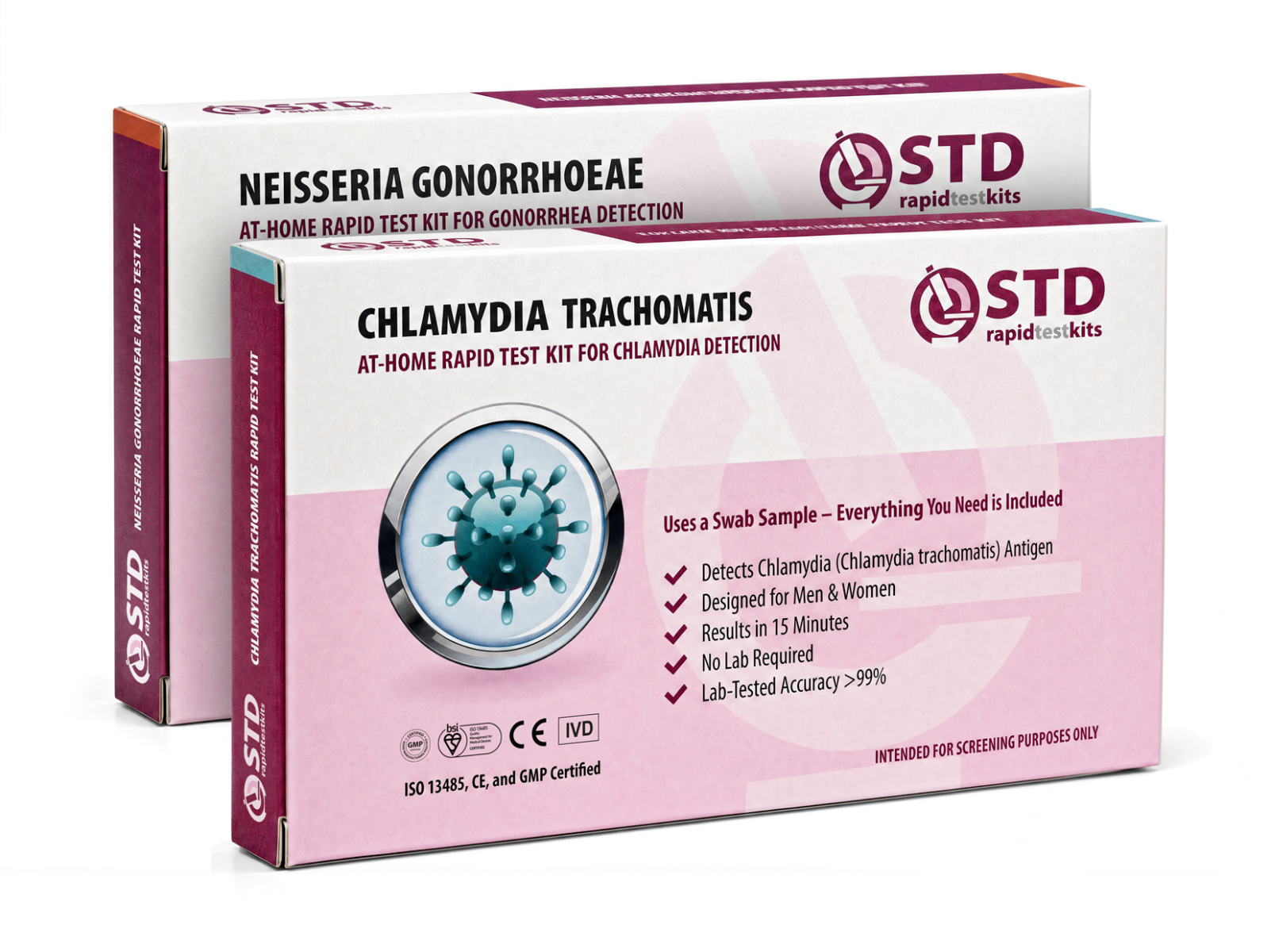
That said, when a partner is diagnosed with trichomoniasis, men are often co-infected with the more common bacterial STIs that we do test for at home. The combination kits below screen those infections at home and are validated for men and women.
At-Home Testing Versus Clinic Testing
For the STIs that men can test for at home, the at-home and clinic options each have real strengths. The right choice depends on what you are testing for, how comfortable you are with self-collection, how easily you can access medical care, and how much privacy matters to you.
| Testing route | How it works | Strengths | Considerations |
|---|---|---|---|
| Clinic NAAT (urine) | Urine sample analyzed in a medical laboratory | Highly sensitive, immediate access to follow-up care, valid trich result for men | Requires appointment or clinic visit; results in days |
| At-home rapid lateral-flow | Self-collected sample analyzed using a rapid cassette | Private, discreet, 15-minute result, no clinic visit | Lateral-flow kits screen at home; positives are worth confirming with a lab NAAT when possible |
| Mail-in molecular test | Sample collected at home and mailed to a partner lab | Lab-quality NAAT analysis with home convenience | Several-day turnaround, shipping logistics |
Why Privacy Drives So Many Testing Decisions
For many men, the biggest barrier to getting tested is not cost. It is the awkwardness of scheduling a visit, explaining the situation, and sitting in a waiting room. That barrier matters because it determines whether someone tests at all. A test that never happens cannot find an infection.
At-home testing exists precisely to remove that friction. For broader screening across multiple infections, a single combination kit can cover several common bacterial STIs in one go, which is useful because co-infection between trichomoniasis and other STIs is common. Researchers consistently find that people diagnosed with one STI are more likely to be carrying another.

What Happens If Trichomoniasis Goes Untreated
Because many men never notice symptoms, some infections remain untreated for long stretches of time. While trichomoniasis is generally less aggressive in men than in women, untreated infection still carries risks.
Research suggests the parasite may contribute to urethritis or, less commonly, prostatic inflammation in certain cases. Long-term low-grade inflammation can affect reproductive health over time, and a small but consistent body of evidence links untreated trichomoniasis to an increased risk of acquiring or transmitting HIV. The biological reason is straightforward: inflamed genital tissue is easier for viruses and bacteria to enter through. The CDC's 2021 STI treatment guidelines specifically flag this HIV-risk relationship as a reason to treat trichomoniasis in men and women alike.
The most immediate concern, though, is transmission. Even without symptoms, the parasite continues to move between partners as long as it is present.

Why Trichomoniasis Spreads So Easily Between Partners
One of the strange realities of trichomoniasis is that men often learn about it through someone else's symptoms. A partner notices irritation, unusual discharge, or discomfort, decides to get tested, and the diagnosis triggers a conversation that pulls everyone into testing.
This pattern is so consistent that it shapes how clinicians counsel patients. The person carrying the parasite may feel completely healthy while their partner experiences clear, sometimes uncomfortable symptoms. The difference is anatomy. The parasite thrives more easily in vaginal tissue than in the male urethra, multiplies faster there, and triggers the inflammation that becomes noticeable. In a male body the same parasite can live just below the threshold of perceptible irritation.
Understanding this helps reduce a lot of unnecessary suspicion in relationships. The presence of a silent infection does not automatically mean someone has been recently unfaithful or has been hiding symptoms. Trichomoniasis can persist quietly for months, and people can carry it through long stretches of a relationship without ever having had a moment where something felt wrong.
1. One partner (most often a woman) develops noticeable irritation, discharge, or odor and goes to a clinic.
2. The lab test confirms trichomoniasis.
3. The clinician asks her to notify recent sexual partners. Those partners are encouraged to test and to be treated at the same time even if they feel completely fine.
4. The asymptomatic carrier (often a male partner) tests positive, treats, and the cycle stops.
This sequence is so well-documented that CDC's STI treatment guidelines build expedited partner therapy directly into the recommended management of trichomoniasis. A silent positive in a partner is the expected outcome, not a red flag about the relationship.
Common Myths That Keep Men From Getting Tested
Because trichomoniasis does not get the same cultural attention as infections like chlamydia or herpes, misinformation spreads easily. Many men assume they would immediately notice something wrong if they were infected. That assumption is the single biggest reason silent infections continue to circulate.
| Common belief | What the evidence shows |
|---|---|
| If a man has trichomoniasis, he will definitely have symptoms. | Most infected men experience no symptoms at all. |
| You would notice discharge or irritation immediately. | Many men never develop visible discharge or irritation. |
| Trichomoniasis always clears on its own. | Some infections persist for months without treatment. |
| If you feel normal, you cannot pass it to someone else. | Asymptomatic men can still transmit the parasite during sex. |
| Condoms make trichomoniasis transmission impossible. | Condoms reduce risk substantially but do not eliminate it. |
Treatment Basics
Treatment for trichomoniasis is almost always straightforward once the infection is identified. The CDC's recommended first-line treatment is a course of metronidazole, an antibiotic that targets the parasite directly. Tinidazole is another effective option. For women, the current CDC guidance is a multi-day course of metronidazole rather than the older single-dose regimen, based on evidence that the multi-day course produces fewer treatment failures.
For men, a single dose of metronidazole is typically effective, though regimens may vary based on individual circumstances. Whatever the regimen, the most important practical step is that both partners get treated at the same time. If only one person takes antibiotics, the parasite can simply bounce back from the untreated partner the next time they have sex. Sexual-health providers consistently recommend:
- Testing and treating all current sexual partners
- Avoiding sexual contact until the full course of treatment is complete
- Avoiding alcohol during and for 24 to 72 hours after some regimens (per the medication's labelled precautions)
- Retesting at around three months if reinfection risk continues
Why Routine Screening Matters Even Without Symptoms
Many people assume STD testing is something you only do when something feels wrong. In practice, public-health experts recommend that sexually active adults test on a regular basis, especially when starting a new sexual relationship. The reason is exactly this category of infection: trichomoniasis, chlamydia, and gonorrhea often produce few or no symptoms in men, and routine screening is the only way to catch them.
Regular testing offers a few specific benefits. It catches infections before they spread to more partners. It removes the anxiety of guessing whether something is wrong. And it normalizes a conversation that many couples now have at the start of a relationship as a baseline expectation, on the same calendar as a routine physical or dental check-up.
Why the Global Burden Stays Under the Radar
Trichomoniasis affects far more people globally than gonorrhea or syphilis, with the WHO's most recent estimates putting new infections at roughly 156 million worldwide each year. Despite that scale, the infection receives less surveillance attention than other STIs. Part of the reason is that it is not a nationally notifiable disease in the United States, so case counts depend on opt-in studies rather than mandatory reporting.
Surveillance also undercounts men specifically because men are screened far less often than women in routine sexual-health visits. The result is a real-world prevalence picture that almost certainly underestimates how common asymptomatic male carriage actually is. For an individual reader, the practical implication is simple: the local statistics do not reflect the actual risk picture, and silent infections in male partners are a routine occurrence rather than a rare one.
Frequently Asked Questions
- Can a man really have trichomoniasis and feel completely nothing?
- Yes, and men are actually more likely than women to carry trichomoniasis without feeling a thing. The CDC puts total asymptomatic carriage across sexes at roughly 70%, with the rate skewing even higher in men. Urethral tissue generates far less noticeable inflammation than vaginal tissue under the same parasite load, which is why most men only discover the infection through a partner's diagnosis or a routine screen.
- If I had trichomoniasis, would I notice something when I urinate?
- Not necessarily. Some men do notice mild burning during or after urination, or a faint irritation after ejaculation. But many feel nothing at all. The discomfort can be subtle enough to blend into everyday sensations you would never connect to an infection.
- How do men usually find out they have it?
- Most find out because a partner gets symptoms first. A partner gets diagnosed at a clinic, and the partner-notification conversation leads both people to test. That sequence accounts for the majority of male trichomoniasis diagnoses in real-world clinical settings.
- Could I have been carrying it for months without knowing?
- Yes, it is possible. The natural history of trichomoniasis in men is not perfectly mapped because men are screened much less often than women, but documented cases include infections that persisted for many months before being diagnosed. Some clear naturally; others linger.
- Can I pass trichomoniasis to a partner even with zero symptoms?
- Yes. Feeling healthy does not stop the parasite from moving between partners during sex. From a transmission standpoint, an asymptomatic infection behaves like any other active infection.
- Is trichomoniasis serious for men?
- It is treatable and rarely causes long-term harm when addressed. The bigger concerns are transmission to partners and a documented association between untreated trichomoniasis and higher HIV acquisition risk, because genital inflammation makes other infections easier to acquire.
- Do men actually need treatment if they have no symptoms?
- Yes. CDC and WHO both recommend treating asymptomatic male partners of women diagnosed with trichomoniasis. A short course of antibiotics, usually metronidazole or tinidazole, clears the parasite and prevents reinfection ping-ponging between partners.
- Should I get tested if my partner tested positive, even though I feel fine?
- Yes. Partner testing and concurrent treatment is the standard recommendation. For men, a clinic urine NAAT is the most accurate test available for trichomoniasis itself. At-home rapid trichomoniasis kits are validated for female samples only, so a clinic visit or mail-in molecular kit is the right route for men.
You Deserve Clarity, Not Guesswork
Trichomoniasis has an unusual reputation in sexual health conversations. It is common, it is curable, and yet in men it routinely stays invisible. No pain, no itching, no obvious warning sign that something needs attention. That silence is exactly why so many people discover it by accident, after a partner tests positive or after a routine screening picks it up.
The goal is not to panic about every possible infection. The goal is clarity. When symptoms cannot be trusted as a warning system, testing becomes the simplest way to remove uncertainty for yourself and the people you care about. The right test depends on what specifically you need to rule out: a clinic urine NAAT covers trichomoniasis itself for men, and our at-home rapid combination kits cover the bacterial and blood-borne co-infections that often travel alongside it.
- U.S. Centers for Disease Control and Prevention. Trichomoniasis fact sheet, including symptom prevalence (about 30 percent of infected people develop symptoms) and the 5 to 28 day symptom-onset window.
- U.S. Centers for Disease Control and Prevention. 2021 Sexually Transmitted Infections Treatment Guidelines, trichomoniasis section, covering first-line metronidazole regimens for men and women, expedited partner therapy, and the HIV-risk relationship.
- World Health Organization. Sexually transmitted infections fact sheet, including global incidence estimates for trichomoniasis (approximately 156 million new cases per year).
- NHS. Trichomoniasis patient overview, covering symptoms in men and women, transmission, and treatment.
- U.S. Centers for Disease Control and Prevention. Sexually Transmitted Infections Surveillance overview, providing the national context for STI reporting and the limits of surveillance for non-notifiable infections like trichomoniasis.
- Cleveland Clinic. Trichomoniasis overview, covering causes, symptoms, provider-administered diagnosis, and antibiotic treatment with metronidazole or tinidazole.
