
Published: November 2025 | Last updated: May 2026 | Editorial review and quality control: Martina N.
Should I be tested for chlamydia while pregnant?
If you are under 25, yes: screen at your first prenatal visit. If you are 25 or older, test when you have a new partner, multiple partners, or a partner with an STI. Most infected women have no symptoms. Azithromycin is safe across all trimesters, and a test of cure 4 weeks after treatment confirms clearance before birth.
Finding out you might have chlamydia while pregnant is one of the more frightening moments a woman can have during prenatal care. The fear is reasonable. Chlamydia is the most commonly reported notifiable infection in the United States, with 1,648,568 cases reported in 2023 (CDC STI Surveillance, 2023), and during pregnancy it carries real risks for your baby if it goes untreated. The good news, and there is genuinely good news here, is that chlamydia in pregnancy is one of the most testable, most treatable, and most preventable infections you can encounter. With one swab, a short course of pregnancy-safe antibiotics, and a follow-up test, the entire risk picture changes.
What follows is a plain-English walkthrough: what chlamydia actually does during pregnancy, when to test, what treatment looks like, what to expect after a positive result, how to handle a partner conversation, and how to make sure neither reinfection nor stigma gets between you and a healthy delivery.
Key Takeaways
- Chlamydia in pregnancy is usually silent. Most women have no symptoms, which is why the CDC recommends routine screening for those under 25 and for older women at increased risk, not just when something feels wrong.
- Treatment is safe and effective. Azithromycin (single 1-gram oral dose) is the CDC-recommended first-line antibiotic during pregnancy, and a test of cure about 4 weeks later confirms the infection has cleared before delivery.
Why Most Pregnant Women Don't Know They Have It
Chlamydia is famously quiet. The CDC's chlamydia overview states plainly that the infection often causes no symptoms but can still cause serious health problems (CDC, About Chlamydia; Mayo Clinic chlamydia overview). There is no burning, no unusual discharge, no pelvic pain, nothing that would prompt a symptom-driven clinic visit on its own.
That silence is the whole reason chlamydia gets caught at routine prenatal screening rather than at a symptom-driven visit. The bacteria, Chlamydia trachomatis, can sit in the cervix or urethra for months, sometimes longer, while you feel completely normal. When pregnancy adds new physiology (more vaginal discharge, more frequent urinary symptoms, occasional spotting), even the rare symptoms that do appear are easy to write off as ordinary pregnancy changes or a urinary tract infection.
The other reason cases get missed: not every prenatal practice tests automatically. CDC guidance recommends first-trimester screening for all pregnant women under 25 and for older pregnant women at increased risk (a new partner, multiple partners, a partner with an STI), but in real practice some providers default to age-only screening that misses women who fall in between. If your prenatal panel did not include chlamydia and you would feel better having it run, asking is reasonable.
This article is published by stdrapidtestkits.com, which sells at-home STI testing kits. We recommend products based on whether they fit the reader's actual concern, not commercial benefit. Any positive home-test result during pregnancy should be confirmed with your prenatal provider, who will repeat the test with a clinical NAAT and prescribe pregnancy-safe treatment.
How Chlamydia Affects Your Baby (Even When You Feel Fine)
The risk to a baby is concentrated at delivery, not during pregnancy itself. Chlamydia does not generally cross the placenta. The infection's primary route to the newborn is through contact with cervical and vaginal tissue during vaginal delivery, where the bacteria can colonize the eyes or the upper respiratory tract. Some of those infants go on to develop neonatal conjunctivitis (an eye infection called ophthalmia neonatorum) within the first month, or chlamydial pneumonia in the first one to three months of life (CDC STI Treatment Guidelines, Pregnancy; NHS chlamydia overview).
Untreated chlamydia in pregnancy has also been associated with a higher risk of preterm birth and low birth weight (WHO chlamydia fact sheet). These associations are not deterministic; many women with chlamydia carry to term without complication. Early detection and treatment is what makes that the typical outcome rather than the lucky one, which is the whole reason first-trimester screening sits inside the CDC's prenatal standard of care.
When the infection is treated and cleared before delivery, the route from your body to the baby's eyes and lungs is closed. The four-week test of cure exists specifically to confirm that closure on paper before birth.
| Risk to baby | How it happens | What protects against it |
|---|---|---|
| Neonatal conjunctivitis (eye infection) | Bacterial exposure during vaginal delivery | Maternal screening and treatment in pregnancy; routine antibiotic eye prophylaxis at birth |
| Chlamydial pneumonia (1 to 3 months of age) | Inhalation of infected secretions during delivery | Treat the mother during pregnancy so the baby is not exposed at birth |
| Preterm labor or low birth weight | Inflammation of fetal membranes from untreated infection | Early prenatal screening and prompt antibiotic treatment |
The Best Time to Test During Pregnancy
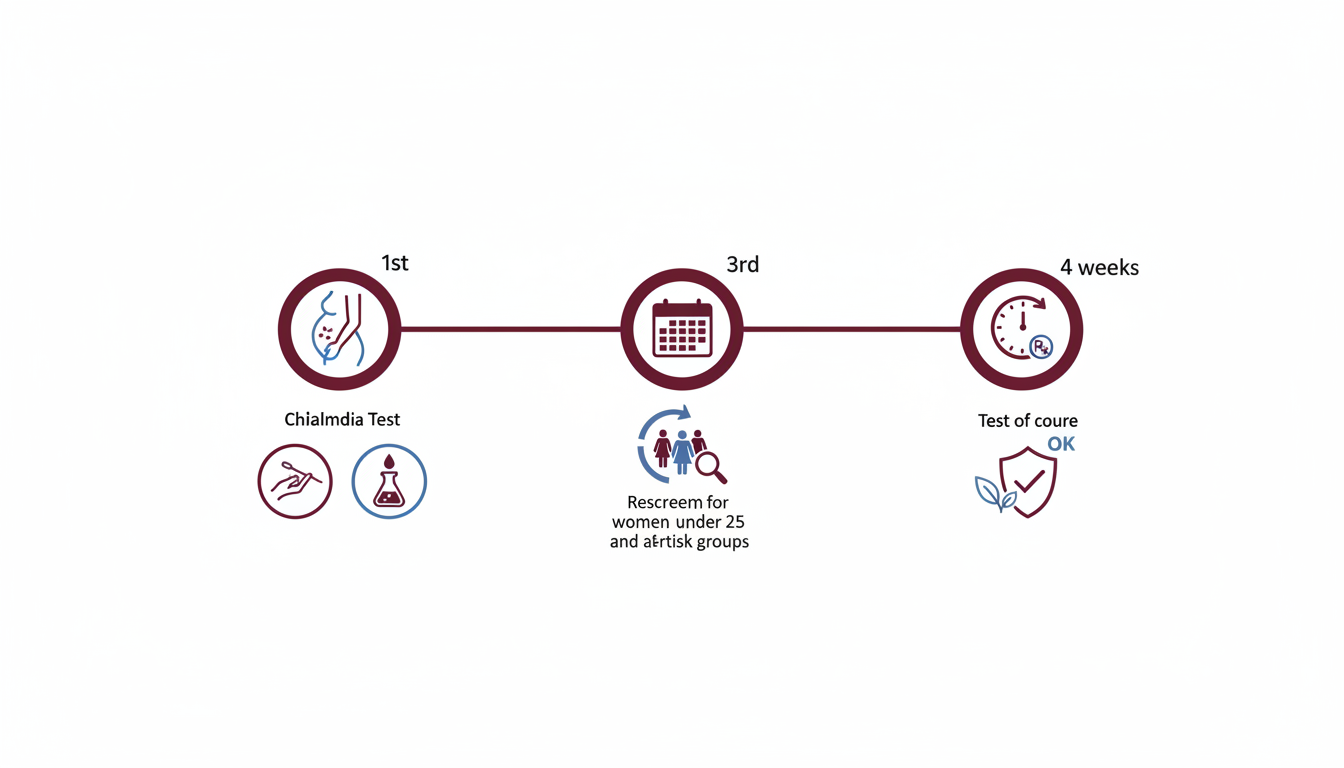
The CDC's prenatal STI screening guidance is age- and risk-based: all pregnant women under 25, and older pregnant women at increased risk, should be tested for chlamydia at the first prenatal visit, ideally in the first trimester (CDC STI Treatment Guidelines, Pregnancy). Earlier is better because it gives time to treat, reconfirm clearance with a test of cure, and prevent any chance of transmission at birth. If you fall outside the screened groups but want the test for peace of mind, ask your provider; many will run it without question.
If you weren't tested in the first trimester, it is not too late. Chlamydia testing is safe at any stage of pregnancy and so is the standard treatment. Many women only learn about chlamydia screening late in pregnancy and still complete treatment well before delivery.
The third-trimester retest matters most for women under 25 and those at increased risk: a new partner, multiple partners, or a partner whose status is uncertain. Chlamydia can be acquired at any point, and a clean first-trimester result does not protect you from a later exposure. The CDC's specific third-trimester criterion is any pregnant woman under 25, or any older woman who has had one of those exposures during this pregnancy.
How Testing Actually Works (and Why It Is Less Awkward Than You Think)
Chlamydia testing in pregnancy is quick, private, and painless. In a clinic setting your provider will use one of two sample types: a self-collected vaginal swab or a urine sample. Both feed into the same laboratory test, a nucleic acid amplification test (NAAT), which is the gold standard and is unaffected by pregnancy (CDC chlamydia treatment guidelines). Prenatal practices commonly co-test for chlamydia and gonorrhea on the same swab, since the two share exposure routes and the same sample type covers both.
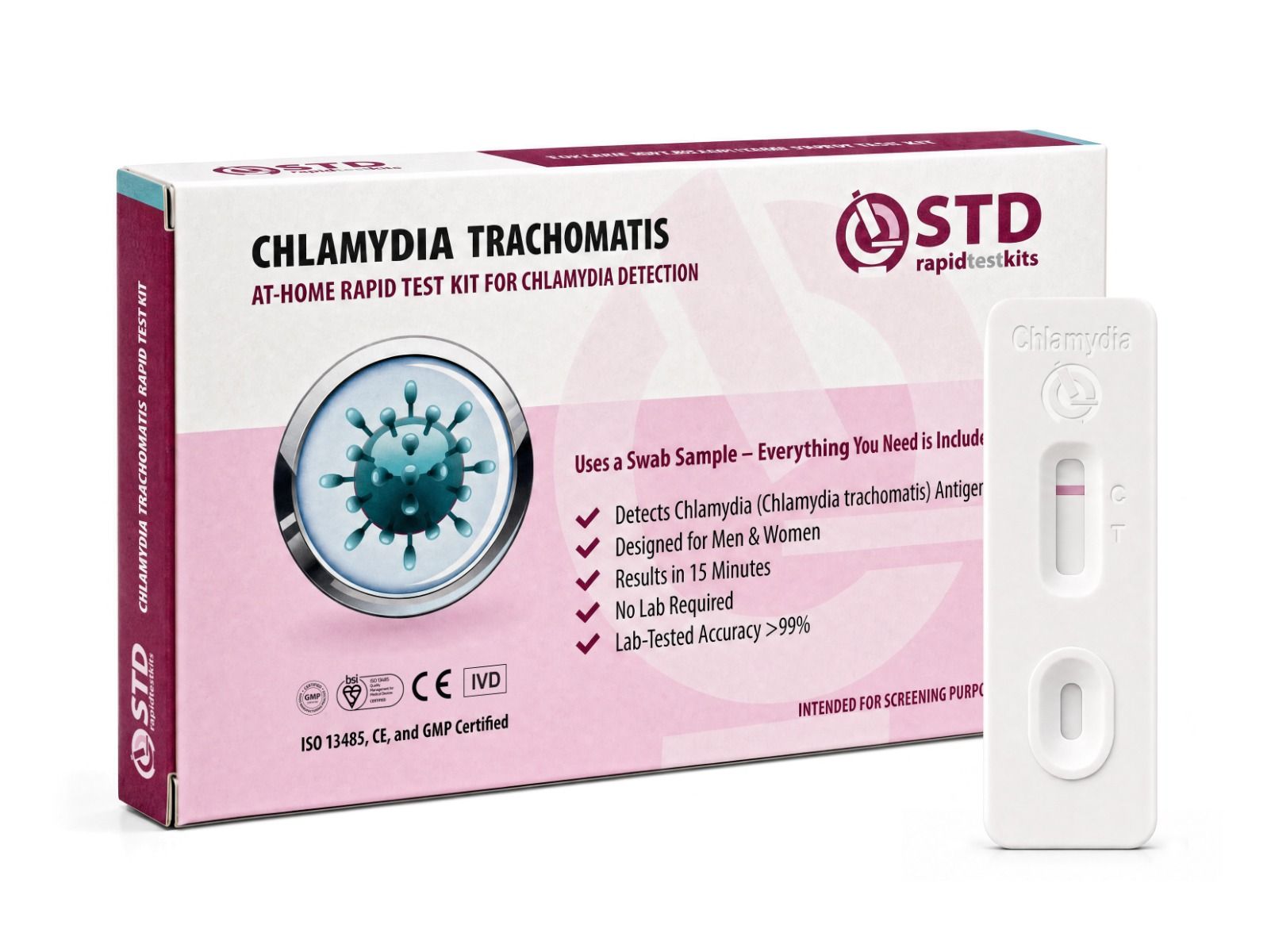
For women who want to do an initial screen at home, lateral-flow rapid test kits use the same self-collected vaginal swab. The chemistry is different from a lab NAAT (rapid lateral flow rather than amplification), so a positive home result should be confirmed by your prenatal provider, who will repeat with a NAAT and start treatment. A negative home result late in pregnancy with no symptoms is reassuring, but if you have a known exposure, retest at the clinic.
When chlamydia symptoms do appear during pregnancy, they tend to mimic things people already attribute to being pregnant, which is part of why infection so often gets missed. The table below shows the overlap that catches women off guard.
| Possible symptom | Why it gets overlooked in pregnancy |
|---|---|
| Increased vaginal discharge | Often dismissed as normal pregnancy discharge changes |
| Mild pelvic discomfort | Easy to attribute to ligament stretching or early uterine growth |
| Burning with urination | Frequently assumed to be a urinary tract infection rather than an STI |
| Light spotting after sex | Sometimes chalked up to a more sensitive cervix in pregnancy |
Is Treatment Safe While Pregnant?
Yes. Treating chlamydia during pregnancy is both safe and routine. The CDC's first-line recommendation for pregnant women is a single 1-gram oral dose of azithromycin (CDC chlamydia treatment guidelines). One dose, taken in the clinic or at home, fully treats uncomplicated chlamydia in the majority of cases, and starts acting against the bacteria within hours.
If azithromycin is not tolerated, an alternative regimen of amoxicillin (500 mg three times daily for 7 days) is also considered safe in pregnancy. Doxycycline, the standard outside of pregnancy, is contraindicated from the second trimester onward because of the risk of permanent tooth discoloration in the developing fetus (CDC chlamydia treatment guidelines).
From a practical standpoint: treatment in the clinic almost always means a single visit, a single dose, and clearance of the infection well before delivery. The treatment also benefits the baby directly. Antibiotics taken before birth eliminate the bacterial reservoir that the baby would otherwise be exposed to in the birth canal. The two pregnancy-safe regimens sit side by side below for reference.
| Antibiotic | Dosage | Safe in pregnancy? | Notes |
|---|---|---|---|
| Azithromycin | 1 g single oral dose | Yes (CDC first-line) | Preferred regimen in pregnancy. One dose, completed in-clinic or at home. |
| Amoxicillin | 500 mg three times daily for 7 days | Yes (CDC alternative) | Used when azithromycin is not tolerated. |
| Doxycycline | 100 mg twice daily for 7 days | No | Contraindicated in pregnancy due to fetal tooth-discoloration risk. |
What Happens After Treatment
After treatment for chlamydia in pregnancy, the CDC recommends two follow-up steps that women outside of pregnancy may not have heard of. First, a test of cure about 4 weeks after antibiotics, preferably by NAAT, which confirms the infection has cleared. Second, a retest about 3 months after treatment to catch reinfection, which is common (CDC STI Treatment Guidelines, Pregnancy). Outside of pregnancy, the test of cure is generally not required for uncomplicated cases; in pregnancy it is, because the stakes at delivery are higher.
Abstain from sex for 7 days after a single-dose azithromycin treatment, or until completion of a 7-day amoxicillin course, before resuming intimacy. Resuming sex earlier is the single most common cause of an apparent treatment failure on the test of cure, because what looks like persistence is usually reinfection from a still-untreated partner.
If your test of cure comes back positive, the most common explanation is reinfection from an untreated partner, not antibiotic failure. Antibiotic resistance in chlamydia is rare. Confirm your partner has been treated, repeat your own course, and abstain through the full 7-day window before resuming sex, then retest 4 weeks later.
Post-treatment protocol in pregnancy
- Test of cure at 4 weeks after antibiotics: a follow-up NAAT confirms the infection has cleared.
- Abstain from sex for 7 days after a single-dose azithromycin treatment, or until completion of a 7-day amoxicillin course.
- Retest at 3 months to catch reinfection. Reinfection is the most common cause of a positive follow-up, not antibiotic failure.
- Third-trimester retest if you are under 25 or have any new exposure during pregnancy.
The Partner Conversation (and Why It Matters for You and the Baby)
Reinfection is one of the most underappreciated risks in chlamydia care. If your partner is not treated at the same time you are, you can be reinfected days after finishing your antibiotics, and during pregnancy that means a fresh exposure right back to the same risk picture you just cleared. The CDC's expedited partner therapy (EPT) guidance exists for exactly this reason: in many states a clinician can prescribe treatment for the partner without a separate visit (CDC clinical EPT guidance).
The conversation does not have to be a confrontation. A common phrasing that works well is something like: "My prenatal screening picked up an infection that's treatable but needs both of us on antibiotics so I don't pass it back. Can we both go in this week?" Framing it as protecting the pregnancy keeps the focus on shared responsibility rather than blame.
If a direct conversation is genuinely unsafe (a partner who is controlling, abusive, or has reacted badly to past health conversations), most clinics offer anonymous partner-notification services that contact the partner without revealing your identity. Ask your provider; they handle this routinely. Whatever route you take on partner treatment, the follow-up logic stays the same.
If the partner cannot get to a clinic quickly, ask the prescriber about EPT. Per the <a href="https://www.cdc.gov/std/treatment-guidelines/clinical-EPT.htm" target="_blank" rel="noopener noreferrer">CDC's EPT guidance</a>, providers in many states can dispense or prescribe partner antibiotics directly through the index patient, which shortens the reinfection window during pregnancy. EPT for chlamydia has been shown to reduce reinfection rates at follow-up compared with standard partner notification.
Why this matters at the test of cure: if a follow-up test comes back positive, antibiotic failure is rare. The far more likely cause is reinfection from a partner who was not treated in parallel. Both of you taking the same antibiotics, abstaining for the recommended window, and then retesting is what breaks the cycle.
Preventing Reinfection Without Losing Intimacy
You do not have to give up sex during pregnancy to stay protected. Barrier protection (external or internal condoms, dental dams for oral contact) is the single most effective tool against chlamydia and against most other STIs. If you and a partner have not been using condoms because you are already pregnant, the calculus has changed: condoms now protect the pregnancy, not just against pregnancy.
For couples who want to skip barrier protection during pregnancy, a clean joint testing baseline is the alternative. Both partners test for chlamydia (and ideally a broader STI panel), confirm negative results, and stay honest about any new exposures. This is the same logic many couples already use; it just gets reframed for pregnancy.
Pregnancy also tends to surface emotional shifts around sex (changing libido, body-image discomfort, vulnerability) that have nothing to do with infection but that often blur into the same conversation. Treat the protection conversation as separate from those, and easier to tackle.
If you and a partner want to skip barrier protection during pregnancy, the alternative is straightforward: both of you test for chlamydia (and ideally a broader STI panel), confirm negative results, and stay honest about any new exposures. The conversation feels less awkward when it is framed as a one-time check rather than ongoing surveillance.
If You Don't Fit the "Typical" Risk Profile
A practical truth that public-health screening guidelines acknowledge: a meaningful share of pregnant women who test positive for chlamydia are in long-term, presumed-monogamous relationships. They were not expecting a positive result. They had not changed partners. In some cases the infection had been quietly present from before pregnancy and was simply never screened for in their pre-pregnancy years.
This is part of why CDC guidance includes a risk-based criterion alongside the under-25 cutoff. Chlamydia is genuinely silent and genuinely common, and assumptions (yours, your partner's, or your provider's) about who "gets" it are not reliable. Chlamydia is one of the most commonly reported infections in the United States, affecting people across age groups and relationship types (CDC, About Chlamydia).
Screening for chlamydia in pregnancy works the same way as a glucose tolerance test: routine, impersonal, and informative regardless of what the result says. You screen because the cost of missing it is real, the cost of catching it is small, and the answer informs the rest of pregnancy care.
Ask anyway. CDC screening guidance reflects population-level risk, not a personal verdict on your relationship. Many providers will run the test on request even when you fall outside the formally screened groups. Bringing it up is normal patient self-advocacy, and it is the safer position for the rest of pregnancy care.
How Stigma Gets in the Way (and How to Push Past It)
Stigma around STIs is one of the harder barriers to early detection in pregnancy. Words like "clean" and "dirty" still shape how patients and sometimes providers talk about screening, and that language alone can make women hesitate to ask for a test. Perceived judgment from a provider is a commonly cited reason women delay STI screening, even when the test itself is offered for free.
If your provider is dismissive, options include requesting the test in writing through the practice's patient portal so it sits in a record, asking for a different provider in the same practice (most clinics handle this without friction), or doing an initial home screen privately and bringing the result to a confirmatory clinic visit. None of these is dramatic; all of them are normal patient self-advocacy.
Asking for the test is not what creates the risk; the silent infection does.
Two of the most reliable workarounds: send the request through the practice's patient portal so it sits in a dated written record, or ask the front desk to schedule you with a different provider in the same practice. Both are handled routinely.
Delivery: Where Most of the Worry Lives
Most of the anxiety around chlamydia in pregnancy ends up focused on delivery, and specifically on whether the baby will pick up the infection during birth. The short answer is that this risk is exactly what the test of cure and the third-trimester retest are designed to prevent. According to the NHS chlamydia overview, untreated maternal chlamydia at delivery can cause newborn conjunctivitis in the first month of life, and less commonly chlamydial pneumonia in the first few months. Both are treatable with antibiotics, and the timeline-driven care plan is built so the newborn never has to be treated in the first place.
A treated infection with a negative test of cure on file does not change the delivery plan. The C-section decision is driven by other obstetric factors, not by a chlamydia diagnosis earlier in pregnancy. The table below shows how the at-delivery status maps to the newborn picture.
| Status at delivery | Implication for the newborn |
|---|---|
| Infection treated and most recent test negative | Risk of vertical transmission is essentially eliminated; standard delivery and postpartum care. |
| Treated but not retested | Low risk overall but unconfirmed; the test of cure is what closes this gap. |
| Untreated or recurrent infection at delivery | Increased risk of newborn conjunctivitis and, less commonly, chlamydial pneumonia. Both are treatable, but the heightened newborn monitoring is precaution rather than prognosis. |
Breastfeeding After a Treated Chlamydia Infection
Chlamydia is not transmitted through breast milk. Once treatment is complete and a follow-up test confirms the infection has cleared, breastfeeding plans proceed as they otherwise would. If treatment falls close to delivery, talk through the timing with your prenatal care team so they can plan any extra newborn monitoring (see the callout below).
In the typical case, where treatment happened weeks or months earlier and the test of cure was negative, breastfeeding goes ahead with no additional precautions related to chlamydia. For specific questions about any medication you are taking and breastfeeding, your prenatal team or pediatrician is the right source.
If the chlamydia diagnosis or treatment falls in the last few weeks of pregnancy and there is not enough time for a full test-of-cure cycle before birth, the care team will plan extra newborn monitoring (typically an eye exam for chlamydial conjunctivitis within the first month, and a watchful eye for respiratory symptoms in the first few months). Both newborn complications are treatable; the heightened watch is precaution, not prognosis.
The Emotional Layer That Doesn't Show Up on the Chart
Clinical care for chlamydia in pregnancy follows a defined pathway. The emotional response to a diagnosis rarely follows one. A positive STI result during pregnancy often surfaces questions about partner history, timing, and self-image that the medical chart does not have a column for.
The data does not support a story in which a positive chlamydia test means someone did something wrong. Chlamydia is one of the most common bacterial STIs worldwide, frequently asymptomatic for months, and routinely screened in pregnancy precisely because it is so easy to miss.
Most obstetric practices and prenatal clinics have either an on-staff social worker or a referral pathway to a perinatal mental-health provider. Asking for that support is a routine ask, not an unusual one. Sexual-health diagnoses during pregnancy are one of the specific situations these services exist for, separate from the medical care plan itself.
Every Pregnancy Deserves the Same Standard of Care
Whether this is your first pregnancy or your fifth, the standard is the same: a routine first-trimester chlamydia screen if you fall within the CDC-screened groups, a third-trimester retest if any new exposure has happened, prompt treatment with a pregnancy-safe antibiotic if positive, a partner treated in parallel, and a test of cure at 4 weeks. That is the entire pathway. Most women complete it without complication.
Chlamydia in pregnancy is common, treatable, and almost entirely preventable as a cause of newborn complications when it is caught and cleared before delivery. The discomfort of asking for the test is small; the discomfort of finding out at delivery, when the bacteria are now in the birth canal, is much larger.
If a clinic visit is hard to schedule or hard to face right now, an at-home screening test is a reasonable starting point. Bring any positive home result to your prenatal provider; a confirming NAAT and same-visit treatment are both routine.
Your next step in the chlamydia-in-pregnancy pathway
Are you under 25, or do you have any increased-risk factor this pregnancy (a new partner, multiple partners, or a partner with an STI)?
Yes: Request a chlamydia screen at your first prenatal visit, and a retest in the third trimester. If your prenatal panel did not include chlamydia, ask for it now.
No: You can still ask for the test if you want it for peace of mind; many providers will run it on request even outside the formally screened groups.
Did the screening come back positive?
Yes: Begin azithromycin (single 1 g oral dose) right away. Arrange a test of cure 4 weeks after treatment, and make sure your partner is treated in parallel before either of you resumes sex.
Was your test of cure also positive?
Yes: Reinfection from an untreated partner is the most likely cause. Both of you complete a fresh course, abstain through the full 7-day window, and retest together 4 weeks later.
No: Standard prenatal care continues. A routine retest at 3 months stays on the schedule, plus a third-trimester retest if any new exposure has occurred.
Three checkpoints walk you through the standard care plan. Your prenatal team should follow the same pattern.
FAQs
- I tested positive for chlamydia while pregnant. Did I already harm my baby?
- No. The bacteria travel to the newborn through the birth canal at delivery, not across the placenta during pregnancy. Treating before birth closes that exposure window entirely. A treated infection with a confirmed test of cure also doesn't change the delivery plan; obstetric care continues normally.
- Can I have chlamydia in pregnancy with no symptoms at all?
- Yes, and that is the rule rather than the exception. The CDC describes chlamydia as commonly asymptomatic, and pregnancy does not change that. Most women who test positive in pregnancy felt completely normal beforehand, which is exactly why routine prenatal screening exists for the groups it covers.
- How quickly do the antibiotics work?
- Single-dose azithromycin starts acting against the bacteria within hours, but the body still needs time to fully clear the infection. That is why the CDC STI Treatment Guidelines recommend the test of cure about 4 weeks after treatment in pregnancy, rather than testing immediately.
- Is azithromycin actually safe to take while pregnant?
- Yes. Azithromycin is the CDC first-line treatment for chlamydia in pregnancy and is considered safe across all three trimesters, with a long pregnancy safety record. Amoxicillin is a safe alternative if azithromycin is not tolerated. Doxycycline is the one to avoid because of fetal tooth-discoloration risk.
- Can chlamydia clear on its own without treatment?
- Some untreated infections do appear to clear over time in observational studies, but the timeline is unreliable and clearance is not the assumption care teams operate on, particularly during pregnancy. Treatment is short, predictable, and protective of the newborn, which is why it is recommended rather than watchful waiting.
- I was treated already. Why did my retest come back positive?
- Check whether your partner was treated at the same time you were; that is almost always the explanation. Resistance to standard antibiotics is rare in chlamydia. The plan from here: both of you complete a fresh course, abstain through the 7-day window, then retest together.
- How long should I wait before sex after antibiotics?
- A full seven days after the azithromycin dose, or until the amoxicillin course finishes, whichever comes later. The window lets the antibiotics fully clear the bacteria before any new exposure resets the count.
- Can I use an at-home chlamydia test while pregnant?
- Yes. At-home rapid tests use a self-collected vaginal swab that is safe in pregnancy. They are useful as an initial screen, especially if you want privacy before raising the topic with your provider. Any positive result should be confirmed and treated through your prenatal care team using a clinical NAAT.
- U.S. Centers for Disease Control and Prevention. About Chlamydia: prevalence, transmission, and asymptomatic course of infection.
- U.S. Centers for Disease Control and Prevention. STI Treatment Guidelines: Chlamydial Infections, including dosage, antibiotic selection, and the doxycycline contraindication during the second and third trimesters.
- U.S. Centers for Disease Control and Prevention. STI Treatment Guidelines: Pregnant Women, including age- and risk-based screening, the 4-week test of cure timing, third-trimester retest, and pregnancy-safe regimens.
- U.S. Centers for Disease Control and Prevention. Annual STI Surveillance Report (2023), used here for the 1,648,568 reported chlamydia cases figure.
- U.S. Centers for Disease Control and Prevention. Expedited Partner Therapy (EPT) clinical guidance, used here for partner-management framing.
- World Health Organization. Chlamydia fact sheet: global epidemiology and adverse pregnancy outcomes including preterm birth and low birth weight.
- National Health Service. Chlamydia overview, used here for newborn conjunctivitis and chlamydial pneumonia transmission notes at delivery.
- Mayo Clinic. Chlamydia symptoms and causes overview, used here for the asymptomatic-presentation framing.
