
Published: October 2025 | Last updated: May 2026 | Editorial review and quality control: Martina N.
If you live in Texas and you've spent any time recently worrying about STDs, the worry is not in your head. Through the most recent years with complete Texas-level data, chlamydia, gonorrhea, and syphilis were trending upward in the state, placing Texas near the top of national surveillance tables. CDC's 2024 provisional national data shows an early national decline in the three infections combined, but state-level breakdowns for 2024 are pending, and Texas's longer-term structural drivers (sex-ed gaps, rural access barriers, stigma, underfunded clinics) have not changed. The reasons are largely structural, and most of them have very little to do with how often Texans are having sex.
This guide pulls together what the public-health data, state surveillance reports, and clinical guidelines actually say about why infections keep climbing here. It's written for the person who Googled symptoms at midnight, the partner who isn't sure when to retest, and anyone who's been quietly avoiding a clinic because privacy in their town is harder to come by than honesty. We're a medical-writing team summarizing CDC, WHO, and Texas DSHS guidance into plain English; this isn't a substitute for a clinician, but it should answer most of the questions you'd want to ask one.
Key takeaways
- Texas reports one of the highest sexually transmitted infection rates in the country in CDC's most recent surveillance data, with chlamydia driving most diagnoses and congenital syphilis showing the steepest climb.
- Many of these infections cause no noticeable symptoms for weeks or months, so the only reliable way to catch them early is testing at the right window after a possible exposure, even when nothing feels wrong.
First, look at the numbers
Texas's STI numbers reflect measurement gaps and structural barriers more than behavior patterns. CDC's annual STI surveillance, the gold-standard count, places Texas in the top tier of states for total reported infections (CDC STI surveillance). The Texas Department of State Health Services tracks the same picture at the state level: chlamydia accounts for the largest share of reported cases, gonorrhea is climbing, and syphilis (especially congenital syphilis, where infection passes from a pregnant person to the baby) has shown the steepest rise of any reportable STI in the past decade.
Reported cases are an undercount. CDC has consistently noted that many bacterial STIs go undiagnosed because most early infections cause no obvious symptoms, and screening rates lag behind recommendations. The agency's surveillance commentary specifically calls out under-screening as a driver of the apparent rise: better testing finds more infections, while a rising case count alongside falling testing access is the more concerning combination.
Compared with smaller states, Texas has more people, more medically underserved counties, and more structural reasons people skip the test that would have caught an infection early.
So why are STD rates rising in Texas?
Four structural factors do most of the work: underfunded local public-health clinics, abstinence-leaning sex education that leaves young Texans with real knowledge gaps, large rural and Rio Grande Valley areas with limited STI testing access, and stigma that delays first tests and disclosure to partners. Most of the rise is driven by chlamydia, gonorrhea, and syphilis, which are easy to treat once diagnosed. At-home rapid tests close part of the access gap, but they don't replace clinic-based treatment for a positive result.
Stigma is doing more damage than the bacteria
Public-health researchers in conservative-leaning U.S. regions have long flagged stigma as one of the strongest predictors of delayed STI testing. People who anticipate being judged tend to wait, and the wait is exactly when an asymptomatic infection moves from one body to the next.
The pattern shows up clearly in Texas. State surveillance reports note that significant infection clusters emerge in communities where confidential testing is harder to access. For LGBTQ+ Texans, survivors of purity-based sex education, and anyone in a small town where the clinic intake form may be reviewed by a neighbor, walking through a public-health clinic door can feel like a confession. Clinicians who serve these communities describe the same friction repeatedly: the clinical question (do I have an infection?) is straightforward, but the social cost of getting it answered is not.
This is why anonymous and at-home testing options matter more in Texas than they might in a state with denser clinic coverage.
Fear of judgment leads to silence. Silence leads to delayed first tests. Delay turns a treatable bacterial infection into ongoing transmission and, occasionally, into the long-term complications nobody warned the patient about: pelvic inflammatory disease, infertility, or congenital syphilis in a future pregnancy. Each step in this chain is preventable; the test that breaks the chain takes about fifteen minutes.
The sex-ed gap
Texas has historically emphasized abstinence-based instruction in school health curricula, with comprehensive sexuality education varying widely by district. The state's policy framework requires districts to opt in to anything beyond abstinence-focused content, and many have not, according to district-level reporting from advocacy groups like Texas Freedom Network's Healthy Youth Texas project (Texas Freedom Network).
The clinical consequence is concrete. Young people who never learned how chlamydia transmits (often through oral or non-penetrative contact, often without symptoms) tend to assume that "no symptoms" or "not technically intercourse" rules out infection. Both assumptions are wrong, and both push the first STI test later than it should happen.
Honest information about what condoms cover (and what they don't), what window periods mean, and how often asymptomatic STIs drive transmission is the cheapest infection-control tool available. Where curricula leave that out, individuals have to seek the information themselves; this article is part of that.
Texas's curriculum framework treats anything beyond abstinence-focused instruction as an optional extension that each district has to actively choose. When a district doesn't opt in, students can finish school health class without learning how chlamydia or gonorrhea transmit through oral or non-penetrative contact, why most early infections show no symptoms, what a window period is, or what condoms do and don't cover. Those four gaps are the ones that show up most often when adults later ask why their first positive test surprised them.
Health deserts and the testing dead zones
When you map STI infrastructure in Texas, two things stand out. First, large rural areas have no full-service public-health clinic within easy driving distance. Second, even where clinics exist, hours and capacity are limited.
The Texas DSHS county map of STI services reflects this clearly: full-spectrum testing is concentrated in the major metros (Houston, Dallas-Fort Worth, San Antonio, Austin, El Paso) and the Rio Grande Valley anchors, with thinner coverage across West Texas, the Panhandle, and large stretches of East Texas. For a person in an unincorporated community 60 to 80 miles from the nearest open clinic, "go get tested" is not a low-friction recommendation.
Add the practical layer: limited weekday hours, the need to take time off work, transportation, childcare, and (in many cases) the absence of insurance that would cover a private-clinic visit. The structural barriers stack until skipping the test becomes the path of least resistance, even for people who genuinely want to know. PrEP (pre-exposure prophylaxis for HIV) faces the same access barriers: the medication requires a prescription and periodic lab monitoring, which is difficult to obtain in counties with minimal primary-care infrastructure.
At-home rapid tests don't solve the rural-care gap. They can't replace clinic-based treatment, partner-services follow-up, or pregnancy-related screening. What they can do is answer one specific question: did this exposure result in an infection?

When silence still means infection
The hardest thing about most bacterial STIs is that they don't announce themselves. CDC's chlamydia fact sheet states that the majority of infections cause no noticeable symptoms (CDC: Chlamydia). For gonorrhea, asymptomatic infection is also common, especially at extragenital sites such as the throat or rectum, where infection can persist while genital symptoms stay absent (CDC: Gonorrhea). Early syphilis can present as a single painless sore (a chancre) that heals on its own within a few weeks, then re-emerges weeks or months later as the systemic secondary stage with rash and flu-like symptoms (CDC: Syphilis).
This is why "I would know if I had something" is the most common reason people delay testing. A mild itch gets blamed on detergent. A faint discharge gets attributed to a normal cycle change. A fading sore gets ignored because it stopped hurting; the bacteria, meanwhile, are still there.
Texas's surveillance trends would look different if more infections were caught at the asymptomatic stage rather than during a complication visit. Pelvic inflammatory disease, infertility, and congenital syphilis are downstream effects of infections that were treatable at the screening stage, often with a single antibiotic dose.
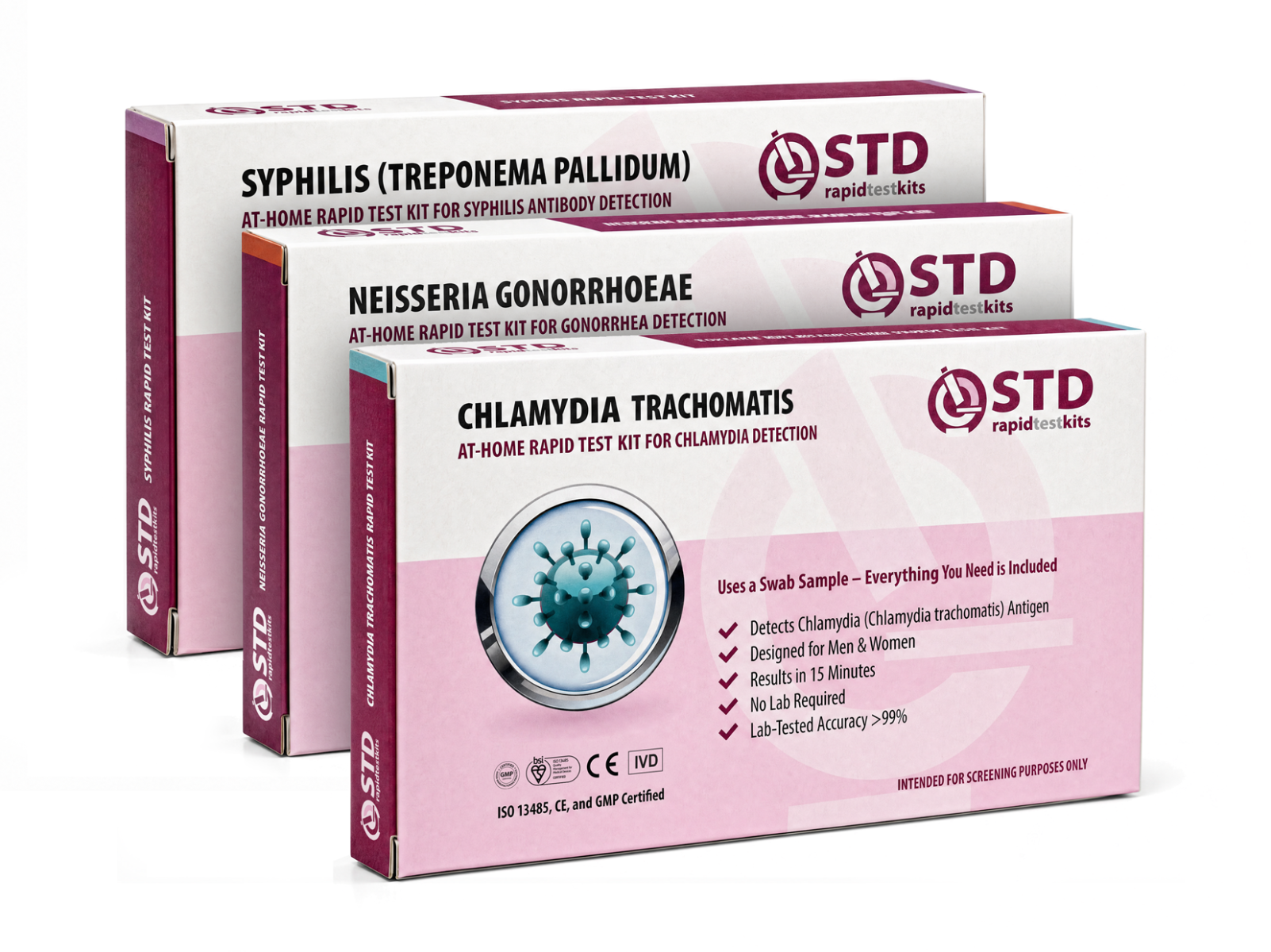
The actionable rule of thumb: if you've had a new partner since your last test, schedule a screen at the appropriate window even if you feel completely fine. Testing once a year as a baseline (more often if you have multiple partners or a partner whose other partners you don't know) is the floor recommended by most clinical guidelines. We sell rapid at-home lateral-flow test kits for several of the infections discussed in this article; relevant options are linked below.
Window periods and when to test
The window period is the time between exposure and when a test can reliably detect infection. Test too early and a real infection will read negative because the bacteria, viral load, or antibodies haven't reached the test's detection threshold yet. This is one of the most common ways people end up reassured at day five and surprised at day twenty.
The CDC's STI Treatment Guidelines and HIV testing guidance set the windows below as starting points (CDC STI Treatment Guidelines). Different test technologies (rapid lateral-flow at home, laboratory NAAT (nucleic acid amplification test), fourth-generation HIV antigen-antibody assays) have different sensitivity profiles, so retest timing varies by test type as well as infection.
| Infection | Earliest reliable test | Recommended retest | Often asymptomatic? |
|---|---|---|---|
| Chlamydia | About 1 to 2 weeks after exposure | 2 weeks; sooner if symptoms appear | Yes, in most infections |
| Gonorrhea | About 1 to 2 weeks after exposure | 2 weeks; sooner if symptoms appear | Often, especially throat or rectal sites |
| Syphilis (early) | 3 to 6 weeks after exposure | 6 to 12 weeks for confirmation | Often, especially after the primary sore heals |
| HIV (lab Ag/Ab 4th-gen) | About 18 to 45 days after exposure | 12 weeks for definitive result | Yes, including during early infection |
| Trichomoniasis | 1 to 4 weeks after exposure | 2 to 4 weeks if first test was early | Common, especially in men |
If you tested positive, here's what comes next
A positive result is information, not a verdict. The next twenty minutes after seeing a positive often feel disproportionate to the clinical reality, which is usually a treatable infection identified early, before complications.
For most positives, the path is the same. First, confirm the result through clinical care; most home rapid tests recommend lab confirmation before treatment, and a clinician can also screen for co-infections you didn't test for. Second, get treated. Bacterial STIs (chlamydia, gonorrhea, syphilis, trichomoniasis) are typically cleared with a short antibiotic course. Third, notify recent sexual partners so they can also test and treat. Fourth, wait the recommended period before sex (often 7 days after single-dose treatment, longer if treatment is multi-dose) and use barrier protection during that window.
If the result is HIV-positive, the path looks different but is no less manageable. Modern antiretroviral therapy is daily medication that suppresses viral replication to undetectable levels in most people, and undetectable-equals-untransmittable is now an established public-health principle (CDC: HIV treatment and U=U). Earlier treatment improves long-term outcomes for the individual and reduces onward transmission in the community.

How to tell a partner without making it worse
The single highest-leverage thing a person can do after a positive result, beyond getting treated, is tell recent partners so they can test and treat too. It's also the part most people freeze on.
A short, factual message works better than a careful long one. The pattern that lands cleanly:
"Hey, I tested positive for [infection]. I wanted to give you a heads-up so you can test. It's treatable, and most of the time it's caught at the asymptomatic stage like this."
You don't owe a sexual history. You don't owe an apology. You're sharing clinical information so a person can make a clinical decision.
If the conversation feels too high-stakes (a partner you barely know, a partner whose reaction you're worried about, a partner you no longer have direct contact with), anonymous partner-notification services exist. State and local health departments offer this through partner services (CDC STI resources); third-party tools like TellYourPartner.org and Don't Spread It are also widely used and don't require revealing your identity.
Most people who have chlamydia have no symptoms. If you do have symptoms, they may not appear until several weeks after you have sex with an infected partner.
Retesting after treatment
Retesting too soon after treatment is one of the most common mistakes in self-managed sexual health. Bacterial STIs respond to antibiotics, but a NAAT or antibody-based test can pick up residual non-viable genetic material or persistent antibodies for weeks after the infection itself is cleared. A "still positive" result during this period doesn't mean treatment failed; it means the test is doing what tests do.
CDC's STI Treatment Guidelines recommend the following:
- Chlamydia and gonorrhea: a test-of-cure isn't routinely needed in adults treated with the recommended regimen, but rescreening at 3 months is recommended because reinfection rates are high.
- Syphilis: titer monitoring (RPR or VDRL, a blood antibody test that tracks whether treatment is working) at 6 and 12 months after treatment, with intervals depending on stage and HIV status.
- HIV: clinical follow-up determined by treatment response and viral load testing on a schedule set by the prescribing clinician.
- Trichomoniasis: rescreening within 3 months of treatment, especially for women, because reinfection from untreated partners is common.
Discreet testing in conservative Texas
For some Texans, the choice between testing and not testing isn't really about the test. It's about whether anyone (a parent, a roommate, a coworker, a small-town mail carrier) might find out. We hear this constantly, and the concerns are legitimate.
Mail-based at-home test kits address this in two specific ways. First, packaging is unbranded; the outer envelope or box doesn't identify the sender or the contents. Second, billing descriptors on credit-card statements show neutral merchant names rather than "STD" or "sexual health." For people who share a household, share a card, or live somewhere mail is unusually visible, both details matter.
This doesn't make testing free of friction; it makes it possible in situations where a clinic visit isn't. If a positive result comes back, follow-up with a clinician (in person or via telehealth) is part of the path.

What to do this week, not someday
The reasons Texas's STI rates keep rising are structural, but the response on the individual level isn't. The state isn't going to fix the access gap or the curriculum gap in the next year; the infrastructure problems are real and they are not going away quickly. What can change in the next 24 hours is whether you know your status. Concrete next steps:
- If you've had a new partner since your last test: schedule a screen at the appropriate window from the table above, even if you feel completely fine.
- If you've had any symptoms (burning, discharge, sores, unusual itching), even ones you've talked yourself out of: test now or see a clinician this week.
- Baseline cadence: test once a year if you have one regular partner; more often (every 3 to 6 months) if you have multiple partners or a partner whose other partners you don't know.
- If you test positive: confirm with a lab or clinician, get treated, and notify recent partners directly or through an anonymous notification service.
Frequently asked questions
- Can I get an STI even if my partner used a condom?
- Yes, for some infections. Condoms greatly reduce transmission of infections that spread through fluids (chlamydia, gonorrhea, HIV, hepatitis B, trichomoniasis). They reduce, but don't eliminate, transmission of skin-to-skin infections like herpes, HPV, and syphilis when sores or affected skin sit outside the area the condom covers. The strongest protection is consistent condom use combined with periodic testing for both partners.
- I tested negative five days after a possible exposure. Am I in the clear?
- Probably not. Five days is inside the window period for almost every common STI, meaning the test can read negative even when the infection is present. The standard advice is to retest at the timing in the window-period table above (about two weeks for chlamydia and gonorrhea, longer for syphilis and HIV). Test again sooner if symptoms appear.
- What's the most-diagnosed STI in Texas?
- Chlamydia, by a wide margin. Texas DSHS surveillance reports show chlamydia accounting for the largest share of reported cases. It's also the infection most likely to be silent, which is why the diagnosed count almost certainly understates the true infection count.
- Can I have an STI with zero symptoms?
- Yes, and this is why routine screening matters more than waiting for symptoms. Chlamydia and gonorrhea are asymptomatic in the majority of cases; trichomoniasis and early syphilis often are too. CDC fact sheets note the high asymptomatic share as the primary reason the diagnosed count understates true infection rates. Testing on a cadence rather than only after symptoms appear is the only reliable way to find these infections before they spread or cause complications.
- Will anyone know I ordered a home STI test?
- Not from the package or the bank statement. Reputable home-test sellers ship in unbranded outer packaging with no clinical labelling, and credit-card statements show neutral merchant names. If you share an address or share a card with someone, both details meaningfully reduce the chance of accidental disclosure.
- How accurate are at-home rapid STI tests?
- Specific accuracy varies by infection and by kit; check the data sheet on the product page for the test you're considering. At-home rapid lateral-flow tests perform well for screening when used at the correct window after exposure, but they're a different test technology from laboratory NAAT, which has higher analytical sensitivity. Best practice: use the home test as a screen and confirm any positive result with a lab test before starting treatment.
- Do I have to tell my partner if I test positive?
- Ethically and from a public-health standpoint, yes; their ability to test and treat depends on knowing. Legally, partner-notification rules vary by state and infection. State and local health departments offer confidential partner services that can notify partners on your behalf if direct contact feels too hard, and third-party anonymous tools exist as well.
- I share a household with people I don't want to tell. How do I keep the test private?
- Order with discreet packaging and neutral billing (most home-test sellers default to both). If household mail is genuinely a problem, options include shipping to a workplace, a friend's address, or an Amazon Locker or USPS Hold for Pickup; both services let you collect the package yourself with no home delivery. The test itself is taken in the bathroom and produces results in minutes, which keeps the whole process inside one short window of privacy.
- U.S. Centers for Disease Control and Prevention. Annual STI surveillance reports index; the state-level Texas ranking draws on prior final annual reports accessible from this index, while the 2024 provisional data foregrounded on the page covers national trends only, with state-level breakdowns pending final publication.
- Texas Department of State Health Services. Root domain for state-level health programs; STI program sub-page URLs require re-verification before next publish.
- U.S. Centers for Disease Control and Prevention. Chlamydia topic page, used for asymptomatic prevalence and screening cadence.
- U.S. Centers for Disease Control and Prevention. Gonorrhea topic page, used for extragenital (throat and rectal) infection notes and asymptomatic patterns.
- U.S. Centers for Disease Control and Prevention. Syphilis topic page, used for stage progression (primary chancre, secondary rash, latent) and congenital syphilis context.
- U.S. Centers for Disease Control and Prevention. STI Treatment Guidelines, used for treatment regimens, retest schedules, and partner-services guidance.
- Texas Freedom Network. Sex-education policy research and advocacy on Texas school health curriculum implementation.
- U.S. Centers for Disease Control and Prevention. HIV treatment and Undetectable=Untransmittable (U=U) guidance.
