
Published: September 2025 | Last updated: May 2026 | Editorial review and quality control: Martina N.
The idea that women who have sex with women do not need to worry about sexually transmitted infections is one of the most persistent myths in sexual health. It can feel intuitive at first, because there is no penis or semen in the picture. The CDC’s own guidance on women who have sex with women (often shortened to WSW) tells a different story, and so does the NHS guidance for lesbian and bisexual women. Many STIs spread through skin contact, mucous-membrane contact, shared fluids, and shared toys, which means cisgender women, transgender women, and nonbinary people whose partners are women can absolutely pass infections to each other.
This article walks through what the public-health evidence says about transmission between female partners, where the medical system has historically failed queer women, and what a reasonable testing plan looks like for someone whose partners are women.
Key Takeaways
- Women who have sex with women can transmit and acquire most STIs, including HPV, herpes, trichomoniasis, gonorrhea, chlamydia, syphilis, and (rarely) HIV, according to the CDC and NHS.
- An annual STI panel plus testing between new partners is a reasonable baseline for WSW; the most useful panel includes vaginal swab, throat swab where oral sex is regular, and blood tests for HIV and syphilis.
Why the “no risk” myth lasted so long
If you grew up queer or questioning, your sex education probably had a sentence-long mention of “using protection” that quietly assumed a male partner. Female-female intimacy was usually skipped entirely, with no mention of dental dams, barriers on toys, or which infections spread without intercourse. The omission reflects how public-health curricula were built around heterosexual transmission and treated everything else as a footnote.
Older epidemiology compounded the problem. Through the 1990s and into the 2000s, STI surveillance focused on cervical-cancer screening and heterosexual transmission, with very little data on women whose partners were exclusively women. The U.S. Centers for Disease Control and Prevention now addresses WSW as a population that does acquire and transmit a wide range of STIs, but that updated framing took decades to filter into clinical practice. Many providers still default to “low-risk” assumptions during a visit, especially when a patient mentions only female partners.
A generation of WSW patients were never offered routine screening, never told which barriers reduce risk, and never asked about specific practices. Without systematic data collection on female-female transmission, the misconception that nothing could pass between women had room to settle in unchallenged.
Through the 1990s and 2000s, U.S. STI surveillance collected almost no data on women whose partners were exclusively women. That left a generation of WSW patients without routine screening guidance and let the “no risk” myth harden into received wisdom.
How STIs actually move between women
Most STIs do not require penetration or ejaculation to spread. They need a pathway: skin contact, contact with mucous membranes (the moist tissues lining the genitals, anus, mouth, and throat), shared body fluids, or a shared object that has touched someone’s genitals or fluids. Sex between women involves all of those pathways routinely, even in the most loving and non-penetrative encounters.
The mechanisms break down roughly as follows:
- Skin-to-skin spread. Herpes simplex virus (HSV-1 and HSV-2), human papillomavirus (HPV), syphilis, and molluscum contagiosum spread through direct contact with infected skin or mucous tissue. Visible sores are not required; HSV and HPV both shed without symptoms.
- Mucous-membrane exposure during oral sex. Pharyngeal gonorrhea, oral herpes, and HPV can all transmit between mouths and genitals in either direction.
- Fluid exchange. Trichomoniasis, chlamydia, gonorrhea, and bacterial vaginosis can move between partners through vaginal fluids, including when fluids are transferred via fingers or shared toys.
- Shared toys. A dildo, vibrator, or strap-on used by one partner and then immediately by another, without a fresh condom or a wash, can carry HPV, HSV, trichomonas, and bacteria from one vagina to another.
- Blood exposure. Although female-to-female HIV transmission is rare in the published literature, contact with menstrual blood through cuts or shared toys is the mechanism the CDC cites in the few documented cases.
None of these routes require a male partner, penetration, or visible symptoms. Routine STI screening for WSW now sits in the CDC’s and NHS’s guidance precisely because the transmission routes are so undemanding.
Do women who have sex with women need STI testing?
Yes. Herpes, HPV, trichomoniasis, chlamydia, gonorrhea, syphilis, and (rarely) HIV can all transmit between female partners through skin contact, mucous-membrane contact, shared fluids, or shared toys. The CDC, NHS, and WHO all classify WSW as a population that acquires and passes STIs, with the most consistent risks being HPV, herpes, trichomoniasis, and bacterial vaginosis. Annual screening plus testing between new partners is a reasonable baseline; the most useful panel includes vaginal swab, throat swab where oral sex is regular, and blood tests for HIV and syphilis.

The specific infections that matter most for WSW
Looking at the population-level evidence, four infections come up most often in studies of women who have sex with women: HPV, herpes, trichomoniasis, and bacterial vaginosis. Three of those are sexually transmitted; bacterial vaginosis is more accurately called sexually associated, but it tracks new sexual partners closely and shifts readily between female partners.
Human papillomavirus (HPV)
HPV is widely described by public-health authorities as one of the most prevalent STIs. The CDC links HPV to cervical, anal, and oropharyngeal cancers and recommends routine vaccination through age 26 (with shared clinical decision-making through age 45). It spreads through skin-to-skin contact and can transfer via fingers and shared toys, not only during penetrative sex. Women whose partners are exclusively women still need routine cervical screening (pap smears or HPV co-testing on the schedule a clinician recommends), because lifelong exposure does not require a male partner.
Herpes simplex virus (HSV-1 and HSV-2)
Both HSV-1 (more common around the mouth) and HSV-2 (more common in the genital area) shed asymptomatically, which is the public-health term for the periods when the virus is on the skin or in fluids without producing any visible sore. The CDC’s herpes resources note that most people with genital herpes do not know they have it; symptoms, when they appear, are often mild enough to be mistaken for a pimple or ingrown hair. Transmission between female partners can happen through kissing, oral sex, genital-to-genital contact, or shared toys.
Trichomoniasis
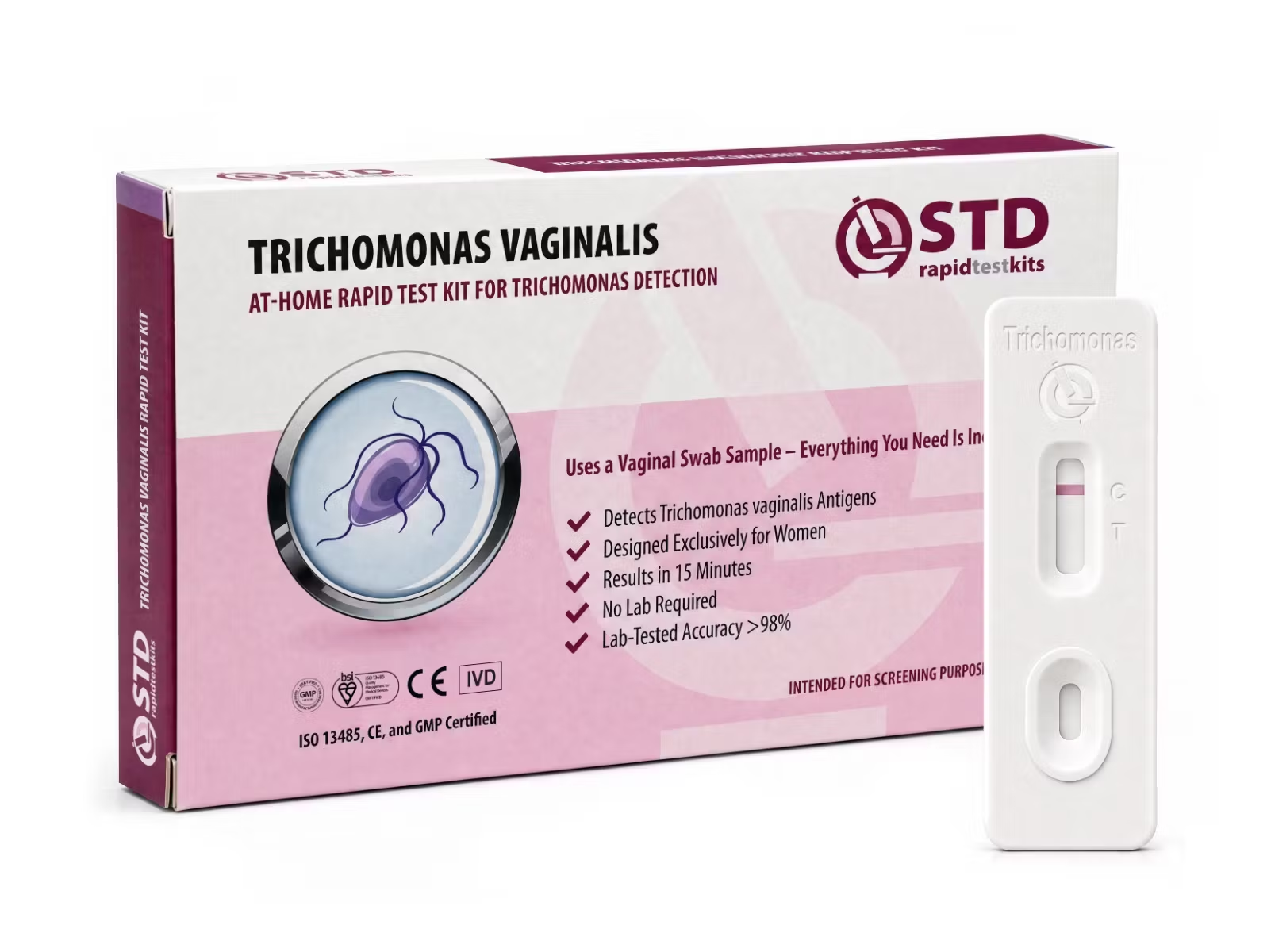
Trichomonas vaginalis is a single-celled parasite. The CDC’s trichomoniasis resources state that most infections produce no symptoms, with roughly 70 percent of cases going unnoticed in the patient. It can survive on fingers and on toys for short periods and has been documented as transmitting between female partners, though it is more commonly acquired from male partners. Itching, change in discharge, and irritation are the classic symptoms when they do appear. Many providers do not test for trich routinely, so this is one to ask about specifically.
Bacterial vaginosis (BV)
BV is not strictly an STI, but it behaves like one in WSW couples. Sharing vaginal flora through fingers, toys, or unprotected contact appears to drive concordance rates between female partners. The CDC’s WSW guidance specifically mentions BV as a recurrent concern; treating one partner without treating the other often leads to reinfection.
Toys, hands, and the “just oral” assumption
Sex between women is often more varied than sex education ever described. Oral, mutual touching, vibrators, dildos, plugs, strap-ons, and shared toys are all routine, and so are practices that switch between vaginas and other body parts within a session. Every one of those acts has a small but real route for an STI to move.
Oral sex sits at the center of a lot of misconceptions. Many people frame it as low-risk or risk-free, which is partly true and partly off. The risk of HIV transmission via oral sex is genuinely very low. Risk of acquiring or passing herpes, HPV, gonorrhea, chlamydia, and syphilis through oral-genital contact is not zero, and the WHO’s STI fact sheet lists oral contact among the documented transmission routes. Pharyngeal (throat) gonorrhea, in particular, often goes undetected because most people do not request a throat swab and the infection is frequently silent.
Shared toys carry the same considerations as shared genital contact. Using a condom on a toy, changing it between partners, or designating separate toys for separate people are simple barrier strategies that reduce transmission of HPV, HSV, trichomonas, and bacterial-vaginosis-associated bacteria. Hands carry a smaller but real risk; washing between body parts (vagina, anus, mouth) and between partners is a quick, low-effort hygiene step that meaningfully reduces movement of fluids.
None of this means every encounter needs to be treated like a clinical procedure. Those same barriers and routines from heterosexual sex education apply, with small adjustments, to WSW practice.
Why your doctor may not have asked the right questions
If you have ever told a primary-care doctor that you sleep only with women and watched them visibly relax, you have seen the WSW clinical blind spot in real time. The default assumption in many primary-care settings is still that female-female sex means low risk, which gets translated into no testing. The result, as the CDC’s own WSW guidance points out, is that WSW patients are routinely under-screened.
Several drivers keep this pattern in place:
- Clinician training on STI screening still focuses on heterosexual transmission as the default model.
- Sexual-history questions often stop at orientation, when the relevant variable is sexual practices: oral, vaginal, anal, toys, fingers.
- Patients sometimes hesitate to volunteer specific practices, especially in front of a provider who has not signaled it is a safe question.
- STI panels are often ordered as “the standard panel” without a discussion of which sites (vagina, throat, rectum) to swab, so infections at non-default sites get missed.
Improvement sits on both sides, with clinicians and patients sharing the load. Clinicians are increasingly trained to ask about specific practices, and most patients still benefit from being prepared to advocate. Saying “I have oral and genital contact with partners, and I would like vaginal-swab and throat-swab testing along with bloodwork” is a concrete, specific ask that any clinic can act on.
Building a testing plan that fits WSW practice
There is no single right cadence for STI testing, and the CDC’s guidance is deliberately practice-based rather than identity-based. A reasonable baseline for most WSW patients looks like this:
- Annual STI screening, regardless of how stable the partnership feels. This catches asymptomatic HPV, HSV, trichomoniasis, and BV early.
- A new screen when you change partners, ideally before resuming unbarriered contact with the new partner. Both partners testing in the same window is the strongest signal you have.
- Symptom-driven testing, any time you notice itching, new discharge, sores, pelvic pain, or unusual bleeding. Do not wait for an annual.
- Cervical-cancer screening (pap or HPV co-test) on the schedule your clinician recommends, regardless of partner gender. The U.S. Preventive Services Task Force and the CDC are consistent that WSW need cervical screening on the same cadence as women whose partners are men.
- Site-specific swabs. If you give or receive oral sex regularly, ask for a throat swab in addition to the vaginal swab and blood tests.
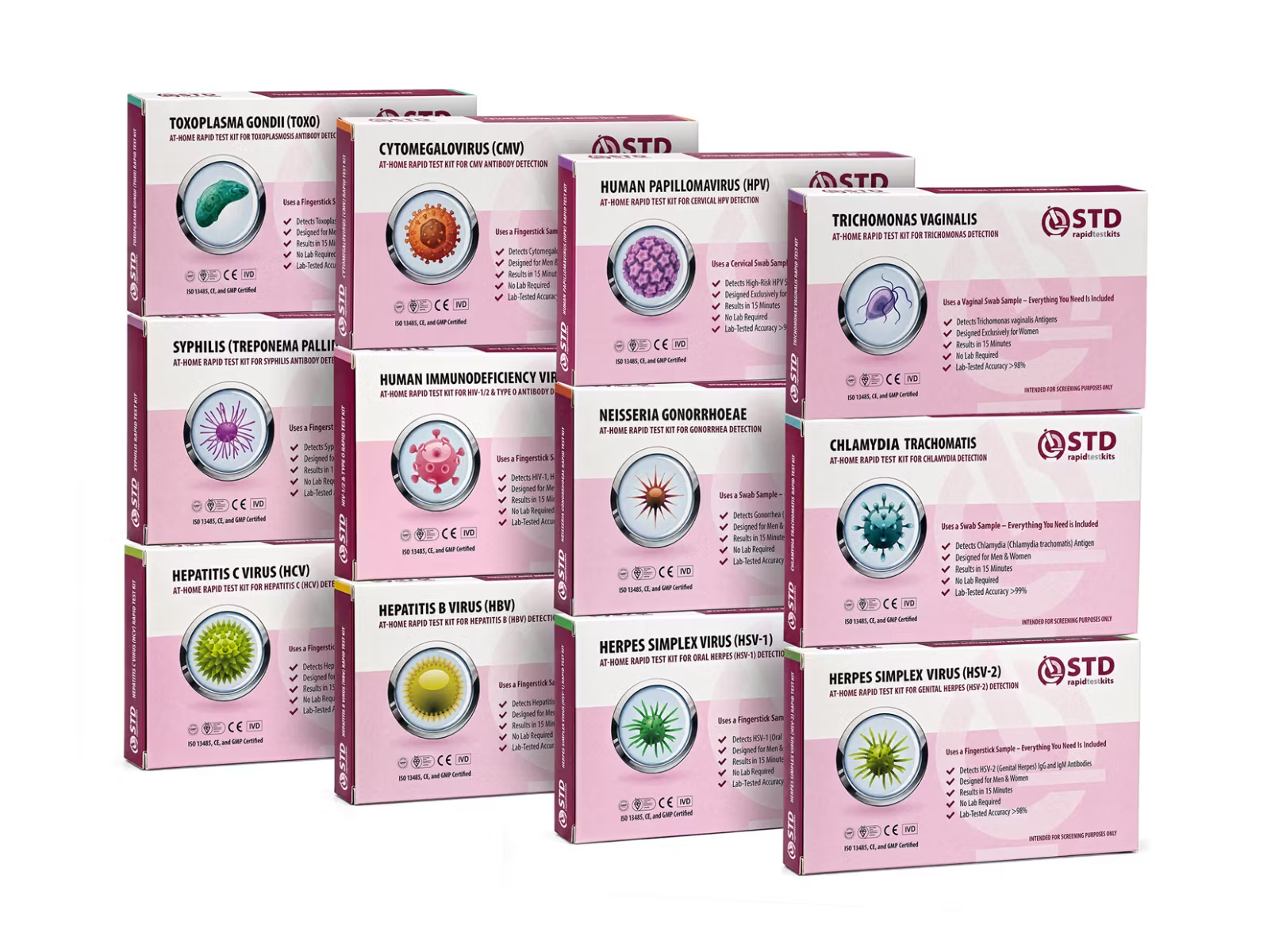
At-home rapid tests, including the lateral-flow kits sold on this site, are useful as a screening layer between clinic visits or as a privacy-preserving first step. They are screening tools rather than laboratory NAAT (nucleic acid amplification) tests, which remain the higher-sensitivity option for confirming a positive or working up a suspicious symptom. A positive at-home rapid result is worth following up with a clinic for treatment and confirmatory testing where indicated.
Women who have sex with women are at risk for acquiring bacterial, viral, and protozoal STIs from current and previous partners, both female and male. Risk depends on the specific sexual practices and on the prevalence of STIs within partners’ sexual networks.
Five myths, briefly
To make the picture portable, here are the five most common claims this article pushes back on, with the short version of what the evidence says:
- “Two women cannot give each other STIs.” Skin, mucous-membrane, and fluid contact all transmit infections regardless of partner gender. HPV, HSV, trich, and BV are the most consistent risks in WSW data.
- “You only need to test if you have had sex with a man.” Lifetime sexual history matters, and current-relationship transmission is well-documented in female-female couples for HPV, HSV, and trich. Testing is practice-based, not orientation-based.
- “No symptoms means no infection.” Most STIs are asymptomatic in people with vaginas, especially in early stages. Screening exists because feeling fine is not diagnostic.
- “Oral sex is safe.” Lower-risk for some infections (HIV), real-risk for others (gonorrhea, HSV, HPV, syphilis). The lower-risk framing got overgeneralized in pop culture into a no-risk framing, which is inaccurate.
- “We are both clean.” “Clean” is a casual word that does not document anything specific. Two recent negative STI panels with no new exposures since the testing window is what “safe to drop barriers” concretely means. The distinction matters when planning to stop using condoms or other barriers in a new relationship.
What to do this week
If you have been operating under the “we are both fine” assumption for a while, the most useful first step is also the smallest: book or order a baseline STI panel, even if you are in a stable, long-term partnership. Setting a known starting line, informationally rather than accusatorially, matters. A clean panel today gives you concrete information to plan around, and a positive finding caught early gives you a foothold to act on.
From there, normalize testing between partners and after any new sexual contact, ask your clinician specifically for vaginal-swab plus throat-swab plus bloodwork when relevant, and keep cervical-cancer screening on the regular schedule. Routine testing can become as unremarkable a part of WSW care as contraception counseling has become in heterosexual care.
- Book or order a baseline STI panel: vaginal swab, throat swab if you give or receive oral regularly, and blood tests for HIV and syphilis.
- Test between new partners, before resuming unbarriered contact, with both partners testing in the same window.
- Keep cervical-cancer screening (pap or HPV co-test) on the schedule your clinician recommends, regardless of partner gender.
- Confirm any at-home rapid positive at a clinic with a NAAT or full panel, and bring partners into the conversation if applicable.
FAQs
- Can two women really transmit chlamydia to each other?
- Yes. Chlamydia is documented in WSW couples through oral-genital contact, shared toys, and finger-to-genital contact. The CDC’s WSW guidance addresses chlamydia as both an acquired and a transmitted risk for women whose partners are women.
- Do dental dams actually reduce risk during oral sex?
- Yes. A dental dam (a thin latex or polyurethane sheet) creates a barrier between the mouth and genitals that reduces transmission of HSV, HPV, gonorrhea, chlamydia, and syphilis. They are underused but effective. A condom cut into a sheet is an acceptable improvised alternative.
- Does the HPV vaccine cover everything?
- No. The current Gardasil 9 vaccine covers nine HPV types, including the seven most strongly associated with cervical and anal cancers and the two most associated with genital warts. There are around 200 HPV types in total. Vaccination is the strongest single protection available, and it does not replace routine cervical screening.
- Is HIV a realistic concern in WSW relationships?
- Documented female-to-female HIV transmission is rare enough that no population-level prevalence estimate exists for this route. The CDC has reported isolated cases involving shared toys with blood exposure or contact with menstrual blood through cuts or sores. Annual HIV testing still takes under a minute with a fingerstick kit and is recommended for all sexually active adults, including WSW.
- Which STIs spread skin-to-skin without fluid exchange?
- Herpes simplex (HSV-1 and HSV-2), HPV, syphilis (through contact with a chancre), and molluscum contagiosum can all transfer through direct skin or mucous-membrane contact. This is why genital-to-genital contact and oral-genital contact both count as exposure even without penetration.
- How often should I test if my partners are all women?
- An annual STI panel is the reasonable baseline for any sexually active adult, including WSW. Add testing when you change partners, when symptoms appear, or before dropping barriers in a new relationship. Higher frequency, every three to six months, is appropriate if you have multiple partners or recurring symptoms.
- What if my last doctor didn’t test me for anything specific?
- That is a common WSW experience. You can call back and ask specifically for vaginal-swab testing, throat-swab where relevant, and blood tests for HIV and syphilis. Many clinics also accept patient-initiated requests for trichomoniasis testing, which is frequently left off default panels. An at-home rapid screen can be a useful in-between option while you wait for a follow-up appointment.
- U.S. Centers for Disease Control and Prevention. STI Treatment Guidelines, dedicated section on women who have sex with women, covering risk, screening, and clinical recommendations.
- U.S. Centers for Disease Control and Prevention. Human papillomavirus (HPV) overview, including HPV-linked cancers, transmission, vaccination, and cervical screening recommendations.
- U.S. Centers for Disease Control and Prevention. Genital herpes overview, asymptomatic shedding, and partner counseling.
- U.S. Centers for Disease Control and Prevention. Trichomoniasis overview, asymptomatic prevalence, and screening recommendations.
- World Health Organization. Sexually transmitted infections fact sheet, with global transmission routes and risk-reduction guidance.
- UK National Health Service. Sexual health for lesbian and bisexual women, with practical screening and barrier guidance.
