Can You Get an STI From Sharing Sex Toys?
Sharing a sex toy can pass on STIs, but the real risk varies sharply by infection. HPV is the most reliable transfer; herpes and trichomoniasis follow; HIV transmission via toys is theoretical and rare. This guide covers which infections matter, how toy materials change the math, what cleaning methods work, and when to test if you have already shared.
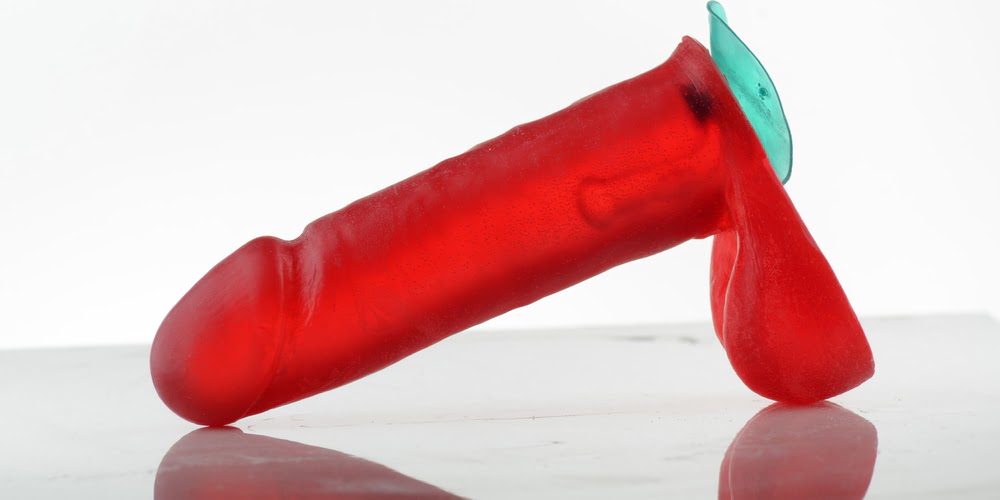



- HPV is the STI most reliably documented to survive on shared sex toys; herpes, trichomoniasis, and BV follow at lower but real rates.
- A fresh external condom on the toy each time it switches users, plus cleaning between sessions, drops the practical risk close to zero for most pathogens.
Published: November 2025 | Last updated: April 2026 | Editorial review and quality control: Martina N.
The short version is yes: you can pick up an STI from a sex toy that has been used by someone else and not properly cleaned between users. The longer version is more reassuring than the headline suggests. Most STIs need either skin-to-skin contact, mucosal contact, or a direct exchange of bodily fluids to transmit, and most of those pathways break down quickly once a virus or bacterium is sitting on a non-living surface. A handful of pathogens stick around long enough to matter, and those are the ones worth knowing about.
The map below is ordered by how strong the evidence for toy-mediated transmission is, not by how scary the disease sounds. HIV, the infection most people fear first, is one of the rarest routes here. HPV, which most people do not worry about much, is the clearest case. Knowing the difference is what lets you make calm, accurate decisions instead of anxious ones. If you share toys (or are thinking about it), this guide covers what to clean, when to use a barrier, and when testing makes sense.
Can I get an STI from sharing a sex toy?
Yes, transmission is possible. The infections most likely to make the trip are HPV, herpes, and trichomoniasis. Bacterial STIs like chlamydia and gonorrhea can also transfer when toys move quickly between users without cleaning. HIV transmission via shared toys is theoretical and very rare per CDC surveillance. The two preventive moves that work for nearly every infection on this list: a fresh external condom on the toy each time it switches users, and proper cleaning between sessions.
Key Takeaways
- HPV is the STI most reliably documented to survive on shared sex toys; herpes, trichomoniasis, and BV follow at lower but real rates.
- A fresh external condom on the toy each time it switches users, plus cleaning between sessions, drops the practical risk close to zero for most pathogens.
Yes, sex toys can carry STIs, and the risk has structure
Sexually transmitted infections are not all built the same way. HIV, for example, dies quickly once it leaves the body and meets air or a dry surface. Bacterial infections like chlamydia and gonorrhea are similarly fragile outside their preferred environment of warm mucous membranes. At the other end of the spectrum, HPV is unusually durable: peer-reviewed studies have detected viable virus on toy surfaces hours after exposure, and standard household cleaning does not reliably remove it from porous materials.
So the risk of catching an STI from a shared toy is not a single number. It depends on which infection, how the toy is being used, what the toy is made of, and what (if anything) was done between users. The framing from the CDC's STI guidance is straightforward: anything that touches genital, anal, or oral mucous membranes can in principle move an infection from one of those membranes to another, including via objects.
Two things make sex toys higher-risk than, say, a shared towel:
- Toys touch mucous membranes directly, often inside the body. Mucous membranes are where most STIs prefer to live.
- Many toys are made from porous materials (more on this below) that are difficult or impossible to fully sanitize.
On the other side of the ledger, toys tend to be less risky than direct contact. The gap between users is usually long enough that fragile pathogens like HIV and syphilis lose viability before the next contact, and a simple barrier (a condom or a finger cot) creates near-complete separation when used correctly.
Hold those two columns in mind as we go through the specific infections.
Higher-risk factors: direct mucous-membrane contact; porous materials that trap pathogens between users.
Lower-risk factors: fragile pathogens lose viability in the gap between users; a barrier breaks almost every transmission pathway.
Which STIs can transfer through a shared toy
Here is the practical map, ordered by how strong the evidence for toy-mediated transmission is.
HPV (human papillomavirus)
HPV is the clearest case. Peer-reviewed studies have detected viable high-risk HPV on vibrators up to 24 hours after use, even after cleaning with the bundled toy cleaner. HPV's outer protein shell is unusually tough; it tolerates drying and standard surfactants better than enveloped viruses do. HPV is also the most prevalent STI in the United States by a wide margin per the CDC's HPV pages, so the chance that any random partner is shedding HPV is non-trivial.
What this means in practice: if you and a partner share a toy without barrier or thorough cleaning, HPV is the infection most likely to make the trip. Current CDC vaccination guidance is routine through age 26, with shared clinical decision-making through age 45.
Herpes simplex virus (HSV-1 and HSV-2)
HSV transmits primarily through contact with active lesions or asymptomatic shedding from skin and mucous membranes. Most herpes transmission happens directly, skin-to-skin, but the virus can survive on moist surfaces for a few hours. A toy used during an active genital outbreak (or during a period of asymptomatic shedding) can carry enough viable virus to infect the next user, particularly when used vaginally or anally without a barrier. HSV is enveloped, so soap, alcohol, and drying kill it quickly. Cleaning between uses is highly protective. (See the CDC herpes fact sheet.)
Trichomoniasis
Trichomonas vaginalis is a single-celled parasite that can survive briefly on damp surfaces after being deposited, with clinical literature describing survival on the order of tens of minutes rather than hours. It is the most common curable non-viral STI worldwide per the CDC's trichomoniasis guidance. Toy-mediated transmission is well-documented in clinical literature, particularly between people sharing toys without cleaning or a barrier. Worth flagging for this site: at-home rapid trichomoniasis tests are validated for vaginal self-swab only, so partners with a penis who want to test for trich should see a clinic.
Chlamydia and gonorrhea
Both are bacterial STIs that prefer the warm, moist environment of a mucous membrane. Outside the body they lose viability fairly quickly, on the order of minutes to a couple of hours depending on humidity. Toy-mediated transmission is less efficient than direct contact, but it is real, especially when a toy moves quickly between users without cleaning. Both infections are asymptomatic in roughly half to two-thirds of carriers per CDC surveillance, which is why screening matters even when no one has noticed anything.
Hepatitis B
Hepatitis B is bloodborne and present in semen and vaginal fluids. The virus is unusually hardy outside the body and can remain infectious on surfaces for days, longer than most other sexually-transmitted viruses (see the CDC's hepatitis B information for transmission and vaccination details). Toys that come into contact with blood (during menstruation, after vigorous use, or with very small mucosal tears) can carry HBV between users. Vaccination eliminates this concern almost entirely; if you and your partner are both vaccinated, HBV via toy sharing is not a meaningful risk.
HIV
HIV transmission through shared sex toys is theoretically possible but vanishingly rare in the published literature. HIV is fragile outside the body. Drying and exposure to air kill it within minutes to hours, and the volumes of fluid involved on a toy surface are usually well below the amount needed for transmission. The CDC does not list shared sex toys as a recognized transmission route in its surveillance materials. The one scenario where the theoretical risk rises is when a toy moves quickly between users with no barrier and visible blood is involved. In that scenario, a fresh condom on the toy is most clearly worthwhile.
Syphilis
Syphilis transmission requires contact with an active chancre or moist mucocutaneous lesion. Treponema pallidum, the bacterium responsible, dies quickly on dry surfaces. Toy-mediated transmission is theoretically possible if a toy makes direct contact with an active lesion and then moves to another partner's mucous membrane within a short window. In practice it is rare, and like HIV it is not a typical route in epidemiological data.
Bacterial vaginosis and yeast (not classical STIs, but worth knowing)
Neither BV nor candida is a classical STI, but both routinely move between partners and between vaginal and anal use of the same toy without cleaning. BV in particular has been shown to travel between sexual partners with vaginas. Toy hygiene is part of preventing repeated cycles of either condition.
| Infection | Toy-mediated risk | Why |
|---|---|---|
| HPV | Highest | Tough viral capsid; survives drying; standard cleaning incomplete on porous toys |
| Herpes (HSV-1, HSV-2) | Moderate | Active lesions or asymptomatic shedding; killed by soap and drying |
| Trichomoniasis | Moderate | Parasite survives briefly on damp surfaces, on the order of tens of minutes |
| Chlamydia | Lower | Bacterial; minutes to hours of viability outside the body |
| Gonorrhea | Lower | Bacterial; similar profile to chlamydia |
| Hepatitis B | Conditional | Bloodborne; environmental persistence longer than most STIs; risk requires blood contact |
| HIV | Very low | Fragile outside the body; not a recognized CDC transmission route via toys |
| Syphilis | Very low | Requires direct contact with active chancre; bacterium dies quickly outside body |
How toy material changes the risk
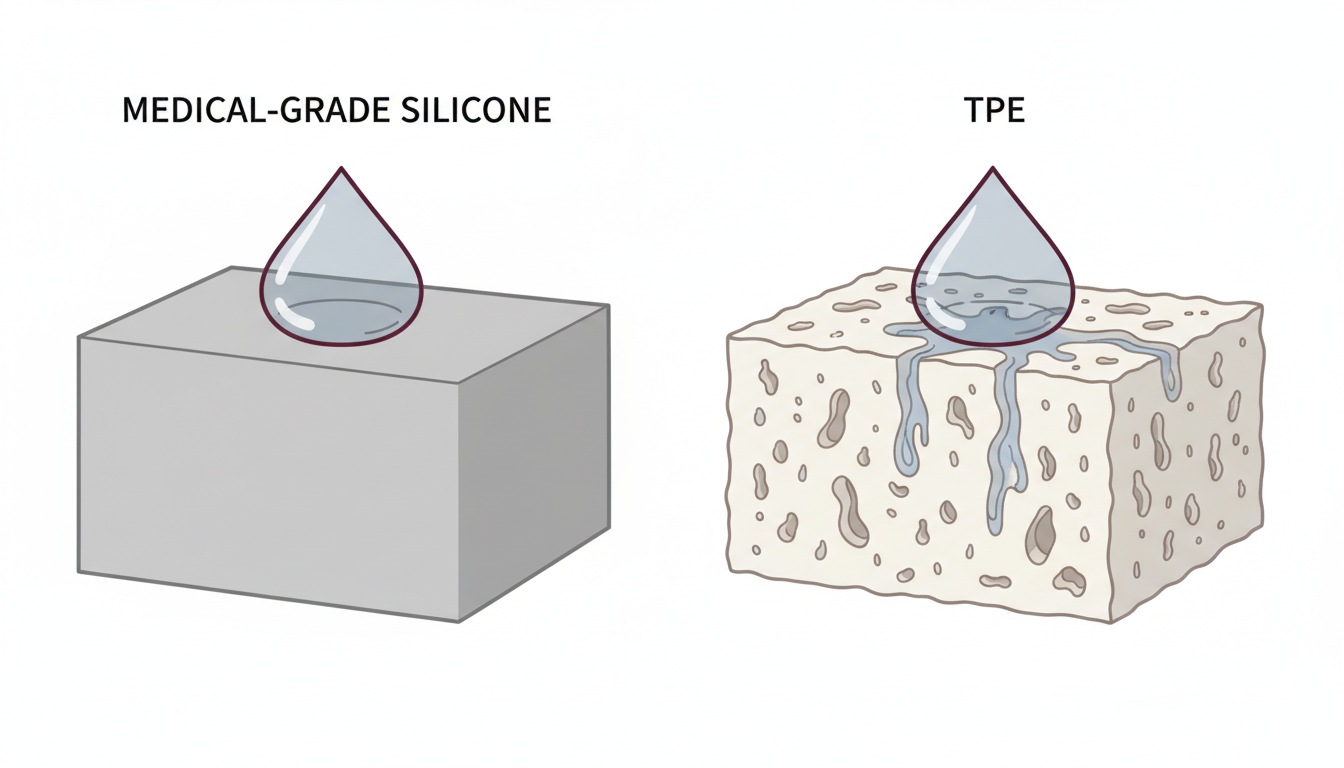
Toys are not just toys. The material a toy is made from determines how well it can be cleaned and how readily it harbors pathogens between users. This is the single most overlooked variable in toy-related infection risk.
Non-porous materials (the safer choice)
- 100% medical-grade silicone (firm or platinum)
- Borosilicate glass
- Stainless steel
- Hard ABS plastic with a sealed surface
These materials have effectively no microscopic pores. Pathogens sit on the surface, where soap, hot water, or (for glass, steel, and non-motorized silicone) boiling or a dishwasher run on a hot cycle can remove them. With proper cleaning, the risk of pathogen carry-over between users is very low.
Porous materials (clean carefully or do not share)
- TPE (thermoplastic elastomer)
- TPR (thermoplastic rubber)
- PVC and "jelly" rubber
- "Cyberskin" and similar realistic blends
- Latex
Porous materials have microscopic surface texture and absorbent characteristics. Cleaning agents and water do not reach pathogens that have settled into the pore structure. These toys cannot be reliably sterilized, and most public-health guidance recommends not sharing them between partners at all. If you do share a porous toy, always use a fresh condom on it for each user, and treat the underlying toy as effectively single-user.
A practical rule
If you do not know what your toy is made of, treat it as porous and use a barrier. Manufacturers generally label silicone clearly because it is a premium feature; the absence of "100% silicone" or "borosilicate glass" on the packaging usually means it is not.
Cleaning and condoms: what works
Two preventive measures cover almost everything. They work better in combination than either alone.
Cleaning protocol by material
Silicone, glass, stainless steel (non-motorized): Boil for 5 to 10 minutes, or run through a dishwasher on a hot cycle without detergent. This is reliable sterilization for HPV, HSV, bacterial STIs, and HIV.
Silicone (motorized vibrator): Wash with warm water and unscented antibacterial soap for at least 30 seconds, paying attention to seams, ridges, and any textured surface. Rinse thoroughly. Air-dry on a clean towel. For high-confidence cleaning between partners, a 70 percent isopropyl alcohol wipe-down before soap and water adds a margin against HSV and bacterial pathogens.
Porous materials (TPE, jelly, latex): Soap and warm water cleaning, every time. But understand that this is partial cleaning, not sterilization. A condom on a porous toy is the protective layer.
Battery-operated, non-waterproof toys: Use a damp cloth with mild soap on the exterior; never submerge. These are particularly hard to fully clean, which is another reason to use a barrier when sharing.
Condoms on toys
A fresh external condom on the toy, changed every time the toy switches users or moves between body openings (vaginal to anal, anal to vaginal, and so on), is the single most reliable barrier method available outside of "do not share." It protects against essentially every STI on the list above, plus it sidesteps the porous-material problem entirely.
The rules are the same as for condoms on penises:
- Use a fresh condom each time the toy changes users.
- Use water-based or silicone-based lube depending on the toy's material (silicone lube can degrade silicone toys; check the manufacturer's guidance).
- Do not reuse a condom after it has come off.
- Change the condom when moving the toy between vaginal and anal use, even with the same person.
What does not work
A "rinse it under the tap" pass between users is not enough. Wiping the toy with a tissue is not enough. Sex toy cleaner sprays alone, without water and rubbing, are not enough for porous toys. Boiling a battery-operated vibrator will destroy it. Using bleach is unnecessary and dangerous for body contact.
Cleaning cheat sheet by material
- Non-motorized silicone, glass, stainless steel: boil 5 to 10 minutes or run through the dishwasher on a hot cycle.
- Motorized silicone (vibrators): 30+ seconds of unscented antibacterial soap and warm water at the seams; a 70% isopropyl wipe before soap adds a margin against HSV and bacterial pathogens.
- Porous (TPE, jelly, latex): soap and warm water only; this is partial cleaning, not sterilization, so always use a fresh condom on the toy.
- Battery-operated, non-waterproof toys: damp cloth on the exterior only; never submerge.
When to test after sharing a toy
If you have shared a toy with a new or untested partner and now you are wondering what to do, the right move depends on time since exposure. Most STIs need a window of days to weeks before any test can reliably detect them.
Immediate (0 to 7 days)
Most STI tests cannot detect an infection this soon after exposure. The pathogens have not had time to multiply enough to register on a swab, and antibody tests need weeks to seroconvert. The right move is to wait for the appropriate window period for each test you are considering. If you have new symptoms (unusual discharge, sores, painful urination, pelvic pain), see a clinician, since symptomatic infections can be diagnosed and treated regardless of test windows.
One to four weeks
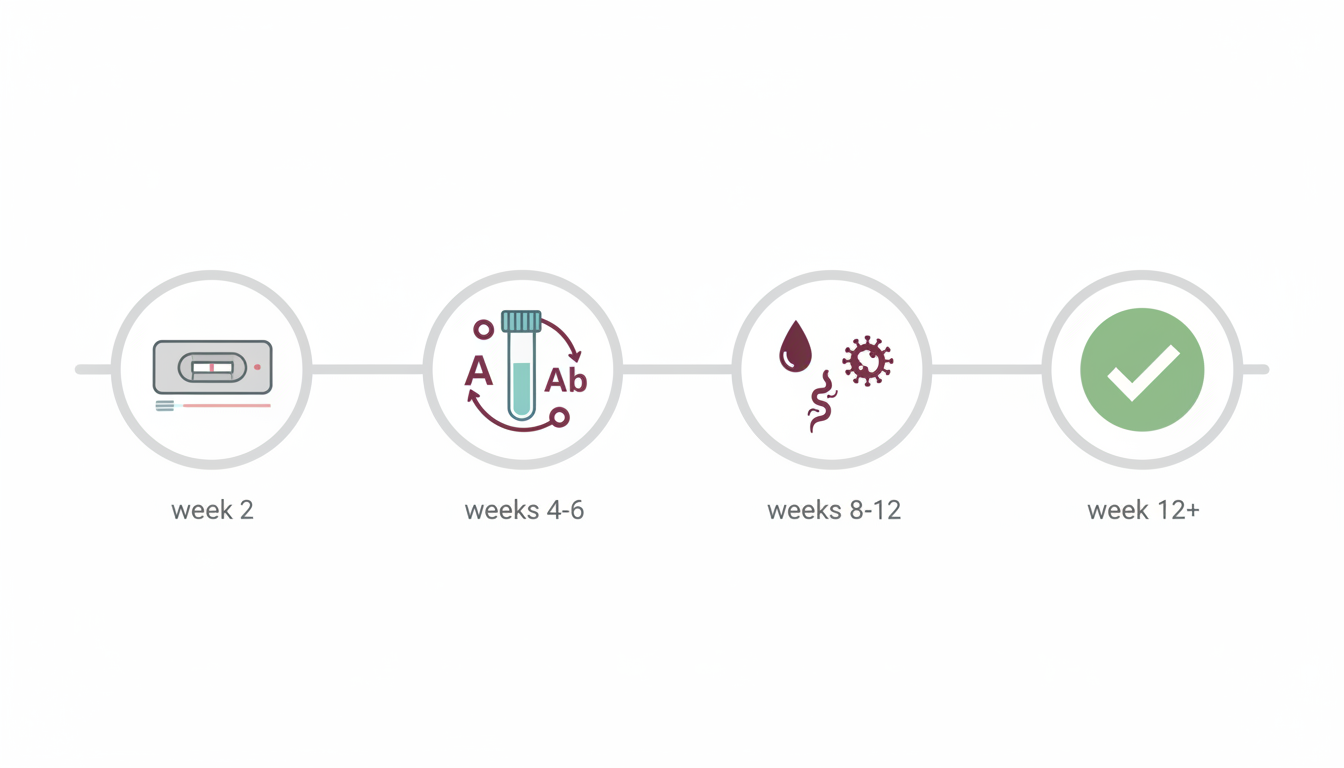
Bacterial STI tests (chlamydia, gonorrhea) become reliable around 2 weeks for swab-based rapid tests, sooner for laboratory NAAT. Trichomoniasis follows a similar timeline. If your concern is specifically bacterial transmission from a recent shared-toy exposure, the 2-week mark is the earliest reasonable home-test point.
Three to twelve weeks
HIV: fourth-generation laboratory antigen-antibody tests detect most infections by 4 to 6 weeks; rapid antibody-only tests need 12 weeks for full sensitivity per CDC guidance.
Syphilis: most infections are detectable by laboratory testing at 6 weeks; some take up to 12.
Hepatitis B and C: HBV surface antigen becomes detectable around 4 to 12 weeks; HCV antibody testing reaches reliable sensitivity around 8 to 11 weeks.
HSV antibody tests (the technology used in at-home rapid HSV kits) need 8 to 12 weeks to reliably detect seroconversion after a new infection.
After three months
A clean test panel at the 12-week mark covers nearly every infection of concern from a single shared-toy exposure. For HPV, there is no FDA-approved at-home antibody test; clinical screening (Pap test for cervical changes, HPV DNA test) is the standard, and the relevant timing is your next routine cervical screening interval rather than acute testing.
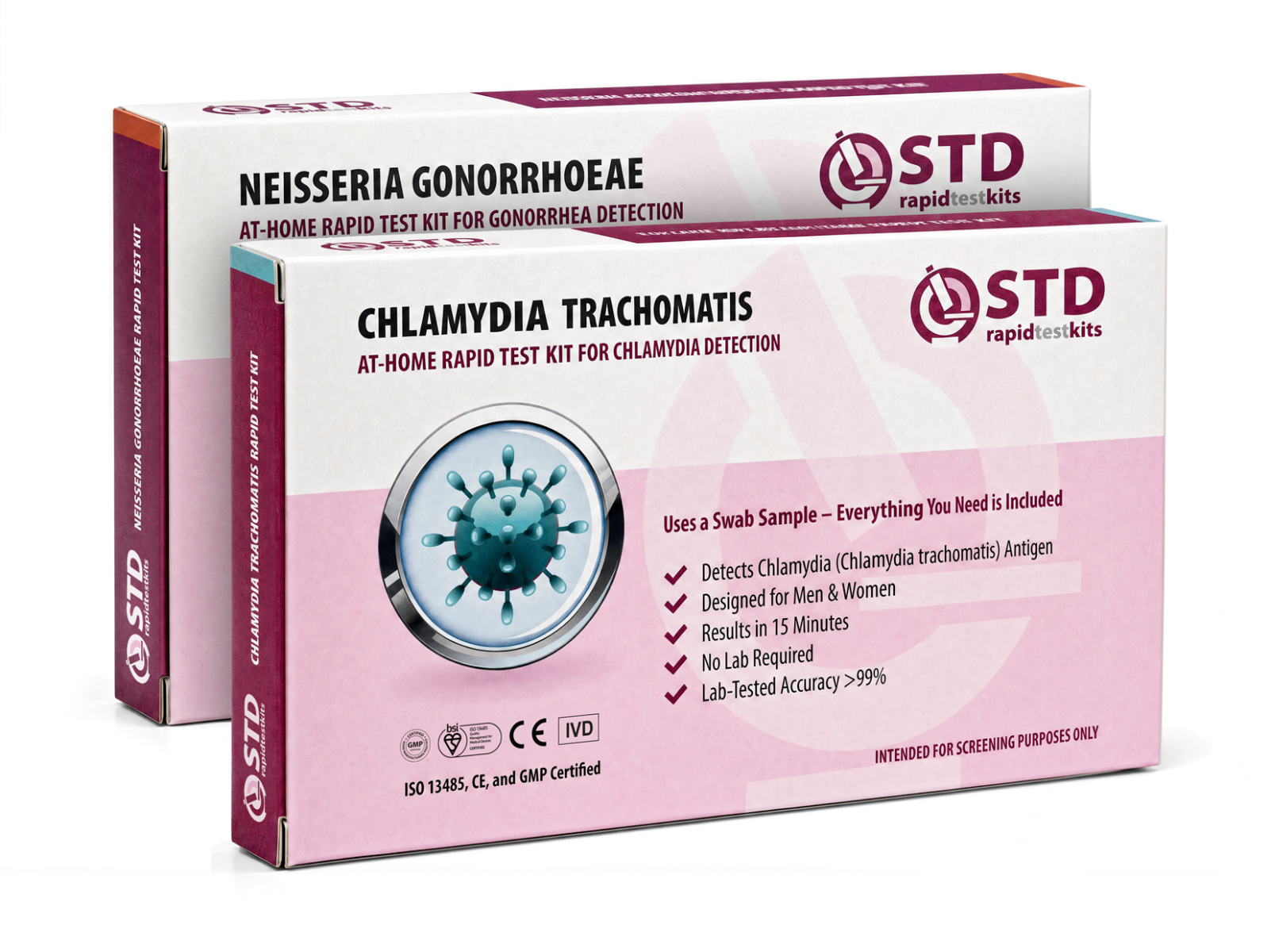
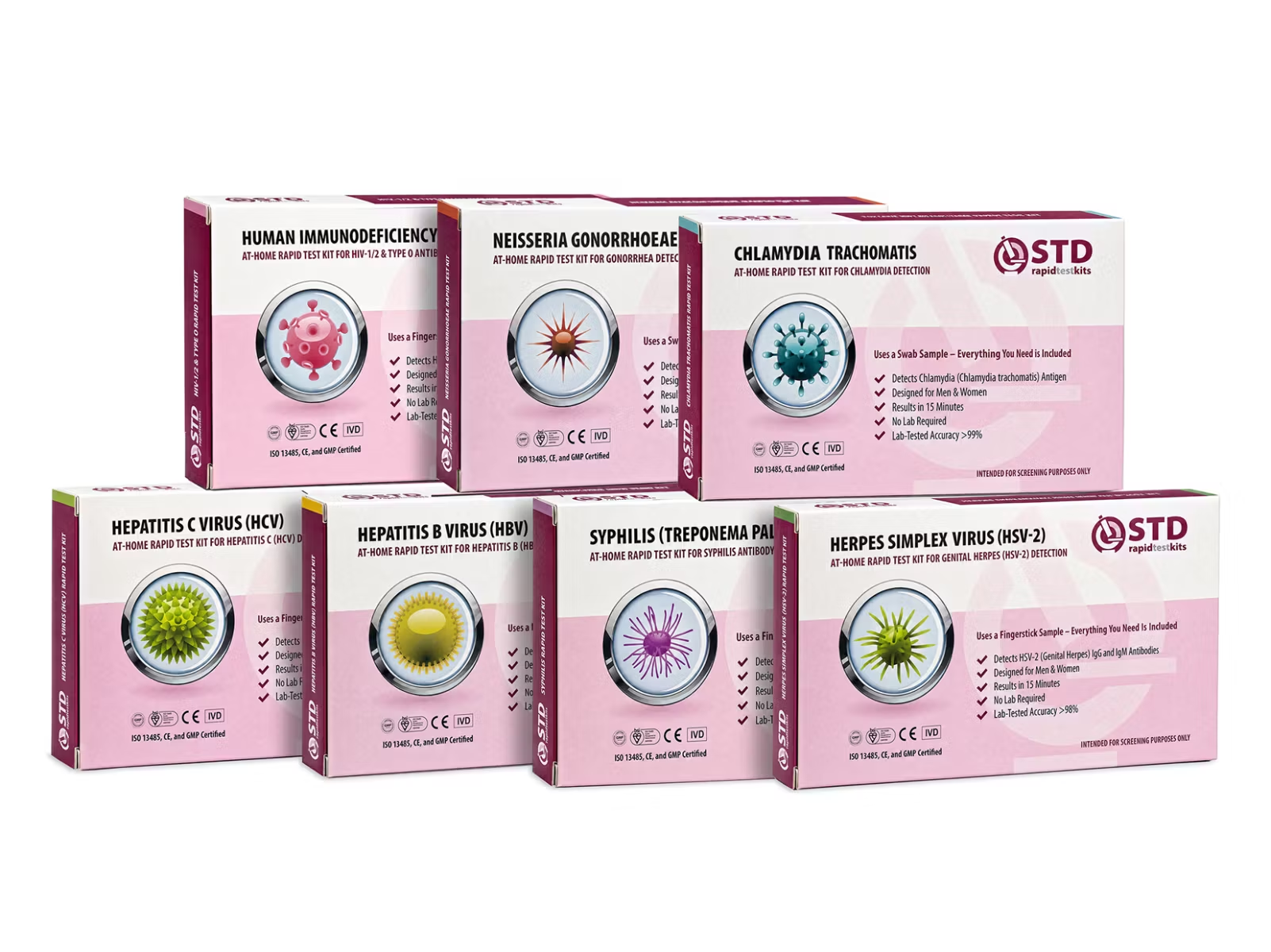
This site sells rapid at-home STI tests; the kits referenced in this article are our own products.
At-home testing options after a possible exposure
Rapid lateral-flow at-home tests cover the major panel-relevant infections after their respective window periods.
Lateral-flow is not NAAT. Our at-home rapid tests use the same swab samples as lab NAAT for chlamydia and gonorrhea, but the chemistry is different. A positive result on a rapid test is high-confidence; a negative result is reliable for the window of testing. For high-risk exposures or persistent symptoms, lab confirmation is worthwhile.
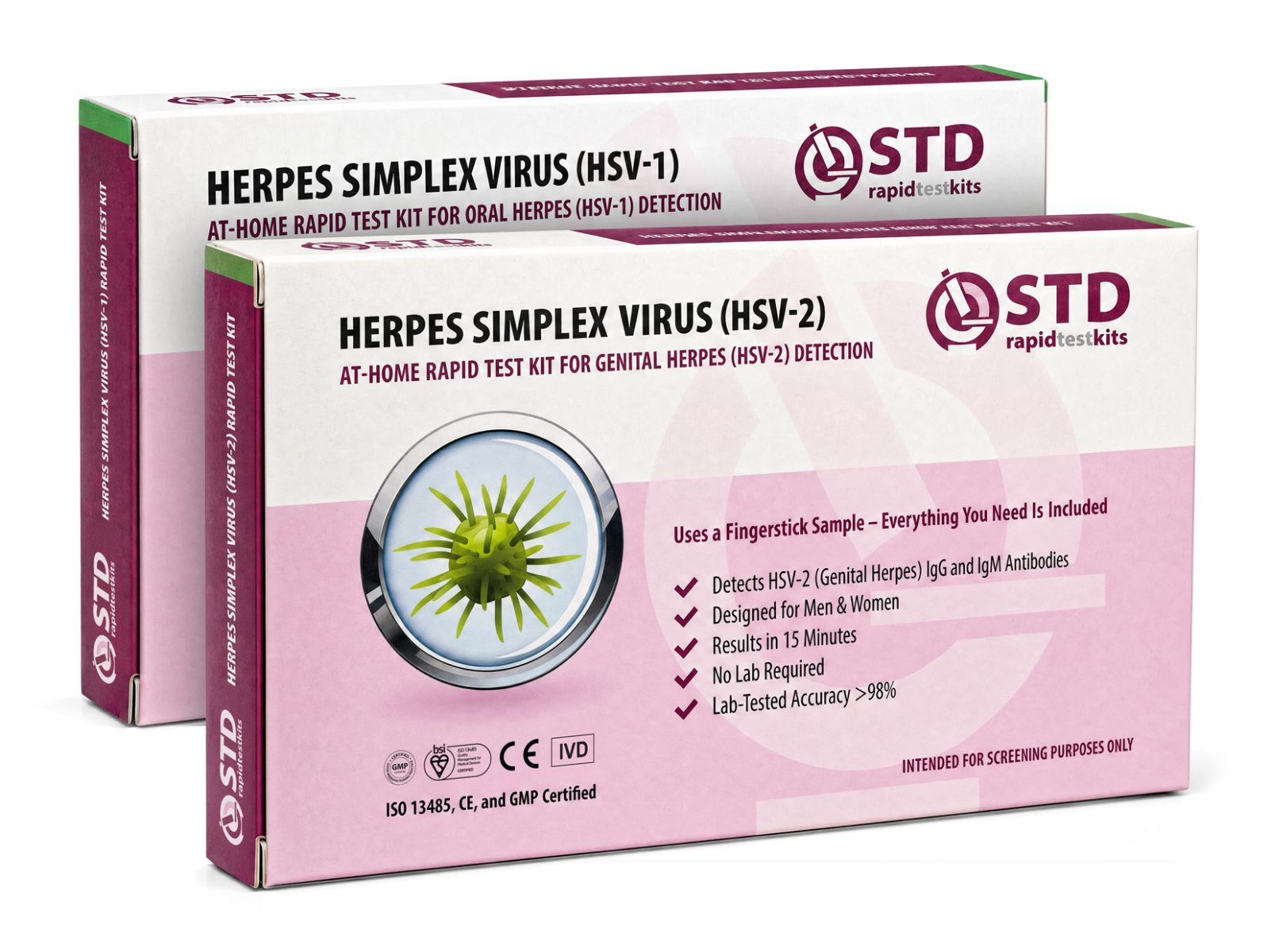
Rapid HSV antibody testing detects seroconversion, not active lesions. If you have an active sore, a clinician's swab or PCR is more useful than an antibody test, because antibodies take weeks to develop. The rapid blood test answers the question "did I pick up HSV from this exposure?" measured 12+ weeks later, not "is this current sore herpes?"
Window-period mismatches are the most common source of false-negative results. Test too early and you get false reassurance. The cleanest approach for a single shared-toy exposure is one full panel at 12 weeks, or staggered tests as each window opens (chlamydia and gonorrhea at 2 weeks, HIV at 6 weeks, syphilis and HSV at 12 weeks).
Our at-home HPV and trichomoniasis kits are validated for vaginal self-swab only, so partners with a penis who need testing for either should see a clinic. Everything else in our panel is any-gender.
Rapid lateral-flow is not NAAT. A positive result is high-confidence; a negative is reliable within the window. Lab NAAT remains the gold standard for confirmation after a high-risk exposure or persistent symptoms.
Rapid HSV antibody tests detect seroconversion, not active lesions. Use them at 12+ weeks after exposure. For a current sore, see a clinician for a swab or PCR.
Window-period mismatches drive most false negatives. The 12-week comprehensive panel is the cleanest single-point option after a single shared-toy exposure.
Talking with your partner about toy hygiene
The conversation is not as awkward as it sounds, even if it feels new. The framing that works best is matter-of-fact: "Before we share this, let me put a condom on it," or "I will boil the silicone one between us." It is the same logic as condoms during partnered sex, applied to objects. Most partners take the cue without friction.
If you are in a longer-term relationship with someone whose STI status you are confident about, the calculus shifts. Toy-sharing without barriers between two STI-tested partners with no other current sexual partners is roughly as risky as unprotected sex with each other, which is to say the toy is not meaningfully changing the risk profile. The cleaning-between-orifices rule still applies: vaginal then anal then back to vaginal can move infections like UTI bacteria, BV-associated organisms, and yeast, regardless of STI status.
For new or casual partners, default to barriers and cleaning. For ongoing partners with known STI status, default to whatever feels comfortable. Both are reasonable. The conversation also opens the door to baseline testing together if neither of you has tested recently, which is itself a useful relationship habit independent of toys.
New or untested partner: default to a fresh condom on the toy and proper cleaning between sessions.
Ongoing partner with confirmed STI status: the toy does not meaningfully change your existing risk profile.
The between-orifice cleaning rule (vaginal to anal, back to vaginal) applies regardless of partner status.
The bottom line
Yes, you can get an STI from sharing a sex toy. The infections most likely to make the trip are HPV (clearly), HSV, and trichomoniasis (less commonly). Bacterial STIs and bloodborne viruses can transfer in narrower circumstances. HIV and syphilis are theoretical but rare via this route. The risk is mostly modifiable. Use a fresh external condom on the toy each time it switches users or moves between body openings. Clean toys properly between sessions: boiling for non-motorized non-porous items, soap and water for everything else. Pick non-porous toys when you can. If you have shared a toy with someone whose status you do not know, screen at the appropriate window period for each infection on the list, or take a comprehensive panel at the 12-week mark to cover everything in one go.
The reassuring frame: this is not a hidden epidemic. With basic cleaning and a barrier, the chance of catching an STI from a shared toy approaches zero for most pathogens. The exception (HPV) is broadly common in sexually active adults regardless of toys, and the vaccine substantially reduces the meaningful risk for the cancer-associated strains.
Many sexually transmitted infections cause no symptoms, particularly in their early stages. Testing is the only way to know your status.
FAQs
- Can you get HIV from sharing a sex toy?
- HIV transmission through shared sex toys is theoretically possible but extremely rare. HIV does not survive long outside the body, and the volumes involved on a toy surface are usually well below transmission thresholds. The CDC does not list toy sharing as a recognized HIV transmission route in its surveillance materials. Cleaning between uses, or a fresh external condom on the toy, makes the risk effectively zero.
- How do I clean a silicone vibrator between partners?
- Non-motorized silicone, glass, or stainless steel? Boil it for 5 to 10 minutes or run it through the dishwasher on a hot cycle without detergent. Motorized vibrator? Thirty seconds of unscented antibacterial soap and warm water at every seam, rinse thoroughly, air-dry on a clean towel. A 70% isopropyl alcohol wipe before the soap step adds a margin against HSV and bacterial pathogens. Never boil anything battery-operated.
- Is it safer to use my own toys instead of sharing?
- Yes, dramatically safer. Single-user toys eliminate transmission of every STI on this list. If you and a partner want sensation variety without sharing, two of the same toy is the cleanest setup. Single-user is also the right answer for porous toys (TPE, jelly, cyberskin) that cannot be reliably sterilized.
- I shared a toy a week ago with someone whose status I do not know. When should I test?
- The safest single-point option is one comprehensive panel at the 12-week mark, which covers nearly every infection of concern from a single shared-toy exposure. If you would rather test sooner, time it to each window: chlamydia and gonorrhea swab tests are reliable from about 2 weeks; HIV with a fourth-generation lab test catches most infections by 4 to 6 weeks; rapid HIV antibody-only tests need 12 weeks. Syphilis and HSV antibody tests reach reliable sensitivity at 8 to 12 weeks, with full confidence at the 12-week mark.
- Does putting a condom on the toy work?
- Yes. A fresh external condom changed every time the toy switches users or moves between body openings (vaginal to anal, anal to vaginal) is the single most reliable preventive measure besides not sharing. Match the lube type to the toy's material; silicone-based lube can degrade silicone toys, so use water-based with silicone toys.
- Are sex toy cleaner sprays enough?
- For non-porous silicone, glass, or stainless steel toys, sprays plus soap and water and thorough rinsing are reasonable. For porous materials (TPE, jelly, cyberskin), no spray reaches into the microscopic pores. Treat porous toys as effectively single-user, or always use a fresh condom on them for each user.
- Can BV (bacterial vaginosis) or yeast pass through shared toys?
- Yes. BV in particular has been shown to travel between sexual partners with vaginas, and shared toys without cleaning are a documented vector. Yeast follows the same pattern. Cleaning between uses, or a fresh condom each time, prevents both. Cleaning between vaginal and anal use of the same toy with the same person also helps prevent recurrent BV.
- My partner has HPV. Does that mean I will too?
- HPV is the most common STI in the United States, and most sexually active adults will be exposed to at least one strain in their lifetime. Most HPV infections clear on their own within 1 to 2 years. The HPV vaccine is recommended through age 26, with shared clinical decision-making through age 45 per CDC guidance. For toy-related risk specifically, a fresh condom on the toy is the most effective barrier short of not sharing.
- U.S. Centers for Disease Control and Prevention. STI fact sheets and surveillance data, including asymptomatic-rate guidance for chlamydia and gonorrhea.
- U.S. Centers for Disease Control and Prevention. HPV fact sheet and HPV vaccination recommendations (routine through age 26, shared clinical decision-making through age 45).
- U.S. Centers for Disease Control and Prevention. HIV transmission, surveillance, and testing-window guidance.
- U.S. Centers for Disease Control and Prevention. Genital herpes (HSV-1 and HSV-2) fact sheet, including transmission and asymptomatic shedding.
- U.S. Centers for Disease Control and Prevention. Trichomoniasis fact sheet, including transmission routes and prevalence.
- U.S. Centers for Disease Control and Prevention. Hepatitis B information, including transmission routes and vaccination guidance.
- UK National Health Service. Sexually transmitted infections (STIs) overview, including transmission routes and home-testing guidance.
- Mayo Clinic. Sexually transmitted diseases (STDs), symptoms, and causes overview.